 Скачать презентацию ONTARIO AND BC ENVIRONMENTAL ASSESSMENT LAW MARCH 21
47868dabe6981675767df45a2bdc8dfd.ppt
- Количество слайдов: 44



ONTARIO AND BC ENVIRONMENTAL ASSESSMENT LAW MARCH 21, 2013
Overview: Environmental Assessment Act (Ontario) • Application of EAA • Preparation of Terms of Reference and Environmental Assessment • EA Hearing Process • Class Environmental Assessments • Ontario Hydro DSM EA) • Public participation (Intervenor Act)
Application of Environmental Assessment Act (Ontario) • Enacted in 1975, substantially amended in 1996 • Aka “Environmental Exemptions Act” • Purpose: “the betterment” of the people of Ontario by providing for the “protection, conservation and wise management” of the environment s. 2
Application of Environmental Assessment Act (Ontario) • Requires proponents to • Consider range of reasonable alternatives • Assess environmental effects of alternatives • Demonstrate that preferred alternative is environmentally superior and necessary • Minister of Environment has overall authority (EA and Approvals Branch) • Broad definition of “environment” (biophysical, socio-economic, cultural and their interrelationships) s. 1. (1)
Application of Environmental Assessment Act (Ontario) • Distinguishes between public and private sector proponents • Applies to public sector undertakings unless exempt by order/regulation s. 3. (c) • Doesn’t apply to private sector undertakings unless designated by regulation, voluntarily included s. 3. 0. 1 • Minister authorized to dispense with statutory requirements to harmonize with other jurisdiction s. 3. (1)
General Regulatory Exemptions • Renewable energy projects • Municipal undertakings less than $3. 5 million • Drainage works • Some waste disposal sites (pilot projects, mobile PCB destruction facilities) • Subdivision agreements • Undertakings by conservation authorities • Financial assistance programs • Research undertakings
Other Regulatory Exemptions • Project-specific Exemptions • Other municipal and provincial undertakings • Long-term Electricity Supply Plan • Sectoral Exemptions • Electricity Projects Regulation • Waste Management Projects Regulation • Transportation Authority Undertakings Regulation
Class Environmental Assessments • 11 categories of Class EAs (municipal roads, forest management activities, commuter rail stations) • Represent 90% of undertakings subject to EAA • Provides for pre-approval of undertaking, self-regulation • Authority to “bump up” Class EA undertaking to individual EA rarely exercised
Process for Individual Environmental Assessments • Intended for “large-scale, complex undertakings with the potential for significant environmental effects and major public interest” (Ministry of Environment website)
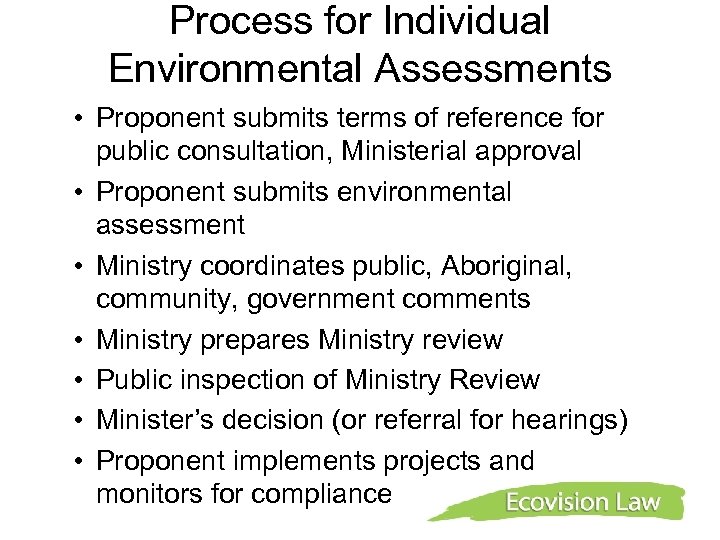
Process for Individual Environmental Assessments • Proponent submits terms of reference for public consultation, Ministerial approval • Proponent submits environmental assessment • Ministry coordinates public, Aboriginal, community, government comments • Ministry prepares Ministry review • Public inspection of Ministry Review • Minister’s decision (or referral for hearings) • Proponent implements projects and monitors for compliance
Public Hearings • EAA empowers Minister to refer an application to Environmental Review Tribunal for public hearing/decision • Public hearings held for high-profile undertakings: landfills, incinerators, highways, timber management, provincial energy demand-supply plan • Only 2 hearings since 1996
Ontario Energy Demand-Supply Hearings • Ontario Hydro 25 -year Demand /Supply Plan (DSP) Report released in 1989 • DSP projected a supply/demand gap opening up in mid-1990 s, reaching 9, 700 MW by 2005 • DSP proposed several additional nuclear, coal-fired generation plants
Ontario Energy Demand-Supply Hearings • DSP referred to EAA hearings by Environmental Assessment Board • Persuasive evidence at hearings that energy demand growth overestimated (total demand in 2009 same as 1989) • DSP revised in 1992 then abandoned • Hearings last several years—longest in Ontario history
Ontario Energy Demand-Supply Hearings • No additional generating facilities built saving Ontario taxpayers billions • Yet DSP hearings considered a failure due to their length and cost
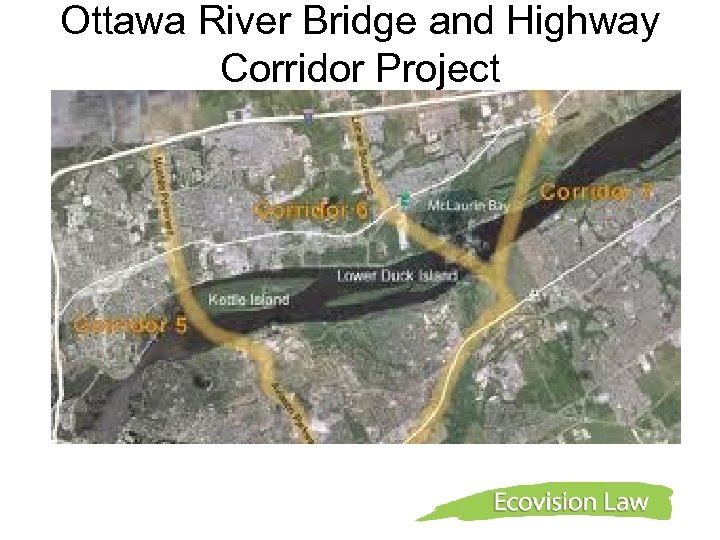
Ottawa River Bridge and Highway Corridor Project • National Capital Commission proposing new bridge across Ottawa River, 6 -lane highway corridor linking Highway 417 in Ottawa and Autoroute 50 in Gatineau • Estimated cost (2008) of $500 -600 m • Corridor options: – Kettle Island (8. 5 km) – Lower Duck Island (12 km) – Gatineau Airport/Mc. Laurin Bay (12 km)
Ottawa River Bridge and Highway Corridor Project
Ottawa River Bridge and Highway Corridor Project • Stated purpose to divert some heavy truck traffic from King Edward corridor • No transportation study has been completed to assess level of diversion • Second purpose to provide more access to Ottawa for Gatineau auto commuters
Ottawa River Bridge and Highway Corridor Project • NCC commenced screening under CEAA, which was terminated when CEAA came into force in July 2012 • CEAA 2012 doesn’t apply to Ottawa River bridge • NCC plans to continue with ad hoc EA • Quebec EA regime applies with Bureau d’audiences publiques sur l’environnement (BAPE) hearings
Ottawa River Bridge and Highway Corridor Project • Environmental threats worse for Kettle Island due to higher population density in quiet, well-established neighbourhood – Truck noise and pollution (within 15 m of school, 20 m of hospital, homes) – Increase in automobile traffic in Ottawa from Gatineau (Kettle Island corridor not suited to transit) – Increased burning of fossil fuels, increased greenhouse gas and other air emissions – Urban sprawl in Gatineau
Ottawa River Bridge and Highway Corridor Project • Ontario stated that EAA doesn’t apply although declaration for non-application procedure not been employed • Agreed that all three options for a bridge and highway corridor are undertakings as defined by EAA, and no regulatory exemption applies • EAA would not apply as Ontario is not a "proponent" but only "partner“ • “Undertaking” not “proponent” triggers EAA
Ottawa River Bridge and Highway Corridor Project • Possible application for judicial review against Ontario? • S. 3. (a) contemplates including entities that do work (such as provincial road construction) on behalf of Her Majesty in right of Ontario • Judicial confirmation needed that Ontario must apply EAA to undertakings proposed by public sector proponents unless exempted
Why the rush to evade Ontario Environmental Assessment? • Costs of EA? • Does carrying out analysis of alternatives make EA work in Ontario more onerous than CEAA 2012 EAs or those of other provinces? • Other statutory schemes such as Planning Act duplicate EAs?
Overview – British Columbia • Environmental Assessment Act Elements • Environmental Assessment Act – Issues • BC Auditor General Report • Northwest Institute Report comparing Federal/Provincial EAs for Prosperity Mine
Environmental Assessment Act • Environmental Assessment Act (EAA) passed in 1994, amended in 2002 • Environmental Assessment Office (EAO) established under EAA to provide “open, accountable and neutrally administered process” to assess “reviewable projects” • Reviewable Projects Regulation identified projects to be reviewed (energy, mining, industry)
Purposes • “promote sustainability by protecting the environment and fostering a sound economy and social well-being” • “prevent or mitigate adverse effects of reviewable projects” • Repealed in 2002 amendments
Key Elements • Projects reviewable by virtue of regulation, EAO executive director discretion, ministerial order • Reviewable projects not be constructed without provincial EA certificate • EAO reviewable project determination • EAO makes order on scope, procedures, methods for project EA • Proponent proposes terms of reference for EAO approval
Key Elements • Proponent assembles required information and public input, applies for EA certificate • EAO reviews application and assessment report for two or more ministers with jurisdiction • Ministers decide to issue certificate, specify conditions, or refer for further assessment
Key Elements (1994) • Mandatory project committees to advise ministers (provincial, federal, municipal, regional, First Nations representatives) • Public advisory committee to make recommendations to project committee • Mandatory public notice provisions at each of four EA process stages • Environmental Assessment Board to conduct hearings on projects referred by Ministers
Key Amendments (2002) • Provided decision-making flexibillity for EAO and Ministers (“less regimented” “more timely and cost-efficient”) • Mandatory project committees replaced by working groups with reduced role • Public advisory committees eliminated • Public consultation mainly by proponent • Mandatory public notice provisions replaced by policy guidance
Reviewable Project Regulations • Coal Mine – 100, 000 t/yr (1994), 250, 000 t/yr (2002) • Mineral Mine - 25, 000 t/yr (1994), 75, 000 to/yr (2002) • Energy Project - 20 MW (1994), 50 MW (2002) • Urban Transit Rail - 8 km (1994), 20 km (2002)
Implications of Thresholds for Reviewable Project Regulations • Vancouver Airport Light Rail Project would not have been reviewed (less than 20 km) • BC Energy Plan opened up hydro development to private sector – January 2009 – 145 water power licences plus 621 applications (many at 49 MW); only 25 subject to BC EA process
Key Issues • • Project Thresholds Links to land use planning, strategic EA Adequacy of public participation Suitability of EA to meet Crown consultation responsibilities • Rigour of Process
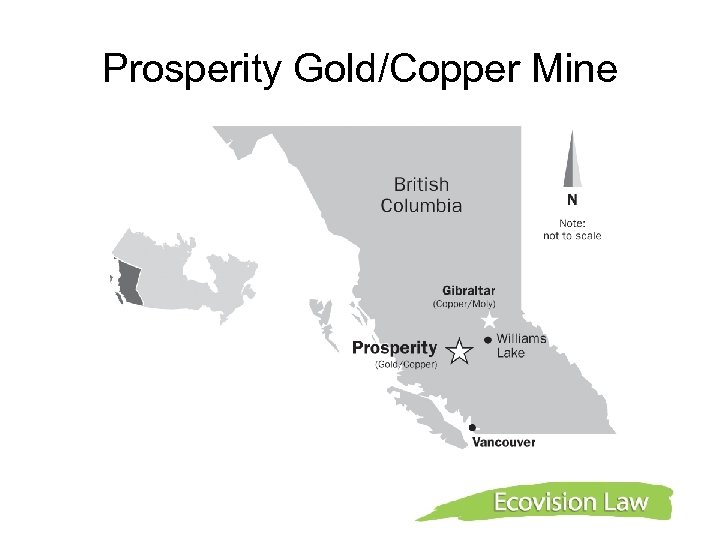
Prosperity Gold/Copper Mine
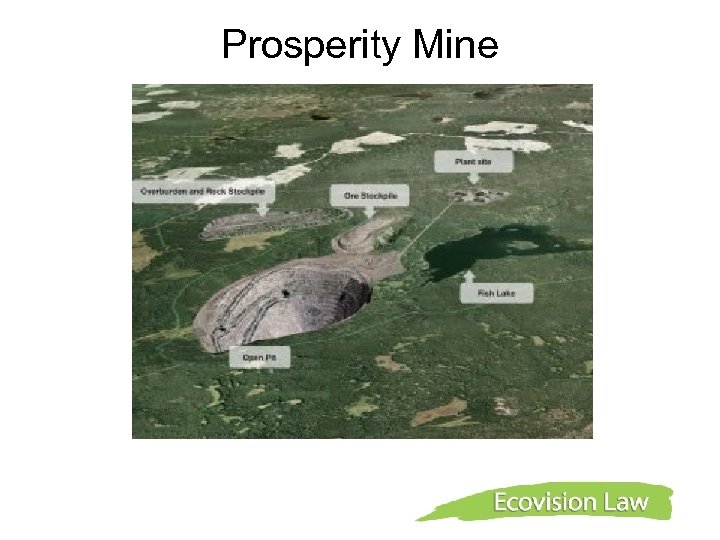
Prosperity Mine
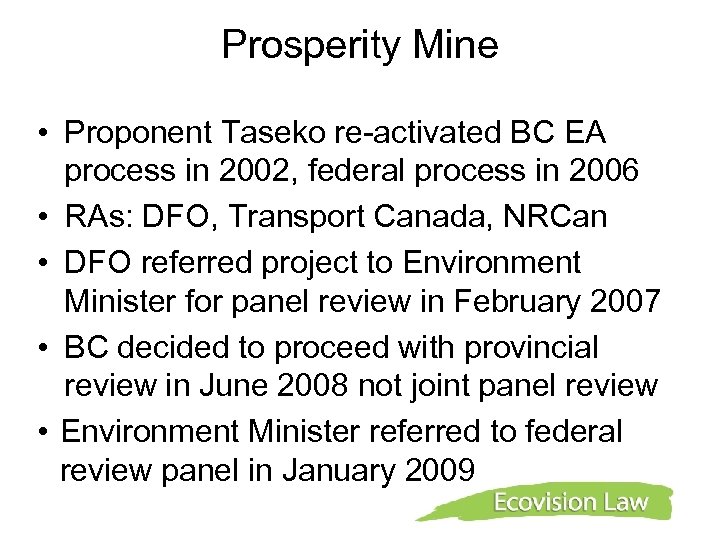
Prosperity Mine • Proponent Taseko re-activated BC EA process in 2002, federal process in 2006 • RAs: DFO, Transport Canada, NRCan • DFO referred project to Environment Minister for panel review in February 2007 • BC decided to proceed with provincial review in June 2008 not joint panel review • Environment Minister referred to federal review panel in January 2009
Prosperity Mine • EA processes conducted separately with province approving project before federal panel review completed • BC approved mine; feds rejected mine on recommendation of federal panel • Why different findings and conclusions?
Comparison of BC and Federal EA Processes • Analysis by Northwest Institute July 2011 • BC EAO “only one significant adverse effect” “limited to a discrete location” loss of fish and fish habitat at Fish Lake/Little Fish Lake • BC ministers advised adverse effects justified by “very significant employment and economic benefits” and proponent’s fish habitat compensation program
Comparison of BC and Federal EA Processes • Federal panel found eight additional significant eight adverse effects: grizzly bears, navigation , local tourism, grazing, First Nation’s trapline, First Nations’ traditional land use and cultural heritage, Aboriginal rights, future generations. • Proponent’s fish habitat compensation program not viable, mitigation not sufficient
Comparison of BC and Federal EA Processes • Why divergent outcomes? • Process: BC “review and comment” process vs. federal panel hearings • Information: Federal panel had more complete information (DFO, First Nations) • Expertise: Federal panel members highly qualified (chair with 27 years experience); EAO four staff on working group
Comparison of BC and Federal EA Processes • Participant Funding – feds yes; BC no • Significance Determination - EAO used large geographic area as baseline; feds, CEA Agency guidelines • Mitigation: BC lacked clear mitigation and compensation policies, deferred to future planning efforts; feds “no net loss” fish habitat policy
Comparison of BC and Federal EA Processes • Standards and Criteria: BC lacks standards/criteria to guide decisionmaking comparable to Fisheries Act/SARA • Legislation: BC Environmental Assessment largely procedural, lacked many substantive aspects of CEAA • Independence: Federal Panel independent unlike EAO Working Group
Comparison of BC and Federal EA Processes • Federal panel found eight additional significant eight adverse effects: grizzly bears, navigation, local tourism, grazing, First Nation’s trapline, First Nations’ traditional land use and cultural heritage, Aboriginal rights, and future generations. • Proponent’s fish habitat compensation program not viable, mitigation not adequate. What accounts for such divergent outcomes? This report reviews
Report of BC Auditor General on BC EAO July 2011 • Focused on post-certification • EAO’s oversight of certified projects not sufficient to ensure that potential significant effects are avoided/mitigated • EAO not ensuring that: – certificate commitments are measureable, enforceable – monitoring responsibilities are clearly defined – compliance and enforcement actions are effective
Report of BC Auditor General on BC EAO • EAO not evaluating effectiveness of environmental assessment mitigation measures to ensure projects are achieving desired outcomes • EAO not making appropriate monitoring, compliance and outcome information available to public to ensure accountability
Скачать презентацию ONTARIO AND BC ENVIRONMENTAL ASSESSMENT LAW MARCH 21
47868dabe6981675767df45a2bdc8dfd.ppt