 Скачать презентацию Online Learning What have we learned Professor Robin
eef7be44af36c27fe9e85ad032481e73.ppt
- Количество слайдов: 32



Online Learning: What have we learned? Professor Robin Mason Institute of Educational Technology The Open University Milton Keynes Stirling oct 97 dp/rm p. 1
What is Online Learning? P course content on the web — — glorified CBT designed and written specifically for the web P course resources on the web — — overheads and hand-outs links to articles and websites P course communication online — — Stirling oct 97 dp/rm p. 2 email and discussion areas collaborative activities and assessments
Evidence from Researchers and Practitioners of Online Teaching Pauthored book Pedited book with international group of authors PJisc-funded research study PPractitioner created e-book Stirling oct 97 dp/rm p. 3
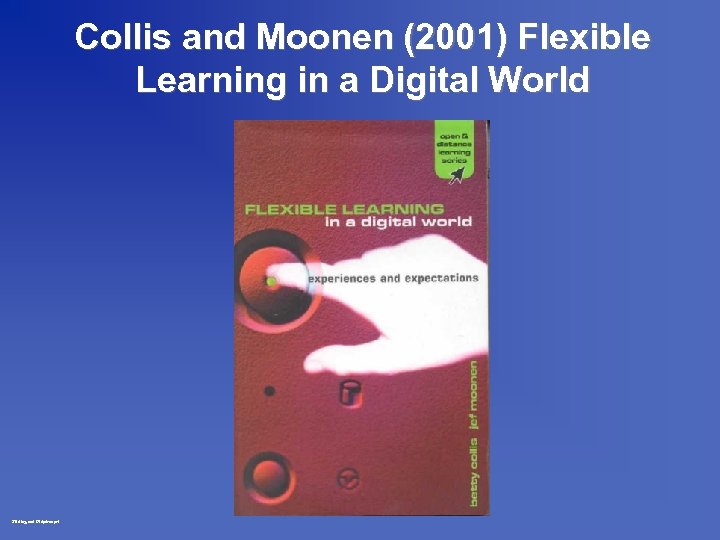
Collis and Moonen (2001) Flexible Learning in a Digital World Stirling oct 97 dp/rm p. 4
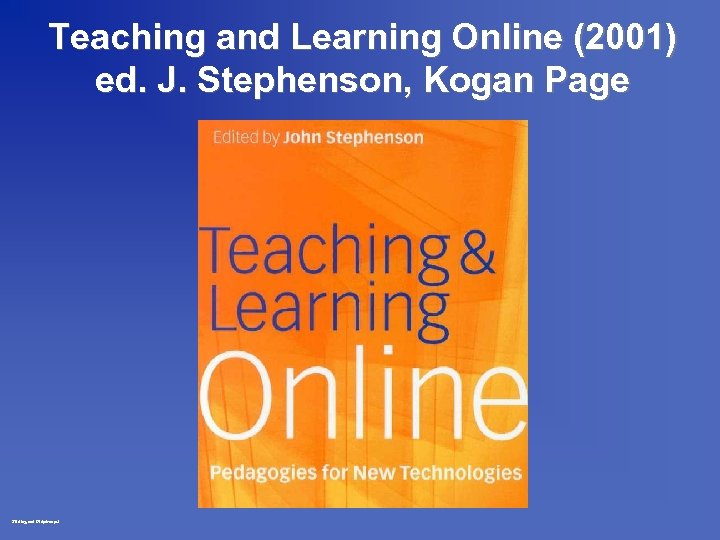
Teaching and Learning Online (2001) ed. J. Stephenson, Kogan Page Stirling oct 97 dp/rm p. 5
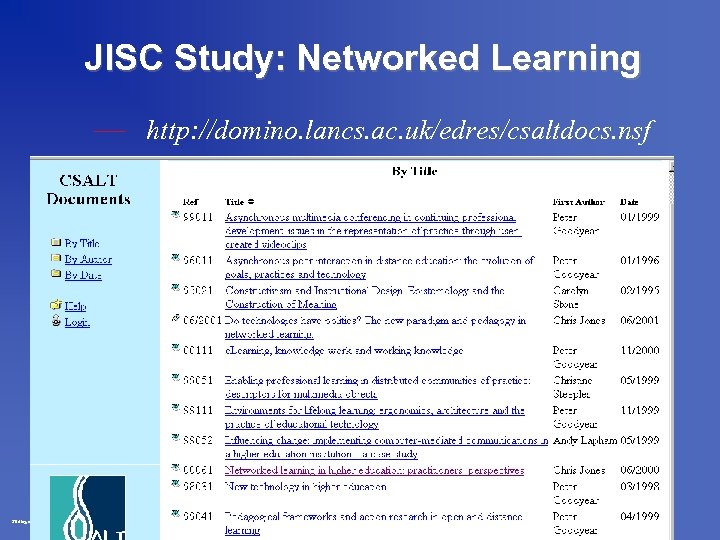
JISC Study: Networked Learning — http: //domino. lancs. ac. uk/edres/csaltdocs. nsf Stirling oct 97 dp/rm p. 6
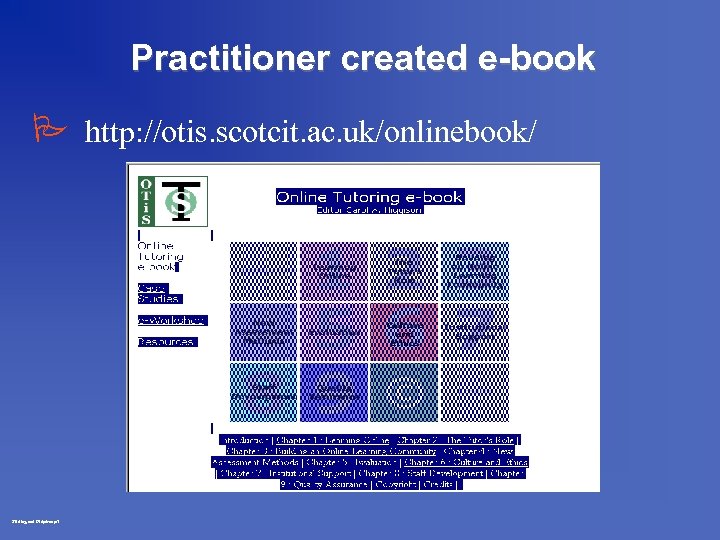
Practitioner created e-book P http: //otis. scotcit. ac. uk/onlinebook/ Stirling oct 97 dp/rm p. 7
Contradictory Findings Pdue to different educational contexts — campus/ remote learners; young/mature students; curriculum areas Pdue to different uses of the term ‘online learning’ — content/communication; wholly/partially online Pdue to different research methodologies — broad-brush large-scale surveys or small, contextualised interviews Stirling oct 97 dp/rm p. 8
1 Course Design Pneed for clear, unequivocal instructions Pneed for comprehensive guidelines Pre-thinking lectures as activities Pteam approach to course design Stirling oct 97 dp/rm p. 9
Course Design for the Web Pcapitalizing on unique features of the web — hyperlinking rather than linear conception of content — links to additional, external resources — must be kept up-to-date, can be changed on the fly — webcasting, simulations, video/audio clips for specialist purposes Stirling oct 97 dp/rm p. 10
2 Assessment P individualisation continuum (learning contract - essays MCQ) P course design continuum (aims and objectives = course content = assessment) P the art of assessment design (challenging assignment v/s marking reliability v/s feasibility) P balancing student centred approach with responsibility of certifying achievement P more innovative assignments are more open to cheating and plagarism Stirling oct 97 dp/rm p. 11
Good Practice in Assessment P use a variety of assessment methods P relate the assessment to the pedagogy P make the aims, criteria and standards explicit P use authentic and holistic tasks P opportunities to complete the feedback Stirling oct 97 dp/rm p. 12 loop
Online Assessment P web pages: projects, literature review, collaborative pages P conferencing: debates, simulations, discussions P MCQ: matching, assertion/ reason, ranking and sequencing, multiple right answers Stirling oct 97 dp/rm p. 13
3 Mixed Mode P combinations of face-to-face meetings with online delivery has become standard P purely face-to-face and purely online courses will increasingly be reserved for specialist uses P e-learning has already evolved to mean enhanced learning (that is, learning enhanced by electronic technologies) Stirling oct 97 dp/rm p. 14
4 Teaching Online P over-emphasised as a new paradigm P training is needed as much because of lack of emphasis on teaching in HE generally as because online teaching is different P online teaching has upset the apple-cart: what is the role of the teacher in HE? P online education is more revolutionary for campus education than for distance education Stirling oct 97 dp/rm p. 15
Online Education: The Time. Consuming Factor P One of the few issues about which there is little disagreement in the literature P Is it a short-term phenomenon? P Need to acknowledge that good teaching, whatever the medium, never happens on the cheap Stirling oct 97 dp/rm p. 16
5 Learning Online P Evidence hasn’t changed over nearly 15 years: the more ‘adult’, the more ‘learning mature’, the more motivated, the more self-confident, the better they enjoy and benefit from online learning Stirling oct 97 dp/rm p. 17
Campus-based studies P sometimes conclude that students feel they are being ‘fobbed off’ with online education P sometimes report greater interactivity with online courses than ftf courses P harder to generate online discussion because of co-location of students Stirling oct 97 dp/rm p. 18
Studies of Distance Education P Studies based on distance students usually show very positive results — more interaction online and greater feeling of community P Still a hard core who resist online interaction or who want to retain ftf tutorials Stirling oct 97 dp/rm p. 19
6 Collaborative Learning P requires organisation, good design and strong leadership by the online tutor especially at the beginning P related to a whole course approach e. g. scaffolding for group work P it can work but not for everyone - significant learning gains for some students Stirling oct 97 dp/rm p. 20
7 Resource-based Learning P when asked, students claim they don’t like RBL because — it is more work — it is more difficult to study for exams — it is often poorly supported — it can appear that the teacher has abrogated the instructor role Stirling oct 97 dp/rm p. 21
8 Prior Learning or Experience P motivation and open-ness to learning matters more than any experience or prior learning P the effect of prior experience with the Internet and mobile phones will lead to greater demand for good course design P good course design engages the whole learner, not just their cognitive centre Stirling oct 97 dp/rm p. 22
9 Context, Context P It is still very difficult to ‘get it right’ the first time — need for pilots, ‘toe in the water’ experiments P Aiming at a moving target — technology, students, curriculum, staff P So many variables — access modes, prior experience, group sizes Stirling oct 97 dp/rm p. 23
10 The Technology P “The technology is the least important part of the learning experience for students” (Yoni Ryan in ‘Changing Faces of Virtual Education’, www. col. org) P Serious technical problems will certainly lead to failure, but ‘good technology’ contributes very little to the success of a course. Stirling oct 97 dp/rm p. 24
New Demands Demand for timely, accurate and personalised learning and performance support — ‘New’ learners want bite-sized chunks of learning, not whole courses — ‘New’ learners want learning tailored to their context — ‘New’ learners want just-in-tine learning — Perishability of knowledge means that there isn’t time to develop long courses Stirling oct 97 dp/rm p. 25
Scenarios for the use of Learning Objects P content aggregation P re-using existing course content P creating your ‘own’ course P designing templates for re-use P creating modular courses Stirling oct 97 dp/rm p. 26
Re-versioning existing content The Open University’s perspective on re-use: — re-shaping — re-sizing — re-purposing — cross media redesign — pre-versioning Stirling oct 97 dp/rm p. 27
Multi-use graphical templates Royal Roads University (www. royalroads. ca) — assemble screens of web course content through graphs, text etc in the learning object library — using templates to develop interactive learning objects http: //207. 194. 130. 32/ELO/default. asp? newversi on_name=Original Stirling oct 97 dp/rm p. 28
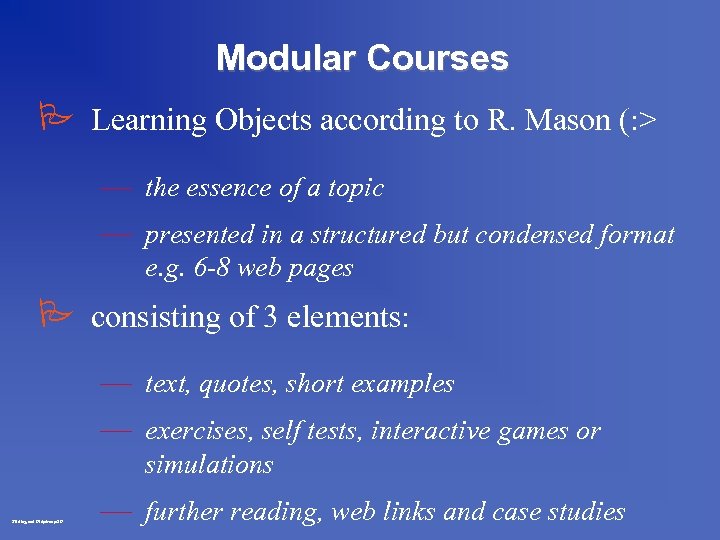
Modular Courses P Learning Objects according to R. Mason (: > — the essence of a topic — presented in a structured but condensed format e. g. 6 -8 web pages P consisting of 3 elements: — text, quotes, short examples — exercises, self tests, interactive games or simulations Stirling oct 97 dp/rm p. 29 — further reading, web links and case studies
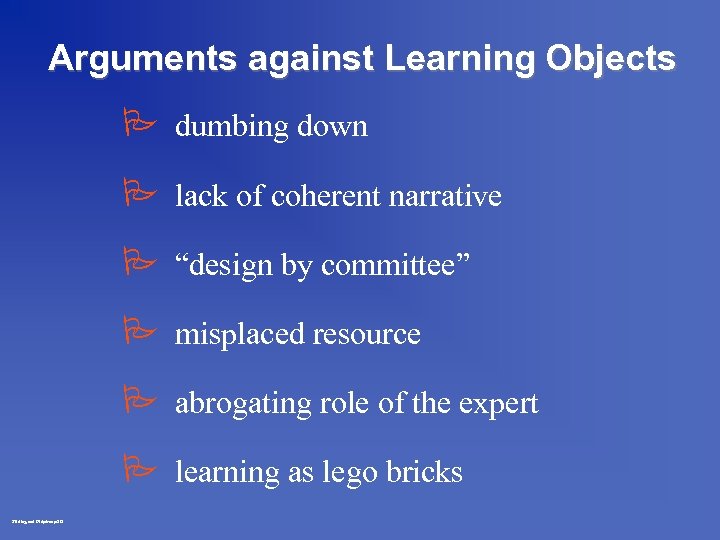
Arguments against Learning Objects P dumbing down P lack of coherent narrative P “design by committee” P misplaced resource P abrogating role of the expert P learning as lego bricks Stirling oct 97 dp/rm p. 30
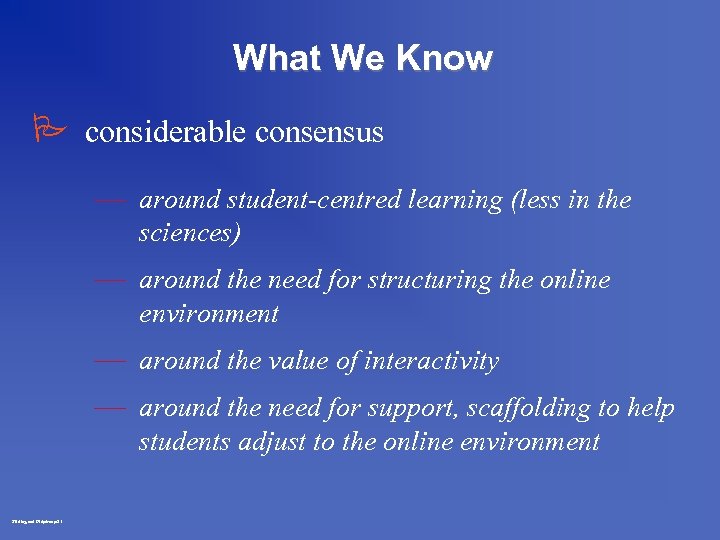
What We Know P considerable consensus — around student-centred learning (less in the sciences) — around the need for structuring the online environment — around the value of interactivity — around the need for support, scaffolding to help students adjust to the online environment Stirling oct 97 dp/rm p. 31
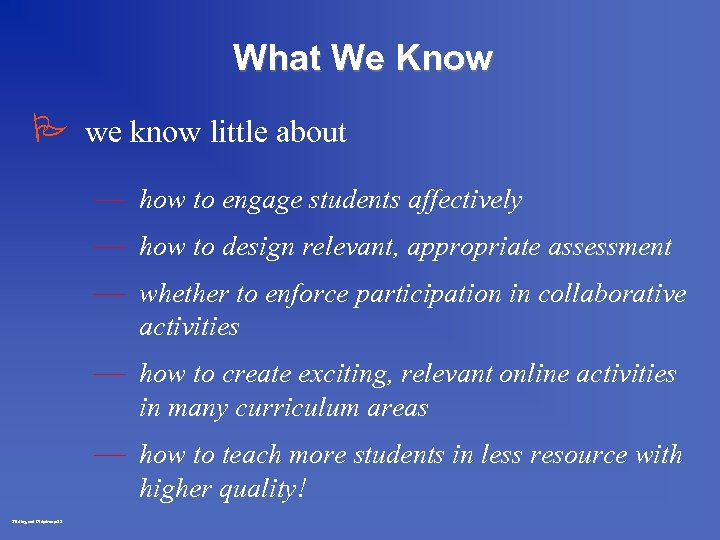
What We Know P we know little about — how to engage students affectively — how to design relevant, appropriate assessment — whether to enforce participation in collaborative activities — how to create exciting, relevant online activities in many curriculum areas — how to teach more students in less resource with higher quality! Stirling oct 97 dp/rm p. 32
Скачать презентацию Online Learning What have we learned Professor Robin
eef7be44af36c27fe9e85ad032481e73.ppt