


 Скачать презентацию Online Courses as Effective Learning Environments or Digital
2de57f737022d06c2d00560e942e8356.ppt
- Количество слайдов: 30
 Online Courses as Effective Learning Environments or "Digital Diploma Mills": The Importance of Collaborative Learning n n Keynote Address, Telelearning ‘ 99 Montreal Canada November Copyright, Starr Roxanne Hiltz New Jersey Institute of Technology
 Two views of Online courses n n A means of cutting the costs of “delivering” educational materials to students, akin to previous use of instructional television. Post materials on the web; collect assignments; can handle thousands of students. OR: A means of improving the quality of learning opportunities, by supporting learning communities in an anytime/anywhere environment (Learning Networks “TLN” or “ALN”)- require small classes mentored by skilled faculty members
 Popular press: negative images of online courses n Article title: “Wiring the Ivory Tower: But will online courses lower standards? ” n n Business Week, August 9, 1999 “No dorms, no sports fields, NO COSTLY PROFESSORS”
 Cites UNext: n n n Will spend $1 million a course for video streamed lectures by “stars” Use part time instructors to answer email and grade assignments NOT what is meant by LN!!
 AFT/NEA Commissioned report on Distance Learning n Asks, “What’s the difference” between traditional and distance courses; argues there is no proof that distance/online is as good or better
 Some Questions about “Differences” This Talk Will Cover: n n n Is online collaborative learning superior to the mass distribution of materials via the Web? How do both models compare to traditional college level courses, in terms of process and outcomes? What are some guidelines for maximizing the quality of research to answer these questions?
 Background n n n Over the last 15 years, NJIT has constructed a series of computer-mediated communication systems tailored to support “anytime/ anywhere” interaction among students and instructors called “Virtual Classroom” [TM] Used first in a variety of individual courses and then for full degree programs; and Developed various evaluation instruments and approaches.
 Virtual Classroom NJIT n n TM Project at 1993 -1996 produced, delivered and evaluated 26 courses comprising the undergraduate majors in Information Systems and Computer Science, with Sloan Foundation support Continuing: “From Virtual Classroom to Virtual University” 1997 -2000 n Expand the innovation to other schools and departments and graduate degree programs 8
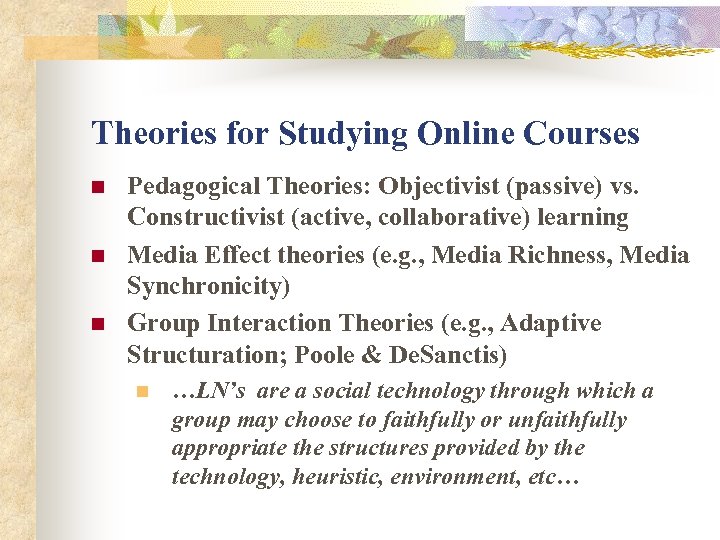 Theories for Studying Online Courses n n n Pedagogical Theories: Objectivist (passive) vs. Constructivist (active, collaborative) learning Media Effect theories (e. g. , Media Richness, Media Synchronicity) Group Interaction Theories (e. g. , Adaptive Structuration; Poole & De. Sanctis) n …LN’s are a social technology through which a group may choose to faithfully or unfaithfully appropriate the structures provided by the technology, heuristic, environment, etc…
 Premises of the NJIT studies: n n Online courses provide unique opportunities to support collaborative (group based) learning Collaborative learning is crucial to the effectiveness of online learning environments
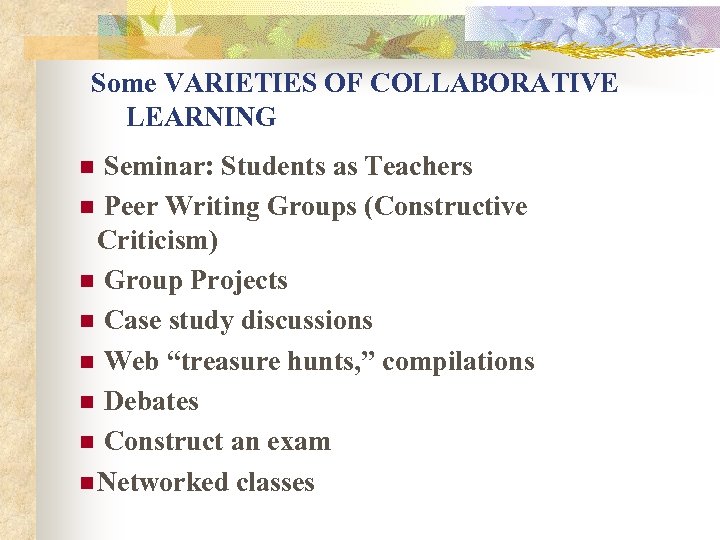 Some VARIETIES OF COLLABORATIVE LEARNING Seminar: Students as Teachers n Peer Writing Groups (Constructive Criticism) n Group Projects n Case study discussions n Web “treasure hunts, ” compilations n Debates n Construct an exam n Networked classes n
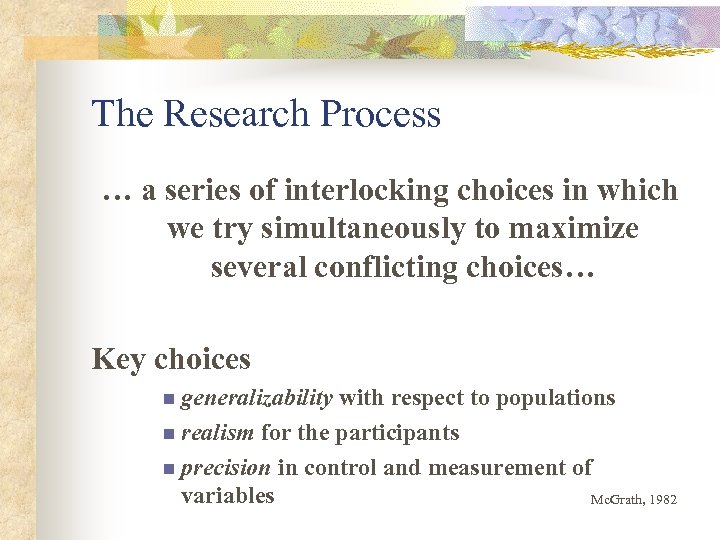 The Research Process … a series of interlocking choices in which we try simultaneously to maximize several conflicting choices… Key choices n generalizability with respect to populations n realism for the participants n precision in control and measurement of variables Mc. Grath, 1982
 Methodological Tradeoffs n n n Large sample surveys can maximize generalizability Laboratory Experiments can maximize precision of control Field experiments can maximize realism Qualitative Methods can maximize depth of understanding ( the “why”) “Triangulation” or multiple methods maximize overall validity of results Replication of results in different settings provides generalizability
 Questionnaire Data (1993 - 1996 completed project) n n n Total Responses (sometimes partial): Virtual Classroom + video: 698 VC + Ft. F: 463 No VC: 268 Question Form: Please compare online classes to your previous experiences with “face to face” college - level courses. To what extent do you agree with the following statements. . . 14
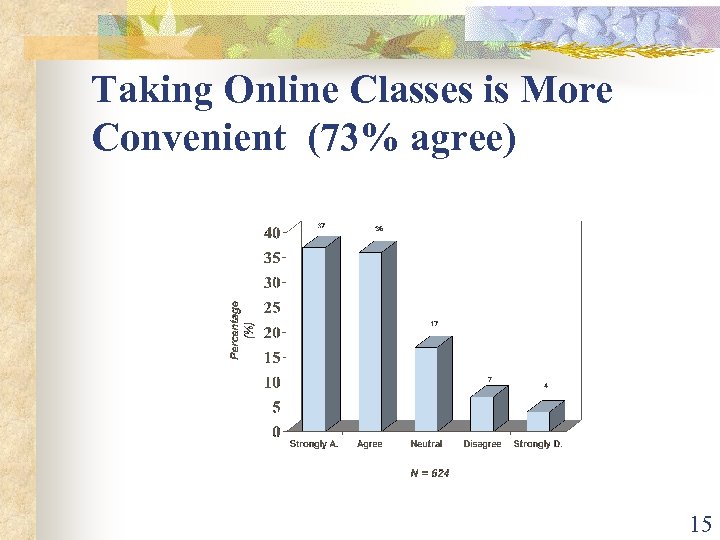 Taking Online Classes is More Convenient (73% agree) 15
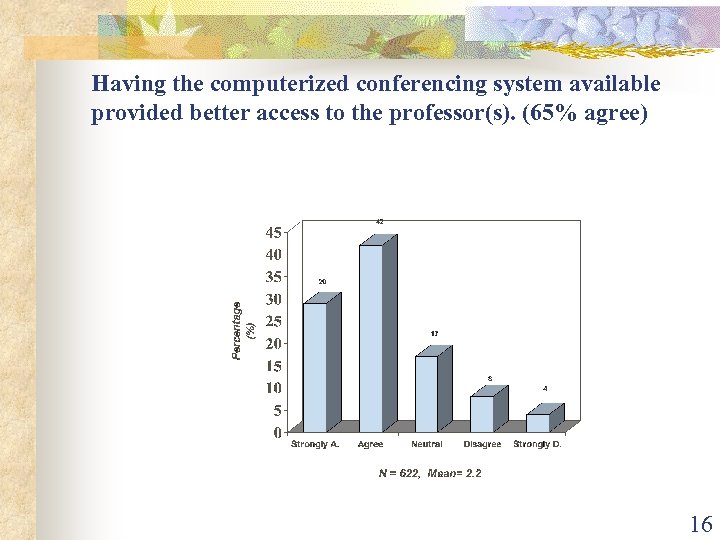 Having the computerized conferencing system available provided better access to the professor(s). (65% agree) 16
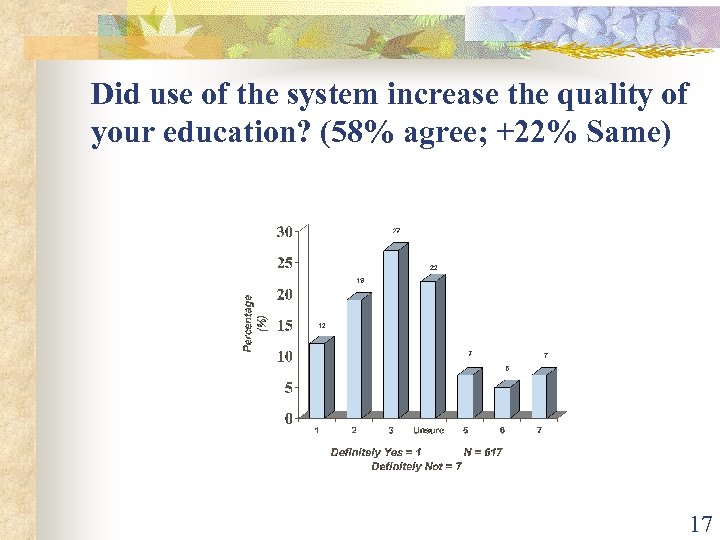 Did use of the system increase the quality of your education? (58% agree; +22% Same) 17
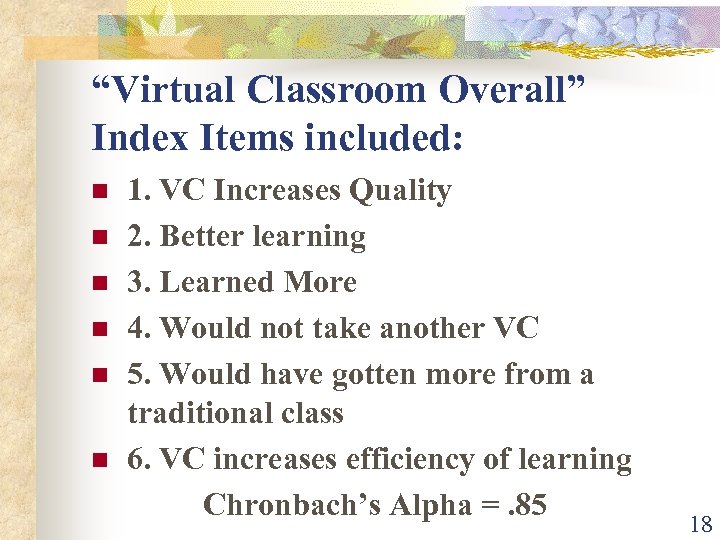 “Virtual Classroom Overall” Index Items included: n n n 1. VC Increases Quality 2. Better learning 3. Learned More 4. Would not take another VC 5. Would have gotten more from a traditional class 6. VC increases efficiency of learning Chronbach’s Alpha =. 85 18
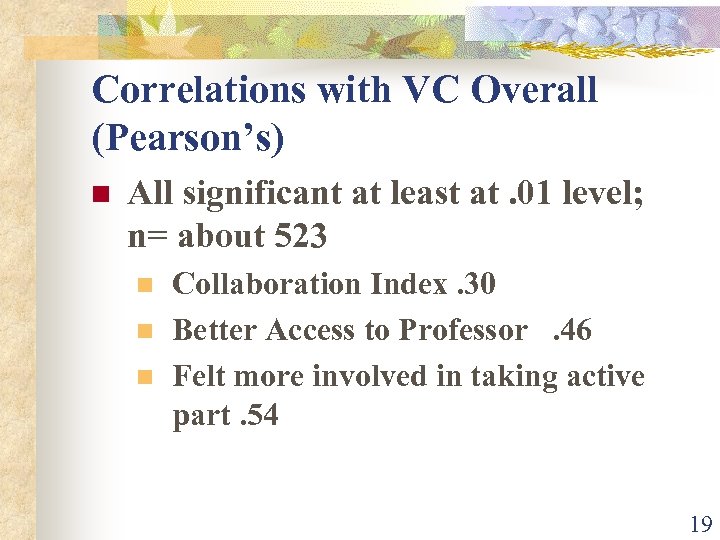 Correlations with VC Overall (Pearson’s) n All significant at least at. 01 level; n= about 523 n n n Collaboration Index. 30 Better Access to Professor. 46 Felt more involved in taking active part. 54 19
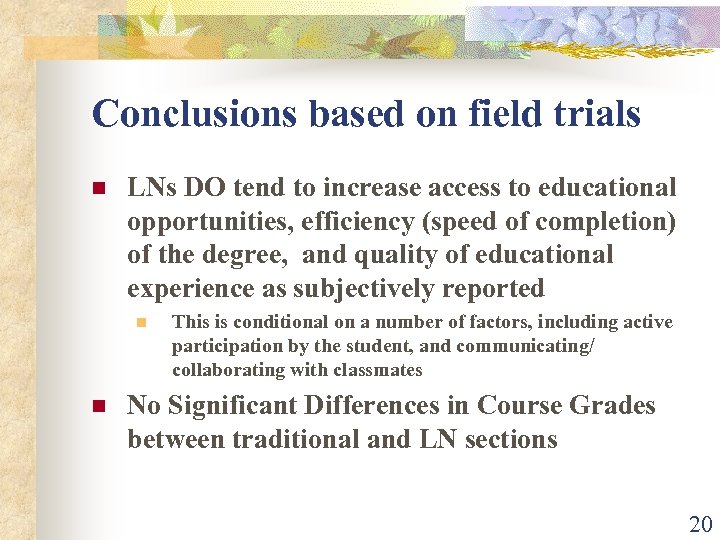 Conclusions based on field trials n LNs DO tend to increase access to educational opportunities, efficiency (speed of completion) of the degree, and quality of educational experience as subjectively reported n n This is conditional on a number of factors, including active participation by the student, and communicating/ collaborating with classmates No Significant Differences in Course Grades between traditional and LN sections 20
 Replication: Similar results from n U. of Illinois, Drexel, SUNY, U. of Central Florida, etc. n n n E. g. Drexel: 95% felt they had better access to Prof Vast majority of students report that LN courses are “better” in terms of access and learning Student evaluations strongly correlated with amount on online interaction with professor and with other students
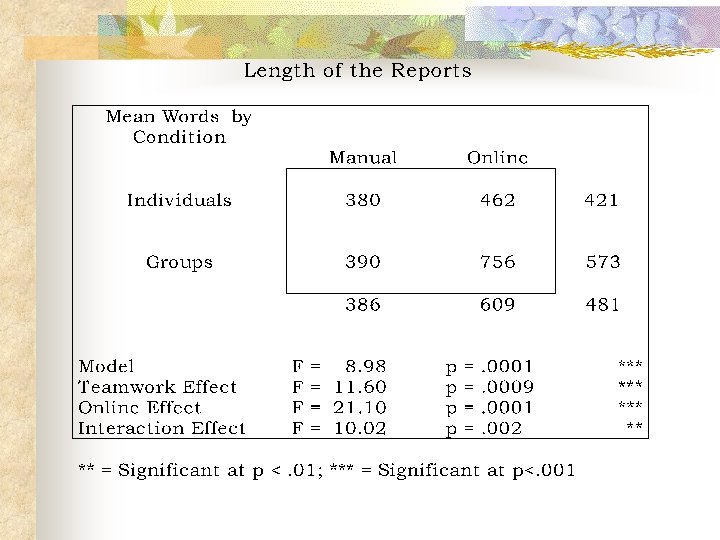
 BUT: n n In terms of the relationship between Collaborative Learning and the effectiveness of LNs, “correlation is not causation” Triangulation: One course in the project, Computers and Society, was selected for a field experiment n Effects of Computer-Mediated Communication on Learning, Performance and Satisfaction: A Comparison of Groups and Individuals Solving Ethical Scenarios, A thesis by: Raquel Benbunan
 TASK SELECTION n RESEARCH METHODS Discussion and solution of computer ethics scenarios n Decision-making task, completed by writing a report on analysis and recommendations for action n Key knowledge in the course and on the final exam 23
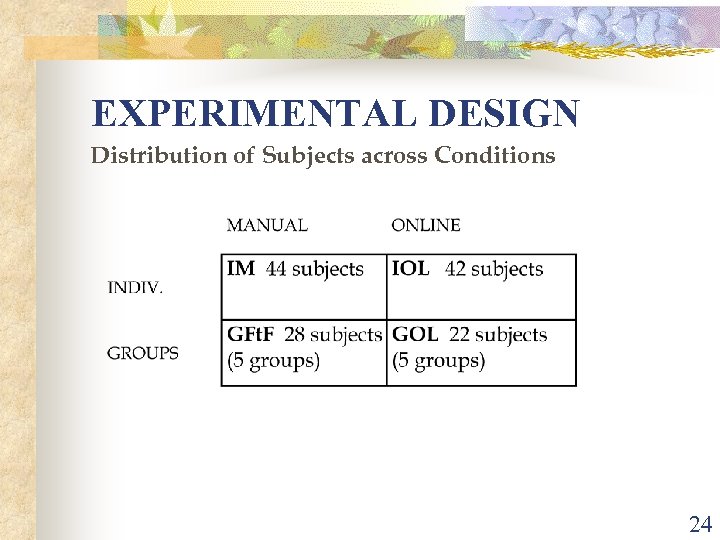 EXPERIMENTAL DESIGN Distribution of Subjects across Conditions 24
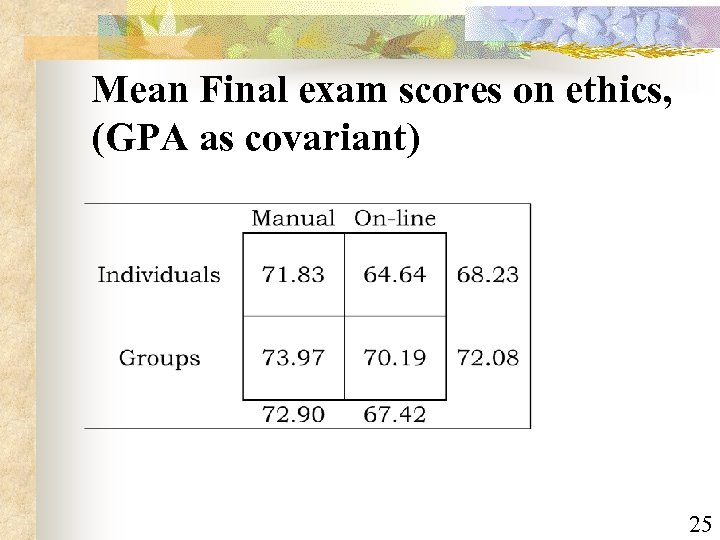 Mean Final exam scores on ethics, (GPA as covariant) 25
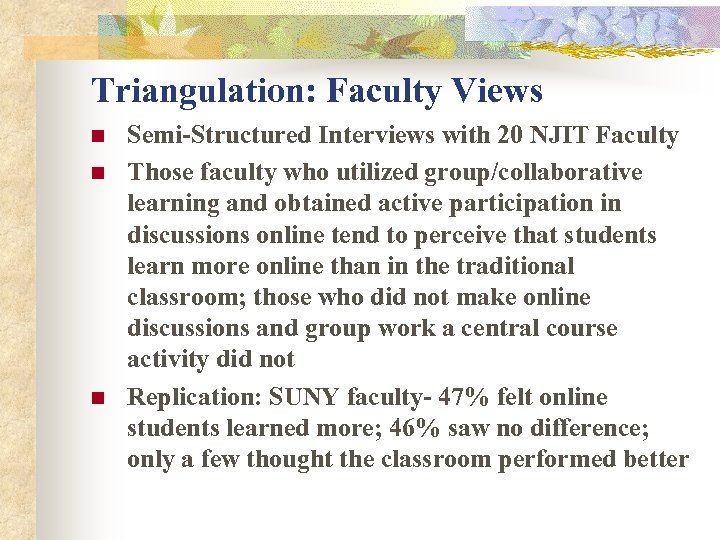 Triangulation: Faculty Views n n n Semi-Structured Interviews with 20 NJIT Faculty Those faculty who utilized group/collaborative learning and obtained active participation in discussions online tend to perceive that students learn more online than in the traditional classroom; those who did not make online discussions and group work a central course activity did not Replication: SUNY faculty- 47% felt online students learned more; 46% saw no difference; only a few thought the classroom performed better
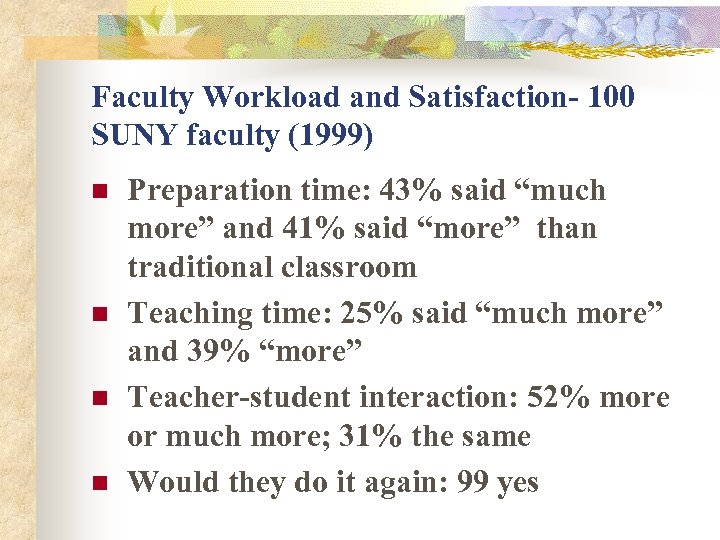 Faculty Workload and Satisfaction- 100 SUNY faculty (1999) n n Preparation time: 43% said “much more” and 41% said “more” than traditional classroom Teaching time: 25% said “much more” and 39% “more” Teacher-student interaction: 52% more or much more; 31% the same Would they do it again: 99 yes
 Summary and Conclusions: n Each of the three NJIT studies has its methodological weaknesses, but taken together they solidly support the conclusions that n n 1. L N courses can be as effective or more effective than traditional classrooms, in terms of access and learning outcomes. 2. Collaborative learning designs are more effective for online learning than individuals working alone with materials posted online. Data from other universities replicate the findings. What’s the Difference? It’s the pedagogy, stupid!!
 A Challenge We Share n Answer the critics with data: Replicate, Triangulate, INNOVATE n For More Info: Roxanne’s home page: http: //eies. njit. edu/~hiltz WWW. ALN. ORG n n