


 Скачать презентацию Ongoing and planned activities Eu FMD Commission
1b4fc34d88bffb1b9c3fc60abdde1d3b.ppt
- Количество слайдов: 37
 Ongoing and planned activities : Eu. FMD Commission and support for FMD control in the Eastern and Southern Mediterranean region Presentation to AGR 45933 Workshop on Animal Health and regional Policies, Brussels 8 -9 th Sept 2011 Keith Sumption, Secretary, Eu. FMD Commission FAO of the UN Rome
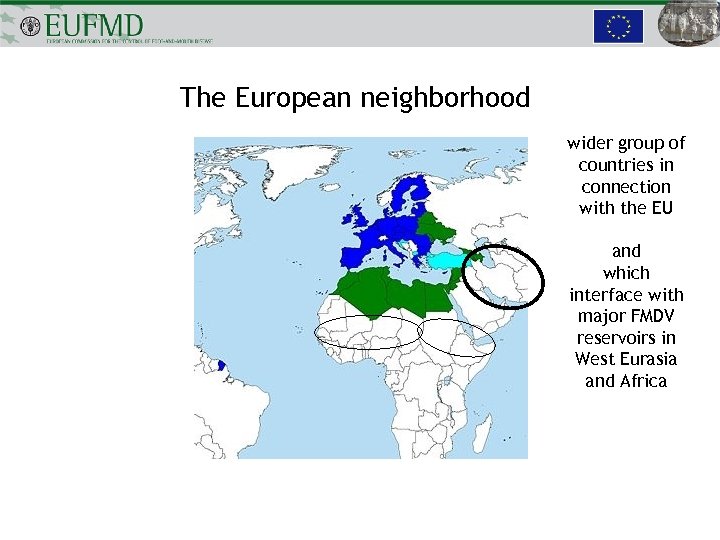 The European neighborhood wider group of countries in connection with the EU and which interface with major FMDV reservoirs in West Eurasia and Africa
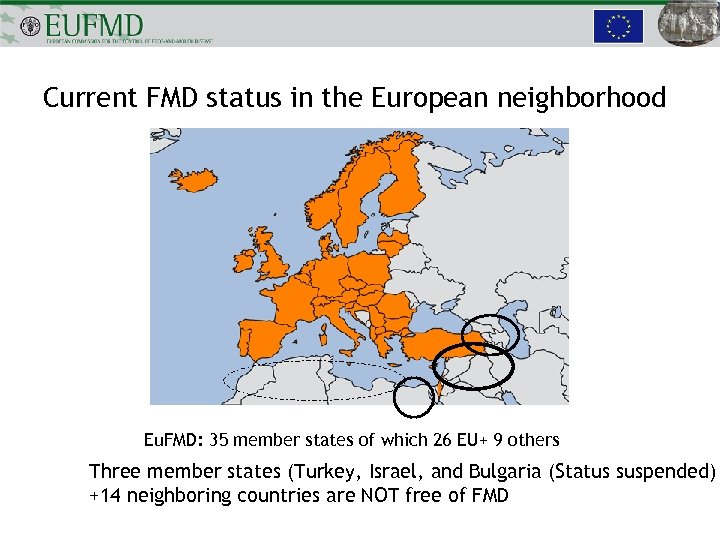 Current FMD status in the European neighborhood Eu. FMD: 35 member states of which 26 EU+ 9 others Three member states (Turkey, Israel, and Bulgaria (Status suspended) +14 neighboring countries are NOT free of FMD
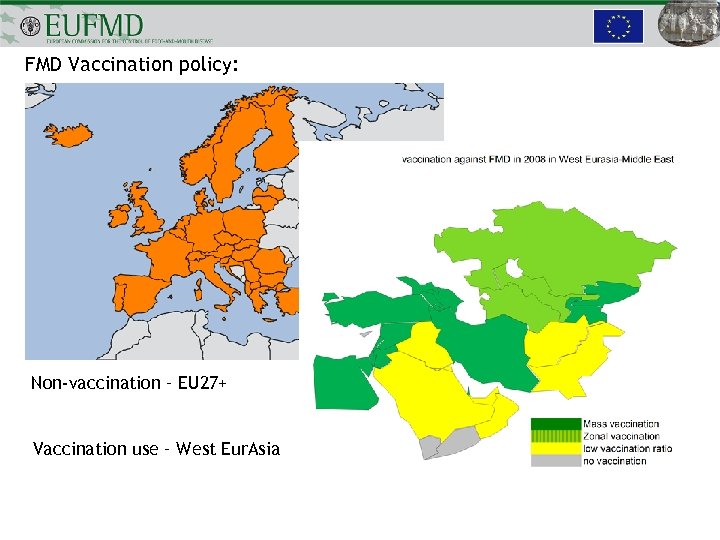 FMD Vaccination policy: Non-vaccination – EU 27+ Vaccination use – West Eur. Asia
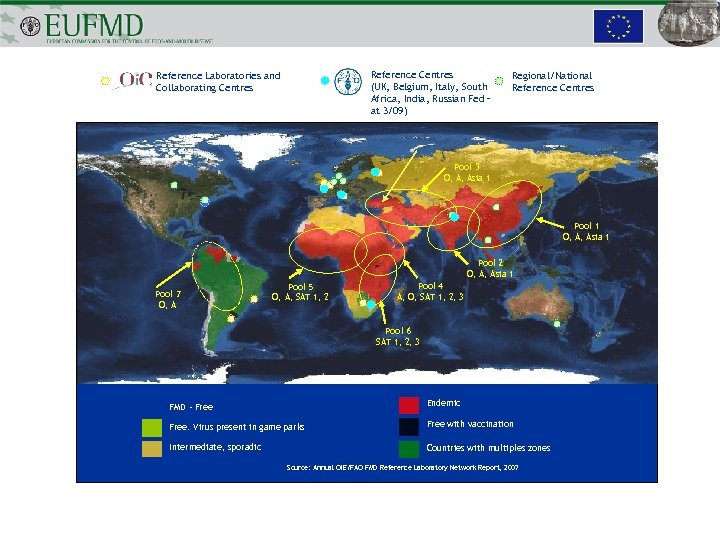 Reference Centres (UK, Belgium, Italy, South Africa, India, Russian Fed – at 3/09) Reference Laboratories and Collaborating Centres Regional/National Reference Centres Pool 3 O, A, Asia 1 Pool 1 O, A, Asia 1 Pool 2 O, A, Asia 1 Pool 7 O, A Pool 5 O, A, SAT 1, 2 Pool 4 A, O, SAT 1, 2, 3 Pool 6 SAT 1, 2, 3 FMD - Free Endemic Free. Virus present in game parks Free with vaccination Intermediate, sporadic Countries with multiples zones Source: Annual OIE/FAO FMD Reference Laboratory Network Report, 2007
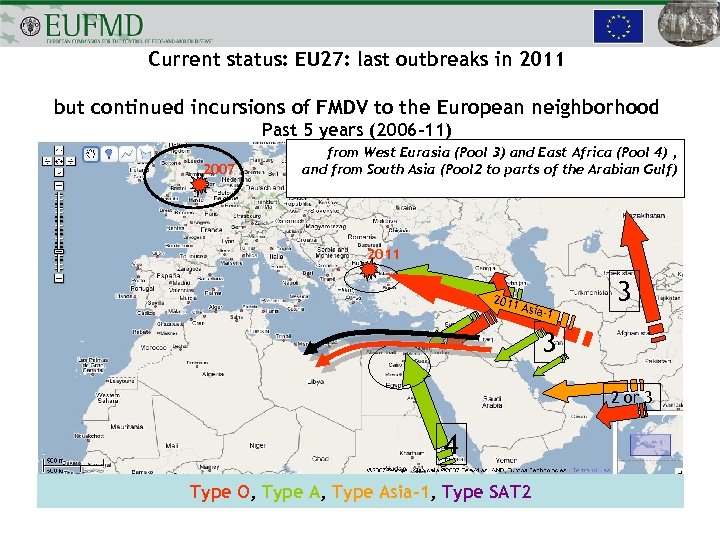 Current status: EU 27: last outbreaks in 2011 but continued incursions of FMDV to the European neighborhood Past 5 years (2006 -11) 2007 from West Eurasia (Pool 3) and East Africa (Pool 4) , and from South Asia (Pool 2 to parts of the Arabian Gulf) 2011 Asia- 1 3 3 2 or 3 4 Type O, Type Asia-1, Type SAT 2
 Main possibilities for FMD introduction • to East and South Mediterranean: – To Eastern Med : from West Eurasia (via Iran/Iraq. . ) – To Southern Med : • from eastern Med (livestock in ships. . ) • From East Africa and parts of Mid-East (shipped) • Trans-sahara (1999 and 2003) • South-East Europe: across landborders: – Turkey (from 6 neighbouring countries) – Israel: from 5 neighbours – Bulgaria and Greece –from one • to EU 27 and Western Balkans: – possible introductions from any of the 7 virus pools • EFSA FMD risk assessment – several pathways
 FMD in the southern/eastern Mediterranean: events, issues and developments Events • Sweeping epidemics of huge intra-regional impact • Frequency and speed of spread increasing: • Three regional epidemics in 3 years (2009 -11) – Two (A, O) reached Libya (presumed by sea) – One reached Bulgaria (Type O) • Main source is West Eurasia (Pakistan to Turkey) • Overspill to middle-east and north Africa (Libya) • In addition: African type A in Egypt, continuing circulation since 2006
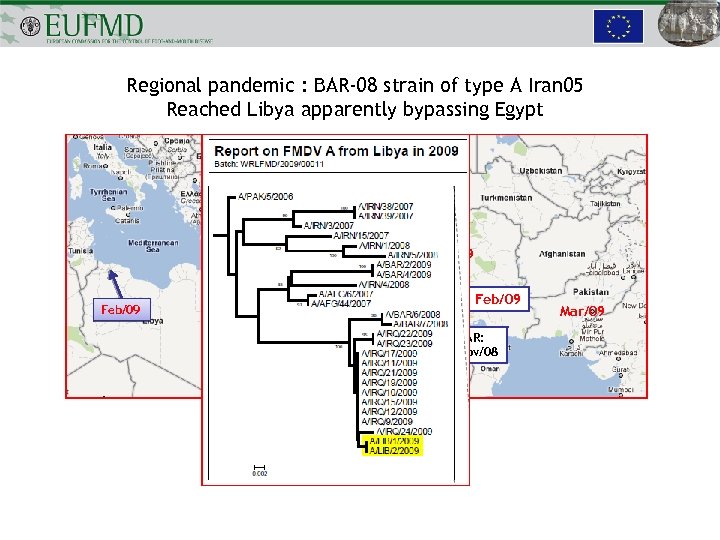 Regional pandemic : BAR-08 strain of type A Iran 05 Reached Libya apparently bypassing Egypt TUR: only One Case close to Iraq/2009 LEB: Mar/09 ISR, +PAT Jun/09 Feb/09 Jan/09 KUW: Feb/09 BAR: Nov/08 Mar/09
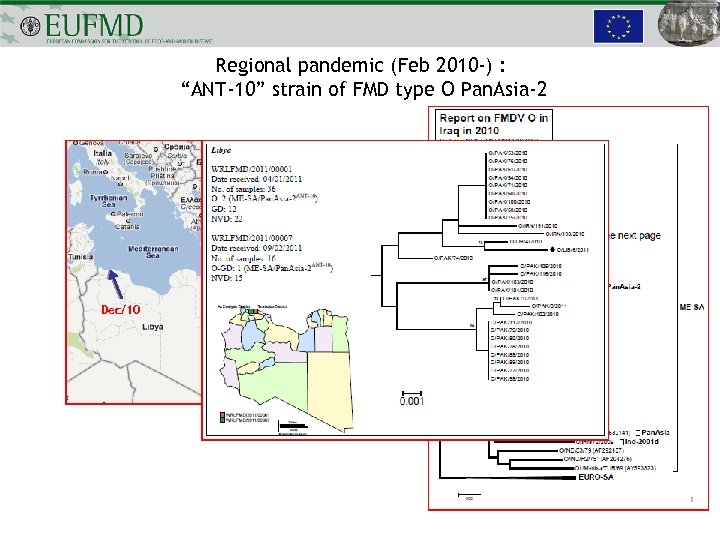 Regional pandemic (Feb 2010 -) : “ANT-10” strain of FMD type O Pan. Asia-2 Jan/11 June/10 Isr: Mar/11 Dec/10 Mar/10 Sept/1 0 Mar/10 July/11 Feb/10
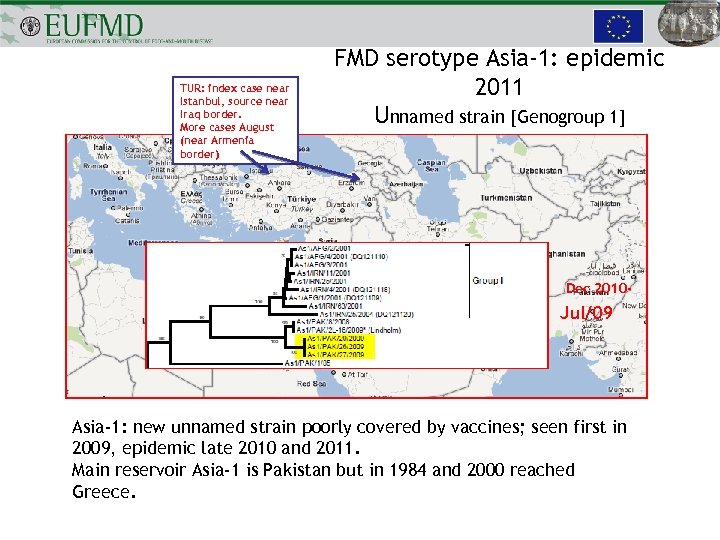 TUR: index case near Istanbul, source near Iraq border. More cases August (near Armenia border) FMD serotype Asia-1: epidemic 2011 Unnamed strain [Genogroup 1] Jan/11 Dec 2010 - Jul/09 BAR: Feb/11 Asia-1: new unnamed strain poorly covered by vaccines; seen first in 2009, epidemic late 2010 and 2011. Main reservoir Asia-1 is Pakistan but in 1984 and 2000 reached Greece.
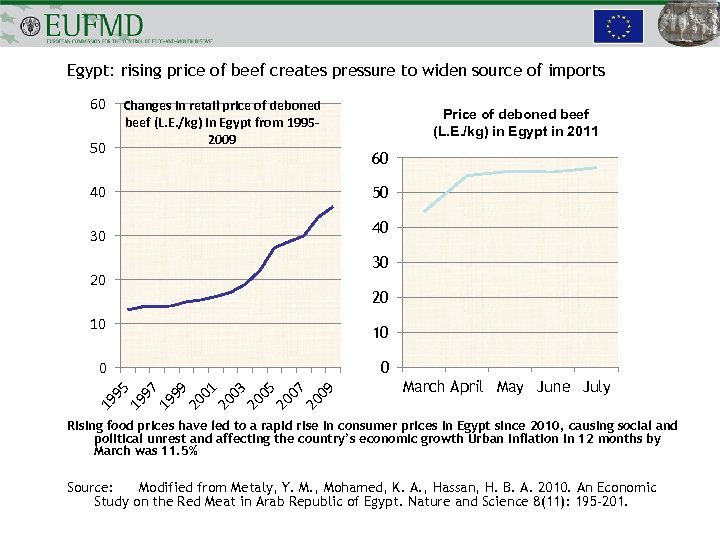 Egypt: rising price of beef creates pressure to widen source of imports 60 50 Changes in retail price of deboned beef (L. E. /kg) in Egypt from 19952009 Price of deboned beef (L. E. /kg) in Egypt in 2011 60 40 50 30 40 30 20 20 10 10 0 01 20 03 20 05 20 07 20 09 March April May June July 20 99 19 97 19 19 95 0 Rising food prices have led to a rapid rise in consumer prices in Egypt since 2010, causing social and political unrest and affecting the country’s economic growth Urban inflation in 12 months by March was 11. 5% Source: Modified from Metaly, Y. M. , Mohamed, K. A. , Hassan, H. B. A. 2010. An Economic Study on the Red Meat in Arab Republic of Egypt. Nature and Science 8(11): 195 -201.
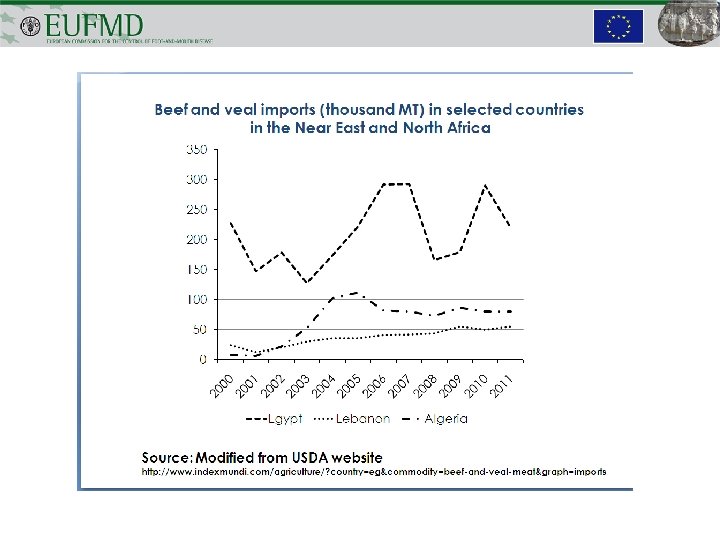
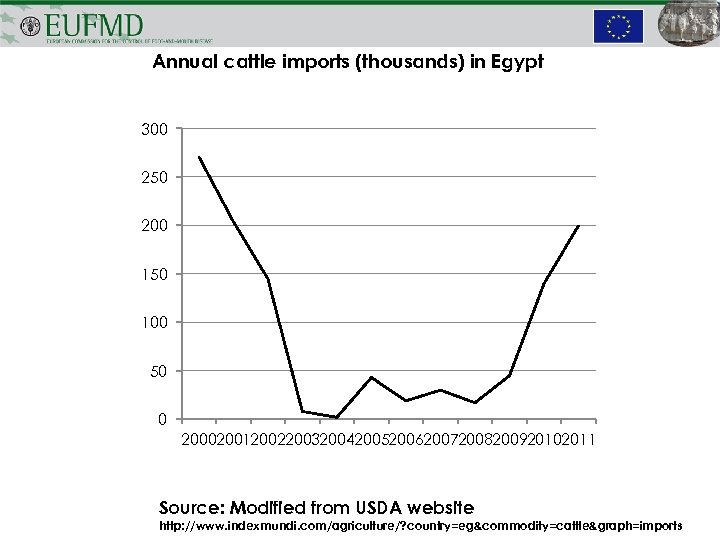 Annual cattle imports (thousands) in Egypt 300 250 200 150 100 50 0 200020012002200320042005200620072008200920102011 Source: Modified from USDA website http: //www. indexmundi. com/agriculture/? country=eg&commodity=cattle&graph=imports
 Issues • Growing reliance on imports – livestock/meat deficits in southern Mediterranean • Impact of global cereal prices – Fattening costs increased – Elevated meat and animal values • Drivers for intra-regional and extra-regional long distance live animal movements • Permeable land borders, smuggling and lack of security • National behaviours in reporting of FMD : penalties encourage non-reporting – Good and bad examples within the region
 Developments • Regional Roadmap for 14 West Eurasian countries: – Co-ordinated projects for early warning and assistance to countries to revise national strategies • FAO/OIE Progressive Control Pathway for FMD (PCP) – Joint tool from 2011– Basis for Regional Long Term Roadmaps – PCP emphasises control programme quality • Addresses lack of reporting • National plans overtaken by political events and demands – Affect publically funded preventive measures – Demand to reduce meat costs (open imports to non-FMD free countries)
 Progressive Control Pathway for FMD (PCP) PCP – what it is –and is NOT PCP is: • Set of activities to identify risk management options, and to assist monitoring and management of FMD control programmes • A basis for self-assessment and comparison of FMD management • A framework for design of national programmes that could be used by countries (+ donors, FAO) NOT : • The Global FMD eradication programme • A set of prescribed control measures
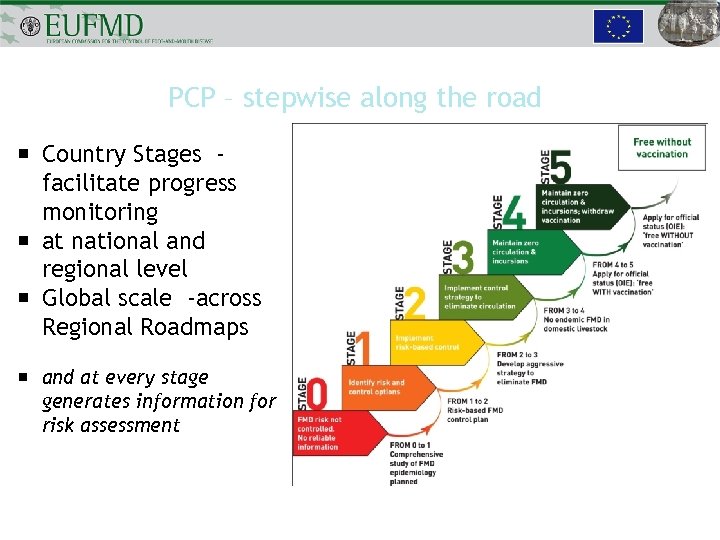 PCP – stepwise along the road Country Stages facilitate progress monitoring at national and regional level Global scale -across Regional Roadmaps and at every stage generates information for risk assessment
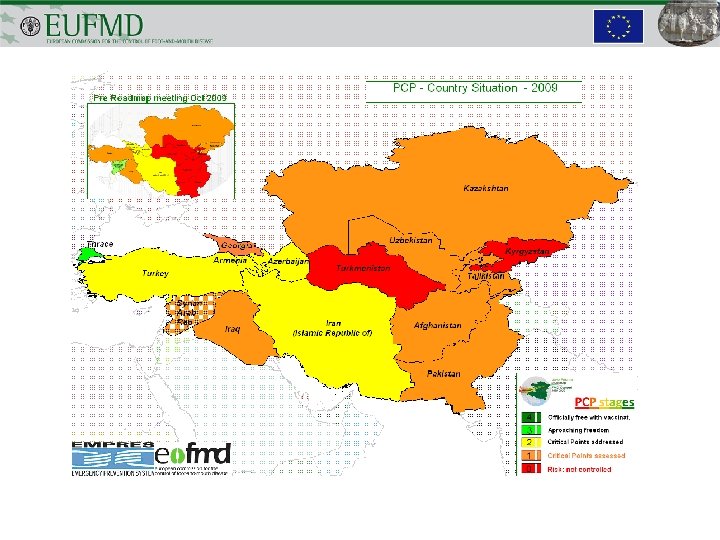
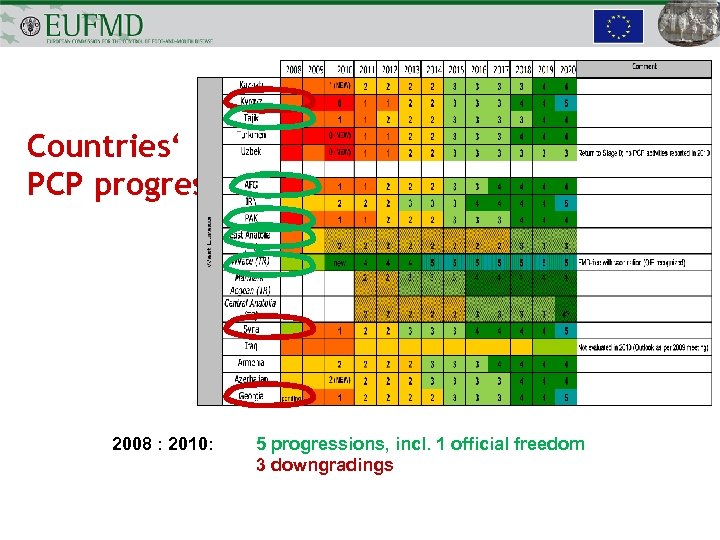 Countries‘ PCP progress 2008 : 2010: 5 progressions, incl. 1 official freedom 3 downgradings
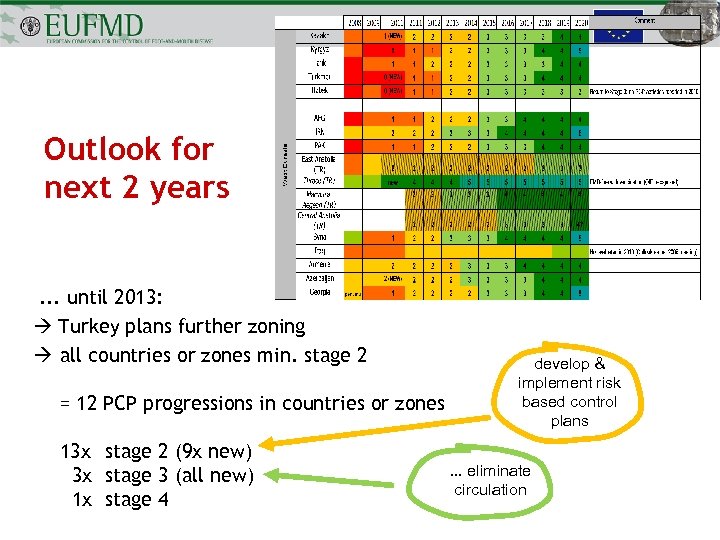 Outlook for next 2 years . . . until 2013: Turkey plans further zoning all countries or zones min. stage 2 = 12 PCP progressions in countries or zones 13 x stage 2 (9 x new) 3 x stage 3 (all new) 1 x stage 4 develop & implement risk based control plans. . . eliminate circulation
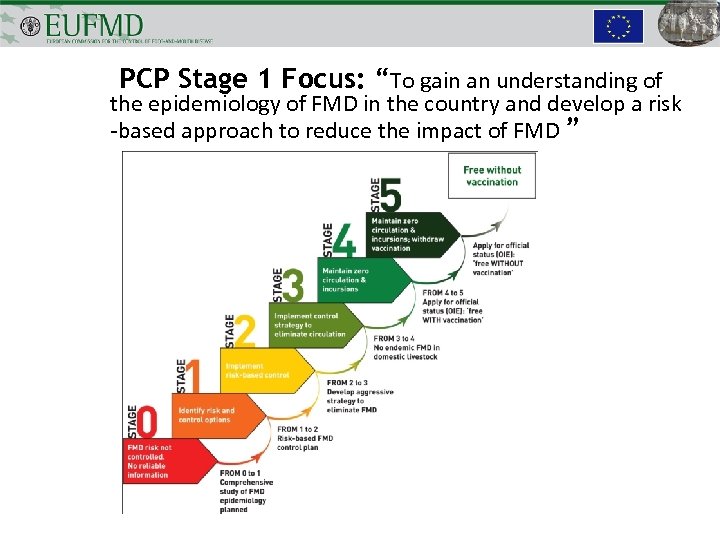 PCP Stage 1 Focus: “To gain an understanding of the epidemiology of FMD in the country and develop a risk -based approach to reduce the impact of FMD ”
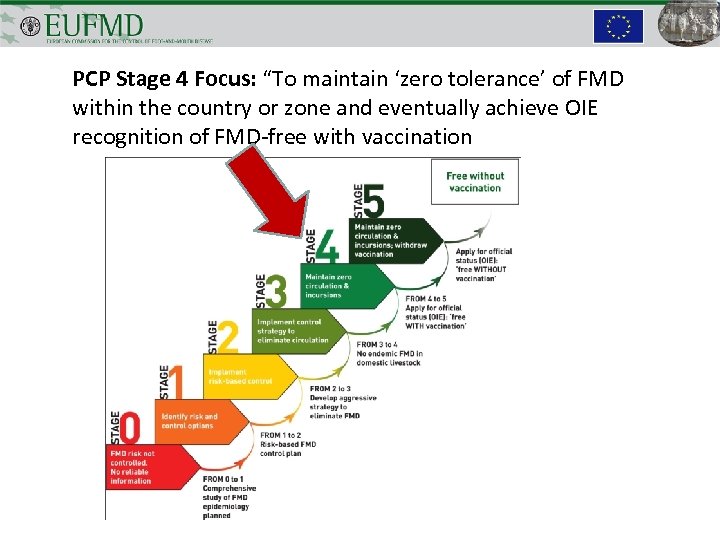 PCP Stage 4 Focus: “To maintain ‘zero tolerance’ of FMD within the country or zone and eventually achieve OIE recognition of FMD-free with vaccination
 Basis for Eu. FMD actions in East and Southern Mediterranean • To reduce threat to EUFMD member states – Includes pre-emptive support to achieve early warning • Bordering to Eu. FMD MS: – MS request action to reduce risk across land borders – Basis for recent assistance to Syria, Lebanon, Jordan, Egypt • Southern Med: – The threat to Eu. FMD MS is across the sea – Eu. FMD can respond to direct calls from countries for assistence (rare) – Or via REMESA, FAO or OIE offices – Or in response to SANCO or Eu. FMD MS request to act • All actions subject to Executive Ctte, and SANCO (if EC Trust Fund request)
 Eu. FMD Actions in East or Southern Mediterranean neighbourhood (2009 -) • Syria: – support to FMD surveillance (2008 -9), towards meeting PCP Stage 3 (issues!) • Lebanon: – emergency vaccination (2009, type A; EC donation) and surveillance or FMD (sero-survey) • Egypt: – FAO Emergency TCP followed by 150, 000 US$ EC/Eu. FMD (2010 -11) towards completing PCP Stage 1 (surveillance/diagnostic lab support). • Tunisia: – diagnostic kits provided for sero-surveys on Libyan border (May 2011). Offer via FAO to support further “proof of FMD risk” surveillance (30 k) not yet taken up • Training: – Real-Time Training in FMD response (Eu. FMD/EC program Phase I) • 1 -2 vets trained from Morocco (1), Algeria (2), Tunisia (1). • Three vets trained from each EU MS in same period
 Egypt and PCP stage 1 • TCP 1 (2009) concluded that Egypt had entered PCP stage 1 – National study planned (TCP 2) • TCP 2 (2010 -2011): For PCP stage 1, a number of steps are not yet completed: – Active monitoring of virus circulation: • Underreporting of FMD outbreaks – Understanding the epidemiology • Serosurveillance may reveal risk factors for FMD infection, however riskpoints with major husbandry / marketing chains are not yet identified – Targeting of measures – risk-based control • Need for developing an integrated FMD control strategy, focusing on the critical risk points • This requires establishing of a FMD task force to design the control strategy and organise its implementation
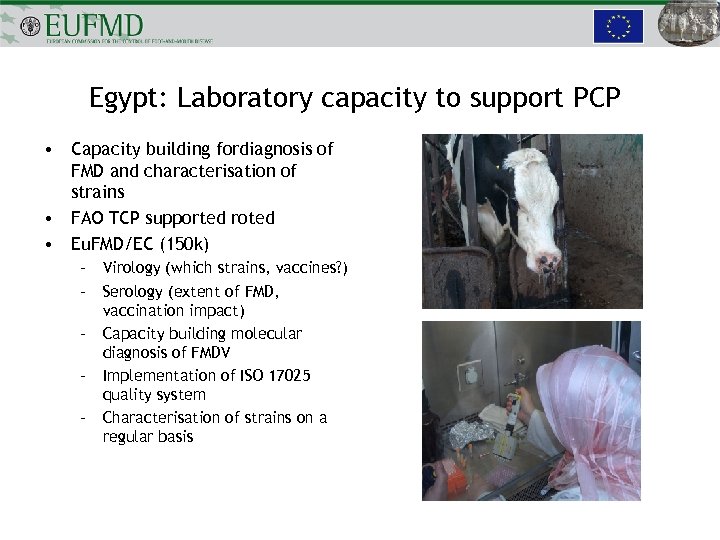 Egypt: Laboratory capacity to support PCP • Capacity building fordiagnosis of FMD and characterisation of strains • FAO TCP supported roted • Eu. FMD/EC (150 k) – Virology (which strains, vaccines? ) – Serology (extent of FMD, vaccination impact) – Capacity building molecular diagnosis of FMDV – Implementation of ISO 17025 quality system – Characterisation of strains on a regular basis
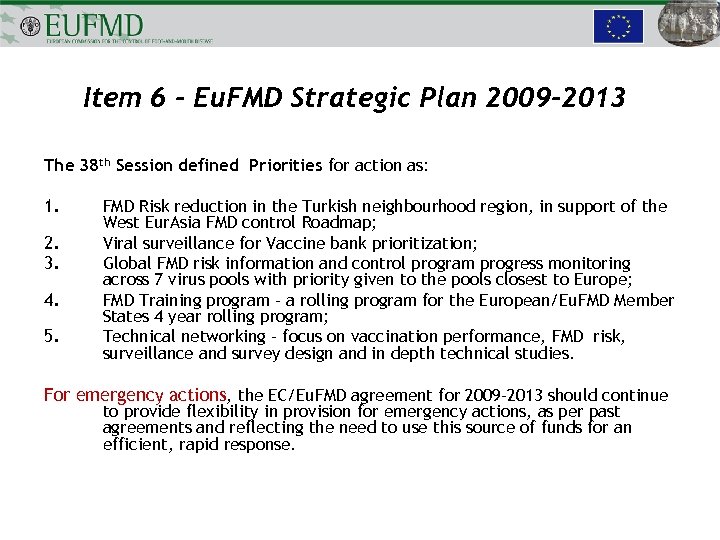 Item 6 - Eu. FMD Strategic Plan 2009 -2013 The 38 th Session defined Priorities for action as: 1. 2. 3. 4. 5. FMD Risk reduction in the Turkish neighbourhood region, in support of the West Eur. Asia FMD control Roadmap; Viral surveillance for Vaccine bank prioritization; Global FMD risk information and control program progress monitoring across 7 virus pools with priority given to the pools closest to Europe; FMD Training program – a rolling program for the European/Eu. FMD Member States 4 year rolling program; Technical networking – focus on vaccination performance, FMD risk, surveillance and survey design and in depth technical studies. For emergency actions, the EC/Eu. FMD agreement for 2009 -2013 should continue to provide flexibility in provision for emergency actions, as per past agreements and reflecting the need to use this source of funds for an efficient, rapid response.
 Summary The Action Plan for May 2011 -April 2013 • continue initiated activities that were agreed in the period since May 2009 • initiate new activities following the most recent experience with FMD in South-Eastern Europe. • new priority: FMD MANAGEMENT CAPACITY BUILDING (EUROPEAN COUNTRIES)
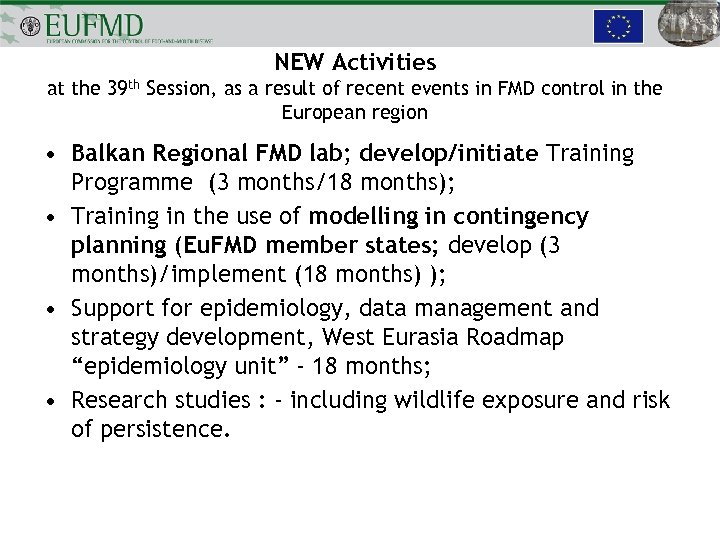 NEW Activities at the 39 th Session, as a result of recent events in FMD control in the European region • Balkan Regional FMD lab; develop/initiate Training Programme (3 months/18 months); • Training in the use of modelling in contingency planning (Eu. FMD member states; develop (3 months)/implement (18 months) ); • Support for epidemiology, data management and strategy development, West Eurasia Roadmap “epidemiology unit” - 18 months; • Research studies : - including wildlife exposure and risk of persistence.
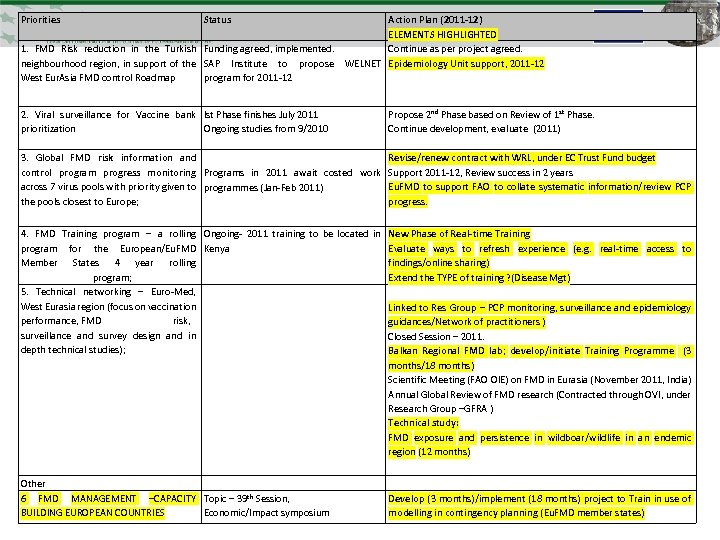 Priorities Status Action Plan (2011 -12) ELEMENTS HIGHLIGHTED 1. FMD Risk reduction in the Turkish Funding agreed, implemented. Continue as per project agreed. neighbourhood region, in support of the SAP Institute to propose WELNET Epidemiology Unit support, 2011 -12 West Eur. Asia FMD control Roadmap program for 2011 -12 2. Viral surveillance for Vaccine bank Ist Phase finishes July 2011 prioritization Ongoing studies from 9/2010 Propose 2 nd Phase based on Review of 1 st Phase. Continue development, evaluate (2011) 3. Global FMD risk information and Revise/renew contract with WRL, under EC Trust Fund budget control program progress monitoring Programs in 2011 await costed work Support 2011 -12, Review success in 2 years across 7 virus pools with priority given to programmes (Jan-Feb 2011) Eu. FMD to support FAO to collate systematic information/review PCP the pools closest to Europe; progress. 4. FMD Training program – a rolling Ongoing- 2011 training to be located in New Phase of Real-time Training program for the European/Eu. FMD Kenya Evaluate ways to refresh experience (e. g. real-time access to Member States 4 year rolling findings/online sharing) program; Extend the TYPE of training ? (Disease Mgt) 5. Technical networking – Euro-Med, West Eurasia region (focus on vaccination Linked to Res Group – PCP monitoring, surveillance and epidemiology performance, FMD risk, guidances/Network of practitioners ) surveillance and survey design and in Closed Session – 2011. depth technical studies); Balkan Regional FMD lab; develop/initiate Training Programme (3 months/18 months) Scientific Meeting (FAO OIE) on FMD in Eurasia (November 2011, India) Annual Global Review of FMD research (Contracted through OVI, under Research Group –GFRA ) Technical study: FMD exposure and persistence in wildboar/wildlife in an endemic region (12 months) Other 6 FMD MANAGEMENT –CAPACITY Topic – 39 th Session, BUILDING EUROPEAN COUNTRIES Economic/Impact symposium Develop (3 months)/implement (18 months) project to Train in use of modelling in contingency planning (Eu. FMD member states)
 Budgetary implications and implementing mechanisms • Estimated additional costs (2 years): 1. 6 million USD • Funds available within EC TF (4 year agreement, 8 m€) : utilisation subject to SANCO agreement on workplan • Funding for additional actions (e. g Med neighbours) – Unallocated funds (reserve) in the 8 m€ budget – Use subject to SANCO
 Outlook: Mediterranean neighbourhood • • high risk periods upcoming: festivals and winter Impacts of political change: on preventive programs, on detection and emergency response Eastern: • • Egypt: – – Phase 2 of Eu. FMD/EC program needed (2012: Phase I affected by revolution) Syria/Lebanon/Jordan/PAT: – FMD situation uncertain (winter high risk period); Southern: • Libya: – • • FMD situation? Revised national strategy/program support? Tunisia: – requests made to FAO for support, revision given changed situation? ; Algeria/Morocco; – stabilisation in region may allow return to schedule to gain official recognised freedom ?
 Institutional Actions Suggested • PCP Stage Re-assessments: – Eastern and Southern Mediterranean – FAO/OIE Joint Workshop with Senior VS of each country – Towards a framework for national and regional activities • Contract for International FMD Reference Laboratory Services (WRL Pirbright) – – Stressed! > 600 samples per year from neighboring regions Revised contract addressing current Europe/Regional needs Responding to strain on national budgets Service essential to support Europe and neighborhood
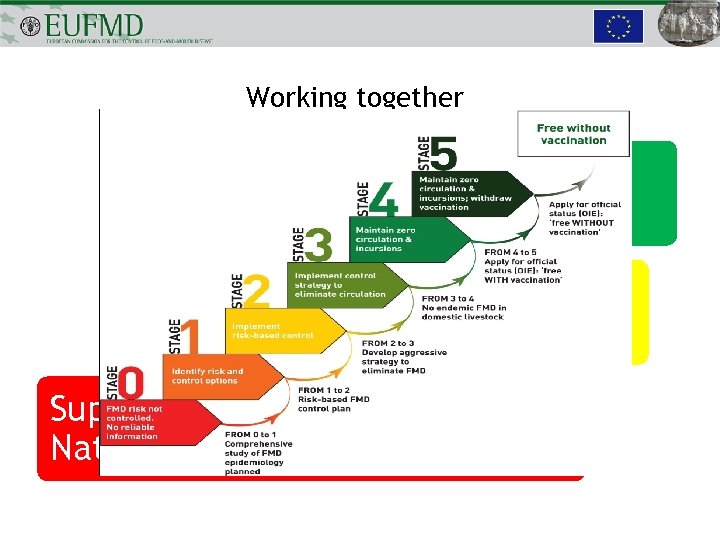 Working together Global Progress As part of Regional Long Term Roadmaps Supporting sustainable National Strategies
 Acknowledgements EUFMD Commission member states CVOs of West Eurasian countries EC (DG-SANCO –Trust Fund; Alf Füssel) FAO (J. Domenech, J. Lubroth, G Ferrari, J Pinto) OIE (G. Bruckner, J Domenech) FAO World Reference Laboratory (WRL) Pirbright (D Paton, Jef Hammond) Supporting centres: EUFMD Secretariat staff (Nadia Rumich) RAHCs in Beirut, Tunis, FAO Ankara and Cairo