


 Скачать презентацию One Sky Center R Dale Walker MD Director
43465f8a182c2f36f0b0ae256e8a5119.ppt
- Количество слайдов: 25
 One Sky Center R. Dale Walker, MD, Director Michelle Singer, Communications Coordinator, ICMI Project Director Doug Bigelow, Ph. D, Deputy Director MEETING THE EVIDENCE-BASED STANDARD
 “THE LEARNING HEALTHCARE SYSTEM”
 OUTLINE q Evidence-Based vs Culture-Based Dilemma q What is “Evidence”? q Multiple Streams of Evidence q The Learning Healthcare System q Description: A Scientific Framework q Some Culture-Based Interventions
 EBI – CBI DILEMMA § Epistemological gulf § § § Epistemological debate § § § Western Traditional AI/AN Validity of traditional world view Freedom to live by a traditional world view Practical debate § Controlling by purse strings
 BRIDGING EBI – CBI § Bridging § § Evidence is? Status of evidence for EBI How to meet reasonable standards of evidence Practice Improvement § § Multiple Streams of Evidence Learning Healthcare System http: //coce. samhsa. gov/cod_resources/PDF/OP 5 -Practices-8 -13 -07. pdf http: //www. iom. edu/CMS/28312/RT-EBM/41894. aspx
 SOURCES OF EVIDENCE 1. Intervention/program research § § § Ø Ø Ø Randomized Controlled Trials (RCT) Nonrandomized, uncontrolled Evaluation Adaptation of Proven Intervention Like a Proven Intervention Basis in Proven Theory, Principles, Facts
 EVIDENCE-BASED INTERVENTIONS PROCESS AND CRITERIA § Criteria: § § § Fidelity Internal Validity (vs confounding variables) External validity Reliability—repeatability. Process: § § § Scientific experts Independent judging and rating Compilation and Summary
 NATURE OF BEHAVIORAL INTERVENTION Ø Therapeutic power of Choice Ø Self-healing guided by expert healers Ø Uniqueness of interpersonal relationships Ø Complexity of factors
 STATUS OF “EVIDENCE” IN EBI 1. Individual studies 2. Reviewed collections 3. Lists of model, best, promising, alternative 4. Survivors of meta-analyses
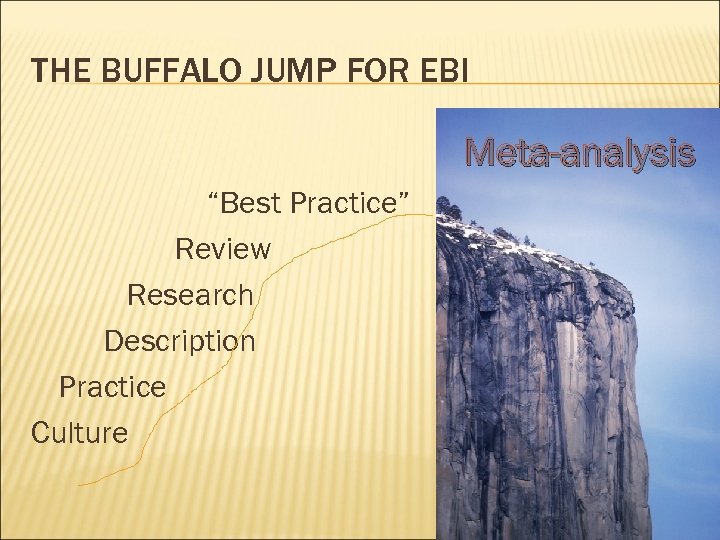 THE BUFFALO JUMP FOR EBI Meta-analysis “Best Practice” Review Research Description Practice Culture
 REASONABLE STANDARDS OF EVIDENCE FOR IMPROVED PRACTICES § § § “Best Practices” = highest scientific standards Balance point Reasonable standards are: § § Repeatability Achievable within resources and constraints Allow conclusions without intolerable doubt Low risk of harm, if conclusions are wrong
 ADAPTATION-ADOPTION Adoption requires buy-in Acceptance Ø Implementation Ø
 ADAPTATION-ADOPTION Adaptation to unique local culture and context Players Ø Rules, expectations, traditions Ø Resources/collaborations Ø Opportunity to contribute to strategic plan Ø
 ADAPTATION-ADOPTION § MI, CBT, SFP, Project Venture, Canoe Journey implementations Ø § are unique in every setting Every replication is an Adaptation
 EBI OUT OF THE BOX § The EBI idea is changing Ø SAMHSA: “multiple streams of evidence” Ø IOM: “Learning Healthcare System”
 OTHER SOURCES OF EVIDENCE § Intervention/program RTC; Evaluation 1. Adaptation of Proven Intervention 2. Analogous to a Proven Intervention 3. Basis in Proven Theory, Principles, Facts
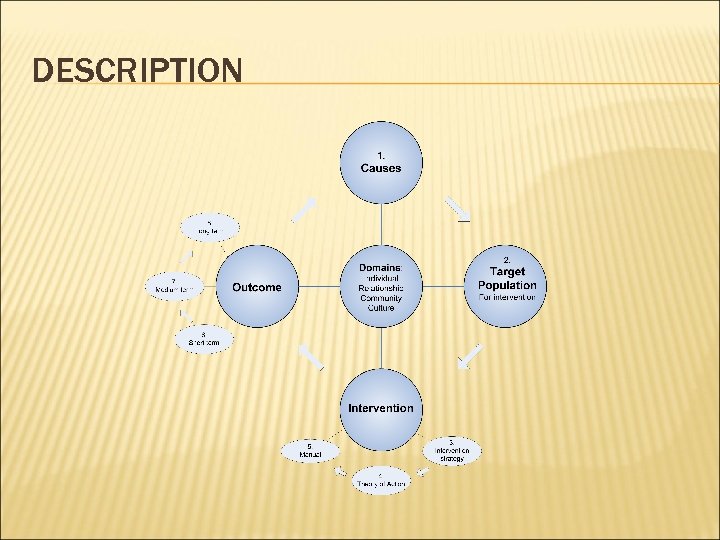 DESCRIPTION
 IMPORTANCE OF PROGRAM MANUALS § “Operationalization” a way of knowing/believing § From black box to detail § Consistency with body of knowledge § Who, what, when, where, how, decisions Repeatability §
 PROVEN THEORY, PRINCIPLES & FACTS § § Social ecology (influences) Prevention § § § Universal/ selected/ indicated Risk and Resilience Readiness to Change Risk taking/seeking Stress vulnerability § § § § Modeling (observational learning) Instrumental learning Group dynamics Conformity, altruism Listening and support Catharsis Psychopharmacology
 KINDS OF INTERVENTION STRATEGY • • • Screening • Gatekeeping • Diagnosis • Treatment • Traditional healing • Traditional ritual/ceremony • Postvention • Parent/family training • Group work • • School/institution-based Education/skills Experiential Socialization/acculturation Public Health (risk/resilience) Services develop/coord L E/justice/corrections Community competency Community change Culture
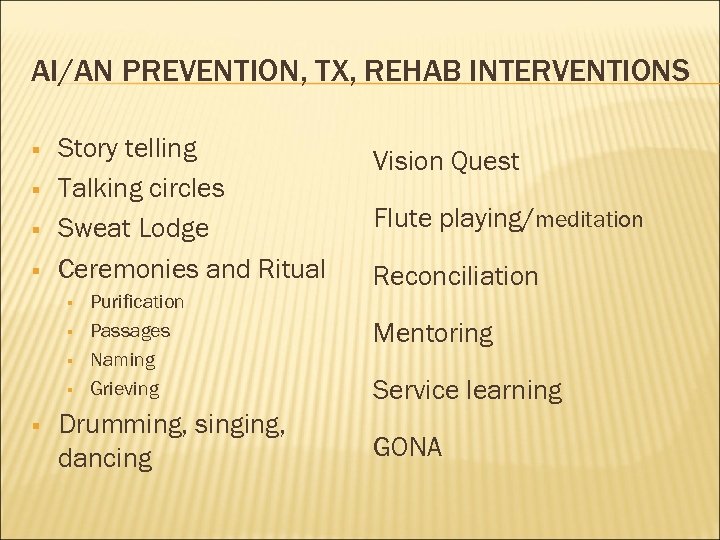 AI/AN PREVENTION, TX, REHAB INTERVENTIONS § § Story telling Talking circles Sweat Lodge Ceremonies and Ritual § § § Purification Passages Naming Grieving Drumming, singing, dancing Vision Quest Flute playing/meditation Reconciliation Mentoring Service learning GONA
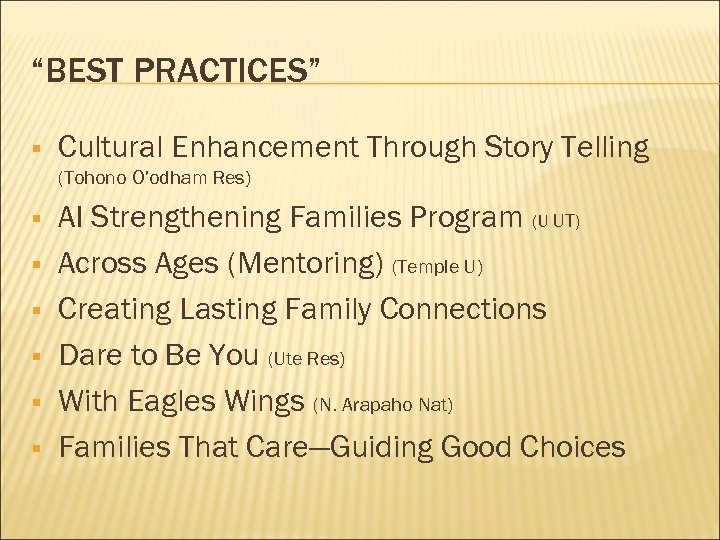 “BEST PRACTICES” § Cultural Enhancement Through Story Telling (Tohono O’odham Res) § § § AI Strengthening Families Program (U UT) Across Ages (Mentoring) (Temple U) Creating Lasting Family Connections Dare to Be You (Ute Res) With Eagles Wings (N. Arapaho Nat) Families That Care—Guiding Good Choices
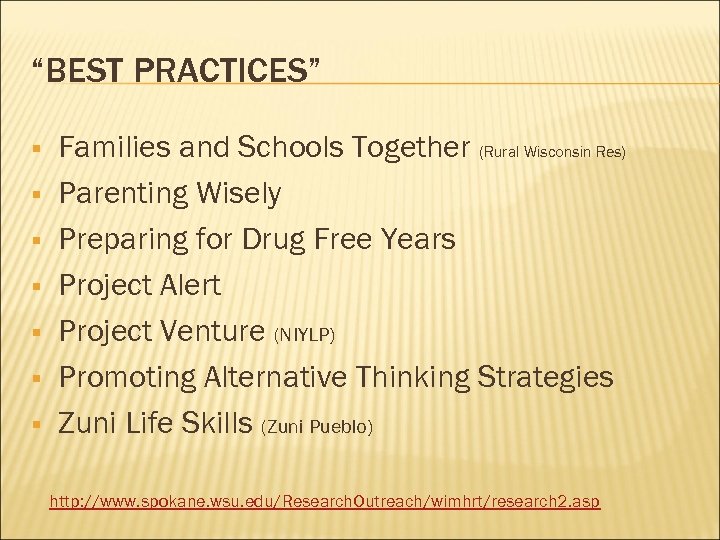 “BEST PRACTICES” § § § § Families and Schools Together (Rural Wisconsin Res) Parenting Wisely Preparing for Drug Free Years Project Alert Project Venture (NIYLP) Promoting Alternative Thinking Strategies Zuni Life Skills (Zuni Pueblo) http: //www. spokane. wsu. edu/Research. Outreach/wimhrt/research 2. asp
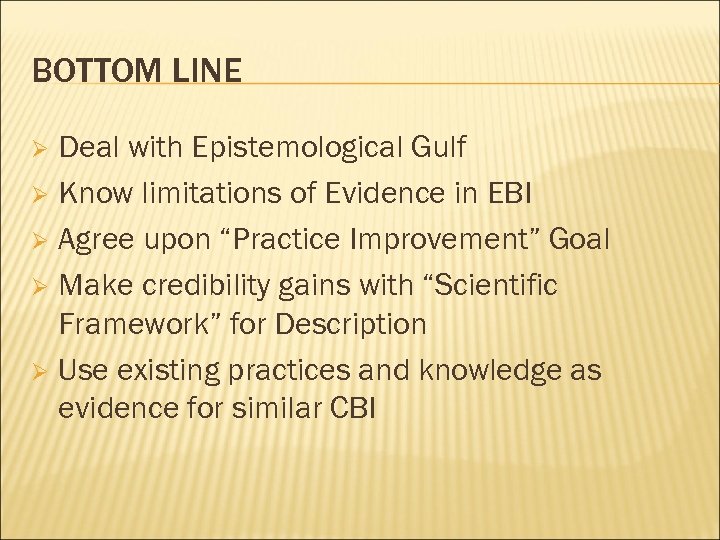 BOTTOM LINE Deal with Epistemological Gulf Ø Know limitations of Evidence in EBI Ø Agree upon “Practice Improvement” Goal Ø Make credibility gains with “Scientific Framework” for Description Ø Use existing practices and knowledge as evidence for similar CBI Ø
 Feel Free To Contact Us At: One Sky Center (o) 503 -494 -3703 onesky@ohsu. edu www. oneskycenter. org