


 Скачать презентацию One Economics Many Recipes Dani Rodrik IEA June
e98f3a42410a1b5945002a2d7da305ca.ppt
- Количество слайдов: 28
 One Economics, Many Recipes Dani Rodrik IEA, June 2008
 The new thinking on growth strategies (1) u Presumptive strategies – – ISI Washington Consensus Big Push Governance agenda u Long laundry list of reforms u Focus on complementarity of reforms rather than prioritization or sequencing A bias towards universal recipes, “best-practices, ” and rules of thumb u – In a wide range of areas: trade, fiscal, social, legal, regulatory, etc.
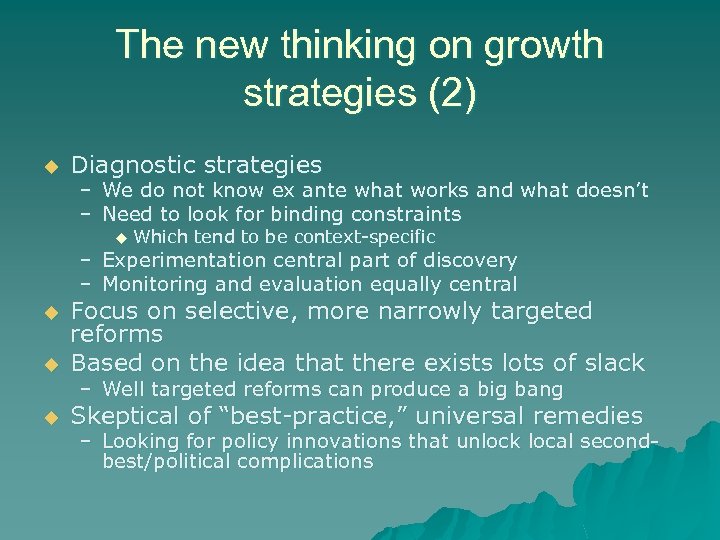 The new thinking on growth strategies (2) u Diagnostic strategies – We do not know ex ante what works and what doesn’t – Need to look for binding constraints u Which tend to be context-specific – Experimentation central part of discovery – Monitoring and evaluation equally central u Focus on selective, more narrowly targeted reforms Based on the idea that there exists lots of slack u Skeptical of “best-practice, ” universal remedies u – Well targeted reforms can produce a big bang – Looking for policy innovations that unlock local secondbest/political complications
 The Litmus test u Do you believe there is an unconditional and unambiguous mapping from specific policies to economic outcomes? – If yes, you are in the presumptive camp – If no, you must rely on the diagnostic strategy
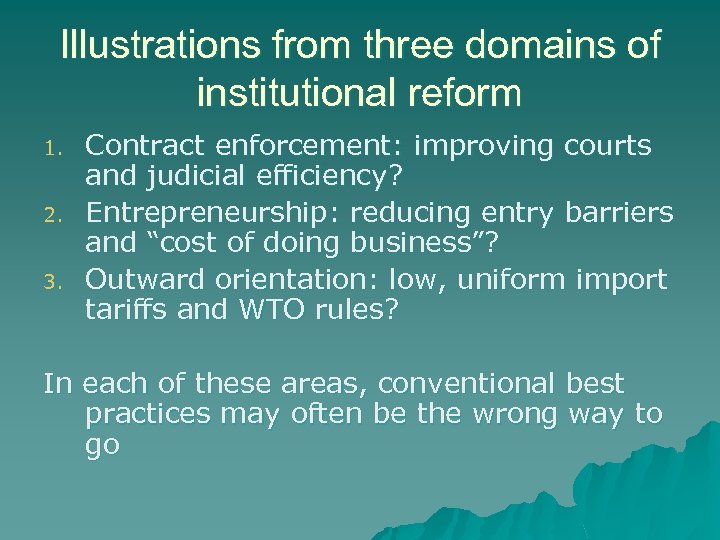 Illustrations from three domains of institutional reform 1. 2. 3. Contract enforcement: improving courts and judicial efficiency? Entrepreneurship: reducing entry barriers and “cost of doing business”? Outward orientation: low, uniform import tariffs and WTO rules? In each of these areas, conventional best practices may often be the wrong way to go
 An African story (1) Courts are inefficient, costly to use, and potentially corruptible u Firms rarely resort to them u They rely on relational contracting instead: u – long-term, trust-based relationships with suppliers and customers – screen potential business partners by gathering information – inspect goods on delivery prior to payment – frequently renegotiate when contract terms are not fulfilled
 An African illustration (2) Source: Bigsten et al. (1999)
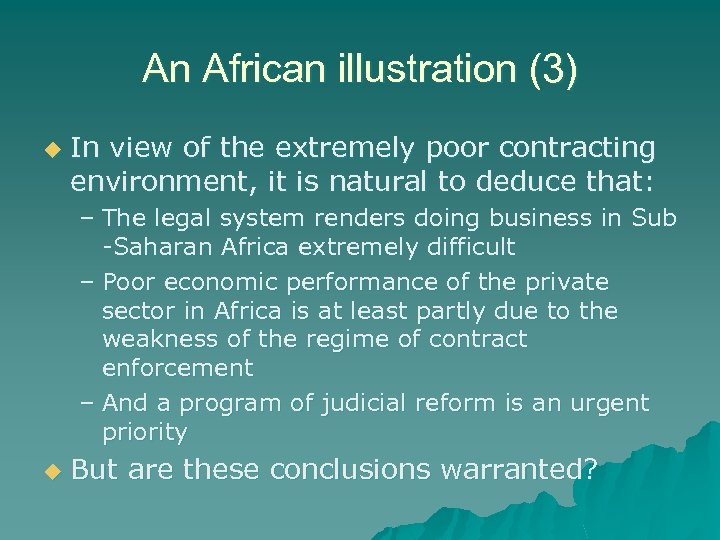 An African illustration (3) u In view of the extremely poor contracting environment, it is natural to deduce that: – The legal system renders doing business in Sub -Saharan Africa extremely difficult – Poor economic performance of the private sector in Africa is at least partly due to the weakness of the regime of contract enforcement – And a program of judicial reform is an urgent priority u But are these conclusions warranted?
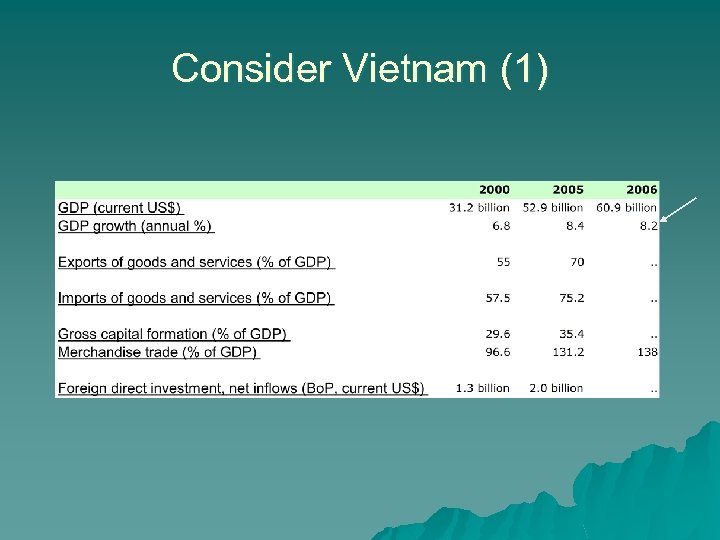 Consider Vietnam (1)
 Consider Vietnam (2) “The managers we interviewed said they did not believe the courts can help them. "They normally just create more problems. . . in Vietnam no one believes we have a good legal system“ … Another said, "The court is weak and no entrepreneurs use it" … These comments are corroborated by answers to our questionnaire about how disputes are managed. Responding to a question about third parties that can enforce agreements with customers or suppliers, 89% of managers said, "there is no one. " Only 9% said a court or other government agency could help. Third parties are even less help for disputes over the quality of goods; only 2% of the managers said they would take such disputes to court or appeal to local authorities. ” Source: Mc. Millan and Woodruff (1999)
 How firms solve contracting problems in Vietnam u “To compensate for the inadequacy of the courts, the firms use repeated-game incentives. Contracting is supported by the threat of loss of future business. Interestingly … the managers told us they are reluctant to sanction trading partners. If a customer reneges on a debt they often allow payment to be delayed and forgive part of the debt. As a result the retaliation is not as immediate or predictable as in the simple repeated-game story and therefore not as effective a sanction. To ensure compliance, the firms rely on other devices that supplement the shadow of the future… We find that more elaborate governance structures are used in transactions with a greater risk of reneging. Also, firms sometimes scrutinize prospective trading partners before beginning to transact, checking the firms’ reliability via other firms in the same line of business or familial connections. ” u In other words, they use exactly the same relational contracting strategies as firms in Africa
 Even in the absence of courts, relational contracting can support high levels of economic activity u Sort of like traffic in Hanoi… http: //www. youtube. com/watch? v=e. C 4 BN 9 k. In. Xg
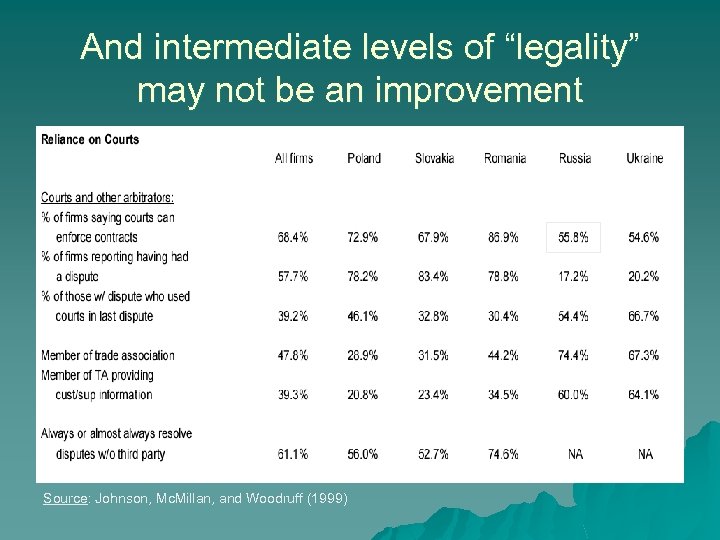 And intermediate levels of “legality” may not be an improvement Source: Johnson, Mc. Millan, and Woodruff (1999)
 A little bit of improvement in the judiciary can make things worse u Sort of like traffic in St. Petersburg… http: //www. youtube. com/watch? v=H 2 JFL 1 Sk 21 Y
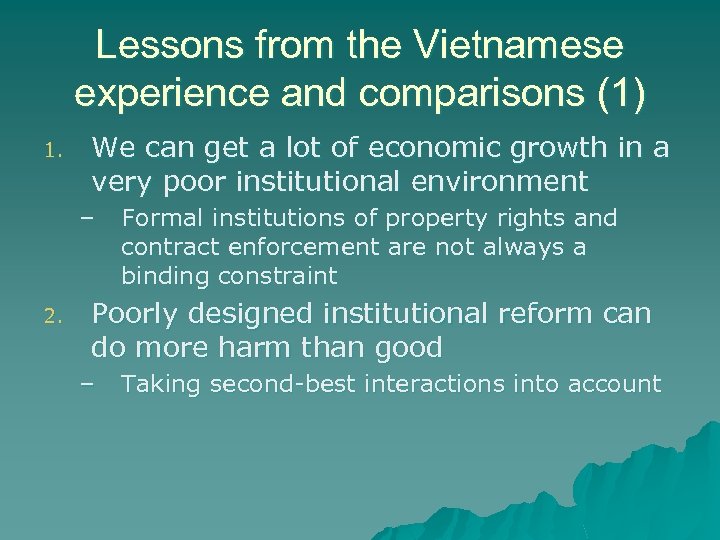 Lessons from the Vietnamese experience and comparisons (1) 1. We can get a lot of economic growth in a very poor institutional environment – 2. Formal institutions of property rights and contract enforcement are not always a binding constraint Poorly designed institutional reform can do more harm than good – Taking second-best interactions into account
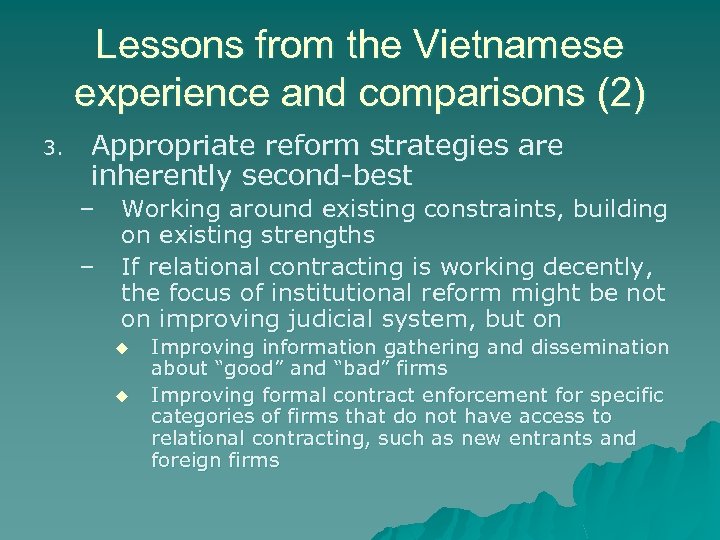 Lessons from the Vietnamese experience and comparisons (2) 3. Appropriate reform strategies are inherently second-best – – Working around existing constraints, building on existing strengths If relational contracting is working decently, the focus of institutional reform might be not on improving judicial system, but on u u Improving information gathering and dissemination about “good” and “bad” firms Improving formal contract enforcement for specific categories of firms that do not have access to relational contracting, such as new entrants and foreign firms
 Example 2: Entry regulation and entrepreneurship (1) u u Entry regulations and barriers reduce competition and generate rents Is this good or bad for entrepreneurship? World Bank’s Doing Business Surveys based on the presumption that entry regulations are an unmitigated bad Implied strategy of institutional reform: focus on reducing the regulatory cost of entry – Reduce licensing requirements and costs, streamline procedures, speed up bureaucratic processes – Presumably even if this entails some costs in terms of background checks, enforcements of regulations and standards, and accuracy of tax registers.
 Example 2: Entry regulation and entrepreneurship (2) Maintained hypothesis: entry barriers are the binding constraint on entrepreneurship u But entrepreneurship can also be constrained by other factors u – High costs of contracting environment – Low private returns – Low level of public inputs u When problem lies with low returns, the presence of rents can play a useful role
 Example 2: Entry regulation and entrepreneurship (3) u Models where rents are required to stimulate private investment and entrepreneurship: – Hausmann and Rodrik (2003): rents as returns to cost discovery – Hellman, Murdock, and Stiglitz (1997): franchise value for banks as an incentive device for monitoring borrowers – Acemoglu, Aghion, and Zilibotti (2006): rent-sustained long-term relationship to sustain high investment early in the development process u u In all these models, there are second-best reasons why maximizing free entry is not optimal Minimizing bureaucratic hurdles may not be optimal when other types of constraints bind as well—e. g. , accuracy of tax registers and fiscal constraints
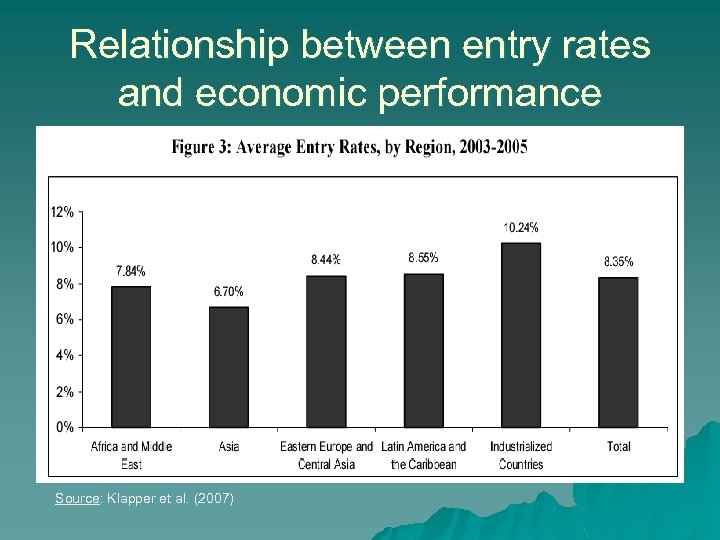 Relationship between entry rates and economic performance Source: Klapper et al. (2007)
 Example 3: Outward orientation (1) Best practice: low and uniform tariffs, no QRs, and WTO membership u With few exceptions, successful globalizers have pursued different strategies u – South Korea and Taiwan: export subsidies – China: SEZs – SE Asia and Mauritius: EPZs – In all cases, discretionary tariff and QR regimes, non-compliance with WTO rules on TRIMS and local-content regulations
 Example 3: Outward orientation (2) u u u What is the advantage of these alternative strategies? They generate export-oriented incentives at the margin while keeping protection in place for preexisting formal-sector activities With the benefit of – Managing employment in the transition – Managing political economy u u The Latin American pattern as the counterfactual The lesson: a given economic objective—outward orientation—can be achieved through different institutional designs, and sometimes it is worth doing things in an unorthodox, round-about way if this serves to relax other constraints elsewhere in the system.
 Bottom line: “good” institutions serve similar functions… All successful countries u provide effective property rights protection and contract enforcement u maintain macroeconomic stability u integrate in the world economy u ensure an appropriate environment for productive diversification and innovation u provide effective prudential regulation of financial intermediaries u maintain social cohesion and political stability u …
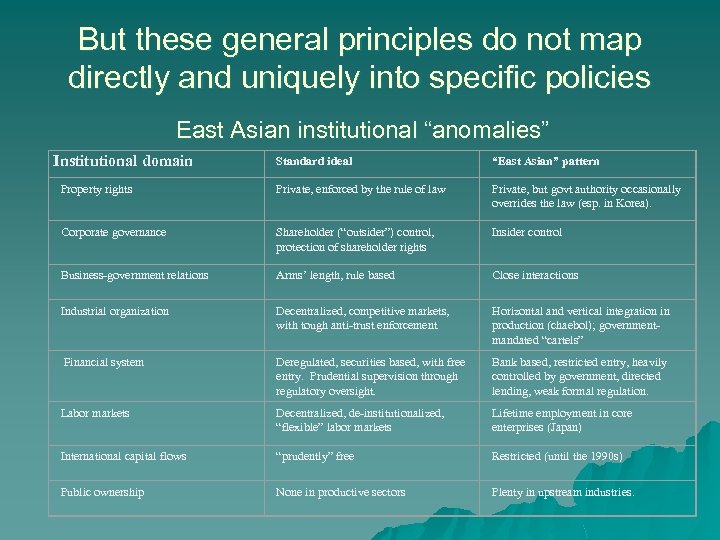 But these general principles do not map directly and uniquely into specific policies East Asian institutional “anomalies” Institutional domain Standard ideal “East Asian” pattern Property rights Private, enforced by the rule of law Corporate governance Shareholder (“outsider”) control, protection of shareholder rights Arms’ length, rule based Private, but govt authority occasionally overrides the law (esp. in Korea). Insider control Business-government relations Industrial organization Decentralized, competitive markets, with tough anti-trust enforcement Financial system Deregulated, securities based, with free entry. Prudential supervision through regulatory oversight. Labor markets Decentralized, de-institutionalized, “flexible” labor markets International capital flows “prudently” free Public ownership None in productive sectors Close interactions Horizontal and vertical integration in production (chaebol); governmentmandated “cartels” Bank based, restricted entry, heavily controlled by government, directed lending, weak formal regulation. Lifetime employment in core enterprises (Japan) Restricted (until the 1990 s) Plenty in upstream industries.
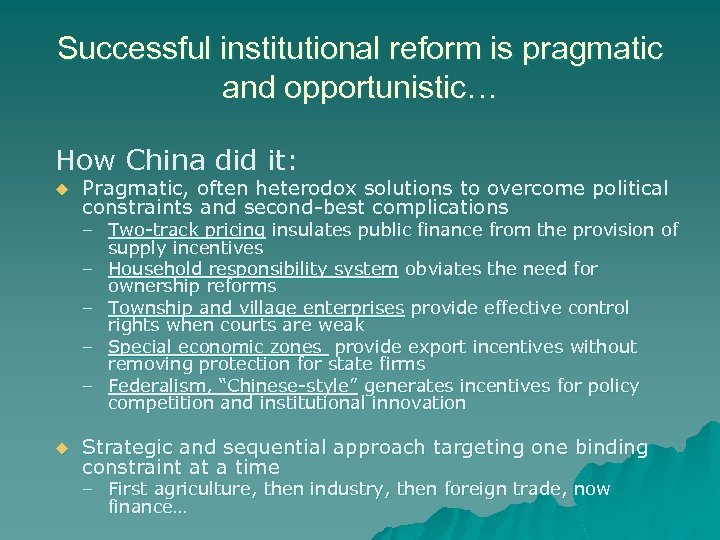 Successful institutional reform is pragmatic and opportunistic… How China did it: u Pragmatic, often heterodox solutions to overcome political constraints and second-best complications – Two-track pricing insulates public finance from the provision of supply incentives – Household responsibility system obviates the need for ownership reforms – Township and village enterprises provide effective control rights when courts are weak – Special economic zones provide export incentives without removing protection for state firms – Federalism, “Chinese-style” generates incentives for policy competition and institutional innovation u Strategic and sequential approach targeting one binding constraint at a time – First agriculture, then industry, then foreign trade, now finance…
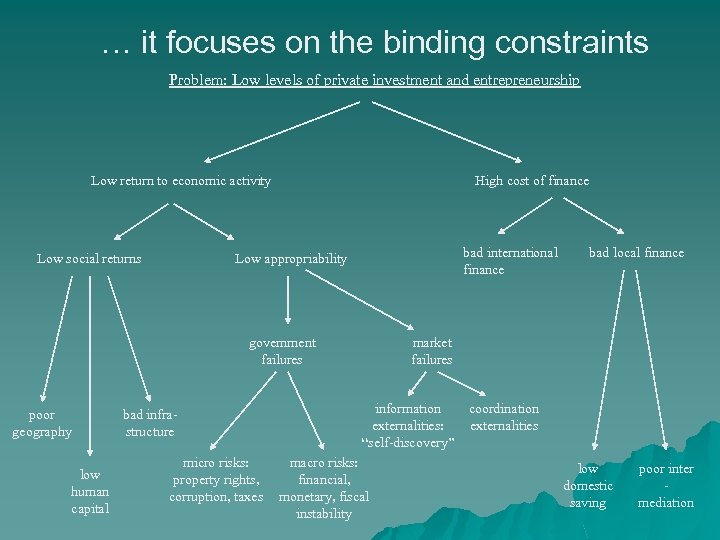 … it focuses on the binding constraints Problem: Low levels of private investment and entrepreneurship Low return to economic activity Low social returns High cost of finance bad international finance Low appropriability government failures poor geography low human capital bad infrastructure micro risks: property rights, corruption, taxes bad local finance market failures information externalities: “self-discovery” macro risks: financial, monetary, fiscal instability coordination externalities low domestic saving poor inter mediation
 And it does not disregard historical legacies Historical and geographic determinants of institutions u Demand-side explanations: institutions are created by those who stand to benefit from them – Colonial origins (Acemoglu, Johnson, Robinson 2001) u Glaeser et al. (2004) critique u u Type of agriculture: small-holding versus plantation (Engerman and Sokoloff 2002) Size of educated middle class (Rajan and Zingales 2006) u Benign theories u Malign theories – Initial factor endowments – Expanding international economic integration u – Trade and capital flows increase demand for “good” institutions – Increased trade strengthens “regressive” elites (Latin America, U. S. South) Supply-side explanations – Imposition by foreign powers u East Germany, North Korea, Japan(? ), . . u “law and development” school u Chinese example – Adoption of imported legal norms and rules – Institutional innovation and experimentation
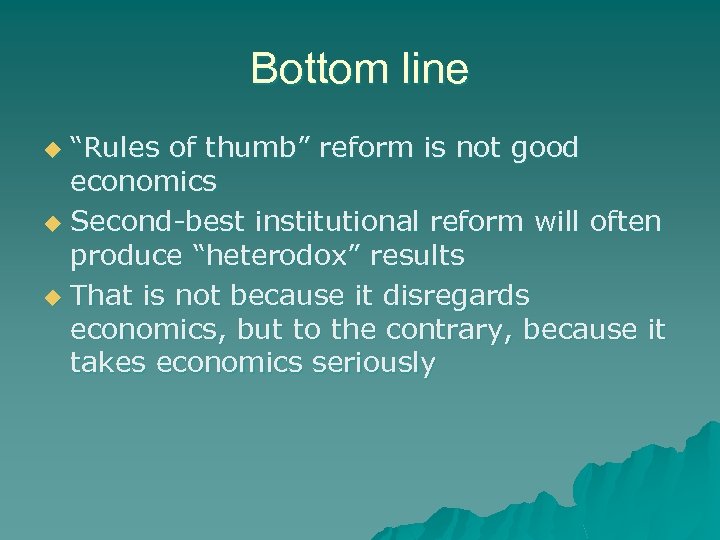 Bottom line “Rules of thumb” reform is not good economics u Second-best institutional reform will often produce “heterodox” results u That is not because it disregards economics, but to the contrary, because it takes economics seriously u