 Скачать презентацию Oncology Reimbursement Past Present and Future Association of
62e0ccbd7b27a097c3ad67d8f88e4f32.ppt
- Количество слайдов: 60




Oncology Reimbursement Past, Present and Future Association of Northern California Oncologists Medical Oncology Association of Southern California
Welcome & Introduction Peter Paul Yu, MD ANCO President Steven Tucker, MD MOASC President
Forthcoming ANCO Events • ANCO Audio Conference: Managed Care Contracting in an ASP World Wednesday, July 13 th, 12 PM • ANCO 2005 Annual Meeting Tenaya Lodge at Yosemite October 14 -16 th
Acknowledgment of Support Sponsors AMGEN • APP/Abraxis Oncology Bayer Oncology/Onyx Pharmaceuticals • Berlex Laboratories Genentech Bio. Oncology International Oncology Network/Oncology Supply • MGI Pharma Millennium • Novartis Oncology Therapeutics Network/Onmark Exhibtors Astra. Zeneca • biogen. IDEC • Bristol-Myers Squibb Oncology Celgene • Enzon Pharmaceuticals • Lilly Oncology National Oncology Alliance Ortho. Biotech/Tibotec Therapeutics • OSI Pharmaceuticals Pfizer Oncology • Sanofi Aventis Oncology Schering-Plough Oncology • US Oncology
Oncology Reimbursement Past, Present and Future Dean Gesme MD FACPE Past Chair, ASCO Clinical Practice Committee Past Chair, National Coalition for Cancer Survivorship Managing Partner, Iowa Cancer Care

Eleanor Roosevelt Do something every day that scares you!
Ground Rules All Theories are wrong but some are useful.
Doctors are men who prescribe medicine of which they know little, to cure diseases of which they know less, to human being of which they know nothing. Voltaire 1694 -1778

What Health Professionals and Patients Want Quality Care
What Payers Want Cost Control
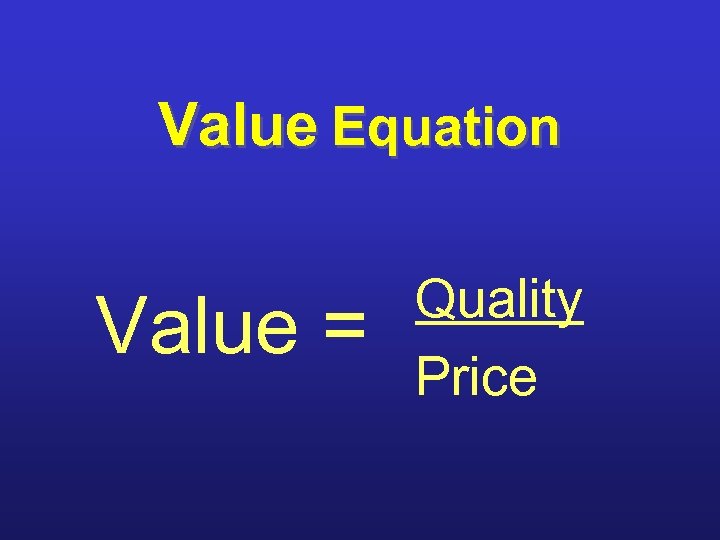
Value Equation Value = Quality Price
Everywhere the old order changes, and happy are those who can change with it Sir William Osler
System Change Transactional l. Transformational l
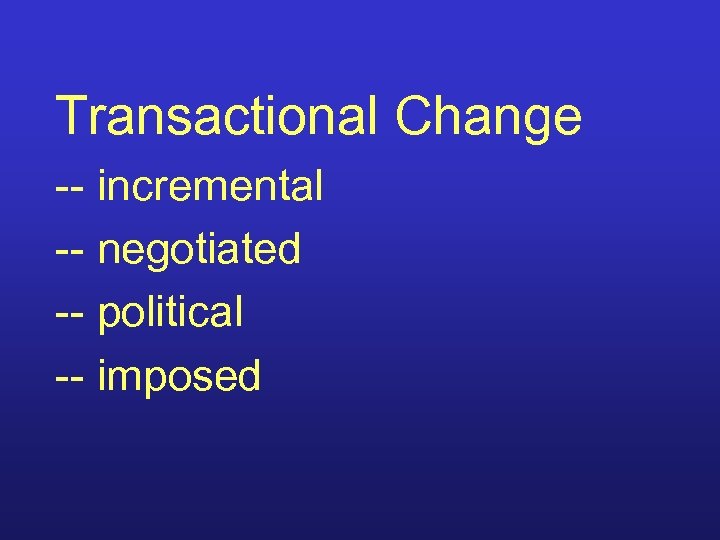
Transactional Change -- incremental -- negotiated -- political -- imposed
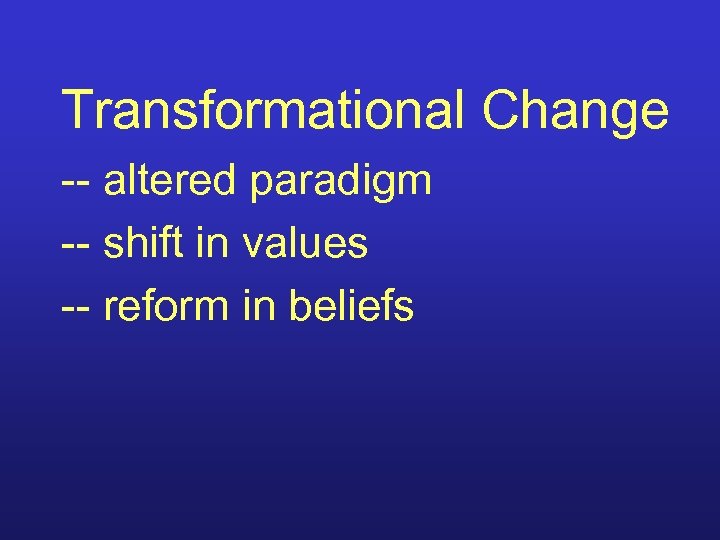
Transformational Change -- altered paradigm -- shift in values -- reform in beliefs
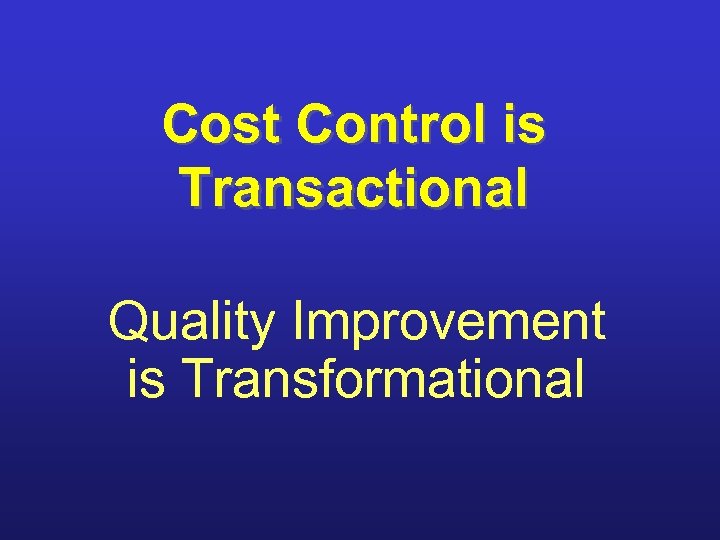
Cost Control is Transactional Quality Improvement is Transformational
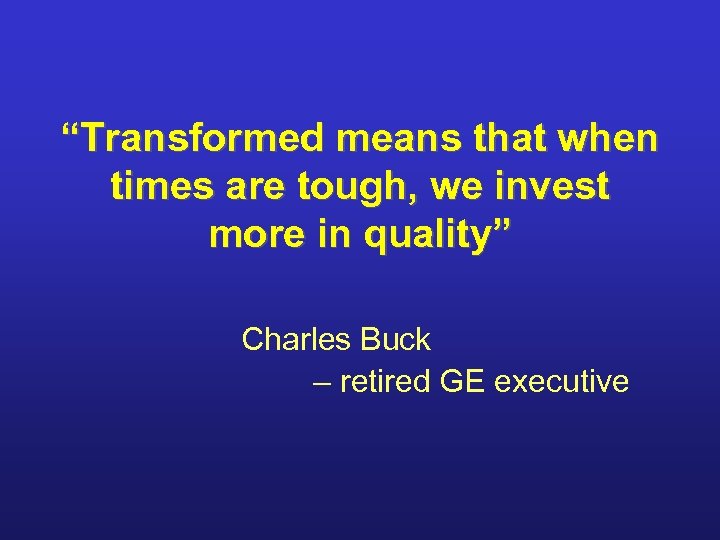
“Transformed means that when times are tough, we invest more in quality” Charles Buck – retired GE executive
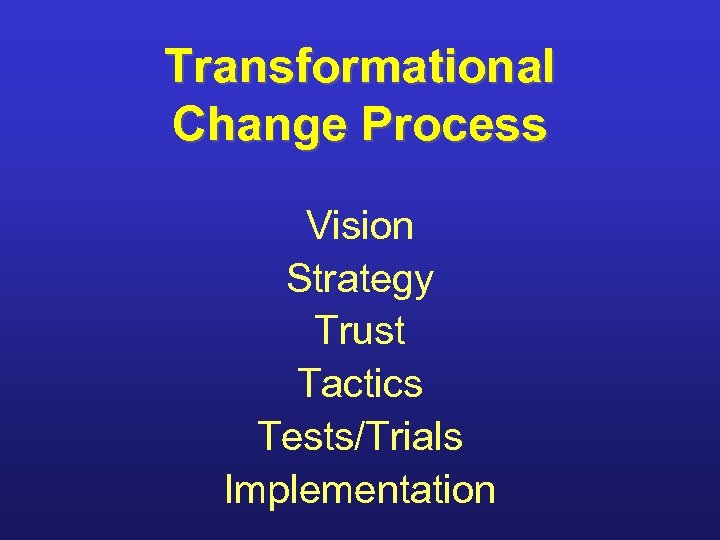
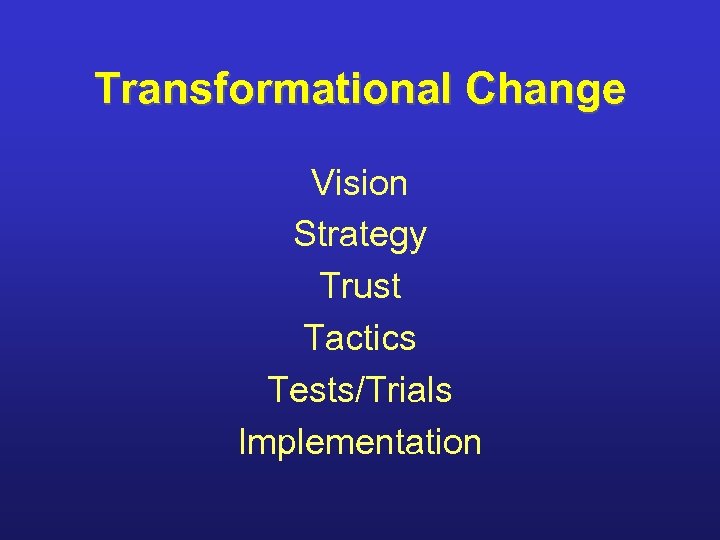
Transformational Change Process Vision Strategy Trust Tactics Tests/Trials Implementation
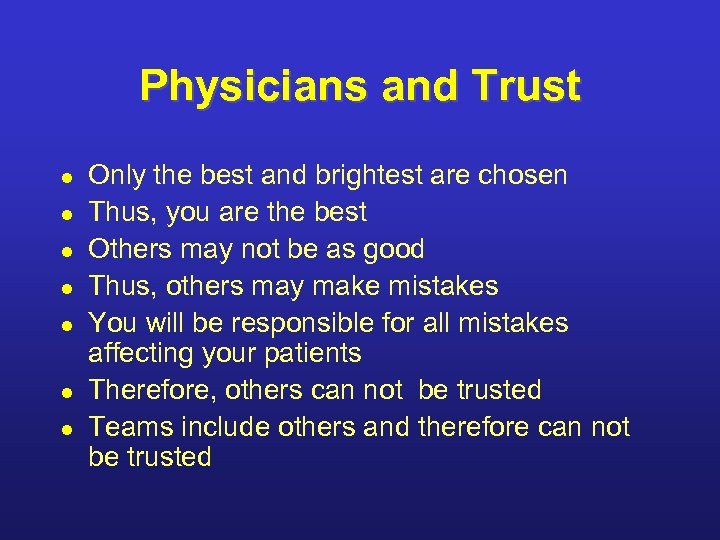
Physicians and Trust l l l l Only the best and brightest are chosen Thus, you are the best Others may not be as good Thus, others may make mistakes You will be responsible for all mistakes affecting your patients Therefore, others can not be trusted Teams include others and therefore can not be trusted
Transformational Change Vision Strategy Trust Tactics Tests/Trials Implementation
What We Say We Want Patient-centric care l Pay for Performance l Improved Quality l Improved Outcomes l
What We Will Pay For Process-centric care l Pay for procedures l Piecework mentality l Identical Pay for Best or Worst Care l
All theories are wrong but some are useful
Oncology Reimbursement History l Current Situation l Future Possibilities l
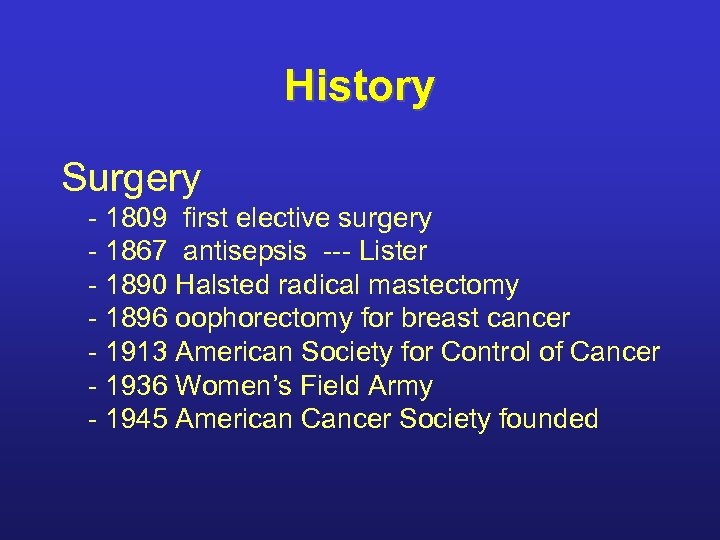
History Surgery - 1809 first elective surgery - 1867 antisepsis --- Lister - 1890 Halsted radical mastectomy - 1896 oophorectomy for breast cancer - 1913 American Society for Control of Cancer - 1936 Women’s Field Army - 1945 American Cancer Society founded
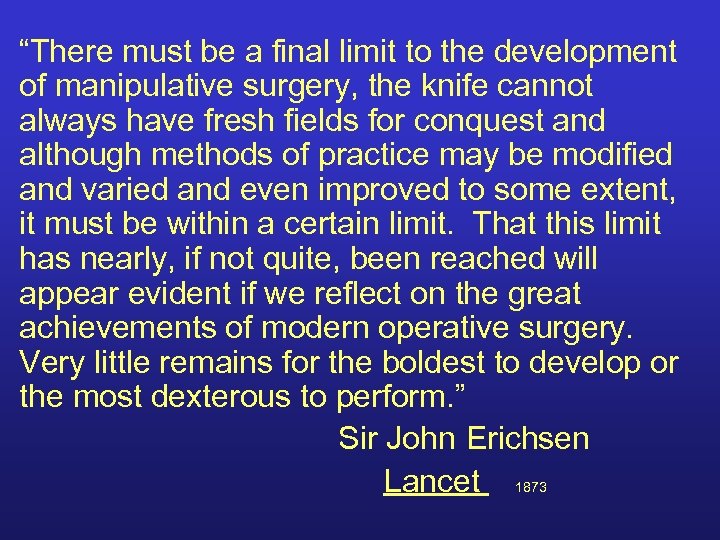
“There must be a final limit to the development of manipulative surgery, the knife cannot always have fresh fields for conquest and although methods of practice may be modified and varied and even improved to some extent, it must be within a certain limit. That this limit has nearly, if not quite, been reached will appear evident if we reflect on the great achievements of modern operative surgery. Very little remains for the boldest to develop or the most dexterous to perform. ” Sir John Erichsen Lancet 1873
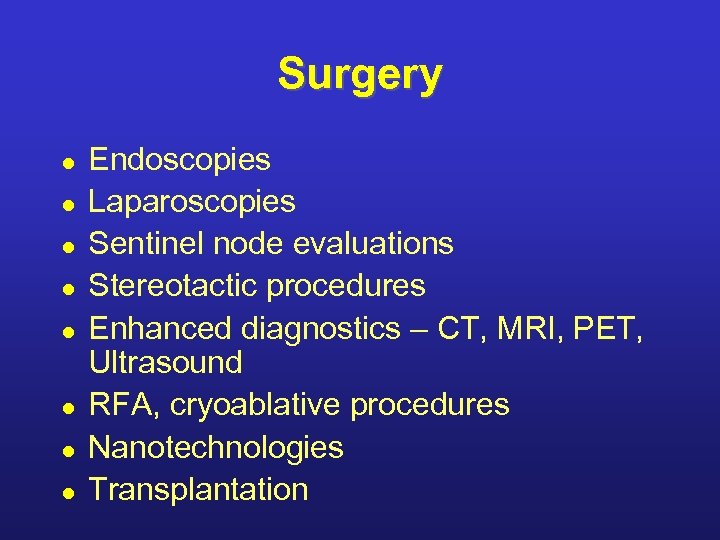
Surgery l l l l Endoscopies Laparoscopies Sentinel node evaluations Stereotactic procedures Enhanced diagnostics – CT, MRI, PET, Ultrasound RFA, cryoablative procedures Nanotechnologies Transplantation
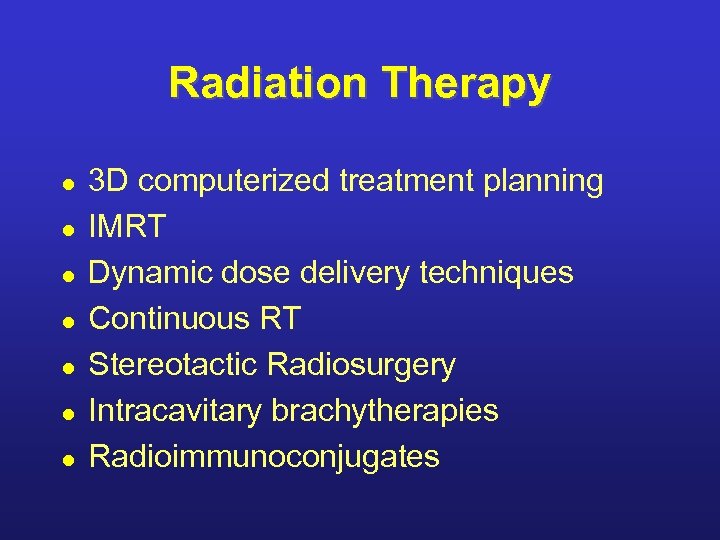
Radiation Therapy l l l l 3 D computerized treatment planning IMRT Dynamic dose delivery techniques Continuous RT Stereotactic Radiosurgery Intracavitary brachytherapies Radioimmunoconjugates
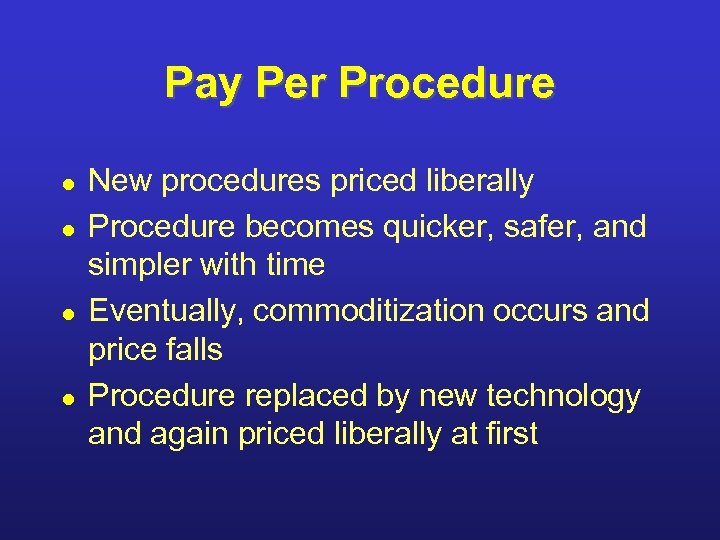
Pay Per Procedure l l New procedures priced liberally Procedure becomes quicker, safer, and simpler with time Eventually, commoditization occurs and price falls Procedure replaced by new technology and again priced liberally at first
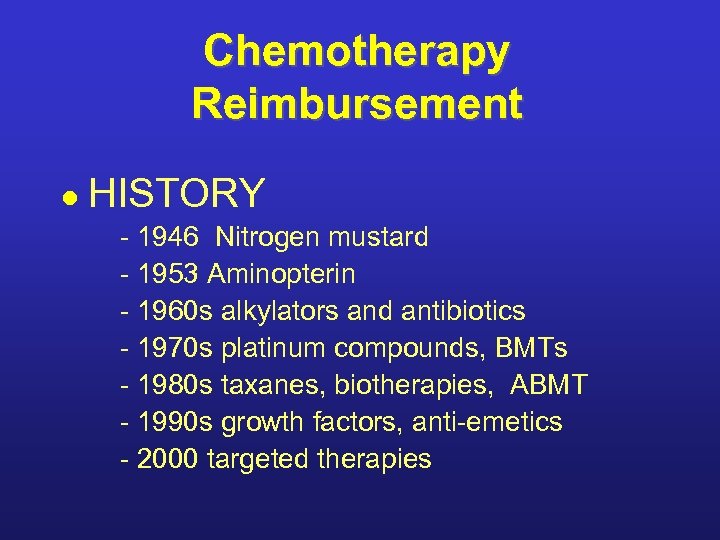
Chemotherapy Reimbursement l HISTORY - 1946 Nitrogen mustard - 1953 Aminopterin - 1960 s alkylators and antibiotics - 1970 s platinum compounds, BMTs - 1980 s taxanes, biotherapies, ABMT - 1990 s growth factors, anti-emetics - 2000 targeted therapies
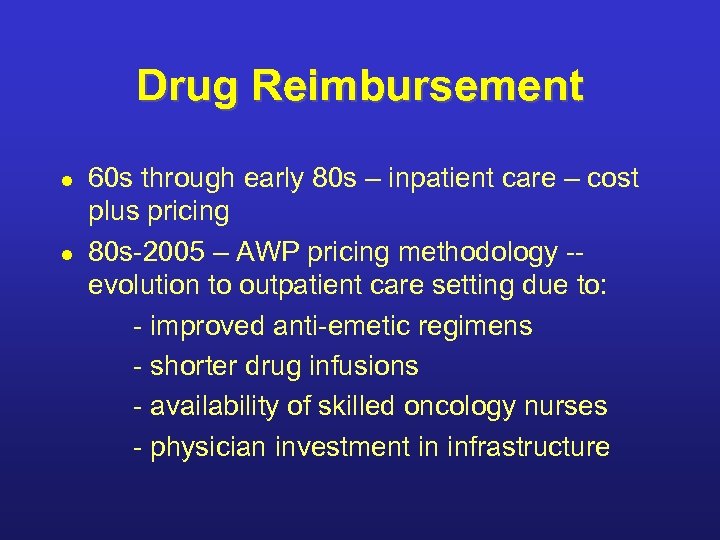
Drug Reimbursement l l 60 s through early 80 s – inpatient care – cost plus pricing 80 s-2005 – AWP pricing methodology -evolution to outpatient care setting due to: - improved anti-emetic regimens - shorter drug infusions - availability of skilled oncology nurses - physician investment in infrastructure
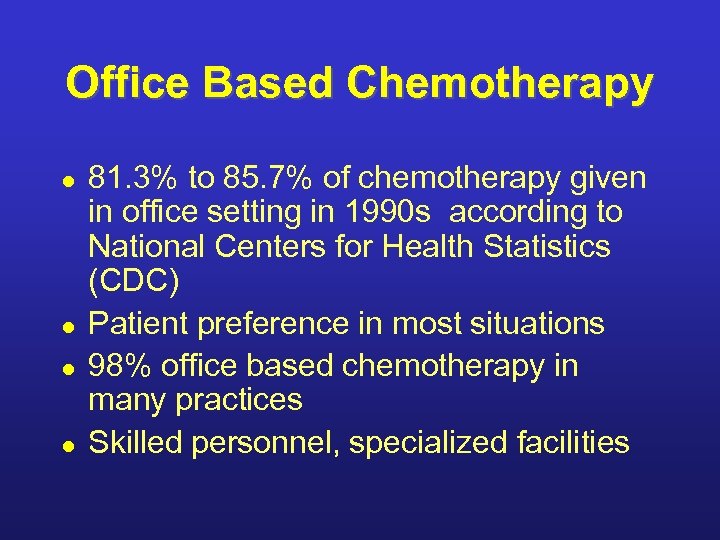
Office Based Chemotherapy l l 81. 3% to 85. 7% of chemotherapy given in office setting in 1990 s according to National Centers for Health Statistics (CDC) Patient preference in most situations 98% office based chemotherapy in many practices Skilled personnel, specialized facilities
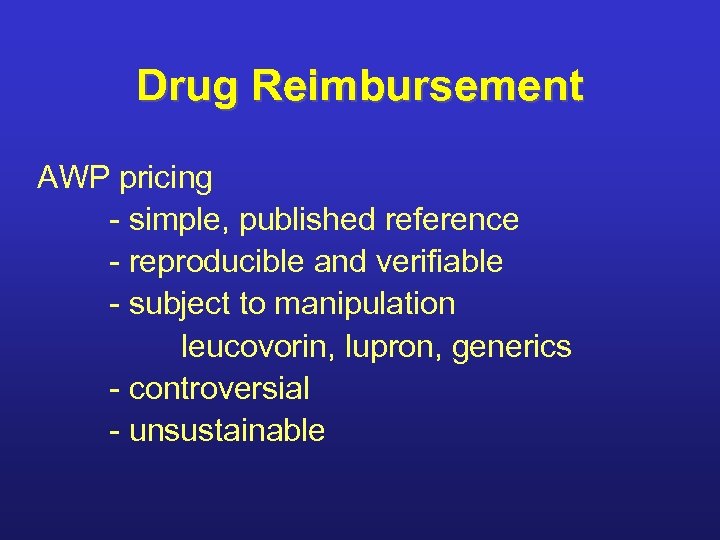
Drug Reimbursement AWP pricing - simple, published reference - reproducible and verifiable - subject to manipulation leucovorin, lupron, generics - controversial - unsustainable
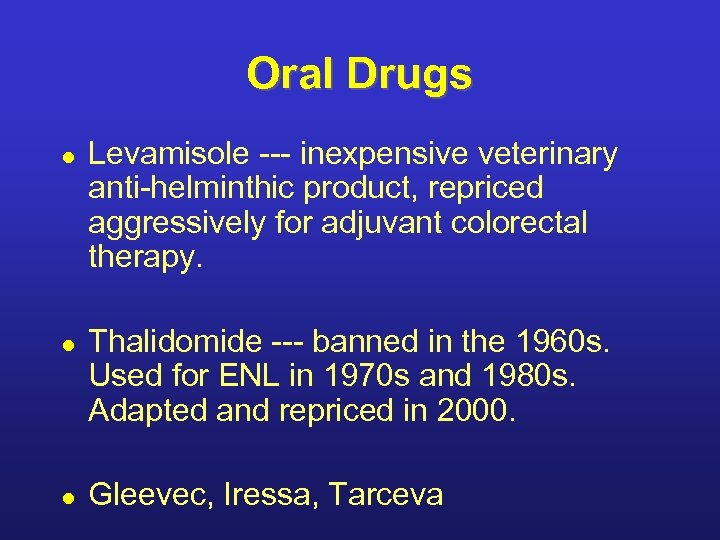
Oral Drugs l l l Levamisole --- inexpensive veterinary anti-helminthic product, repriced aggressively for adjuvant colorectal therapy. Thalidomide --- banned in the 1960 s. Used for ENL in 1970 s and 1980 s. Adapted and repriced in 2000. Gleevec, Iressa, Tarceva
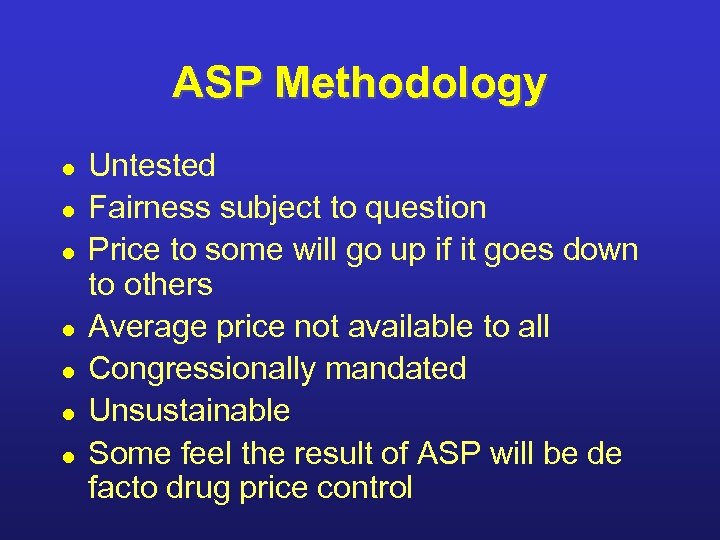
ASP Methodology l l l l Untested Fairness subject to question Price to some will go up if it goes down to others Average price not available to all Congressionally mandated Unsustainable Some feel the result of ASP will be de facto drug price control
Drug Administration l l l CMS uses AMA CPT coding for reimbursing all physician services Administration fees based on historical charges and “practice expense” before 2005 as no “physician work” considered Practice expense defined using “top down” methodology ---average price per hour for each specialty rather than resource based
Drug Administration l l Drug administration relative values supplemented in 2004 by 32% add-on mandated by MMA ASCO and other surveys suggest that administration costs still severely undervalued even with the add-on in 2004 2005 add-on decreases to 3% Temporary codes for Medicare only
Temporary Codes l l l New code for implanted port flush – minor effect financially Add physician work component to admin codes – AMA RUC throws out physician survey data and uses lower values similar to 2004 Unbundling of admin codes for 2005 – but practice expense recalculated to factor in unbundling CMS mandates payments for physician time spent dealing with chemotherapy admin complications – but no new codes and no consideration of special resources Treatment planning and services provided relative to chemo admin (patient teaching, phone calls, financial counseling, psychosocial support) not separately payable – AMA CPT Workgroup formed
Temporary Codes l l 2005 temporary codes will be incorporated in AMA published codes in 2006 Thus, 2005 will see private plans use different codes than Medicare Confusing and complicated for patients, physicians and payers Increased office overhead for billing
Americans always try to do the right thing, after they have tried every thing else. Winston Churchill
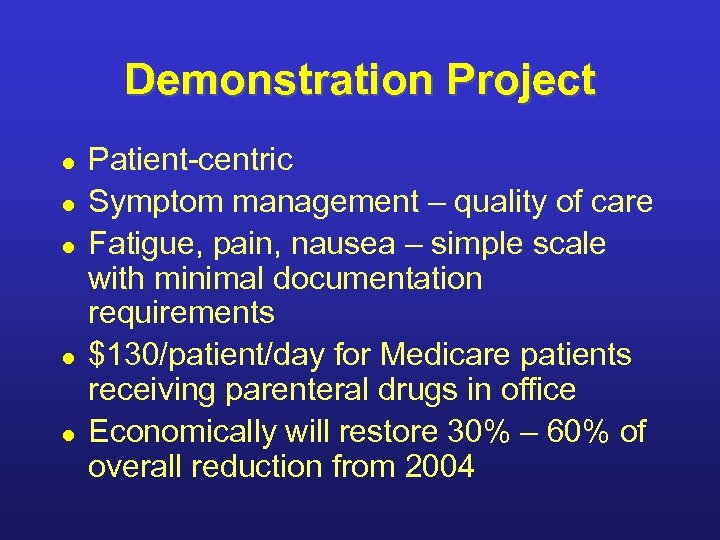
Demonstration Project l l l Patient-centric Symptom management – quality of care Fatigue, pain, nausea – simple scale with minimal documentation requirements $130/patient/day for Medicare patients receiving parenteral drugs in office Economically will restore 30% – 60% of overall reduction from 2004
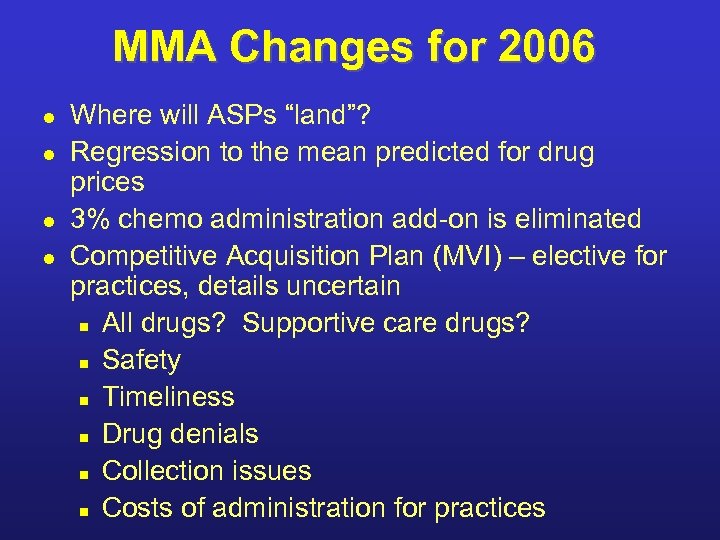
MMA Changes for 2006 l l Where will ASPs “land”? Regression to the mean predicted for drug prices 3% chemo administration add-on is eliminated Competitive Acquisition Plan (MVI) – elective for practices, details uncertain n All drugs? Supportive care drugs? n Safety n Timeliness n Drug denials n Collection issues n Costs of administration for practices
The moral test of government is how it treats those who are in the dawn of life, the children, those who are in the twilight of life, the elderly, and those who are in the shadows of life – the sick, the needy and the handicapped. Hubert H. Humphrey

The Future l
It’s difficult to make predictions, especially about the future. Y Berra, C Stengel, S Goldwyn, D Quayle, W Rogers, M Twain, V Gorge, G Marx, W Allen, and many others
The Future Transactional change OR Transformational change
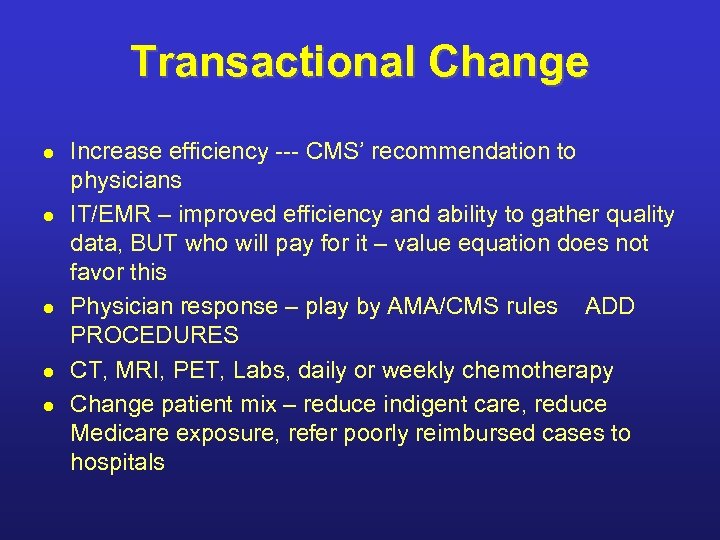
Transactional Change l l l Increase efficiency --- CMS’ recommendation to physicians IT/EMR – improved efficiency and ability to gather quality data, BUT who will pay for it – value equation does not favor this Physician response – play by AMA/CMS rules ADD PROCEDURES CT, MRI, PET, Labs, daily or weekly chemotherapy Change patient mix – reduce indigent care, reduce Medicare exposure, refer poorly reimbursed cases to hospitals
When elephants dance, the chickens must be careful. Asian proverb
Transformational Change l l Physicians paid for medical advice and care services Reasonable and equitable payment for all expenses related to chemotherapy services and management Commitment to Quality assessment and improvement Trust and teamwork
Obstacles to Transformation l l l Lack of trust CMS commitment to AMA CPT process Limited ability of CMS to spend on transformational projects Preoccupation with cost control Private payers deferral to CMS payment methodologies Lack of techniques to define quality
Quality l l l Pay for performance is certainly acceptable --- but…. Requires uniform definition of performance and validation of measures Surrogates for performance may exist; structure process Donebedian outcomes
Structure l Some payers offer a premium for practices utilizing approved Electronic Medical Records technology
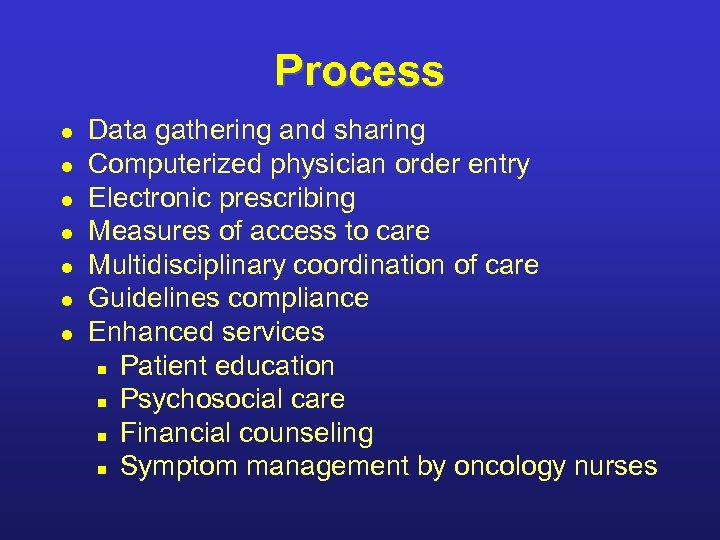
Process l l l l Data gathering and sharing Computerized physician order entry Electronic prescribing Measures of access to care Multidisciplinary coordination of care Guidelines compliance Enhanced services n Patient education n Psychosocial care n Financial counseling n Symptom management by oncology nurses
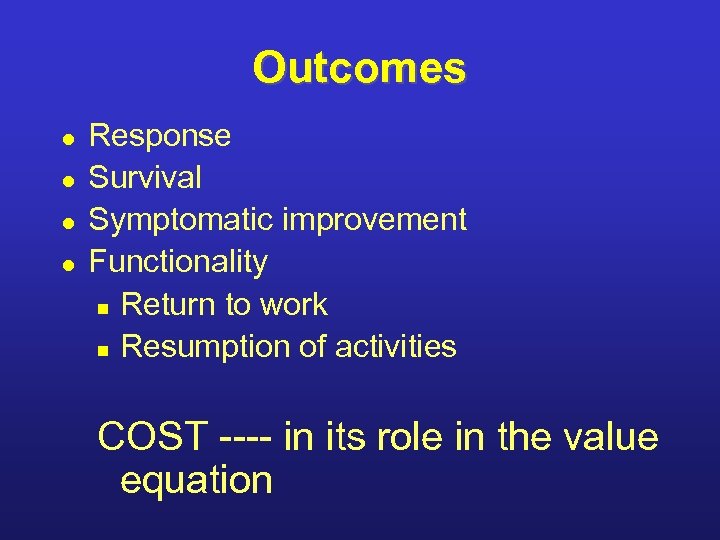
Outcomes l l Response Survival Symptomatic improvement Functionality n Return to work n Resumption of activities COST ---- in its role in the value equation
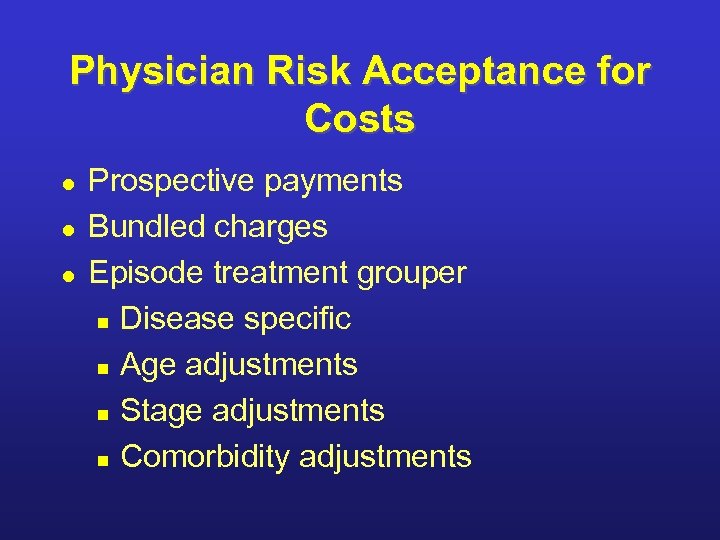
Physician Risk Acceptance for Costs l l l Prospective payments Bundled charges Episode treatment grouper n Disease specific n Age adjustments n Stage adjustments n Comorbidity adjustments

We have upped our quality, so up yours. Anonymous
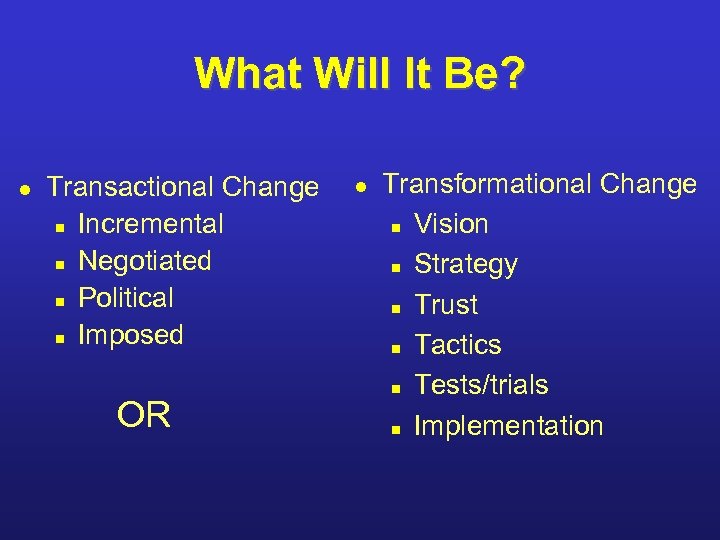
What Will It Be? l Transactional Change n Incremental n Negotiated n Political n Imposed OR l Transformational Change n Vision n Strategy n Trust n Tactics n Tests/trials n Implementation

Science is organized knowledge. Wisdom is organized life. Immanuel Kant
Physicians must lead the healthcare team for the benefits of their patients. Payers must be included as part of the healthcare team. Together we must work to maximize value offered within our healthcare system. This will require transformational change.
These are my principles and if you don’t like them, I have others. Groucho Marx
Скачать презентацию Oncology Reimbursement Past Present and Future Association of
62e0ccbd7b27a097c3ad67d8f88e4f32.ppt