 Скачать презентацию On the Way to a Sustainable Energy Future
0eaf196582e13e0a072de904d302f676.ppt
- Количество слайдов: 32



On the Way to a Sustainable Energy Future Ulf Bossel European Fuel Cell Forum Morgenacherstrasse 2 F CH-5452 Oberrohrdorf / Switzerland Tel. : +41 -56 -496 -7292, Fax: - 4412 forum@efcf. com, www. efcf. com Presenting physics, not philosophy 1 Ulf Bossel – October 2005
That’s me: Ulf Bossel Dipl. Ing. , ETH Zürich, Switzerland (1961) Mechanical Engineering: Aerodynamics, Thermodynamics Ph. D. , University of California, Berkeley (1968) Rarefied Gas Dynamics, Molecular Beams Assistant Professor, Syracuse University (1968 -1970) Mechanical and Aerospace Engineering Group Leader, DFVLR, Göttingen, Germany (1970 -1986) Free molecular flow studies (space aerodynamics) Founder and Manager of SOLENTEC, a consulting firm for renewable energy and energy conservation (1978) Fuel Cell Project Manager, ABB Baden, Switzerland (1986 -1990) Manager of ABB’s fuel cell activities in Europe and US Fuel Cell Consultant and Developer (1990 -to date) Siemens, Mitsubishi, Statoil, Eniricerche, EPRI, Novem European Fuel Cell Forum (1994 to date) International Fuel Cell Conferences Lucerne FUEL CELL FORUM 2006 (July 3 – 7, 2006) www. efcf. com Ulf Bossel – October 2005 2
Sustainable Energy Future ? ? ? Entering Hydrogen County Leaving Gasoline County 3 Ulf Bossel – October 2005
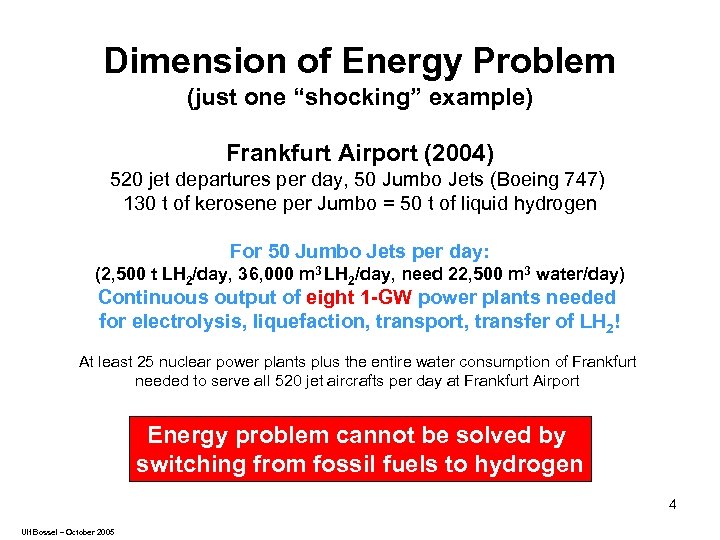
Dimension of Energy Problem (just one “shocking” example) Frankfurt Airport (2004) 520 jet departures per day, 50 Jumbo Jets (Boeing 747) 130 t of kerosene per Jumbo = 50 t of liquid hydrogen For 50 Jumbo Jets per day: (2, 500 t LH 2/day, 36, 000 m 3 LH 2/day, need 22, 500 m 3 water/day) Continuous output of eight 1 -GW power plants needed for electrolysis, liquefaction, transport, transfer of LH 2! At least 25 nuclear power plants plus the entire water consumption of Frankfurt needed to serve all 520 jet aircrafts per day at Frankfurt Airport Energy problem cannot be solved by switching from fossil fuels to hydrogen 4 Ulf Bossel – October 2005
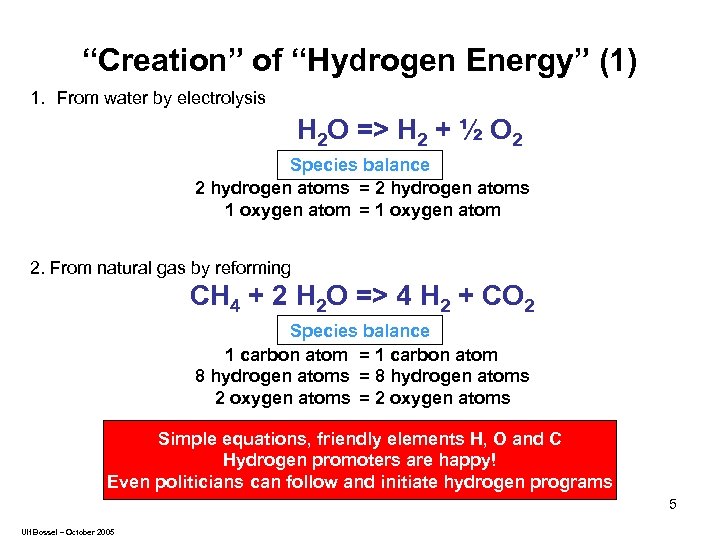
“Creation” of “Hydrogen Energy” (1) 1. From water by electrolysis H 2 O => H 2 + ½ O 2 Species balance 2 hydrogen atoms = 2 hydrogen atoms 1 oxygen atom = 1 oxygen atom 2. From natural gas by reforming CH 4 + 2 H 2 O => 4 H 2 + CO 2 Species balance 1 carbon atom = 1 carbon atom 8 hydrogen atoms = 8 hydrogen atoms 2 oxygen atoms = 2 oxygen atoms Simple equations, friendly elements H, O and C Hydrogen promoters are happy! Even politicians can follow and initiate hydrogen programs 5 Ulf Bossel – October 2005
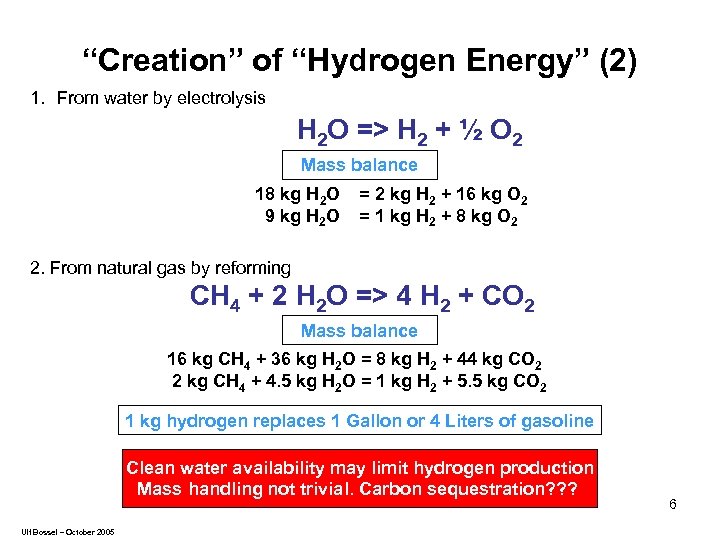
“Creation” of “Hydrogen Energy” (2) 1. From water by electrolysis H 2 O => H 2 + ½ O 2 Mass balance 18 kg H 2 O 9 kg H 2 O = 2 kg H 2 + 16 kg O 2 = 1 kg H 2 + 8 kg O 2 2. From natural gas by reforming CH 4 + 2 H 2 O => 4 H 2 + CO 2 Mass balance 16 kg CH 4 + 36 kg H 2 O = 8 kg H 2 + 44 kg CO 2 2 kg CH 4 + 4. 5 kg H 2 O = 1 kg H 2 + 5. 5 kg CO 2 1 kg hydrogen replaces 1 Gallon or 4 Liters of gasoline Clean water availability may limit hydrogen production Mass handling not trivial. Carbon sequestration? ? ? Ulf Bossel – October 2005 6
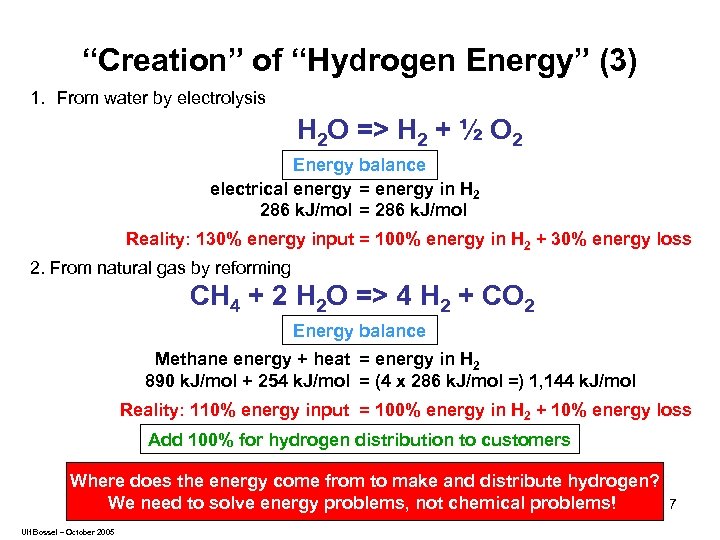
“Creation” of “Hydrogen Energy” (3) 1. From water by electrolysis H 2 O => H 2 + ½ O 2 Energy balance electrical energy = energy in H 2 286 k. J/mol = 286 k. J/mol Reality: 130% energy input = 100% energy in H 2 + 30% energy loss 2. From natural gas by reforming CH 4 + 2 H 2 O => 4 H 2 + CO 2 Energy balance Methane energy + heat = energy in H 2 890 k. J/mol + 254 k. J/mol = (4 x 286 k. J/mol =) 1, 144 k. J/mol Reality: 110% energy input = 100% energy in H 2 + 10% energy loss Add 100% for hydrogen distribution to customers Where does the energy come from to make and distribute hydrogen? We need to solve energy problems, not chemical problems! Ulf Bossel – October 2005 7
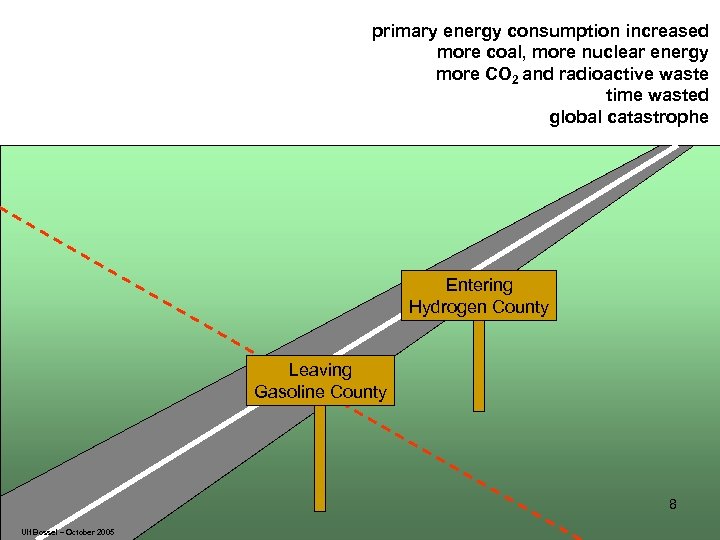
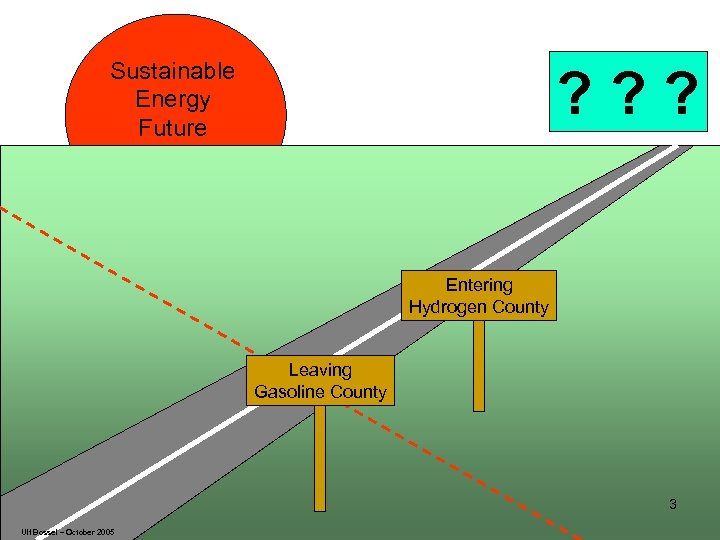
primary energy consumption increased more coal, more nuclear energy more CO 2 and radioactive waste time wasted global catastrophe Entering Hydrogen County Leaving Gasoline County 8 Ulf Bossel – October 2005
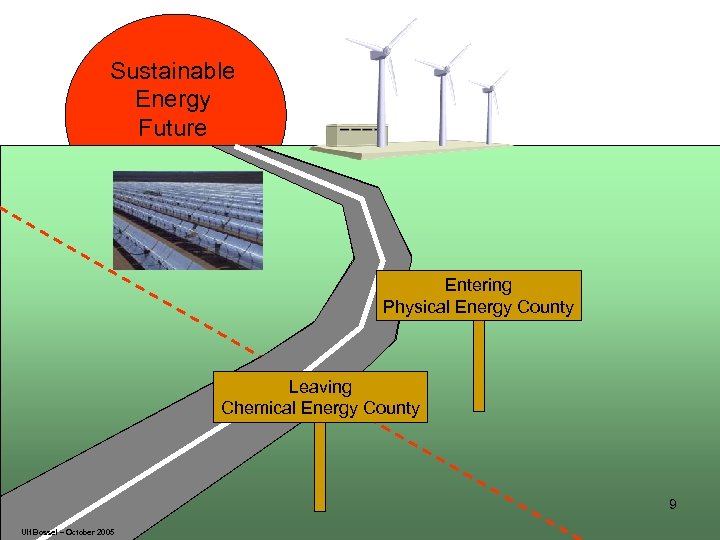
Sustainable Energy Future Entering Physical Energy County Leaving Chemical Energy County 9 Ulf Bossel – October 2005
Common Goal: Sustainable Energy Future Only two conditions must be satisfied: 1. Energy source, sink, handling and use must be sustainable 2. Energy must be distributed and used with highest efficiency Need to re-organize the entire energy system for a sustainable energy future 10 Ulf Bossel – October 2005
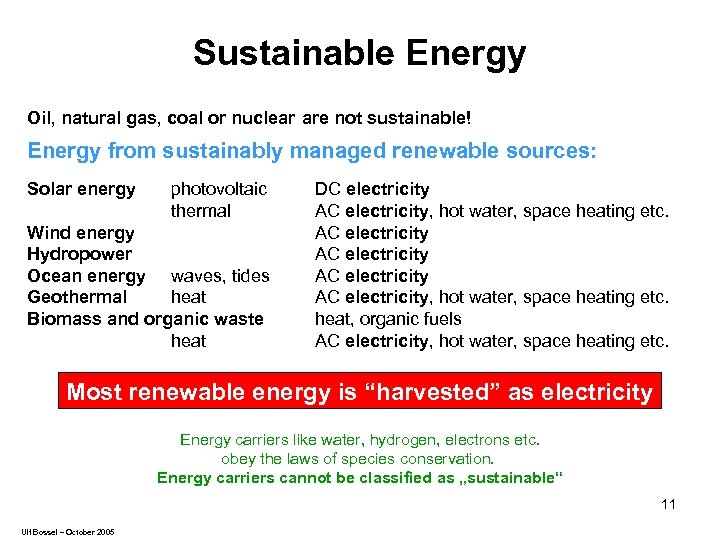
Sustainable Energy Oil, natural gas, coal or nuclear are not sustainable! Energy from sustainably managed renewable sources: Solar energy photovoltaic thermal Wind energy Hydropower Ocean energy waves, tides Geothermal heat Biomass and organic waste heat DC electricity AC electricity, hot water, space heating etc. heat, organic fuels AC electricity, hot water, space heating etc. Most renewable energy is “harvested” as electricity Energy carriers like water, hydrogen, electrons etc. obey the laws of species conservation. Energy carriers cannot be classified as „sustainable“ 11 Ulf Bossel – October 2005
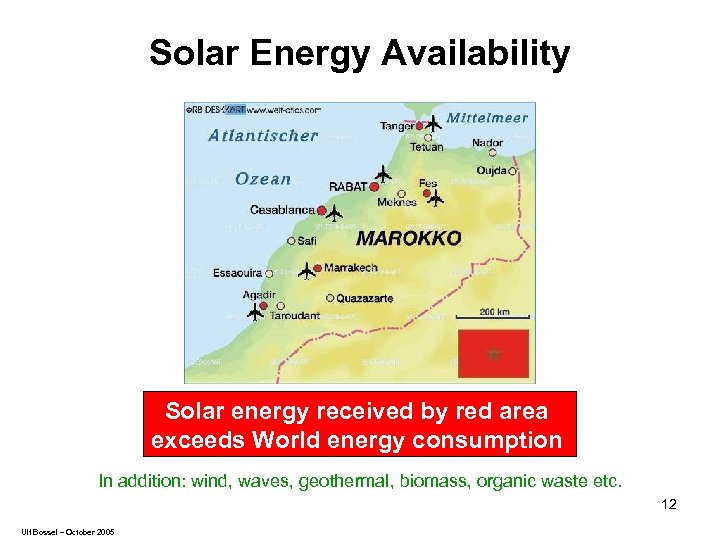
Solar Energy Availability Solar energy received by red area exceeds World energy consumption In addition: wind, waves, geothermal, biomass, organic waste etc. 12 Ulf Bossel – October 2005
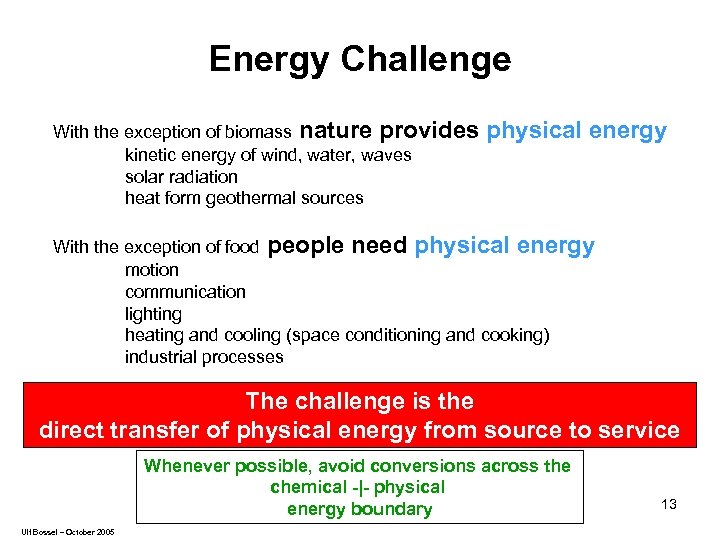
Energy Challenge With the exception of biomass nature provides kinetic energy of wind, water, waves solar radiation heat form geothermal sources physical energy With the exception of food people need physical energy motion communication lighting heating and cooling (space conditioning and cooking) industrial processes The challenge is the direct transfer of physical energy from source to service Whenever possible, avoid conversions across the chemical -|- physical energy boundary Ulf Bossel – October 2005 13
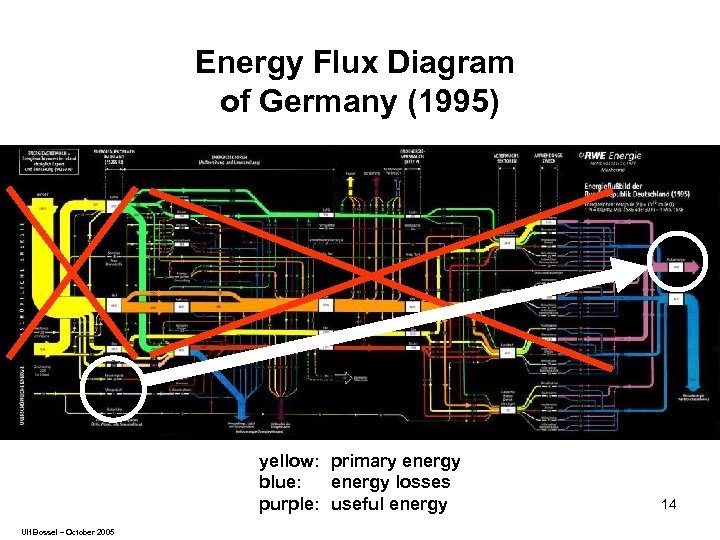
Energy Flux Diagram of Germany (1995) yellow: primary energy blue: energy losses purple: useful energy Ulf Bossel – October 2005 14
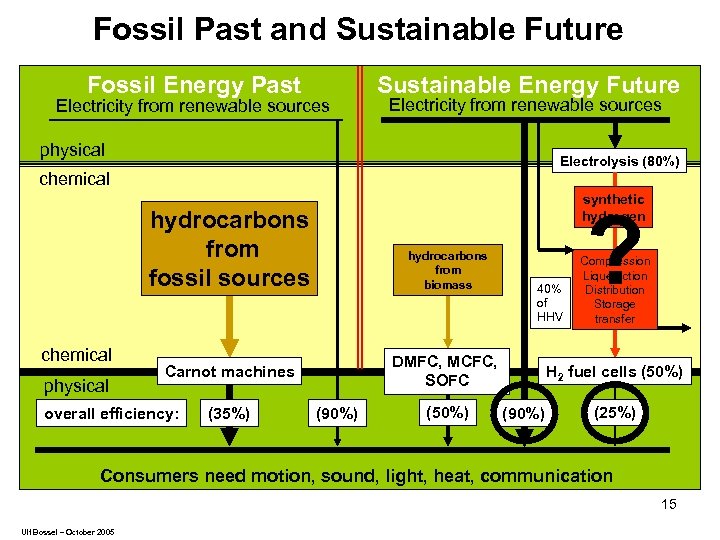
Fossil Past and Sustainable Future Fossil Energy Past Electricity from renewable sources Sustainable Energy Future Electricity from renewable sources physical Electrolysis (80%) chemical synthetic hydrogen hydrocarbons from fossil sources chemical physical hydrocarbons from biomass DMFC, MCFC, SOFC Carnot machines overall efficiency: (35%) 40% of HHV (90%) (50%) ? Compression Liquefaction Distribution Storage transfer H 2 fuel cells (50%) (90%) (25%) Consumers need motion, sound, light, heat, communication 15 Ulf Bossel – October 2005
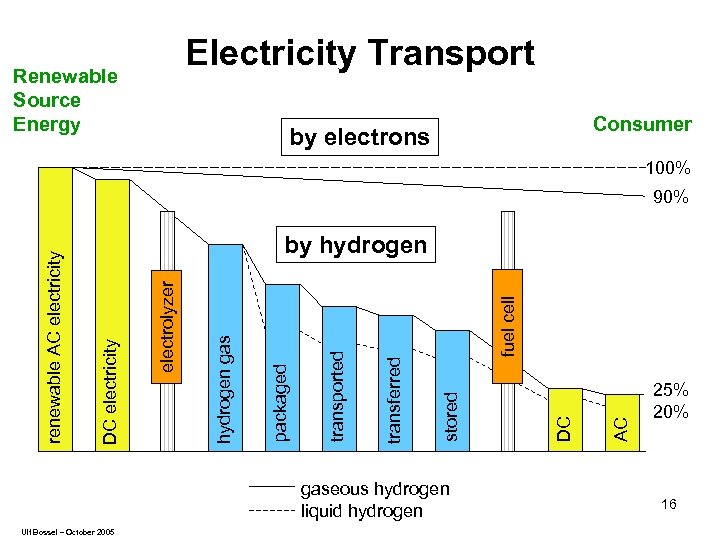
Electricity Transport Renewable Source Energy Consumer by electrons 100% gaseous hydrogen liquid hydrogen Ulf Bossel – October 2005 AC DC fuel cell stored transferred transported packaged hydrogen gas electrolyzer by hydrogen DC electricity renewable AC electricity 90% 25% 20% 16
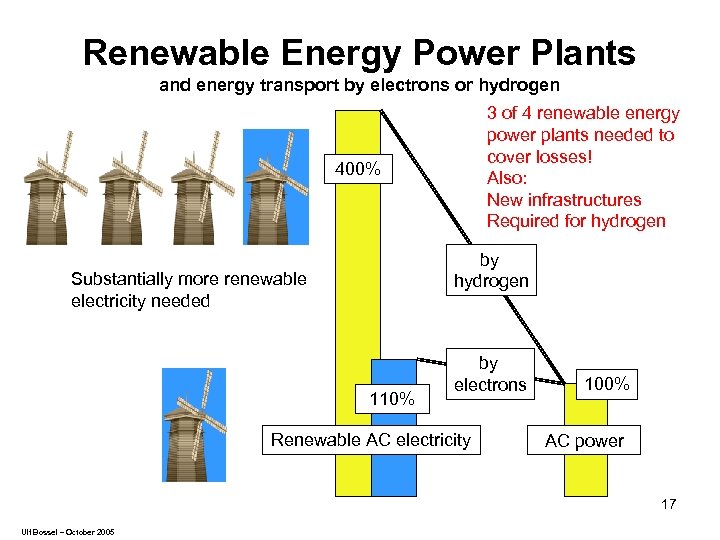
Renewable Energy Power Plants and energy transport by electrons or hydrogen 3 of 4 renewable energy power plants needed to cover losses! Also: New infrastructures Required for hydrogen 400% by hydrogen Substantially more renewable electricity needed 110% by electrons Renewable AC electricity 100% AC power 17 Ulf Bossel – October 2005
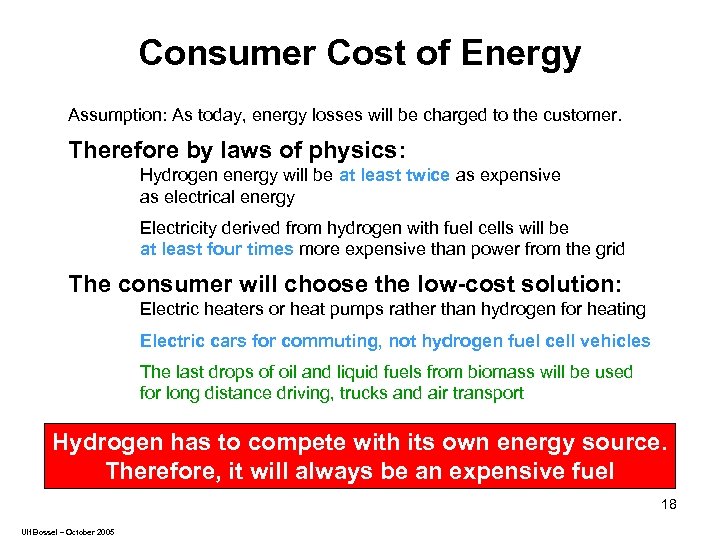
Consumer Cost of Energy Assumption: As today, energy losses will be charged to the customer. Therefore by laws of physics: Hydrogen energy will be at least twice as expensive as electrical energy Electricity derived from hydrogen with fuel cells will be at least four times more expensive than power from the grid The consumer will choose the low-cost solution: Electric heaters or heat pumps rather than hydrogen for heating Electric cars for commuting, not hydrogen fuel cell vehicles The last drops of oil and liquid fuels from biomass will be used for long distance driving, trucks and air transport Hydrogen has to compete with its own energy source. Therefore, it will always be an expensive fuel 18 Ulf Bossel – October 2005
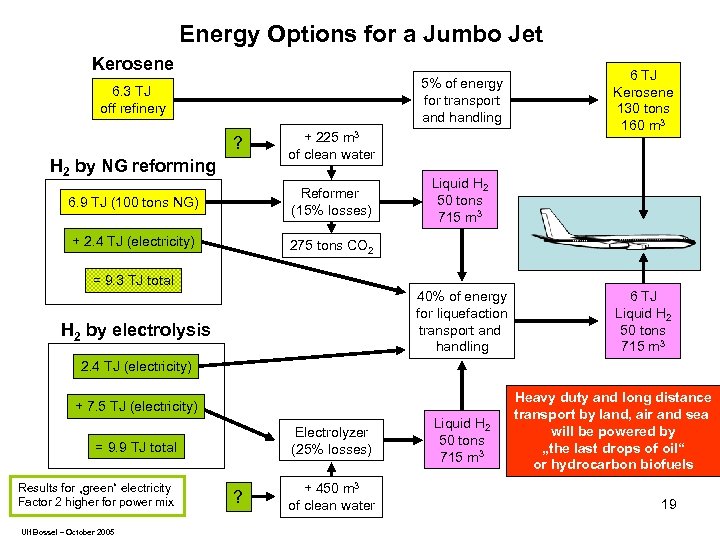
Energy Options for a Jumbo Jet Kerosene 5% of energy for transport and handling 6. 3 TJ off refinery ? H 2 by NG reforming + 225 m 3 of clean water 6. 9 TJ (100 tons NG) Reformer (15% losses) + 2. 4 TJ (electricity) 6 TJ Kerosene 130 tons 160 m 3 Liquid H 2 50 tons 715 m 3 275 tons CO 2 = 9. 3 TJ total 40% of energy for liquefaction transport and handling H 2 by electrolysis 6 TJ Liquid H 2 50 tons 715 m 3 2. 4 TJ (electricity) + 7. 5 TJ (electricity) Electrolyzer (25% losses) = 9. 9 TJ total Results for „green“ electricity Factor 2 higher for power mix Ulf Bossel – October 2005 ? + 450 m 3 of clean water Liquid H 2 50 tons 715 m 3 Heavy duty and long distance transport by land, air and sea will be powered by „the last drops of oil“ or hydrocarbon biofuels 19
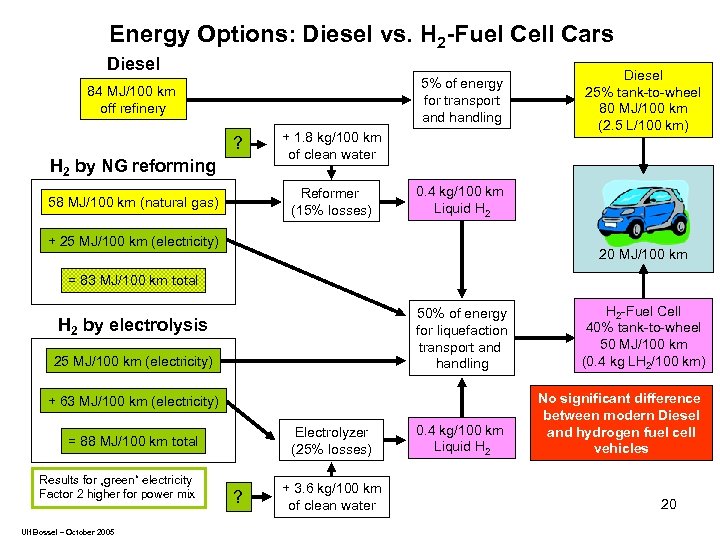
Energy Options: Diesel vs. H 2 -Fuel Cell Cars Diesel 5% of energy for transport and handling 84 MJ/100 km off refinery ? H 2 by NG reforming + 1. 8 kg/100 km of clean water Reformer (15% losses) 58 MJ/100 km (natural gas) Diesel 25% tank-to-wheel 80 MJ/100 km (2. 5 L/100 km) 0. 4 kg/100 km Liquid H 2 + 25 MJ/100 km (electricity) 20 MJ/100 km = 83 MJ/100 km total 50% of energy for liquefaction transport and handling H 2 by electrolysis 25 MJ/100 km (electricity) + 63 MJ/100 km (electricity) Electrolyzer (25% losses) = 88 MJ/100 km total Results for „green“ electricity Factor 2 higher for power mix Ulf Bossel – October 2005 ? + 3. 6 kg/100 km of clean water 0. 4 kg/100 km Liquid H 2 -Fuel Cell 40% tank-to-wheel 50 MJ/100 km (0. 4 kg LH 2/100 km) No significant difference between modern Diesel and hydrogen fuel cell vehicles 20
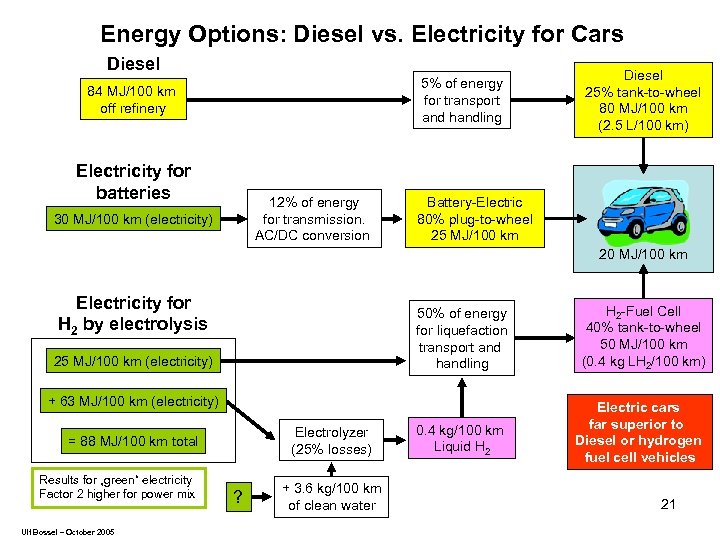
Energy Options: Diesel vs. Electricity for Cars Diesel 5% of energy for transport and handling 84 MJ/100 km off refinery Electricity for batteries 12% of energy for transmission. AC/DC conversion 30 MJ/100 km (electricity) Diesel 25% tank-to-wheel 80 MJ/100 km (2. 5 L/100 km) Battery-Electric 80% plug-to-wheel 25 MJ/100 km 20 MJ/100 km Electricity for H 2 by electrolysis 50% of energy for liquefaction transport and handling 25 MJ/100 km (electricity) + 63 MJ/100 km (electricity) Electrolyzer (25% losses) = 88 MJ/100 km total Results for „green“ electricity Factor 2 higher for power mix Ulf Bossel – October 2005 ? + 3. 6 kg/100 km of clean water 0. 4 kg/100 km Liquid H 2 -Fuel Cell 40% tank-to-wheel 50 MJ/100 km (0. 4 kg LH 2/100 km) Electric cars far superior to Diesel or hydrogen fuel cell vehicles 21
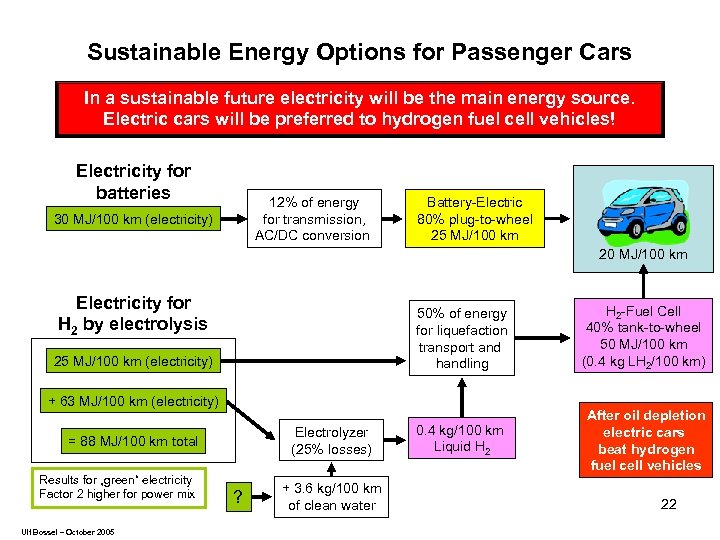
Sustainable Energy Options for Passenger Cars In a sustainable future electricity will be the main energy source. Electric cars will be preferred to hydrogen fuel cell vehicles! Electricity for batteries 12% of energy for transmission, AC/DC conversion 30 MJ/100 km (electricity) Battery-Electric 80% plug-to-wheel 25 MJ/100 km 20 MJ/100 km Electricity for H 2 by electrolysis 50% of energy for liquefaction transport and handling 25 MJ/100 km (electricity) H 2 -Fuel Cell 40% tank-to-wheel 50 MJ/100 km (0. 4 kg LH 2/100 km) 0. 4 kg/100 km Liquid H 2 After oil depletion electric cars beat hydrogen fuel cell vehicles + 63 MJ/100 km (electricity) Electrolyzer (25% losses) = 88 MJ/100 km total Results for „green“ electricity Factor 2 higher for power mix Ulf Bossel – October 2005 ? + 3. 6 kg/100 km of clean water 22
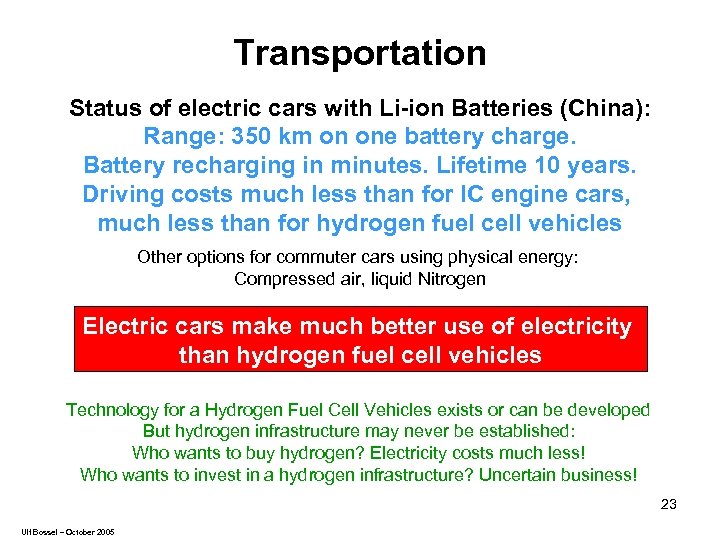
Transportation Status of electric cars with Li-ion Batteries (China): Range: 350 km on one battery charge. Battery recharging in minutes. Lifetime 10 years. Driving costs much less than for IC engine cars, much less than for hydrogen fuel cell vehicles Other options for commuter cars using physical energy: Compressed air, liquid Nitrogen Electric cars make much better use of electricity than hydrogen fuel cell vehicles Technology for a Hydrogen Fuel Cell Vehicles exists or can be developed But hydrogen infrastructure may never be established: Who wants to buy hydrogen? Electricity costs much less! Who wants to invest in a hydrogen infrastructure? Uncertain business! 23 Ulf Bossel – October 2005
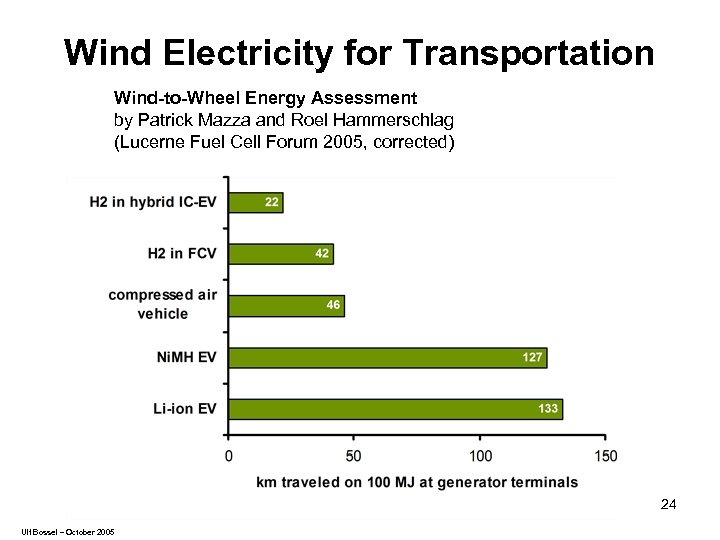
Wind Electricity for Transportation Wind-to-Wheel Energy Assessment by Patrick Mazza and Roel Hammerschlag (Lucerne Fuel Cell Forum 2005, corrected) 24 Ulf Bossel – October 2005
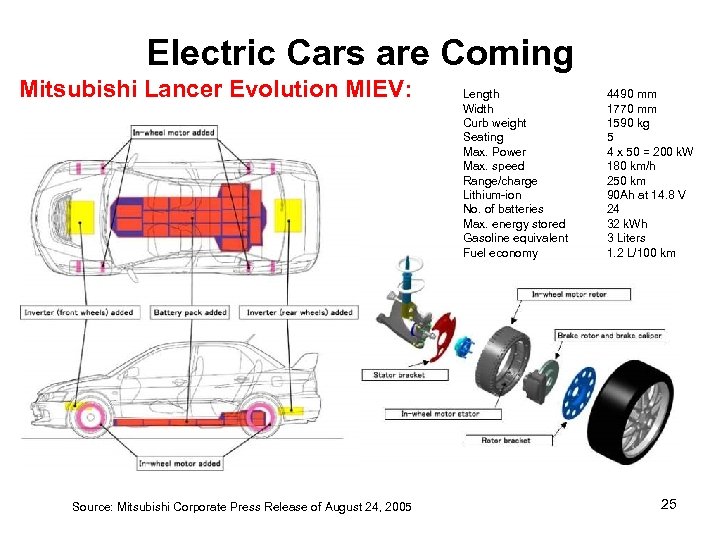
Electric Cars are Coming Mitsubishi Lancer Evolution MIEV: Source: Mitsubishi Corporate Press Release of August 24, 2005 Length Width Curb weight Seating Max. Power Max. speed Range/charge Lithium-ion No. of batteries Max. energy stored Gasoline equivalent Fuel economy 4490 mm 1770 mm 1590 kg 5 4 x 50 = 200 k. W 180 km/h 250 km 90 Ah at 14. 8 V 24 32 k. Wh 3 Liters 1. 2 L/100 km 25
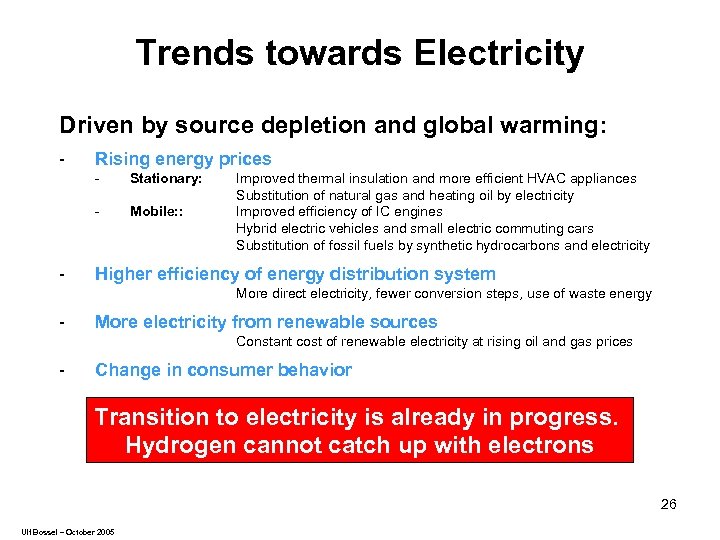
Trends towards Electricity Driven by source depletion and global warming: - Rising energy prices - - Stationary: Mobile: : Improved thermal insulation and more efficient HVAC appliances Substitution of natural gas and heating oil by electricity Improved efficiency of IC engines Hybrid electric vehicles and small electric commuting cars Substitution of fossil fuels by synthetic hydrocarbons and electricity Higher efficiency of energy distribution system More direct electricity, fewer conversion steps, use of waste energy - More electricity from renewable sources Constant cost of renewable electricity at rising oil and gas prices - Change in consumer behavior Transition to electricity is already in progress. Hydrogen cannot catch up with electrons 26 Ulf Bossel – October 2005
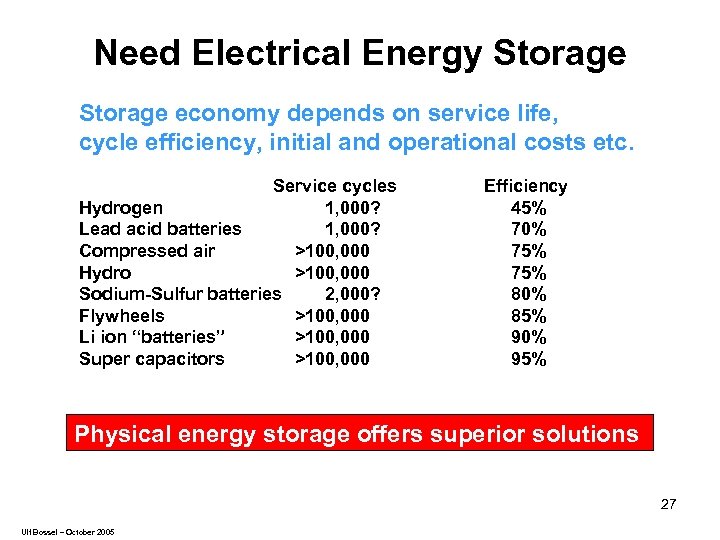
Need Electrical Energy Storage economy depends on service life, cycle efficiency, initial and operational costs etc. Service cycles Hydrogen 1, 000? Lead acid batteries 1, 000? Compressed air >100, 000 Hydro >100, 000 Sodium-Sulfur batteries 2, 000? Flywheels >100, 000 Li ion “batteries” >100, 000 Super capacitors >100, 000 Efficiency 45% 70% 75% 80% 85% 90% 95% Physical energy storage offers superior solutions 27 Ulf Bossel – October 2005
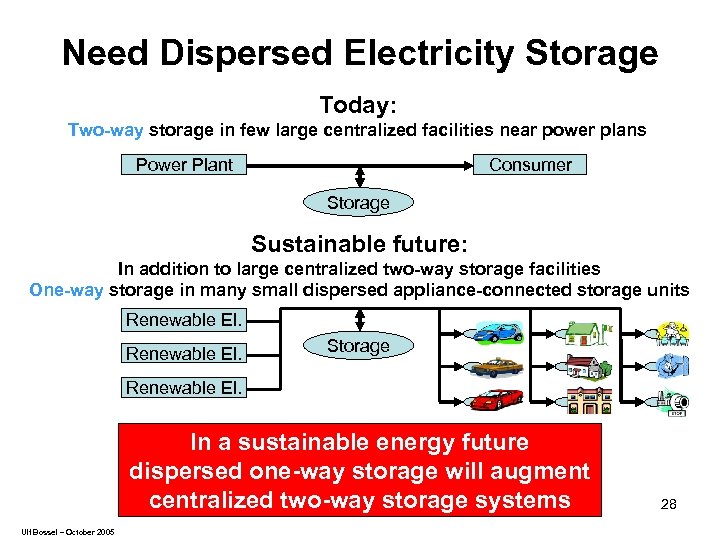
Need Dispersed Electricity Storage Today: Two-way storage in few large centralized facilities near power plans Power Plant Consumer Storage Sustainable future: In addition to large centralized two-way storage facilities One-way storage in many small dispersed appliance-connected storage units Renewable El. Storage Renewable El. In a sustainable energy future dispersed one-way storage will augment centralized two-way storage systems Ulf Bossel – October 2005 28
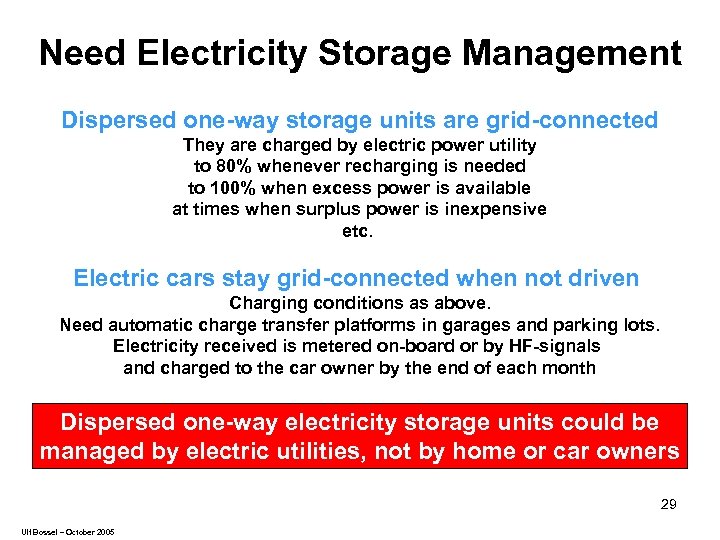
Need Electricity Storage Management Dispersed one-way storage units are grid-connected They are charged by electric power utility to 80% whenever recharging is needed to 100% when excess power is available at times when surplus power is inexpensive etc. Electric cars stay grid-connected when not driven Charging conditions as above. Need automatic charge transfer platforms in garages and parking lots. Electricity received is metered on-board or by HF-signals and charged to the car owner by the end of each month Dispersed one-way electricity storage units could be managed by electric utilities, not by home or car owners 29 Ulf Bossel – October 2005
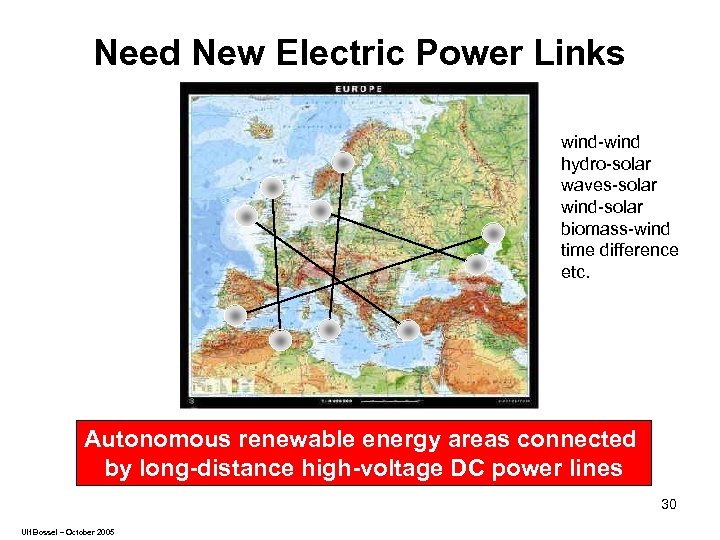
Need New Electric Power Links wind-wind hydro-solar waves-solar wind-solar biomass-wind time difference etc. Autonomous renewable energy areas connected by long-distance high-voltage DC power lines 30 Ulf Bossel – October 2005
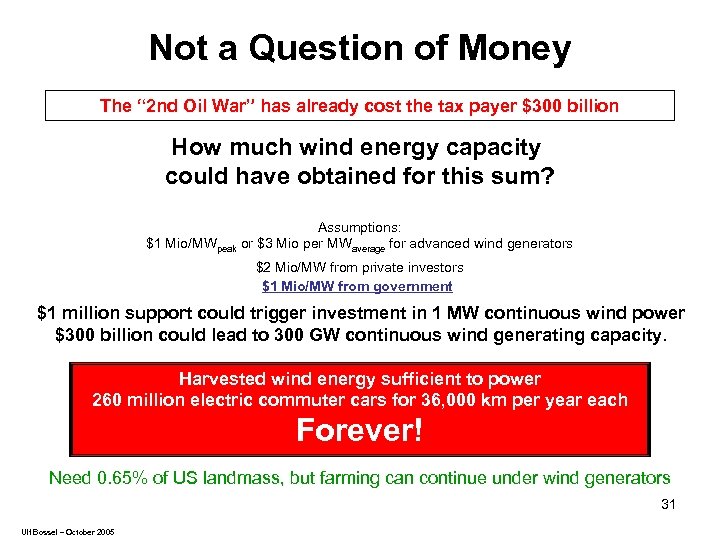
Not a Question of Money The “ 2 nd Oil War” has already cost the tax payer $300 billion How much wind energy capacity could have obtained for this sum? Assumptions: $1 Mio/MWpeak or $3 Mio per MWaverage for advanced wind generators $2 Mio/MW from private investors $1 Mio/MW from government $1 million support could trigger investment in 1 MW continuous wind power $300 billion could lead to 300 GW continuous wind generating capacity. Harvested wind energy sufficient to power 260 million electric commuter cars for 36, 000 km per year each Forever! Need 0. 65% of US landmass, but farming can continue under wind generators 31 Ulf Bossel – October 2005
Conclusions A sustainable energy future is possible when based on energy from renewable sources and highest efficiency! Energy base must be changed from chemical to physical Physics is eternal and cannot be changed by governments. Therefore by laws of physics: Hydrogen can never compete with its own energy source. A “Hydrogen Economy” has no past, no present and no future Prepare for an “Electron Economy” We need: Energy strategies based on physics, not fantasies Investments in sustainable technology, not research True political leadership 32 Ulf Bossel – October 2005
Скачать презентацию On the Way to a Sustainable Energy Future
0eaf196582e13e0a072de904d302f676.ppt