 Скачать презентацию On the Topologies Formed by Selfish Peers Thomas
957b795f1f5c986e61270be9c001e844.ppt
- Количество слайдов: 28



On the Topologies Formed by Selfish Peers Thomas Moscibroda Stefan Schmid Roger Wattenhofer IPTPS 2006 Santa Barbara, California, USA
Motivation Power of Peer-to-Peer Computing = Accumulation of Resources of Individual Peers – – CPU Cycles Memory Bandwidth … Collaboration is of peers is vital! However, many free riders in practice! Stefan Schmid, ETH Zurich @ IPTPS 2006 2
Motivation • Free riding – Downloading without uploading – Using storage of other peers without contributing own disk space – Etc. • In this talk: selfish neighbor selection in unstructured P 2 P systems • Goals of selfish peer: (1) Maintain links only to a few neighbors (small out-degree) (2) Small latencies to all other peers in the system (fast lookups) • What is the impact on the P 2 P topologies? Stefan Schmid, ETH Zurich @ IPTPS 2006 3
Talk Overview • Problem statement • Game-theoretic tools • How good / bad are topologies formed by selfish peers? • Stability of topologies formed by selfish peers • Conclusion Stefan Schmid, ETH Zurich @ IPTPS 2006 4
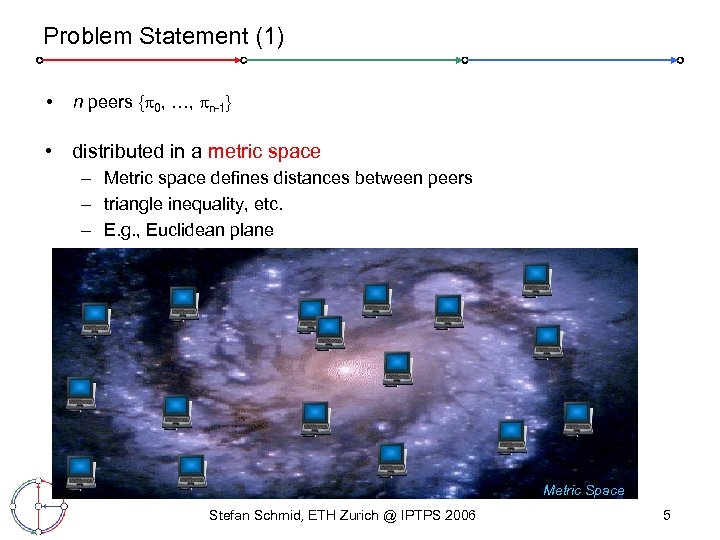
Problem Statement (1) • n peers { 0, …, n-1} • distributed in a metric space – Metric space defines distances between peers – triangle inequality, etc. – E. g. , Euclidean plane Metric Space Stefan Schmid, ETH Zurich @ IPTPS 2006 5
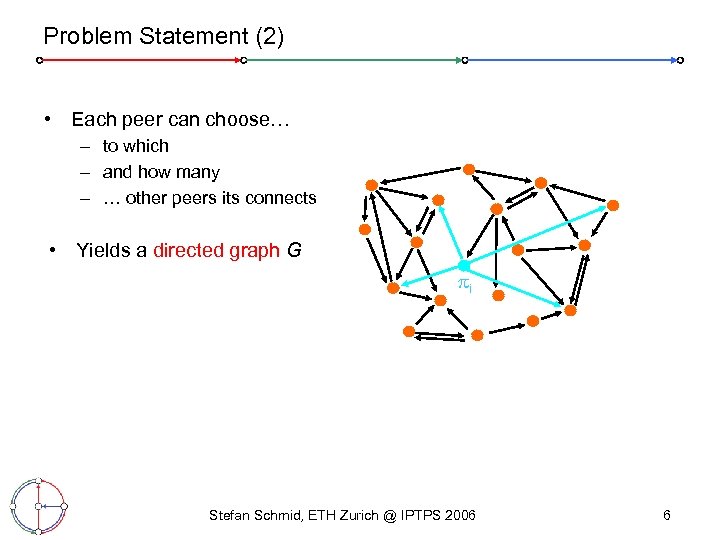
Problem Statement (2) • Each peer can choose… – to which – and how many – … other peers its connects • Yields a directed graph G i Stefan Schmid, ETH Zurich @ IPTPS 2006 6
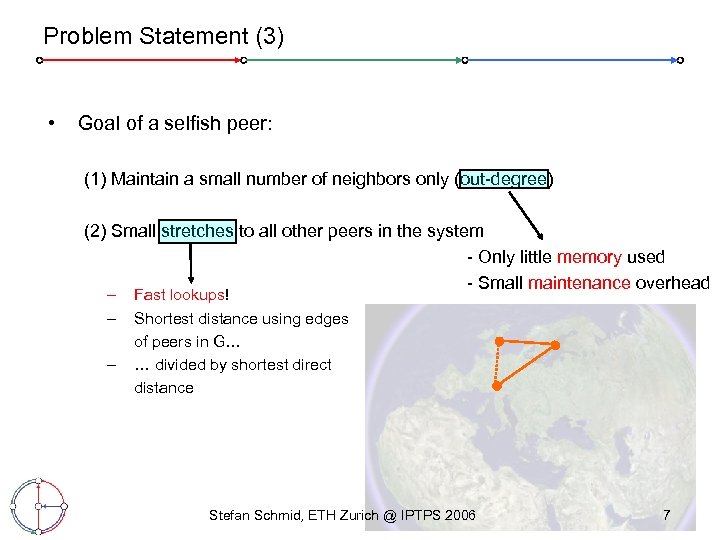
Problem Statement (3) • Goal of a selfish peer: (1) Maintain a small number of neighbors only (out-degree) (2) Small stretches to all other peers in the system - Only little memory used - Small maintenance overhead – – – Fast lookups! Shortest distance using edges of peers in G… … divided by shortest direct distance Stefan Schmid, ETH Zurich @ IPTPS 2006 7
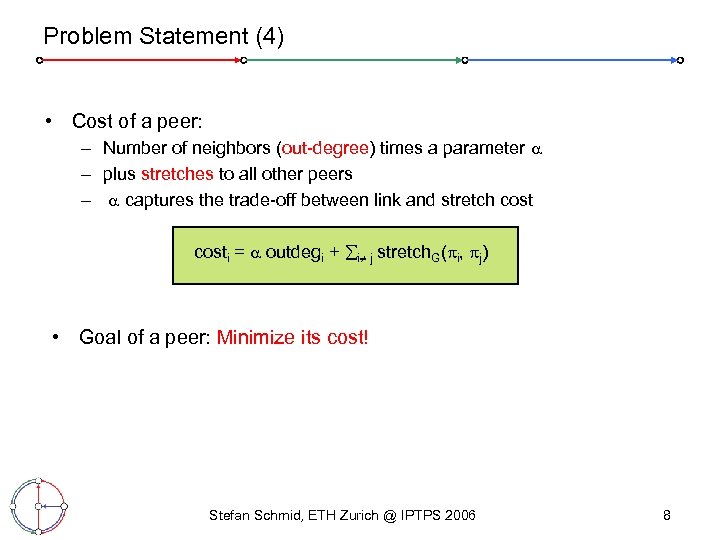
Problem Statement (4) • Cost of a peer: – Number of neighbors (out-degree) times a parameter – plus stretches to all other peers – captures the trade-off between link and stretch costi = outdegi + i j stretch. G( i, j) • Goal of a peer: Minimize its cost! Stefan Schmid, ETH Zurich @ IPTPS 2006 8
Talk Overview • Problem statement • Game-theoretic tools • How good / bad are topologies formed by selfish peers? • Stability of topologies formed by selfish peers • Conclusion Stefan Schmid, ETH Zurich @ IPTPS 2006 9
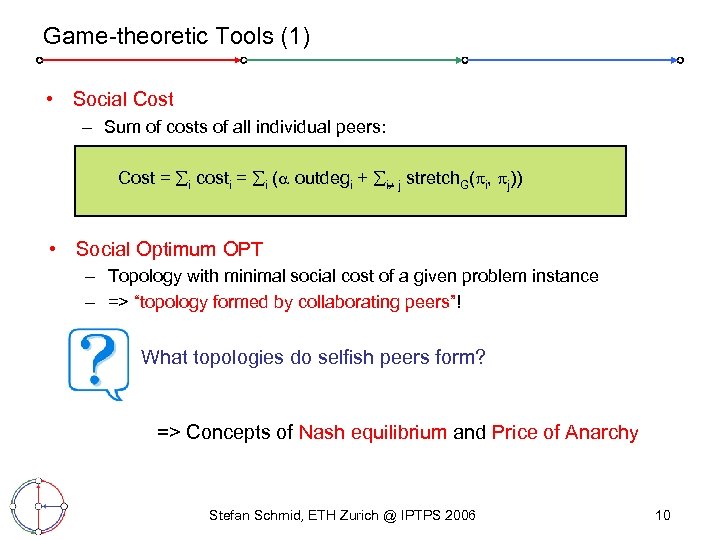
Game-theoretic Tools (1) • Social Cost – Sum of costs of all individual peers: Cost = i costi = i ( outdegi + i j stretch. G( i, j)) • Social Optimum OPT – Topology with minimal social cost of a given problem instance – => “topology formed by collaborating peers”! • What topologies do selfish peers form? => Concepts of Nash equilibrium and Price of Anarchy Stefan Schmid, ETH Zurich @ IPTPS 2006 10
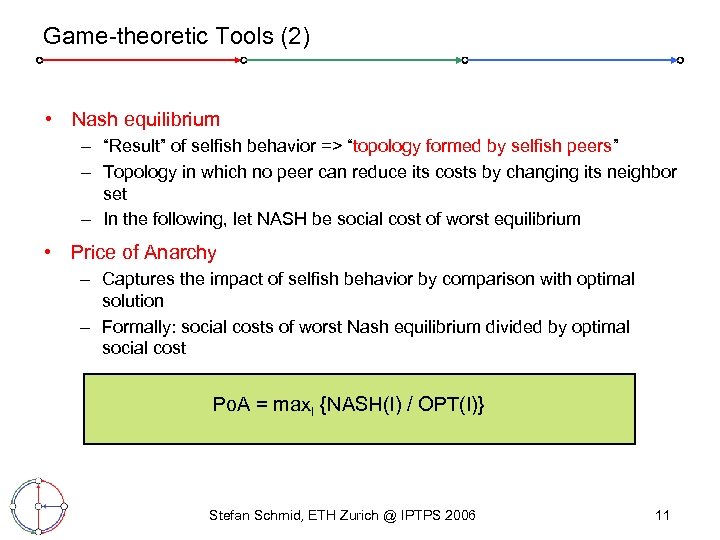
Game-theoretic Tools (2) • Nash equilibrium – “Result” of selfish behavior => “topology formed by selfish peers” – Topology in which no peer can reduce its costs by changing its neighbor set – In the following, let NASH be social cost of worst equilibrium • Price of Anarchy – Captures the impact of selfish behavior by comparison with optimal solution – Formally: social costs of worst Nash equilibrium divided by optimal social cost Po. A = max. I {NASH(I) / OPT(I)} Stefan Schmid, ETH Zurich @ IPTPS 2006 11
Talk Overview • Problem statement • Game-theoretic tools • How good / bad are topologies formed by selfish peers? • Stability of topologies formed by selfish peers • Conclusion Stefan Schmid, ETH Zurich @ IPTPS 2006 12
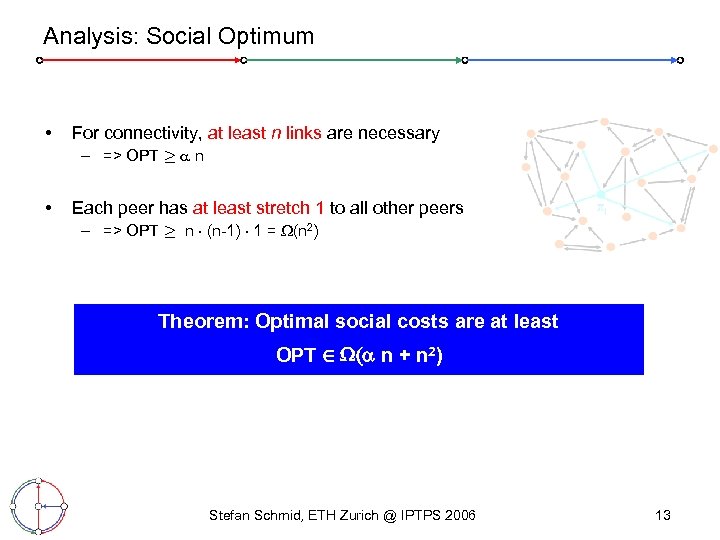
Analysis: Social Optimum • For connectivity, at least n links are necessary – => OPT ¸ n • Each peer has at least stretch 1 to all other peers – => OPT ¸ n ¢ (n-1) ¢ 1 = (n 2) Theorem: Optimal social costs are at least OPT 2 ( n + n 2) Stefan Schmid, ETH Zurich @ IPTPS 2006 13
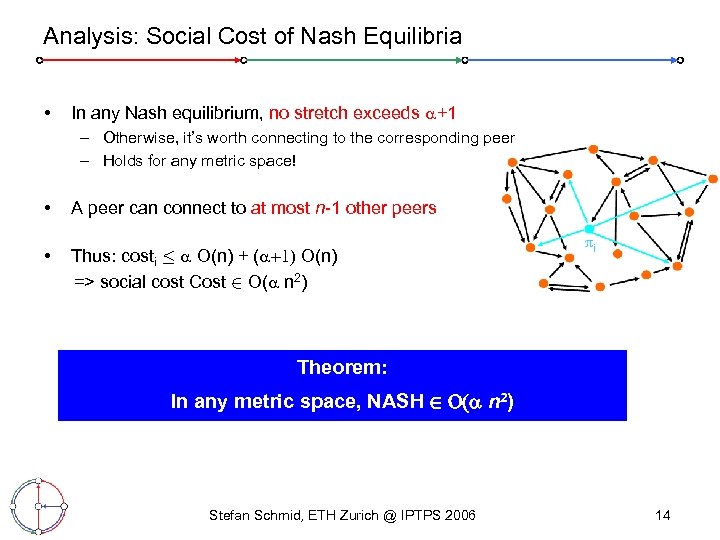
Analysis: Social Cost of Nash Equilibria • In any Nash equilibrium, no stretch exceeds +1 – Otherwise, it’s worth connecting to the corresponding peer – Holds for any metric space! • A peer can connect to at most n-1 other peers • Thus: costi · O(n) + ( +1) O(n) => social cost Cost 2 O( n 2) Theorem: In any metric space, NASH 2 O( n 2) Stefan Schmid, ETH Zurich @ IPTPS 2006 14
Analysis: Price of Anarchy (Upper Bound) • Since OPT = ( n + n 2). . . • … and since NASH = O( n 2 ), • we have the following upper bound for the price of anarchy: Theorem: In any metric space, Po. A 2 O(min{ , n}). Stefan Schmid, ETH Zurich @ IPTPS 2006 15
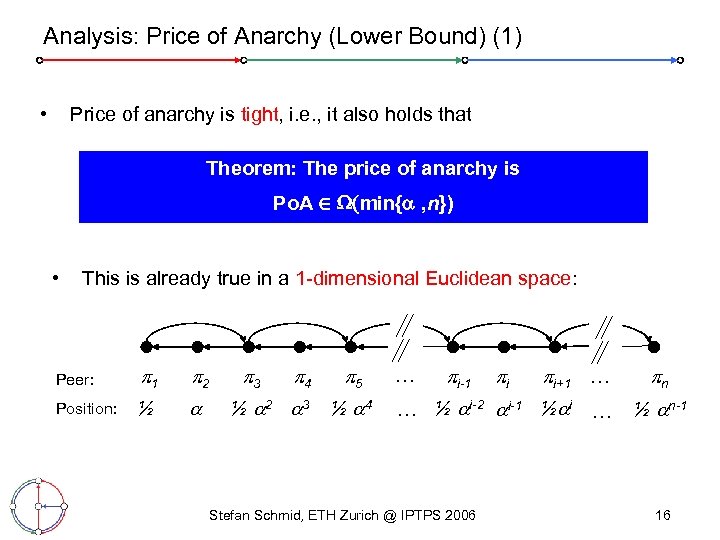
Analysis: Price of Anarchy (Lower Bound) (1) • Price of anarchy is tight, i. e. , it also holds that Theorem: The price of anarchy is Po. A 2 (min{ , n}) • This is already true in a 1 -dimensional Euclidean space: Peer: 1 Position: ½ 2 3 4 ½ 2 3 5 ½ 4 … i-1 i i+1 … … ½ i-2 i-1 ½ i … Stefan Schmid, ETH Zurich @ IPTPS 2006 n ½ n-1 16
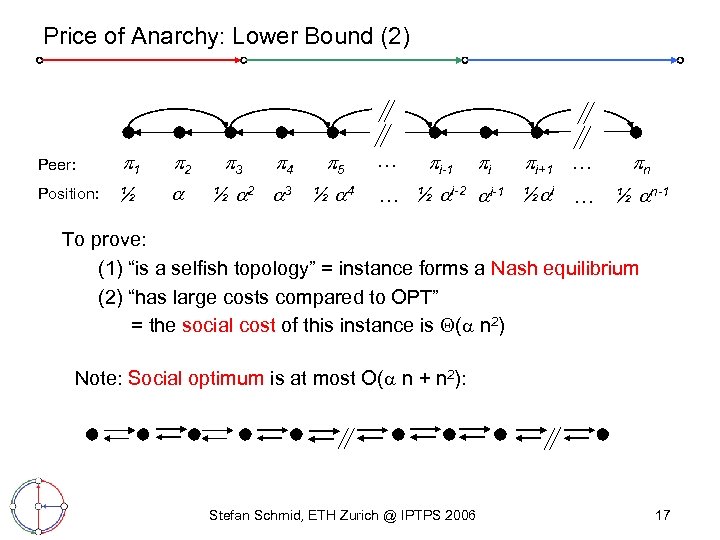
Price of Anarchy: Lower Bound (2) Peer: 1 Position: ½ 2 3 4 ½ 2 3 5 ½ 4 … i-1 i i+1 … … ½ i-2 i-1 ½ i … n ½ n-1 To prove: (1) “is a selfish topology” = instance forms a Nash equilibrium (2) “has large costs compared to OPT” = the social cost of this instance is ( n 2) Note: Social optimum is at most O( n + n 2): Stefan Schmid, ETH Zurich @ IPTPS 2006 17
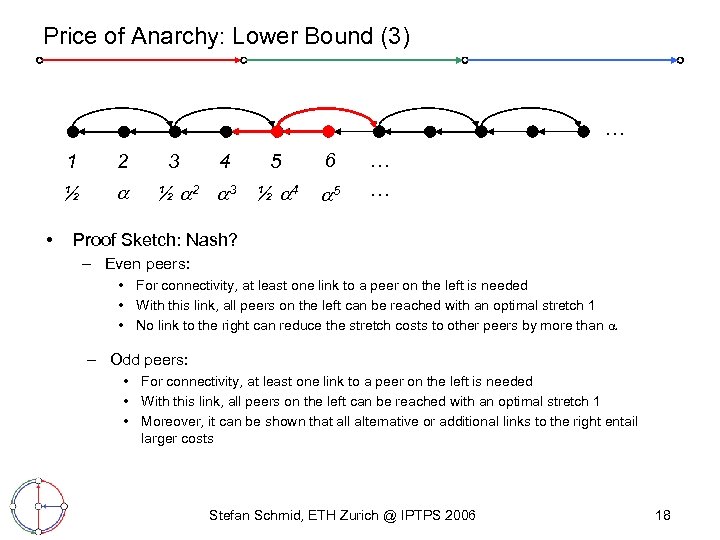
Price of Anarchy: Lower Bound (3) … 1 ½ • 2 3 4 ½ 2 3 5 6 ½ 4 5 … … Proof Sketch: Nash? – Even peers: • For connectivity, at least one link to a peer on the left is needed • With this link, all peers on the left can be reached with an optimal stretch 1 • No link to the right can reduce the stretch costs to other peers by more than – Odd peers: • For connectivity, at least one link to a peer on the left is needed • With this link, all peers on the left can be reached with an optimal stretch 1 • Moreover, it can be shown that all alternative or additional links to the right entail larger costs Stefan Schmid, ETH Zurich @ IPTPS 2006 18
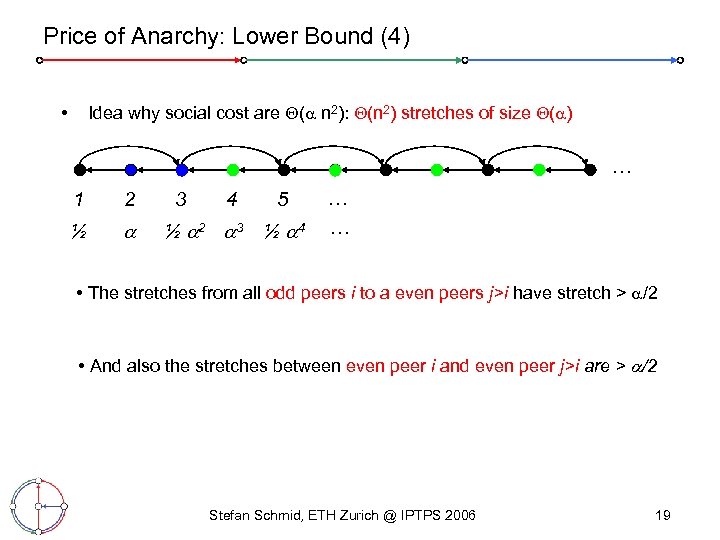
Price of Anarchy: Lower Bound (4) Idea why social cost are ( n 2): (n 2) stretches of size ( ) • … 1 2 ½ 3 4 ½ 2 3 5 ½ 4 … … • The stretches from all odd peers i to a even peers j>i have stretch > /2 • And also the stretches between even peer i and even peer j>i are > /2 Stefan Schmid, ETH Zurich @ IPTPS 2006 19
Price of Anarchy Theorem: The price of anarchy is Po. A 2 (min{ , n}) • Po. A can grow linearly in the total number of peers • Po. A can grow linearly in the relative importance of degree costs Stefan Schmid, ETH Zurich @ IPTPS 2006 20
Talk Overview • Problem statement • Game-theoretic tools • How good / bad are topologies formed by selfish peers? • Stability of topologies formed by selfish peers • Conclusion Stefan Schmid, ETH Zurich @ IPTPS 2006 21
Stability (1) • Peers change their neighbors to improve their individual costs. • How long thus it take until no peer has an incentive to change its neighbors anymore? Theorem: Even in the absence of churn, peer mobility or other sources of dynamism, the system may never stabilize (i. e. , P 2 P system never reaches a Nash equilibrium)! Stefan Schmid, ETH Zurich @ IPTPS 2006 22
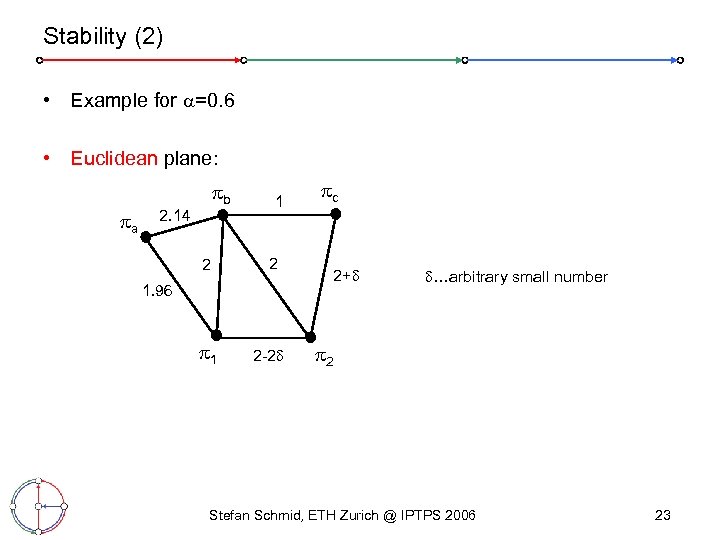
Stability (2) • Example for =0. 6 • Euclidean plane: a b 2. 14 2 1. 96 1 2 -2 c 2+ …arbitrary small number 2 Stefan Schmid, ETH Zurich @ IPTPS 2006 23
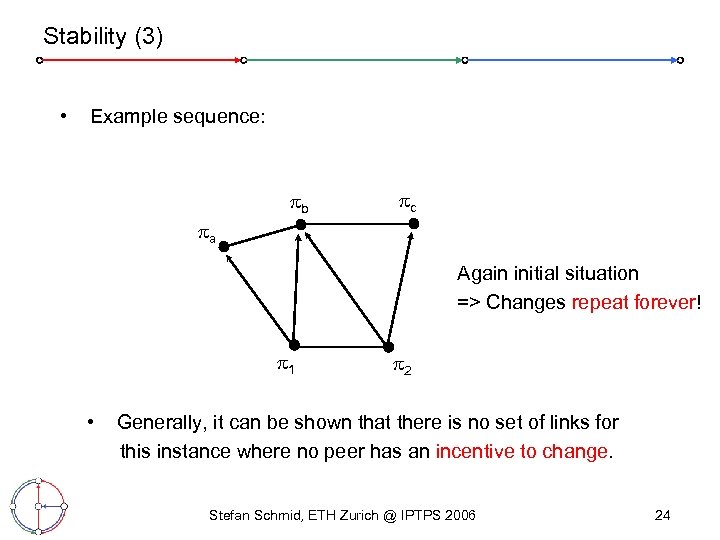
Stability (3) • Example sequence: b c a Again initial situation => Changes repeat forever! 1 • 2 Generally, it can be shown that there is no set of links for this instance where no peer has an incentive to change. Stefan Schmid, ETH Zurich @ IPTPS 2006 24
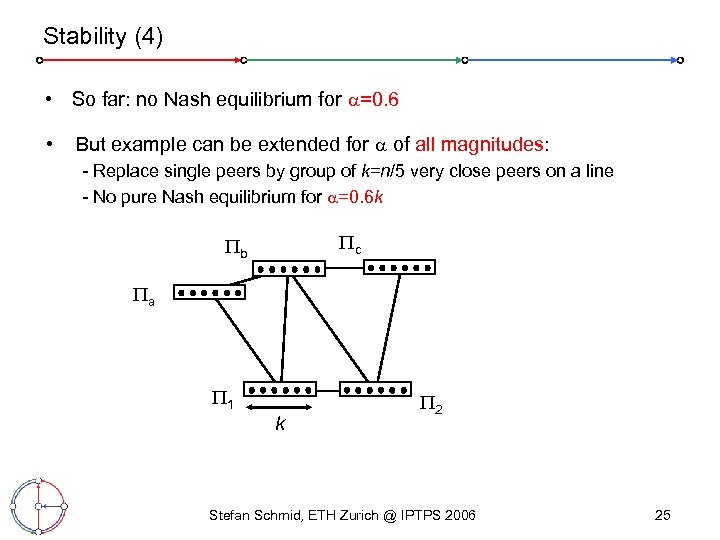
Stability (4) • So far: no Nash equilibrium for =0. 6 • But example can be extended for of all magnitudes: - Replace single peers by group of k=n/5 very close peers on a line - No pure Nash equilibrium for =0. 6 k c b a 1 k 2 Stefan Schmid, ETH Zurich @ IPTPS 2006 25
Talk Overview • Problem statement • Game-theoretic tools • How good / bad are topologies formed by selfish peers? • Stability of topologies formed by selfish peers • Conclusion Stefan Schmid, ETH Zurich @ IPTPS 2006 26
Conclusion • Unstructured topologies created by selfish peers • Efficiency of topology deteriorates linearly in the relative importance of links compared to stretch costs, and in the number of peers • Instable even in static environments • Future Work: - Complexity of stability? NP-hard! - Routing or congestion aspects? - Other forms of selfish behavior? - More local view of peers? - Mechanism design? Stefan Schmid, ETH Zurich @ IPTPS 2006 27
Questions? Thank you for your attention! Acknowledgments: Uri Nadav from Tel Aviv University, Israel Yvonne Anne Oswald from ETH, Switzerland Stefan Schmid, ETH Zurich @ IPTPS 2006 28
Скачать презентацию On the Topologies Formed by Selfish Peers Thomas
957b795f1f5c986e61270be9c001e844.ppt