


 Скачать презентацию On the strategies for the formation of longdistance
e43a22ff1d52f4fc9bf8ee559b4b8dbb.ppt
- Количество слайдов: 94
 On the strategies for the formation of longdistance dependencies in subject questions Marcel den Dikken CUNY Graduate Center & Meertens Institute (KNAW)
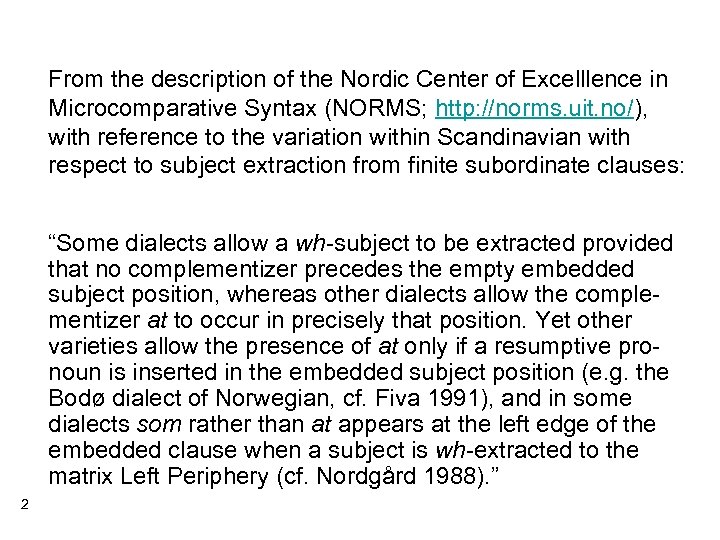 From the description of the Nordic Center of Excelllence in Microcomparative Syntax (NORMS; http: //norms. uit. no/), with reference to the variation within Scandinavian with respect to subject extraction from finite subordinate clauses: “Some dialects allow a wh-subject to be extracted provided that no complementizer precedes the empty embedded subject position, whereas other dialects allow the complementizer at to occur in precisely that position. Yet other varieties allow the presence of at only if a resumptive pronoun is inserted in the embedded subject position (e. g. the Bodø dialect of Norwegian, cf. Fiva 1991), and in some dialects som rather than at appears at the left edge of the embedded clause when a subject is wh-extracted to the matrix Left Periphery (cf. Nordgård 1988). ” 2
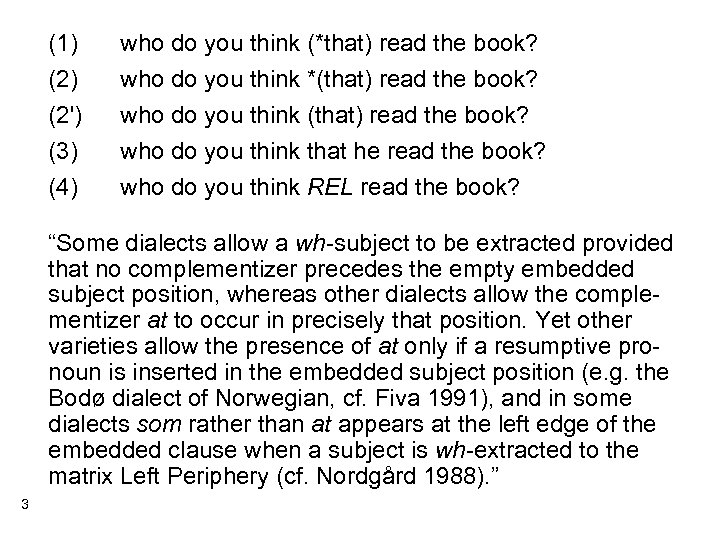 (1) (2') who do you think (*that) read the book? who do you think *(that) read the book? who do you think (that) read the book? (3) (4) who do you think that he read the book? who do you think REL read the book? “Some dialects allow a wh-subject to be extracted provided that no complementizer precedes the empty embedded subject position, whereas other dialects allow the complementizer at to occur in precisely that position. Yet other varieties allow the presence of at only if a resumptive pronoun is inserted in the embedded subject position (e. g. the Bodø dialect of Norwegian, cf. Fiva 1991), and in some dialects som rather than at appears at the left edge of the embedded clause when a subject is wh-extracted to the matrix Left Periphery (cf. Nordgård 1988). ” 3
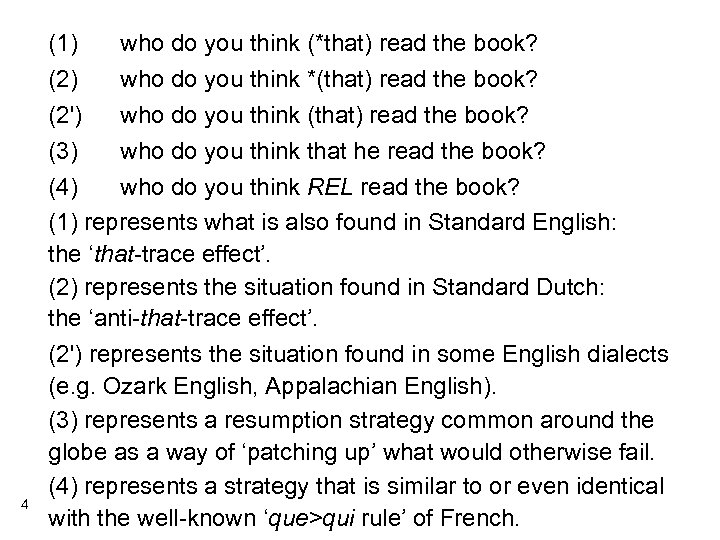 (1) (2') 4 who do you think (*that) read the book? who do you think *(that) read the book? who do you think (that) read the book? (3) who do you think that he read the book? (4) who do you think REL read the book? (1) represents what is also found in Standard English: the ‘that-trace effect’. (2) represents the situation found in Standard Dutch: the ‘anti-that-trace effect’. (2') represents the situation found in some English dialects (e. g. Ozark English, Appalachian English). (3) represents a resumption strategy common around the globe as a way of ‘patching up’ what would otherwise fail. (4) represents a strategy that is similar to or even identical with the well-known ‘que>qui rule’ of French.
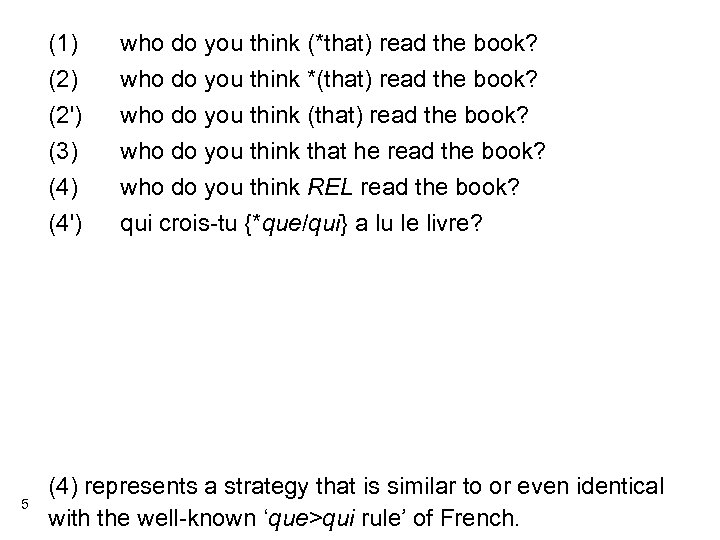 (1) (2') (3) (4') 5 who do you think (*that) read the book? who do you think *(that) read the book? who do you think that he read the book? who do you think REL read the book? qui crois-tu {*que/qui} a lu le livre? (4) represents a strategy that is similar to or even identical with the well-known ‘que>qui rule’ of French.
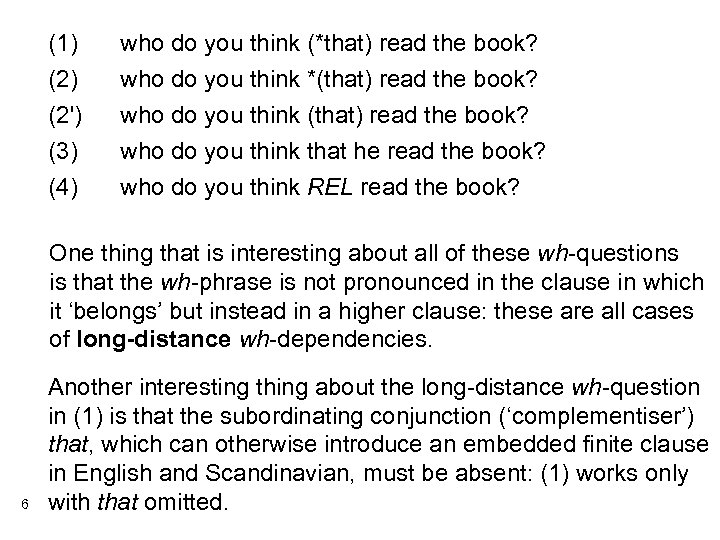 (1) (2') who do you think (*that) read the book? who do you think *(that) read the book? who do you think (that) read the book? (3) (4) who do you think that he read the book? who do you think REL read the book? One thing that is interesting about all of these wh-questions is that the wh-phrase is not pronounced in the clause in which it ‘belongs’ but instead in a higher clause: these are all cases of long-distance wh-dependencies. 6 Another interesting thing about the long-distance wh-question in (1) is that the subordinating conjunction (‘complementiser’) that, which can otherwise introduce an embedded finite clause in English and Scandinavian, must be absent: (1) works only with that omitted.
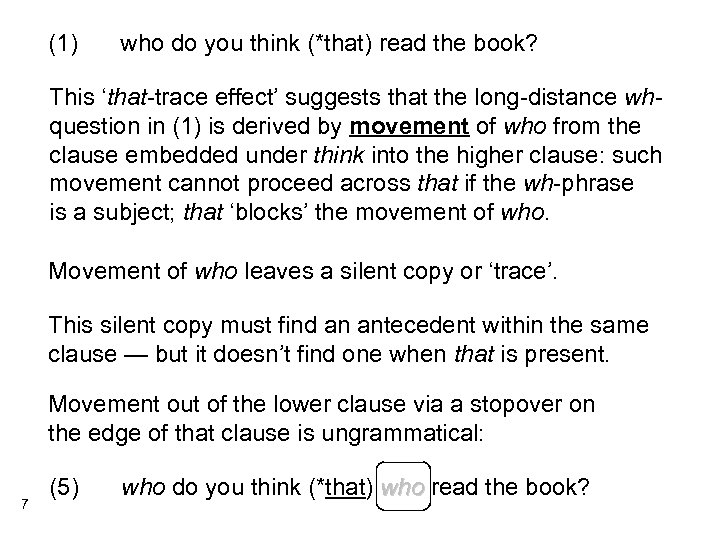 (1) who do you think (*that) read the book? This ‘that-trace effect’ suggests that the long-distance whquestion in (1) is derived by movement of who from the clause embedded under think into the higher clause: such movement cannot proceed across that if the wh-phrase is a subject; that ‘blocks’ the movement of who. Movement of who leaves a silent copy or ‘trace’. This silent copy must find an antecedent within the same clause — but it doesn’t find one when that is present. Movement out of the lower clause via a stopover on the edge of that clause is ungrammatical: 7 (5) who do you think (*that) who read the book?
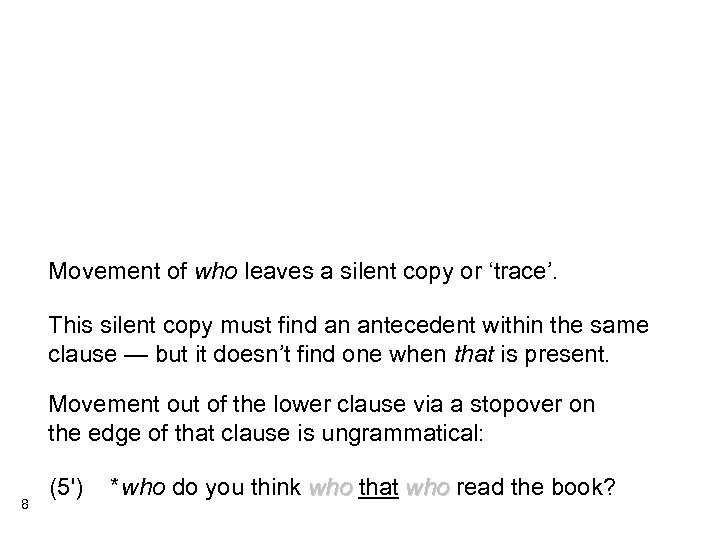 Movement of who leaves a silent copy or ‘trace’. This silent copy must find an antecedent within the same clause — but it doesn’t find one when that is present. Movement out of the lower clause via a stopover on the edge of that clause is ungrammatical: 8 (5') *who do you think who that who read the book?
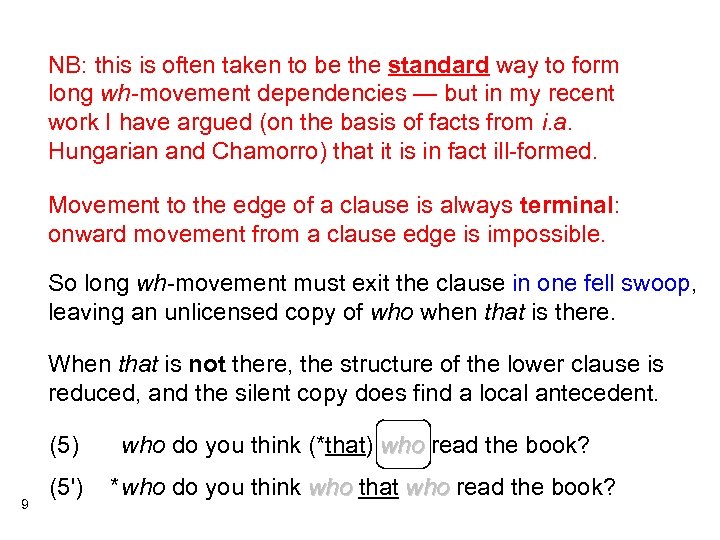 NB: this is often taken to be the standard way to form long wh-movement dependencies — but in my recent work I have argued (on the basis of facts from i. a. Hungarian and Chamorro) that it is in fact ill-formed. Movement to the edge of a clause is always terminal: onward movement from a clause edge is impossible. So long wh-movement must exit the clause in one fell swoop, leaving an unlicensed copy of who when that is there. When that is not there, the structure of the lower clause is reduced, and the silent copy does find a local antecedent. (5) 9 who do you think (*that) who read the book? (5') *who do you think who that who read the book?
 an aside. . . The literature is literally teeming with so-called evidence for successive-cyclic movement through Spec. CP: • complementiser agreement • embedded inversion • quantifier float • intermediate P-stranding • etc. Upon inspection, none of this actually constitutes evidence specifically for successive-cyclic movement through Spec. CP. See Den Dikken (2009) for detailed discussion. 10 I will pick out one case-study here: sentence processing.
![Gibson & Warren (2004) [Syntax] present evidence for the presence of intermediate traces coming](https://present5.com/presentation/e43a22ff1d52f4fc9bf8ee559b4b8dbb/image-11.jpg "Gibson & Warren (2004) [Syntax] present evidence for the presence of intermediate traces coming") Gibson & Warren (2004) [Syntax] present evidence for the presence of intermediate traces coming from English native speakers’ processing of long wh-questions. (x) a. the manager who the consultant claimed that the new proposal had pleased will hire five workers tomorrow b. the manager who the consultant’s claim about the new proposal had pleased will hire five workers tomorrow (y) a. the consultant claimed that the new proposal had pleased the manager who will hire five workers tomorrow b. the consultant’s claim about the new proposal had pleased the manager who will hire five workers tomorrow In (xa), the reading time delay at pleased (caused by the distance between the filler and the gap) is shorter than in (xb). 11 In (ya, b), where no extraction is involved from the complement of pleased, no such difference in RTs at pleased is found.
Gibson & Warren (2004) [Syntax] present evidence for the presence of intermediate traces coming from English native speakers’ processing of long wh-questions. (x) a. the manager who the consultant claimed that the new proposal had pleased will hire five workers tomorrow b. the manager who the consultant’s claim about the new proposal had pleased will hire five workers tomorrow (y) a. the consultant claimed that the new proposal had pleased the manager who will hire five workers tomorrow b. the consultant’s claim about the new proposal had pleased the manager who will hire five workers tomorrow In (xa), the reading time delay at pleased (caused by the distance between the filler and the gap) is shorter than in (xb). 11 In (ya, b), where no extraction is involved from the complement of pleased, no such difference in RTs at pleased is found.
![Gibson & Warren (2004) [Syntax] present evidence for the presence of intermediate traces coming](https://present5.com/presentation/e43a22ff1d52f4fc9bf8ee559b4b8dbb/image-12.jpg "Gibson & Warren (2004) [Syntax] present evidence for the presence of intermediate traces coming") Gibson & Warren (2004) [Syntax] present evidence for the presence of intermediate traces coming from English native speakers’ processing of long wh-questions. ↓ (x) a. the manager who the consultant claimed that the new proposal had pleased will hire five workers tomorrow b. the manager who the consultant’s claim about the new proposal had pleased will hire five workers tomorrow The shorter RT at pleased in (xa) compared to (xb) is taken to suggest that the gap following pleased is less distant from its immediate antecedent in (xa) than it is in (xb). This in turn is taken to suggest that there is a wh-antecedent near the gap in object position in the embedded CP in (xa). This wh-antecedent is taken to be an intermediate trace, situated in the embedded Spec. CP position — because. . . 12
Gibson & Warren (2004) [Syntax] present evidence for the presence of intermediate traces coming from English native speakers’ processing of long wh-questions. ↓ (x) a. the manager who the consultant claimed that the new proposal had pleased will hire five workers tomorrow b. the manager who the consultant’s claim about the new proposal had pleased will hire five workers tomorrow The shorter RT at pleased in (xa) compared to (xb) is taken to suggest that the gap following pleased is less distant from its immediate antecedent in (xa) than it is in (xb). This in turn is taken to suggest that there is a wh-antecedent near the gap in object position in the embedded CP in (xa). This wh-antecedent is taken to be an intermediate trace, situated in the embedded Spec. CP position — because. . . 12
![Gibson & Warren (2004) [Syntax] present evidence for the presence of intermediate traces coming](https://present5.com/presentation/e43a22ff1d52f4fc9bf8ee559b4b8dbb/image-13.jpg "Gibson & Warren (2004) [Syntax] present evidence for the presence of intermediate traces coming") Gibson & Warren (2004) [Syntax] present evidence for the presence of intermediate traces coming from English native speakers’ processing of long wh-questions. ↓ (x) a. the manager who the consultant claimed that the new proposal had pleased will hire five workers tomorrow b. the manager who the consultant’s claim about the new proposal had pleased will hire five workers tomorrow (y) a. the consultant claimed that the new proposal had pleased the manager who will hire five workers tomorrow b. the consultant’s claim about the new proposal had pleased the manager who will hire five workers tomorrow 13 Gibson & Warren also find a longer RT at that in (xa) than in the corresponding non-extraction case in (ya). But they also note that the RT at about in (xb) is longer than in the non-extraction case in (yb), so the longer RT at that in (xa) is not clear evidence for a trace specifically in Spec. CP.
Gibson & Warren (2004) [Syntax] present evidence for the presence of intermediate traces coming from English native speakers’ processing of long wh-questions. ↓ (x) a. the manager who the consultant claimed that the new proposal had pleased will hire five workers tomorrow b. the manager who the consultant’s claim about the new proposal had pleased will hire five workers tomorrow (y) a. the consultant claimed that the new proposal had pleased the manager who will hire five workers tomorrow b. the consultant’s claim about the new proposal had pleased the manager who will hire five workers tomorrow 13 Gibson & Warren also find a longer RT at that in (xa) than in the corresponding non-extraction case in (ya). But they also note that the RT at about in (xb) is longer than in the non-extraction case in (yb), so the longer RT at that in (xa) is not clear evidence for a trace specifically in Spec. CP.
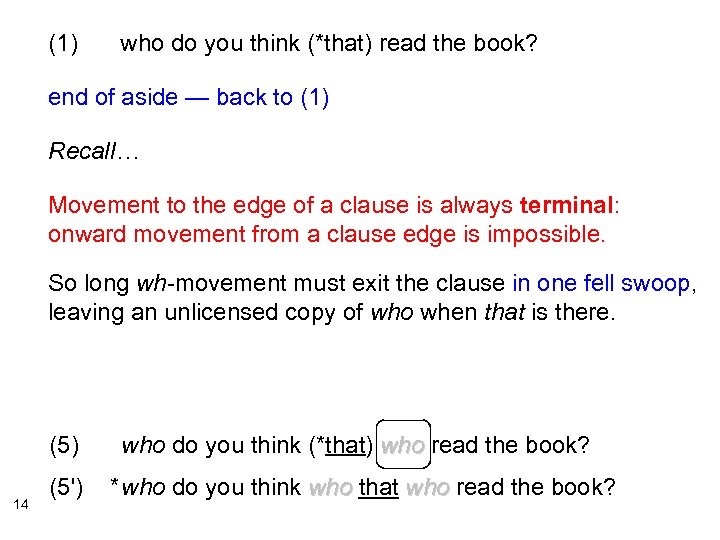 (1) who do you think (*that) read the book? end of aside — back to (1) Recall… Movement to the edge of a clause is always terminal: onward movement from a clause edge is impossible. So long wh-movement must exit the clause in one fell swoop, leaving an unlicensed copy of who when that is there. (5) 14 who do you think (*that) who read the book? (5') *who do you think who that who read the book?
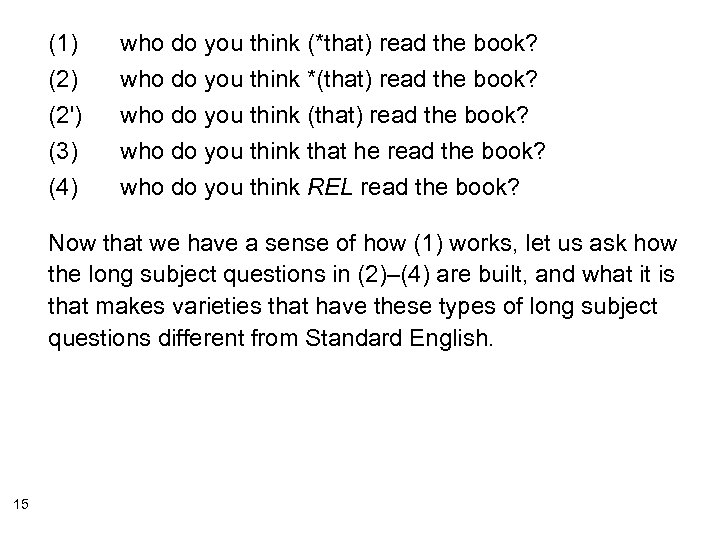 (1) (2') who do you think (*that) read the book? who do you think *(that) read the book? who do you think (that) read the book? (3) (4) who do you think that he read the book? who do you think REL read the book? Now that we have a sense of how (1) works, let us ask how the long subject questions in (2)–(4) are built, and what it is that makes varieties that have these types of long subject questions different from Standard English. 15
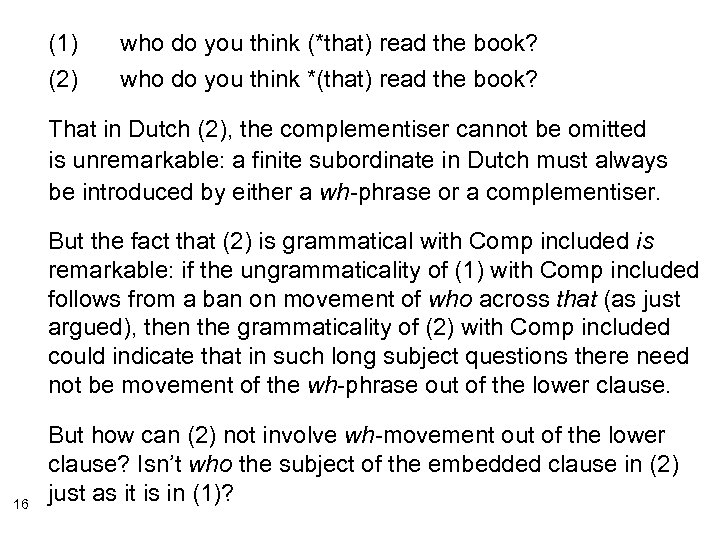 (1) (2) who do you think (*that) read the book? who do you think *(that) read the book? That in Dutch (2), the complementiser cannot be omitted is unremarkable: a finite subordinate in Dutch must always be introduced by either a wh-phrase or a complementiser. But the fact that (2) is grammatical with Comp included is remarkable: if the ungrammaticality of (1) with Comp included follows from a ban on movement of who across that (as just argued), then the grammaticality of (2) with Comp included could indicate that in such long subject questions there need not be movement of the wh-phrase out of the lower clause. 16 But how can (2) not involve wh-movement out of the lower clause? Isn’t who the subject of the embedded clause in (2) just as it is in (1)?
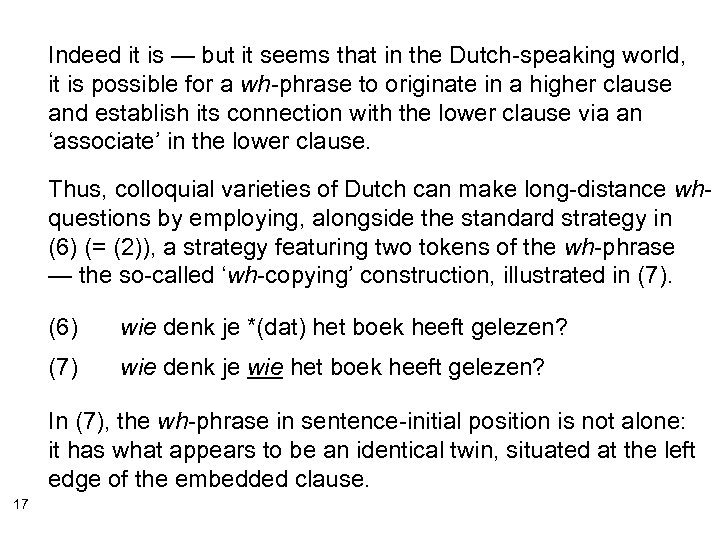 Indeed it is — but it seems that in the Dutch-speaking world, it is possible for a wh-phrase to originate in a higher clause and establish its connection with the lower clause via an ‘associate’ in the lower clause. Thus, colloquial varieties of Dutch can make long-distance whquestions by employing, alongside the standard strategy in (6) (= (2)), a strategy featuring two tokens of the wh-phrase — the so-called ‘wh-copying’ construction, illustrated in (7). (6) wie denk je *(dat) het boek heeft gelezen? (7) wie denk je wie het boek heeft gelezen? In (7), the wh-phrase in sentence-initial position is not alone: it has what appears to be an identical twin, situated at the left edge of the embedded clause. 17
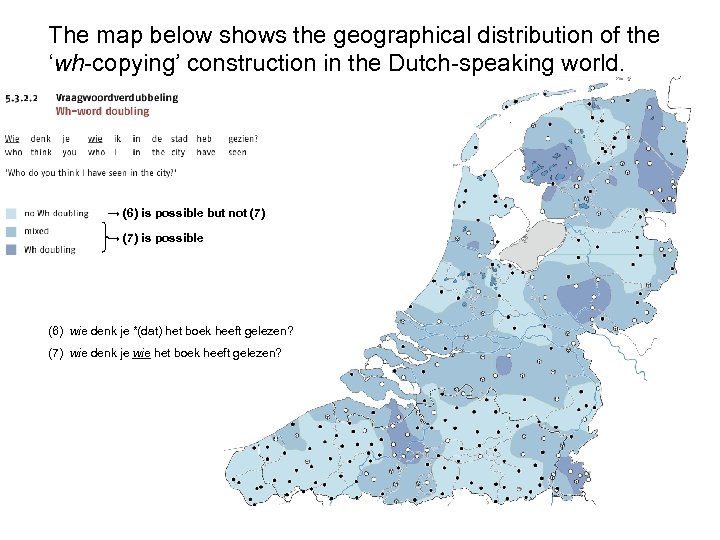 The map below shows the geographical distribution of the ‘wh-copying’ construction in the Dutch-speaking world. → (6) is possible but not (7) → (7) is possible (6) wie denk je *(dat) het boek heeft gelezen? (7) wie denk je wie het boek heeft gelezen? 18
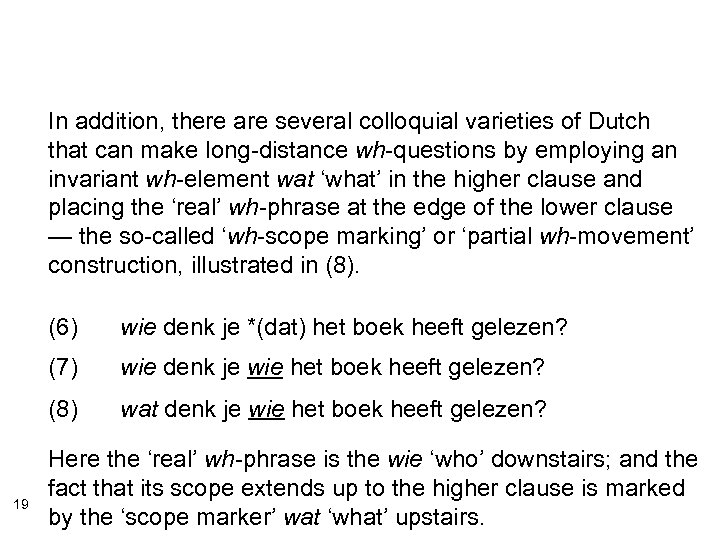 In addition, there are several colloquial varieties of Dutch that can make long-distance wh-questions by employing an invariant wh-element wat ‘what’ in the higher clause and placing the ‘real’ wh-phrase at the edge of the lower clause — the so-called ‘wh-scope marking’ or ‘partial wh-movement’ construction, illustrated in (8). (6) (7) wie denk je wie het boek heeft gelezen? (8) 19 wie denk je *(dat) het boek heeft gelezen? wat denk je wie het boek heeft gelezen? Here the ‘real’ wh-phrase is the wie ‘who’ downstairs; and the fact that its scope extends up to the higher clause is marked by the ‘scope marker’ wat ‘what’ upstairs.
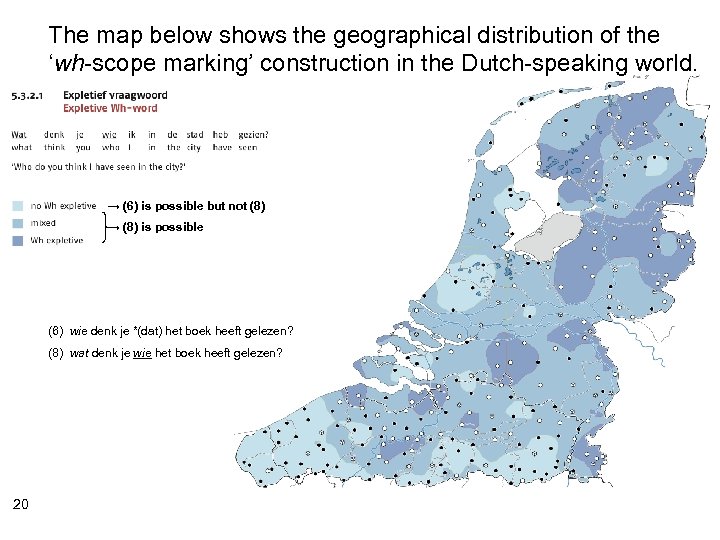 The map below shows the geographical distribution of the ‘wh-scope marking’ construction in the Dutch-speaking world. → (6) is possible but not (8) → (8) is possible (6) wie denk je *(dat) het boek heeft gelezen? (8) wat denk je wie het boek heeft gelezen? 20
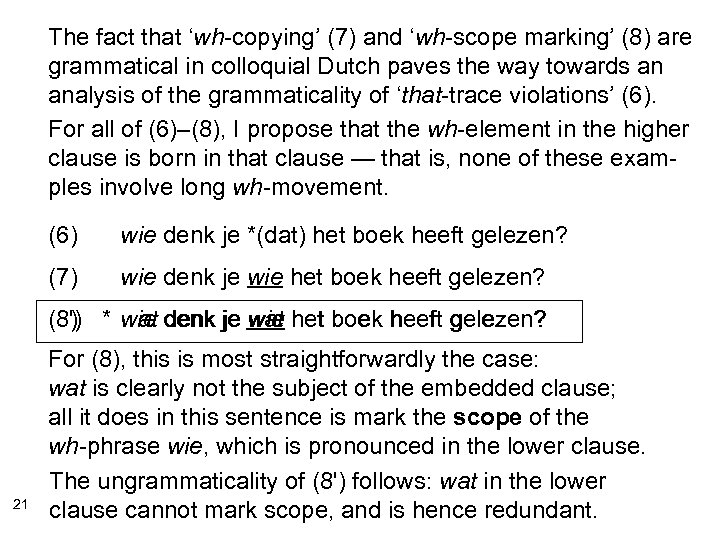 The fact that ‘wh-copying’ (7) and ‘wh-scope marking’ (8) are grammatical in colloquial Dutch paves the way towards an analysis of the grammaticality of ‘that-trace violations’ (6). For all of (6)–(8), I propose that the wh-element in the higher clause is born in that clause — that is, none of these examples involve long wh-movement. (6) wie denk je *(dat) het boek heeft gelezen? (7) wie denk je wie het boek heeft gelezen? (8') * wie denk je wat het boek heeft gelezen? (8) wat wie 21 For (8), this is most straightforwardly the case: wat is clearly not the subject of the embedded clause; all it does in this sentence is mark the scope of the wh-phrase wie, which is pronounced in the lower clause. The ungrammaticality of (8') follows: wat in the lower clause cannot mark scope, and is hence redundant.
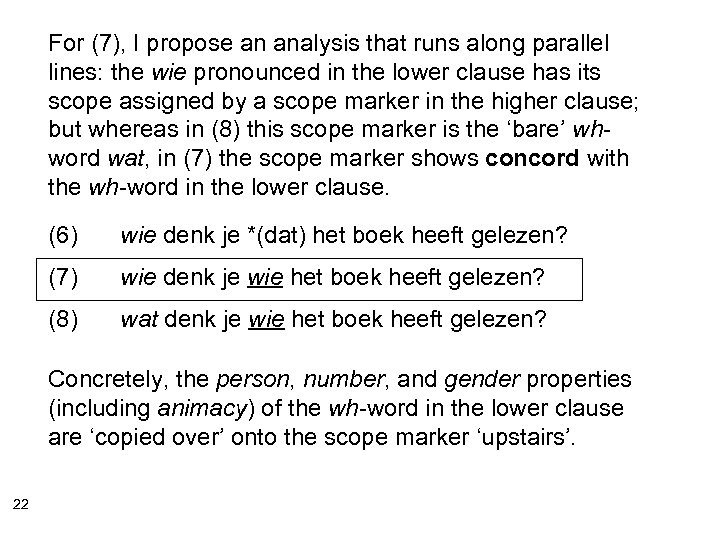 For (7), I propose an analysis that runs along parallel lines: the wie pronounced in the lower clause has its scope assigned by a scope marker in the higher clause; but whereas in (8) this scope marker is the ‘bare’ whword wat, in (7) the scope marker shows concord with the wh-word in the lower clause. (6) wie denk je *(dat) het boek heeft gelezen? (7) wie denk je wie het boek heeft gelezen? (8) wat denk je wie het boek heeft gelezen? Concretely, the person, number, and gender properties (including animacy) of the wh-word in the lower clause are ‘copied over’ onto the scope marker ‘upstairs’. 22
![(7) wie denk je wie[Pers/Num/Gen] het boek heeft gelezen? wat (7) wie denk je](https://present5.com/presentation/e43a22ff1d52f4fc9bf8ee559b4b8dbb/image-23.jpg "(7) wie denk je wie[Pers/Num/Gen] het boek heeft gelezen? wat (7) wie denk je") (7) wie denk je wie[Pers/Num/Gen] het boek heeft gelezen? wat (7) wie denk je wie het boek heeft gelezen? Concretely, the person, number, and gender properties (including animacy) of the wh-word in the lower clause are ‘copied over’ onto the scope marker ‘upstairs’. 23
(7) wie denk je wie[Pers/Num/Gen] het boek heeft gelezen? wat (7) wie denk je wie het boek heeft gelezen? Concretely, the person, number, and gender properties (including animacy) of the wh-word in the lower clause are ‘copied over’ onto the scope marker ‘upstairs’. 23
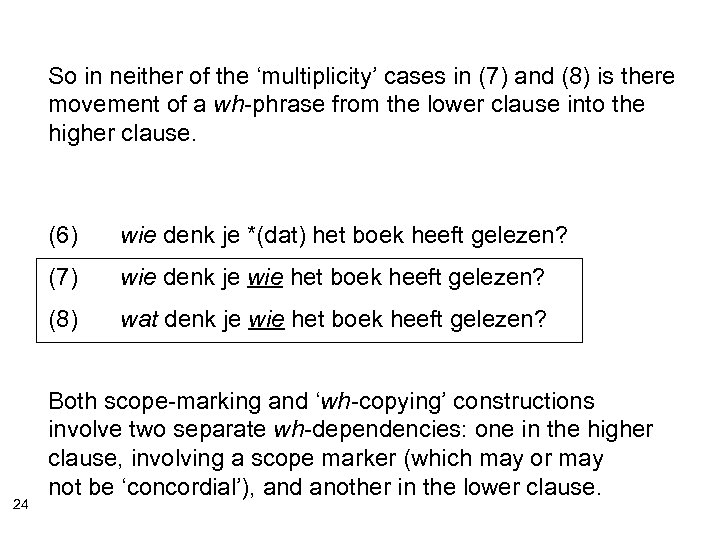 So in neither of the ‘multiplicity’ cases in (7) and (8) is there movement of a wh-phrase from the lower clause into the higher clause. (6) (7) wie denk je wie het boek heeft gelezen? (8) 24 wie denk je *(dat) het boek heeft gelezen? wat denk je wie het boek heeft gelezen? Both scope-marking and ‘wh-copying’ constructions involve two separate wh-dependencies: one in the higher clause, involving a scope marker (which may or may not be ‘concordial’), and another in the lower clause.
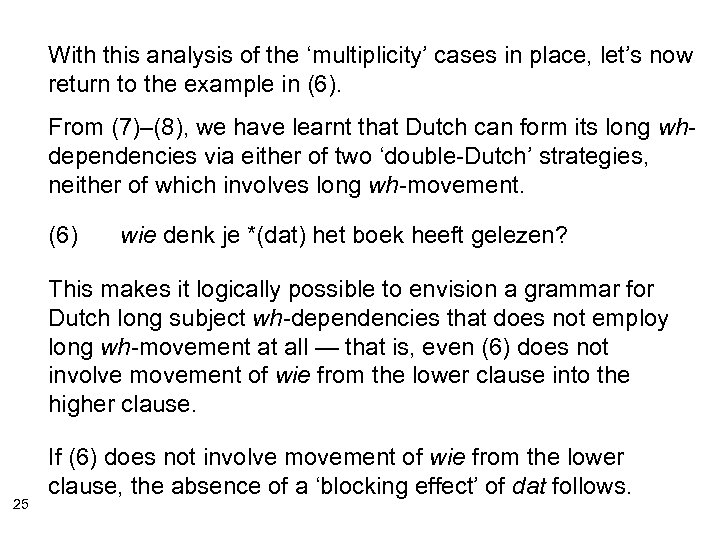 With this analysis of the ‘multiplicity’ cases in place, let’s now return to the example in (6). From (7)–(8), we have learnt that Dutch can form its long whdependencies via either of two ‘double-Dutch’ strategies, neither of which involves long wh-movement. (6) wie denk je *(dat) het boek heeft gelezen? This makes it logically possible to envision a grammar for Dutch long subject wh-dependencies that does not employ long wh-movement at all — that is, even (6) does not involve movement of wie from the lower clause into the higher clause. 25 If (6) does not involve movement of wie from the lower clause, the absence of a ‘blocking effect’ of dat follows.
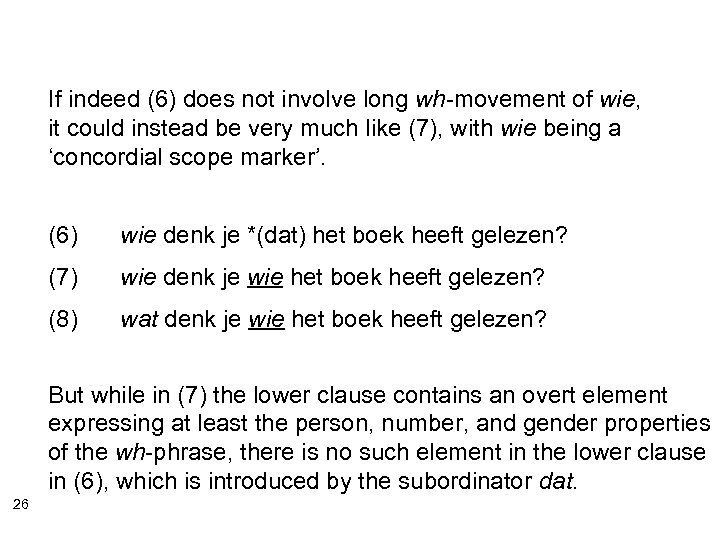 If indeed (6) does not involve long wh-movement of wie, it could instead be very much like (7), with wie being a ‘concordial scope marker’. (6) wie denk je *(dat) het boek heeft gelezen? (7) wie denk je wie het boek heeft gelezen? (8) wat denk je wie het boek heeft gelezen? But while in (7) the lower clause contains an overt element expressing at least the person, number, and gender properties of the wh-phrase, there is no such element in the lower clause in (6), which is introduced by the subordinator dat. 26
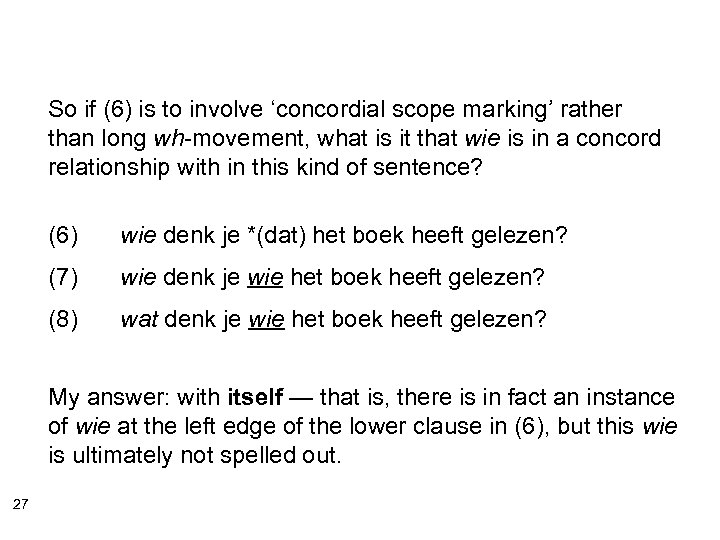 So if (6) is to involve ‘concordial scope marking’ rather than long wh-movement, what is it that wie is in a concord relationship with in this kind of sentence? (6) wie denk je *(dat) het boek heeft gelezen? (7) wie denk je wie het boek heeft gelezen? (8) wat denk je wie het boek heeft gelezen? My answer: with itself — that is, there is in fact an instance of wie at the left edge of the lower clause in (6), but this wie is ultimately not spelled out. 27
![(7) wie denk je wie[Pers/Num/Gen] het boek heeft gelezen? wat Recall that in (7)](https://present5.com/presentation/e43a22ff1d52f4fc9bf8ee559b4b8dbb/image-28.jpg "(7) wie denk je wie[Pers/Num/Gen] het boek heeft gelezen? wat Recall that in (7)") (7) wie denk je wie[Pers/Num/Gen] het boek heeft gelezen? wat Recall that in (7) the element introducing the lower clause entertains a concord relationship with the upstairs scope marker for its person, number, and gender properties. Those properties are a subset of the full array of features borne by these elements; and as a result, the ‘concordial scope marker’ and the introducer of the lower clause are not always strictly identical. (9) 28 a. b. c. d. wie denk je welk type je bent? wie denk je welk team er kampioen wordt? wie denk je welke topsportvrouw dit is? wie denk je welke stellen nog bij elkaar zijn?
(7) wie denk je wie[Pers/Num/Gen] het boek heeft gelezen? wat Recall that in (7) the element introducing the lower clause entertains a concord relationship with the upstairs scope marker for its person, number, and gender properties. Those properties are a subset of the full array of features borne by these elements; and as a result, the ‘concordial scope marker’ and the introducer of the lower clause are not always strictly identical. (9) 28 a. b. c. d. wie denk je welk type je bent? wie denk je welk team er kampioen wordt? wie denk je welke topsportvrouw dit is? wie denk je welke stellen nog bij elkaar zijn?
![(7) wie denk je wie[Pers/Num/Gen] het boek heeft gelezen? wat Recall that in (7)](https://present5.com/presentation/e43a22ff1d52f4fc9bf8ee559b4b8dbb/image-29.jpg "(7) wie denk je wie[Pers/Num/Gen] het boek heeft gelezen? wat Recall that in (7)") (7) wie denk je wie[Pers/Num/Gen] het boek heeft gelezen? wat Recall that in (7) the element introducing the lower clause entertains a concord relationship with the upstairs scope marker for its person, number, and gender properties. Those properties are a subset of the full array of features borne by these elements; and as a result, the ‘concordial scope marker’ and the introducer of the lower clause are not always strictly identical. NB: Jacqueline van Kampen reports that (9) does not occur in child Dutch, but (9') does; I will return to (9') later on. 29 (9') welke jongen denk je wie daar loopt?
(7) wie denk je wie[Pers/Num/Gen] het boek heeft gelezen? wat Recall that in (7) the element introducing the lower clause entertains a concord relationship with the upstairs scope marker for its person, number, and gender properties. Those properties are a subset of the full array of features borne by these elements; and as a result, the ‘concordial scope marker’ and the introducer of the lower clause are not always strictly identical. NB: Jacqueline van Kampen reports that (9) does not occur in child Dutch, but (9') does; I will return to (9') later on. 29 (9') welke jongen denk je wie daar loopt?
![(7) wie denk je wie[Pers/Num/Gen] het boek heeft gelezen? wat Recall that in (7)](https://present5.com/presentation/e43a22ff1d52f4fc9bf8ee559b4b8dbb/image-30.jpg "(7) wie denk je wie[Pers/Num/Gen] het boek heeft gelezen? wat Recall that in (7)") (7) wie denk je wie[Pers/Num/Gen] het boek heeft gelezen? wat Recall that in (7) the element introducing the lower clause entertains a concord relationship with the upstairs scope marker for its person, number, and gender properties. Those properties are a subset of the full array of features borne by these elements; and as a result, the ‘concordial scope marker’ and the introducer of the lower clause are not always strictly identical. 30 Now imagine what would happen if there were not a partial concord but a full concord relationship between the scope marker and the lower wh-element.
(7) wie denk je wie[Pers/Num/Gen] het boek heeft gelezen? wat Recall that in (7) the element introducing the lower clause entertains a concord relationship with the upstairs scope marker for its person, number, and gender properties. Those properties are a subset of the full array of features borne by these elements; and as a result, the ‘concordial scope marker’ and the introducer of the lower clause are not always strictly identical. 30 Now imagine what would happen if there were not a partial concord but a full concord relationship between the scope marker and the lower wh-element.
![(10) wie denk je wie[ALL FEATURES] het boek heeft gelezen? wat What we end](https://present5.com/presentation/e43a22ff1d52f4fc9bf8ee559b4b8dbb/image-31.jpg "(10) wie denk je wie[ALL FEATURES] het boek heeft gelezen? wat What we end") (10) wie denk je wie[ALL FEATURES] het boek heeft gelezen? wat What we end up with as a result of full concord between the two wh-elements is a situation in which we have two fully identical wh-elements in the syntactic structure, one looking down on (‘c-commanding’) the other. When we now want to linearise and spell out the result of full concord in (10), we face a dilemma: one cannot precede or follow oneself. To avoid a contradiction, the phonology realises the output of the derivation in (10) by spelling out only the higher of the two wh-elements. 31
(10) wie denk je wie[ALL FEATURES] het boek heeft gelezen? wat What we end up with as a result of full concord between the two wh-elements is a situation in which we have two fully identical wh-elements in the syntactic structure, one looking down on (‘c-commanding’) the other. When we now want to linearise and spell out the result of full concord in (10), we face a dilemma: one cannot precede or follow oneself. To avoid a contradiction, the phonology realises the output of the derivation in (10) by spelling out only the higher of the two wh-elements. 31
![(10) wie denk je wie[ALL FEATURES] het boek heeft gelezen? wat dat With the](https://present5.com/presentation/e43a22ff1d52f4fc9bf8ee559b4b8dbb/image-32.jpg "(10) wie denk je wie[ALL FEATURES] het boek heeft gelezen? wat dat With the") (10) wie denk je wie[ALL FEATURES] het boek heeft gelezen? wat dat With the lower wh-element left unrealised, we would now seem to derive (6'), which is ungrammatical. (6') *wie denk je het boek heeft gelezen? But (6') is independently rejected by the requirement that the left edge of a subordinate finite clause in Dutch may not be left empty. An overt subordinating conjunction is therefore needed whenever full-concordial scope marking takes place in a long wh-question in Dutch. So (10) comes out as (6) (=(2)). 32 (6) wie denk je dat het boek heeft gelezen?
(10) wie denk je wie[ALL FEATURES] het boek heeft gelezen? wat dat With the lower wh-element left unrealised, we would now seem to derive (6'), which is ungrammatical. (6') *wie denk je het boek heeft gelezen? But (6') is independently rejected by the requirement that the left edge of a subordinate finite clause in Dutch may not be left empty. An overt subordinating conjunction is therefore needed whenever full-concordial scope marking takes place in a long wh-question in Dutch. So (10) comes out as (6) (=(2)). 32 (6) wie denk je dat het boek heeft gelezen?
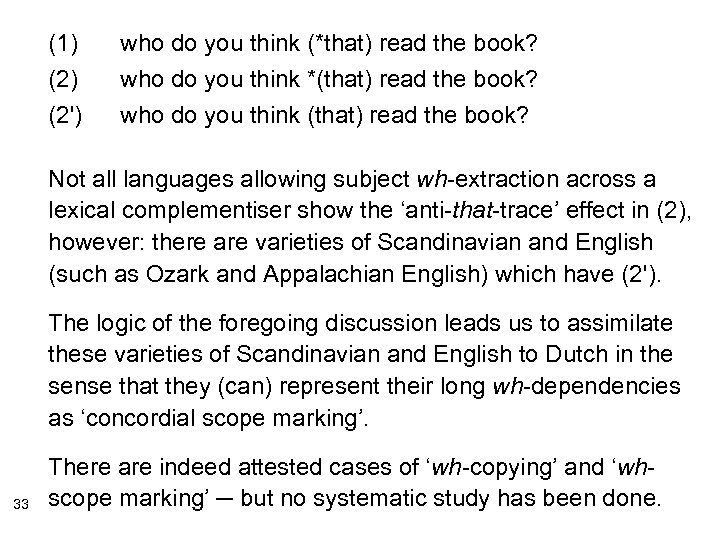 (1) (2') who do you think (*that) read the book? who do you think *(that) read the book? who do you think (that) read the book? Not all languages allowing subject wh-extraction across a lexical complementiser show the ‘anti-that-trace’ effect in (2), however: there are varieties of Scandinavian and English (such as Ozark and Appalachian English) which have (2'). The logic of the foregoing discussion leads us to assimilate these varieties of Scandinavian and English to Dutch in the sense that they (can) represent their long wh-dependencies as ‘concordial scope marking’. 33 There are indeed attested cases of ‘wh-copying’ and ‘whscope marking’ ─ but no systematic study has been done.
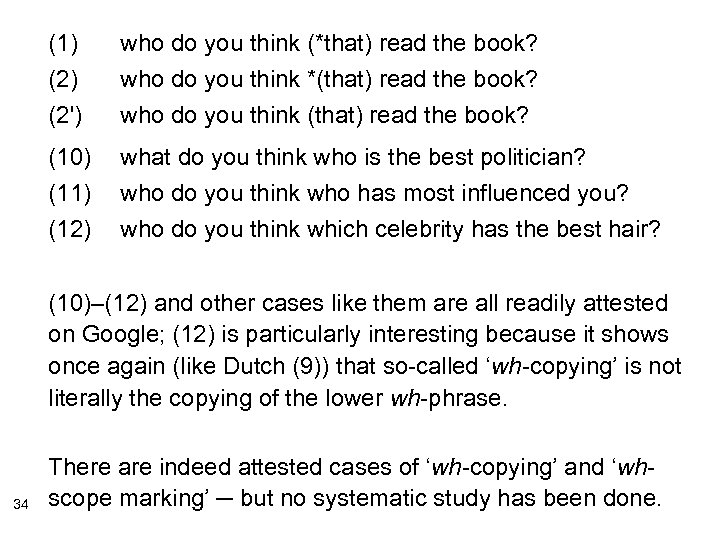 (1) (2') who do you think (*that) read the book? who do you think *(that) read the book? who do you think (that) read the book? (10) (11) (12) what do you think who is the best politician? who do you think who has most influenced you? who do you think which celebrity has the best hair? (10)–(12) and other cases like them are all readily attested on Google; (12) is particularly interesting because it shows once again (like Dutch (9)) that so-called ‘wh-copying’ is not literally the copying of the lower wh-phrase. 34 There are indeed attested cases of ‘wh-copying’ and ‘whscope marking’ ─ but no systematic study has been done.
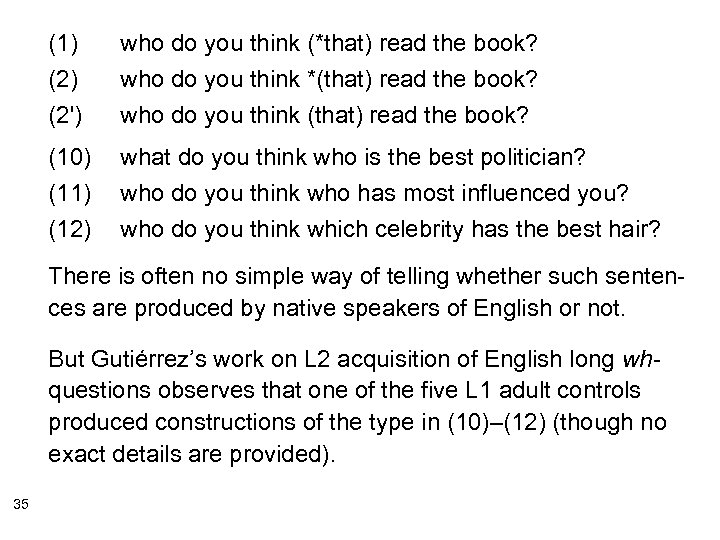 (1) (2') who do you think (*that) read the book? who do you think *(that) read the book? who do you think (that) read the book? (10) (11) (12) what do you think who is the best politician? who do you think who has most influenced you? who do you think which celebrity has the best hair? There is often no simple way of telling whether such sentences are produced by native speakers of English or not. But Gutiérrez’s work on L 2 acquisition of English long whquestions observes that one of the five L 1 adult controls produced constructions of the type in (10)–(12) (though no exact details are provided). 35
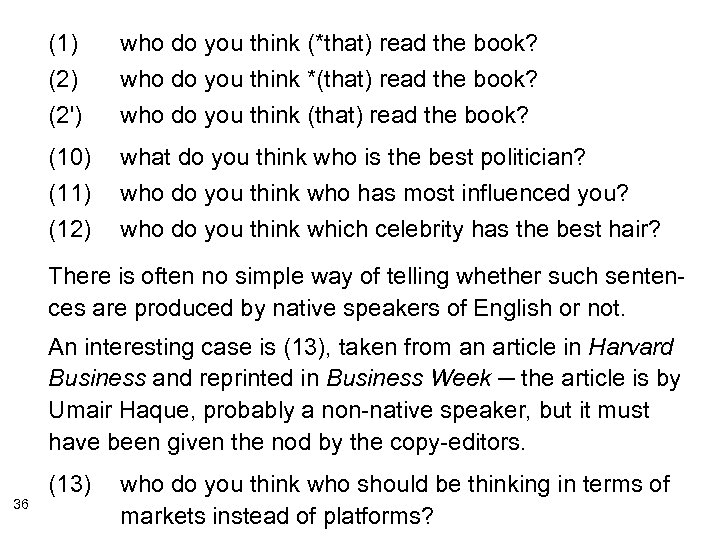 (1) (2') who do you think (*that) read the book? who do you think *(that) read the book? who do you think (that) read the book? (10) (11) (12) what do you think who is the best politician? who do you think who has most influenced you? who do you think which celebrity has the best hair? There is often no simple way of telling whether such sentences are produced by native speakers of English or not. An interesting case is (13), taken from an article in Harvard Business and reprinted in Business Week ─ the article is by Umair Haque, probably a non-native speaker, but it must have been given the nod by the copy-editors. 36 (13) who do you think who should be thinking in terms of markets instead of platforms?
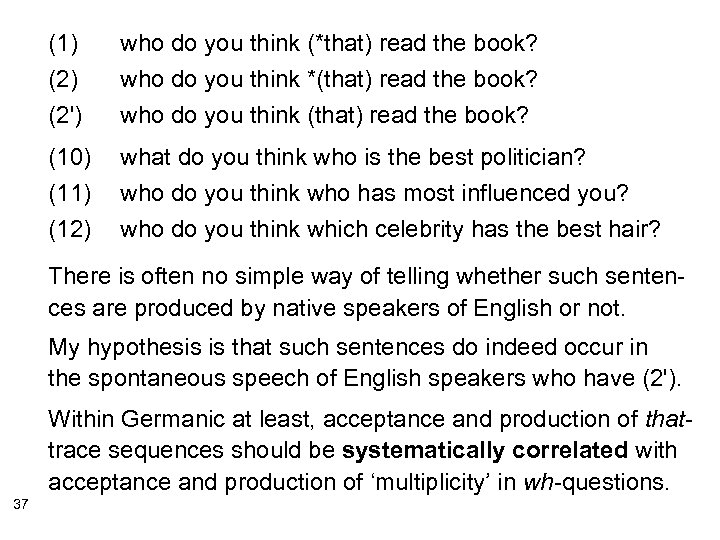 (1) (2') who do you think (*that) read the book? who do you think *(that) read the book? who do you think (that) read the book? (10) (11) (12) what do you think who is the best politician? who do you think who has most influenced you? who do you think which celebrity has the best hair? There is often no simple way of telling whether such sentences are produced by native speakers of English or not. My hypothesis is that such sentences do indeed occur in the spontaneous speech of English speakers who have (2'). Within Germanic at least, acceptance and production of thattrace sequences should be systematically correlated with acceptance and production of ‘multiplicity’ in wh-questions. 37
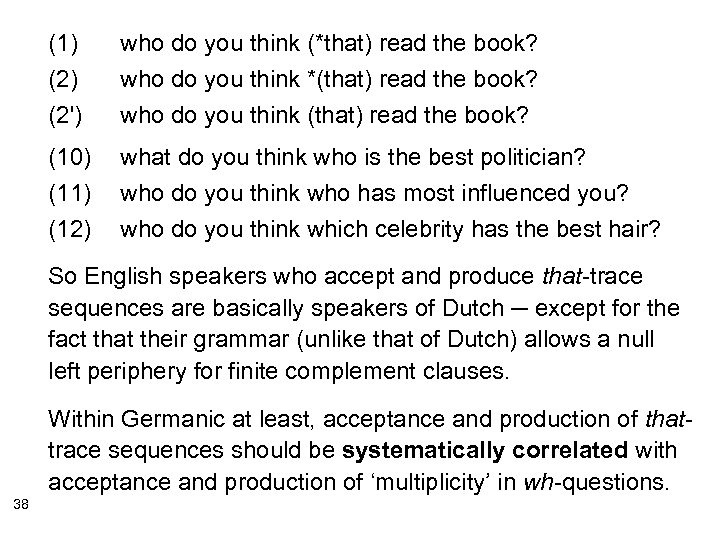 (1) (2') who do you think (*that) read the book? who do you think *(that) read the book? who do you think (that) read the book? (10) (11) (12) what do you think who is the best politician? who do you think who has most influenced you? who do you think which celebrity has the best hair? So English speakers who accept and produce that-trace sequences are basically speakers of Dutch ─ except for the fact that their grammar (unlike that of Dutch) allows a null left periphery for finite complement clauses. Within Germanic at least, acceptance and production of thattrace sequences should be systematically correlated with acceptance and production of ‘multiplicity’ in wh-questions. 38
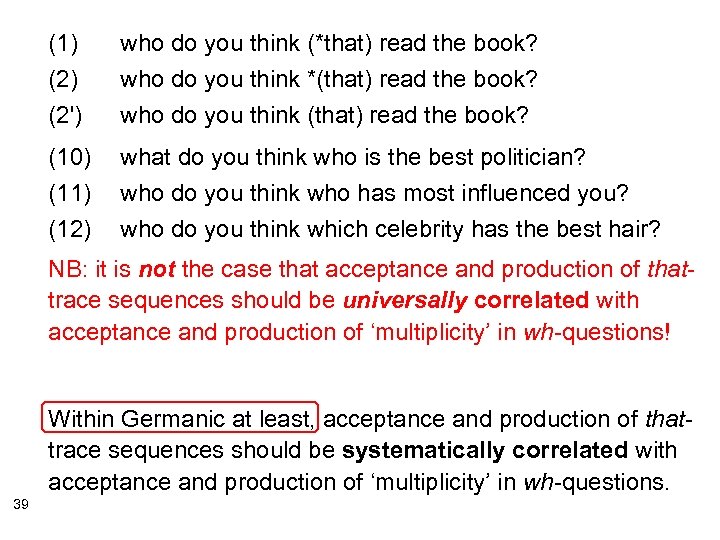 (1) (2') who do you think (*that) read the book? who do you think *(that) read the book? who do you think (that) read the book? (10) (11) (12) what do you think who is the best politician? who do you think who has most influenced you? who do you think which celebrity has the best hair? NB: it is not the case that acceptance and production of thattrace sequences should be universally correlated with acceptance and production of ‘multiplicity’ in wh-questions! Within Germanic at least, acceptance and production of thattrace sequences should be systematically correlated with acceptance and production of ‘multiplicity’ in wh-questions. 39
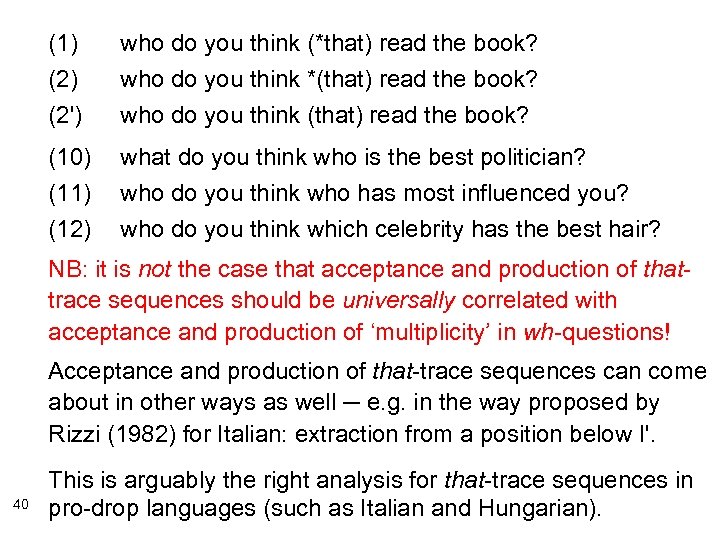 (1) (2') who do you think (*that) read the book? who do you think *(that) read the book? who do you think (that) read the book? (10) (11) (12) what do you think who is the best politician? who do you think who has most influenced you? who do you think which celebrity has the best hair? NB: it is not the case that acceptance and production of thattrace sequences should be universally correlated with acceptance and production of ‘multiplicity’ in wh-questions! Acceptance and production of that-trace sequences can come about in other ways as well ─ e. g. in the way proposed by Rizzi (1982) for Italian: extraction from a position below I'. 40 This is arguably the right analysis for that-trace sequences in pro-drop languages (such as Italian and Hungarian).
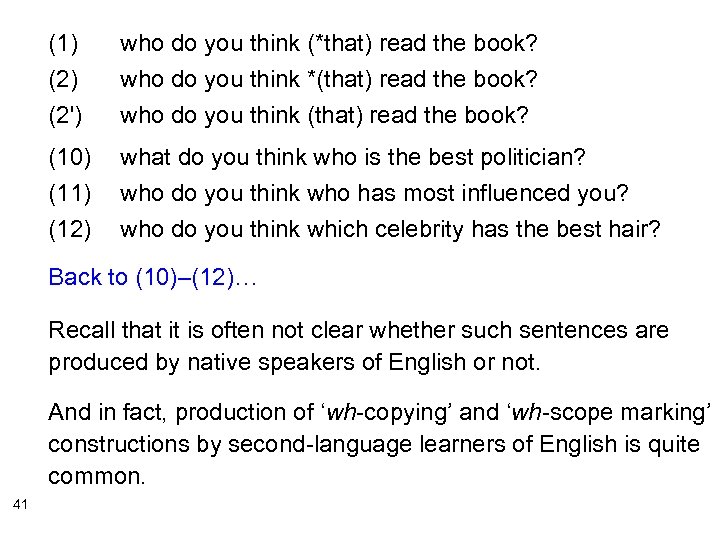 (1) (2') who do you think (*that) read the book? who do you think *(that) read the book? who do you think (that) read the book? (10) (11) (12) what do you think who is the best politician? who do you think who has most influenced you? who do you think which celebrity has the best hair? Back to (10)–(12)… Recall that it is often not clear whether such sentences are produced by native speakers of English or not. And in fact, production of ‘wh-copying’ and ‘wh-scope marking’ constructions by second-language learners of English is quite common. 41
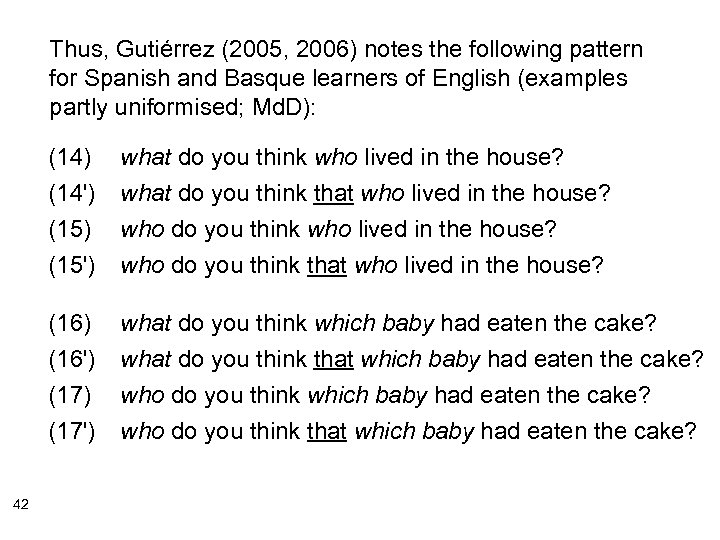 Thus, Gutiérrez (2005, 2006) notes the following pattern for Spanish and Basque learners of English (examples partly uniformised; Md. D): (14) (14') (15') (16') (17') 42 what do you think who lived in the house? what do you think that who lived in the house? who do you think that who lived in the house? what do you think which baby had eaten the cake? what do you think that which baby had eaten the cake? who do you think that which baby had eaten the cake?
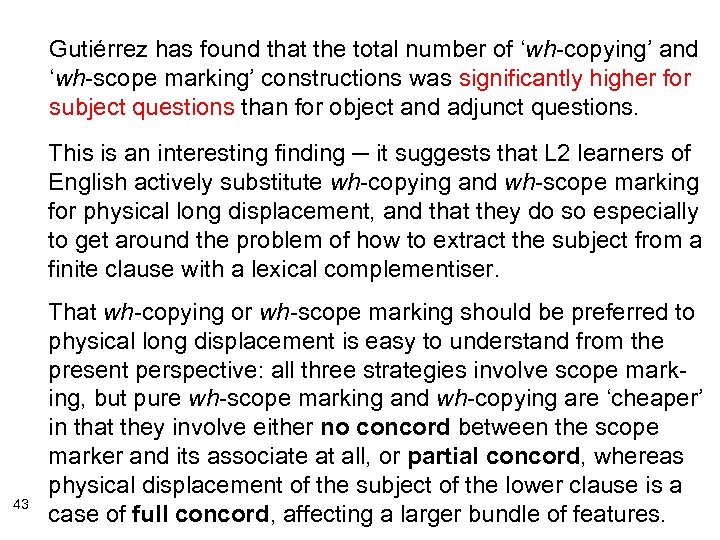 Gutiérrez has found that the total number of ‘wh-copying’ and ‘wh-scope marking’ constructions was significantly higher for subject questions than for object and adjunct questions. This is an interesting finding ─ it suggests that L 2 learners of English actively substitute wh-copying and wh-scope marking for physical long displacement, and that they do so especially to get around the problem of how to extract the subject from a finite clause with a lexical complementiser. 43 That wh-copying or wh-scope marking should be preferred to physical long displacement is easy to understand from the present perspective: all three strategies involve scope marking, but pure wh-scope marking and wh-copying are ‘cheaper’ in that they involve either no concord between the scope marker and its associate at all, or partial concord, whereas physical displacement of the subject of the lower clause is a case of full concord, affecting a larger bundle of features.
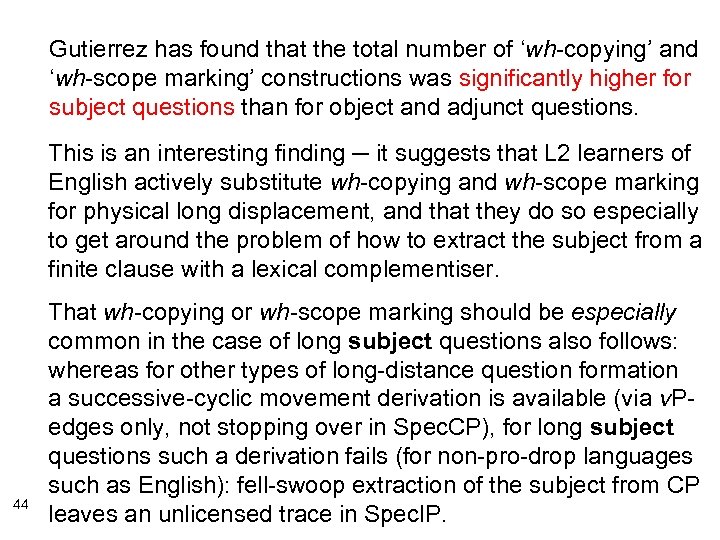 Gutierrez has found that the total number of ‘wh-copying’ and ‘wh-scope marking’ constructions was significantly higher for subject questions than for object and adjunct questions. This is an interesting finding ─ it suggests that L 2 learners of English actively substitute wh-copying and wh-scope marking for physical long displacement, and that they do so especially to get around the problem of how to extract the subject from a finite clause with a lexical complementiser. 44 That wh-copying or wh-scope marking should be especially common in the case of long subject questions also follows: whereas for other types of long-distance question formation a successive-cyclic movement derivation is available (via v. Pedges only, not stopping over in Spec. CP), for long subject questions such a derivation fails (for non-pro-drop languages such as English): fell-swoop extraction of the subject from CP leaves an unlicensed trace in Spec. IP.
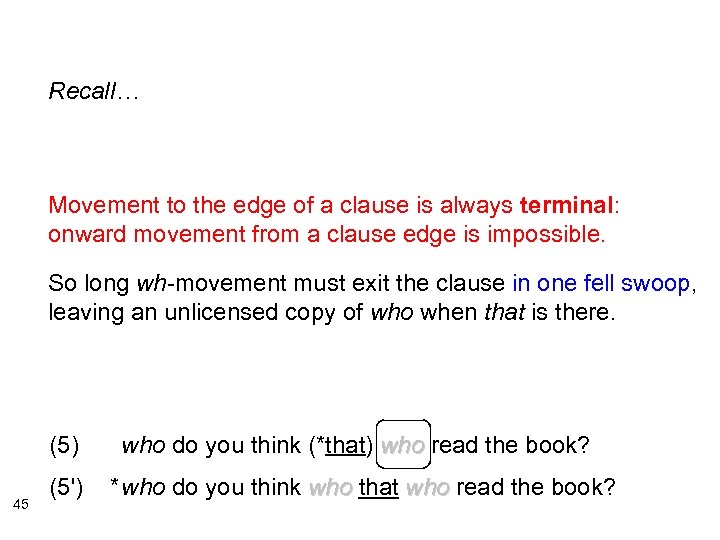 Recall… Movement to the edge of a clause is always terminal: onward movement from a clause edge is impossible. So long wh-movement must exit the clause in one fell swoop, leaving an unlicensed copy of who when that is there. (5) 45 who do you think (*that) who read the book? (5') *who do you think who that who read the book?
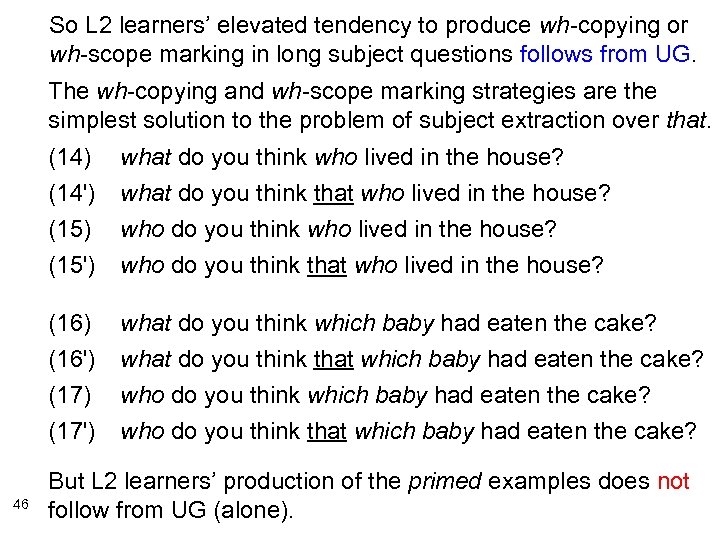 So L 2 learners’ elevated tendency to produce wh-copying or wh-scope marking in long subject questions follows from UG. The wh-copying and wh-scope marking strategies are the simplest solution to the problem of subject extraction over that. (14) (14') (15') (16') (17') 46 what do you think who lived in the house? what do you think that who lived in the house? who do you think that who lived in the house? what do you think which baby had eaten the cake? what do you think that which baby had eaten the cake? who do you think that which baby had eaten the cake? But L 2 learners’ production of the primed examples does not follow from UG (alone).
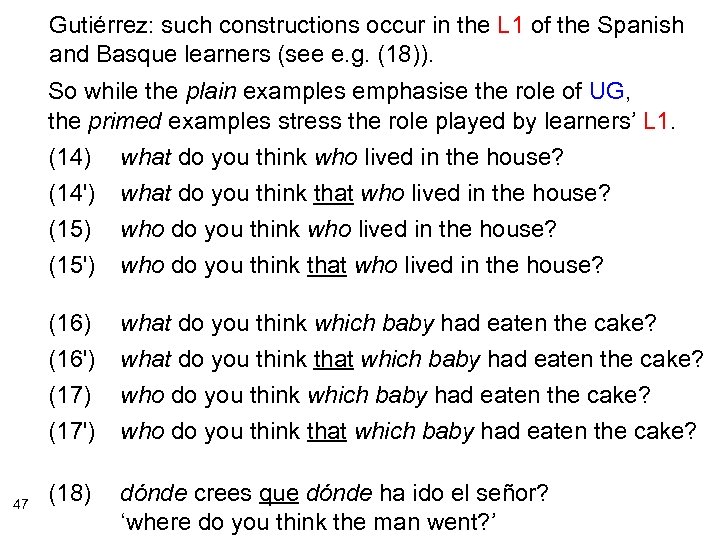 Gutiérrez: such constructions occur in the L 1 of the Spanish and Basque learners (see e. g. (18)). So while the plain examples emphasise the role of UG, the primed examples stress the role played by learners’ L 1. (14) (14') (15') (16') (17') 47 what do you think who lived in the house? what do you think that who lived in the house? who do you think that who lived in the house? what do you think which baby had eaten the cake? what do you think that which baby had eaten the cake? who do you think that which baby had eaten the cake? (18) dónde crees que dónde ha ido el señor? ‘where do you think the man went? ’
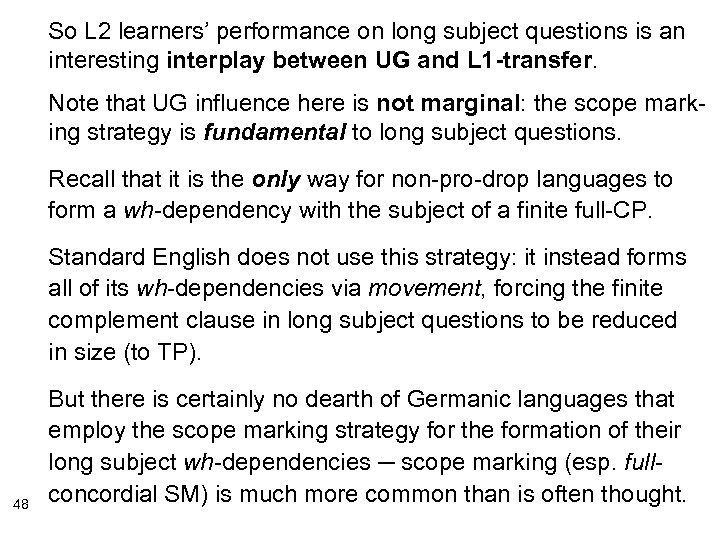 So L 2 learners’ performance on long subject questions is an interesting interplay between UG and L 1 -transfer. Note that UG influence here is not marginal: the scope marking strategy is fundamental to long subject questions. Recall that it is the only way for non-pro-drop languages to form a wh-dependency with the subject of a finite full-CP. Standard English does not use this strategy: it instead forms all of its wh-dependencies via movement, forcing the finite complement clause in long subject questions to be reduced in size (to TP). 48 But there is certainly no dearth of Germanic languages that employ the scope marking strategy for the formation of their long subject wh-dependencies ─ scope marking (esp. fullconcordial SM) is much more common than is often thought.
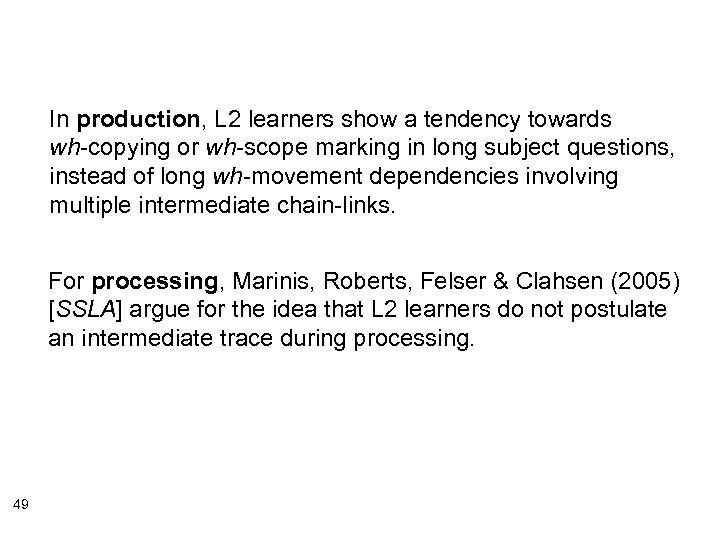 In production, L 2 learners show a tendency towards wh-copying or wh-scope marking in long subject questions, instead of long wh-movement dependencies involving multiple intermediate chain-links. For processing, Marinis, Roberts, Felser & Clahsen (2005) [SSLA] argue for the idea that L 2 learners do not postulate an intermediate trace during processing. 49
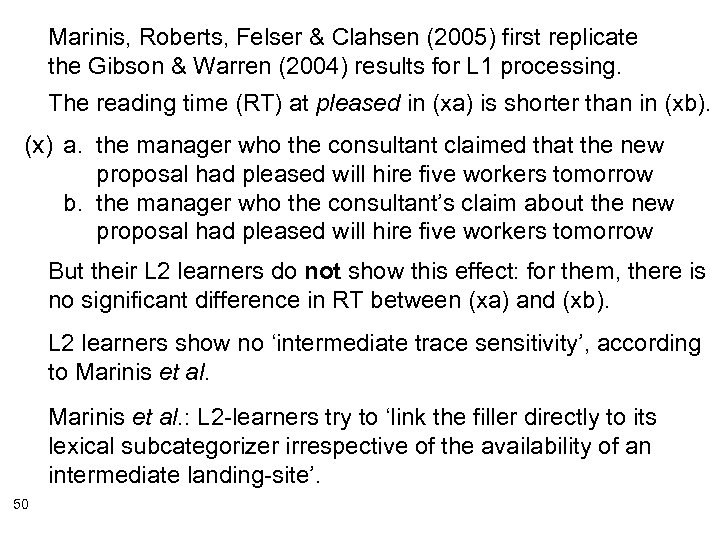 Marinis, Roberts, Felser & Clahsen (2005) first replicate the Gibson & Warren (2004) results for L 1 processing. The reading time (RT) at pleased in (xa) is shorter than in (xb). (x) a. the manager who the consultant claimed that the new proposal had pleased will hire five workers tomorrow b. the manager who the consultant’s claim about the new proposal had pleased will hire five workers tomorrow But their L 2 learners do not show this effect: for them, there is no significant difference in RT between (xa) and (xb). L 2 learners show no ‘intermediate trace sensitivity’, according to Marinis et al. : L 2 -learners try to ‘link the filler directly to its lexical subcategorizer irrespective of the availability of an intermediate landing-site’. 50
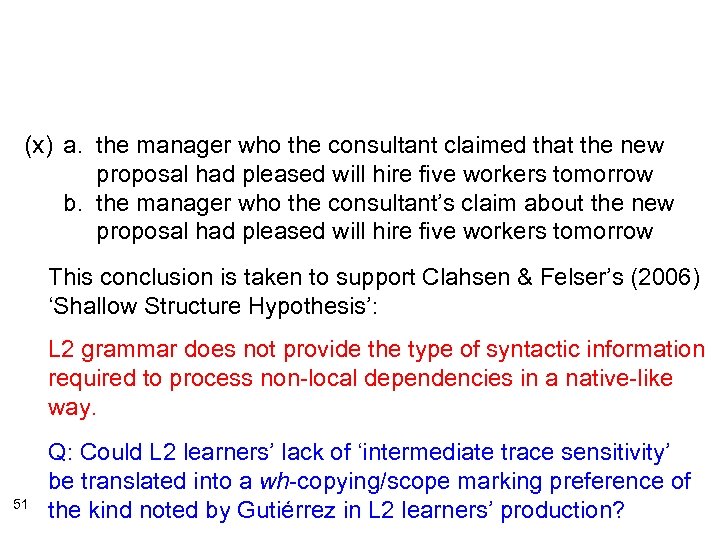 (x) a. the manager who the consultant claimed that the new proposal had pleased will hire five workers tomorrow b. the manager who the consultant’s claim about the new proposal had pleased will hire five workers tomorrow This conclusion is taken to support Clahsen & Felser’s (2006) ‘Shallow Structure Hypothesis’: L 2 grammar does not provide the type of syntactic information required to process non-local dependencies in a native-like way. 51 Q: Could L 2 learners’ lack of ‘intermediate trace sensitivity’ be translated into a wh-copying/scope marking preference of the kind noted by Gutiérrez in L 2 learners’ production?
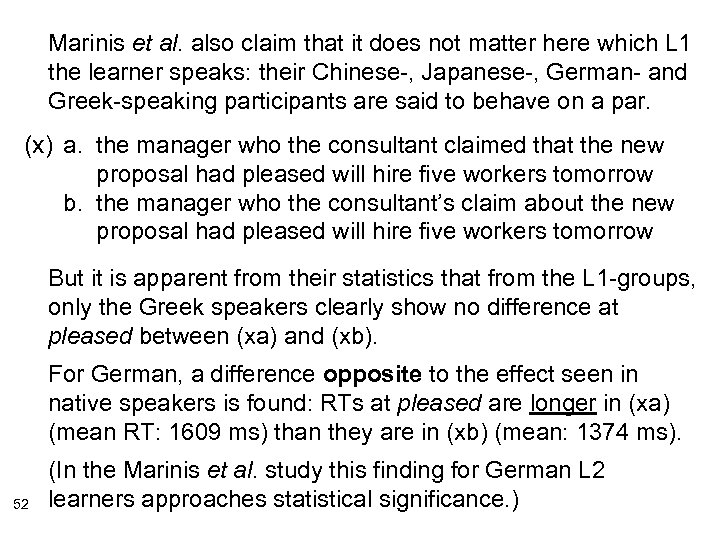 Marinis et al. also claim that it does not matter here which L 1 the learner speaks: their Chinese-, Japanese-, German- and Greek-speaking participants are said to behave on a par. (x) a. the manager who the consultant claimed that the new proposal had pleased will hire five workers tomorrow b. the manager who the consultant’s claim about the new proposal had pleased will hire five workers tomorrow But it is apparent from their statistics that from the L 1 -groups, only the Greek speakers clearly show no difference at pleased between (xa) and (xb). For German, a difference opposite to the effect seen in native speakers is found: RTs at pleased are longer in (xa) (mean RT: 1609 ms) than they are in (xb) (mean: 1374 ms). 52 (In the Marinis et al. study this finding for German L 2 learners approaches statistical significance. )
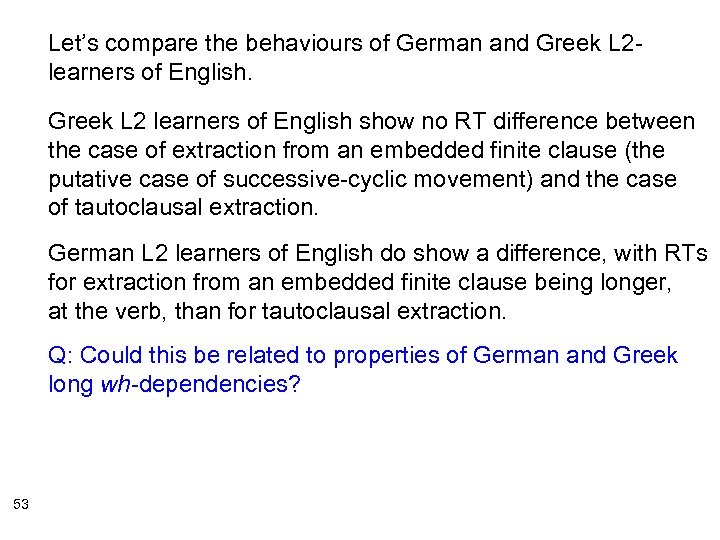 Let’s compare the behaviours of German and Greek L 2 learners of English. Greek L 2 learners of English show no RT difference between the case of extraction from an embedded finite clause (the putative case of successive-cyclic movement) and the case of tautoclausal extraction. German L 2 learners of English do show a difference, with RTs for extraction from an embedded finite clause being longer, at the verb, than for tautoclausal extraction. Q: Could this be related to properties of German and Greek long wh-dependencies? 53
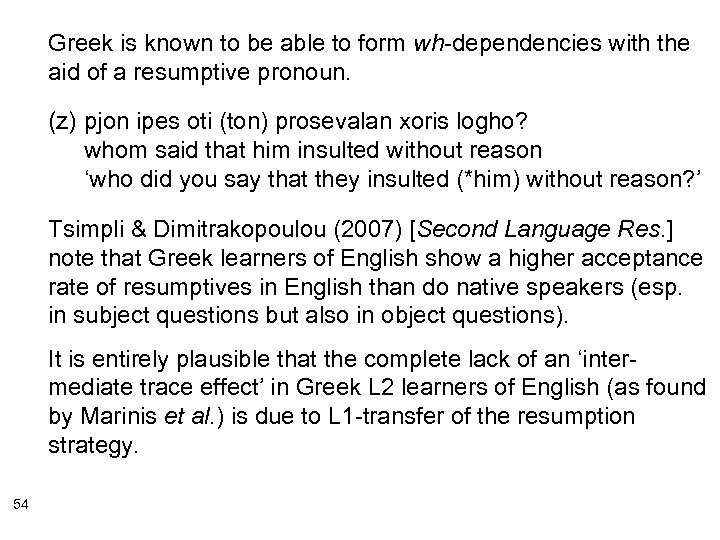 Greek is known to be able to form wh-dependencies with the aid of a resumptive pronoun. (z) pjon ipes oti (ton) prosevalan xoris logho? whom said that him insulted without reason ‘who did you say that they insulted (*him) without reason? ’ Tsimpli & Dimitrakopoulou (2007) [Second Language Res. ] note that Greek learners of English show a higher acceptance rate of resumptives in English than do native speakers (esp. in subject questions but also in object questions). It is entirely plausible that the complete lack of an ‘intermediate trace effect’ in Greek L 2 learners of English (as found by Marinis et al. ) is due to L 1 -transfer of the resumption strategy. 54
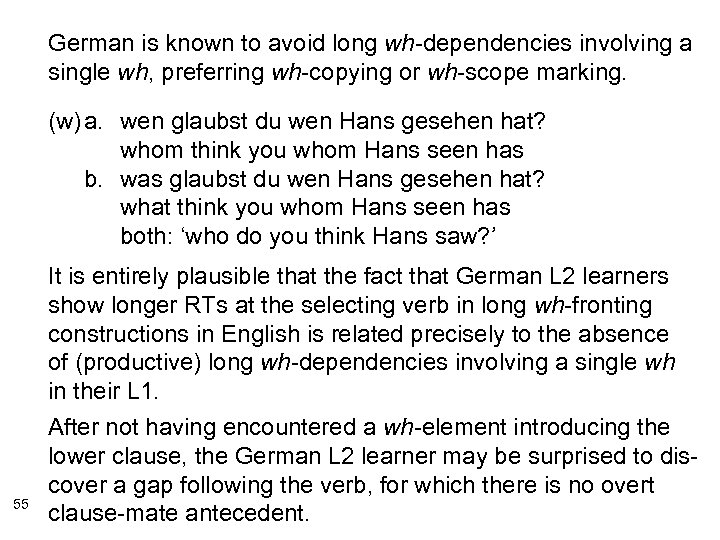 German is known to avoid long wh-dependencies involving a single wh, preferring wh-copying or wh-scope marking. (w) a. wen glaubst du wen Hans gesehen hat? whom think you whom Hans seen has b. was glaubst du wen Hans gesehen hat? what think you whom Hans seen has both: ‘who do you think Hans saw? ’ 55 It is entirely plausible that the fact that German L 2 learners show longer RTs at the selecting verb in long wh-fronting constructions in English is related precisely to the absence of (productive) long wh-dependencies involving a single wh in their L 1. After not having encountered a wh-element introducing the lower clause, the German L 2 learner may be surprised to discover a gap following the verb, for which there is no overt clause-mate antecedent.
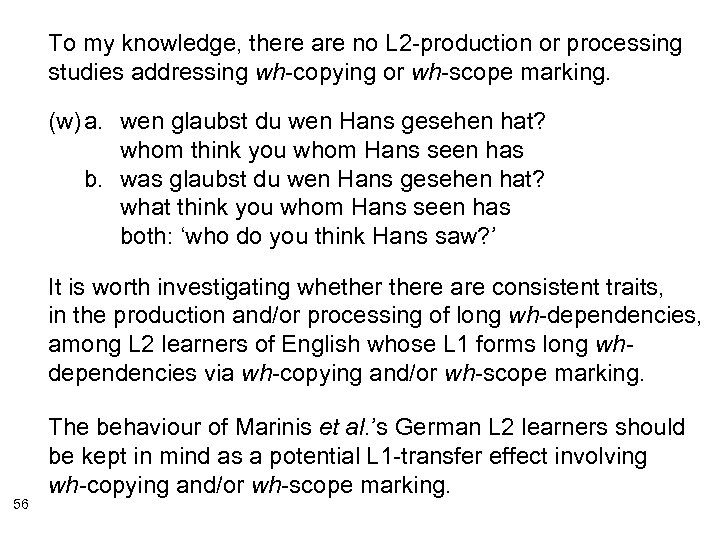 To my knowledge, there are no L 2 -production or processing studies addressing wh-copying or wh-scope marking. (w) a. wen glaubst du wen Hans gesehen hat? whom think you whom Hans seen has b. was glaubst du wen Hans gesehen hat? what think you whom Hans seen has both: ‘who do you think Hans saw? ’ It is worth investigating whethere are consistent traits, in the production and/or processing of long wh-dependencies, among L 2 learners of English whose L 1 forms long whdependencies via wh-copying and/or wh-scope marking. 56 The behaviour of Marinis et al. ’s German L 2 learners should be kept in mind as a potential L 1 -transfer effect involving wh-copying and/or wh-scope marking.
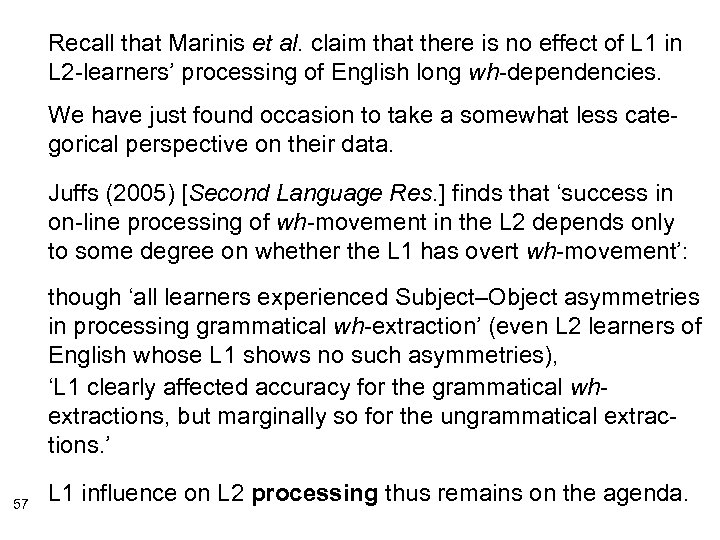 Recall that Marinis et al. claim that there is no effect of L 1 in L 2 -learners’ processing of English long wh-dependencies. We have just found occasion to take a somewhat less categorical perspective on their data. Juffs (2005) [Second Language Res. ] finds that ‘success in on-line processing of wh-movement in the L 2 depends only to some degree on whether the L 1 has overt wh-movement’: though ‘all learners experienced Subject–Object asymmetries in processing grammatical wh-extraction’ (even L 2 learners of English whose L 1 shows no such asymmetries), ‘L 1 clearly affected accuracy for the grammatical whextractions, but marginally so for the ungrammatical extractions. ’ 57 L 1 influence on L 2 processing thus remains on the agenda.
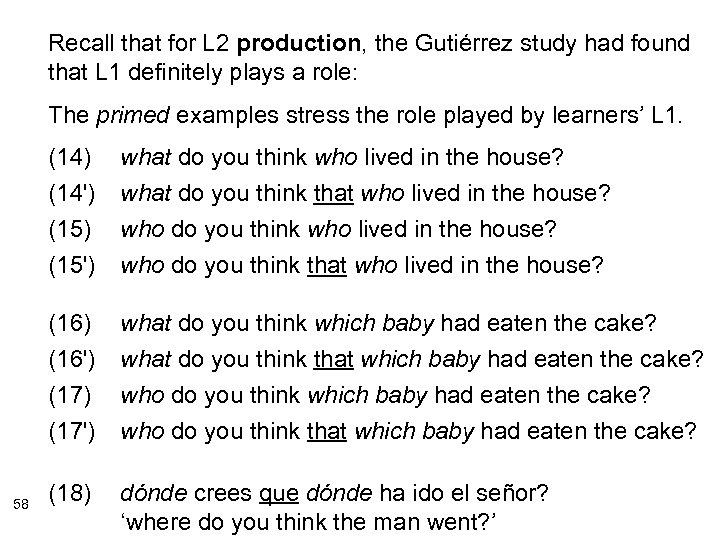 Recall that for L 2 production, the Gutiérrez study had found that L 1 definitely plays a role: The primed examples stress the role played by learners’ L 1. (14) (14') (15') (16') (17') 58 what do you think who lived in the house? what do you think that who lived in the house? who do you think that who lived in the house? what do you think which baby had eaten the cake? what do you think that which baby had eaten the cake? who do you think that which baby had eaten the cake? (18) dónde crees que dónde ha ido el señor? ‘where do you think the man went? ’
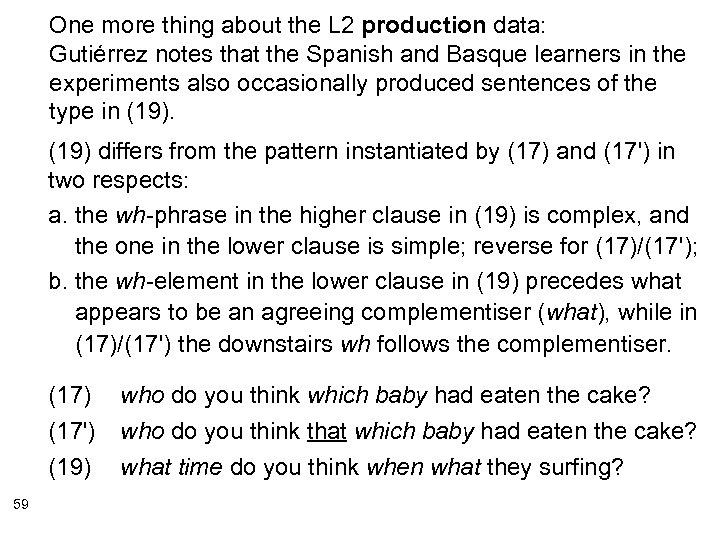 One more thing about the L 2 production data: Gutiérrez notes that the Spanish and Basque learners in the experiments also occasionally produced sentences of the type in (19) differs from the pattern instantiated by (17) and (17') in two respects: a. the wh-phrase in the higher clause in (19) is complex, and the one in the lower clause is simple; reverse for (17)/(17'); b. the wh-element in the lower clause in (19) precedes what appears to be an agreeing complementiser (what), while in (17)/(17') the downstairs wh follows the complementiser. (17) (17') (19) 59 who do you think which baby had eaten the cake? who do you think that which baby had eaten the cake? what time do you think when what they surfing?
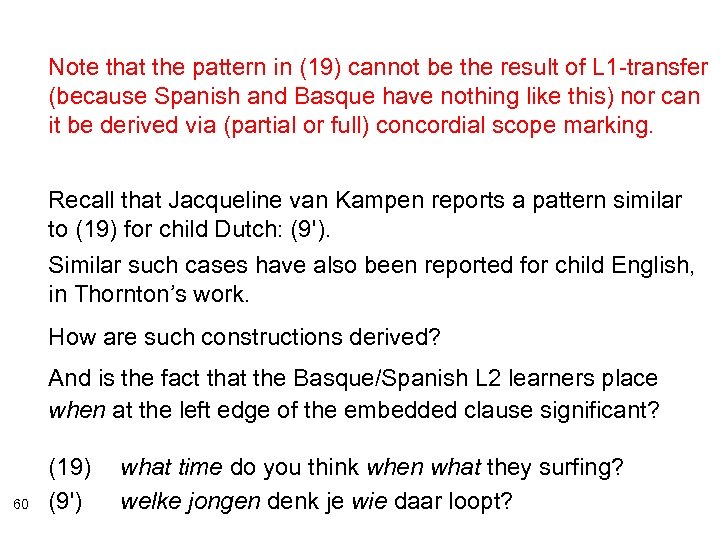 Note that the pattern in (19) cannot be the result of L 1 -transfer (because Spanish and Basque have nothing like this) nor can it be derived via (partial or full) concordial scope marking. Recall that Jacqueline van Kampen reports a pattern similar to (19) for child Dutch: (9'). Similar such cases have also been reported for child English, in Thornton’s work. How are such constructions derived? And is the fact that the Basque/Spanish L 2 learners place when at the left edge of the embedded clause significant? 60 (19) (9') what time do you think when what they surfing? welke jongen denk je wie daar loopt?
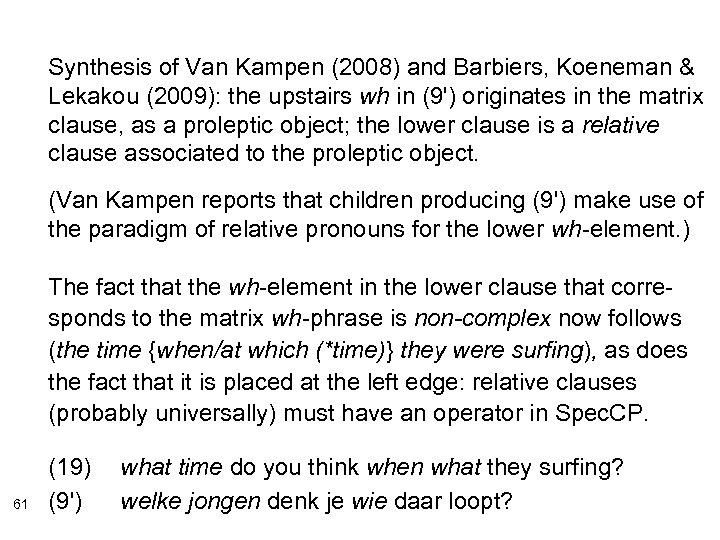 Synthesis of Van Kampen (2008) and Barbiers, Koeneman & Lekakou (2009): the upstairs wh in (9') originates in the matrix clause, as a proleptic object; the lower clause is a relative clause associated to the proleptic object. (Van Kampen reports that children producing (9') make use of the paradigm of relative pronouns for the lower wh-element. ) The fact that the wh-element in the lower clause that corresponds to the matrix wh-phrase is non-complex now follows (the time {when/at which (*time)} they were surfing), as does the fact that it is placed at the left edge: relative clauses (probably universally) must have an operator in Spec. CP. 61 (19) (9') what time do you think when what they surfing? welke jongen denk je wie daar loopt?
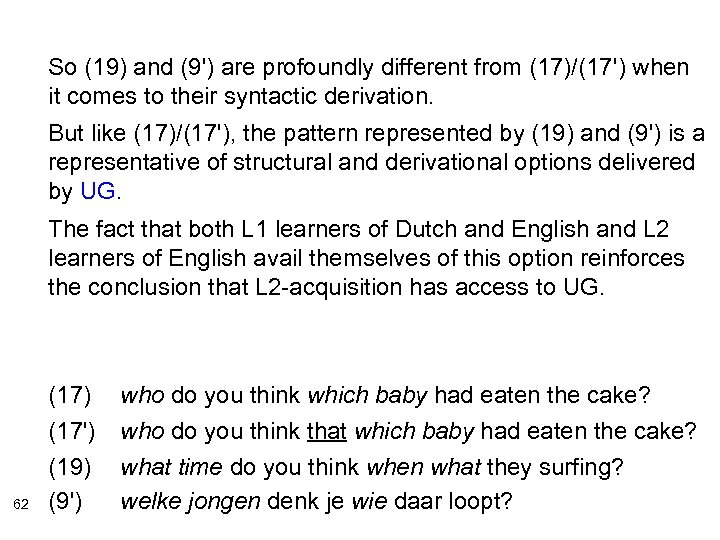 So (19) and (9') are profoundly different from (17)/(17') when it comes to their syntactic derivation. But like (17)/(17'), the pattern represented by (19) and (9') is a representative of structural and derivational options delivered by UG. The fact that both L 1 learners of Dutch and English and L 2 learners of English avail themselves of this option reinforces the conclusion that L 2 -acquisition has access to UG. 62 (17) (17') (19) (9') who do you think which baby had eaten the cake? who do you think that which baby had eaten the cake? what time do you think when what they surfing? welke jongen denk je wie daar loopt?
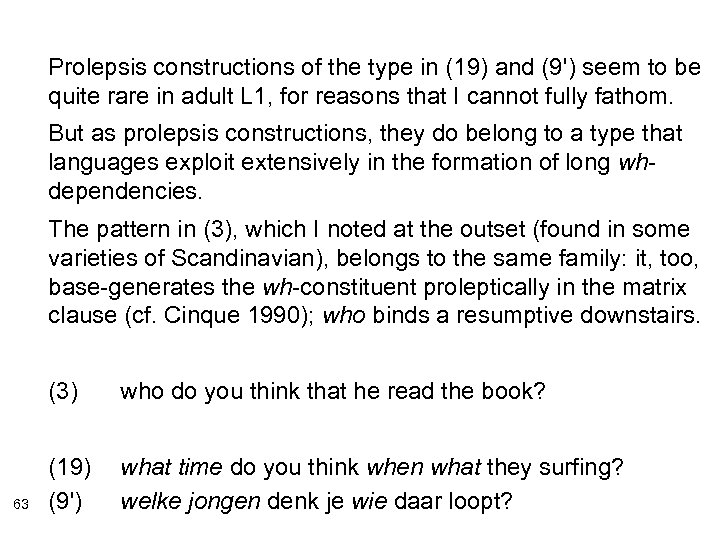 Prolepsis constructions of the type in (19) and (9') seem to be quite rare in adult L 1, for reasons that I cannot fully fathom. But as prolepsis constructions, they do belong to a type that languages exploit extensively in the formation of long whdependencies. The pattern in (3), which I noted at the outset (found in some varieties of Scandinavian), belongs to the same family: it, too, base-generates the wh-constituent proleptically in the matrix clause (cf. Cinque 1990); who binds a resumptive downstairs. (3) 63 who do you think that he read the book? (19) (9') what time do you think when what they surfing? welke jongen denk je wie daar loopt?
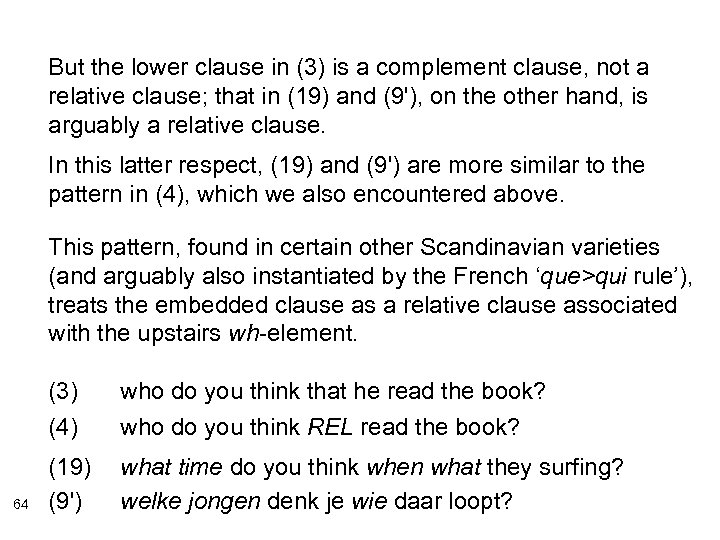 But the lower clause in (3) is a complement clause, not a relative clause; that in (19) and (9'), on the other hand, is arguably a relative clause. In this latter respect, (19) and (9') are more similar to the pattern in (4), which we also encountered above. This pattern, found in certain other Scandinavian varieties (and arguably also instantiated by the French ‘que>qui rule’), treats the embedded clause as a relative clause associated with the upstairs wh-element. (3) (4) 64 who do you think that he read the book? who do you think REL read the book? (19) (9') what time do you think when what they surfing? welke jongen denk je wie daar loopt?
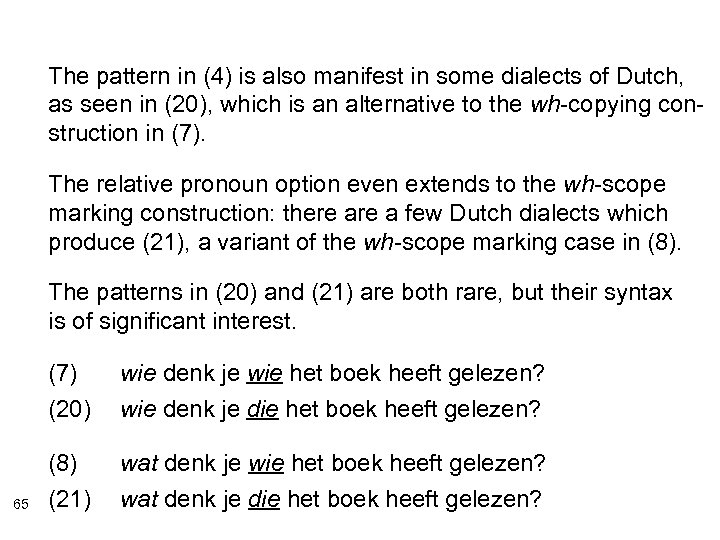 The pattern in (4) is also manifest in some dialects of Dutch, as seen in (20), which is an alternative to the wh-copying construction in (7). The relative pronoun option even extends to the wh-scope marking construction: there a few Dutch dialects which produce (21), a variant of the wh-scope marking case in (8). The patterns in (20) and (21) are both rare, but their syntax is of significant interest. (7) (20) 65 wie denk je wie het boek heeft gelezen? wie denk je die het boek heeft gelezen? (8) (21) wat denk je wie het boek heeft gelezen? wat denk je die het boek heeft gelezen?
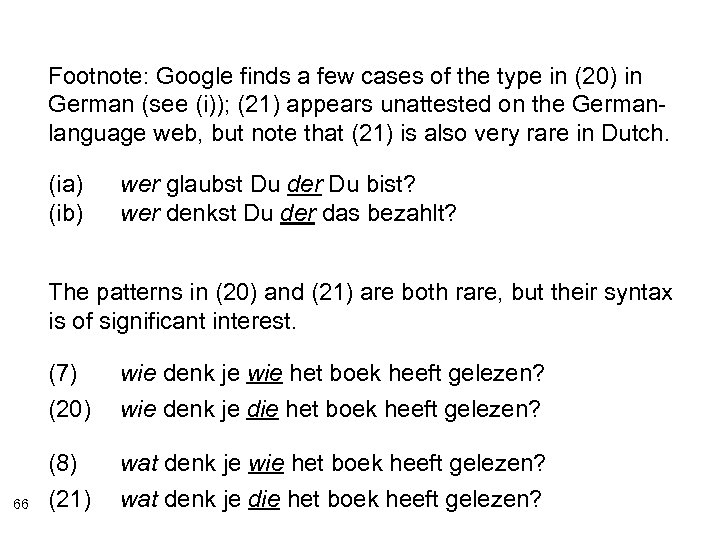 Footnote: Google finds a few cases of the type in (20) in German (see (i)); (21) appears unattested on the Germanlanguage web, but note that (21) is also very rare in Dutch. (ia) (ib) wer glaubst Du der Du bist? wer denkst Du der das bezahlt? The patterns in (20) and (21) are both rare, but their syntax is of significant interest. (7) (20) 66 wie denk je wie het boek heeft gelezen? wie denk je die het boek heeft gelezen? (8) (21) wat denk je wie het boek heeft gelezen? wat denk je die het boek heeft gelezen?
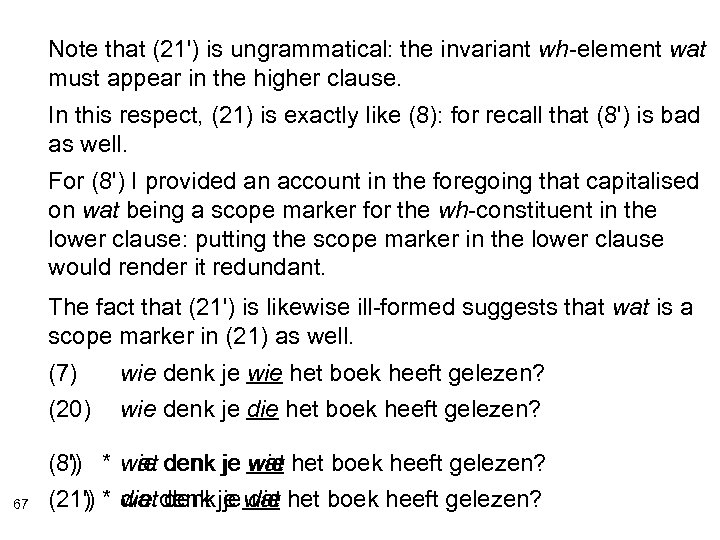 Note that (21') is ungrammatical: the invariant wh-element wat must appear in the higher clause. In this respect, (21) is exactly like (8): for recall that (8') is bad as well. For (8') I provided an account in the foregoing that capitalised on wat being a scope marker for the wh-constituent in the lower clause: putting the scope marker in the lower clause would render it redundant. The fact that (21') is likewise ill-formed suggests that wat is a scope marker in (21) as well. (7) (20) 67 wie denk je wie het boek heeft gelezen? wie denk je die het boek heeft gelezen? (8') (8) * wat denk je wat het boek heeft gelezen? wie (21') die denk je die (21) * wat denk je wat het boek heeft gelezen?
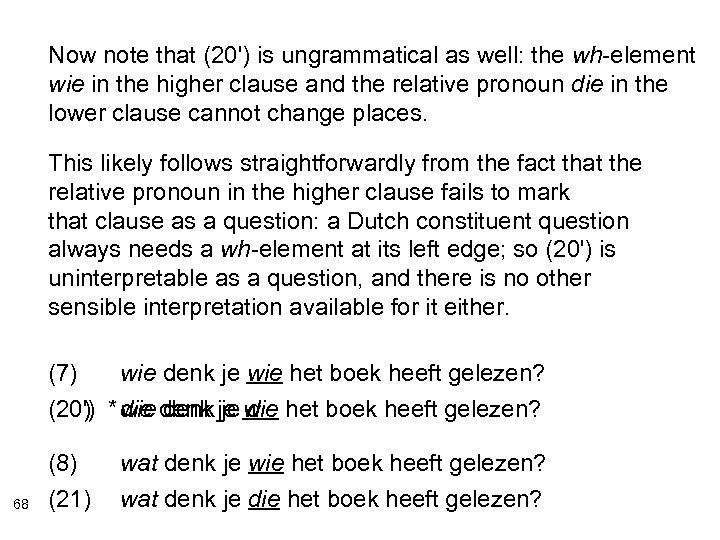 Now note that (20') is ungrammatical as well: the wh-element wie in the higher clause and the relative pronoun die in the lower clause cannot change places. This likely follows straightforwardly from the fact that the relative pronoun in the higher clause fails to mark that clause as a question: a Dutch constituent question always needs a wh-element at its left edge; so (20') is uninterpretable as a question, and there is no other sensible interpretation available for it either. (7) wie denk je wie het boek heeft gelezen? (20') wie denk je die (20) *die denk je wie het boek heeft gelezen? 68 (8) (21) wat denk je wie het boek heeft gelezen? wat denk je die het boek heeft gelezen?
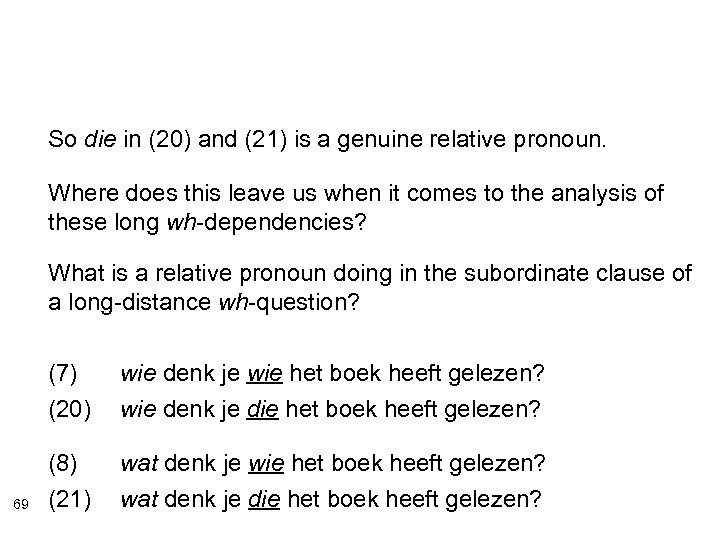 So die in (20) and (21) is a genuine relative pronoun. Where does this leave us when it comes to the analysis of these long wh-dependencies? What is a relative pronoun doing in the subordinate clause of a long-distance wh-question? (7) (20) 69 wie denk je wie het boek heeft gelezen? wie denk je die het boek heeft gelezen? (8) (21) wat denk je wie het boek heeft gelezen? wat denk je die het boek heeft gelezen?
![(7) wie denk je wie[Pers/Num/Gen] het boek heeft gelezen? wat First let us return](https://present5.com/presentation/e43a22ff1d52f4fc9bf8ee559b4b8dbb/image-70.jpg "(7) wie denk je wie[Pers/Num/Gen] het boek heeft gelezen? wat First let us return") (7) wie denk je wie[Pers/Num/Gen] het boek heeft gelezen? wat First let us return to (7). For (7), I have proposed an analysis in terms of ‘partialconcordial scope marking’. Concretely, the person, number, and gender properties (including animacy) of the wh-word in the lower clause are ‘copied over’ onto the scope marker upstairs. (7) (20) 70 wie denk je wie het boek heeft gelezen? wie denk je die het boek heeft gelezen? (8) (21) wat denk je wie het boek heeft gelezen? wat denk je die het boek heeft gelezen?
(7) wie denk je wie[Pers/Num/Gen] het boek heeft gelezen? wat First let us return to (7). For (7), I have proposed an analysis in terms of ‘partialconcordial scope marking’. Concretely, the person, number, and gender properties (including animacy) of the wh-word in the lower clause are ‘copied over’ onto the scope marker upstairs. (7) (20) 70 wie denk je wie het boek heeft gelezen? wie denk je die het boek heeft gelezen? (8) (21) wat denk je wie het boek heeft gelezen? wat denk je die het boek heeft gelezen?
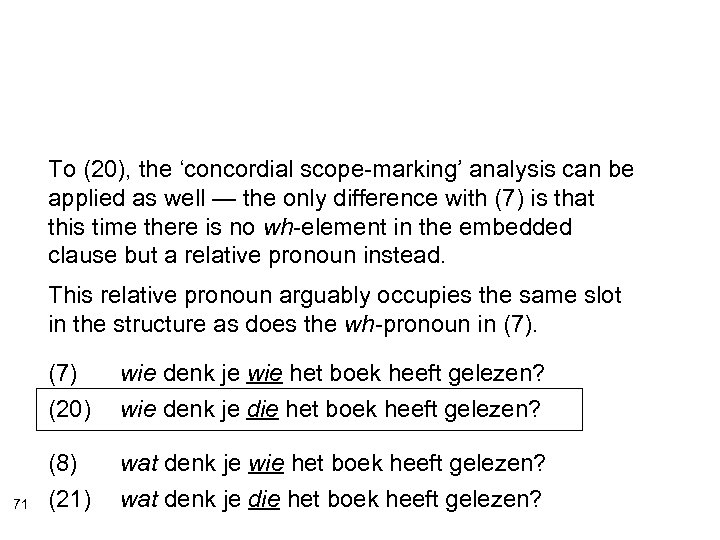 To (20), the ‘concordial scope-marking’ analysis can be applied as well — the only difference with (7) is that this time there is no wh-element in the embedded clause but a relative pronoun instead. This relative pronoun arguably occupies the same slot in the structure as does the wh-pronoun in (7) (20) 71 wie denk je wie het boek heeft gelezen? wie denk je die het boek heeft gelezen? (8) (21) wat denk je wie het boek heeft gelezen? wat denk je die het boek heeft gelezen?
![(20) wie denk je die[Pers/Num/Gen] het boek heeft gelezen? wat Since the scope marker](https://present5.com/presentation/e43a22ff1d52f4fc9bf8ee559b4b8dbb/image-72.jpg "(20) wie denk je die[Pers/Num/Gen] het boek heeft gelezen? wat Since the scope marker") (20) wie denk je die[Pers/Num/Gen] het boek heeft gelezen? wat Since the scope marker originating in the higher clause is itself inherently [+wh], the concord relationship between die and the scope marker is just what is needed to turn the scope marker into wie. The use of die in the lower clause in (20) is really more economical than that of wie in the lower clause in (7) (20) 72 wie denk je wie het boek heeft gelezen? wie denk je die het boek heeft gelezen? (8) (21) wat denk je wie het boek heeft gelezen? wat denk je die het boek heeft gelezen?
(20) wie denk je die[Pers/Num/Gen] het boek heeft gelezen? wat Since the scope marker originating in the higher clause is itself inherently [+wh], the concord relationship between die and the scope marker is just what is needed to turn the scope marker into wie. The use of die in the lower clause in (20) is really more economical than that of wie in the lower clause in (7) (20) 72 wie denk je wie het boek heeft gelezen? wie denk je die het boek heeft gelezen? (8) (21) wat denk je wie het boek heeft gelezen? wat denk je die het boek heeft gelezen?
![(21) wat denk je die[Pers/Num/Gen] het boek heeft gelezen? X Now that we have](https://present5.com/presentation/e43a22ff1d52f4fc9bf8ee559b4b8dbb/image-73.jpg "(21) wat denk je die[Pers/Num/Gen] het boek heeft gelezen? X Now that we have") (21) wat denk je die[Pers/Num/Gen] het boek heeft gelezen? X Now that we have the outlines of an account for (20), the analysis of (21) is straightforward: it is basically analogous to (20); the only difference between them is that in (20) there is concord between the die and the scope marker upstairs, whereas in (21) there is no such concord. (7) (20) 73 wie denk je wie het boek heeft gelezen? wie denk je die het boek heeft gelezen? (8) (21) wat denk je wie het boek heeft gelezen? wat denk je die het boek heeft gelezen?
(21) wat denk je die[Pers/Num/Gen] het boek heeft gelezen? X Now that we have the outlines of an account for (20), the analysis of (21) is straightforward: it is basically analogous to (20); the only difference between them is that in (20) there is concord between the die and the scope marker upstairs, whereas in (21) there is no such concord. (7) (20) 73 wie denk je wie het boek heeft gelezen? wie denk je die het boek heeft gelezen? (8) (21) wat denk je wie het boek heeft gelezen? wat denk je die het boek heeft gelezen?
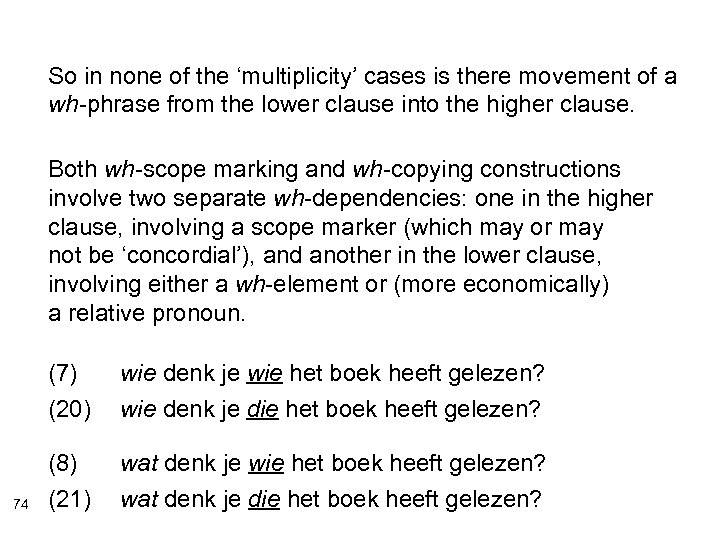 So in none of the ‘multiplicity’ cases is there movement of a wh-phrase from the lower clause into the higher clause. Both wh-scope marking and wh-copying constructions involve two separate wh-dependencies: one in the higher clause, involving a scope marker (which may or may not be ‘concordial’), and another in the lower clause, involving either a wh-element or (more economically) a relative pronoun. (7) (20) 74 wie denk je wie het boek heeft gelezen? wie denk je die het boek heeft gelezen? (8) (21) wat denk je wie het boek heeft gelezen? wat denk je die het boek heeft gelezen?
![(10) wie denk je wie[ALL FEATURES] het boek heeft gelezen? wat For the apparent](https://present5.com/presentation/e43a22ff1d52f4fc9bf8ee559b4b8dbb/image-75.jpg "(10) wie denk je wie[ALL FEATURES] het boek heeft gelezen? wat For the apparent") (10) wie denk je wie[ALL FEATURES] het boek heeft gelezen? wat For the apparent long-distance wh-movement construction in (6), I also proposed a ‘concordial scope marking’ analysis. In particular, I proposed that (6) involves full concord between the scope marker and its associate downstairs. Full-concordial scope marking is spelled out in the phonology in a form that is indistinguishable on the surface from the output of long-distance wh-movement: only the higher of the two wh-elements is spelled out (to avoid a linearisation conflict at PF). 75 (6) wie denk je dat het boek heeft gelezen?
(10) wie denk je wie[ALL FEATURES] het boek heeft gelezen? wat For the apparent long-distance wh-movement construction in (6), I also proposed a ‘concordial scope marking’ analysis. In particular, I proposed that (6) involves full concord between the scope marker and its associate downstairs. Full-concordial scope marking is spelled out in the phonology in a form that is indistinguishable on the surface from the output of long-distance wh-movement: only the higher of the two wh-elements is spelled out (to avoid a linearisation conflict at PF). 75 (6) wie denk je dat het boek heeft gelezen?
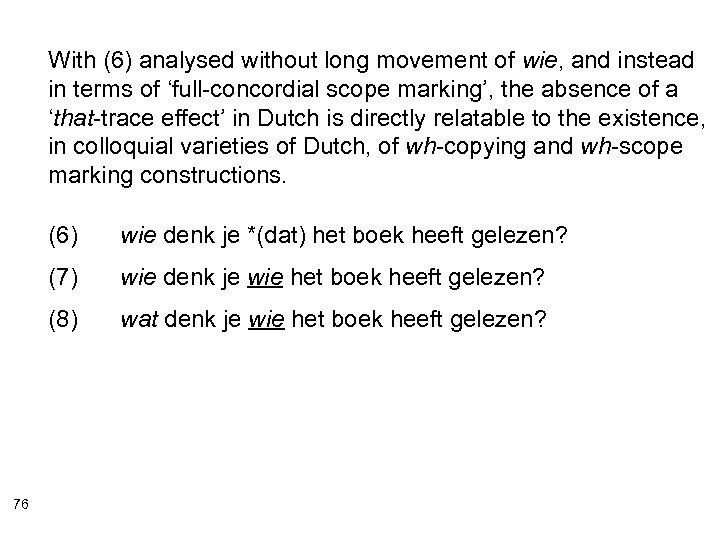 With (6) analysed without long movement of wie, and instead in terms of ‘full-concordial scope marking’, the absence of a ‘that-trace effect’ in Dutch is directly relatable to the existence, in colloquial varieties of Dutch, of wh-copying and wh-scope marking constructions. (6) (7) wie denk je wie het boek heeft gelezen? (8) 76 wie denk je *(dat) het boek heeft gelezen? wat denk je wie het boek heeft gelezen?
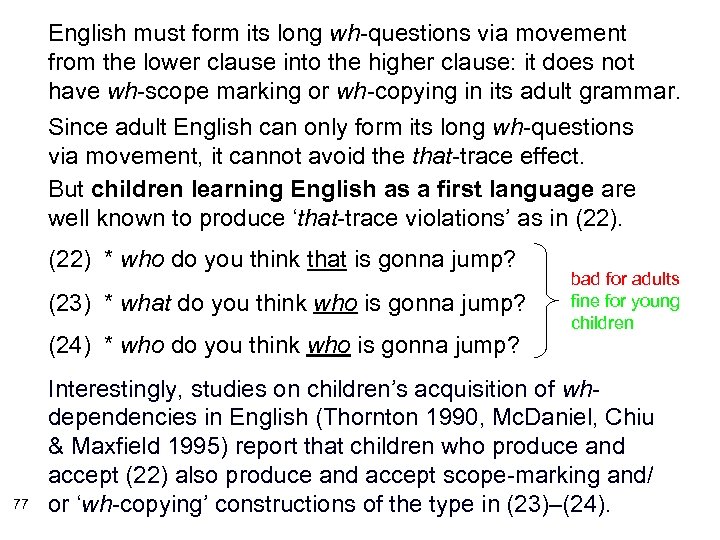 English must form its long wh-questions via movement from the lower clause into the higher clause: it does not have wh-scope marking or wh-copying in its adult grammar. Since adult English can only form its long wh-questions via movement, it cannot avoid the that-trace effect. But children learning English as a first language are well known to produce ‘that-trace violations’ as in (22) * who do you think that is gonna jump? (23) * what do you think who is gonna jump? (24) * who do you think who is gonna jump? 77 bad for adults fine for young children Interestingly, studies on children’s acquisition of whdependencies in English (Thornton 1990, Mc. Daniel, Chiu & Maxfield 1995) report that children who produce and accept (22) also produce and accept scope-marking and/ or ‘wh-copying’ constructions of the type in (23)–(24).
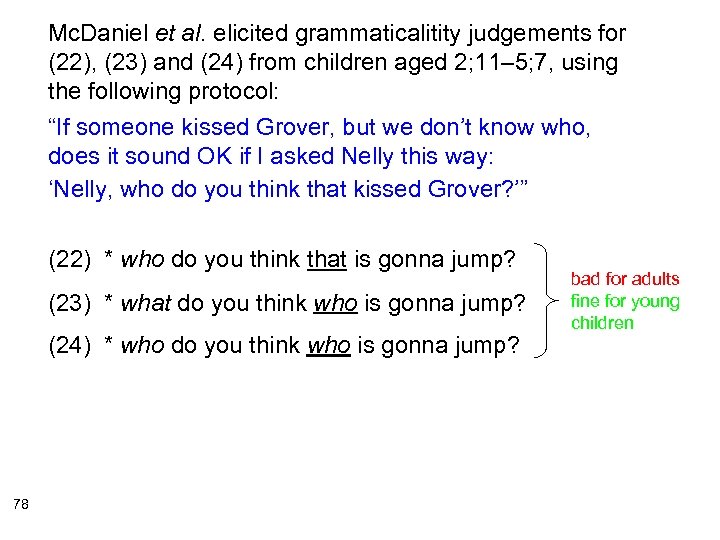 Mc. Daniel et al. elicited grammaticalitity judgements for (22), (23) and (24) from children aged 2; 11– 5; 7, using the following protocol: “If someone kissed Grover, but we don’t know who, does it sound OK if I asked Nelly this way: ‘Nelly, who do you think that kissed Grover? ’” (22) * who do you think that is gonna jump? (23) * what do you think who is gonna jump? (24) * who do you think who is gonna jump? 78 bad for adults fine for young children
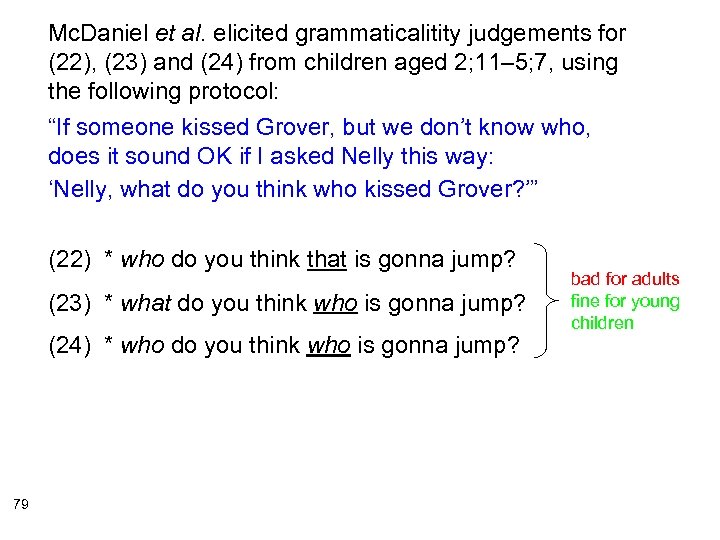 Mc. Daniel et al. elicited grammaticalitity judgements for (22), (23) and (24) from children aged 2; 11– 5; 7, using the following protocol: “If someone kissed Grover, but we don’t know who, does it sound OK if I asked Nelly this way: ‘Nelly, what do you think who kissed Grover? ’” (22) * who do you think that is gonna jump? (23) * what do you think who is gonna jump? (24) * who do you think who is gonna jump? 79 bad for adults fine for young children
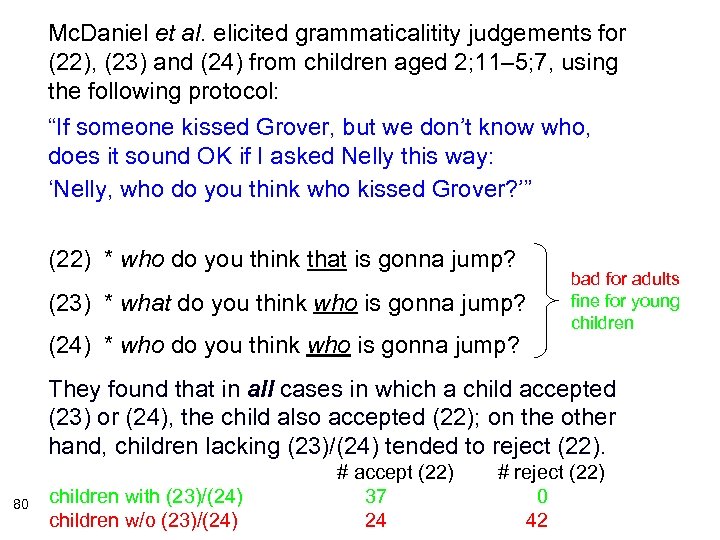 Mc. Daniel et al. elicited grammaticalitity judgements for (22), (23) and (24) from children aged 2; 11– 5; 7, using the following protocol: “If someone kissed Grover, but we don’t know who, does it sound OK if I asked Nelly this way: ‘Nelly, who do you think who kissed Grover? ’” (22) * who do you think that is gonna jump? (23) * what do you think who is gonna jump? (24) * who do you think who is gonna jump? bad for adults fine for young children They found that in all cases in which a child accepted (23) or (24), the child also accepted (22); on the other hand, children lacking (23)/(24) tended to reject (22). 80 children with (23)/(24) children w/o (23)/(24) # accept (22) 37 24 # reject (22) 0 42
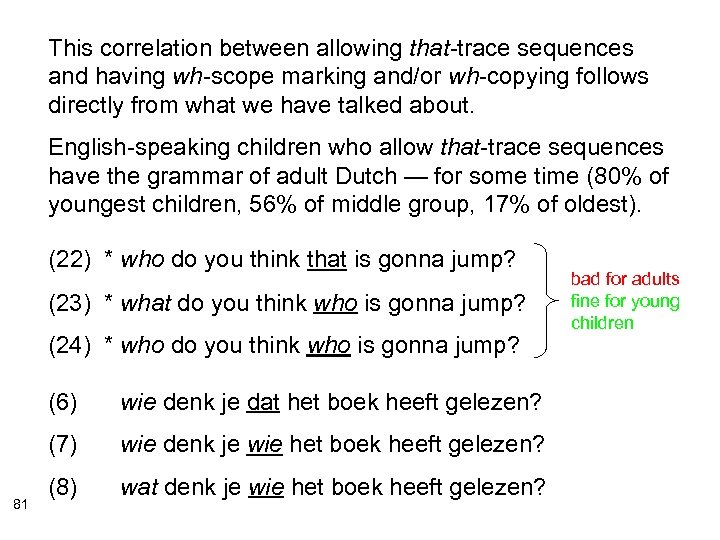 This correlation between allowing that-trace sequences and having wh-scope marking and/or wh-copying follows directly from what we have talked about. English-speaking children who allow that-trace sequences have the grammar of adult Dutch — for some time (80% of youngest children, 56% of middle group, 17% of oldest). (22) * who do you think that is gonna jump? (23) * what do you think who is gonna jump? (24) * who do you think who is gonna jump? (6) (7) 81 wie denk je dat het boek heeft gelezen? wie denk je wie het boek heeft gelezen? (8) wat denk je wie het boek heeft gelezen? bad for adults fine for young children
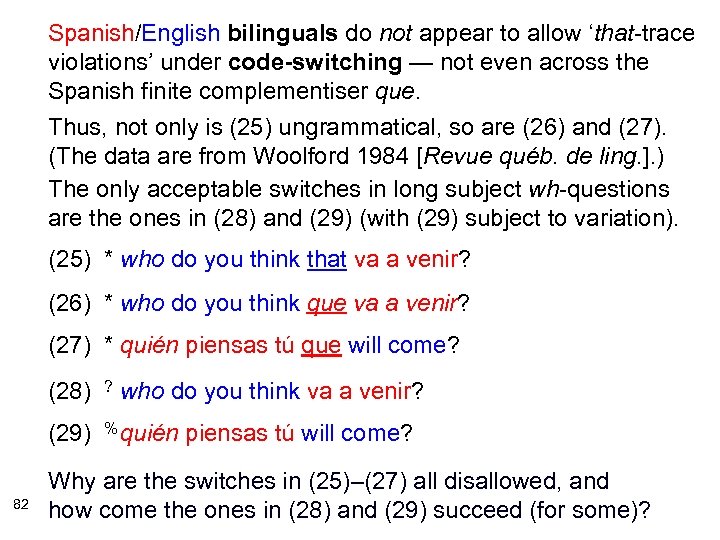 Spanish/English bilinguals do not appear to allow ‘that-trace violations’ under code-switching — not even across the Spanish finite complementiser que. Thus, not only is (25) ungrammatical, so are (26) and (27). (The data are from Woolford 1984 [Revue québ. de ling. ]. ) The only acceptable switches in long subject wh-questions are the ones in (28) and (29) (with (29) subject to variation). (25) * who do you think that va a venir? (26) * who do you think que va a venir? (27) * quién piensas tú que will come? (28) (29) 82 ? who do you think va a venir? % quién piensas tú will come? Why are the switches in (25)–(27) all disallowed, and how come the ones in (28) and (29) succeed (for some)?
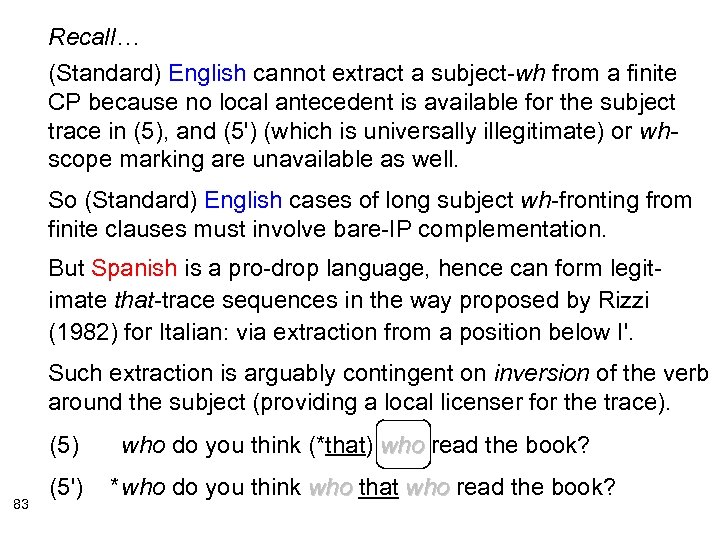 Recall… (Standard) English cannot extract a subject-wh from a finite CP because no local antecedent is available for the subject trace in (5), and (5') (which is universally illegitimate) or whscope marking are unavailable as well. So (Standard) English cases of long subject wh-fronting from finite clauses must involve bare-IP complementation. But Spanish is a pro-drop language, hence can form legitimate that-trace sequences in the way proposed by Rizzi (1982) for Italian: via extraction from a position below I'. Such extraction is arguably contingent on inversion of the verb around the subject (providing a local licenser for the trace). (5) 83 who do you think (*that) who read the book? (5') *who do you think who that who read the book?
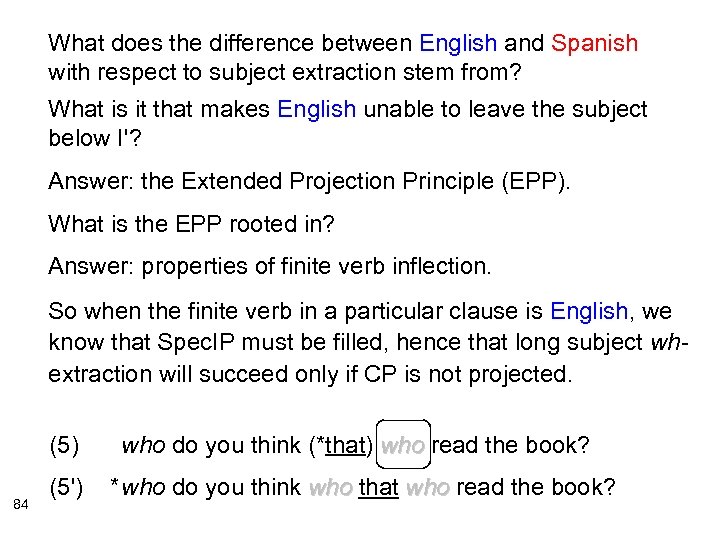 What does the difference between English and Spanish with respect to subject extraction stem from? What is it that makes English unable to leave the subject below I'? Answer: the Extended Projection Principle (EPP). What is the EPP rooted in? Answer: properties of finite verb inflection. So when the finite verb in a particular clause is English, we know that Spec. IP must be filled, hence that long subject whextraction will succeed only if CP is not projected. (5) 84 who do you think (*that) who read the book? (5') *who do you think who that who read the book?
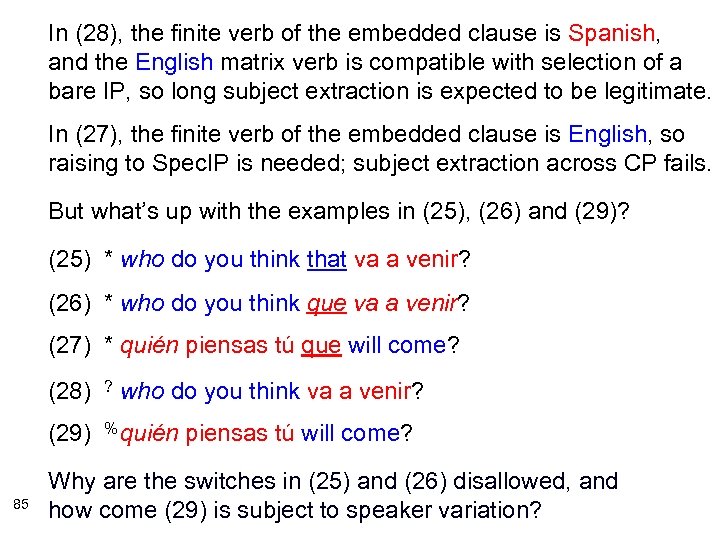 In (28), the finite verb of the embedded clause is Spanish, and the English matrix verb is compatible with selection of a bare IP, so long subject extraction is expected to be legitimate. In (27), the finite verb of the embedded clause is English, so raising to Spec. IP is needed; subject extraction across CP fails. But what’s up with the examples in (25), (26) and (29)? (25) * who do you think that va a venir? (26) * who do you think que va a venir? (27) * quién piensas tú que will come? (28) (29) 85 ? who do you think va a venir? % quién piensas tú will come? Why are the switches in (25) and (26) disallowed, and how come (29) is subject to speaker variation?
 In (26), the derivation in the embedded clause proceeds via inversion, followed by fell-swoop movement of the subject into the matrix clause (without a stopover in Spec. CP). Such a derivation is contingent on the matrix verb agreeing with the complement clause (Rackowski & Richards 2005). But the English matrix verb cannot agree with the Spanish CP. So (26) violates locality. (26) * who do you think que va a venir? 86
 In (25), the English verb can agree with the English CP, so here the problem lies elsewhere. Recall that in order for the subject to extract across a finite CP, a local licenser for its trace must be available — and inversion makes this possible in Spanish (the lg of the lower clause). Inversion requires functional structure outside IP. (25) * who do you think that va a venir? But such Spanish-specific functional structure is not licensed in the complement of an English C. So (25) needs inversion in order for wh-movement to work, but does not support the F-structure required for inversion. 87
 (29) ‘varies from quite good to quite bad’, for which Woolford has no account. There are two logically possible scenarios on my account: (i) V takes a bare IP complement (ii) V takes a CP complement without a complementiser Option (i) has no output: it violates the selectional restrictions imposed by V=Spanish (Spanish verbs must select full-CP finite complements, tolerate no finite bare-IP complements). Option (ii) satisfies categorial selection but forces CP to be English (Spanish CP must be headed by overt que). But V=Spanish cannot agree with an English CP: recall *(26). (29) 88 % quién piensas tú will come? So how can (29) survive, and why is it good only for a subset of Spanish/English bilinguals?
 Since option (ii) forces the complement-CP to be English, and since V=Spanish cannot agree with an English CP. . . the only way we can make (29) survive is by not forcing V to agree with CP. (ii) V takes a CP complement without a complementiser Extraction from CP forces the matrix V to agree with CP (Rackowski & Richards 2005). So (29), for the speakers for whom it is good, must involve a scope marking derivation, involving two separate wh-chains, one in the lower clause and one in the higher clause. (29) 89 % quién piensas tú will come? So how can (29) survive, and why is it good only for a subset of Spanish/English bilinguals?
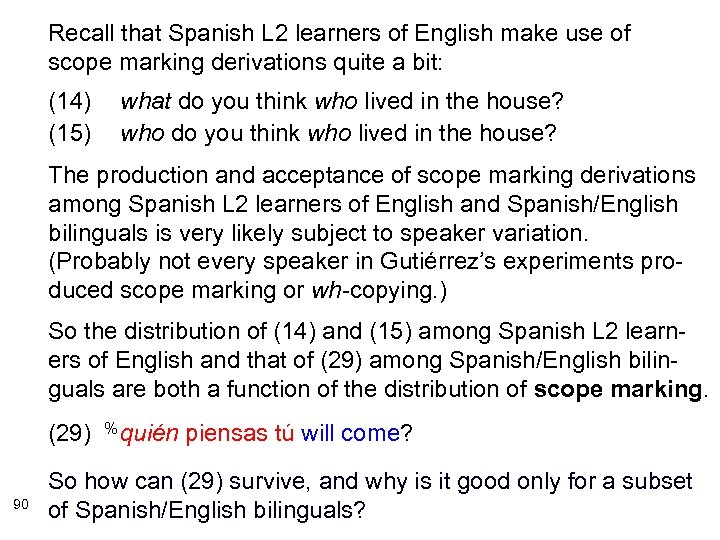 Recall that Spanish L 2 learners of English make use of scope marking derivations quite a bit: (14) (15) what do you think who lived in the house? who do you think who lived in the house? The production and acceptance of scope marking derivations among Spanish L 2 learners of English and Spanish/English bilinguals is very likely subject to speaker variation. (Probably not every speaker in Gutiérrez’s experiments produced scope marking or wh-copying. ) So the distribution of (14) and (15) among Spanish L 2 learners of English and that of (29) among Spanish/English bilinguals are both a function of the distribution of scope marking. (29) 90 % quién piensas tú will come? So how can (29) survive, and why is it good only for a subset of Spanish/English bilinguals?
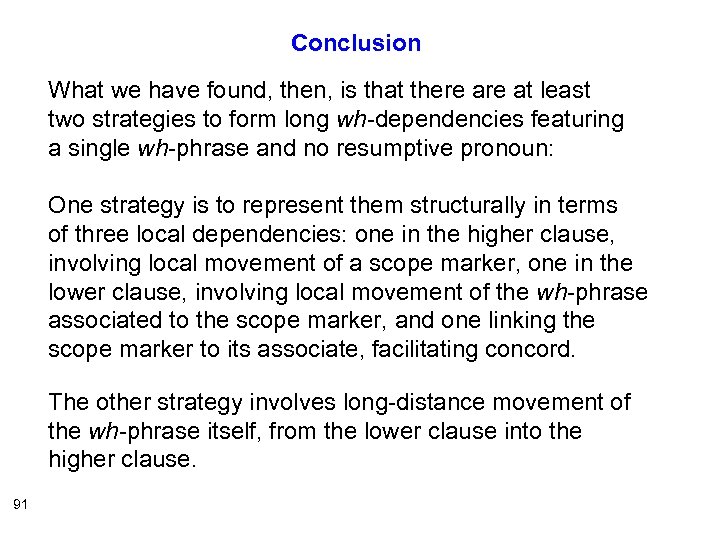 Conclusion What we have found, then, is that there at least two strategies to form long wh-dependencies featuring a single wh-phrase and no resumptive pronoun: One strategy is to represent them structurally in terms of three local dependencies: one in the higher clause, involving local movement of a scope marker, one in the lower clause, involving local movement of the wh-phrase associated to the scope marker, and one linking the scope marker to its associate, facilitating concord. The other strategy involves long-distance movement of the wh-phrase itself, from the lower clause into the higher clause. 91
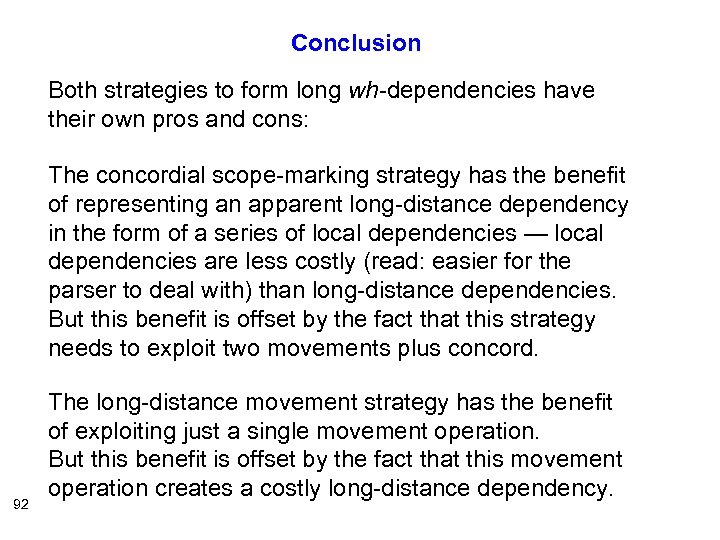 Conclusion Both strategies to form long wh-dependencies have their own pros and cons: The concordial scope-marking strategy has the benefit of representing an apparent long-distance dependency in the form of a series of local dependencies — local dependencies are less costly (read: easier for the parser to deal with) than long-distance dependencies. But this benefit is offset by the fact that this strategy needs to exploit two movements plus concord. 92 The long-distance movement strategy has the benefit of exploiting just a single movement operation. But this benefit is offset by the fact that this movement operation creates a costly long-distance dependency.
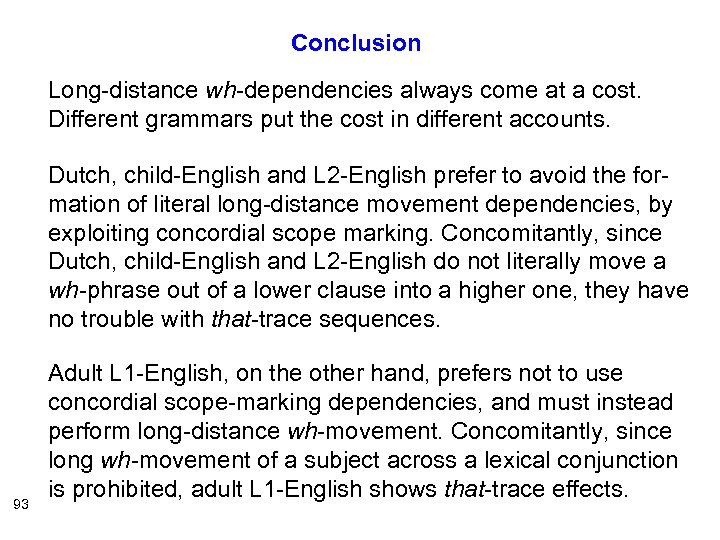 Conclusion Long-distance wh-dependencies always come at a cost. Different grammars put the cost in different accounts. Dutch, child-English and L 2 -English prefer to avoid the formation of literal long-distance movement dependencies, by exploiting concordial scope marking. Concomitantly, since Dutch, child-English and L 2 -English do not literally move a wh-phrase out of a lower clause into a higher one, they have no trouble with that-trace sequences. 93 Adult L 1 -English, on the other hand, prefers not to use concordial scope-marking dependencies, and must instead perform long-distance wh-movement. Concomitantly, since long wh-movement of a subject across a lexical conjunction is prohibited, adult L 1 -English shows that-trace effects.
 Thank you very much. Marcel den Dikken Mden-Dikken@gc. cuny. edu