 Скачать презентацию On the Road to UMTS Universal Mobile Telecommunications
1b3e2f3b72b99192fb50358b1f87a99b.ppt
- Количество слайдов: 56



On the Road to UMTS (Universal Mobile Telecommunications Service) Hongyi Wu Xiaojun Cao Copyright, 2000 © SUNY at Buffalo.
Outline • • • Introduction to GSM GPRS EDGE UMTS WCDMA Summery
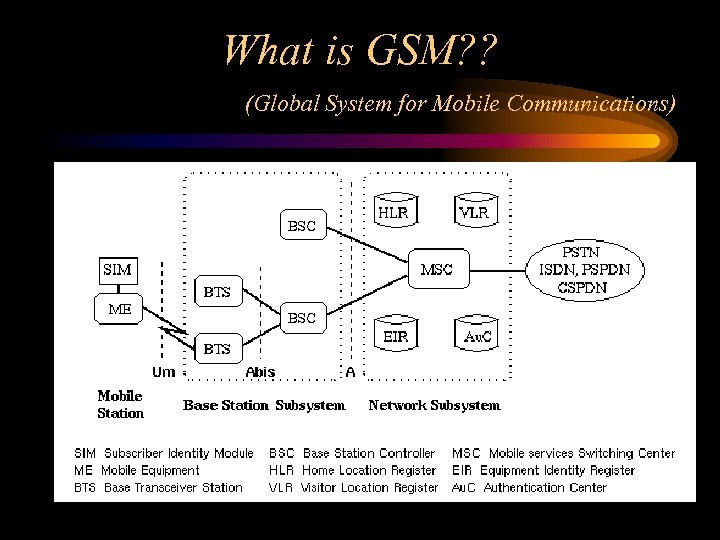
What is GSM? ? (Global System for Mobile Communications)
GSM Architecture • Three broad parts – Mobile Station (MS): carried by the subscriber – Base Station Subsystem: control radio link with MS – Network Subsystem: its main part is MSC • Interfaces: – Um Interface : known as air interface or radio link. – Abis Interface: between BTS and BSC – A Interface: between BSC and MSC
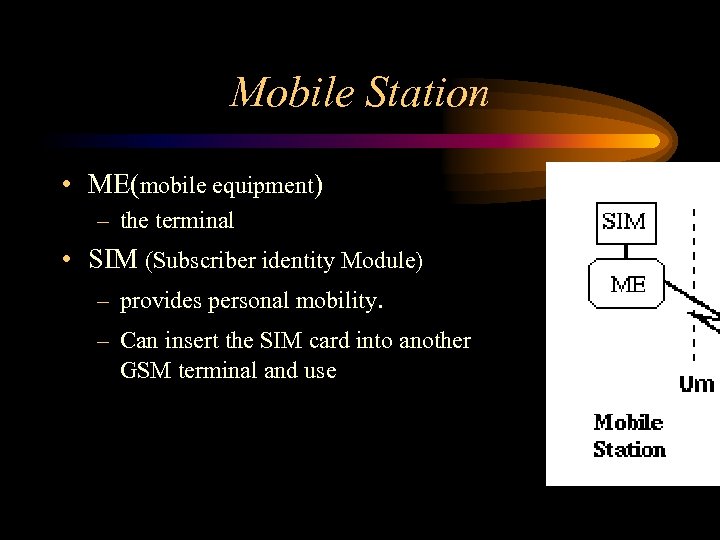
Mobile Station • ME(mobile equipment) – the terminal • SIM (Subscriber identity Module) – provides personal mobility. – Can insert the SIM card into another GSM terminal and use
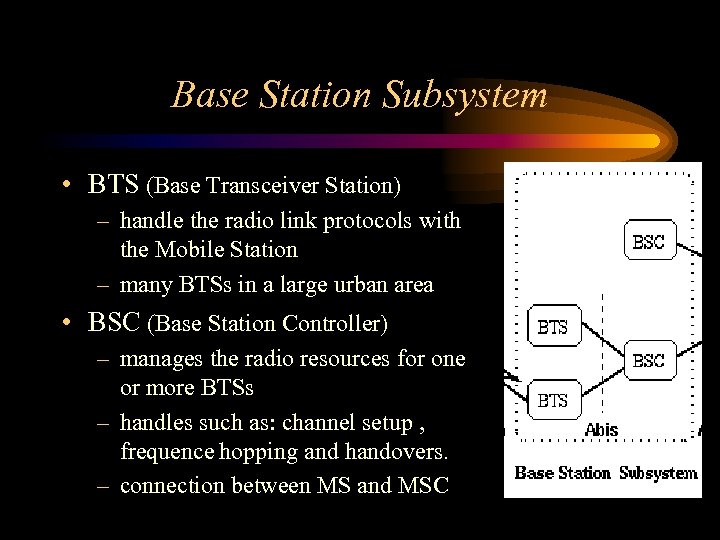
Base Station Subsystem • BTS (Base Transceiver Station) – handle the radio link protocols with the Mobile Station – many BTSs in a large urban area • BSC (Base Station Controller) – manages the radio resources for one or more BTSs – handles such as: channel setup , frequence hopping and handovers. – connection between MS and MSC
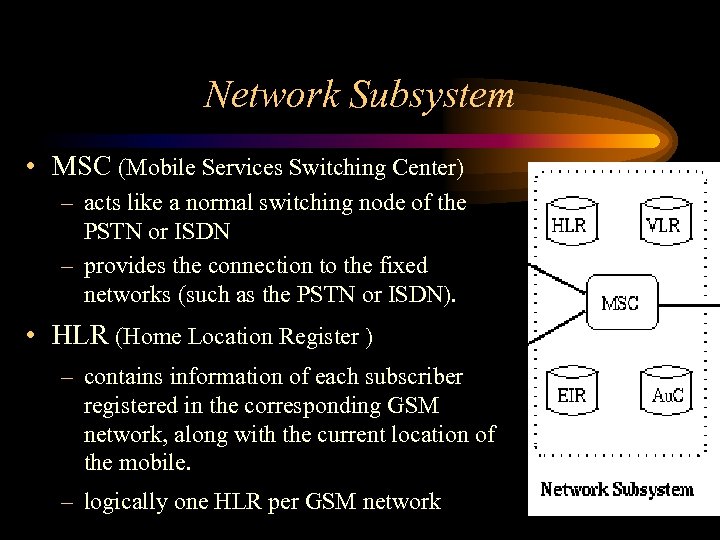
Network Subsystem • MSC (Mobile Services Switching Center) – acts like a normal switching node of the PSTN or ISDN – provides the connection to the fixed networks (such as the PSTN or ISDN). • HLR (Home Location Register ) – contains information of each subscriber registered in the corresponding GSM network, along with the current location of the mobile. – logically one HLR per GSM network
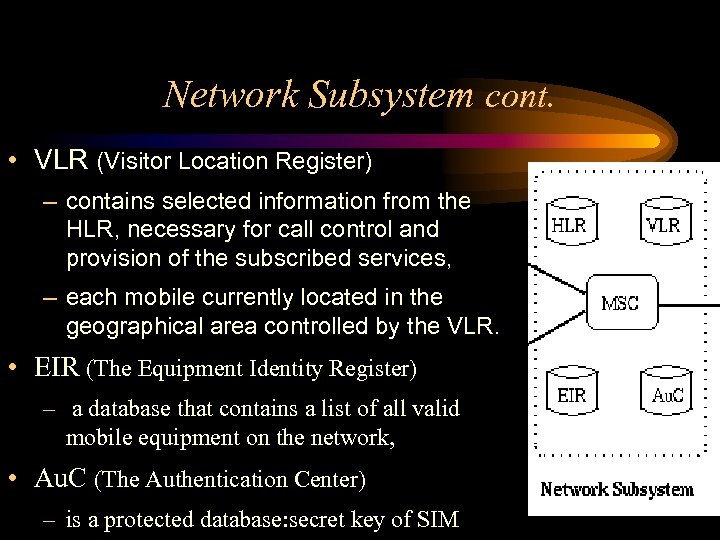
Network Subsystem cont. • VLR (Visitor Location Register) – contains selected information from the HLR, necessary for call control and provision of the subscribed services, – each mobile currently located in the geographical area controlled by the VLR. • EIR (The Equipment Identity Register) – a database that contains a list of all valid mobile equipment on the network, • Au. C (The Authentication Center) – is a protected database: secret key of SIM
GSM Features • Multiple access: use TDMA/FDMA to share the limited radio spectrum – The FDMA part involves the division by frequency of the (maximum) 25 MHz bandwidth into 124 carrier frequencies spaced 200 k. Hz apart. – Each of these carrier frequencies is then divided in time, using a TDMA scheme. • GSM is a digital network – Based on Circuit-switch
GSM Features cont. • SMS: Short Message Service – is a bi-directional service for short (up to 160 bytes) messages. Messages are transported in a store-andforward fashion. – an acknowledgement of receipt is provided to the sender. – can also be used in a cell-broadcast mode, for sending messages such as traffic updates or news updates. Messages can also be stored in the SIM card for later retrieval
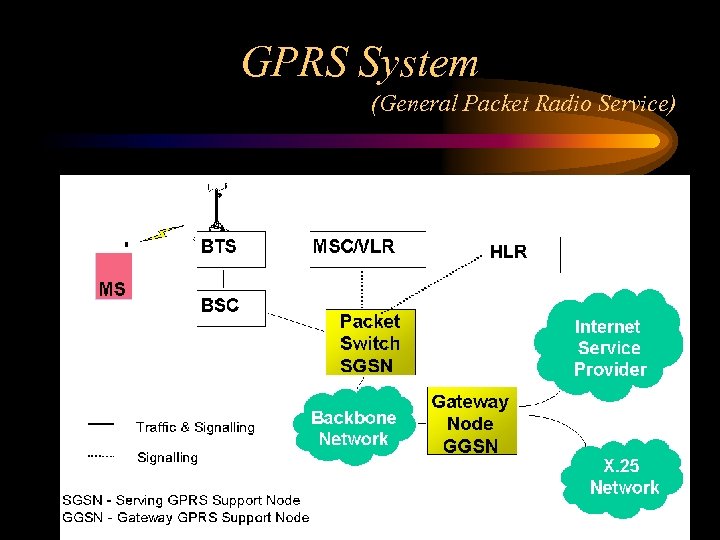
GPRS System (General Packet Radio Service)
GPRS Architecture • Introduce two new nodes into GSM network – SGSN (the Serving GPRS Support Node): • Keep track of the location of the mobile within its service area and send/receive packets from the mobile , passing them on, or receiving them from the GGSN – GGSN (Gateway GPRS Support Node): • convert the GSM packets into other packet protocols (e. g. IP or X. 25) and send them out into another network.
GPRS Features • Log on to GPRS – A GPRS-capable terminal communicates with GSM base Stations, but unlike circuit-switched data calls which connects to MSC, GPRS packets are sent from the base station to SGSN, SGSN communicates with GGSN. – Establishes a Packet Data Protocol (PDP) which is logical connection between the mobile and GGSN – now visible to the outside fixed networks
GPRS Features Cont. – SGSN and GGSN use GPRS tunnel protocol (GTP) which operates over the top of TCP/IP to encapsulate the packets – Tunnels: information may be encrypted and additional data is added to each packet to prevent tampering • Packed based – No dial-up, just as with a LAN connection. – No delay for sending data
GPRS Features Cont. – pay for the amount of data they actually communicate, and not the idle time – users need to confirm their agreement to pay for the delivery of content from the service. This is performed by using WAP (Wireless Application Protocol) – unsolicited packets may not be charged – voice and Data Communication at the same time – can be viewed as a sub-network of the Internet
GPRS Features Cont. • Spectrum Efficiency – users can share the resource (Radio link), it is used only when users are actually sending or receiving data • Speed: Based on GMSK – a modulation technique known as Gaussian minimumshift keying. – Theoretical Max speeds up to 171. 2 kbps. (GSM: 9. 6 Kbps)
GPRS Features Cont. – a channel that is 200 k. Hz wide, is divided into 8 separate data streams, each carrying maximum 20 kbps(14. 4 kbps typical), GSM only use one channel, GPRS combine up to 8 of these channels. • complement rather than replace the current data services available through today’s GSM – doesn't require new radio spectrum – supports TDMA: also use for IS-136
GPRS Phrase • Phrase 1 – expectedly to be available commercially in 2001, Point to point GPRS will be supported • Phrase 2 – net yet fully defined, but is expected to higher data rates through possible incorporation of techniques such as EDGE, in addition to Point-to-Multipoint support.
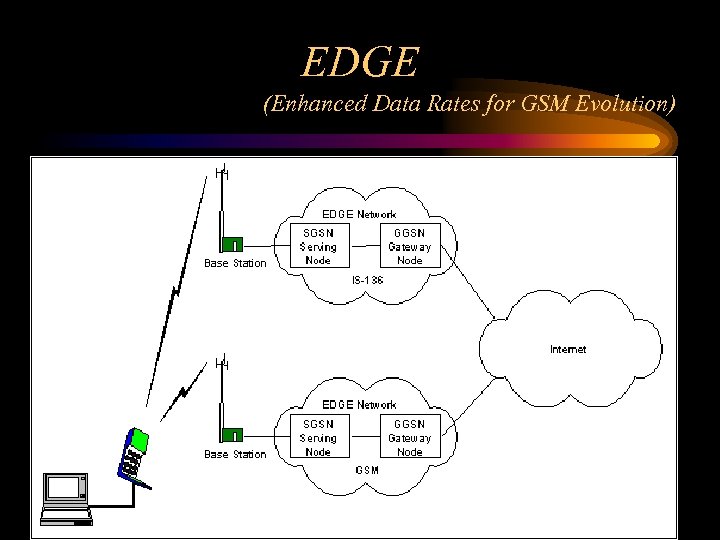
EDGE (Enhanced Data Rates for GSM Evolution)
EDGE Features • Introduce new methods at the physical layer – new form of modulation: 8 PSK(phrase Shift Keying) • introduced as a complement to GMSK (Gaussian Filter Minimum Shift Keying) • 8 PSK: use 8 phrases to carry signals – Different ways of encoding • nine MCS(Module Coding Schemes) have been defined, from 8. 8 kbps per timeslot(MCS-1 with GMSK modulation) up to 59. 2 kbps per timeslot(MCS-9 with 8 PSK modulation) – High radio interface data rates (up to 384 kbps)
EDGE Features cont. • Provides an evolutionary migration path from GPRS to UMTS – Only one EDGE transceiver unit need to be added to each cell. – Software upgrades to BSC and Base Stations can be carried out remotely. – Higher layer protocols (GGSN, SGSN) stay the same – Can be introduced smoothly in GPRS(doesn’t require any new elements)
EDGE Features cont. • EDGE is a technology both for – HSCSD(High Speed Circuit Switched Data) is simply a Circuit Switched Data call in which a single user can take over up to four separate channels at the same time. – and for GPRS(General Packet Radio Service) to meet the demands of wireless multimedia applications. – Also introduced into existing IS-136 networks
EDGE Features cont. • The Data networking for WCDMA will likely be based on EDGE/GPRS infrastructure protocols, Such as GTP(GPRS Tunneling Protocol) • As a consequence EDGE is a way to provide 3 G services on 2 G networks
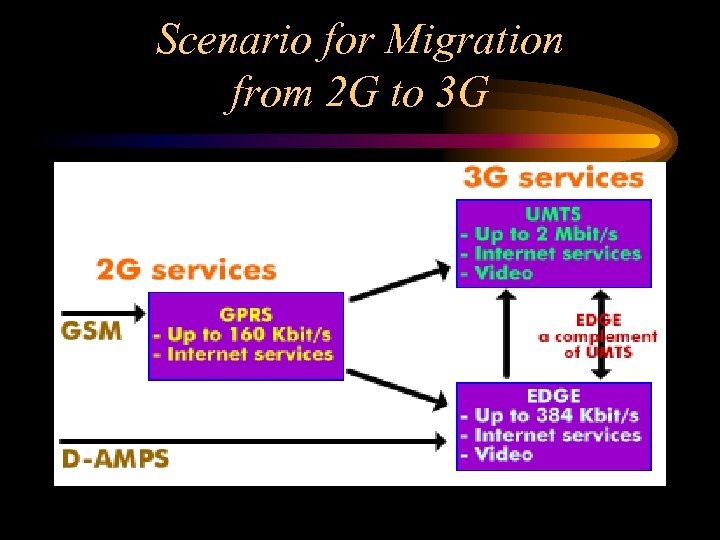
Scenario for Migration from 2 G to 3 G
What are 3 G Technologies? • UMTS (Universal Mobile Telecommunications Service) – EDGE can co-exist with UMTS • e. g. Edge provide high speed services for wide-area coverage while UMTS is deployed in urban hot spots. • Cdma 2000 – based on the cdma One standard, two air modes: • one based on the parallel use of 3 contiguous cdma. One carriers (multi-carrier approach), • the other one on the use of the corresponding 3 carriers width spreading (direct spread approach)
What are 3 G Technologies? Cont. • UWC-136 (USA cellular standard) – based on GPRS and EDGE technologies defined by ETSI for data on overlay of ANSI-136 "classical" networks for voice. Nevertheless, UWC -136 can benefit from the expected standardization of voice over IP (Vo. IP) on EDGE. D-AMPS operators mainly promote UWC-136.
To be Continued • Mr. Hong. Yi Wu will give us More detail about these topics
What does UMTS provide? • Circuit- and Packet-Oriented Services • Seamless Global Roaming • Capacity and Capability to serve more than 50% population • A Wide Range of Services – Voice, low-rate data and high-rate data – 144 kb/s, 384 kb/s , 2 Mb/s
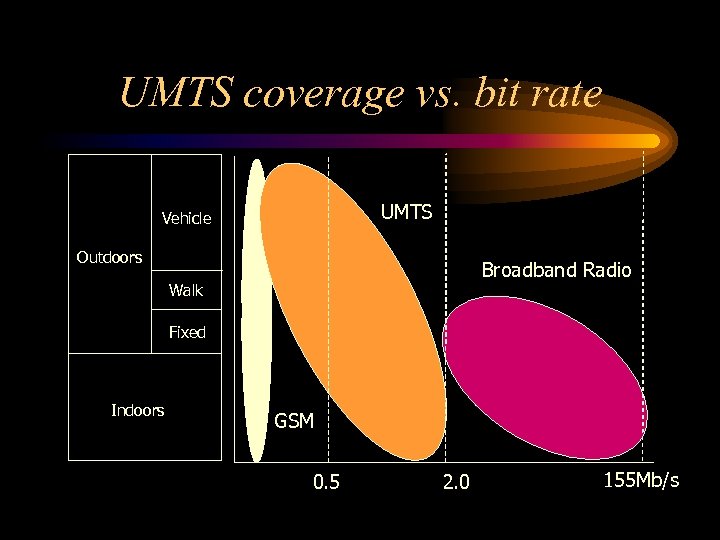
UMTS coverage vs. bit rate UMTS Vehicle Outdoors Broadband Radio Walk Fixed Indoors GSM 0. 5 2. 0 155 Mb/s
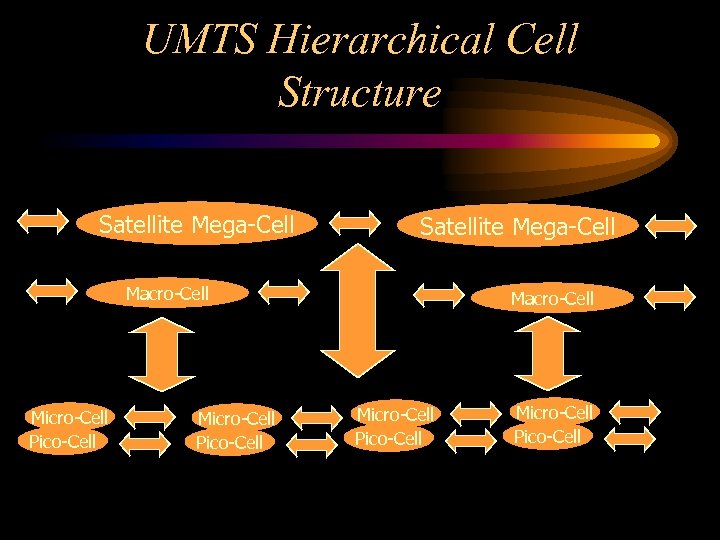
UMTS Hierarchical Cell Structure Satellite Mega-Cell Macro-Cell Micro-Cell Pico-Cell
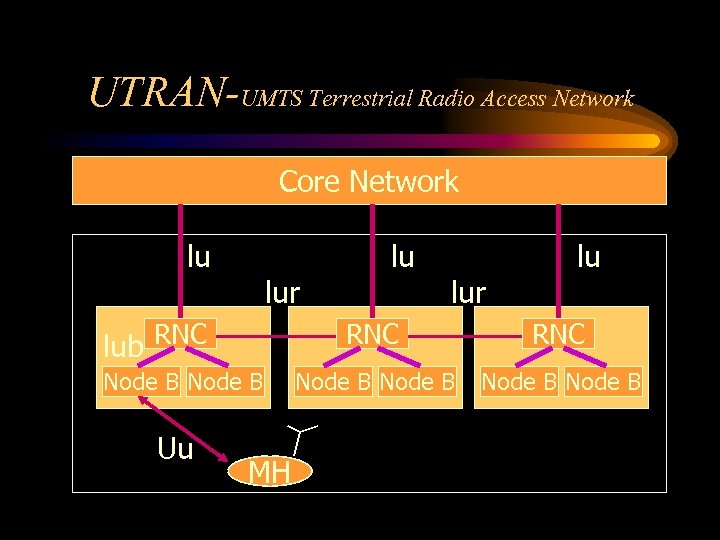
UTRAN-UMTS Terrestrial Radio Access Network Core Network lu lur lub RNC lur lu RNC Node B Uu lu MH RNC Node B
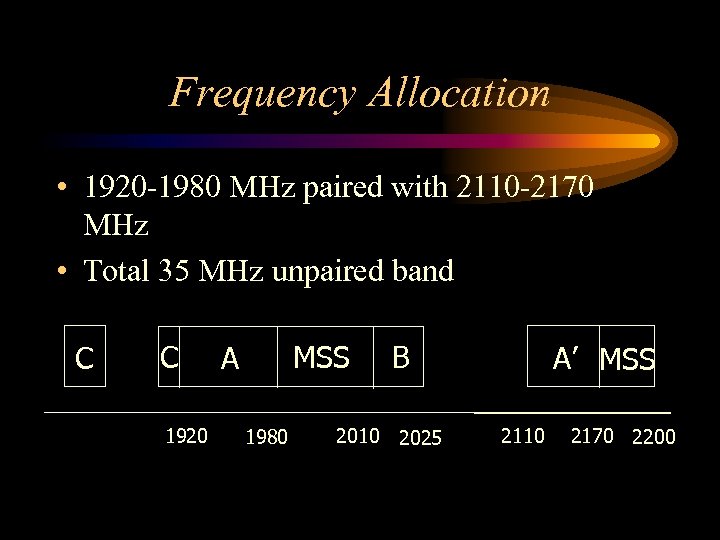
Frequency Allocation • 1920 -1980 MHz paired with 2110 -2170 MHz • Total 35 MHz unpaired band C C 1920 MSS A 1980 B 2010 2025 A’ MSS 2110 2170 2200
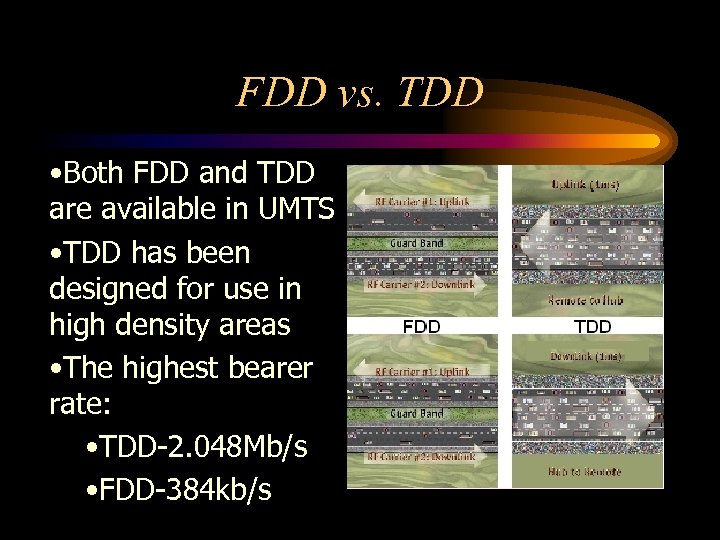
FDD vs. TDD • Both FDD and TDD are available in UMTS • TDD has been designed for use in high density areas • The highest bearer rate: • TDD-2. 048 Mb/s • FDD-384 kb/s
WCDMA • • • Radio Parameters Performance Improvement Channels Channel Generation Power Control Handoff
WCDMA Radio Parameters • Group 200 KHz bands into 4. 2 -5. 0 MHz carriers • Chip Rate is 4. 096 Mchips/sec • System Capacity of 128 channels per cell provided by 5 MHz bandwidth
WCDMA Performance Improvement • • Capacity Improvement No Frequency Planning Multiple Services per Connection Frequency Handoff – HCS – Hot Spot
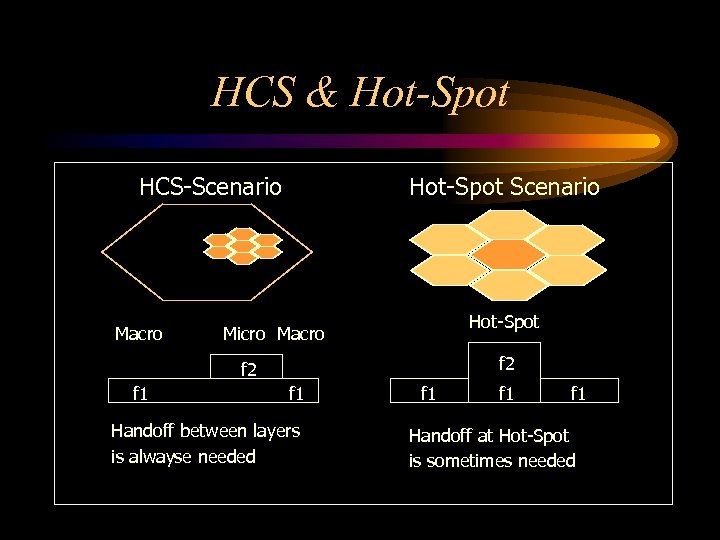
HCS & Hot-Spot HCS-Scenario Macro Hot-Spot Scenario Hot-Spot Micro Macro f 2 f 1 Handoff between layers is alwayse needed f 1 f 1 Handoff at Hot-Spot is sometimes needed
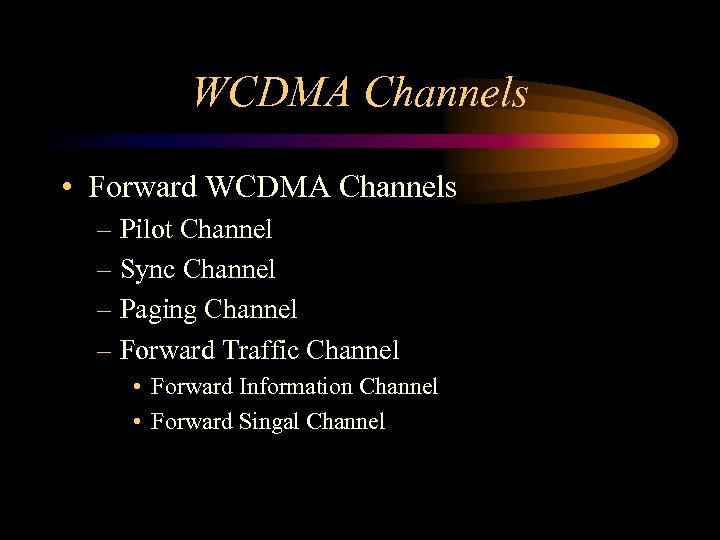
WCDMA Channels • Forward WCDMA Channels – Pilot Channel – Sync Channel – Paging Channel – Forward Traffic Channel • Forward Information Channel • Forward Singal Channel
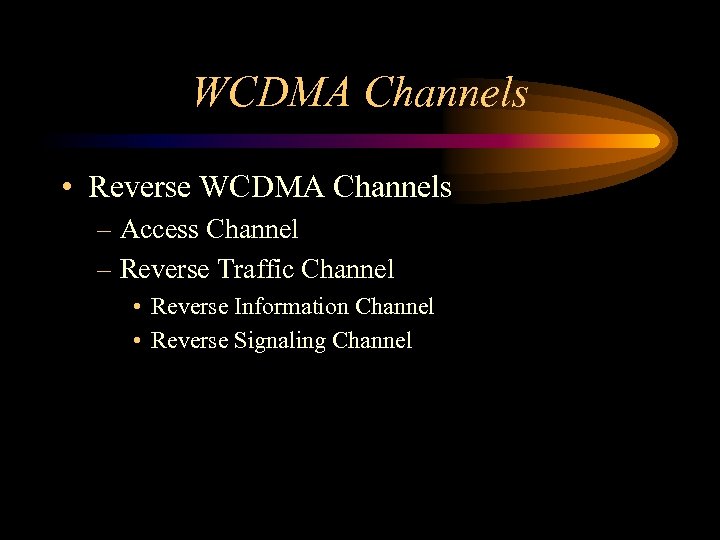
WCDMA Channels • Reverse WCDMA Channels – Access Channel – Reverse Traffic Channel • Reverse Information Channel • Reverse Signaling Channel
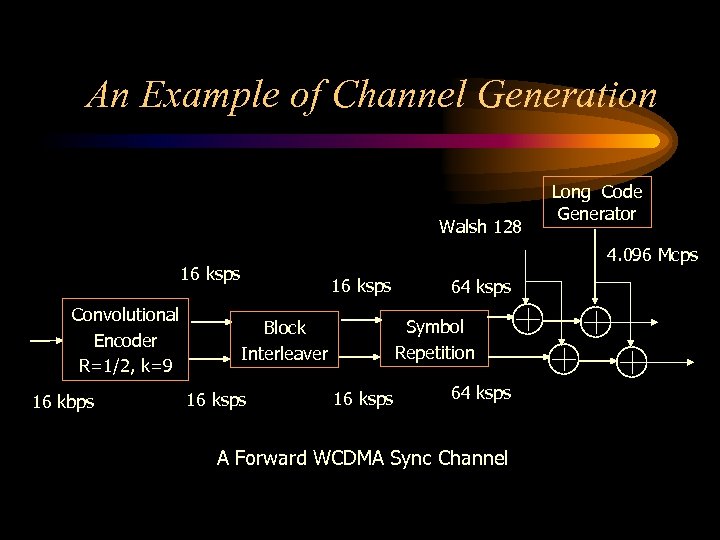
An Example of Channel Generation Walsh 128 4. 096 Mcps 16 ksps Convolutional Encoder R=1/2, k=9 16 kbps Long Code Generator 16 ksps Symbol Repetition Block Interleaver 16 ksps 64 ksps A Forward WCDMA Sync Channel
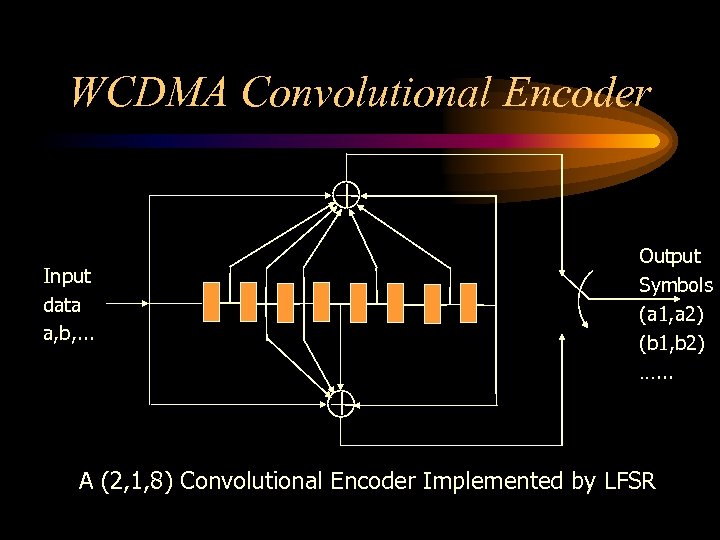
WCDMA Convolutional Encoder Input data a, b, . . . Output Symbols (a 1, a 2) (b 1, b 2) …. . . A (2, 1, 8) Convolutional Encoder Implemented by LFSR
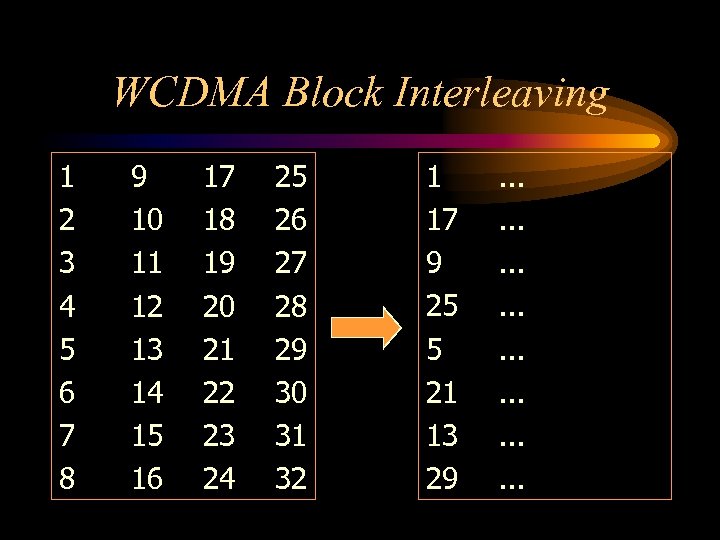
WCDMA Block Interleaving 1 2 3 4 5 6 7 8 9 10 11 12 13 14 15 16 17 18 19 20 21 22 23 24 25 26 27 28 29 30 31 32 1 17 9 25 5 21 13 29 . . .
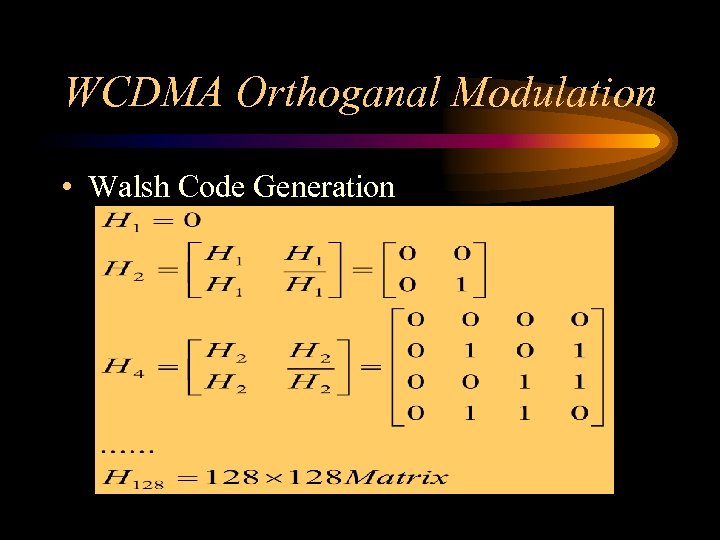
WCDMA Orthoganal Modulation • Walsh Code Generation
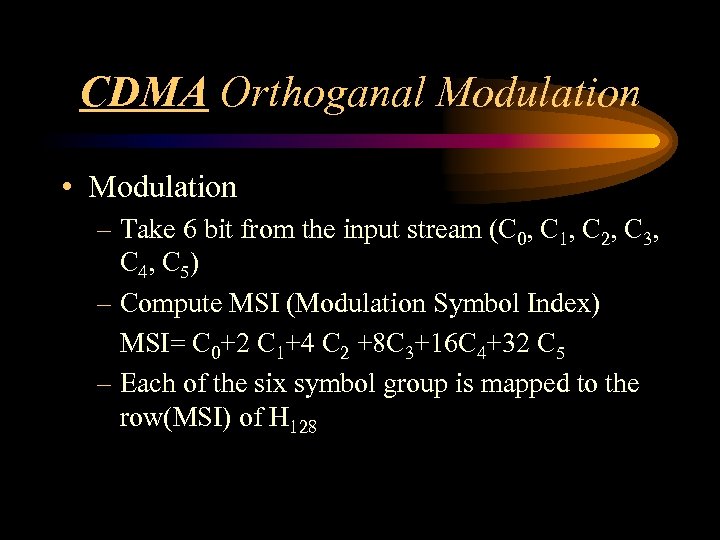
CDMA Orthoganal Modulation • Modulation – Take 6 bit from the input stream (C 0, C 1, C 2, C 3, C 4, C 5) – Compute MSI (Modulation Symbol Index) MSI= C 0+2 C 1+4 C 2 +8 C 3+16 C 4+32 C 5 – Each of the six symbol group is mapped to the row(MSI) of H 128
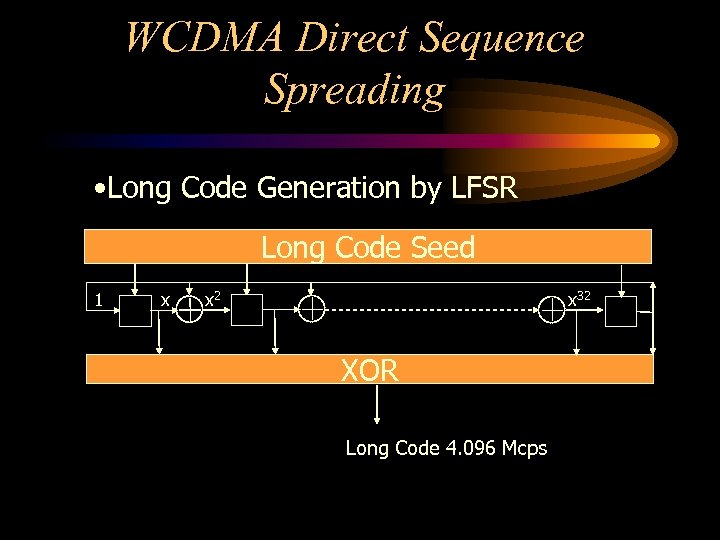
WCDMA Direct Sequence Spreading • Long Code Generation by LFSR Long Code Seed 1 x x 2 x 32 XOR Long Code 4. 096 Mcps
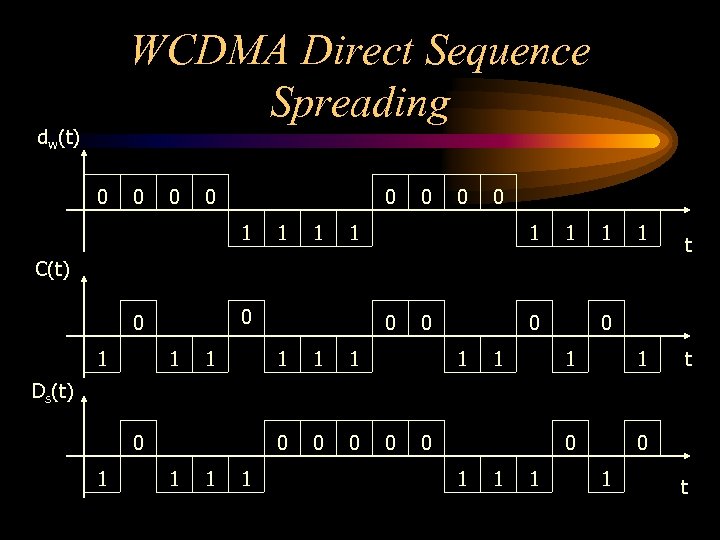
WCDMA Direct Sequence Spreading dw(t) 0 0 0 1 1 1 C(t) 0 0 1 1 1 0 0 0 1 1 t 0 1 1 0 t 0 Ds(t) 0 1 1 0 0 1 1 t
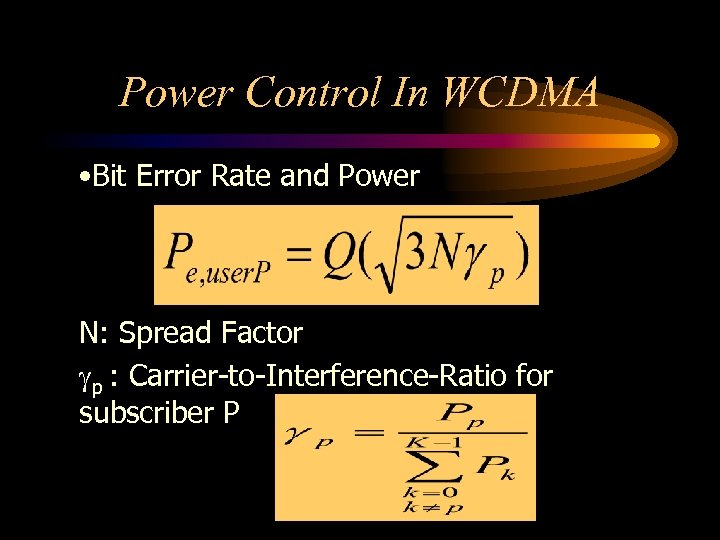
Power Control In WCDMA • Bit Error Rate and Power N: Spread Factor p : Carrier-to-Interference-Ratio for subscriber P
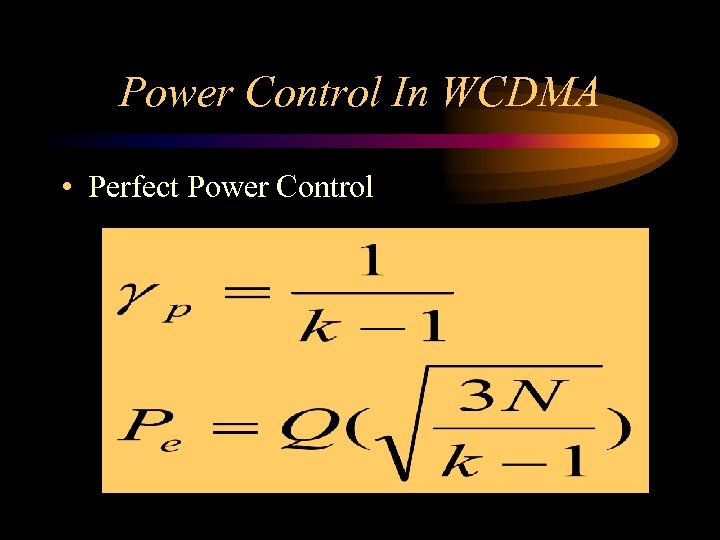
Power Control In WCDMA • Perfect Power Control
Power Control In WCDMA • Near-Far Problem in CDMA – Different Performance for Subcriber Links – A Few Subscribers closest to the BTS may contribute too much multiple Access Interference.
Power Control In WCDMA • How to do power control – Force all users to transmit the minimum amount of power – Reduce the power transmitted by users closest to the BTS; increase the power transmitted by users farest to the BTS
Power Control In WCDMA • Open Loop vs. Close Loop – Open Loop Power Control Subscriber measures the DL power and adjusts its transmission power – Close Loop Power Control BS measures the UL power. MS measures the DL power and reports to the BS. BS instructs the user to raise or lower it transmission power
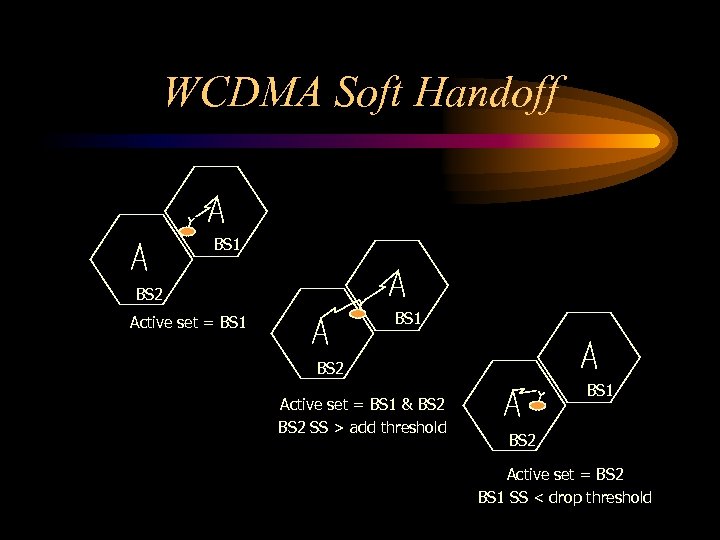
WCDMA Soft Handoff BS 1 BS 2 BS 1 Active set = BS 1 BS 2 Active set = BS 1 & BS 2 SS > add threshold BS 1 BS 2 Active set = BS 2 BS 1 SS < drop threshold
Active Research Topics • • • Cellular system architecture UMTS air interface Power control in CDMA Handoff Satellite-UMTS traffic
Reference • • • http: //www. europe. alcatel. fr/telecom/rcd/keytech/ http: //www. comms. eee. strath. ac. uk/~gozalvez/gsm/ http: //www. gsmworld. com/ http: //www. ibctelecoms. com/ http: //www. span. net. au/ http: //www. cdg. org/tech/a_ross/ http: //www. nokia. com/networks/mobile/ http: //www. gsmdata. com/ http: //www. sds. lcs. mit. edu/~turletti/gmsk/ • http: //www. wirelessweek. com/issues/3 G/
Reference • • http: //www. umts-forum. org/reports. html http: //www. itu. int/imt/ http: //www. etsi. org/ S. Dutnall, N. Lobley, A. Clapton, UMTS: The mobile part of broadband communications for the next century IEEE Atm Workshop, Proceedings. p 242252, 1998 S. Breyer, G. Dega, V. Kumar, L. Szabo, Global view of the UMTS concept Alcatel Telecommunications Review. n 3 1999. p 219 -227 M. Lee, CDMA Network Security , Prentice-Hall, 1998 U. Black, Mobile & Wireless Networks, Prentice-Hall, 1999 M. Gallagher, W. Webb, UMTS: The next generation of mobile radio, IEE Review. v 45 n 2 1999. p 59 -63
Reference • • • A. Samukic, UMTS Universal Mobile Telecommunications System: Development of standards for the third generation, IEEE Global Telecommunications Conference & Exhibition. v 4 1998. p 1976 -1983 N. Prasad, GSM evolution towards third generation UMTS/IMT 2000, IEEE International Conference on Personal Wireless Communications 1999, p 50 -54 A. Samukic, UMTS universal mobile telecommunications system: Development of standards for the third generation, IEEE Transactions on Vehicular Technology. v 47 n 4 Nov 1998. p 1099 -1104
Скачать презентацию On the Road to UMTS Universal Mobile Telecommunications
1b3e2f3b72b99192fb50358b1f87a99b.ppt