 Скачать презентацию On the Path to an Aberration Detection System
cfce4956d2b5bede6e54058aba52eef4.ppt
- Количество слайдов: 25




On the Path to an Aberration Detection System for STD Surveillance Delicia Carey 1, Ranell Myles 1, Samuel Groseclose 1 1 Division of STD Prevention, Centers for Disease Control and Prevention, Atlanta, GA March 12, 2008 National STD Prevention Conference

Presentation Overview • • Background Objectives Rationale Methods Results Conclusion/Implications Next Steps
Background What is an “aberration”? An aberration in public health surveillance data can be defined as a change in the distribution or frequency of health related outcomes that is statistically significant when compared with historical data.
Background Aberration Detection Methods • Detect changes in the reported occurrence of health events • Assist epidemiologists in the recognition of an unusual case reporting pattern • Stimulate public health investigation
Objectives To apply selected aberration detection methods to syphilis surveillance data at the federal level and describe their performance characteristics To implement methods/monitoring system at state and/or local level
Rationale • Syphilis elimination shifted surveillance focus to early detection and control of outbreaks • Standardized approach for the identification of fluctuations in reported cases • More timely response to emerging outbreaks and support a phased response
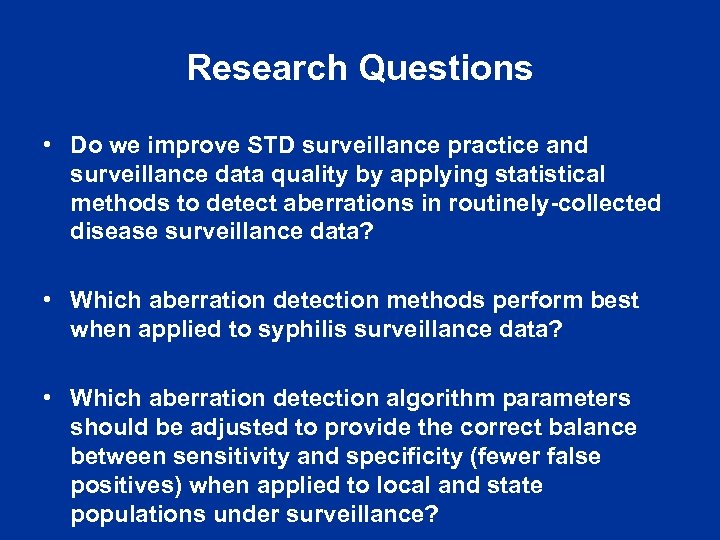
Research Questions • Do we improve STD surveillance practice and surveillance data quality by applying statistical methods to detect aberrations in routinely-collected disease surveillance data? • Which aberration detection methods perform best when applied to syphilis surveillance data? • Which aberration detection algorithm parameters should be adjusted to provide the correct balance between sensitivity and specificity (fewer false positives) when applied to local and state populations under surveillance?

Project Plan • • Phase III Phase IV - Evaluation of Methods - Method Exploration/Adaptation - Pilot Demonstrations - Implementation • Collaborative project: -within DSTDP -between project areas and DSTDP
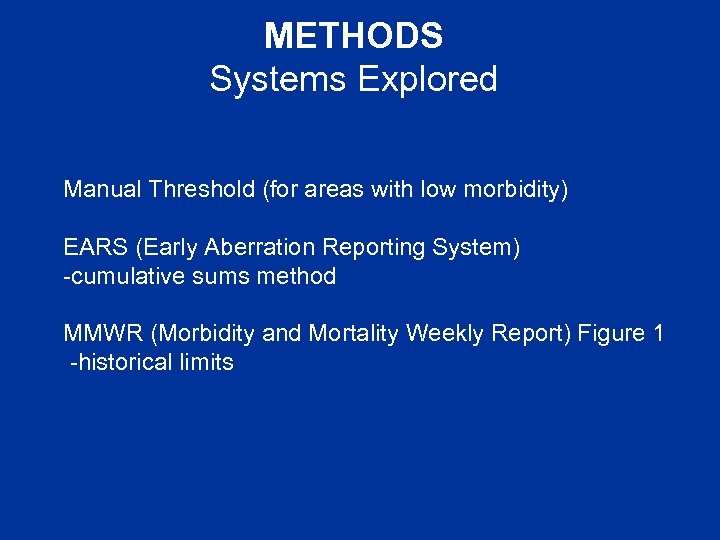
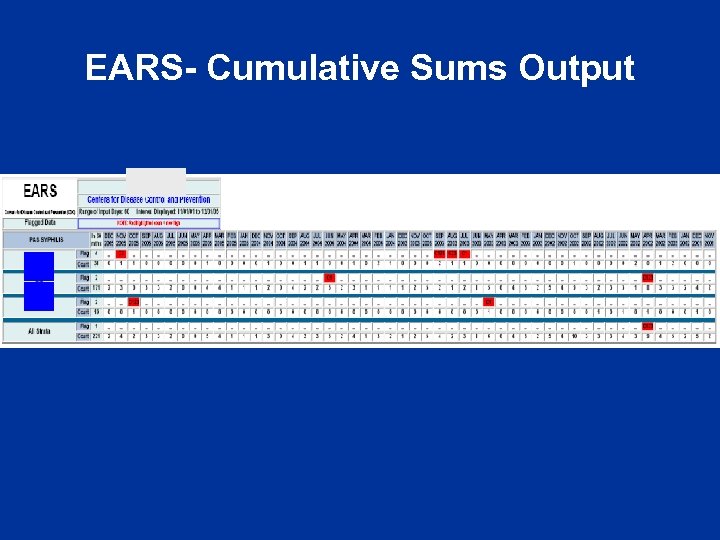
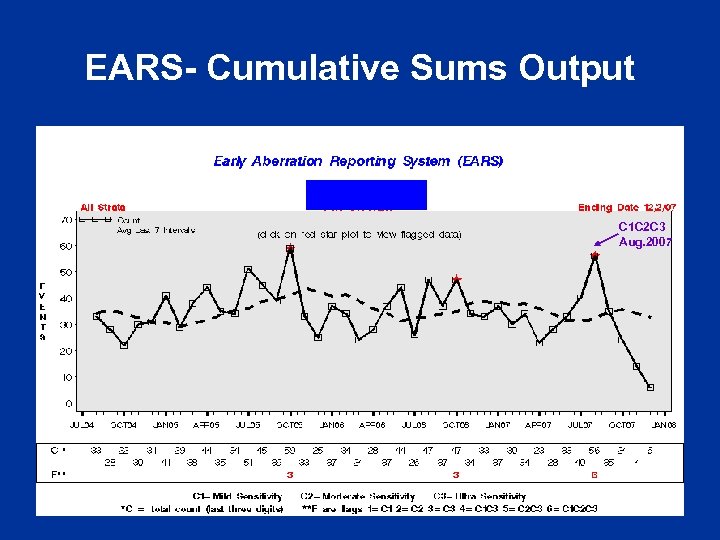
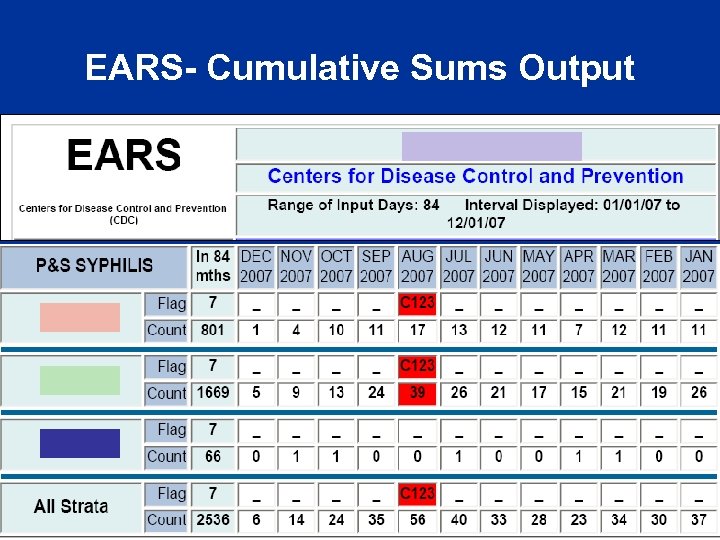
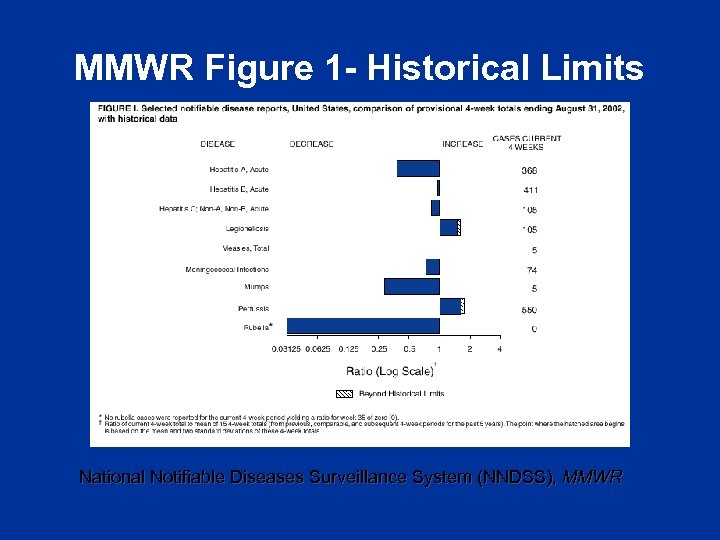
METHODS Systems Explored Manual Threshold (for areas with low morbidity) EARS (Early Aberration Reporting System) -cumulative sums method MMWR (Morbidity and Mortality Weekly Report) Figure 1 -historical limits
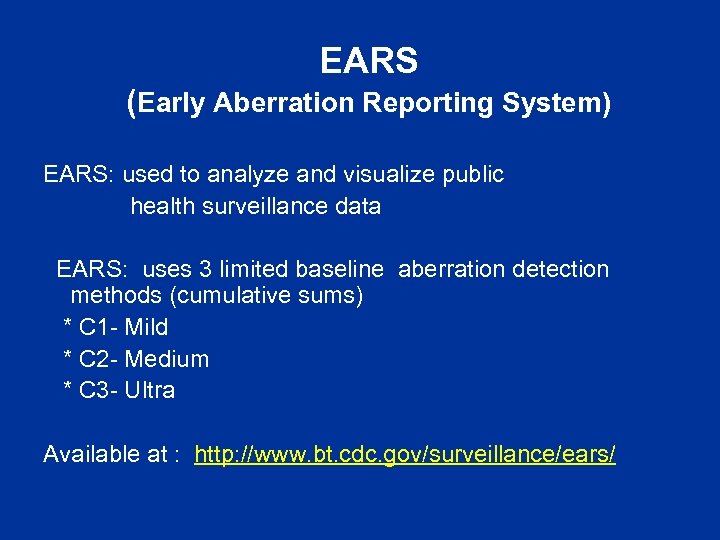
EARS (Early Aberration Reporting System) EARS: used to analyze and visualize public health surveillance data EARS: uses 3 limited baseline aberration detection methods (cumulative sums) * C 1 - Mild * C 2 - Medium * C 3 - Ultra Available at : http: //www. bt. cdc. gov/surveillance/ears/
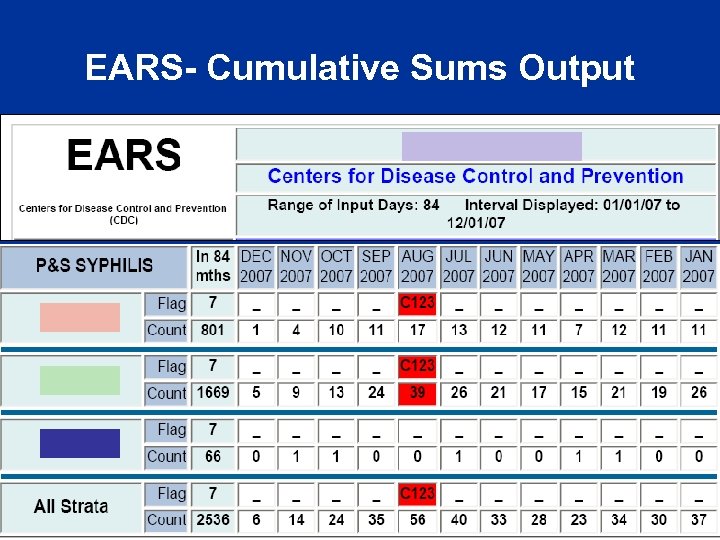
EARS- Cumulative Sums Output
EARS- Cumulative Sums Output
EARS- Cumulative Sums Output C 1 C 2 C 3 Aug. 2007
EARS- Cumulative Sums Output
MMWR Figure 1 - Historical Limits National Notifiable Diseases Surveillance System (NNDSS), MMWR
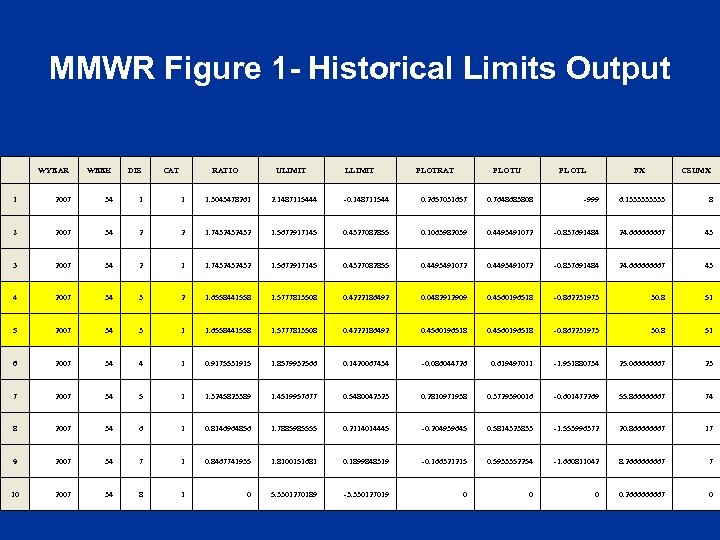
MMWR Figure 1 - Historical Limits Output WYEAR WEEK DIS 1 2007 34 1 2 2007 34 3 2007 4 CAT RATIO ULIMIT LLIMIT PLOTRAT PLOTU PLOTL FX CSUMX 1 1. 3043478261 2. 1487115444 -0. 148711544 0. 2657031657 0. 7648683808 -999 6. 133333 8 2 2 1. 7432432432 1. 5672917145 0. 4327082855 0. 1063982039 0. 4493491072 -0. 837691484 24. 66667 43 34 2 1 1. 7432432432 1. 5672917145 0. 4327082855 0. 4493491072 -0. 837691484 24. 66667 43 2007 34 3 2 1. 6558441558 1. 5777813508 0. 4222186492 0. 0482912909 0. 4560196518 -0. 862231973 30. 8 51 5 2007 34 3 1 1. 6558441558 1. 5777813508 0. 4222186492 0. 4560196518 -0. 862231973 30. 8 51 6 2007 34 4 1 0. 9175531915 1. 8579932566 0. 1420067434 -0. 086044726 0. 619497011 -1. 951880734 25. 066666667 23 7 2007 34 5 1 1. 3245823389 1. 4519957677 0. 5480042323 0. 2810971938 0. 3729390016 -0. 601472269 55. 866666667 74 8 2007 34 6 1 0. 8146964856 1. 7885985555 0. 2114014445 -0. 204939645 0. 5814323833 -1. 553996372 20. 866666667 17 9 2007 34 7 1 0. 8467741935 1. 8100151681 0. 1899848319 -0. 166321215 0. 5933352254 -1. 660811042 8. 266667 7 10 2007 34 8 1 0 5. 3301270189 -3. 330127019 0 0. 266667 0
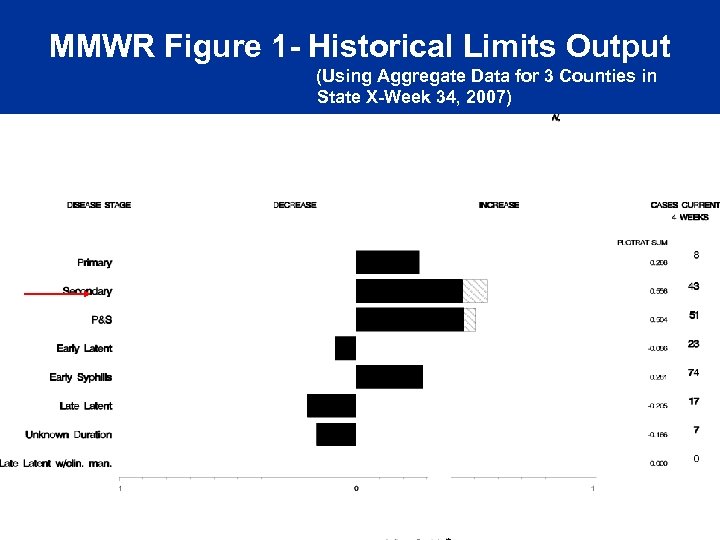
MMWR Figure 1 - Historical Limits Output (Using Aggregate Data for 3 Counties in State X-Week 34, 2007) STAGE PLOTRAT SUM
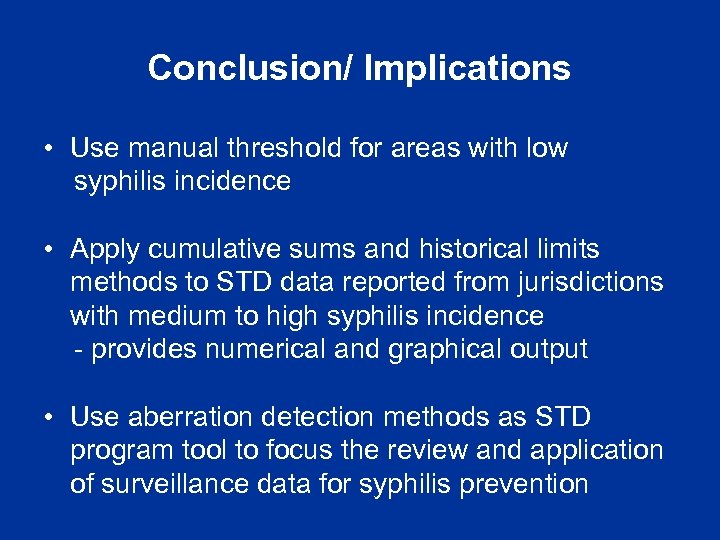
Conclusion/ Implications • Use manual threshold for areas with low syphilis incidence • Apply cumulative sums and historical limits methods to STD data reported from jurisdictions with medium to high syphilis incidence - provides numerical and graphical output • Use aberration detection methods as STD program tool to focus the review and application of surveillance data for syphilis prevention
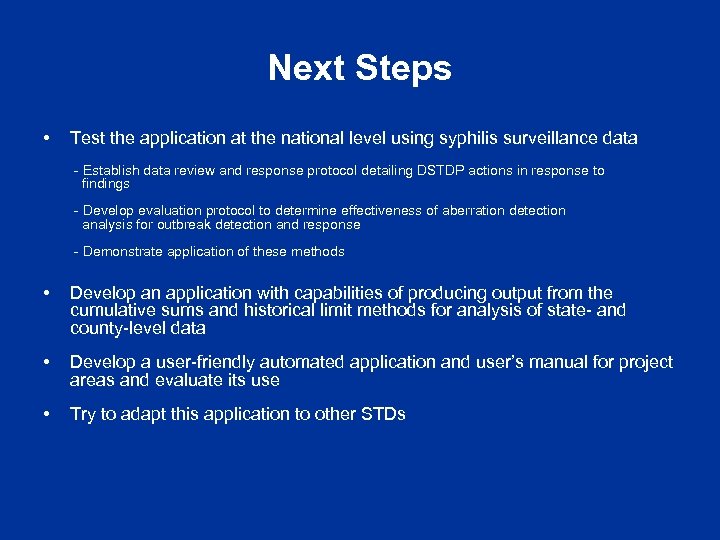
Next Steps • Test the application at the national level using syphilis surveillance data - Establish data review and response protocol detailing DSTDP actions in response to findings - Develop evaluation protocol to determine effectiveness of aberration detection analysis for outbreak detection and response - Demonstrate application of these methods • Develop an application with capabilities of producing output from the cumulative sums and historical limit methods for analysis of state- and county-level data • Develop a user-friendly automated application and user’s manual for project areas and evaluate its use • Try to adapt this application to other STDs

SPECIAL THANKS TO • • • Jim Braxton, NCHHSTP, DSTDP, SDMB Sharon Clanton, NCHHSTP, DSTDP, SDMB Alesia Harvey, NCHHSTP, DSTDP, SDMB Lori Hutwagner, NCPDCID/DBPR/ESRB Fred Rivers, NCHHSTP, DSTDP, SDMB

Questions? ? ? Contact Information Email Address: DCarey@cdc. gov The findings and conclusions in this presentation are those of the author(s) and do not necessarily represent the views of the Centers for Disease Control and Prevention.

BACK-UP SLIDE(S)
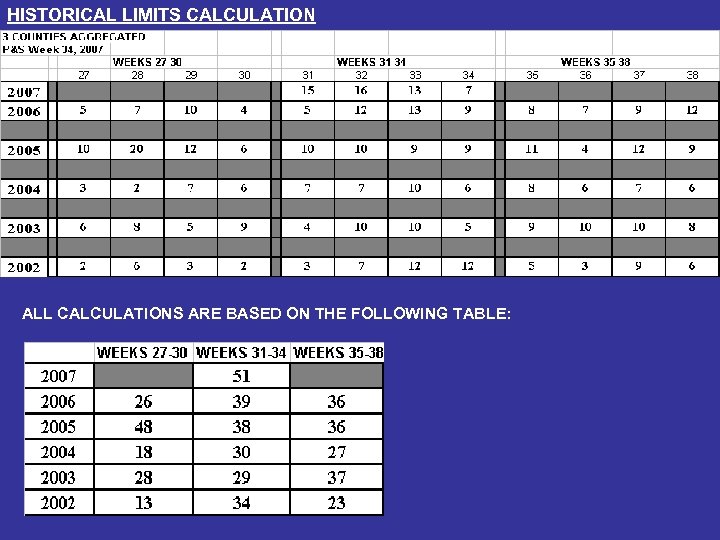
HISTORICAL LIMITS CALCULATION ALL CALCULATIONS ARE BASED ON THE FOLLOWING TABLE:
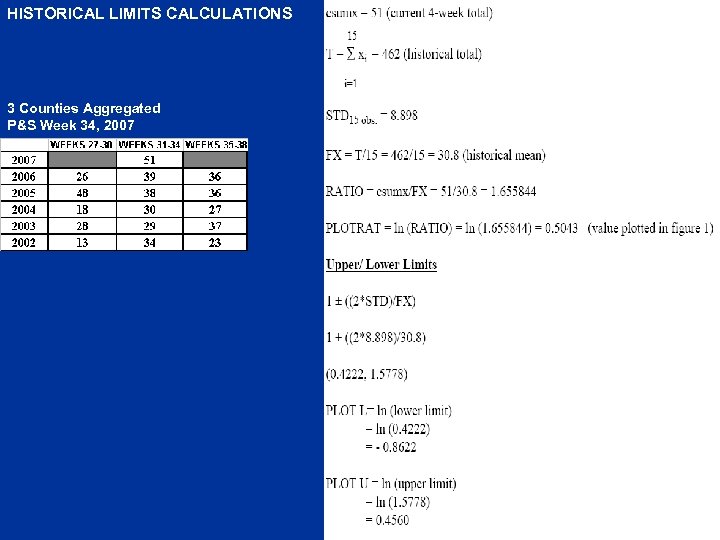
HISTORICAL LIMITS CALCULATIONS 3 Counties Aggregated P&S Week 34, 2007
 Скачать презентацию On the Path to an Aberration Detection System
cfce4956d2b5bede6e54058aba52eef4.ppt