 Скачать презентацию On the Complexity of Search Problems George Pierrakos
77c9626fd76a45ff7f4e7dbffdd4179e.ppt
- Количество слайдов: 11



On the Complexity of Search Problems George Pierrakos Mostly based on: On the Complexity of the Parity Argument and Other Insufficient Proofs of Existence [Pap 94] n On total functions, existence theorems and computational complexity [MP 91] n How easy is local search? [JPY 88] n Computational Complexity [Pap 92] n The complexity of computing a Nash equilibrium [DGP 06] n The complexity of pure Nash equilibria [FPT 04] n slides and scribe notes from many people… n TFNP and Leaf. Covering 1
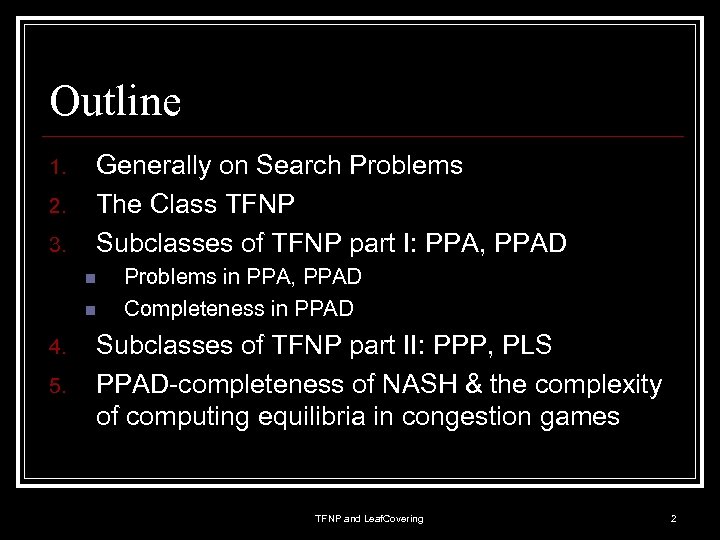
Outline 1. 2. 3. Generally on Search Problems The Class TFNP Subclasses of TFNP part I: PPA, PPAD n n 4. 5. Problems in PPA, PPAD Completeness in PPAD Subclasses of TFNP part II: PPP, PLS PPAD-completeness of NASH & the complexity of computing equilibria in congestion games TFNP and Leaf. Covering 2
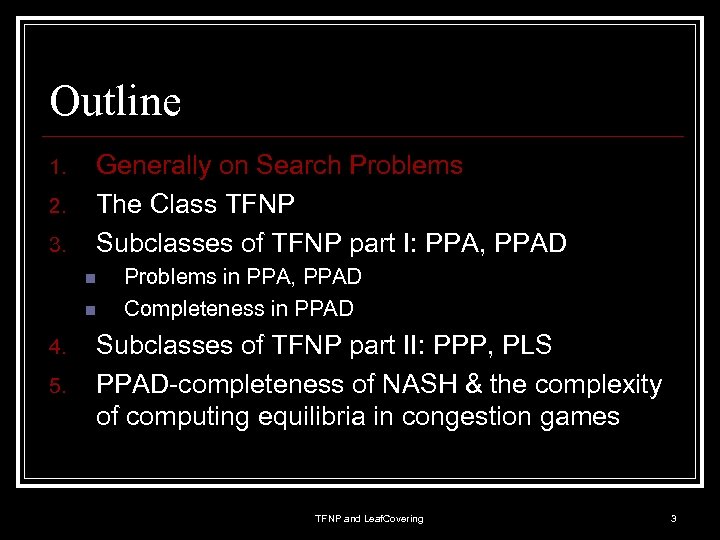
Outline 1. 2. 3. Generally on Search Problems The Class TFNP Subclasses of TFNP part I: PPA, PPAD n n 4. 5. Problems in PPA, PPAD Completeness in PPAD Subclasses of TFNP part II: PPP, PLS PPAD-completeness of NASH & the complexity of computing equilibria in congestion games TFNP and Leaf. Covering 3
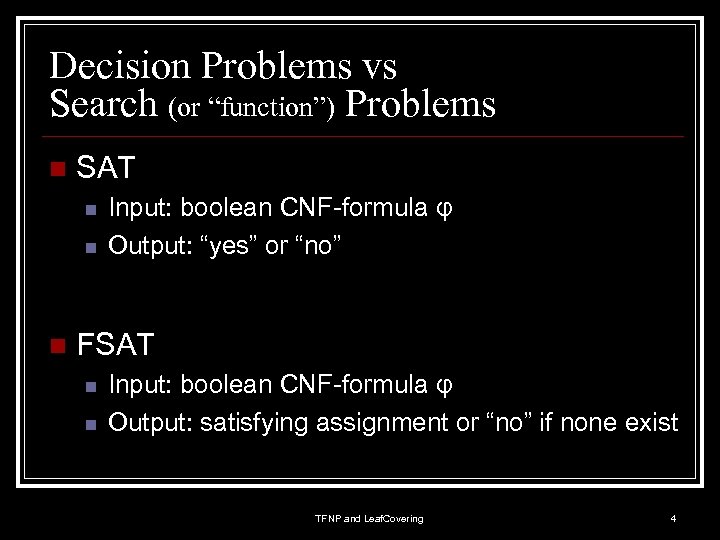
Decision Problems vs Search (or “function”) Problems n SAT n n n Input: boolean CNF-formula φ Output: “yes” or “no” FSAT n n Input: boolean CNF-formula φ Output: satisfying assignment or “no” if none exist TFNP and Leaf. Covering 4
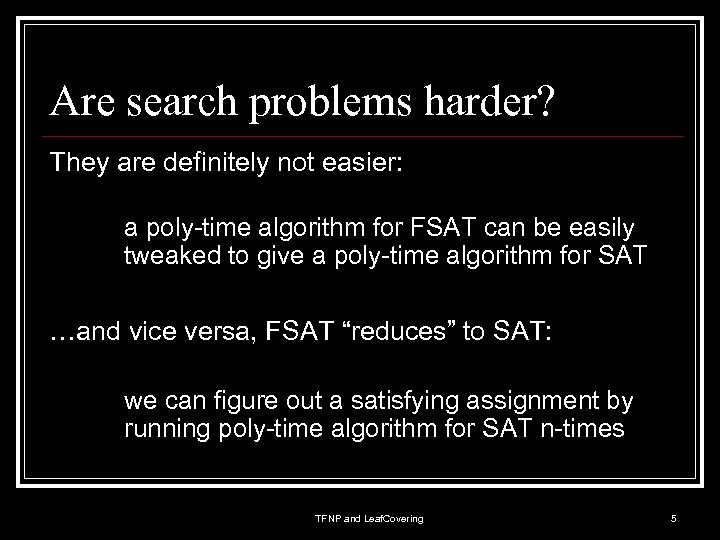
Are search problems harder? They are definitely not easier: a poly-time algorithm for FSAT can be easily tweaked to give a poly-time algorithm for SAT …and vice versa, FSAT “reduces” to SAT: we can figure out a satisfying assignment by running poly-time algorithm for SAT n-times TFNP and Leaf. Covering 5
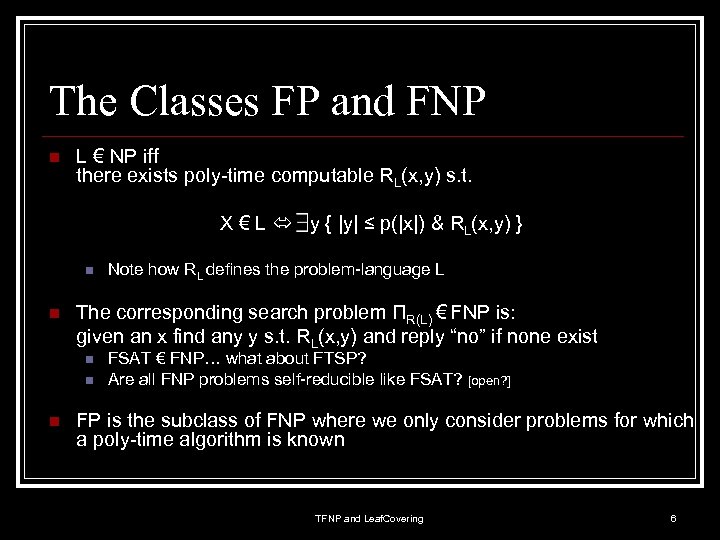
The Classes FP and FNP n L € NP iff there exists poly-time computable RL(x, y) s. t. X € L y { |y| ≤ p(|x|) & RL(x, y) } n n The corresponding search problem ΠR(L) € FNP is: given an x find any y s. t. RL(x, y) and reply “no” if none exist n n n Note how RL defines the problem-language L FSAT € FNP… what about FTSP? Are all FNP problems self-reducible like FSAT? [open? ] FP is the subclass of FNP where we only consider problems for which a poly-time algorithm is known TFNP and Leaf. Covering 6
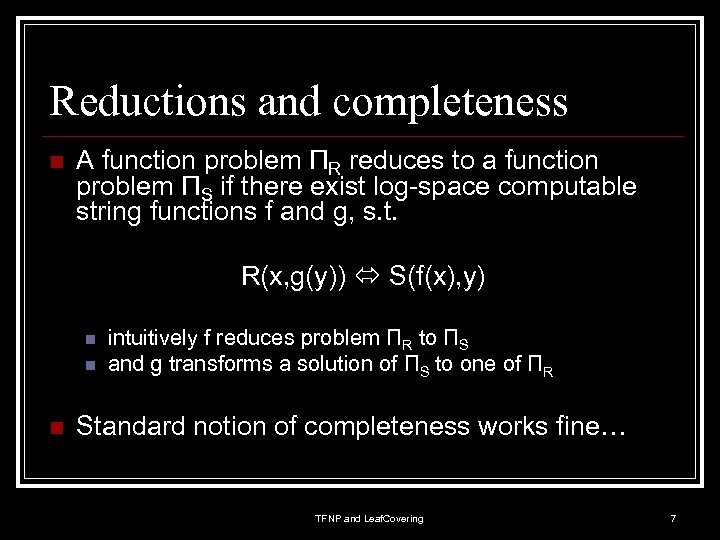
Reductions and completeness n A function problem ΠR reduces to a function problem ΠS if there exist log-space computable string functions f and g, s. t. R(x, g(y)) S(f(x), y) n n n intuitively f reduces problem ΠR to ΠS and g transforms a solution of ΠS to one of ΠR Standard notion of completeness works fine… TFNP and Leaf. Covering 7
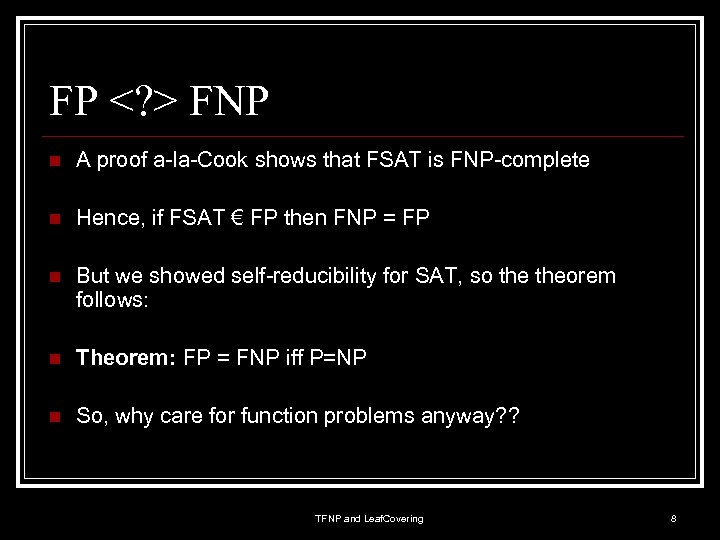
FP <? > FNP n A proof a-la-Cook shows that FSAT is FNP-complete n Hence, if FSAT € FP then FNP = FP n But we showed self-reducibility for SAT, so theorem follows: n Theorem: FP = FNP iff P=NP n So, why care for function problems anyway? ? TFNP and Leaf. Covering 8
Outline 1. 2. 3. Generally on Search Problems The Class TFNP Subclasses of TFNP part I: PPA, PPAD n n 4. 5. Problems in PPA, PPAD Completeness in PPAD Subclasses of TFNP part II: PPP, PLS PPAD-completeness of NASH & the complexity of computing equilibria in congestion games TFNP and Leaf. Covering 9
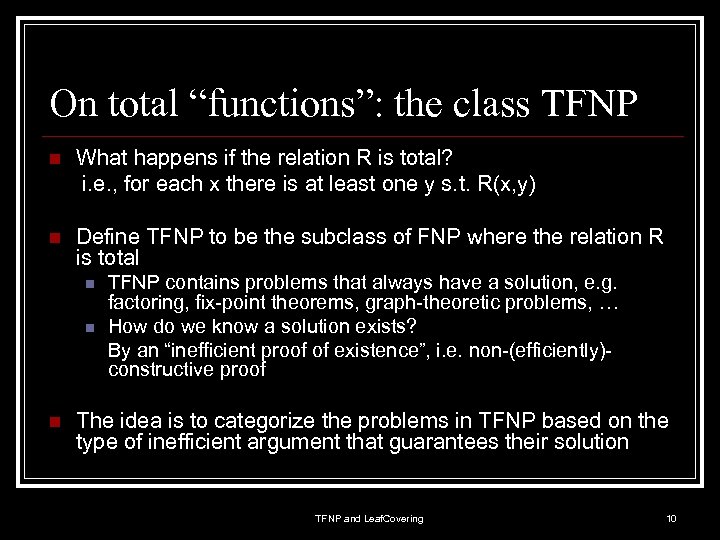
On total “functions”: the class TFNP n What happens if the relation R is total? i. e. , for each x there is at least one y s. t. R(x, y) n Define TFNP to be the subclass of FNP where the relation R is total n n n TFNP contains problems that always have a solution, e. g. factoring, fix-point theorems, graph-theoretic problems, … How do we know a solution exists? By an “inefficient proof of existence”, i. e. non-(efficiently)constructive proof The idea is to categorize the problems in TFNP based on the type of inefficient argument that guarantees their solution TFNP and Leaf. Covering 10
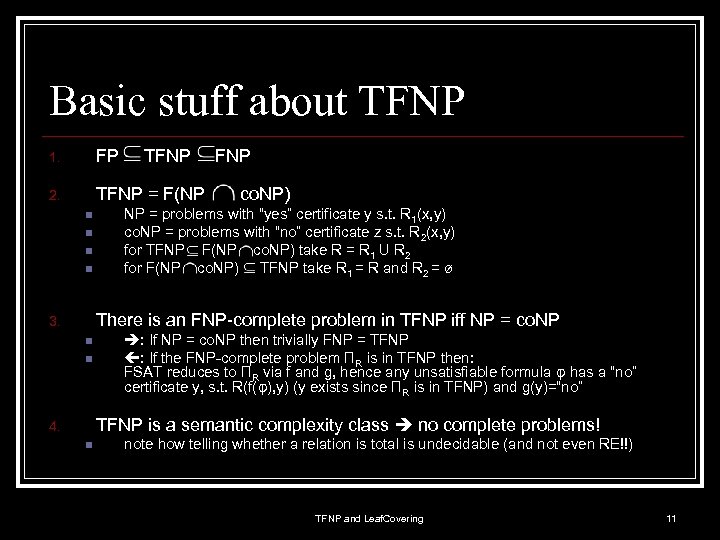
Basic stuff about TFNP 1. FP 2. TFNP = F(NP n n TFNP co. NP) NP = problems with “yes” certificate y s. t. R 1(x, y) co. NP = problems with “no” certificate z s. t. R 2(x, y) for TFNP F(NP co. NP) take R = R 1 U R 2 for F(NP co. NP) TFNP take R 1 = R and R 2 = ø There is an FNP-complete problem in TFNP iff NP = co. NP 3. n n : If NP = co. NP then trivially FNP = TFNP : If the FNP-complete problem ΠR is in TFNP then: FSAT reduces to ΠR via f and g, hence any unsatisfiable formula φ has a “no” certificate y, s. t. R(f(φ), y) (y exists since ΠR is in TFNP) and g(y)=“no” TFNP is a semantic complexity class no complete problems! 4. n note how telling whether a relation is total is undecidable (and not even RE!!) TFNP and Leaf. Covering 11
Скачать презентацию On the Complexity of Search Problems George Pierrakos
77c9626fd76a45ff7f4e7dbffdd4179e.ppt