


 Скачать презентацию On the Calculation of Magnetic Helicity of a
5c639fa2d33dd69534a0257b031be125.ppt
- Количество слайдов: 68
 On the Calculation of Magnetic Helicity of a Solar Active Region and a Cylindrical Flux Rope Qiang Hu, G. M. Webb, B. Dasgupta CSPAR, University of Alabama in Huntsville, USA J. Qiu Montana State University, USA qh 0001@uah. edu
 Acknowledgement Collaborators: Debi P. Choudhary B. Dasgupta Charlie Farrugia G. A. Gary Yang Liu Dana Longcope Jiong Qiu D. Shaikh R. Skoug C. W. Smith/N. F. Ness W. -L. Teh Bengt U. Ö. Sonnerup Vasyl Yurchyshyn Gary Zank NASA grants NNG 04 GF 47 G, NNG 06 GD 41 G, NNX 07 AO 73 G, and NNX 08 AH 46 G (data provided by various NASA/ESA missions, and ground facilities; images credit: mostly NASA/ESA unless where indicated)
 Overview • Helical Structures: Interplanetary Coronal Mass Ejections – In-situ detection and magnetic flux rope model – GS technique and its applications • MDR-based coronal magnetic field extrapolation • Homotopy formula for magnetic vector potential • Summary and Outlook 3
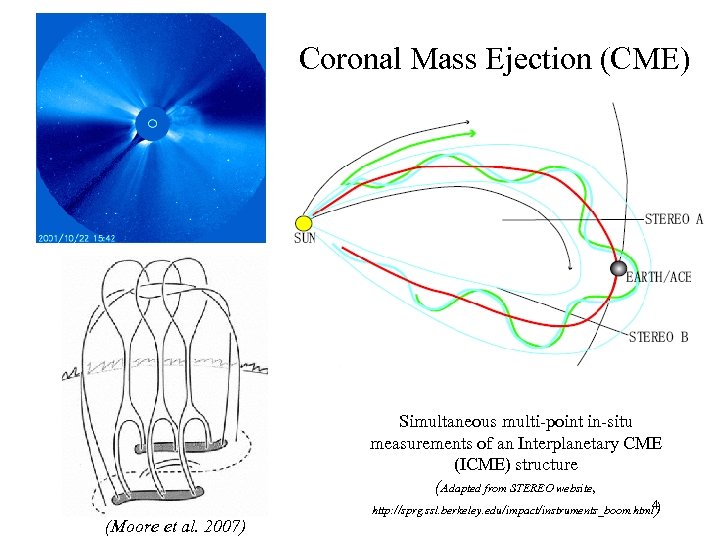 Coronal Mass Ejection (CME) (Moore et al. 2007) Simultaneous multi-point in-situ measurements of an Interplanetary CME (ICME) structure (Adapted from STEREO website, 4 http: //sprg. ssl. berkeley. edu/impact/instruments_boom. html)
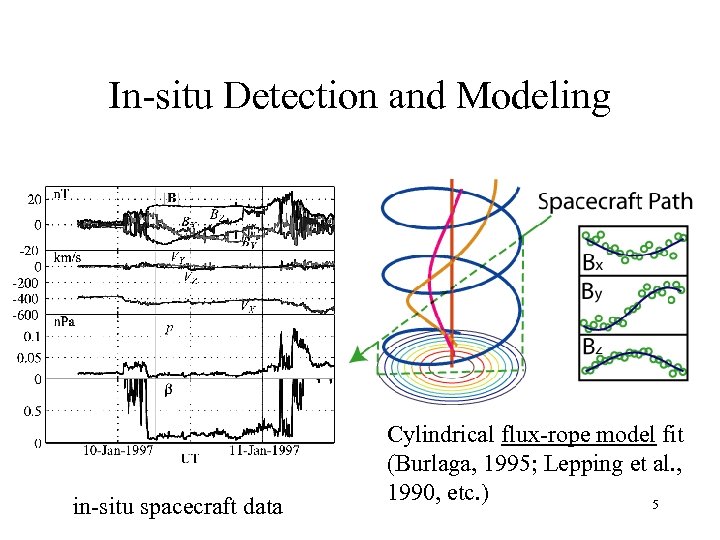 In-situ Detection and Modeling in-situ spacecraft data Cylindrical flux-rope model fit (Burlaga, 1995; Lepping et al. , 1990, etc. ) 5
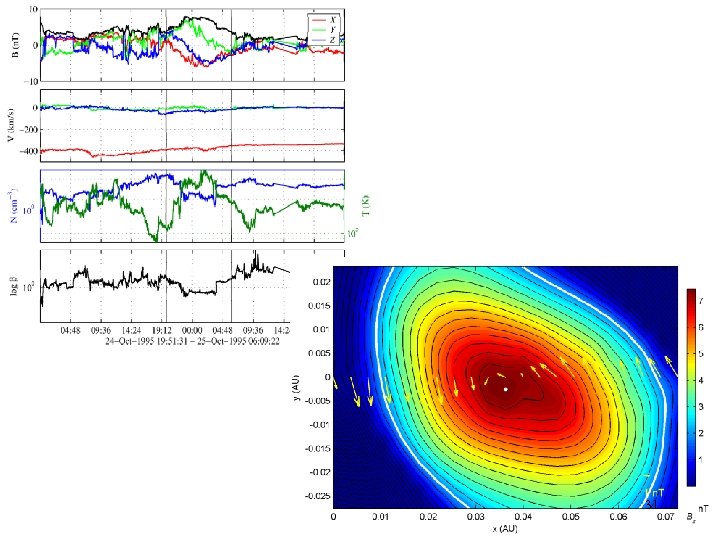
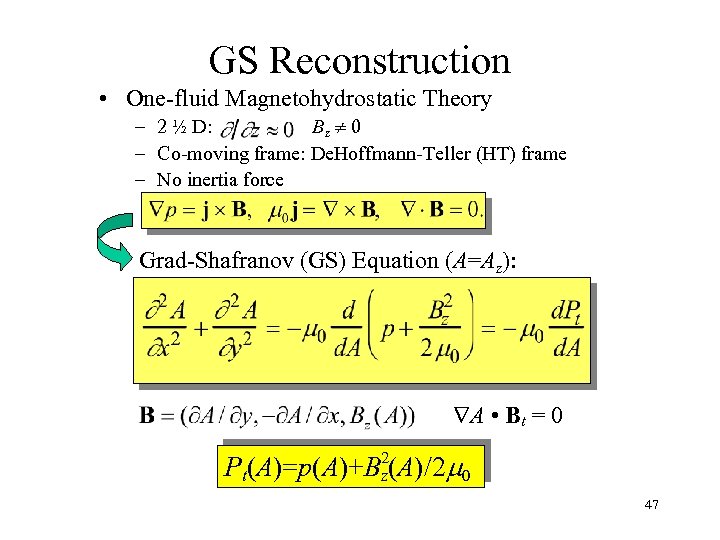
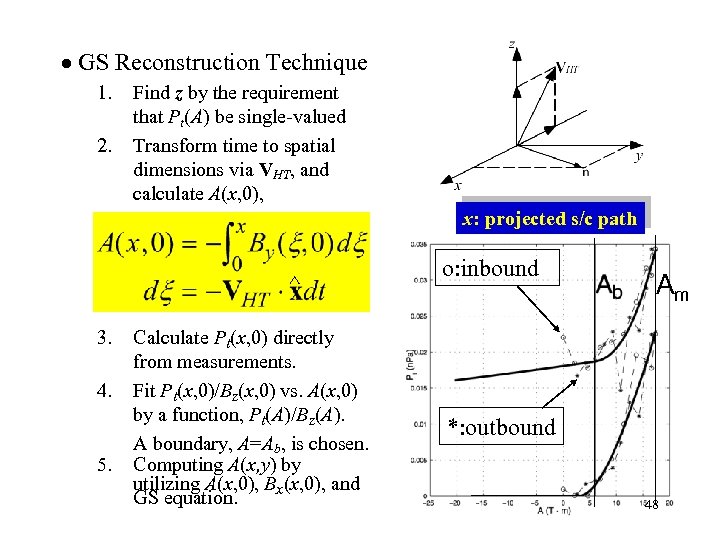
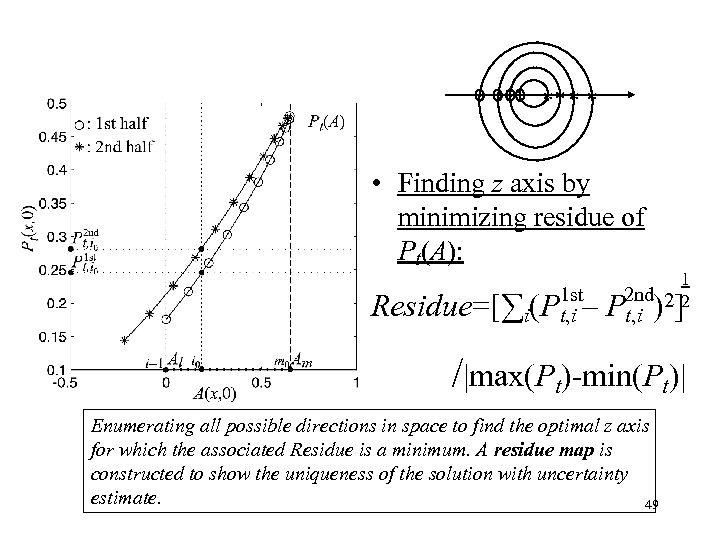
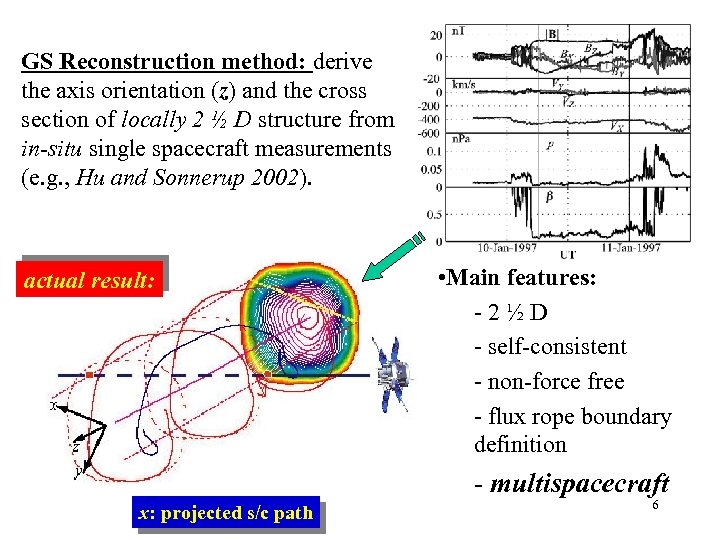 GS Reconstruction method: derive the axis orientation (z) and the cross section of locally 2 ½ D structure from in-situ single spacecraft measurements (e. g. , Hu and Sonnerup 2002). actual result: • Main features: -2½D - self-consistent - non-force free - flux rope boundary definition - multispacecraft x: projected s/c path 6
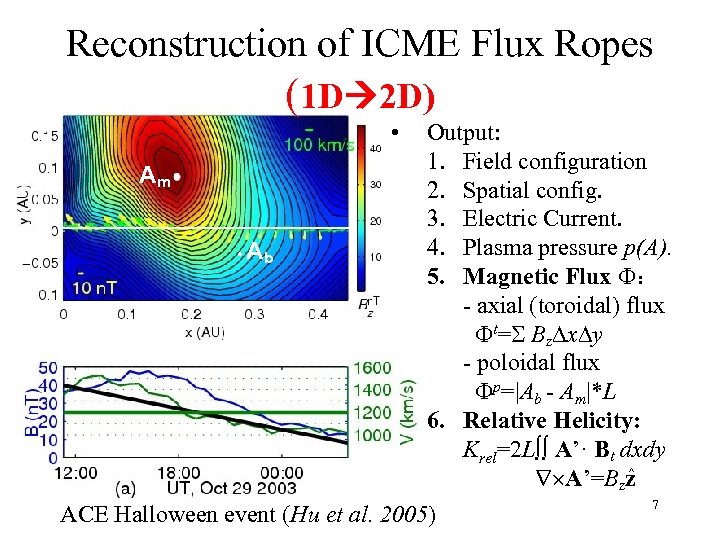 Reconstruction of ICME Flux Ropes (1 D 2 D) • Am • Ab Output: 1. Field configuration 2. Spatial config. 3. Electric Current. 4. Plasma pressure p(A). 5. Magnetic Flux : - axial (toroidal) flux t= Bz x y - poloidal flux p=|Ab - Am|*L 6. Relative Helicity: Krel=2 L A’· Bt dxdy ^ A’=Bzz ACE Halloween event (Hu et al. 2005) 7
![July 11, 1998 [Hu et al, 2004] z=(0. 057, 0. 98, -0. 18) ±](https://present5.com/presentation/5c639fa2d33dd69534a0257b031be125/image-8.jpg "July 11, 1998 [Hu et al, 2004] z=(0. 057, 0. 98, -0. 18) ±") July 11, 1998 [Hu et al, 2004] z=(0. 057, 0. 98, -0. 18) ± (0. 08, 0. 01, 0. 03) RTN 8
July 11, 1998 [Hu et al, 2004] z=(0. 057, 0. 98, -0. 18) ± (0. 08, 0. 01, 0. 03) RTN 8
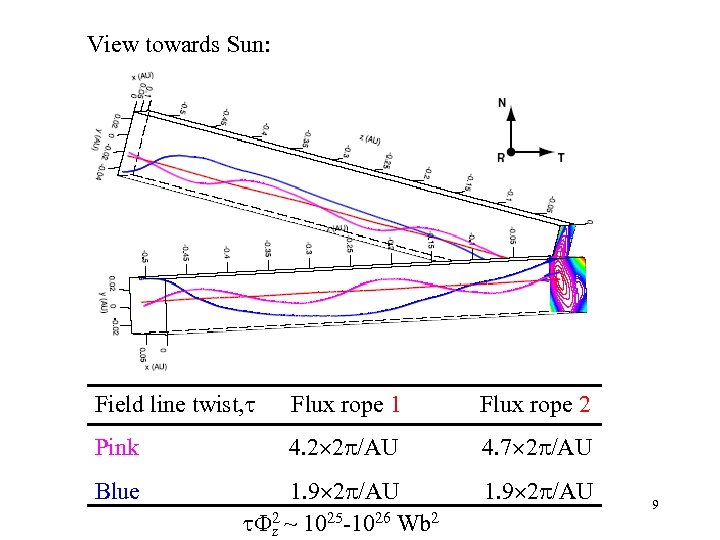 View towards Sun: Field line twist, Flux rope 1 Flux rope 2 Pink 4. 2 2 /AU 4. 7 2 /AU Blue 1. 9 2 /AU 2 z ~ 1025 -1026 Wb 2 1. 9 2 /AU 9
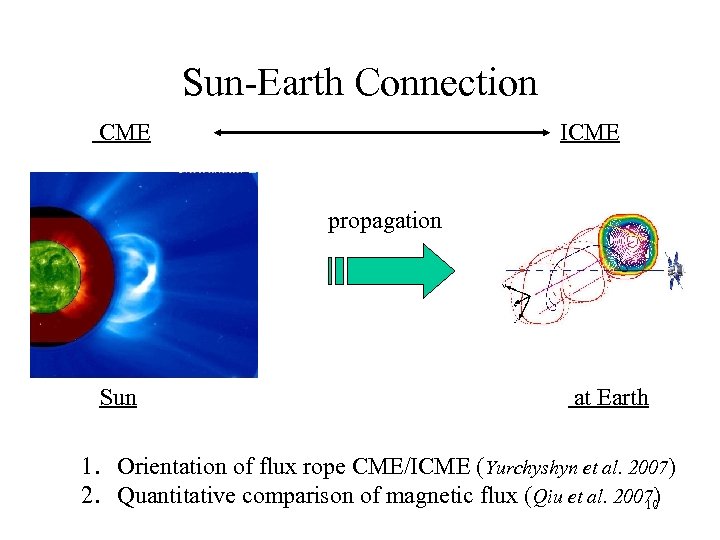 Sun-Earth Connection CME ICME propagation Sun at Earth 1. Orientation of flux rope CME/ICME (Yurchyshyn et al. 2007) 2. Quantitative comparison of magnetic flux (Qiu et al. 2007) 10
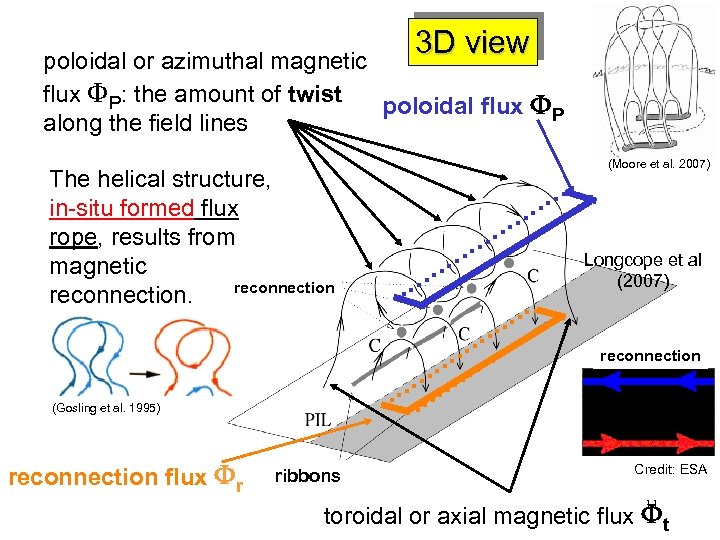 3 D view poloidal or azimuthal magnetic flux P: the amount of twist poloidal flux P along the field lines The helical structure, in-situ formed flux rope, results from magnetic reconnection. (Moore et al. 2007) Longcope et al (2007) reconnection (Gosling et al. 1995) reconnection flux r ribbons Credit: ESA toroidal or axial magnetic flux t 11
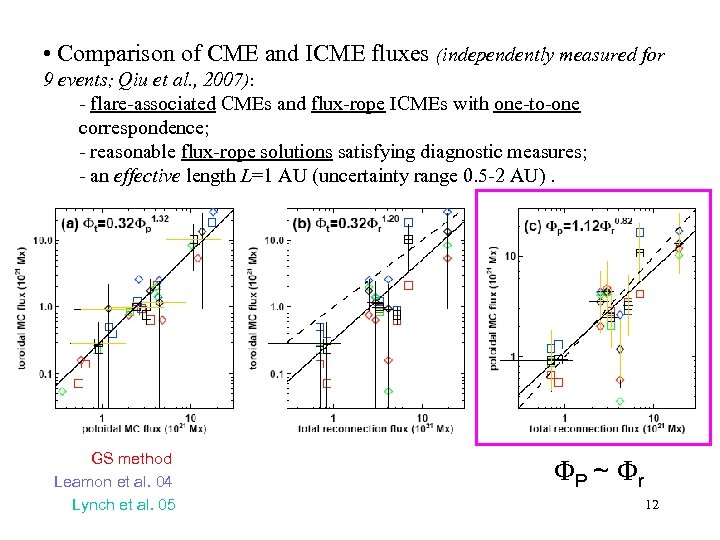 • Comparison of CME and ICME fluxes (independently measured for 9 events; Qiu et al. , 2007): - flare-associated CMEs and flux-rope ICMEs with one-to-one correspondence; - reasonable flux-rope solutions satisfying diagnostic measures; - an effective length L=1 AU (uncertainty range 0. 5 -2 AU). GS method Leamon et al. 04 Lynch et al. 05 P ~ r 12
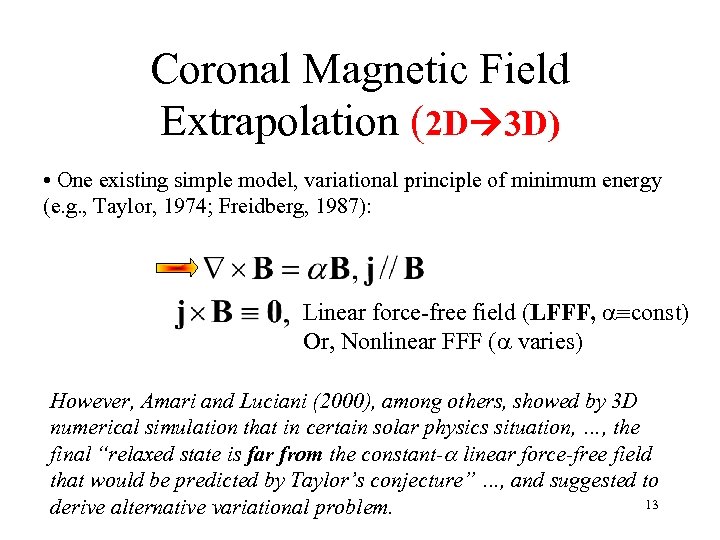 Coronal Magnetic Field Extrapolation (2 D 3 D) • One existing simple model, variational principle of minimum energy (e. g. , Taylor, 1974; Freidberg, 1987): Linear force-free field (LFFF, const) Or, Nonlinear FFF ( varies) However, Amari and Luciani (2000), among others, showed by 3 D numerical simulation that in certain solar physics situation, …, the final “relaxed state is far from the constant- linear force-free field that would be predicted by Taylor’s conjecture” …, and suggested to 13 derive alternative variational problem.
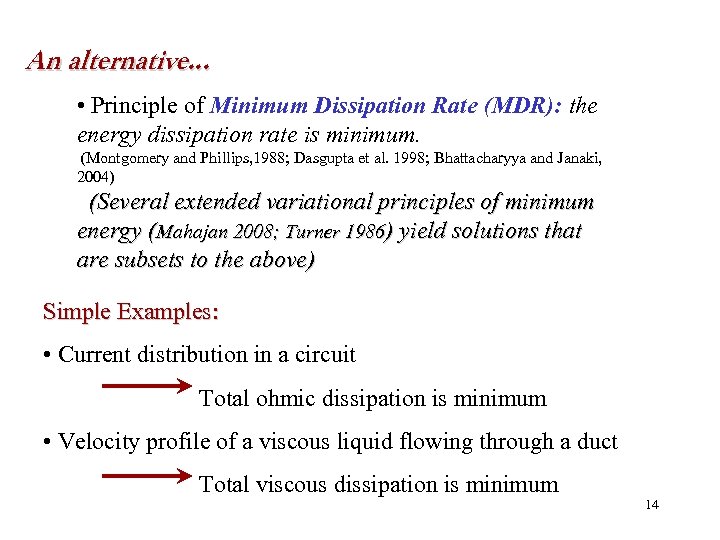 An alternative. . . • Principle of Minimum Dissipation Rate (MDR): the energy dissipation rate is minimum. (Montgomery and Phillips, 1988; Dasgupta et al. 1998; Bhattacharyya and Janaki, 2004) (Several extended variational principles of minimum energy (Mahajan 2008; Turner 1986) yield solutions that are subsets to the above) Simple Examples: • Current distribution in a circuit Total ohmic dissipation is minimum • Velocity profile of a viscous liquid flowing through a duct Total viscous dissipation is minimum 14
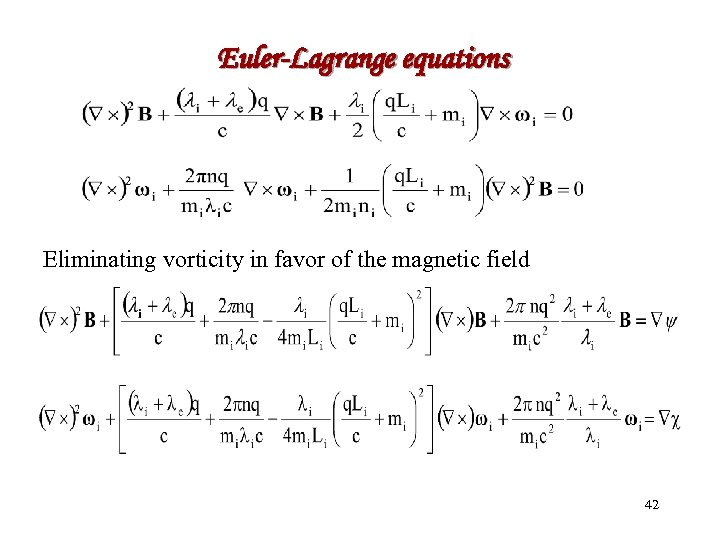
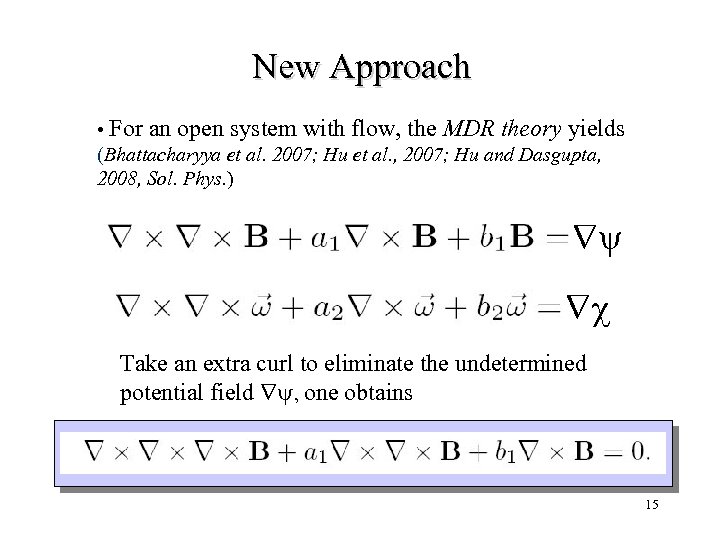 New Approach • For an open system with flow, the MDR theory yields (Bhattacharyya et al. 2007; Hu et al. , 2007; Hu and Dasgupta, 2008, Sol. Phys. ) Take an extra curl to eliminate the undetermined potential field , one obtains 15
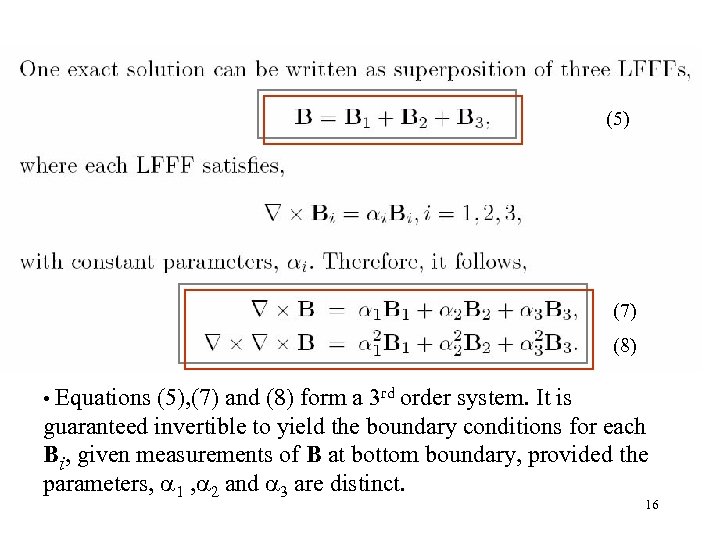 (5) (7) (8) • Equations (5), (7) and (8) form a 3 rd order system. It is guaranteed invertible to yield the boundary conditions for each Bi, given measurements of B at bottom boundary, provided the parameters, 1 , 2 and 3 are distinct. 16
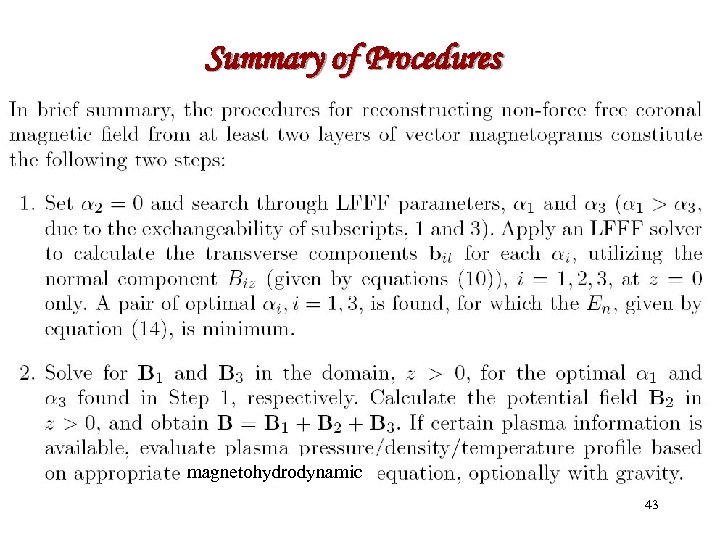
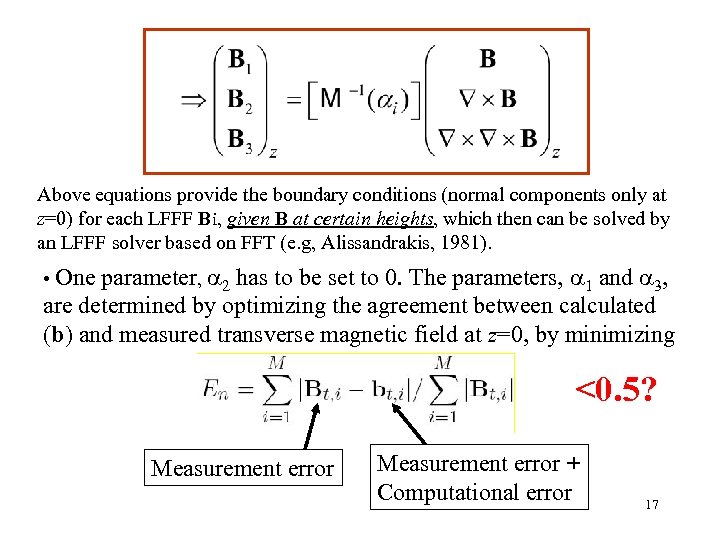 Above equations provide the boundary conditions (normal components only at z=0) for each LFFF Bi, given B at certain heights, which then can be solved by an LFFF solver based on FFT (e. g, Alissandrakis, 1981). • One parameter, 2 has to be set to 0. The parameters, 1 and 3, are determined by optimizing the agreement between calculated (b) and measured transverse magnetic field at z=0, by minimizing <0. 5? Measurement error + Computational error 17
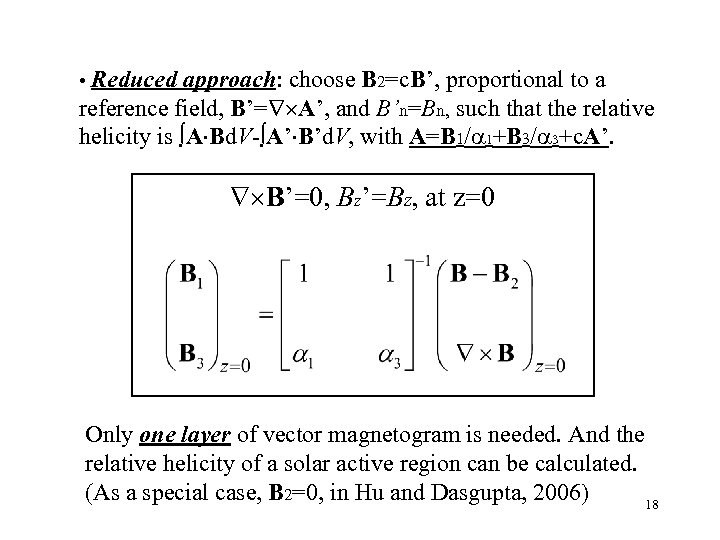 • Reduced approach: choose B 2=c. B’, proportional to a reference field, B’= A’, and B’n=Bn, such that the relative helicity is A Bd. V- A’ B’d. V, with A=B 1/ 1+B 3/ 3+c. A’. B’=0, Bz’=Bz, at z=0 Only one layer of vector magnetogram is needed. And the relative helicity of a solar active region can be calculated. (As a special case, B 2=0, in Hu and Dasgupta, 2006) 18
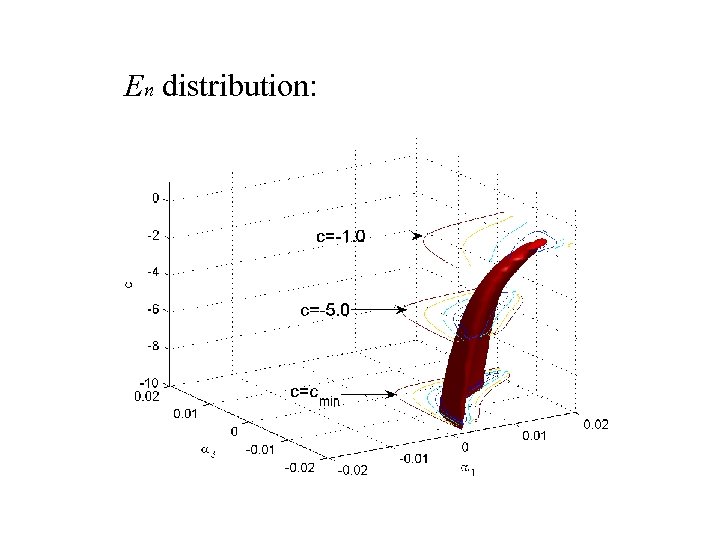
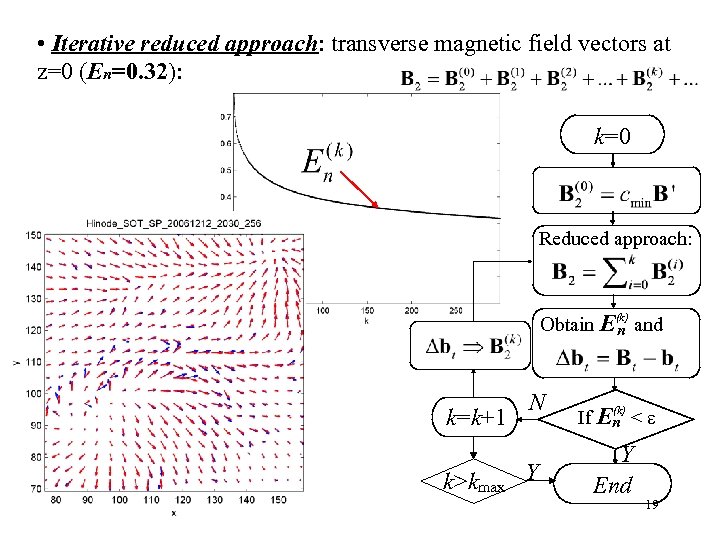 • Iterative reduced approach: transverse magnetic field vectors at z=0 (En=0. 32): k=0 Reduced approach: Obtain E n and (k) k=k+1 N k>kmax Y If En < (k) Y End 19
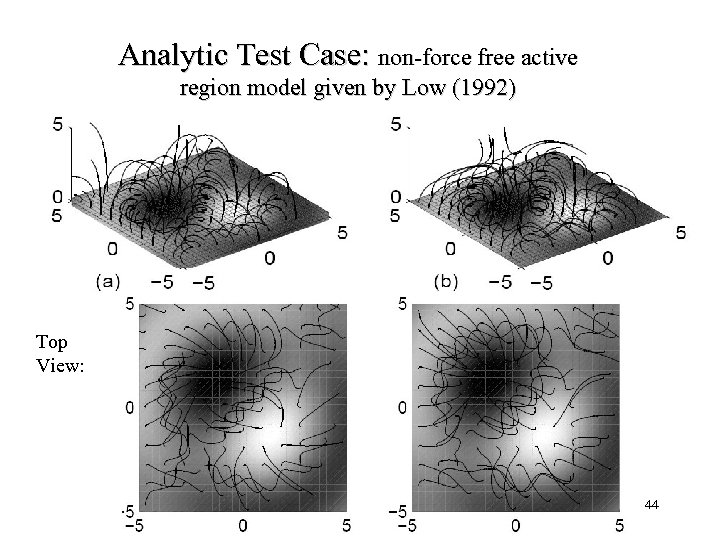
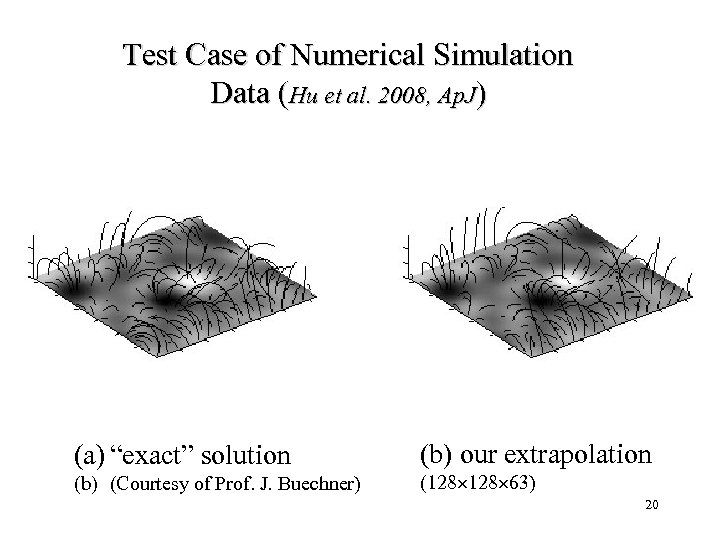 Test Case of Numerical Simulation Data (Hu et al. 2008, Ap. J) (a) “exact” solution (b) our extrapolation (b) (Courtesy of Prof. J. Buechner) (128 63) 20
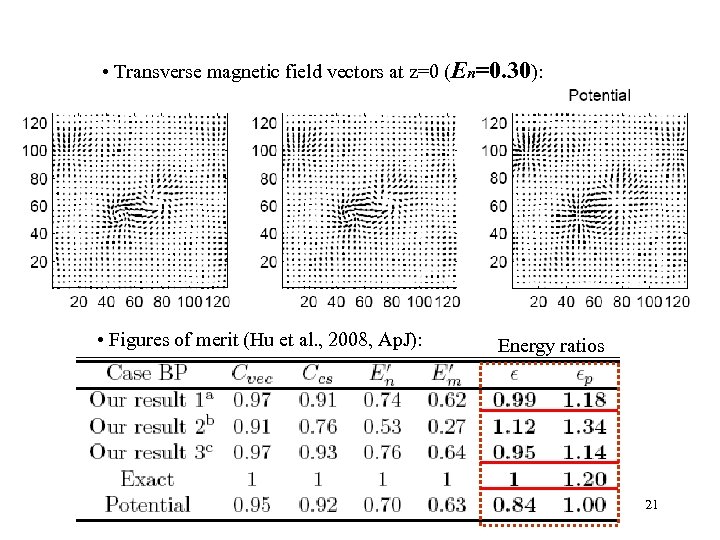 • Transverse magnetic field vectors at z=0 (En=0. 30): • Figures of merit (Hu et al. , 2008, Ap. J): Energy ratios 21
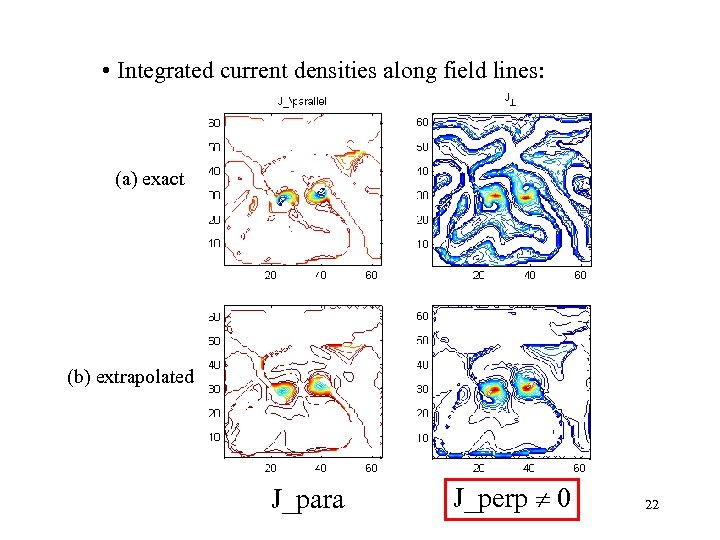 • Integrated current densities along field lines: (a) exact (b) extrapolated J_para J_perp 0 22
 E/Ep_pre=1. 26 E/Ep_post=1. 30 23 (Data courtesy of M. De. Rosa, Schrijver et al. 2008; Hinode is a Japanese mission developed and launched by ISAS/JAXA, with NAOJ as domestic partner and NASA and STFC (UK) as international partners. It is operated by these agencies in co-operation with
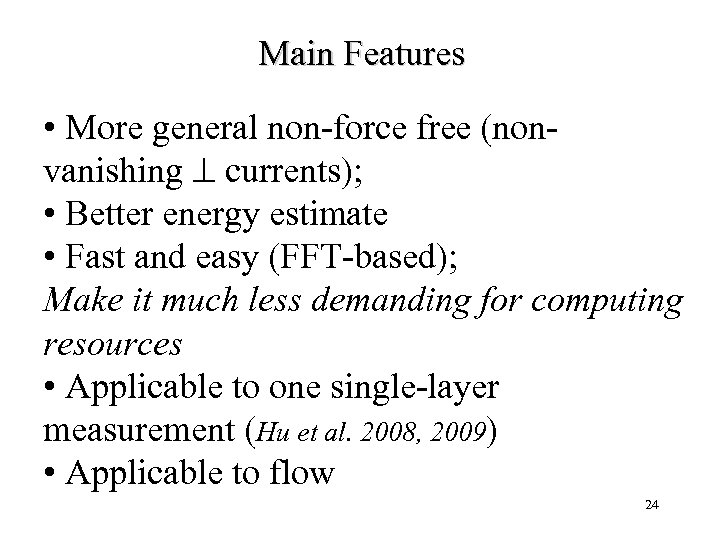 Main Features • More general non-force free (nonvanishing currents); • Better energy estimate • Fast and easy (FFT-based); Make it much less demanding for computing resources • Applicable to one single-layer measurement (Hu et al. 2008, 2009) • Applicable to flow 24
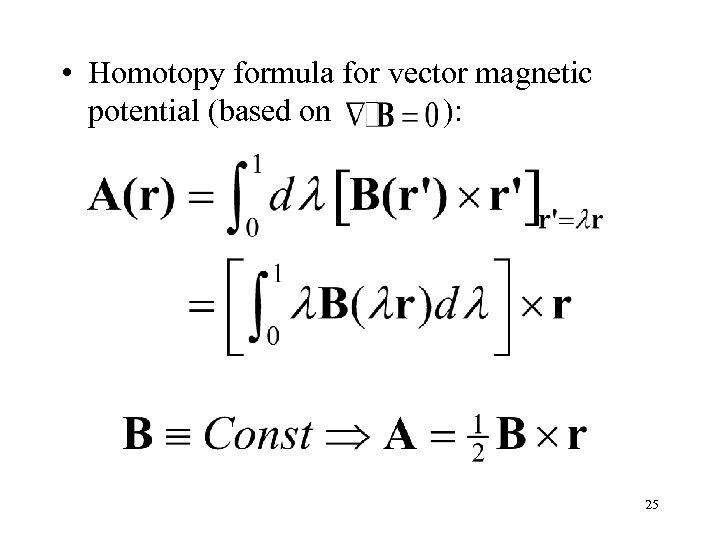 • Homotopy formula for vector magnetic potential (based on ): 25
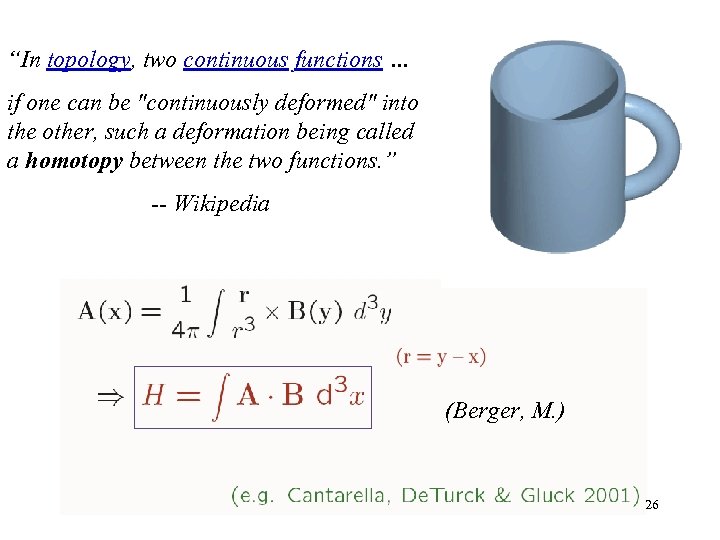 “In topology, two continuous functions … if one can be "continuously deformed" into the other, such a deformation being called a homotopy between the two functions. ” -- Wikipedia (Berger, M. ) 26
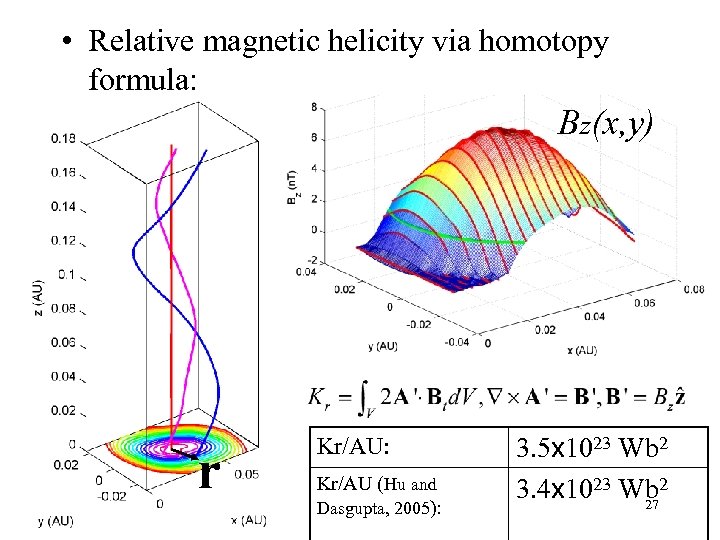 • Relative magnetic helicity via homotopy formula: Bz(x, y) r Kr/AU: Kr/AU (Hu and Dasgupta, 2005): 3. 5 x 10²³ Wb 2 3. 4 x 10²³ Wb 2 27
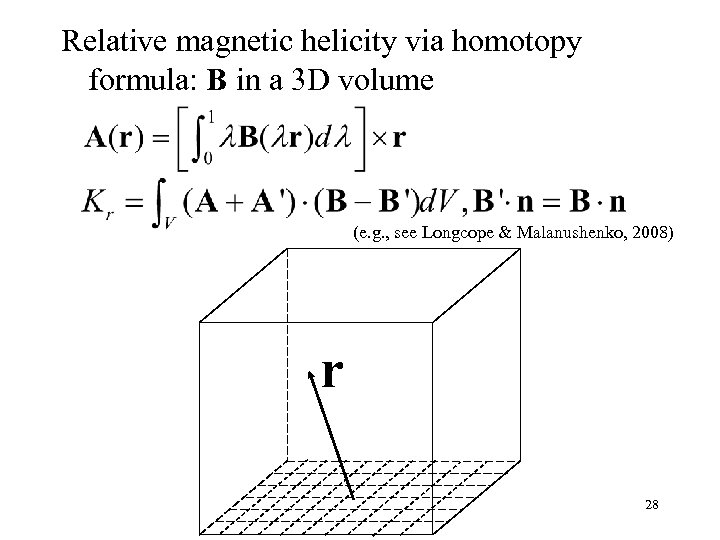 Relative magnetic helicity via homotopy formula: B in a 3 D volume (e. g. , see Longcope & Malanushenko, 2008) r 28
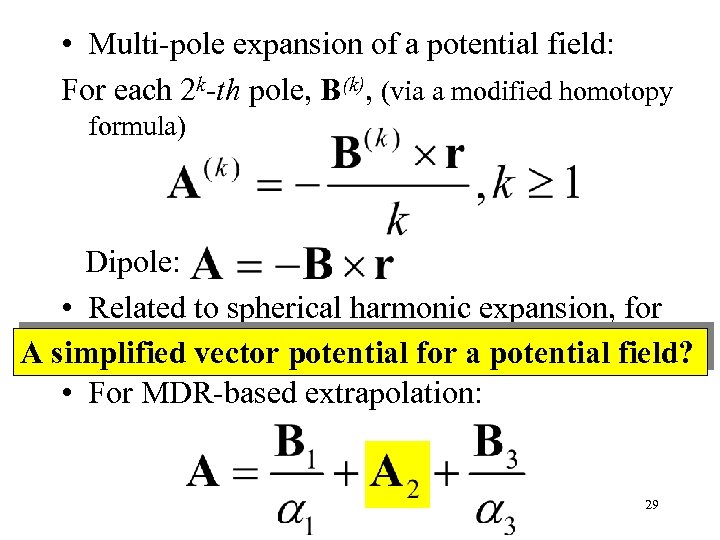 • Multi-pole expansion of a potential field: For each 2 k-th pole, B(k), (via a modified homotopy formula) Dipole: • Related to spherical harmonic expansion, for example. A simplified vector potential for a potential field? • For MDR-based extrapolation: 29
 Outlook • Validate and apply the algorithm for one-layer vector magnetograms • Validate theory – proof of MDR by numerical simulations • Global non-force free extrapolation Stay tuned! 30
 31
31
 • MHD states: 32
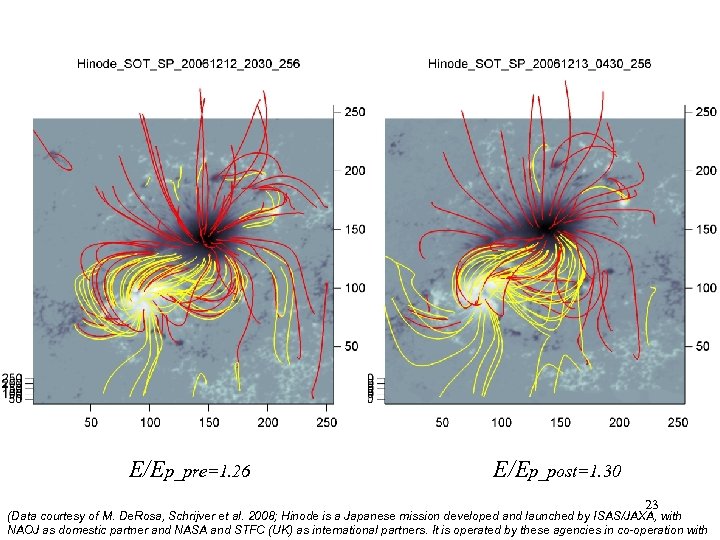
 • Dec. 12 -13 2006 Flare and CME (Schrijver et al. 2008) (SOHO LASCO CME CATALOG http: //cdaw. gsfc. nasa. gov/CME_list/) (KOSOVICHEV & SEKII, 2007) 33
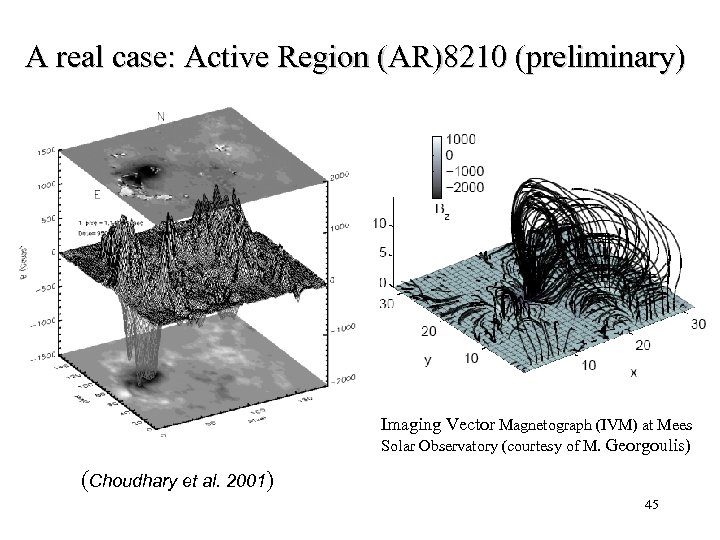
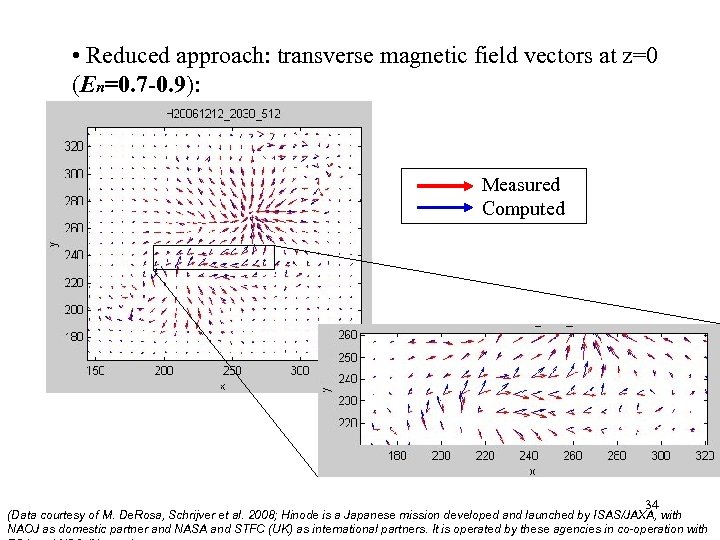 • Reduced approach: transverse magnetic field vectors at z=0 (En=0. 7 -0. 9): Measured Computed 34 (Data courtesy of M. De. Rosa, Schrijver et al. 2008; Hinode is a Japanese mission developed and launched by ISAS/JAXA, with NAOJ as domestic partner and NASA and STFC (UK) as international partners. It is operated by these agencies in co-operation with
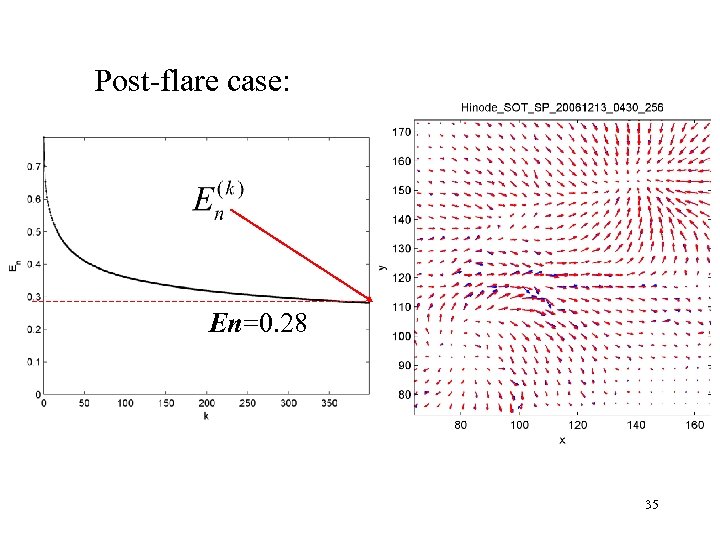 Post-flare case: En=0. 28 35
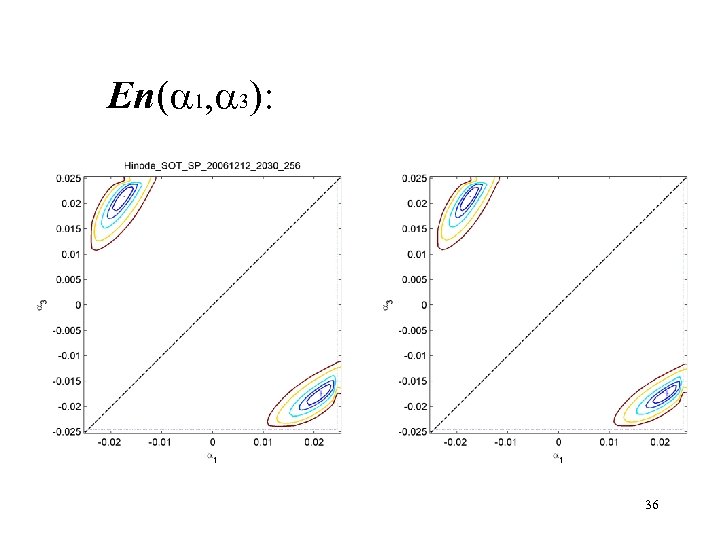 En( 1, 3): 36
 37
37
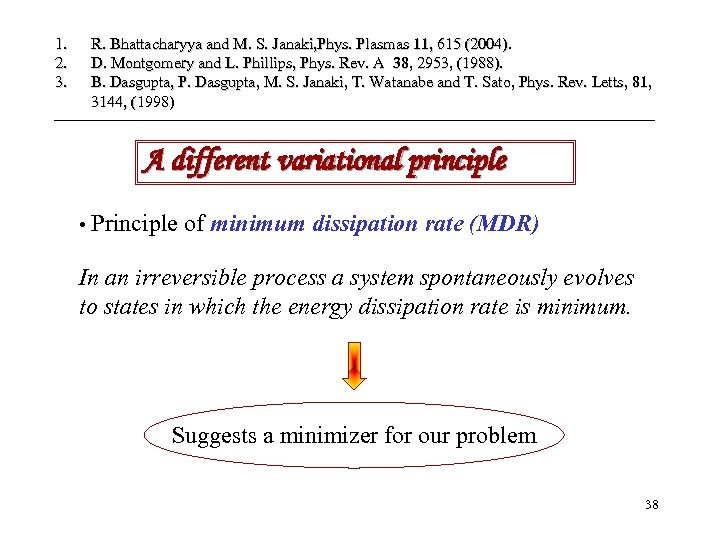 1. 2. 3. R. Bhattacharyya and M. S. Janaki, Phys. Plasmas 11, 615 (2004). D. Montgomery and L. Phillips, Phys. Rev. A 38, 2953, (1988). B. Dasgupta, P. Dasgupta, M. S. Janaki, T. Watanabe and T. Sato, Phys. Rev. Letts, 81, 3144, (1998) A different variational principle • Principle of minimum dissipation rate (MDR) In an irreversible process a system spontaneously evolves to states in which the energy dissipation rate is minimum. Suggests a minimizer for our problem 38
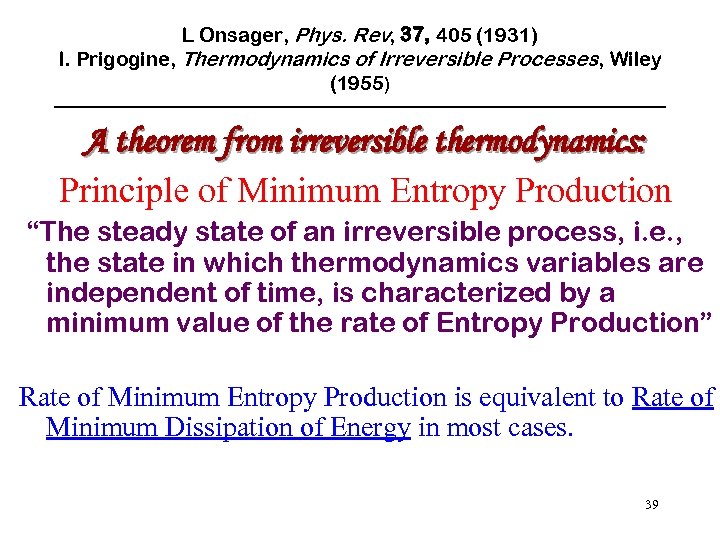 L Onsager, Phys. Rev, 37, 405 (1931) I. Prigogine, Thermodynamics of Irreversible Processes, Wiley (1955) --------------------------------------------------- A theorem from irreversible thermodynamics: Principle of Minimum Entropy Production “The steady state of an irreversible process, i. e. , the state in which thermodynamics variables are independent of time, is characterized by a minimum value of the rate of Entropy Production” Rate of Minimum Entropy Production is equivalent to Rate of Minimum Dissipation of Energy in most cases. 39
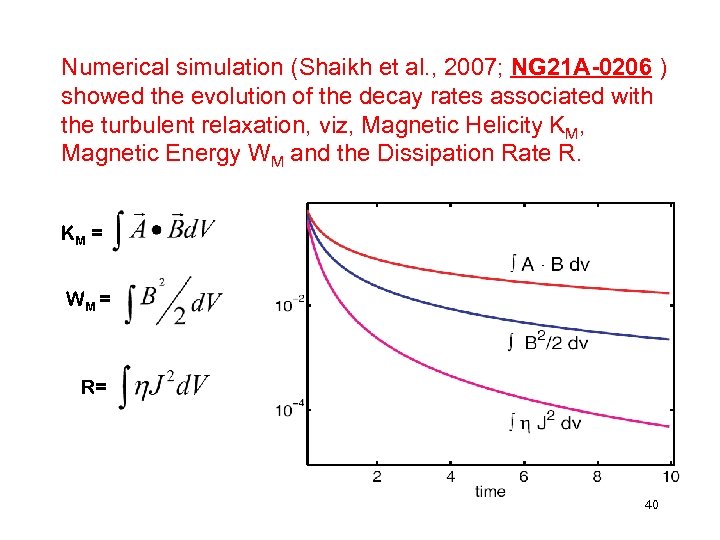 Numerical simulation (Shaikh et al. , 2007; NG 21 A-0206 ) showed the evolution of the decay rates associated with the turbulent relaxation, viz, Magnetic Helicity KM, Magnetic Energy WM and the Dissipation Rate R. KM = WM = R= 40
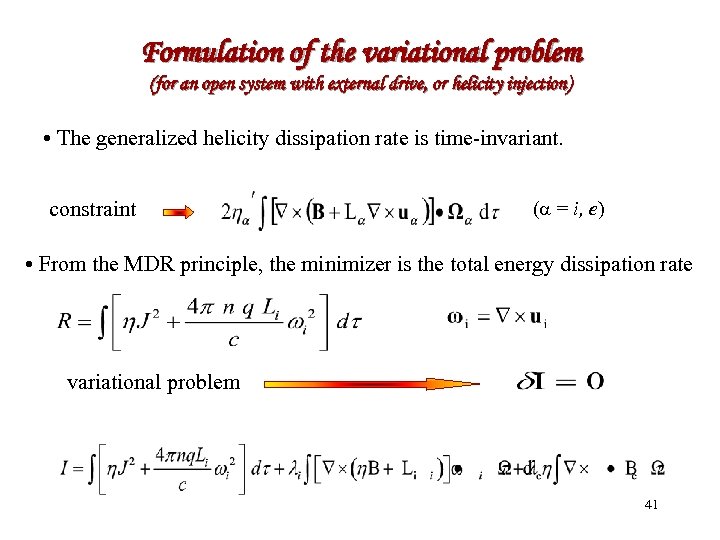 Formulation of the variational problem (for an open system with external drive, or helicity injection) • The generalized helicity dissipation rate is time-invariant. constraint ( = i, e) • From the MDR principle, the minimizer is the total energy dissipation rate variational problem 41
 Euler-Lagrange equations Eliminating vorticity in favor of the magnetic field 42
 Summary of Procedures magnetohydrodynamic 43
 Analytic Test Case: non-force free active region model given by Low (1992) Top View: 44
 A real case: Active Region (AR)8210 (preliminary) Imaging Vector Magnetograph (IVM) at Mees Solar Observatory (courtesy of M. Georgoulis) (Choudhary et al. 2001) 45
 En distribution:
 GS Reconstruction • One-fluid Magnetohydrostatic Theory – 2 ½ D: Bz 0 – Co-moving frame: De. Hoffmann-Teller (HT) frame – No inertia force Grad-Shafranov (GS) Equation (A=Az): A • Bt = 0 Pt(A)=p(A)+Bz(A)/2 0 2 47
 GS Reconstruction Technique 1. 2. Find z by the requirement that Pt(A) be single-valued Transform time to spatial dimensions via VHT, and calculate A(x, 0), x: projected s/c path ^ 3. 4. 5. Calculate Pt(x, 0) directly from measurements. Fit Pt(x, 0)/Bz(x, 0) vs. A(x, 0) by a function, Pt(A)/Bz(A). A boundary, A=Ab, is chosen. Computing A(x, y) by utilizing A(x, 0), Bx(x, 0), and GS equation. o: inbound Am *: outbound 48
 Pt(A) • Finding z axis by minimizing residue of Pt(A): Pt(x, 0) i=1…m o: 1 st half *: 2 nd half A(x, 0) 1 st 1 2 nd 2 2 Residue=[∑i(Pt, i – Pt, i ) ] /|max(Pt)-min(Pt)| Enumerating all possible directions in space to find the optimal z axis for which the associated Residue is a minimum. A residue map is constructed to show the uniqueness of the solution with uncertainty estimate. 49
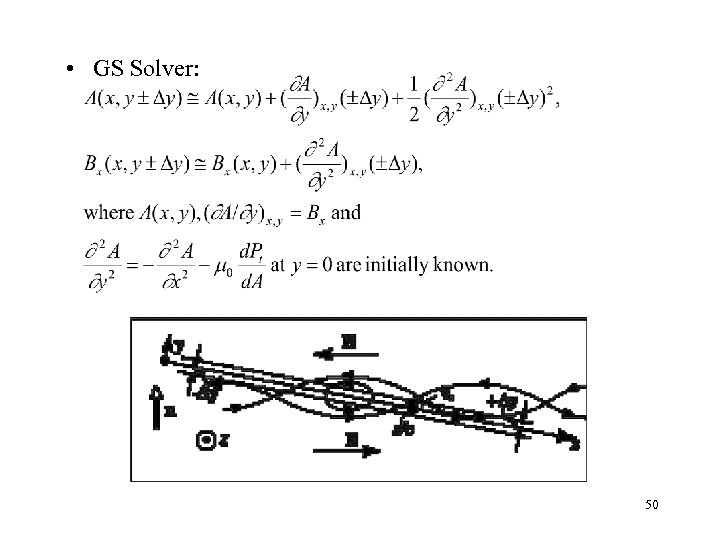 • GS Solver: 50
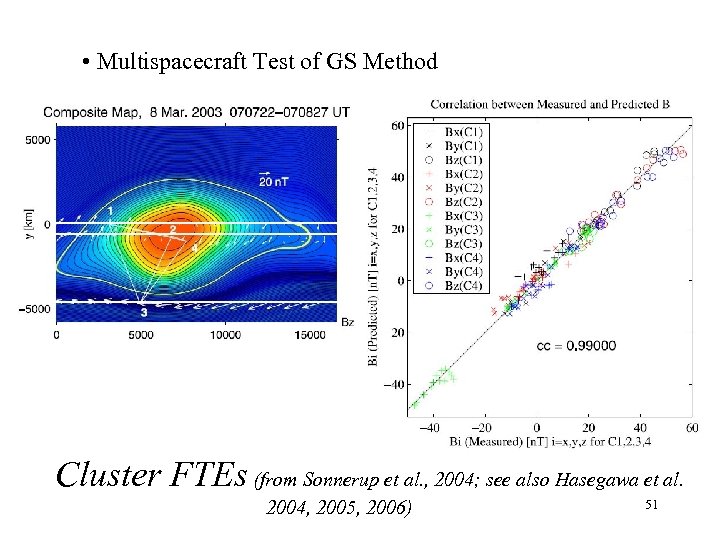 • Multispacecraft Test of GS Method Cluster FTEs (from Sonnerup et al. , 2004; see also Hasegawa et al. 2004, 2005, 2006) 51
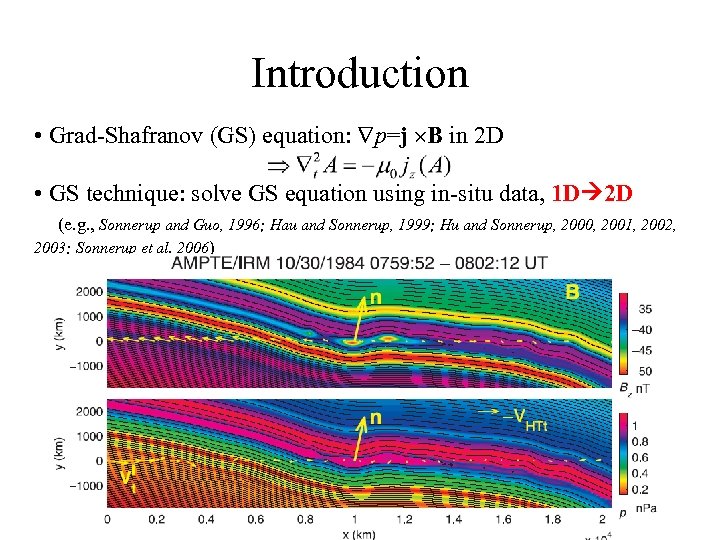 Introduction • Grad-Shafranov (GS) equation: p=j B in 2 D • GS technique: solve GS equation using in-situ data, 1 D 2 D (e. g. , Sonnerup and Guo, 1996; Hau and Sonnerup, 1999; Hu and Sonnerup, 2000, 2001, 2002, 2003; Sonnerup et al. 2006)
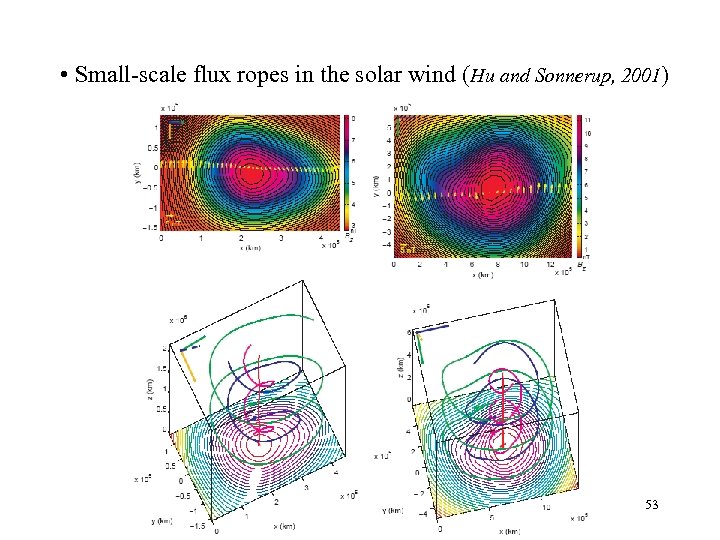 • Small-scale flux ropes in the solar wind (Hu and Sonnerup, 2001) 53
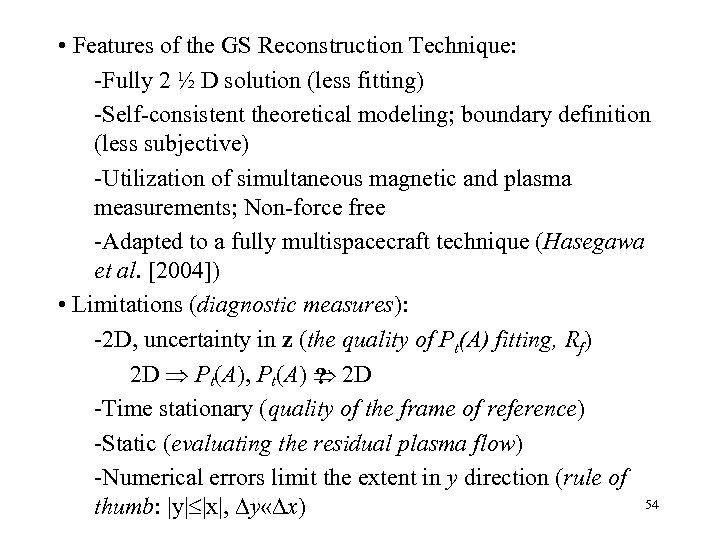 • Features of the GS Reconstruction Technique: -Fully 2 ½ D solution (less fitting) -Self-consistent theoretical modeling; boundary definition (less subjective) -Utilization of simultaneous magnetic and plasma measurements; Non-force free -Adapted to a fully multispacecraft technique (Hasegawa et al. [2004]) • Limitations (diagnostic measures): -2 D, uncertainty in z (the quality of Pt(A) fitting, Rf) 2 D Pt(A), Pt(A) 2 D ? -Time stationary (quality of the frame of reference) -Static (evaluating the residual plasma flow) -Numerical errors limit the extent in y direction (rule of 54 thumb: |y| |x|, y « x)
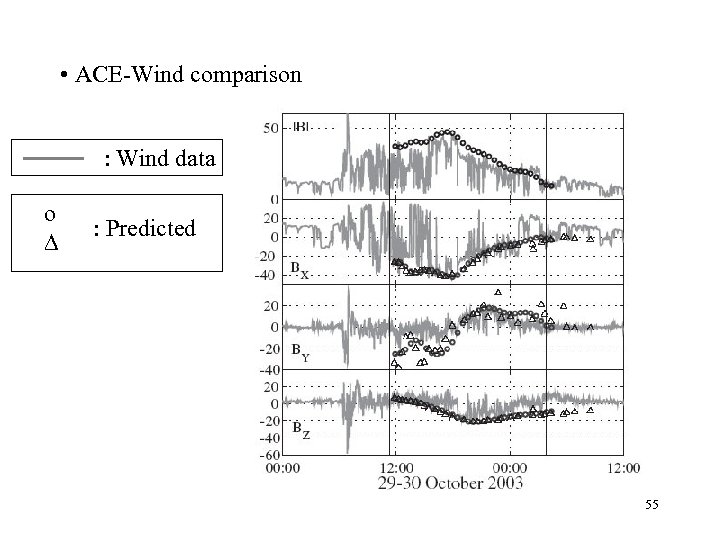 • ACE-Wind comparison : Wind data o : Predicted 55
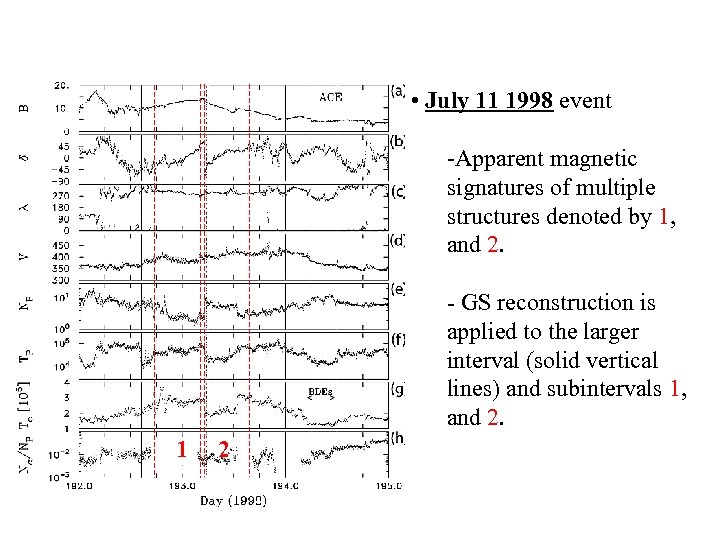 • July 11 1998 event -Apparent magnetic signatures of multiple structures denoted by 1, and 2. - GS reconstruction is applied to the larger interval (solid vertical lines) and subintervals 1, and 2. 1 2
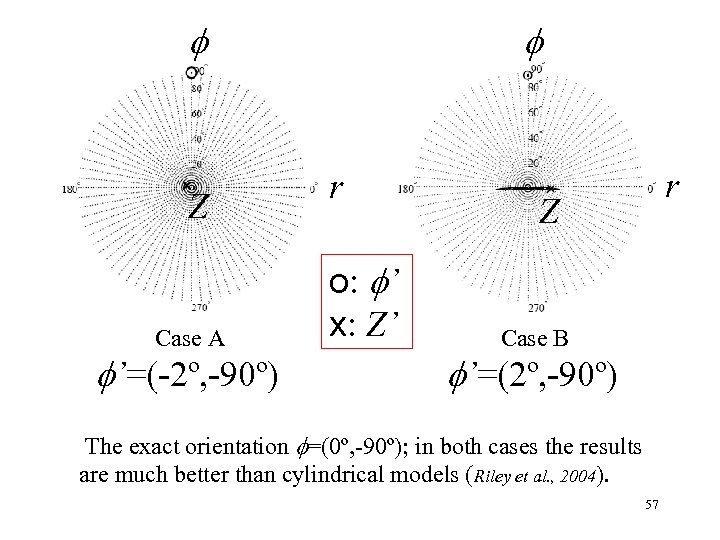 Z Case A ’=(-2º, -90º) r o: ’ x: Z’ r Z Case B ’=(2º, -90º) The exact orientation =(0º, -90º); in both cases the results are much better than cylindrical models (Riley et al. , 2004). 57
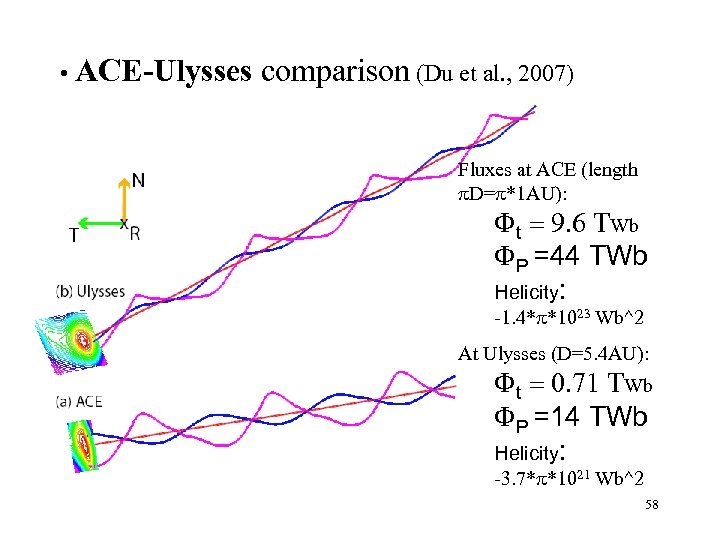 • ACE-Ulysses comparison (Du et al. , 2007) Fluxes at ACE (length D= *1 AU): t = 9. 6 TWb P =44 TWb Helicity: -1. 4* *1023 Wb^2 At Ulysses (D=5. 4 AU): t = 0. 71 TWb P =14 TWb Helicity: -3. 7* *1021 Wb^2 58
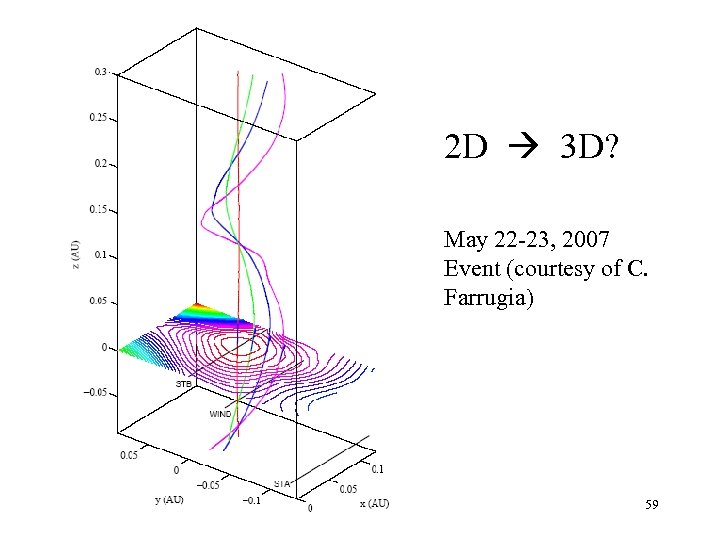 2 D 3 D? May 22 -23, 2007 Event (courtesy of C. Farrugia) 59
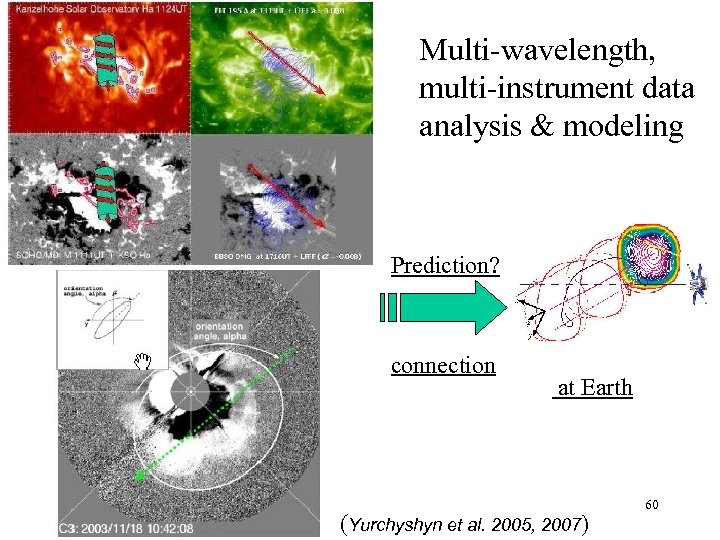 Multi-wavelength, multi-instrument data analysis & modeling Prediction? connection at Earth (Yurchyshyn et al. 2005, 2007) 60
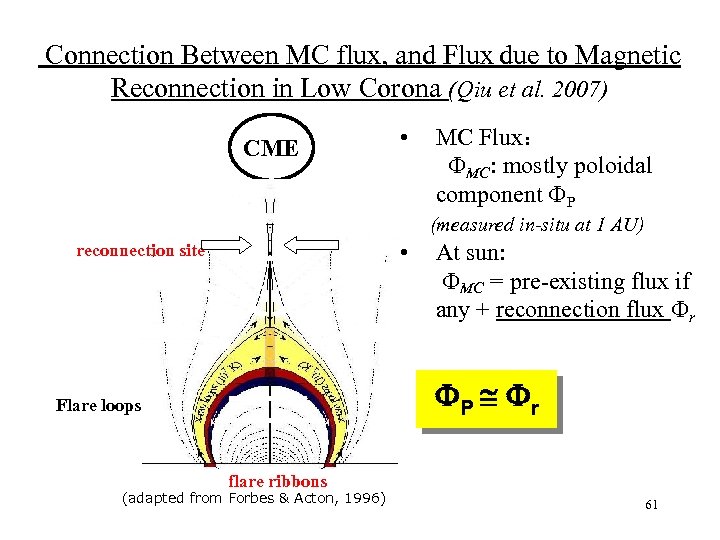 Connection Between MC flux, and Flux due to Magnetic Reconnection in Low Corona (Qiu et al. 2007) CME reconnection site x • MC Flux: MC: mostly poloidal component P (measured in-situ at 1 AU) • At sun: MC = pre-existing flux if any + reconnection flux r P r Flare loops flare ribbons (adapted from Forbes & Acton, 1996) 61
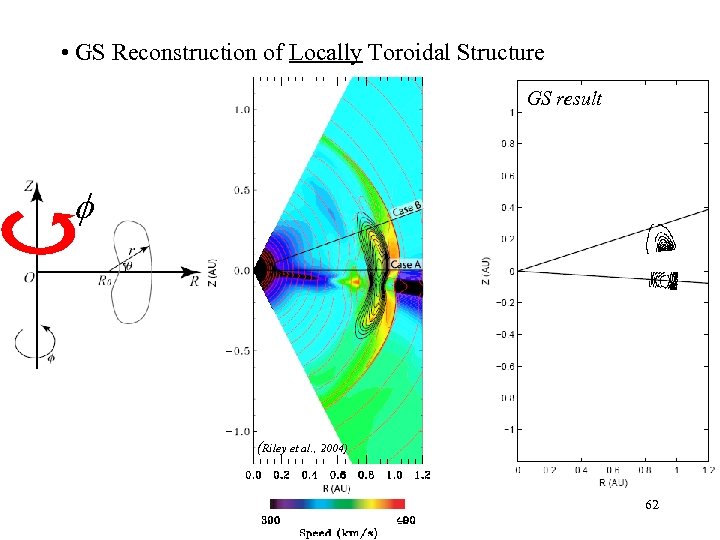 • GS Reconstruction of Locally Toroidal Structure GS result (Riley et al. , 2004) 62
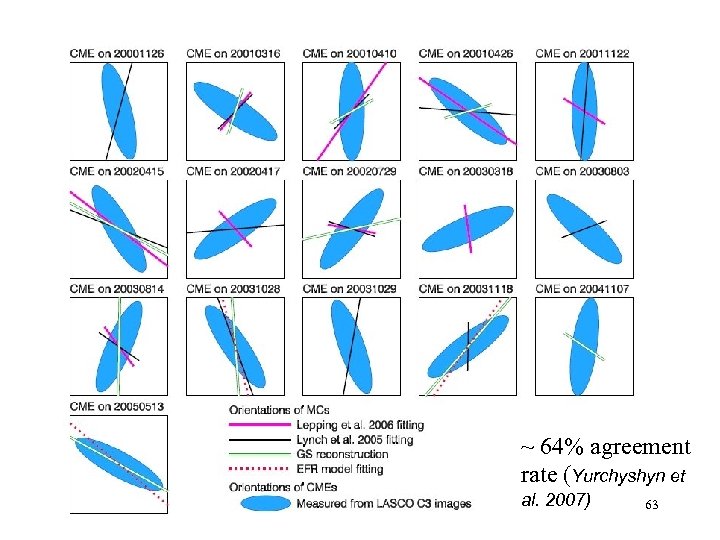 ~ 64% agreement rate (Yurchyshyn et al. 2007) 63
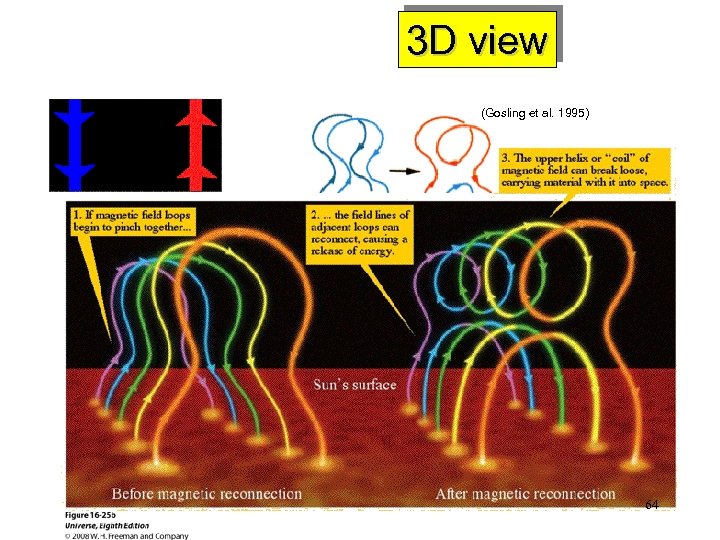 3 D view (Gosling et al. 1995) 64
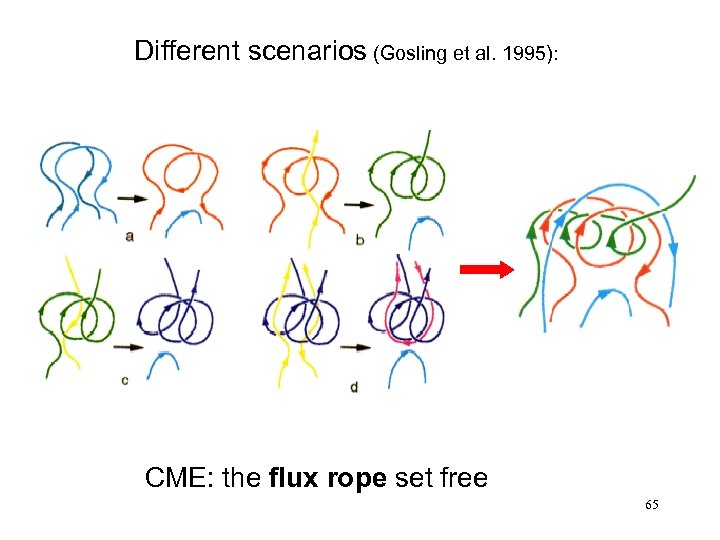 Different scenarios (Gosling et al. 1995): CME: the flux rope set free 65
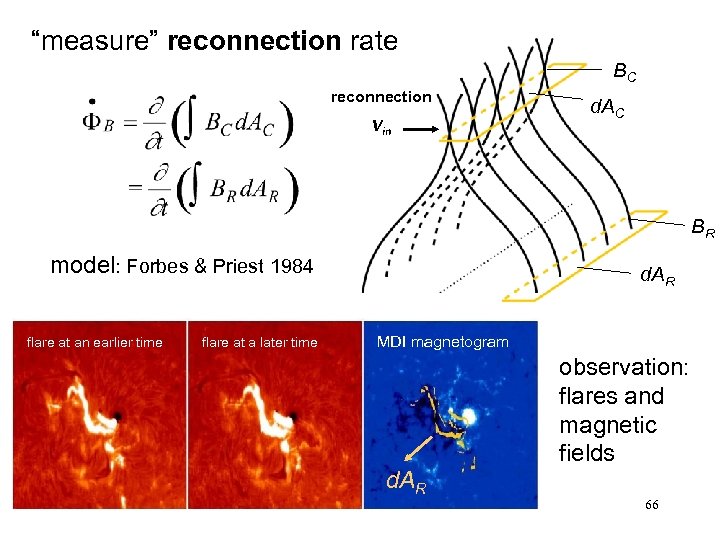 “measure” reconnection rate BC reconnection d. AC Vin v BR reconnection rate (general) model: Forbes & Priest 1984 v flare at an earlier time flare at a later time d. AR MDI magnetogram observation: flares and magnetic fields d. AR 66
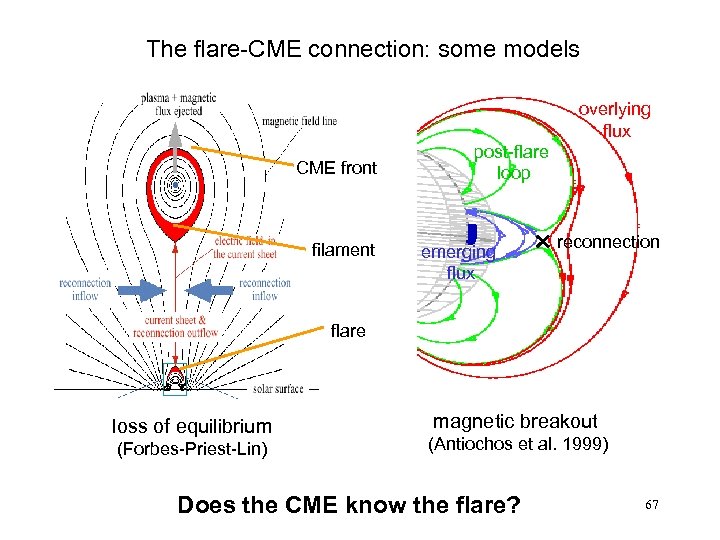 The flare-CME connection: some models overlying flux CME front filament post-flare loop emerging flux reconnection flare loss of equilibrium (Forbes-Priest-Lin) magnetic breakout (Antiochos et al. 1999) Does the CME know the flare? 67
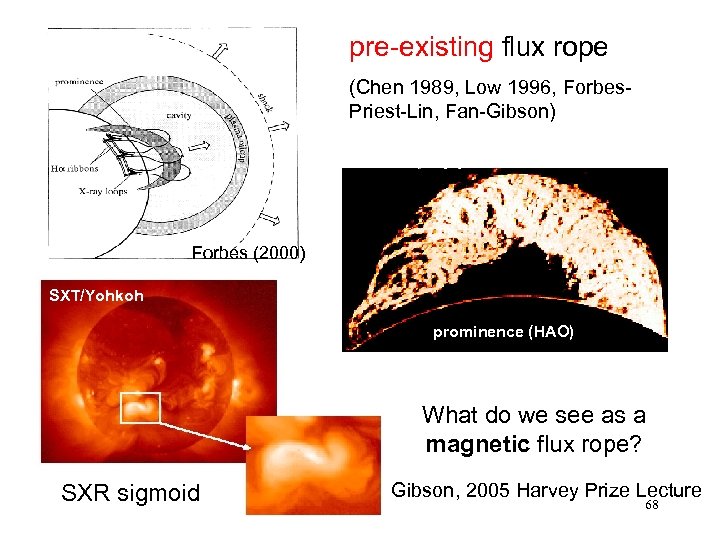 pre-existing flux rope (Chen 1989, Low 1996, Forbes. Priest-Lin, Fan-Gibson) Forbes (2000) SXT/Yohkoh prominence (HAO) What do we see as a magnetic flux rope? SXR sigmoid Gibson, 2005 Harvey Prize Lecture 68