Скачать презентацию On-Site Issue Identification April June 11 Regions Metropolitan City
f926fa76a9b58756707855d8fe607bde.ppt
- Количество слайдов: 27
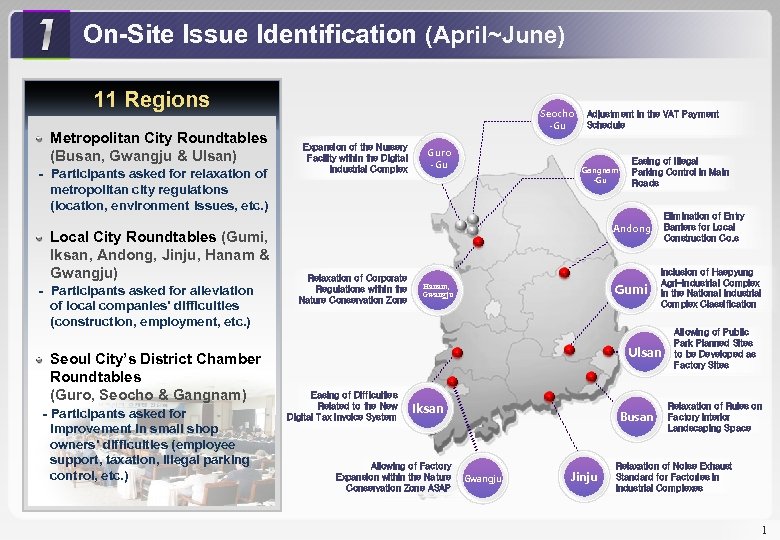 On-Site Issue Identification (April~June) 11 Regions Metropolitan City Roundtables (Busan, Gwangju & Ulsan) - Participants asked for relaxation of metropolitan city regulations (location, environment issues, etc. ) Local City Roundtables (Gumi, Iksan, Andong, Jinju, Hanam & Gwangju) - Participants asked for alleviation of local companies’ difficulties (construction, employment, etc. ) Seoul City’s District Chamber Roundtables (Guro, Seocho & Gangnam) - Participants asked for improvement in small shop owners’ difficulties (employee support, taxation, illegal parking control, etc. ) Seocho -Gu Expansion of the Nursery Facility within the Digital Industrial Complex Guro -Gu Adjustment in the VAT Payment Schedule Gangnam -Gu Easing of Illegal Parking Control in Main Roads Elimination of Entry Barriers for Local Construction Co. s Andong Relaxation of Corporate Regulations within the Nature Conservation Zone Gumi Hanam, Gwangju Inclusion of Haepyung Agri-Industrial Complex in the National Industrial Complex Classification Ulsan Easing of Difficulties Related to the New Digital Tax Invoice System Iksan Allowing of Factory Expansion within the Nature Conservation Zone ASAP Busan Gwangju Jinju Allowing of Public Park Planned Sites to be Developed as Factory Sites Relaxation of Rules on Factory Interior Landscaping Space Relaxation of Noise Exhaust Standard for Factories in Industrial Complexes 1
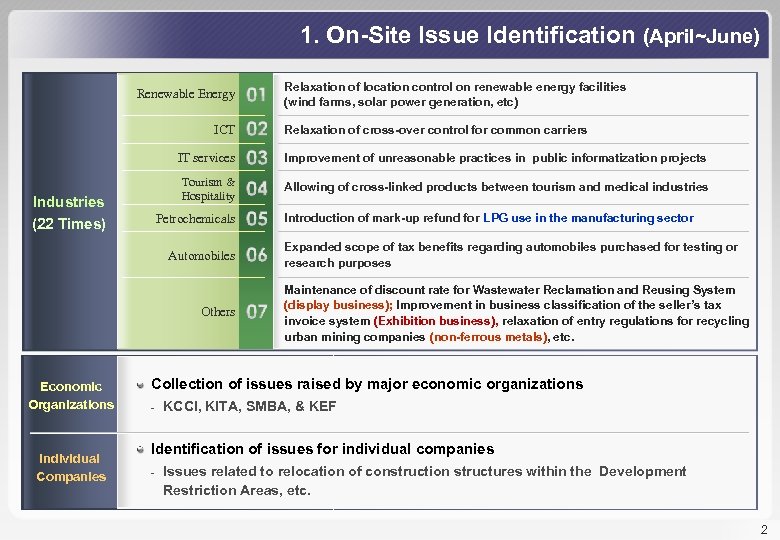 1. On-Site Issue Identification (April~June) Renewable Energy ICT Relaxation of location control on renewable energy facilities (wind farms, solar power generation, etc) Relaxation of cross-over control for common carriers IT services Industries (22 Times) Improvement of unreasonable practices in public informatization projects Tourism & Hospitality Allowing of cross-linked products between tourism and medical industries Petrochemicals Automobiles Others Economic Organizations Individual Companies Introduction of mark-up refund for LPG use in the manufacturing sector Expanded scope of tax benefits regarding automobiles purchased for testing or research purposes Maintenance of discount rate for Wastewater Reclamation and Reusing System (display business); Improvement in business classification of the seller’s tax invoice system (Exhibition business), relaxation of entry regulations for recycling urban mining companies (non-ferrous metals), etc. Collection of issues raised by major economic organizations - KCCI, KITA, SMBA, & KEF Identification of issues for individual companies - Issues related to relocation of construction structures within the Development Restriction Areas, etc. 2
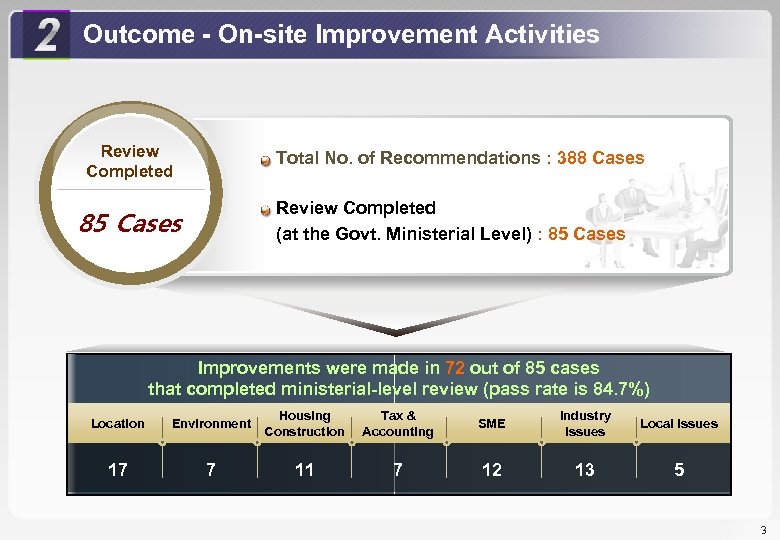 Outcome - On-site Improvement Activities Review ㅊ Completed Total No. of Recommendations : 388 Cases Review Completed (at the Govt. Ministerial Level) : 85 Cases Improvements were made in 72 out of 85 cases that completed ministerial-level review (pass rate is 84. 7%) Location Environment Housing Construction Tax & Accounting SME Industry Issues Local Issues 17 7 11 7 12 13 5 3
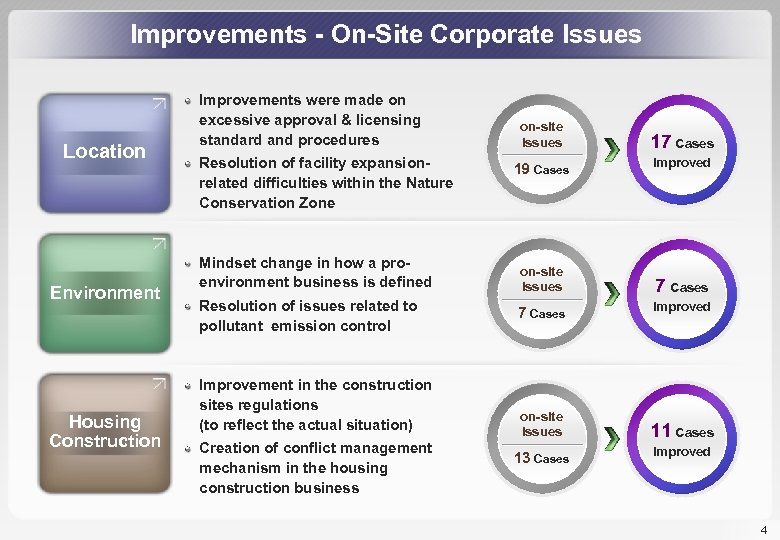 Improvements - On-Site Corporate Issues Location Environment Housing Construction Improvements were made on excessive approval & licensing standard and procedures Resolution of facility expansionrelated difficulties within the Nature Conservation Zone Mindset change in how a proenvironment business is defined Resolution of issues related to pollutant emission control Improvement in the construction sites regulations (to reflect the actual situation) Creation of conflict management mechanism in the housing construction business on-site issues 19 Cases on-site issues 7 Cases on-site issues 13 Cases 17 Cases improved 11 Cases improved 4
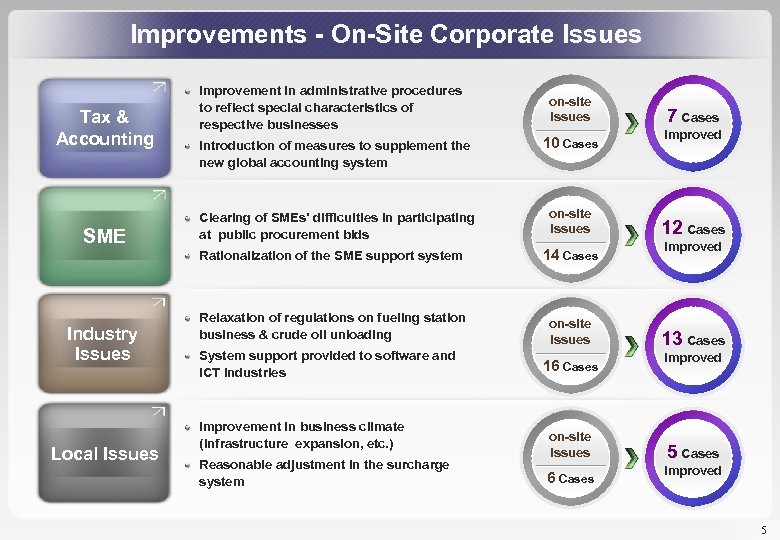 Improvements - On-Site Corporate Issues Tax & Accounting SME Improvement in administrative procedures to reflect special characteristics of respective businesses on-site issues Introduction of measures to supplement the new global accounting system 10 Cases Clearing of SMEs’ difficulties in participating at public procurement bids on-site issues Rationalization of the SME support system Industry Issues Local Issues 14 Cases Relaxation of regulations on fueling station business & crude oil unloading on-site issues System support provided to software and ICT industries Improvement in business climate (infrastructure expansion, etc. ) Reasonable adjustment in the surcharge system 16 Cases on-site issues 6 Cases 7 Cases improved 12 Cases improved 13 Cases improved 5
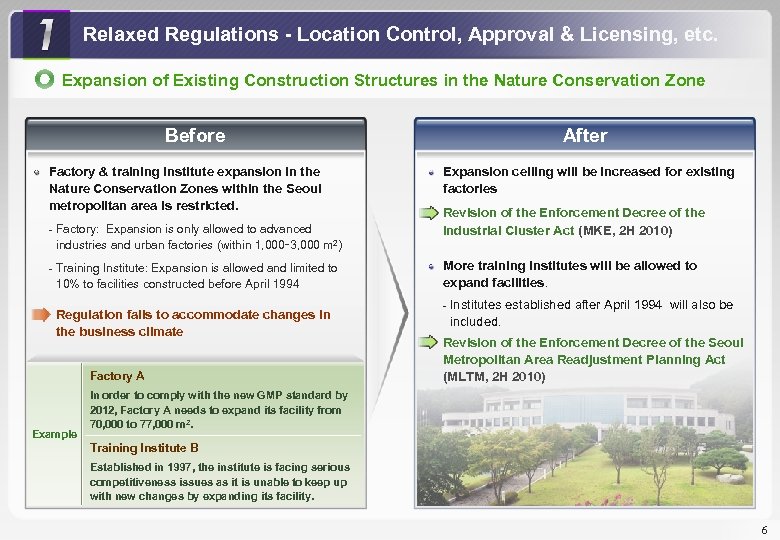 Relaxed Regulations - Location Control, Approval & Licensing, etc. Expansion of Existing Construction Structures in the Nature Conservation Zone Before Factory & training institute expansion in the Nature Conservation Zones within the Seoul metropolitan area is restricted. - Factory: Expansion is only allowed to advanced After Expansion ceiling will be increased for existing factories Revision of the Enforcement Decree of the Industrial Cluster Act (MKE, 2 H 2010) industries and urban factories (within 1, 000∼ 3, 000 m 2) - Training Institute: Expansion is allowed and limited to 10% to facilities constructed before April 1994 Regulation fails to accommodate changes in the business climate Factory A Example More training institutes will be allowed to expand facilities. - Institutes established after April 1994 will also be included. Revision of the Enforcement Decree of the Seoul Metropolitan Area Readjustment Planning Act (MLTM, 2 H 2010) In order to comply with the new GMP standard by 2012, Factory A needs to expand its facility from 70, 000 to 77, 000 m 2. Training Institute B Established in 1997, the institute is facing serious competitiveness issues as it is unable to keep up with new changes by expanding its facility. 6
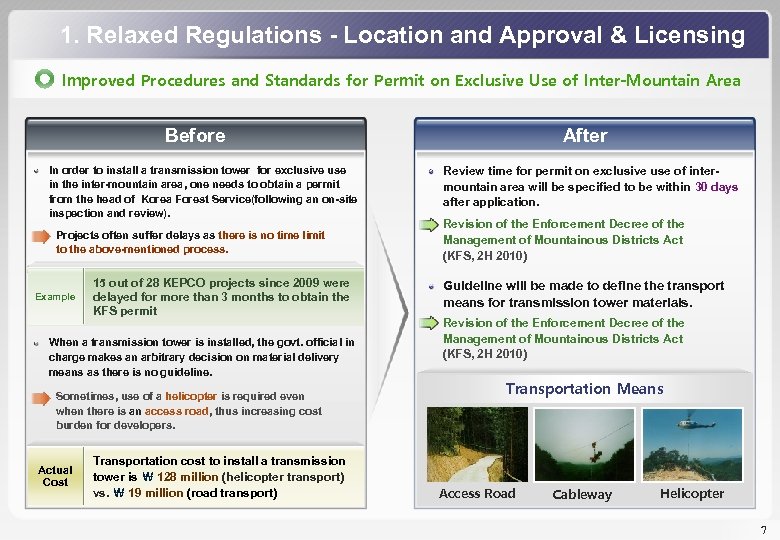 1. Relaxed Regulations - Location and Approval & Licensing Improved Procedures and Standards for Permit on Exclusive Use of Inter-Mountain Area Before In order to install a transmission tower for exclusive use in the inter-mountain area, one needs to obtain a permit from the head of Korea Forest Service(following an on-site inspection and review). Projects often suffer delays as there is no time limit to the above-mentioned process. Example 15 out of 28 KEPCO projects since 2009 were delayed for more than 3 months to obtain the KFS permit When a transmission tower is installed, the govt. official in charge makes an arbitrary decision on material delivery means as there is no guideline. Sometimes, use of a helicopter is required even when there is an access road, thus increasing cost burden for developers. Actual Cost Transportation cost to install a transmission tower is ₩ 128 million (helicopter transport) vs. ₩ 19 million (road transport) After Review time for permit on exclusive use of intermountain area will be specified to be within 30 days after application. Revision of the Enforcement Decree of the Management of Mountainous Districts Act (KFS, 2 H 2010) Guideline will be made to define the transport means for transmission tower materials. Revision of the Enforcement Decree of the Management of Mountainous Districts Act (KFS, 2 H 2010) Transportation Means Access Road Cableway Helicopter 7
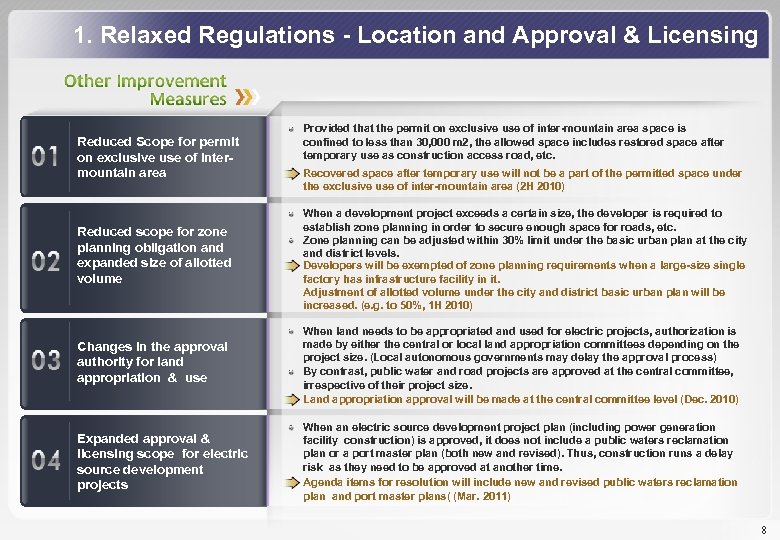 1. Relaxed Regulations - Location and Approval & Licensing Reduced Scope for permit on exclusive use of intermountain area Provided that the permit on exclusive use of inter-mountain area space is confined to less than 30, 000 m 2, the allowed space includes restored space after temporary use as construction access road, etc. Recovered space after temporary use will not be a part of the permitted space under the exclusive use of inter-mountain area (2 H 2010) Reduced scope for zone planning obligation and expanded size of allotted volume When a development project exceeds a certain size, the developer is required to establish zone planning in order to secure enough space for roads, etc. Zone planning can be adjusted within 30% limit under the basic urban plan at the city and district levels. Developers will be exempted of zone planning requirements when a large-size single factory has infrastructure facility in it. Adjustment of allotted volume under the city and district basic urban plan will be increased. (e. g. to 50%, 1 H 2010) Changes in the approval authority for land appropriation & use When land needs to be appropriated and used for electric projects, authorization is made by either the central or local land appropriation committees depending on the project size. (Local autonomous governments may delay the approval process) By contrast, public water and road projects are approved at the central committee, irrespective of their project size. Land appropriation approval will be made at the central committee level (Dec. 2010) Expanded approval & licensing scope for electric source development projects When an electric source development project plan (including power generation facility construction) is approved, it does not include a public waters reclamation plan or a port master plan (both new and revised). Thus, construction runs a delay risk as they need to be approved at another time. Agenda items for resolution will include new and revised public waters reclamation plan and port master plans( (Mar. 2011) 8
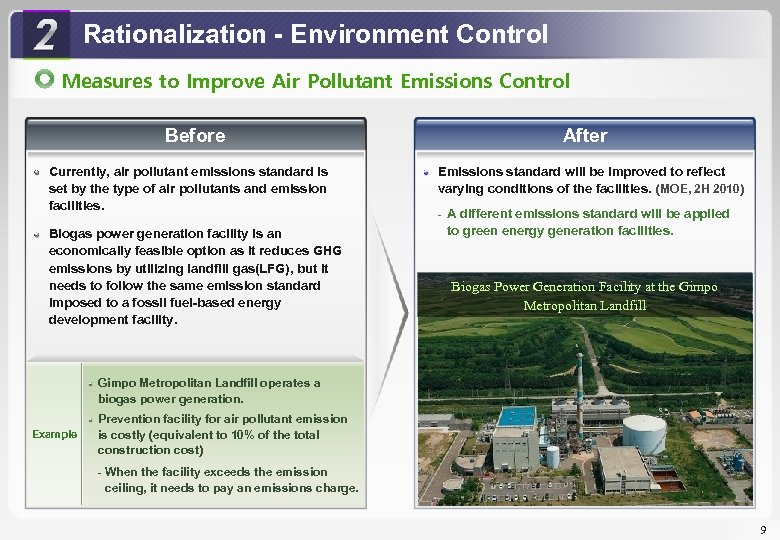 Rationalization - Environment Control Measures to Improve Air Pollutant Emissions Control Before Currently, air pollutant emissions standard is set by the type of air pollutants and emission facilities. Biogas power generation facility is an economically feasible option as it reduces GHG emissions by utilizing landfill gas(LFG), but it needs to follow the same emission standard imposed to a fossil fuel-based energy development facility. After Emissions standard will be improved to reflect varying conditions of the facilities. (MOE, 2 H 2010) - A different emissions standard will be applied to green energy generation facilities. Biogas Power Generation Facility at the Gimpo Metropolitan Landfill operates a biogas power generation. Example Prevention facility for air pollutant emission is costly (equivalent to 10% of the total construction cost) - When the facility exceeds the emission ceiling, it needs to pay an emissions charge. 9
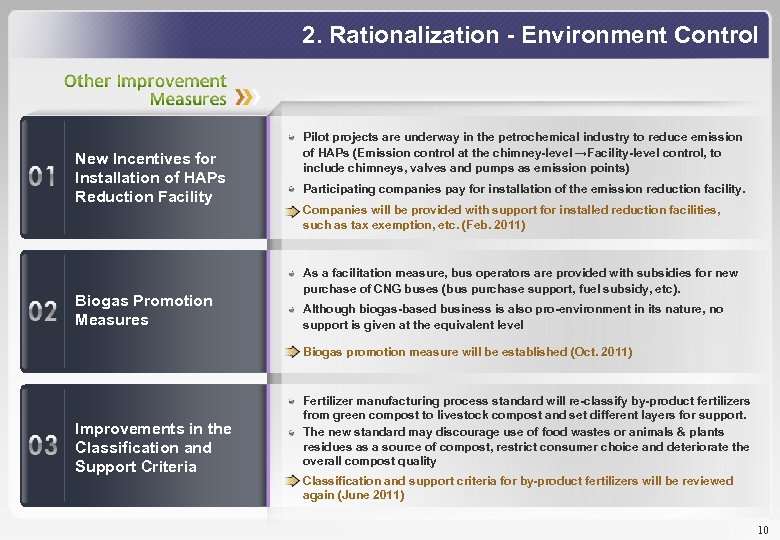 2. Rationalization - Environment Control New Incentives for Installation of HAPs Reduction Facility Biogas Promotion Measures Pilot projects are underway in the petrochemical industry to reduce emission of HAPs (Emission control at the chimney-level →Facility-level control, to include chimneys, valves and pumps as emission points) Participating companies pay for installation of the emission reduction facility. Companies will be provided with support for installed reduction facilities, such as tax exemption, etc. (Feb. 2011) As a facilitation measure, bus operators are provided with subsidies for new purchase of CNG buses (bus purchase support, fuel subsidy, etc). Although biogas-based business is also pro-environment in its nature, no support is given at the equivalent level Biogas promotion measure will be established (Oct. 2011) Improvements in the Classification and Support Criteria Fertilizer manufacturing process standard will re-classify by-product fertilizers from green compost to livestock compost and set different layers for support. The new standard may discourage use of food wastes or animals & plants residues as a source of compost, restrict consumer choice and deteriorate the overall compost quality Classification and support criteria for by-product fertilizers will be reviewed again (June 2011) 10
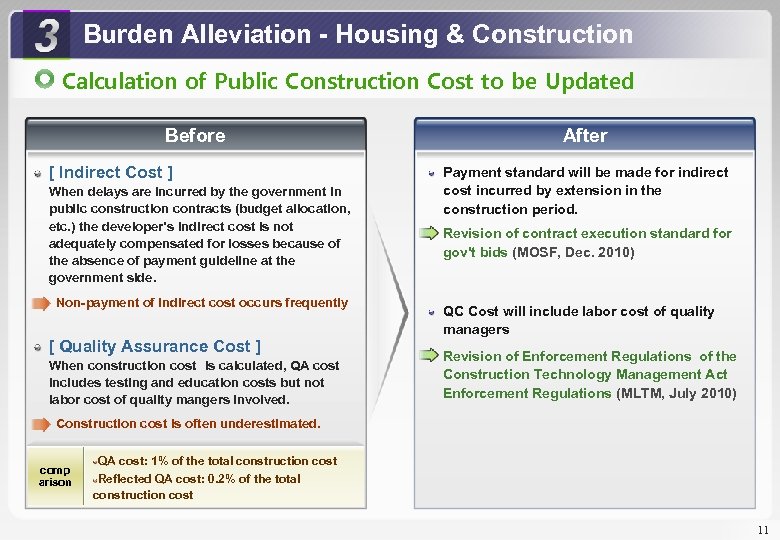 Burden Alleviation - Housing & Construction Calculation of Public Construction Cost to be Updated Before [ Indirect Cost ] When delays are incurred by the government in public construction contracts (budget allocation, etc. ) the developer’s indirect cost is not adequately compensated for losses because of the absence of payment guideline at the government side. Non-payment of indirect cost occurs frequently [ Quality Assurance Cost ] When construction cost is calculated, QA cost includes testing and education costs but not labor cost of quality mangers involved. After Payment standard will be made for indirect cost incurred by extension in the construction period. Revision of contract execution standard for gov't bids (MOSF, Dec. 2010) QC Cost will include labor cost of quality managers Revision of Enforcement Regulations of the Construction Technology Management Act Enforcement Regulations (MLTM, July 2010) Construction cost is often underestimated. comp arison QA cost: 1% of the total construction cost Reflected QA cost: 0. 2% of the total construction cost 11
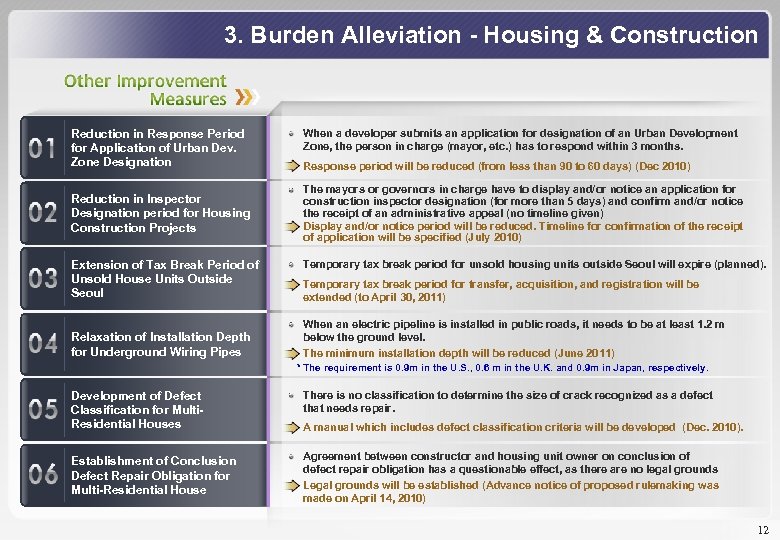 3. Burden Alleviation - Housing & Construction Reduction in Response Period for Application of Urban Dev. Zone Designation Reduction in Inspector Designation period for Housing Construction Projects Extension of Tax Break Period of Unsold House Units Outside Seoul Relaxation of Installation Depth for Underground Wiring Pipes When a developer submits an application for designation of an Urban Development Zone, the person in charge (mayor, etc. ) has to respond within 3 months. Response period will be reduced (from less than 90 to 60 days) (Dec 2010) The mayors or governors in charge have to display and/or notice an application for construction inspector designation (for more than 5 days) and confirm and/or notice the receipt of an administrative appeal (no timeline given) Display and/or notice period will be reduced. Timeline for confirmation of the receipt of application will be specified (July 2010) Temporary tax break period for unsold housing units outside Seoul will expire (planned). Temporary tax break period for transfer, acquisition, and registration will be extended (to April 30, 2011) When an electric pipeline is installed in public roads, it needs to be at least 1. 2 m below the ground level. The minimum installation depth will be reduced (June 2011) * The requirement is 0. 9 m in the U. S. , 0. 6 m in the U. K. and 0. 9 m in Japan, respectively. Development of Defect Classification for Multi. Residential Houses There is no classification to determine the size of crack recognized as a defect that needs repair. Establishment of Conclusion Defect Repair Obligation for Multi-Residential House Agreement between constructor and housing unit owner on conclusion of defect repair obligation has a questionable effect, as there are no legal grounds Legal grounds will be established (Advance notice of proposed rulemaking was made on April 14, 2010) A manual which includes defect classification criteria will be developed (Dec. 2010). 12
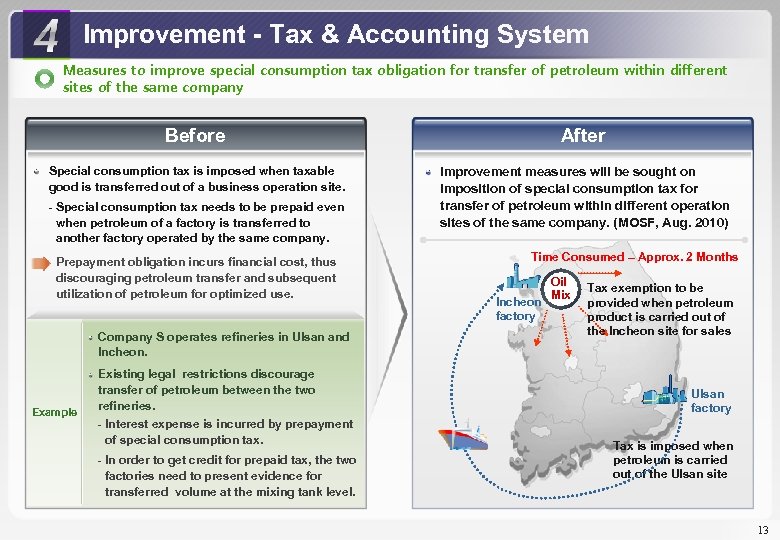 Improvement - Tax & Accounting System Measures to improve special consumption tax obligation for transfer of petroleum within different sites of the same company Before After Special consumption tax is imposed when taxable good is transferred out of a business operation site. Improvement measures will be sought on imposition of special consumption tax for transfer of petroleum within different operation sites of the same company. (MOSF, Aug. 2010) - Special consumption tax needs to be prepaid even when petroleum of a factory is transferred to another factory operated by the same company. Prepayment obligation incurs financial cost, thus discouraging petroleum transfer and subsequent utilization of petroleum for optimized use. Company S operates refineries in Ulsan and Incheon. Example Existing legal restrictions discourage transfer of petroleum between the two refineries. Time Consumed – Approx. 2 Months Incheon factory Oil Mix Tax exemption to be provided when petroleum product is carried out of the Incheon site for sales Ulsan factory - Interest expense is incurred by prepayment of special consumption tax. - In order to get credit for prepaid tax, the two factories need to present evidence for transferred volume at the mixing tank level. Tax is imposed when petroleum is carried out of the Ulsan site 13
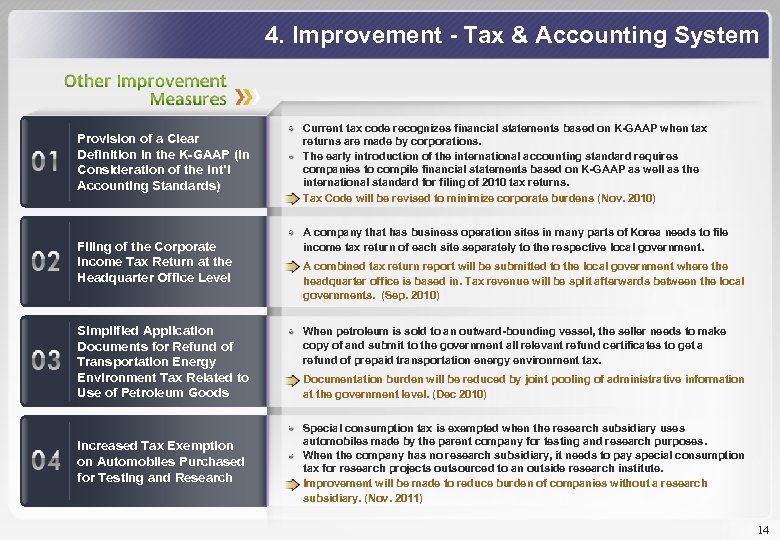 4. Improvement - Tax & Accounting System Provision of a Clear Definition in the K-GAAP (in Consideration of the Int’l Accounting Standards) Filing of the Corporate Income Tax Return at the Headquarter Office Level Simplified Application Documents for Refund of Transportation Energy Environment Tax Related to Use of Petroleum Goods Increased Tax Exemption on Automobiles Purchased for Testing and Research Current tax code recognizes financial statements based on K-GAAP when tax returns are made by corporations. The early introduction of the international accounting standard requires companies to compile financial statements based on K-GAAP as well as the international standard for filing of 2010 tax returns. Tax Code will be revised to minimize corporate burdens (Nov. 2010) A company that has business operation sites in many parts of Korea needs to file income tax return of each site separately to the respective local government. A combined tax return report will be submitted to the local government where the headquarter office is based in. Tax revenue will be split afterwards between the local governments. (Sep. 2010) When petroleum is sold to an outward-bounding vessel, the seller needs to make copy of and submit to the government all relevant refund certificates to get a refund of prepaid transportation energy environment tax. Documentation burden will be reduced by joint pooling of administrative information at the government level. (Dec 2010) Special consumption tax is exempted when the research subsidiary uses automobiles made by the parent company for testing and research purposes. When the company has no research subsidiary, it needs to pay special consumption tax for research projects outsourced to an outside research institute. Improvement will be made to reduce burden of companies without a research subsidiary. (Nov. 2011) 14
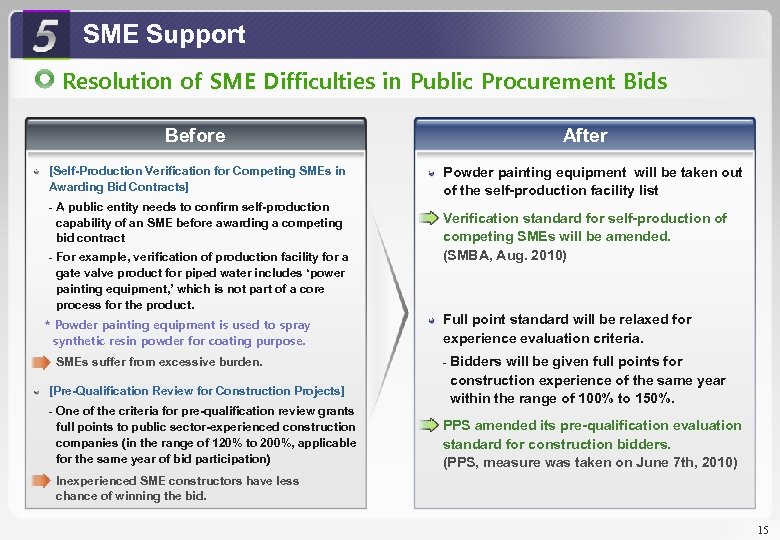 SME Support Resolution of SME Difficulties in Public Procurement Bids Before [Self-Production Verification for Competing SMEs in Awarding Bid Contracts] - A public entity needs to confirm self-production capability of an SME before awarding a competing bid contract - For example, verification of production facility for a gate valve product for piped water includes ‘power painting equipment, ’ which is not part of a core process for the product. * Powder painting equipment is used to spray synthetic resin powder for coating purpose. SMEs suffer from excessive burden. [Pre-Qualification Review for Construction Projects] - One of the criteria for pre-qualification review grants full points to public sector-experienced construction companies (in the range of 120% to 200%, applicable for the same year of bid participation) After Powder painting equipment will be taken out of the self-production facility list Verification standard for self-production of competing SMEs will be amended. (SMBA, Aug. 2010) Full point standard will be relaxed for experience evaluation criteria. - Bidders will be given full points for construction experience of the same year within the range of 100% to 150%. PPS amended its pre-qualification evaluation standard for construction bidders. (PPS, measure was taken on June 7 th, 2010) Inexperienced SME constructors have less chance of winning the bid. 15
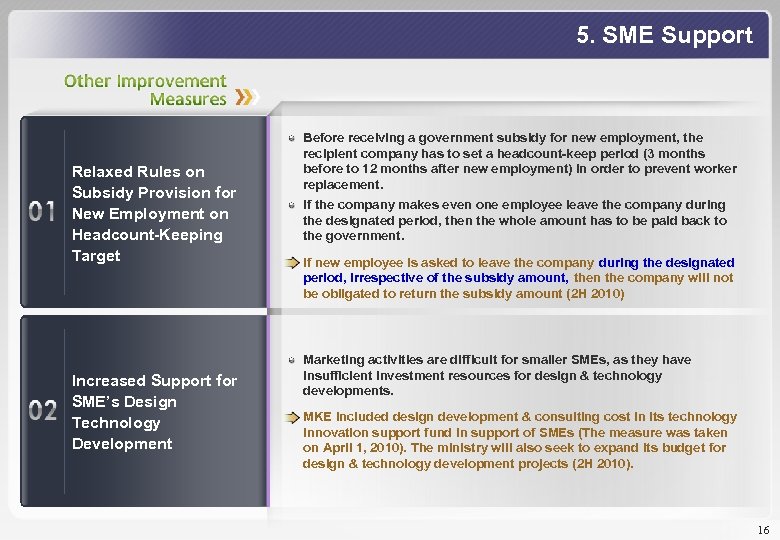 5. SME Support Relaxed Rules on Subsidy Provision for New Employment on Headcount-Keeping Target Increased Support for SME’s Design Technology Development Before receiving a government subsidy for new employment, the recipient company has to set a headcount-keep period (3 months before to 12 months after new employment) in order to prevent worker replacement. If the company makes even one employee leave the company during the designated period, then the whole amount has to be paid back to the government. If new employee is asked to leave the company during the designated period, irrespective of the subsidy amount, then the company will not be obligated to return the subsidy amount (2 H 2010) Marketing activities are difficult for smaller SMEs, as they have insufficient investment resources for design & technology developments. MKE included design development & consulting cost in its technology innovation support fund in support of SMEs (The measure was taken on April 1, 2010). The ministry will also seek to expand its budget for design & technology development projects (2 H 2010). 16
![Clearing – Industry Issues [Petroleum] Fueling Station Operation Before When a fueling station operator](https://present5.com/presentation/f926fa76a9b58756707855d8fe607bde/image-21.jpg "Clearing – Industry Issues [Petroleum] Fueling Station Operation Before When a fueling station operator") Clearing – Industry Issues [Petroleum] Fueling Station Operation Before When a fueling station operator wants to use fireproof glass products, the total length of glass used should not exceed 10% of the fireproof wall as required by law. Improvement in drivers visual disturbance and aesthetic effect is thus limited by this regulation. Drive-in restaurants are not allowed in the fueling station site. The ability of fueling stations to provide convenient service to incoming drivers is thus limited. Overseas Countries Allowed in the U. S. and Europe Fireproof Wall of a Fueling Station After Technical review and safety verification will be carried out before the use of more fireproof glass is allowed. The Enforcement Regulation of the Safety Control of Dangerous Substances Act will be amended. (MEMA, Dec 2010) Drive-in restaurants will be allowed Operation Guideline for supplementary use of fueling station space will be revised. (MEMA, July 2010) Drive-In Restaurants 17
Clearing – Industry Issues [Petroleum] Fueling Station Operation Before When a fueling station operator wants to use fireproof glass products, the total length of glass used should not exceed 10% of the fireproof wall as required by law. Improvement in drivers visual disturbance and aesthetic effect is thus limited by this regulation. Drive-in restaurants are not allowed in the fueling station site. The ability of fueling stations to provide convenient service to incoming drivers is thus limited. Overseas Countries Allowed in the U. S. and Europe Fireproof Wall of a Fueling Station After Technical review and safety verification will be carried out before the use of more fireproof glass is allowed. The Enforcement Regulation of the Safety Control of Dangerous Substances Act will be amended. (MEMA, Dec 2010) Drive-in restaurants will be allowed Operation Guideline for supplementary use of fueling station space will be revised. (MEMA, July 2010) Drive-In Restaurants 17
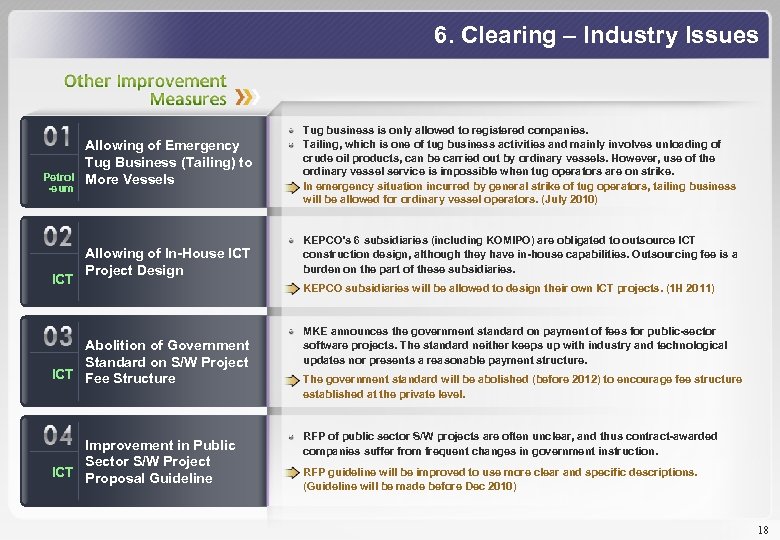 6. Clearing – Industry Issues Petrol -eum ICT Allowing of Emergency Tug Business (Tailing) to More Vessels Allowing of In-House ICT Project Design Abolition of Government Standard on S/W Project ICT Fee Structure Improvement in Public Sector S/W Project ICT Proposal Guideline Tug business is only allowed to registered companies. Tailing, which is one of tug business activities and mainly involves unloading of crude oil products, can be carried out by ordinary vessels. However, use of the ordinary vessel service is impossible when tug operators are on strike. In emergency situation incurred by general strike of tug operators, tailing business will be allowed for ordinary vessel operators. (July 2010) KEPCO’s 6 subsidiaries (including KOMIPO) are obligated to outsource ICT construction design, although they have in-house capabilities. Outsourcing fee is a burden on the part of these subsidiaries. KEPCO subsidiaries will be allowed to design their own ICT projects. (1 H 2011) MKE announces the government standard on payment of fees for public-sector software projects. The standard neither keeps up with industry and technological updates nor presents a reasonable payment structure. The government standard will be abolished (before 2012) to encourage fee structure established at the private level. RFP of public sector S/W projects are often unclear, and thus contract-awarded companies suffer from frequent changes in government instruction. RFP guideline will be improved to use more clear and specific descriptions. (Guideline will be made before Dec 2010) 18
![Clearing - Local Issues [Euijeongbu] Construction Allowed Near A Cultural Heritage Asset Before After](https://present5.com/presentation/f926fa76a9b58756707855d8fe607bde/image-23.jpg "Clearing - Local Issues [Euijeongbu] Construction Allowed Near A Cultural Heritage Asset Before After") Clearing - Local Issues [Euijeongbu] Construction Allowed Near A Cultural Heritage Asset Before After A cultural asset (Jeongmunbu General's Graveyard) is located at the center of the Yonghyun Industrial Complex. Factories within a 300 m range from the graveyard are not allowed to expand. Gyunggi-Do ordinance was amended (2002) to impose building height & level restriction after the designation of this region as an industrial complex. * 90% out of total industrial complex (346, 000 m 2) is restricted by the ordinance. Construction control will be eased to allow factory expansion around the Jeongmunbu General's Graveyard area. Ordinance for Allowing of Appearance Change around the Jeongmunbu General's Graveyard will be announced (Euijeongbu-City, Gyunggi-Do, 2 H 2010) Overview of the Yonghyun Ind. Complex & Jeongmunbu General's Graveyard Construction Standard for Yonghyun Complex No Appearance Change Subject to Cultural Asset Committee Review Less than 2 Levels and 8 m in Height Less than 4 Levels and 14 m in Height Euijeongbu LRT Line Less than 5 Levels and 17 m in Height 19
Clearing - Local Issues [Euijeongbu] Construction Allowed Near A Cultural Heritage Asset Before After A cultural asset (Jeongmunbu General's Graveyard) is located at the center of the Yonghyun Industrial Complex. Factories within a 300 m range from the graveyard are not allowed to expand. Gyunggi-Do ordinance was amended (2002) to impose building height & level restriction after the designation of this region as an industrial complex. * 90% out of total industrial complex (346, 000 m 2) is restricted by the ordinance. Construction control will be eased to allow factory expansion around the Jeongmunbu General's Graveyard area. Ordinance for Allowing of Appearance Change around the Jeongmunbu General's Graveyard will be announced (Euijeongbu-City, Gyunggi-Do, 2 H 2010) Overview of the Yonghyun Ind. Complex & Jeongmunbu General's Graveyard Construction Standard for Yonghyun Complex No Appearance Change Subject to Cultural Asset Committee Review Less than 2 Levels and 8 m in Height Less than 4 Levels and 14 m in Height Euijeongbu LRT Line Less than 5 Levels and 17 m in Height 19
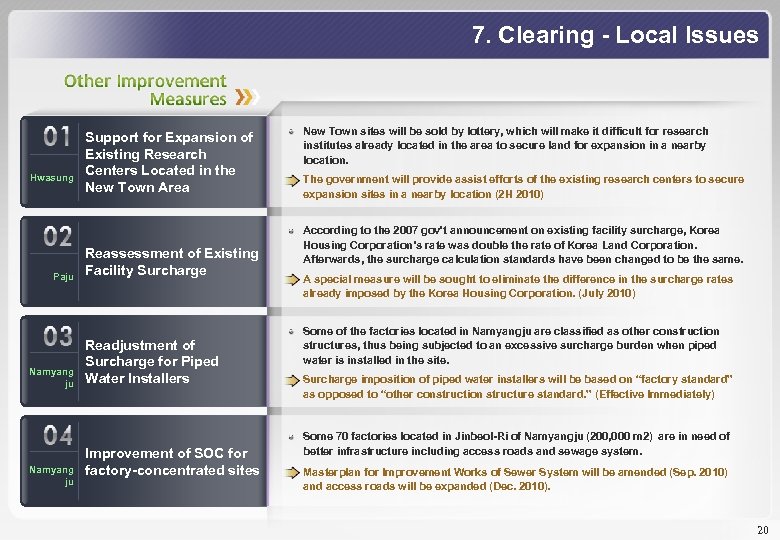 7. Clearing - Local Issues Hwasung Paju Namyang ju Support for Expansion of Existing Research Centers Located in the New Town Area Reassessment of Existing Facility Surcharge Readjustment of Surcharge for Piped Water Installers Improvement of SOC for factory-concentrated sites New Town sites will be sold by lottery, which will make it difficult for research institutes already located in the area to secure land for expansion in a nearby location. The government will provide assist efforts of the existing research centers to secure expansion sites in a nearby location (2 H 2010) According to the 2007 gov't announcement on existing facility surcharge, Korea Housing Corporation’s rate was double the rate of Korea Land Corporation. Afterwards, the surcharge calculation standards have been changed to be the same. A special measure will be sought to eliminate the difference in the surcharge rates already imposed by the Korea Housing Corporation. (July 2010) Some of the factories located in Namyangju are classified as other construction structures, thus being subjected to an excessive surcharge burden when piped water is installed in the site. Surcharge imposition of piped water installers will be based on “factory standard” as opposed to “other construction structure standard. ” (Effective Immediately) Some 70 factories located in Jinbeol-Ri of Namyangju (200, 000 m 2) are in need of better infrastructure including access roads and sewage system. Masterplan for Improvement Works of Sewer System will be amended (Sep. 2010) and access roads will be expanded (Dec. 2010). 20

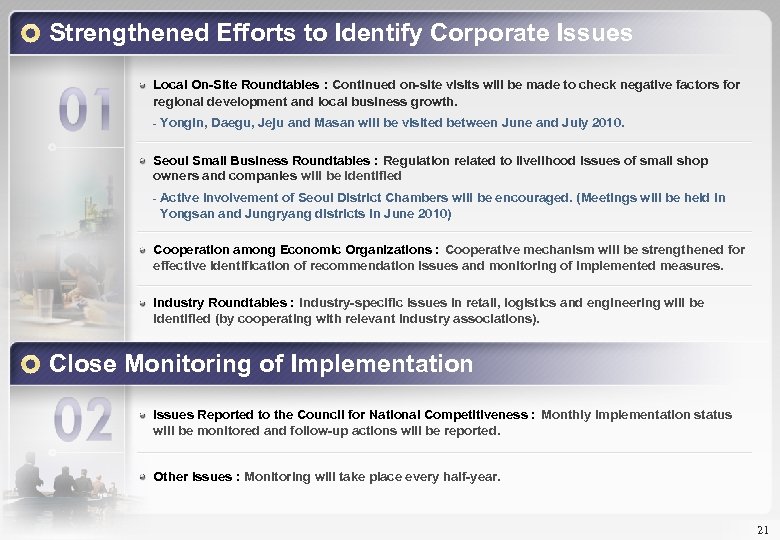 Strengthened Efforts to Identify Corporate Issues Local On-Site Roundtables : Continued on-site visits will be made to check negative factors for regional development and local business growth. - Yongin, Daegu, Jeju and Masan will be visited between June and July 2010. Seoul Small Business Roundtables : Regulation related to livelihood issues of small shop owners and companies will be identified - Active involvement of Seoul District Chambers will be encouraged. (Meetings will be held in Yongsan and Jungryang districts in June 2010) Cooperation among Economic Organizations : Cooperative mechanism will be strengthened for effective identification of recommendation issues and monitoring of implemented measures. Industry Roundtables : Industry-specific issues in retail, logistics and engineering will be identified (by cooperating with relevant industry associations). Close Monitoring of Implementation Issues Reported to the Council for National Competitiveness : Monthly implementation status will be monitored and follow-up actions will be reported. Other Issues : Monitoring will take place every half-year. 21