


 Скачать презентацию On Persistent AE Identifiers Group Name SEC 12 2
76e1b63d5191c00728dce7bfeb4dec7a.ppt
- Количество слайдов: 19
 On Persistent AE Identifiers Group Name: SEC#12. 2 Source: Phil Hawkes, Qualcomm Inc (TIA), phawkes@qti. qualcomm. com Francois Ennesser, Gemalto NV, Francois. Ennesser@gemalto. com Meeting Date: 2014 -09 -10 Agenda Item: TBD
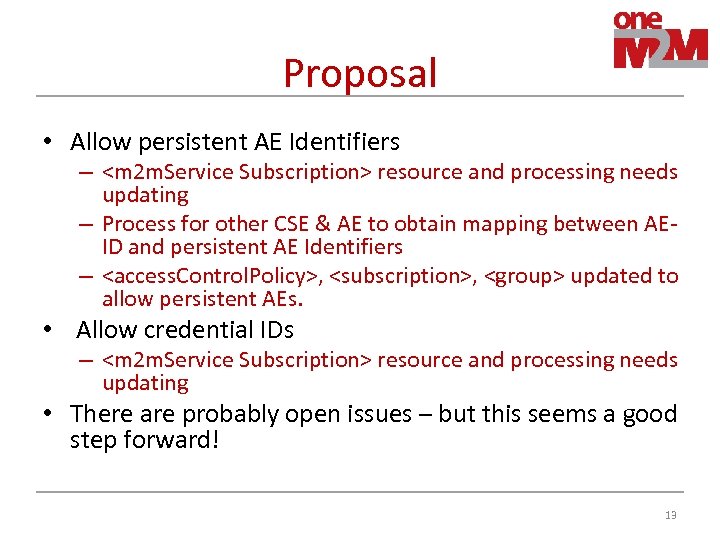
 Overview • Background: What information matters when an AE/CSE asks “which AE will receive this data” or “which AE sent this data”? • Problem: CSE-relative AE-ID might change even though (from perspective of other AEs/CSEs) this is still “the same AE” • Proposal: – Persistent AE Identifiers, – Mapping from AE-ID to persistent AE Identifiers stored in m 2 m. Service. Subscription. – Credential Ids are a special type of persistent AE Identifier 2
 Interactions with an AE • Interaction Mechanisms (aside from Registration) – AE initiates CRUD Ops on resources on various CSE – CSEs send notifications to AE • Other AEs and CSEs use these mechanisms to exchange data with an AE • An AE/CSE may need to know – Which AE will receive data sent by the AE/CSE – Which AE provided the data received by the AE/CSE • A CSE also needs to know which AE originated a CRUD request - for access. Control. Policy processing 3
 What information matters? • When an AE/CSE asks “Which AE will receive this data”, what information does it really care about? • Alternatively, if – At time T 1, the AE receiving the data fits description A – At time T 2, the AE receiving the data fits description B what changes between descriptions A and B are important to the AE/CSE asking the question? • The answer probably changes from one deployment to another!!! – Even worse – two AE/CSEs in a single deployment might care about different information about the AE!!!!! • Note: same for “Which AE provided data…? ” 4
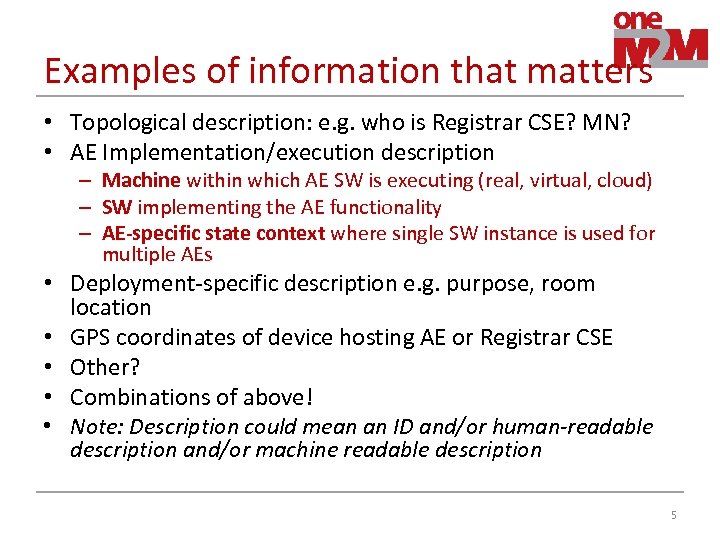 Examples of information that matters • Topological description: e. g. who is Registrar CSE? MN? • AE Implementation/execution description – Machine within which AE SW is executing (real, virtual, cloud) – SW implementing the AE functionality – AE-specific state context where single SW instance is used for multiple AEs • Deployment-specific description e. g. purpose, room location • GPS coordinates of device hosting AE or Registrar CSE • Other? • Combinations of above! • Note: Description could mean an ID and/or human-readable description and/or machine readable description 5
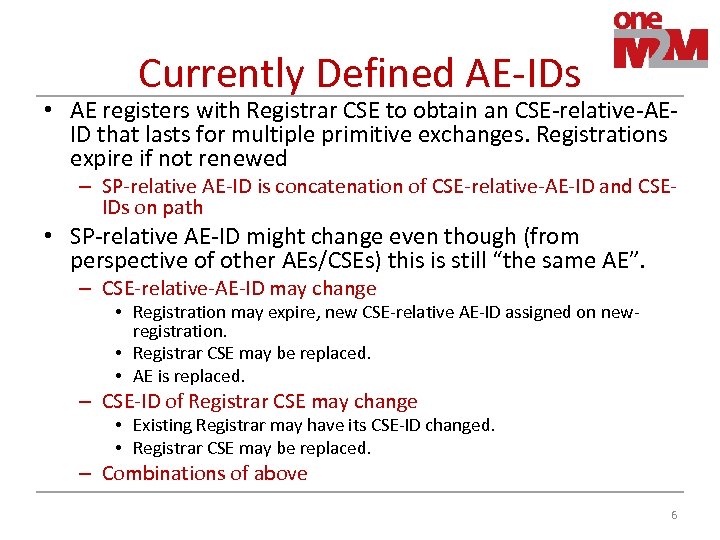 Currently Defined AE-IDs • AE registers with Registrar CSE to obtain an CSE-relative-AEID that lasts for multiple primitive exchanges. Registrations expire if not renewed – SP-relative AE-ID is concatenation of CSE-relative-AE-ID and CSEIDs on path • SP-relative AE-ID might change even though (from perspective of other AEs/CSEs) this is still “the same AE”. – CSE-relative-AE-ID may change • Registration may expire, new CSE-relative AE-ID assigned on newregistration. • Registrar CSE may be replaced. • AE is replaced. – CSE-ID of Registrar CSE may change • Existing Registrar may have its CSE-ID changed. • Registrar CSE may be replaced. – Combinations of above 6
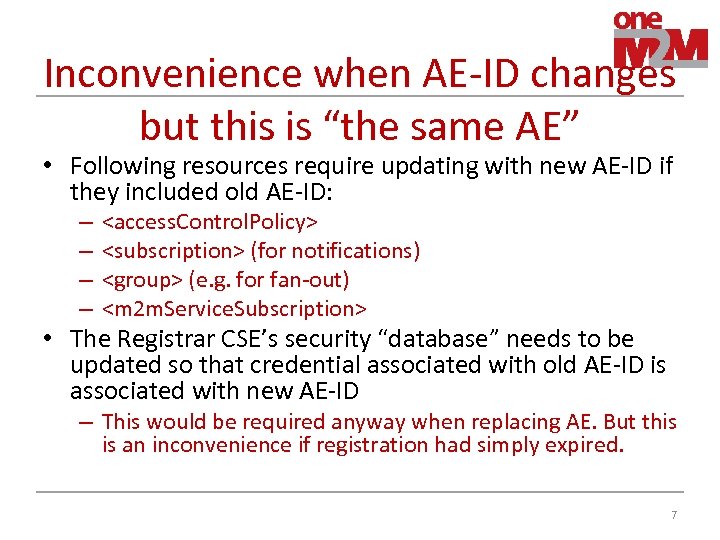 Inconvenience when AE-ID changes but this is “the same AE” • Following resources require updating with new AE-ID if they included old AE-ID: – –
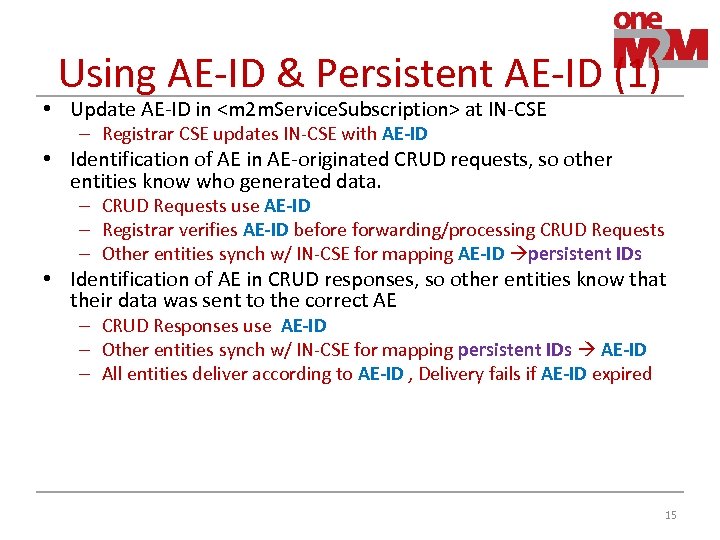
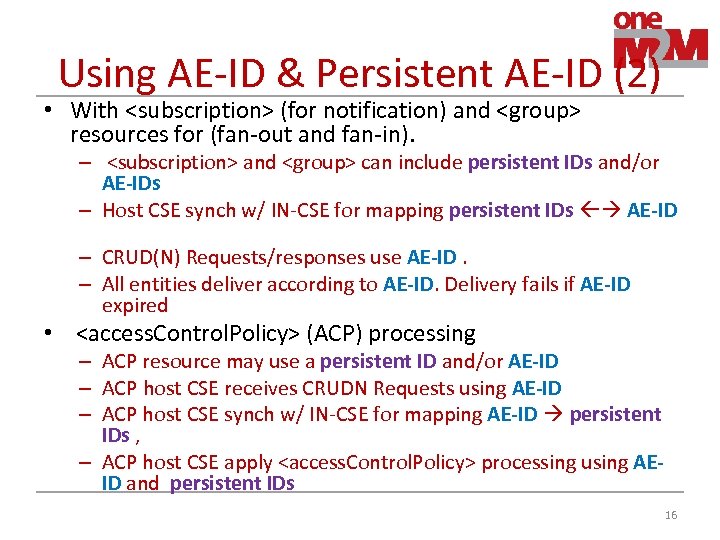
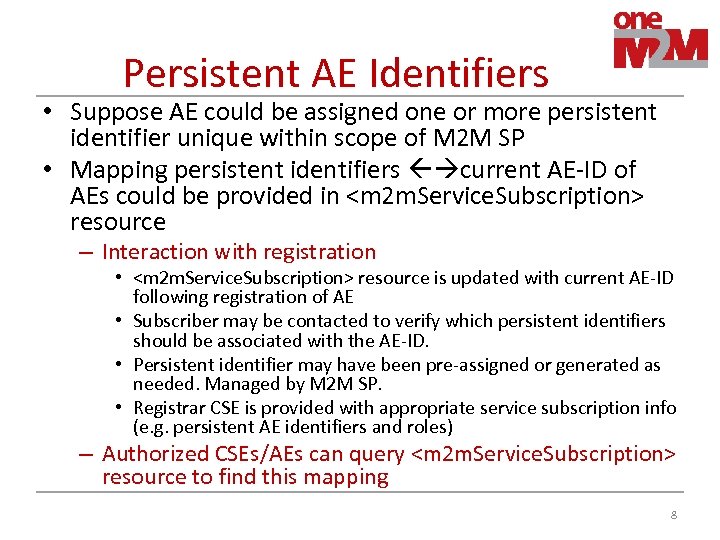 Persistent AE Identifiers • Suppose AE could be assigned one or more persistent identifier unique within scope of M 2 M SP • Mapping persistent identifiers current AE-ID of AEs could be provided in
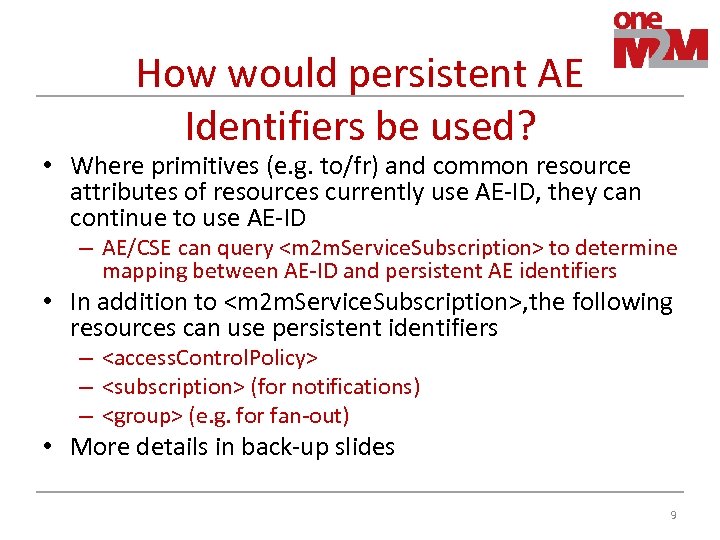 How would persistent AE Identifiers be used? • Where primitives (e. g. to/fr) and common resource attributes of resources currently use AE-ID, they can continue to use AE-ID – AE/CSE can query
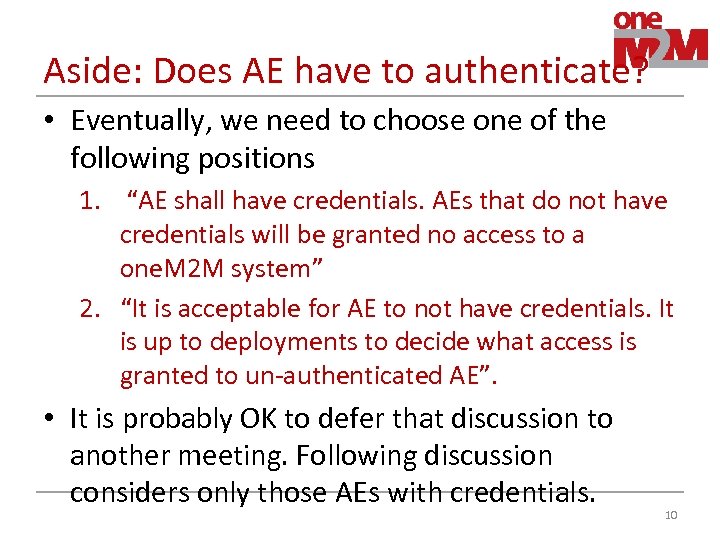 Aside: Does AE have to authenticate? • Eventually, we need to choose one of the following positions 1. “AE shall have credentials. AEs that do not have credentials will be granted no access to a one. M 2 M system” 2. “It is acceptable for AE to not have credentials. It is up to deployments to decide what access is granted to un-authenticated AE”. • It is probably OK to defer that discussion to another meeting. Following discussion considers only those AEs with credentials. 10
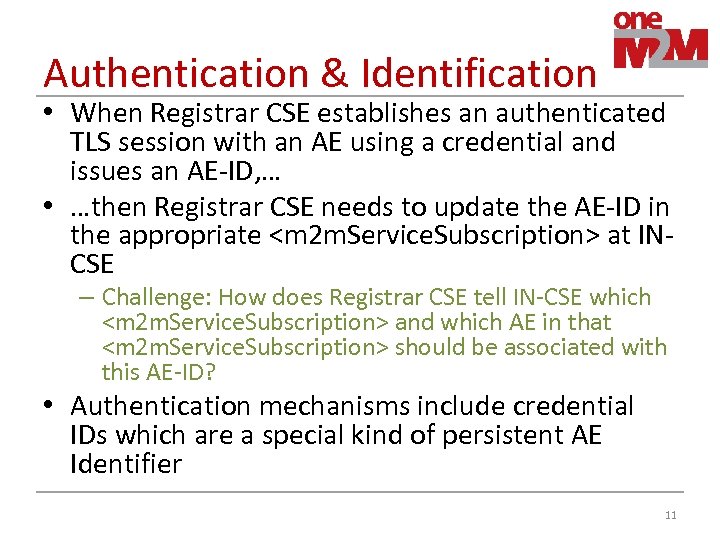 Authentication & Identification • When Registrar CSE establishes an authenticated TLS session with an AE using a credential and issues an AE-ID, … • …then Registrar CSE needs to update the AE-ID in the appropriate
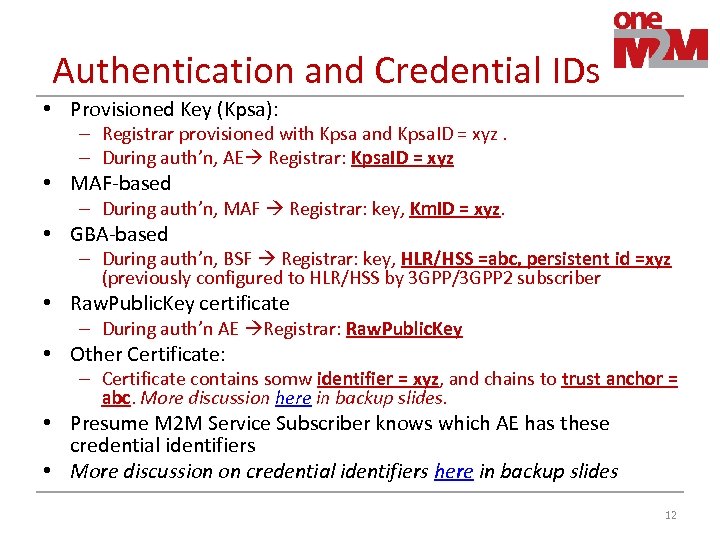 Authentication and Credential IDs • Provisioned Key (Kpsa): – Registrar provisioned with Kpsa and Kpsa. ID = xyz. – During auth’n, AE Registrar: Kpsa. ID = xyz • MAF-based – During auth’n, MAF Registrar: key, Km. ID = xyz. • GBA-based – During auth’n, BSF Registrar: key, HLR/HSS =abc, persistent id =xyz (previously configured to HLR/HSS by 3 GPP/3 GPP 2 subscriber • Raw. Public. Key certificate – During auth’n AE Registrar: Raw. Public. Key • Other Certificate: – Certificate contains somw identifier = xyz, and chains to trust anchor = abc. More discussion here in backup slides. • Presume M 2 M Service Subscriber knows which AE has these credential identifiers • More discussion on credential identifiers here in backup slides 12
 Proposal • Allow persistent AE Identifiers –
 BACKUP SLIDES 14
 Using AE-ID & Persistent AE-ID (1) • Update AE-ID in
 Using AE-ID & Persistent AE-ID (2) • With
 Certificate Chain Examples • Device Certificate: – Certificate contains hardware instance identifier = xyz, and chains to trust anchor = abc. • Whether used for single AE or multiple AE is for another discussion. – Registrar may provide the entire certificate chain or just summary • Presume Subscriber knows which device has hardware instance identifier = xyz • (FFS) Persistent AE Identifier Certificate (issued by M 2 M SP) – Certificate contains persistent AE identifier = xyz and chains to trust anchor = M 2 M SP • Presume Subscriber knows which AE has persistent AE identifier = xyz – Note: currently defined AE-ID Certificate with non-persistent AE-ID won’t work 17
 Credential Identifiers • A credential identifiers in last two slides are persistent AE ID associated with execution context that knows credential secret: e. g – a machine or – a combination of machine + AE SW or – a combination of machine, AE SW and AE-specific state context. • Other Persistent IDs associated with a specific machine etc. would typically have a permanent “binding” to the credential ID. • Some other Persistent IDs might be associated with more temporary aspects of the AE (e. g. “the AE in a device closest to my car”). – These persistent IDs will have a temporary “bindings” to a sequence of credential IDs (assuming those AEs have credentials) • Other information associated with the AE (e. g. see information that matters ) are obtained through other channels – Some info might be configured by the Subscriber – Some info (e. g. location) might be provided via Mcn – Some info might be synchronized with remote entity management 18
 Pre- and Post- authorization • Registrar CSE might know credential identifier and associated service subscription information before authentication – E. g. credentials were pre-provisioned to Registrar CSE or configured manually or configured using remote entity management – Registrar allows registration and passes credential ID and assigned CSErelative AE-ID to IN-CSE. – AE has rights associated with service subscription info (e. g. rights associated with persistent AE IDs and roles) • Also OK for Registrar to obtain credential identifier during authentication and service subscription info after authentication – Registrar receives credential identifier during authentication (e. g. using GBA, MAF or a certificate) – Registrar allows registration and passes credential ID and assigned CSErelative AE-ID to IN-CSE. – AE has only minimal rights until IN-CSE responds with service Subscription Information for that credential ID. – When service subscription info is received by Registrar, then AE receives associated rights (see above) 19