 Скачать презентацию On-line music distribution a case study Lessen the
bc765c5a05391690d96fdf2901c0e12f.ppt
- Количество слайдов: 17



On-line music distribution: a case study Lessen the Importance of Instantiation so Creation Can Better Fiction F. Rousseaux, A. Bonardi & R. Poncelet Virtual Goods 2004
I° an Emerging Phenomenon: Online Electronic Music Distribution
Online Electronic Music Distribution as a Requirement I want to discover some new sound/music ! why not use the Internet ? desire to be WEB hip faith in the progress of new technology fascination for the Internet
The announced CDs death I don’t want to pay for titles I’ll never listen to ! I want to pay less for a title I’ll only listen to once ! why buy a CD when DVD is coming next year ? what happens if it breaks ? lost of an implicit contract lost of a powerful categorisation way lost of a crucial semiotic object (at least heraldic)
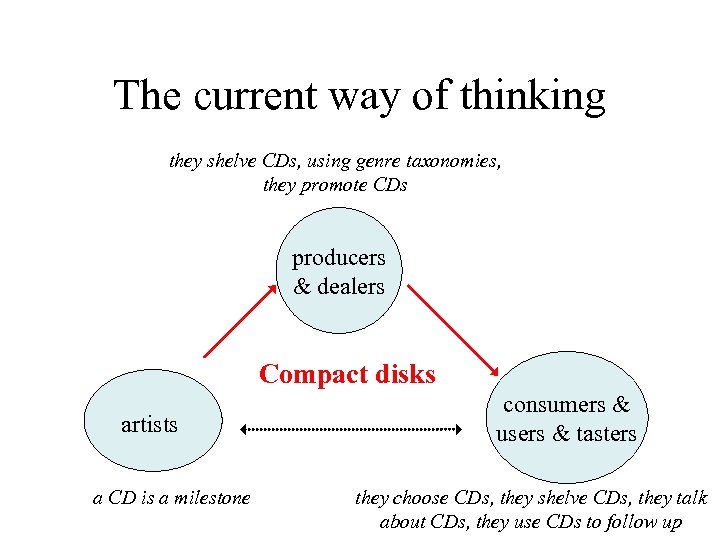
The current way of thinking they shelve CDs, using genre taxonomies, they promote CDs producers & dealers Compact disks artists a CD is a milestone consumers & users & tasters they choose CDs, they shelve CDs, they talk about CDs, they use CDs to follow up
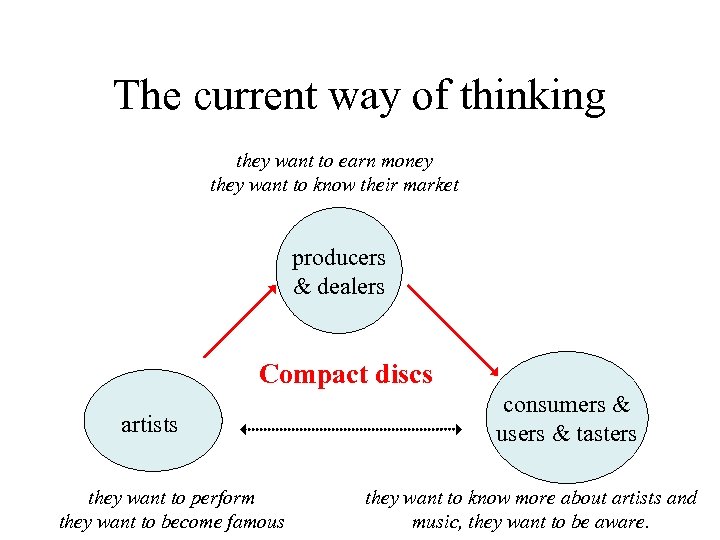
The current way of thinking they want to earn money they want to know their market producers & dealers Compact discs artists they want to perform they want to become famous consumers & users & tasters they want to know more about artists and music, they want to be aware.
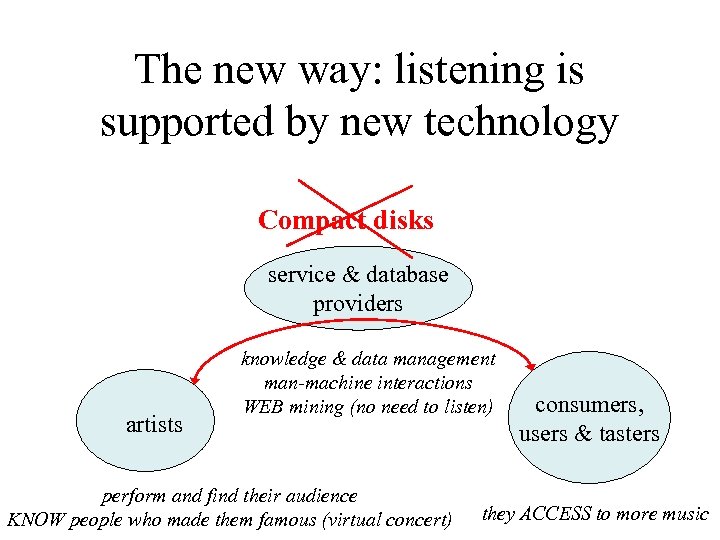
The new way: listening is supported by new technology Compact disks service & database providers artists knowledge & data management man-machine interactions WEB mining (no need to listen) perform and find their audience KNOW people who made them famous (virtual concert) consumers, users & tasters they ACCESS to more music
Why not to get rid of CDs? Massive digitalisation of music: -> makes place for many concurrent ways of music automatic indexing (cultural, editorial, acoustic, …) -> allows some local powerful concept formalising computerised calculus -> opens the way for content mining approaches, involving interactive similarity based search
What was going on with CDs? To market CDs within department stores: -> to shelf products before selling them -> to define metadata for describing music -> this does (did? ) influence our music culture
II° a Theoretical Distinction: What is Similarity?
What is Similarity? • Given an example … • Given a case base … • Looking for a similar example • Different approaches: concept formalising vs content mining
Concept formalising • The example is viewed as an instance of a general structure/variable • Similar examples are produced by variation, and have to be checked “by hand” • Concepts are described in intenso, from formal explanations/distances • If some local ontology is available, the search space is limited by the less abstract concept • Concept formalising is typically “computer supported”
Content mining • The example is viewed as a specialisation of the case base • Similar examples are produced by building close specialisations • Concepts are described in extenso, from the contents they are supposed to abstract • Rectification/iterations/man-machine interactions are natively part of the approach
What is new with content mining? • Concept formalising is involved, but as heuristic means and provocation • Quantity plays a qualitative role (lists are preferred over sets) • The in extenso description of a concept is NOT reducible to any in intenso definition
III° a Conclusion to be Discute: Why such a title/subtitle? Lessen the Importance of Instantiation so Creation Can Better Fiction
Reconcile Art and Culture Content indexing will probably be as important for listening as the invention of the sound-carrier By using new sound/music descriptions, listeners will invent/discover new ways of listening to sound/music
La traversée de la nuit
Скачать презентацию On-line music distribution a case study Lessen the
bc765c5a05391690d96fdf2901c0e12f.ppt