


 Скачать презентацию On Call Defeating Traffic Spikes with a Free-Market
987f331c069964d88096f0421e490d10.ppt
- Количество слайдов: 27
 On. Call Defeating Traffic Spikes with a Free-Market Application Cluster James Norris • Keith Coleman • Armando Fox • George Candea Stanford University
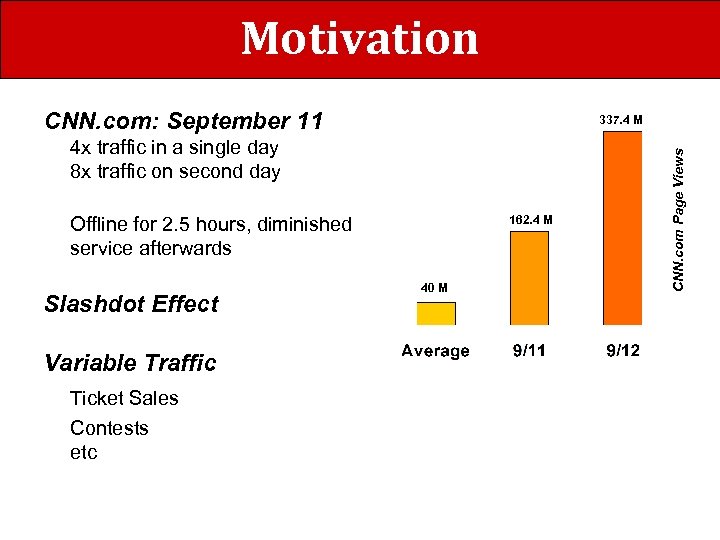 Motivation CNN. com: September 11 4 x traffic in a single day 8 x traffic on second day Offline for 2. 5 hours, diminished service afterwards Slashdot Effect Variable Traffic Ticket Sales Contests etc 162. 4 M 40 M CNN. com Page Views 337. 4 M
 What to do?
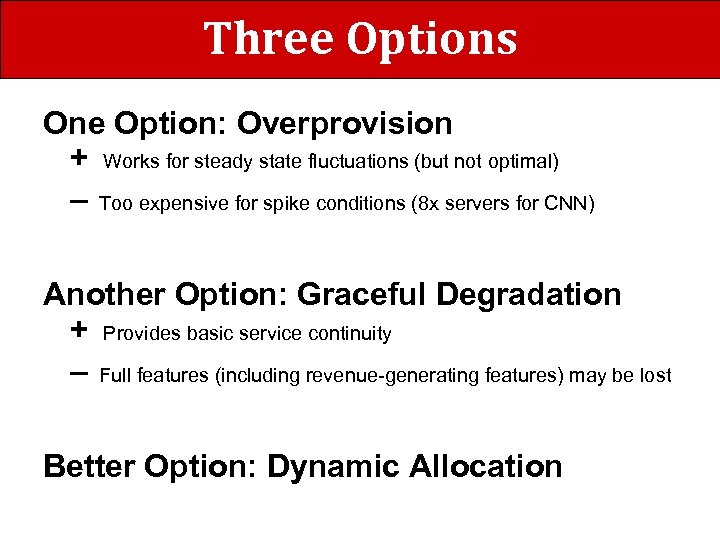 Three Options One Option: Overprovision + Works for steady state fluctuations (but not optimal) – Too expensive for spike conditions (8 x servers for CNN) Another Option: Graceful Degradation + Provides basic service continuity – Full features (including revenue-generating features) may be lost Better Option: Dynamic Allocation
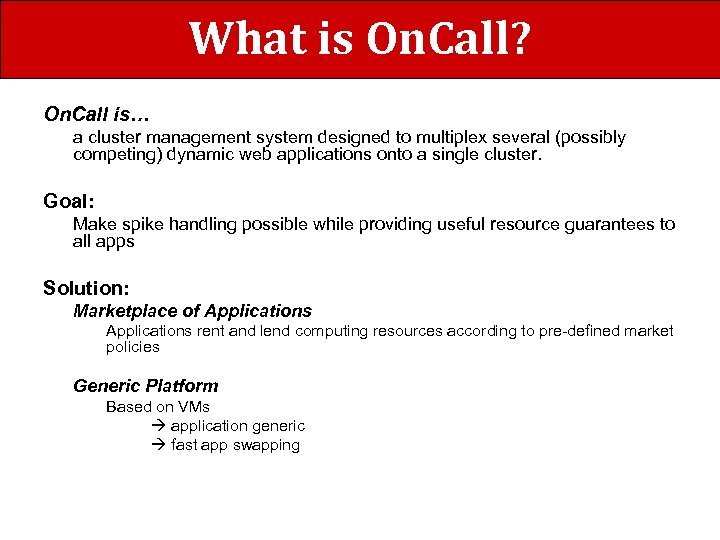 What is On. Call? On. Call is… a cluster management system designed to multiplex several (possibly competing) dynamic web applications onto a single cluster. Goal: Make spike handling possible while providing useful resource guarantees to all apps Solution: Marketplace of Applications rent and lend computing resources according to pre-defined market policies Generic Platform Based on VMs application generic fast app swapping
 Marketplace
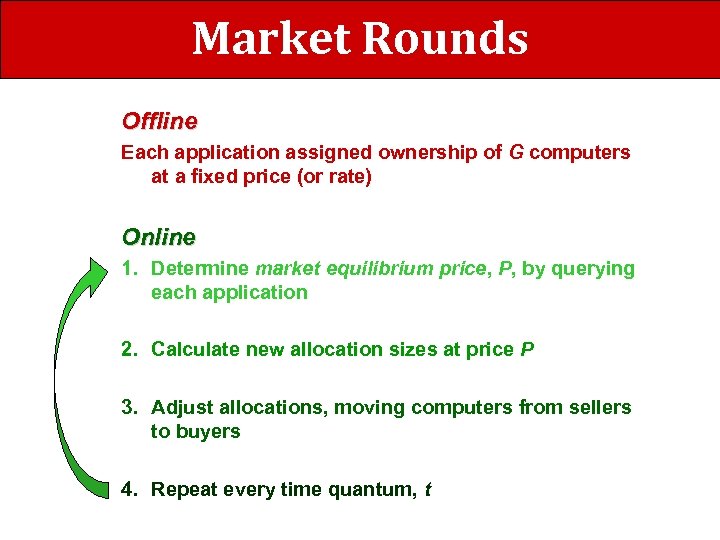 Market Rounds Offline Each application assigned ownership of G computers at a fixed price (or rate) Online 1. Determine market equilibrium price, P, by querying each application 2. Calculate new allocation sizes at price P 3. Adjust allocations, moving computers from sellers to buyers 4. Repeat every time quantum, t
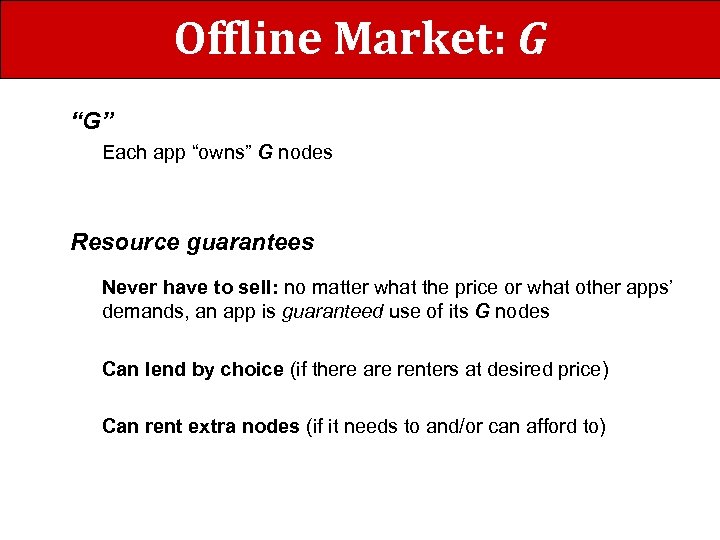 Offline Market: G “G” Each app “owns” G nodes Resource guarantees Never have to sell: no matter what the price or what other apps’ demands, an app is guaranteed use of its G nodes Can lend by choice (if there are renters at desired price) Can rent extra nodes (if it needs to and/or can afford to)
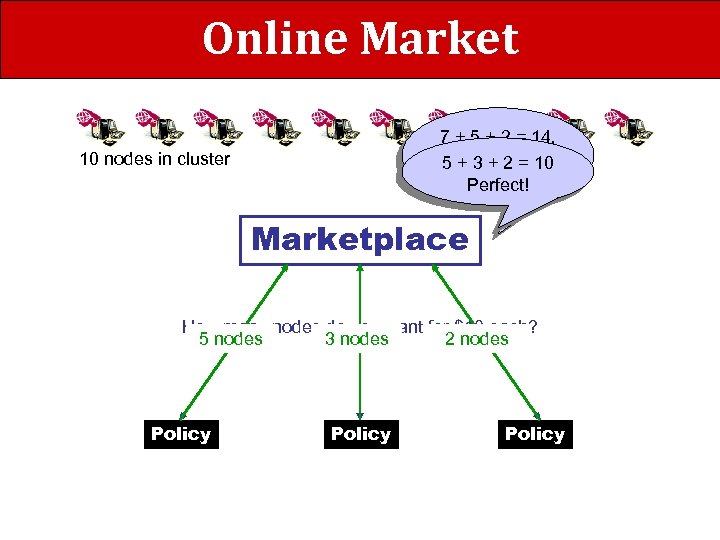 Online Market 7 + 5 + 2 = 14, but I 3 only have 5 + + 2 = 10 10 nodes! Perfect! 10 nodes in cluster Marketplace How many nodes do you want for $10 each? How many nodes do you want for $5 each? 5 7 nodes 3 5 nodes 2 nodes Policy
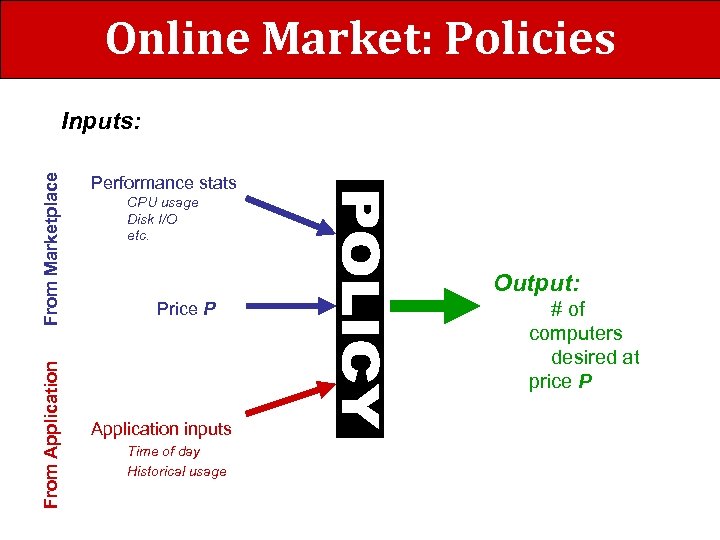 Online Market: Policies From Application From Marketplace Inputs: Performance stats CPU usage Disk I/O etc. Output: Price P Application inputs Time of day Historical usage # of computers desired at price P
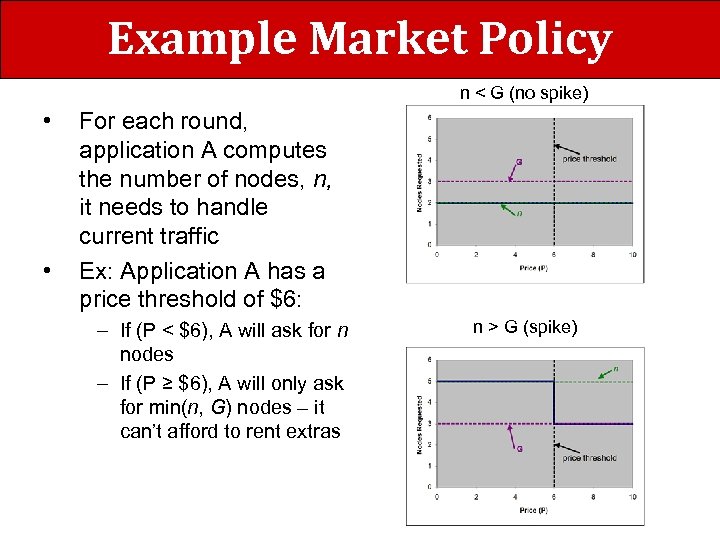 Example Market Policy n < G (no spike) • • For each round, application A computes the number of nodes, n, it needs to handle current traffic Ex: Application A has a price threshold of $6: – If (P < $6), A will ask for n nodes – If (P ≥ $6), A will only ask for min(n, G) nodes – it can’t afford to rent extras n > G (spike)
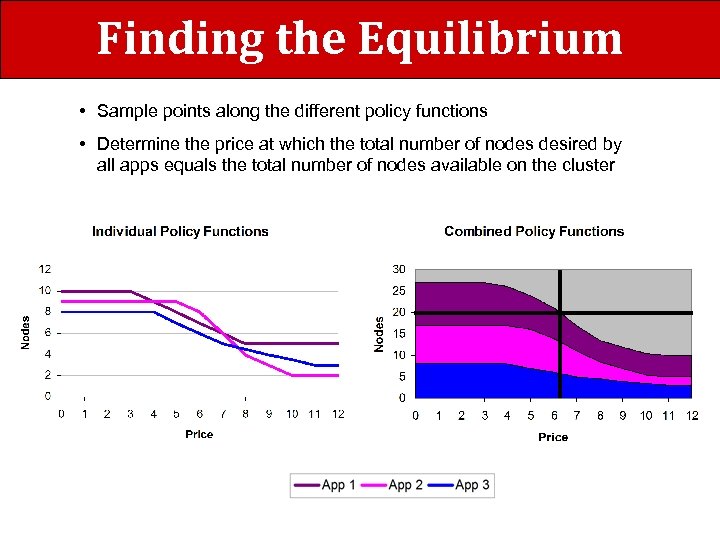 Finding the Equilibrium • Sample points along the different policy functions • Determine the price at which the total number of nodes desired by all apps equals the total number of nodes available on the cluster
 Competitive vs Cooperative Competitive Environments Ex: ASP, where app owners may be in competition Cooperative Environments Ex: Search engine, Yahoogle Quick Case Study App 1: Paid web search (very high value in low latency) App 2: Ad-supported web search (high value in low latency) App 3: Crawler (latency OK, starvation not) For each app, model utility of running at a given time Benefit: If you add an app, just need to model that app, not remodel whole system
 Platform
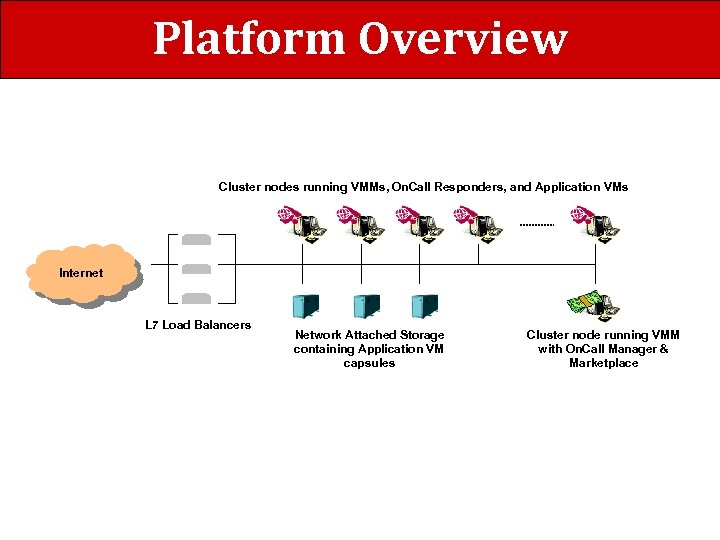 Platform Overview Cluster nodes running VMMs, On. Call Responders, and Application VMs Internet L 7 Load Balancers Network Attached Storage containing Application VM capsules Cluster node running VMM with On. Call Manager & Marketplace
 Does this work?
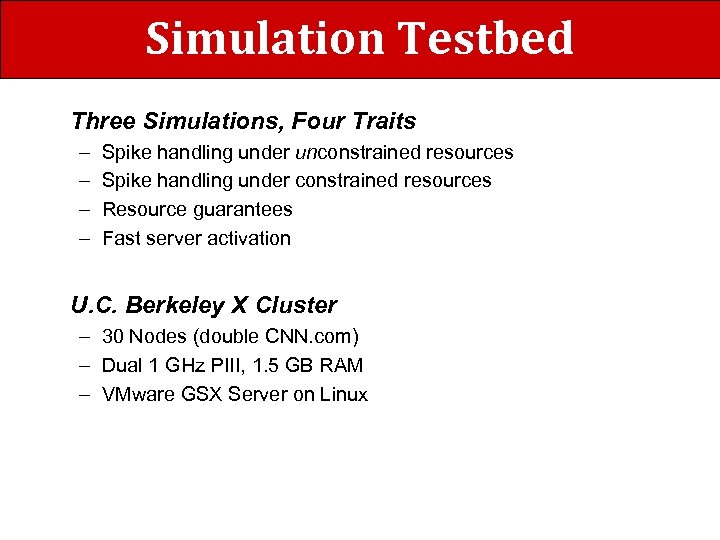 Simulation Testbed Three Simulations, Four Traits – – Spike handling under unconstrained resources Spike handling under constrained resources Resource guarantees Fast server activation U. C. Berkeley X Cluster – 30 Nodes (double CNN. com) – Dual 1 GHz PIII, 1. 5 GB RAM – VMware GSX Server on Linux
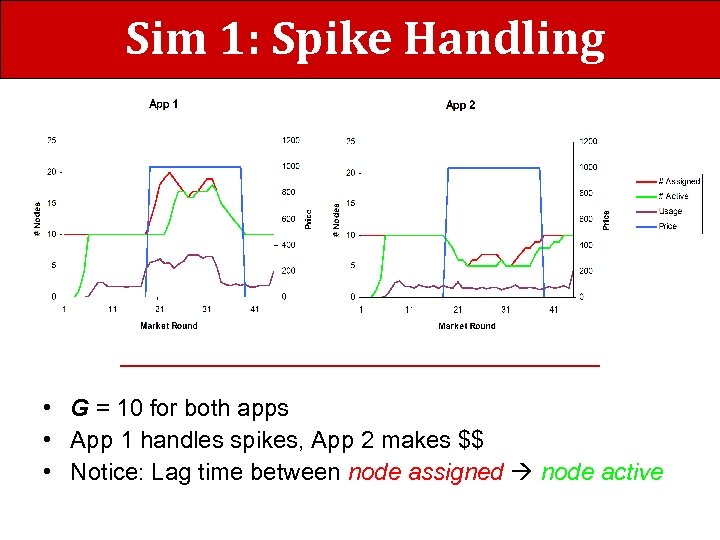 Sim 1: Spike Handling • G = 10 for both apps • App 1 handles spikes, App 2 makes $$ • Notice: Lag time between node assigned node active
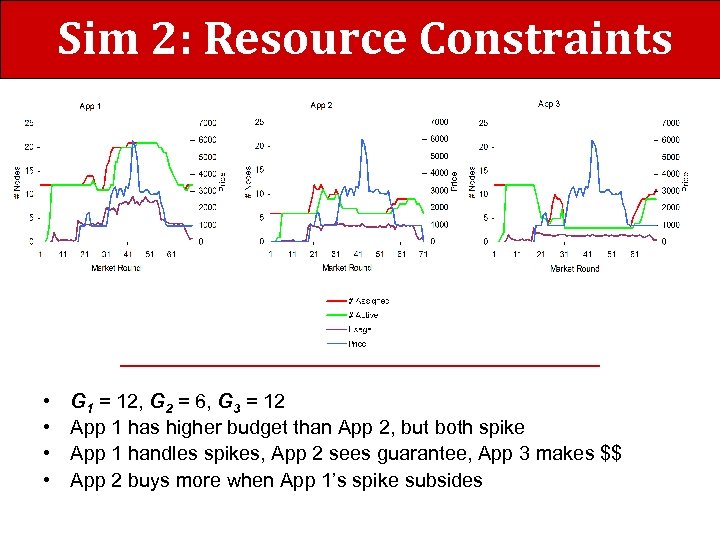 Sim 2: Resource Constraints • • G 1 = 12, G 2 = 6, G 3 = 12 App 1 has higher budget than App 2, but both spike App 1 handles spikes, App 2 sees guarantee, App 3 makes $$ App 2 buys more when App 1’s spike subsides
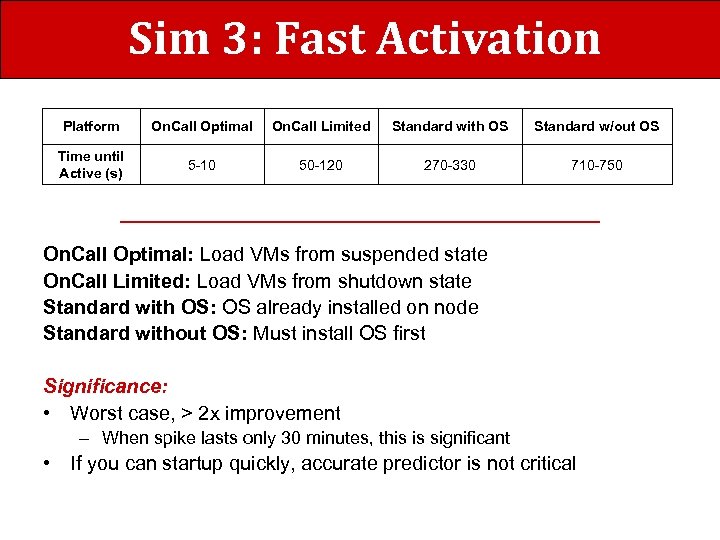 Sim 3: Fast Activation Platform On. Call Optimal On. Call Limited Standard with OS Standard w/out OS Time until Active (s) 5 -10 50 -120 270 -330 710 -750 On. Call Optimal: Load VMs from suspended state On. Call Limited: Load VMs from shutdown state Standard with OS: OS already installed on node Standard without OS: Must install OS first Significance: • Worst case, > 2 x improvement – When spike lasts only 30 minutes, this is significant • If you can startup quickly, accurate predictor is not critical
 Questions?
 Notes and Assumptions Homogeneity Assumption Cluster is assumed to be homogeneous—all nodes rented at same price (for simplicity) Swapping Costs Time delay cost in start up / shut down of an app on a node. If a rental contract is renewed, app runs on same node. “P” Only for Extras Apps only pay price P for nodes above and beyond their own G Ex: Using 40, G = 30 40 – 30 = 10 nodes at price P
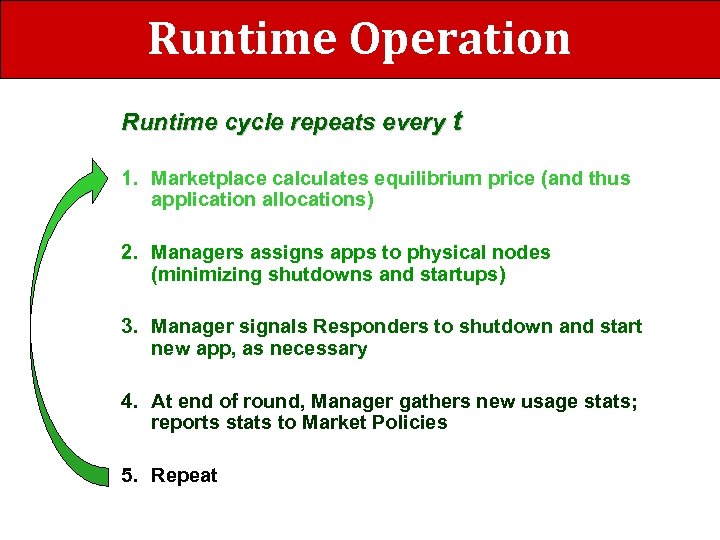 Runtime Operation Runtime cycle repeats every t 1. Marketplace calculates equilibrium price (and thus application allocations) 2. Managers assigns apps to physical nodes (minimizing shutdowns and startups) 3. Manager signals Responders to shutdown and start new app, as necessary 4. At end of round, Manager gathers new usage stats; reports stats to Market Policies 5. Repeat
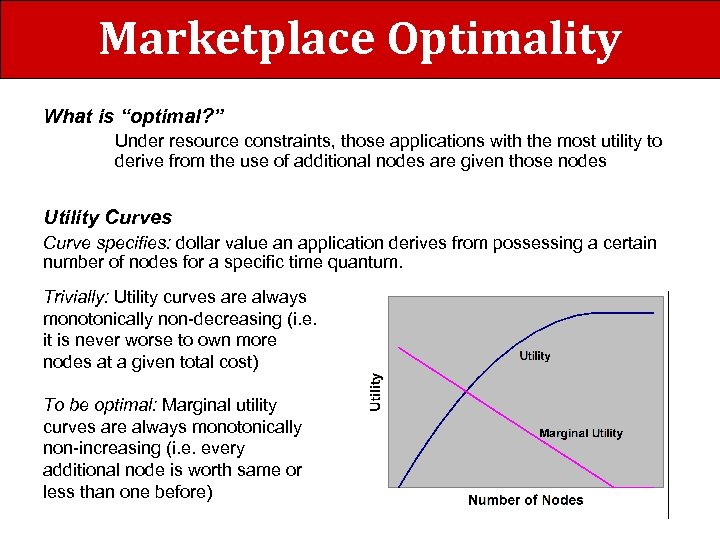 Marketplace Optimality What is “optimal? ” Under resource constraints, those applications with the most utility to derive from the use of additional nodes are given those nodes Utility Curves Curve specifies: dollar value an application derives from possessing a certain number of nodes for a specific time quantum. Trivially: Utility curves are always monotonically non-decreasing (i. e. it is never worse to own more nodes at a given total cost) To be optimal: Marginal utility curves are always monotonically non-increasing (i. e. every additional node is worth same or less than one before)
 Profit Through Efficiency “Shut Down” App ASP shuts down servers when it can buy them for less than the cost of keeping them running (A/C, utilities, etc) ASP can then additional capacity and sell only when profitable
 Marketplace Fairness Markets are optimal if… …they are free and fair Anti-competitive behavior Monopoly/Oligopoly Aggressive tactics Fairness through Regulation Ensure enough distinct owners no monopoly Fine or ban app that engages in overtly anti-competitive behavior
 Future Work VM caching Cache VMs to local disk (speculatively or as read from NAS) Fault tolerance Add master-backup fault tolerance to the On. Call Manager Performance statistics Provide market policies with additional statistics (e. g. end-to-end response time) Scalable data layer Add support for scalable persistent stores that would allow replication on the data tier. Multiplexing Study trade-offs of running several applications on one node