 Скачать презентацию On both sides of the Green Line ONGOING
febfc3e86e6218574f4f579d1c35ea96.ppt
- Количество слайдов: 26



On both sides of the Green Line ONGOING FORCED DISPLACEMENT OF THE INDIGENOUS PALESTINIAN PEOPLE BADIL Resource Center for Palestinian Residency & Refugee Rights December 2008
Who is an IDP? “Persons or groups of persons who have been forced or obliged to flee or leave their homes or places of habitual residence, in particular as a result of or in order to avoid: 1. 2. 3. 4. The effects of armed conflict; Situations of generalized violence; Violations of human rights; or Natural or human-made disasters and who have not crossed an internationally recognized state border. ” UN Guiding Principles on Internal Displacement
Ongoing Internal Forced Displacement in ISRAEL
First Waves of Internal Displacement in Israel Today, there around 338, 000 Palestinian Arab citizens of Israel who are internally displaced. They were displaced during 1948 war and its immediate aftermath on grounds of their nationality, race, ethnicity and religion. The High Court rulings in the 1950 s*
Nevertheless, Israel ignored the HC’s rulings. It continues to confiscate the IDPs’ lands and property for the exclusive use of the Jewish citizens. In 2003, the Israeli HC reversed its previous decision. *
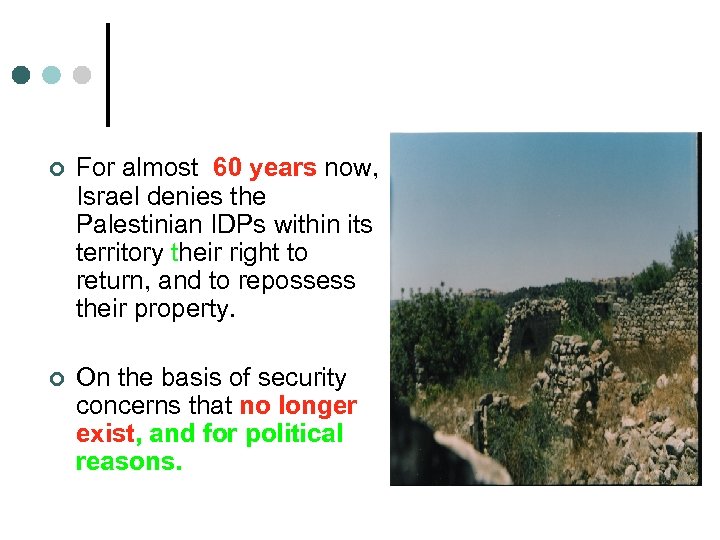
For almost 60 years now, Israel denies the Palestinian IDPs within its territory their right to return, and to repossess their property. On the basis of security concerns that no longer exist, and for political reasons.
Ongoing Waves of Displacement in Israel Among Palestinian citizens of Israel, Bedouins and the population in the “mixed cities”, are particularly at risk of forced displacement. [cut on the grounds of their nationality, ethnicity, race and religion. ]
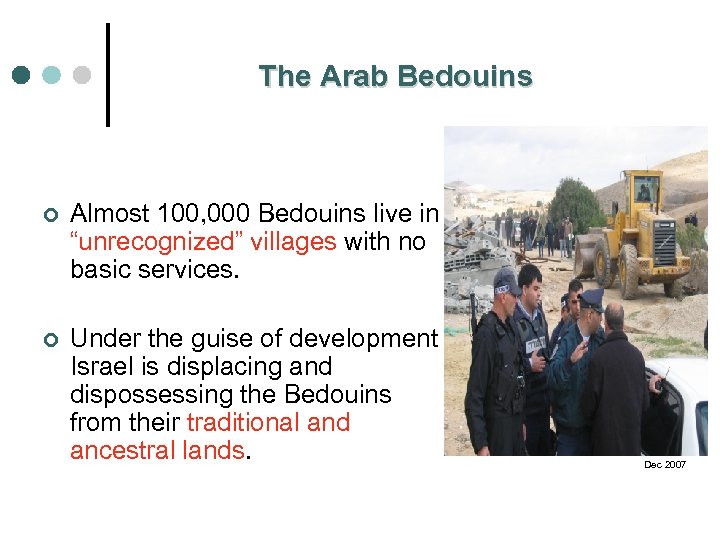
The Arab Bedouins Almost 100, 000 Bedouins live in “unrecognized” villages with no basic services. Under the guise of development Israel is displacing and dispossessing the Bedouins from their traditional and ancestral lands. Dec 2007
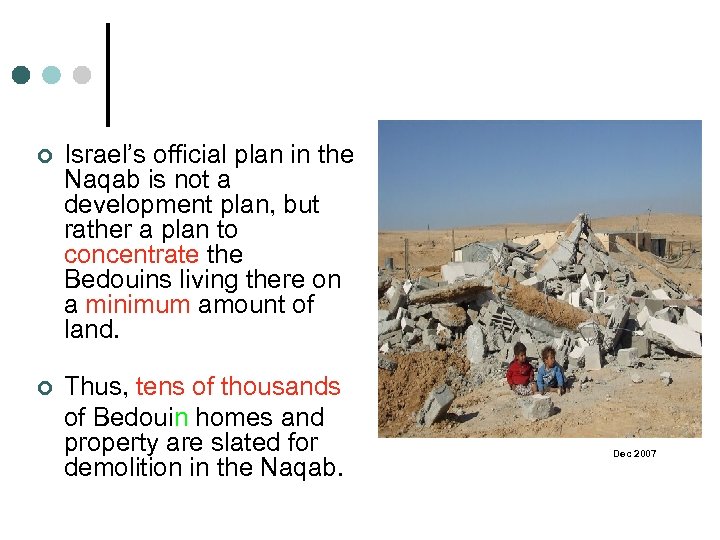
Israel’s official plan in the Naqab is not a development plan, but rather a plan to concentrate the Bedouins living there on a minimum amount of land. Thus, tens of thousands of Bedouin homes and property are slated for demolition in the Naqab. Dec 2007
The Mixed Cities In Jaffa, for instance, some 3, 000 Palestinian inhabitants of this town were recently issued 500 demolition orders, because they are considered squatters in their own homes. Similar practices in Lod, Ramla and Acre.
Ongoing Internal Forced Displacement in THE OCCUPIED PALESTINIAN TERRITORY
Who are IDPs in the OPT? People who have been forced to leave their homes in order to avoid violations of their rights. This may result from: 1. 2. 3. 4. 5. 6. House demolitions Forced evictions Military operations (with no grounds of military necessity) Land confiscation & colonisation* Violence by Jewish settlers** Closure regime, including lack of access to basic services and supplies
At Imminent Risk are the Palestinian Communities: In occupied East Jerusalem Rural areas in the West Bank: Area C Near settlements Near the Separation Wall and affected by its regime In closed military areas and nature reserves Experiencing significant military activity
Vulnerable groups CHILDREN lose protective and nurturing environments. Family unity may be greatly disrupted. BEDOUIN face an existential threat when displaced. They have experienced multiple displacements and have very few coping mechanisms REFUGEES are very vulnerable to forced displacement through military activities. They have reduced coping mechanisms and displacement may result in disruption of access to UNRWA services (e. g. Gaza)
More than 115, 000 Palestinian people have been internally displaced during the last four decades of Israel's occupation. Israel has demolished almost 19, 000 houses in the OPT between 1967 and 2007. Hebron, March 2008
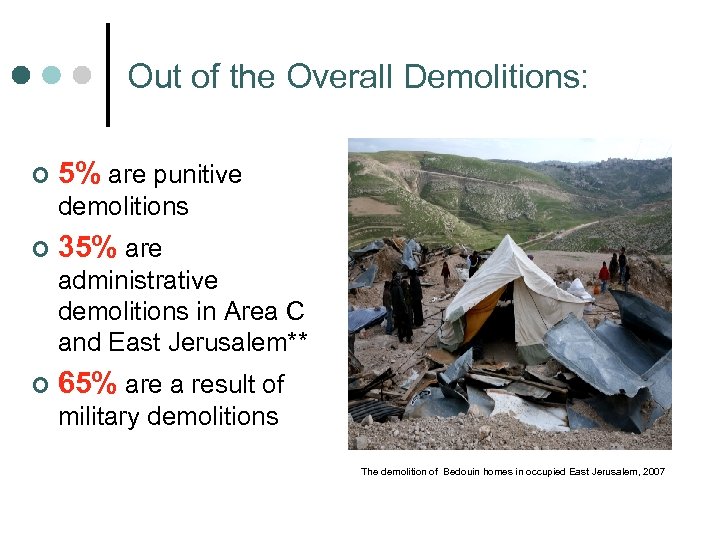
Out of the Overall Demolitions: 5% are punitive demolitions 35% are administrative demolitions in Area C and East Jerusalem** 65% are a result of military demolitions The demolition of Bedouin homes in occupied East Jerusalem, 2007
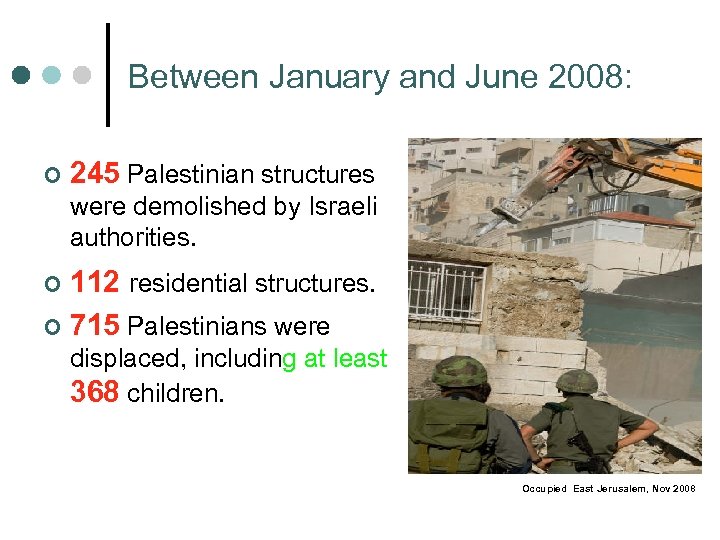
Between January and June 2008: 245 Palestinian structures were demolished by Israeli authorities. 112 residential structures. 715 Palestinians were displaced, including at least 368 children. Occupied East Jerusalem, Nov 2008
Particular Concern: Occupied East Jerusalem Israel has illegally annexed E. Jerusalem and treats Palestinian residents there as foreigners whose status can be revoked under Israeli law. These residents are forced to repeatedly prove their permanent residency status in the city. Revocation of residency rights: 8, 000 IDs were confiscated effecting more than 25, 000 Palestinians. Intensive planning and construction of Jewish settlements. Discrimination in planning, expropriation of lands, and minimal investment in physical infrastructure and municipal services.
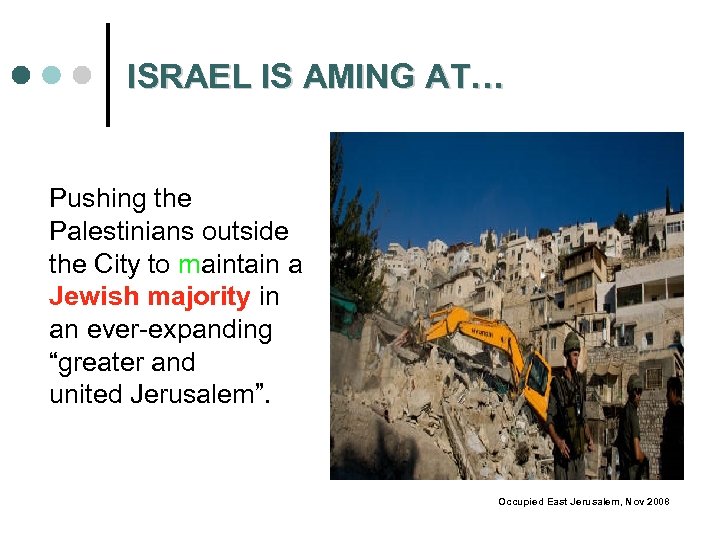
ISRAEL IS AMING AT… Pushing the Palestinians outside the City to maintain a Jewish majority in an ever-expanding “greater and united Jerusalem”. Occupied East Jerusalem, Nov 2008
Consequences Poverty & unemployment Food insecurity & reliance on food aid Lack of access to water / natural resources Lack of access to essential services (e. g. health & education) Reduced agricultural productivity Family separations Lack of adequate standard of living And much more… The combined effects of displacement are analogous to de-development
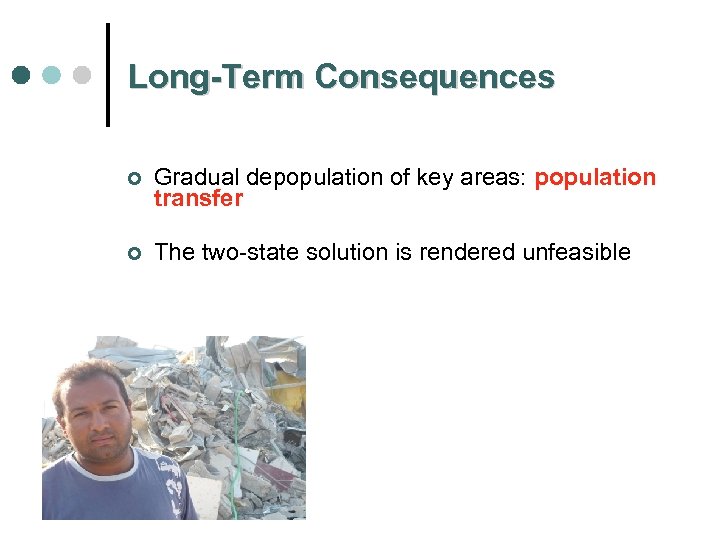
Long-Term Consequences Gradual depopulation of key areas: population transfer The two-state solution is rendered unfeasible
WHAT ARE THE ROOT CAUSES Institutionalized racism and discrimination on grounds of nationality, ethnicity, race and religion in Israel and the OPT Colonization and protracted occupation of the OPT
DEPOPULATION, CONCENTRATION AND SEGREGATION What is Israel’s Purpose?
To grab the maximum amount of land with a minimum number of indigenous Palestinians
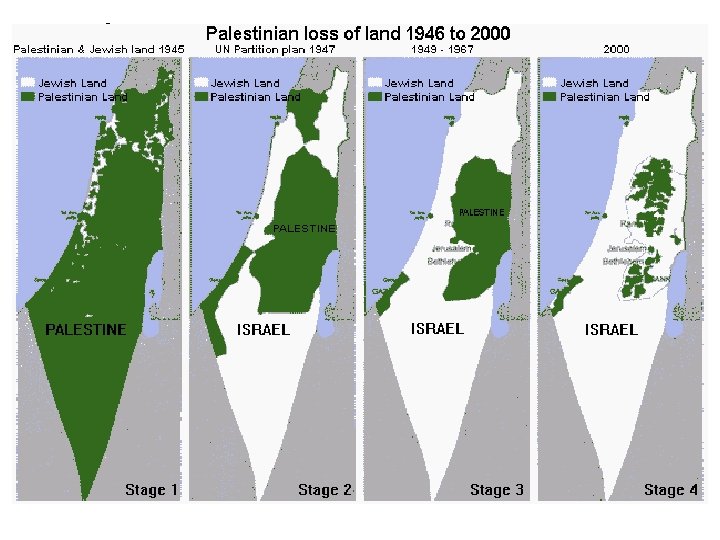
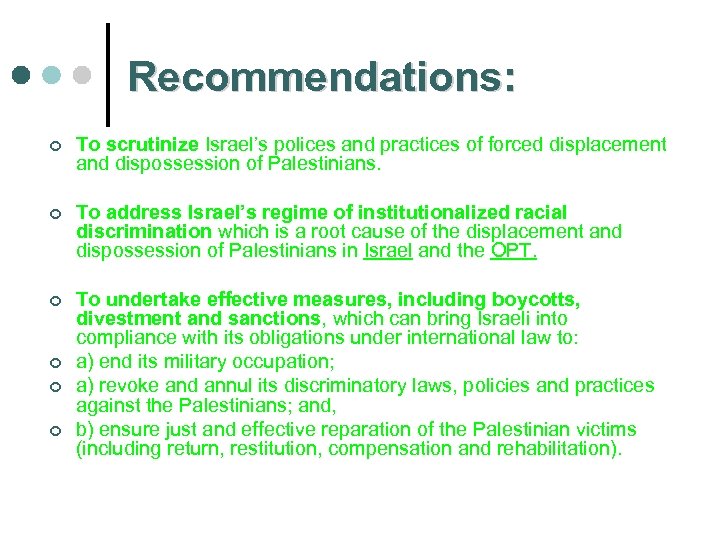
Recommendations: To scrutinize Israel’s polices and practices of forced displacement and dispossession of Palestinians. To address Israel’s regime of institutionalized racial discrimination which is a root cause of the displacement and dispossession of Palestinians in Israel and the OPT. To undertake effective measures, including boycotts, divestment and sanctions, which can bring Israeli into compliance with its obligations under international law to: a) end its military occupation; a) revoke and annul its discriminatory laws, policies and practices against the Palestinians; and, b) ensure just and effective reparation of the Palestinian victims (including return, restitution, compensation and rehabilitation).
Скачать презентацию On both sides of the Green Line ONGOING
febfc3e86e6218574f4f579d1c35ea96.ppt