


 Скачать презентацию OMG Systems Engineering Domain Special Interest Group SE
e5912d18d9d5b62731062541c0244b6e.ppt
- Количество слайдов: 34
 OMG Systems Engineering Domain Special Interest Group (SE DSIG) Meeting Burlingame CA 2007 -12 -12 Integrating Design with Simulation & Analysis Using Sys. ML Status Update to SE DSIG on GIT Sys. ML-related Efforts Russell Peak (presenter), Chris Paredis, Leon Mc. Ginnis Georgia Institute of Technology Product & Systems Lifecycle Mgt. Center www. pslm. gatech. edu Copyright © 2007 by Georgia Tech Research Corporation, Atlanta, Georgia 30332 -0415 USA. All Rights Reserved. Permission to reproduce and distribute without changes for non-commercial purposes (including internal corporate usage) is hereby granted provided this notice and a proper citation are included. 1
 Integrating Design with Simulation & Analysis Using Sys. ML Status Update to SE DSIG on GIT Sys. ML-related Efforts Abstract We provide an update on Sys. ML-related activities at Georgia Tech. This presentation focuses on a project underway with Lockheed aimed at integrating design and engineering analysis using Sys. ML. The primary objective is to define and demonstrate the methodology, tools, requirements, and practical applications for connecting a Sys. ML system specification and design model with multiple engineering analysis and dynamic simulation models. This project employs excavators as a test case and contains several model types being interconnected with a system design model: fluid power (hydraulics), linkage dynamics, structural (FEA), cost, reliability, and factory flow. Citation RS Peak, CJ Paredis, LF Mc. Ginnis (2007 -12) Integrating Design with Simulation & Analysis Using Sys. ML—Status Update to SE DSIG on GIT Sys. ML-related Efforts. Presentation to OMG SE DSIG, Burlingame CA. http: //eislab. gatech. edu/pubs/seminars-etc/2007 -12 -omg-se-dsig-peak/ 2
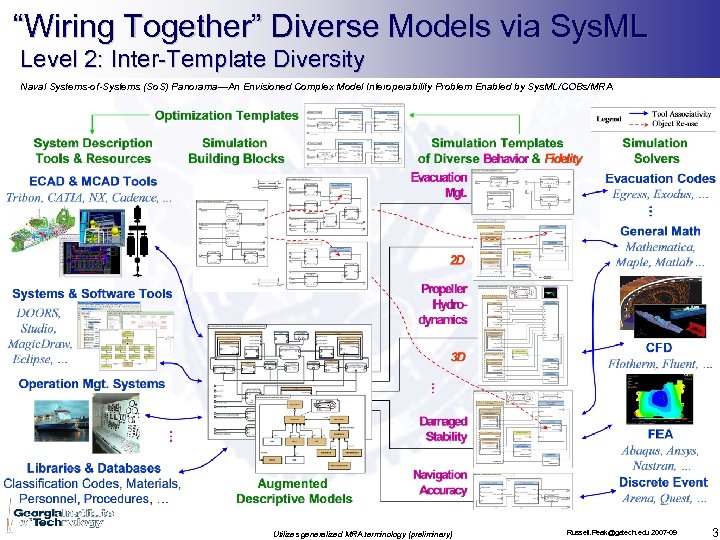 “Wiring Together” Diverse Models via Sys. ML Level 2: Inter-Template Diversity Naval Systems-of-Systems (So. S) Panorama—An Envisioned Complex Model Interoperability Problem Enabled by Sys. ML/COBs/MRA Utilizes generalized MRA terminology (preliminary) Russell. Peak@gatech. edu 2007 -09 3
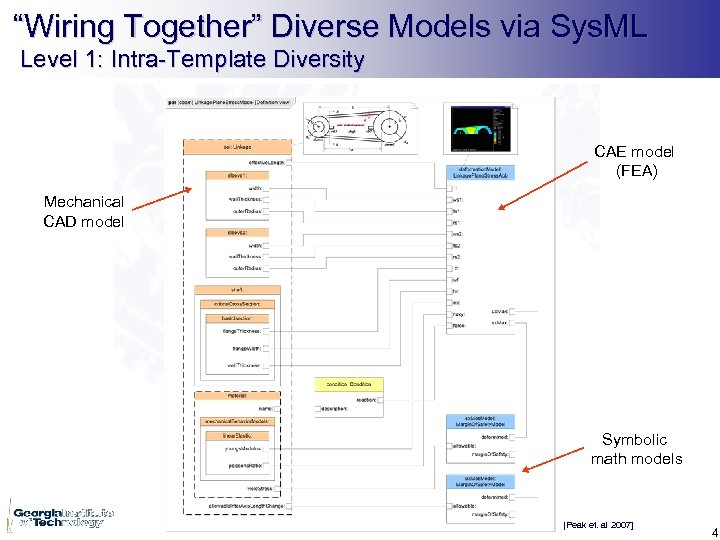 “Wiring Together” Diverse Models via Sys. ML Level 1: Intra-Template Diversity CAE model (FEA) Mechanical CAD model Symbolic math models [Peak et. al 2007] 4
![Diverse Types of Relations. . . (partially supported to date) [Tamburini, Peak, Paredis 2005]](https://present5.com/presentation/e5912d18d9d5b62731062541c0244b6e/image-5.jpg "Diverse Types of Relations. . . (partially supported to date) [Tamburini, Peak, Paredis 2005]") Diverse Types of Relations. . . (partially supported to date) [Tamburini, Peak, Paredis 2005] 5
Diverse Types of Relations. . . (partially supported to date) [Tamburini, Peak, Paredis 2005] 5
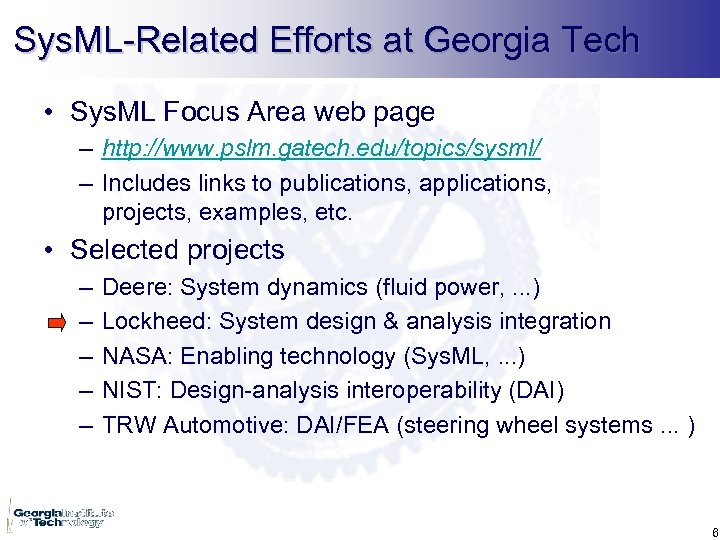 Sys. ML-Related Efforts at Georgia Tech • Sys. ML Focus Area web page – http: //www. pslm. gatech. edu/topics/sysml/ – Includes links to publications, applications, projects, examples, etc. • Selected projects – – – Deere: System dynamics (fluid power, . . . ) Lockheed: System design & analysis integration NASA: Enabling technology (Sys. ML, . . . ) NIST: Design-analysis interoperability (DAI) TRW Automotive: DAI/FEA (steering wheel systems. . . ) 6
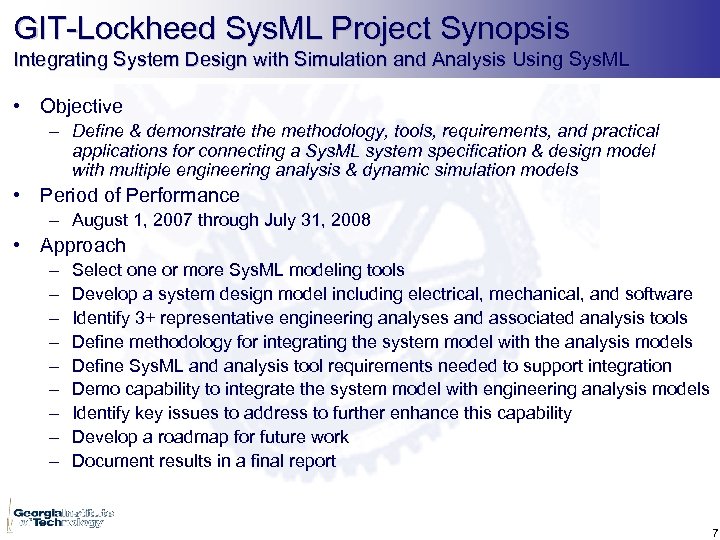 GIT-Lockheed Sys. ML Project Synopsis Integrating System Design with Simulation and Analysis Using Sys. ML • Objective – Define & demonstrate the methodology, tools, requirements, and practical applications for connecting a Sys. ML system specification & design model with multiple engineering analysis & dynamic simulation models • Period of Performance – August 1, 2007 through July 31, 2008 • Approach – – – – – Select one or more Sys. ML modeling tools Develop a system design model including electrical, mechanical, and software Identify 3+ representative engineering analyses and associated analysis tools Define methodology for integrating the system model with the analysis models Define Sys. ML and analysis tool requirements needed to support integration Demo capability to integrate the system model with engineering analysis models Identify key issues to address to further enhance this capability Develop a roadmap for future work Document results in a final report 7
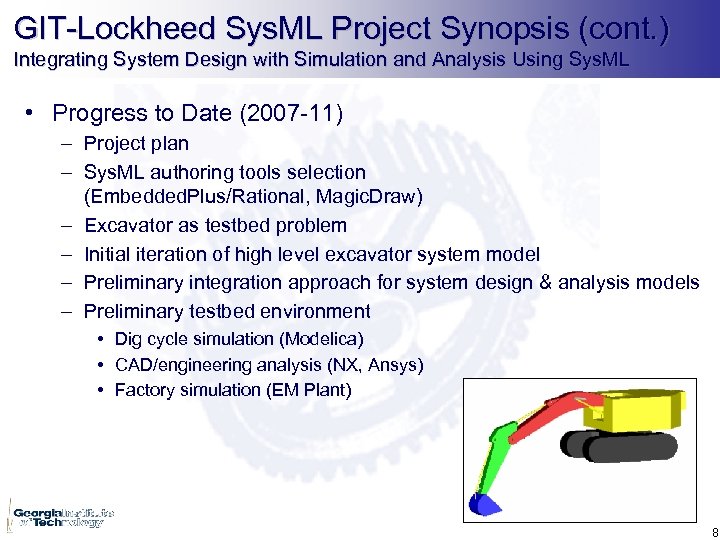 GIT-Lockheed Sys. ML Project Synopsis (cont. ) Integrating System Design with Simulation and Analysis Using Sys. ML • Progress to Date (2007 -11) – Project plan – Sys. ML authoring tools selection (Embedded. Plus/Rational, Magic. Draw) – Excavator as testbed problem – Initial iteration of high level excavator system model – Preliminary integration approach for system design & analysis models – Preliminary testbed environment • Dig cycle simulation (Modelica) • CAD/engineering analysis (NX, Ansys) • Factory simulation (EM Plant) 8
![GIT Modeling Environment for Excavator Test Case [WIP models] 9](https://present5.com/presentation/e5912d18d9d5b62731062541c0244b6e/image-9.jpg "GIT Modeling Environment for Excavator Test Case [WIP models] 9") GIT Modeling Environment for Excavator Test Case [WIP models] 9
GIT Modeling Environment for Excavator Test Case [WIP models] 9
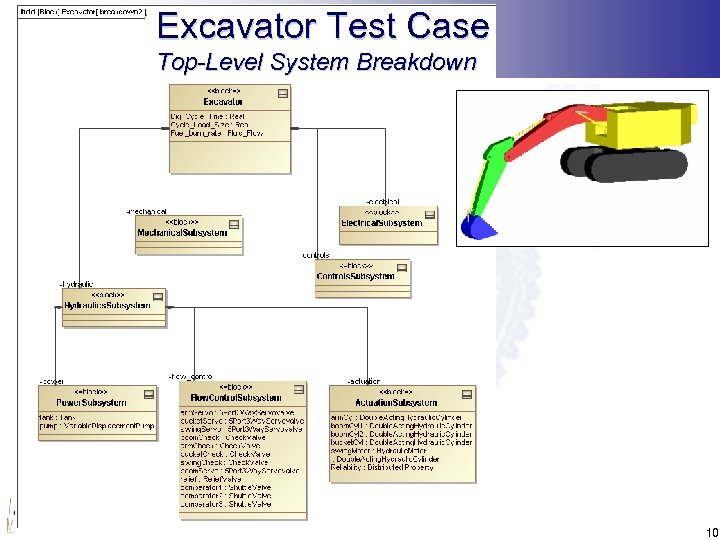 Excavator Test Case Top-Level System Breakdown 10
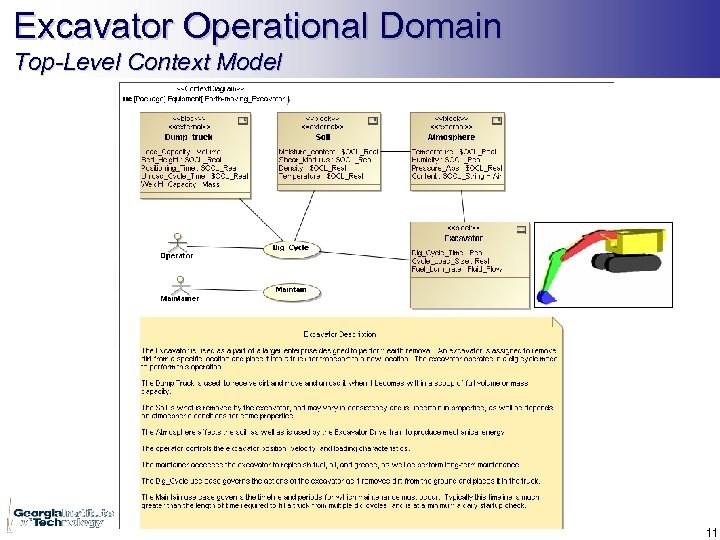 Excavator Operational Domain Top-Level Context Model 11
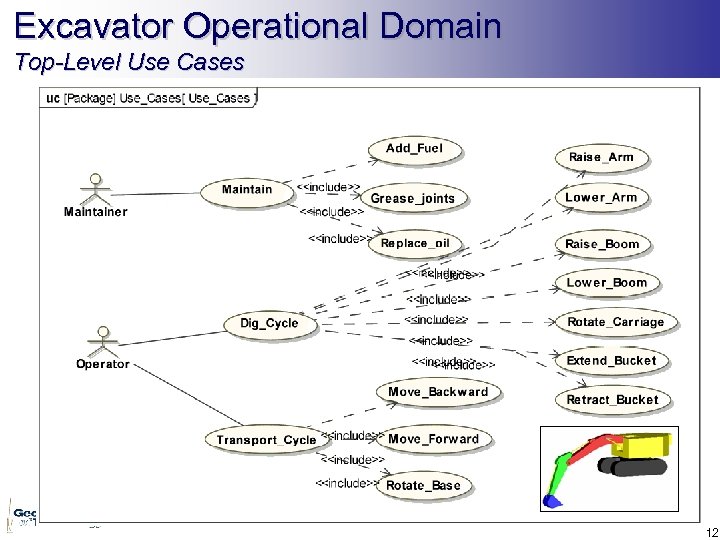 Excavator Operational Domain Top-Level Use Cases 12
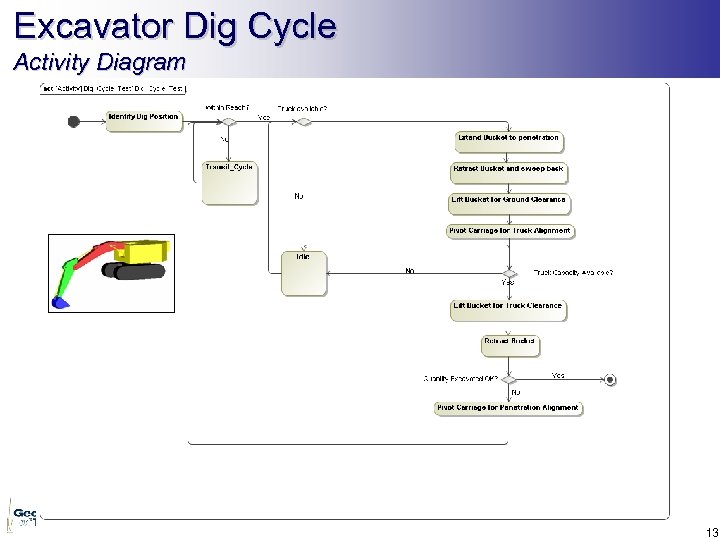 Excavator Dig Cycle Activity Diagram 13
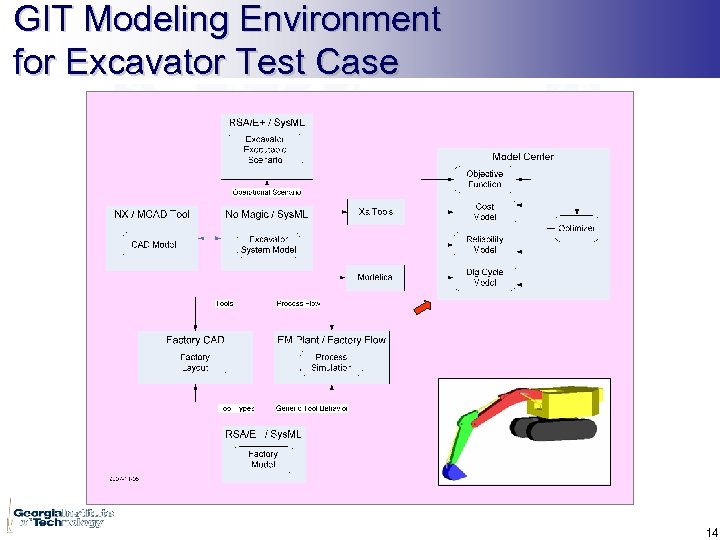 GIT Modeling Environment for Excavator Test Case 14
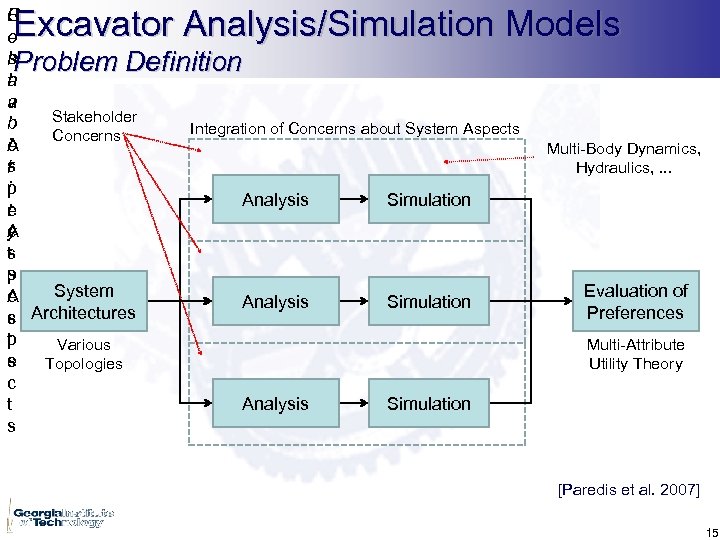 Excavator Analysis/Simulation Models B C R e o h s. Problem Definition l a t i v a Stakeholder i b Integration of Concerns about System Aspects Concerns o A i r s l p i Analysis Simulation e t A c y s t p s System e A Analysis Simulation Architectures c s t p Various s e Topologies c Analysis Simulation t s Multi-Body Dynamics, Hydraulics, . . . Evaluation of Preferences Multi-Attribute Utility Theory [Paredis et al. 2007] 15
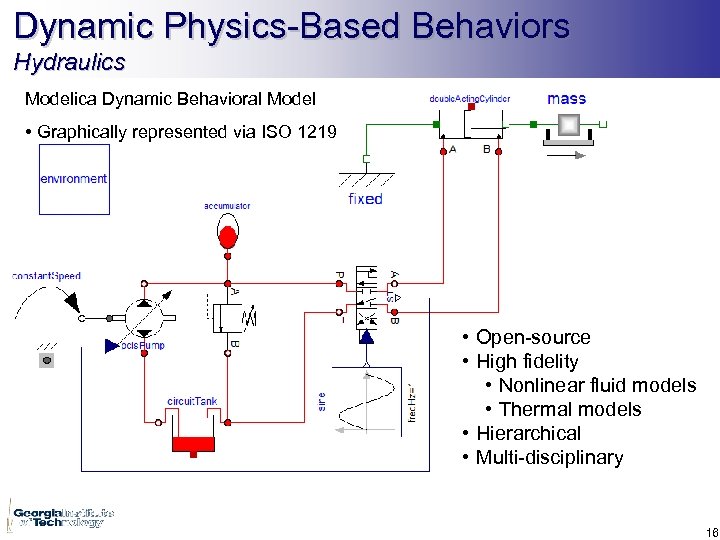 Dynamic Physics-Based Behaviors Hydraulics Modelica Dynamic Behavioral Model • Graphically represented via ISO 1219 • Open-source • High fidelity • Nonlinear fluid models • Thermal models • Hierarchical • Multi-disciplinary 16
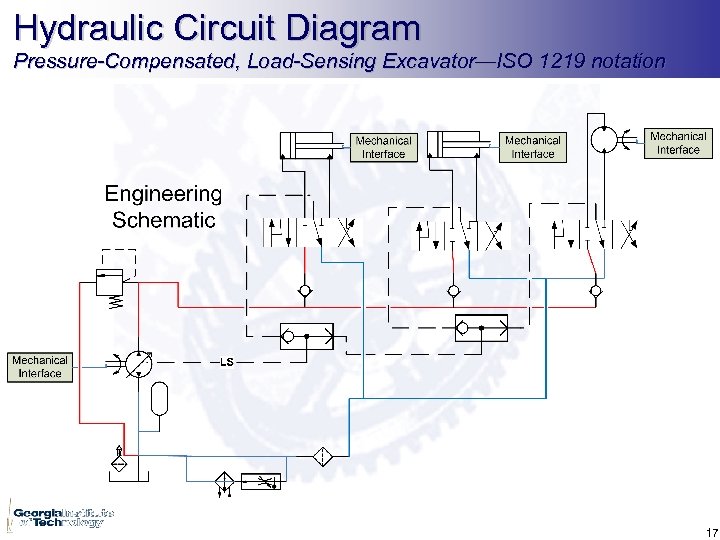 Hydraulic Circuit Diagram Pressure-Compensated, Load-Sensing Excavator—ISO 1219 notation 17
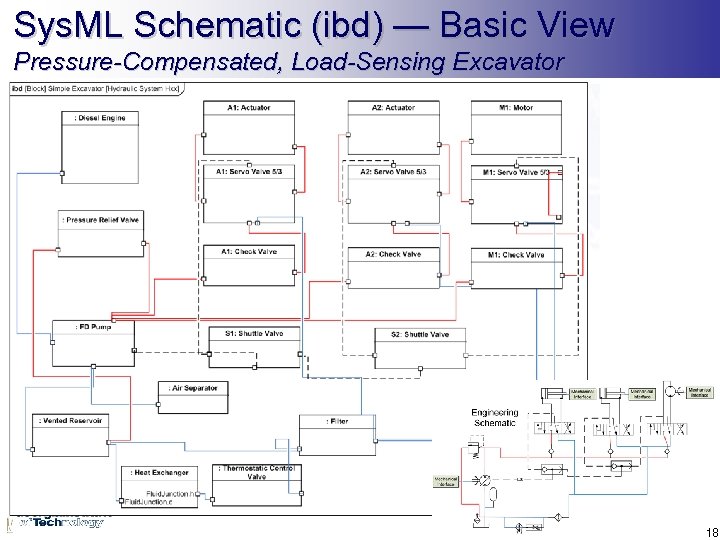 Sys. ML Schematic (ibd) — Basic View Pressure-Compensated, Load-Sensing Excavator 18
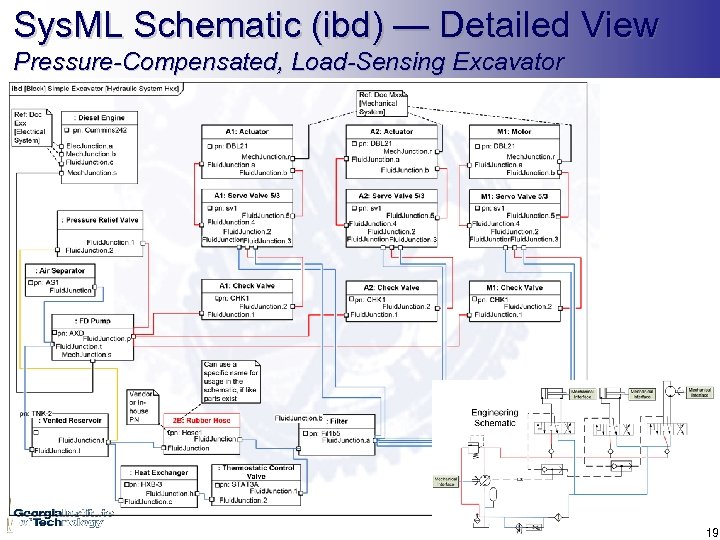 Sys. ML Schematic (ibd) — Detailed View Pressure-Compensated, Load-Sensing Excavator 19
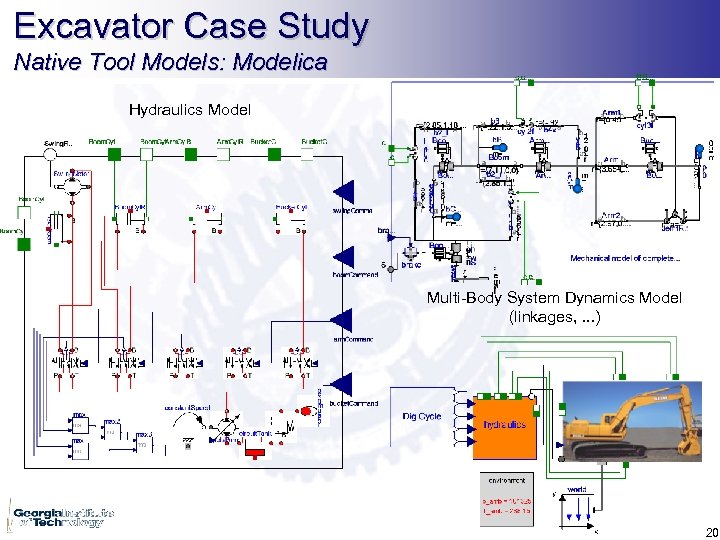 Excavator Case Study Native Tool Models: Modelica Hydraulics Model Multi-Body System Dynamics Model (linkages, . . . ) 20
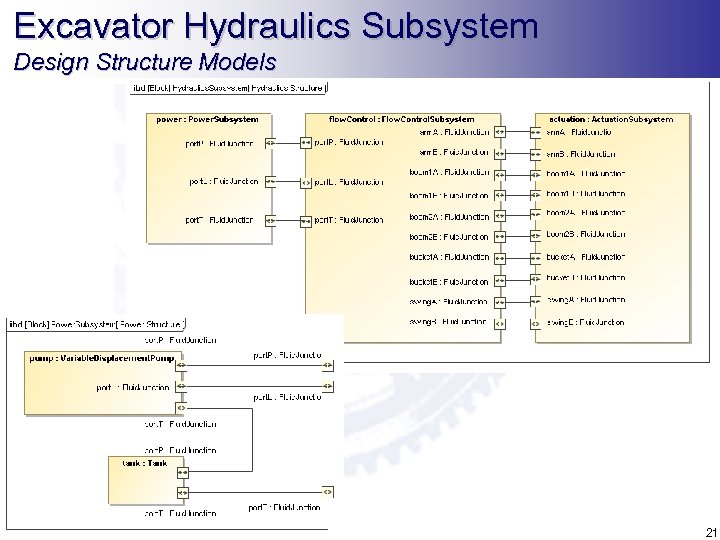 Excavator Hydraulics Subsystem Design Structure Models 21
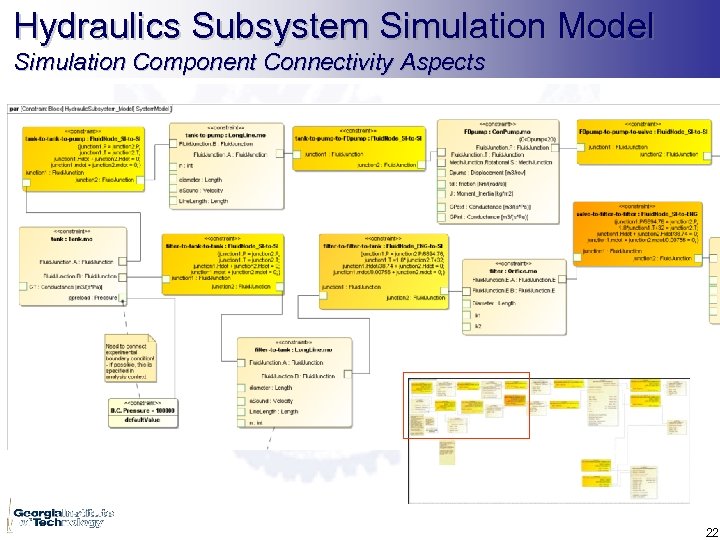 Hydraulics Subsystem Simulation Model Simulation Component Connectivity Aspects 22
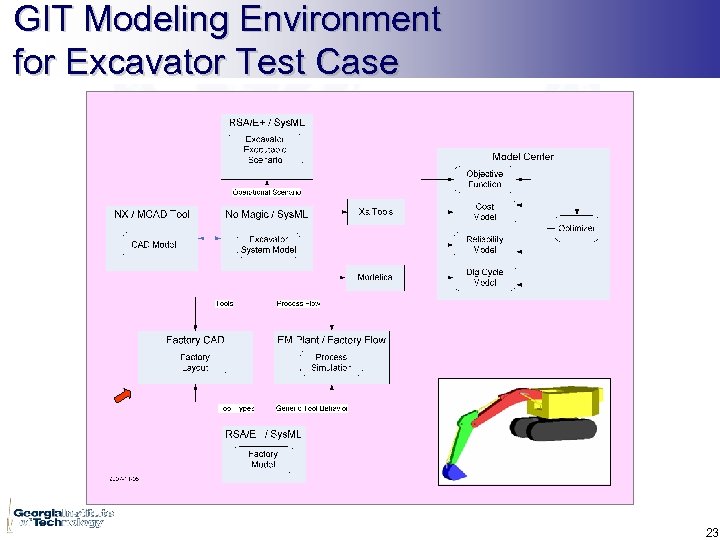 GIT Modeling Environment for Excavator Test Case 23
![Factory/Mfg Modeling & Simulation Using Sys. ML [Mc. Ginnis et al. 2007] Sys. ML](https://present5.com/presentation/e5912d18d9d5b62731062541c0244b6e/image-24.jpg "Factory/Mfg Modeling & Simulation Using Sys. ML [Mc. Ginnis et al. 2007] Sys. ML") Factory/Mfg Modeling & Simulation Using Sys. ML [Mc. Ginnis et al. 2007] Sys. ML State Diagram Sys. ML Sequence Diagram XML Parser Discrete Event Simulation 24
Factory/Mfg Modeling & Simulation Using Sys. ML [Mc. Ginnis et al. 2007] Sys. ML State Diagram Sys. ML Sequence Diagram XML Parser Discrete Event Simulation 24
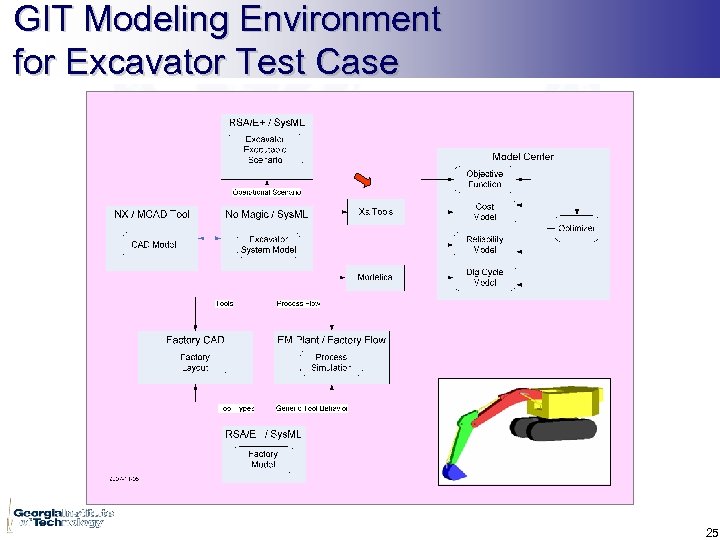 GIT Modeling Environment for Excavator Test Case 25
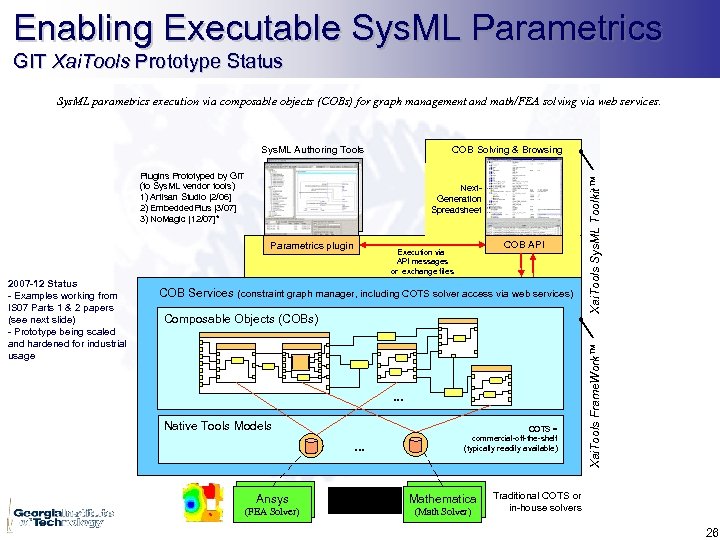 Enabling Executable Sys. ML Parametrics GIT Xai. Tools Prototype Status Sys. ML parametrics execution via composable objects (COBs) for graph management and math/FEA solving via web services. Plugins Prototyped by GIT (to Sys. ML vendor tools) 1) Artisan Studio [2/06] 2) Embedded. Plus [3/07] 3) No. Magic [12/07]* Next. Generation Spreadsheet Parametrics plugin 2007 -12 Status - Examples working from IS 07 Parts 1 & 2 papers (see next slide) - Prototype being scaled and hardened for industrial usage COB API Execution via API messages or exchange files COB Services (constraint graph manager, including COTS solver access via web services) Composable Objects (COBs) . . . Native Tools Models . . . Ansys (FEA Solver) . . . COTS = commercial-off-the-shelf (typically readily available) Mathematica (Math Solver) Xai. Tools Sys. ML Toolkit™ COB Solving & Browsing Xai. Tools Frame. Work™ Sys. ML Authoring Tools Traditional COTS or in-house solvers 26
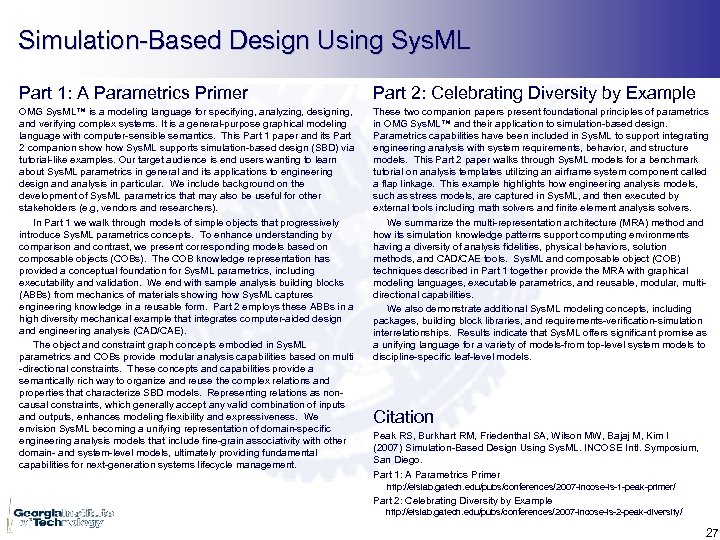 Simulation-Based Design Using Sys. ML Part 1: A Parametrics Primer Part 2: Celebrating Diversity by Example OMG Sys. ML™ is a modeling language for specifying, analyzing, designing, and verifying complex systems. It is a general-purpose graphical modeling language with computer-sensible semantics. This Part 1 paper and its Part 2 companion show Sys. ML supports simulation-based design (SBD) via tutorial-like examples. Our target audience is end users wanting to learn about Sys. ML parametrics in general and its applications to engineering design and analysis in particular. We include background on the development of Sys. ML parametrics that may also be useful for other stakeholders (e. g, vendors and researchers). In Part 1 we walk through models of simple objects that progressively introduce Sys. ML parametrics concepts. To enhance understanding by comparison and contrast, we present corresponding models based on composable objects (COBs). The COB knowledge representation has provided a conceptual foundation for Sys. ML parametrics, including executability and validation. We end with sample analysis building blocks (ABBs) from mechanics of materials showing how Sys. ML captures engineering knowledge in a reusable form. Part 2 employs these ABBs in a high diversity mechanical example that integrates computer-aided design and engineering analysis (CAD/CAE). The object and constraint graph concepts embodied in Sys. ML parametrics and COBs provide modular analysis capabilities based on multi -directional constraints. These concepts and capabilities provide a semantically rich way to organize and reuse the complex relations and properties that characterize SBD models. Representing relations as noncausal constraints, which generally accept any valid combination of inputs and outputs, enhances modeling flexibility and expressiveness. We envision Sys. ML becoming a unifying representation of domain-specific engineering analysis models that include fine-grain associativity with other domain- and system-level models, ultimately providing fundamental capabilities for next-generation systems lifecycle management. These two companion papers present foundational principles of parametrics in OMG Sys. ML™ and their application to simulation-based design. Parametrics capabilities have been included in Sys. ML to support integrating engineering analysis with system requirements, behavior, and structure models. This Part 2 paper walks through Sys. ML models for a benchmark tutorial on analysis templates utilizing an airframe system component called a flap linkage. This example highlights how engineering analysis models, such as stress models, are captured in Sys. ML, and then executed by external tools including math solvers and finite element analysis solvers. We summarize the multi-representation architecture (MRA) method and how its simulation knowledge patterns support computing environments having a diversity of analysis fidelities, physical behaviors, solution methods, and CAD/CAE tools. Sys. ML and composable object (COB) techniques described in Part 1 together provide the MRA with graphical modeling languages, executable parametrics, and reusable, modular, multidirectional capabilities. We also demonstrate additional Sys. ML modeling concepts, including packages, building block libraries, and requirements-verification-simulation interrelationships. Results indicate that Sys. ML offers significant promise as a unifying language for a variety of models-from top-level system models to discipline-specific leaf-level models. Citation Peak RS, Burkhart RM, Friedenthal SA, Wilson MW, Bajaj M, Kim I (2007) Simulation-Based Design Using Sys. ML. INCOSE Intl. Symposium, San Diego. Part 1: A Parametrics Primer http: //eislab. gatech. edu/pubs/conferences/2007 -incose-is-1 -peak-primer/ Part 2: Celebrating Diversity by Example http: //eislab. gatech. edu/pubs/conferences/2007 -incose-is-2 -peak-diversity/ 27
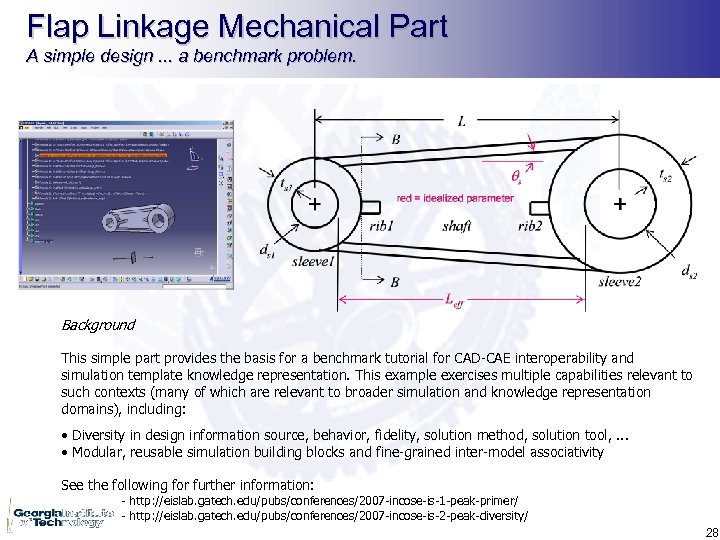 Flap Linkage Mechanical Part A simple design. . . a benchmark problem. Background This simple part provides the basis for a benchmark tutorial for CAD-CAE interoperability and simulation template knowledge representation. This example exercises multiple capabilities relevant to such contexts (many of which are relevant to broader simulation and knowledge representation domains), including: • Diversity in design information source, behavior, fidelity, solution method, solution tool, . . . • Modular, reusable simulation building blocks and fine-grained inter-model associativity See the following for further information: - http: //eislab. gatech. edu/pubs/conferences/2007 -incose-is-1 -peak-primer/ - http: //eislab. gatech. edu/pubs/conferences/2007 -incose-is-2 -peak-diversity/ 28
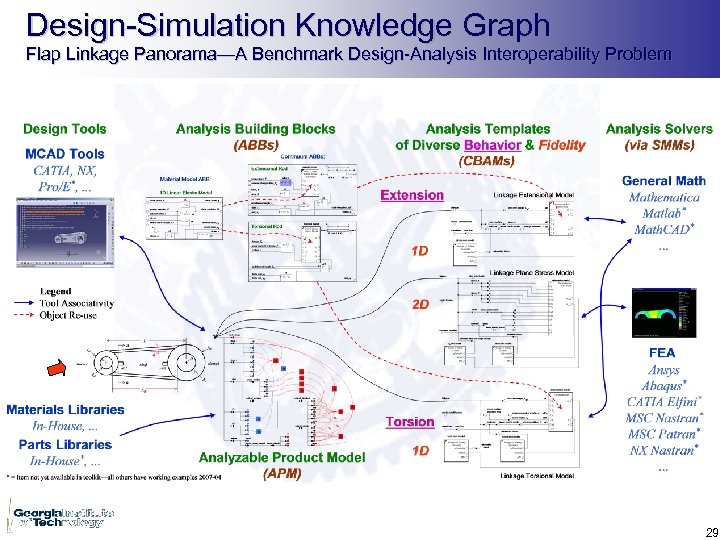 Design-Simulation Knowledge Graph Flap Linkage Panorama—A Benchmark Design-Analysis Interoperability Problem 29
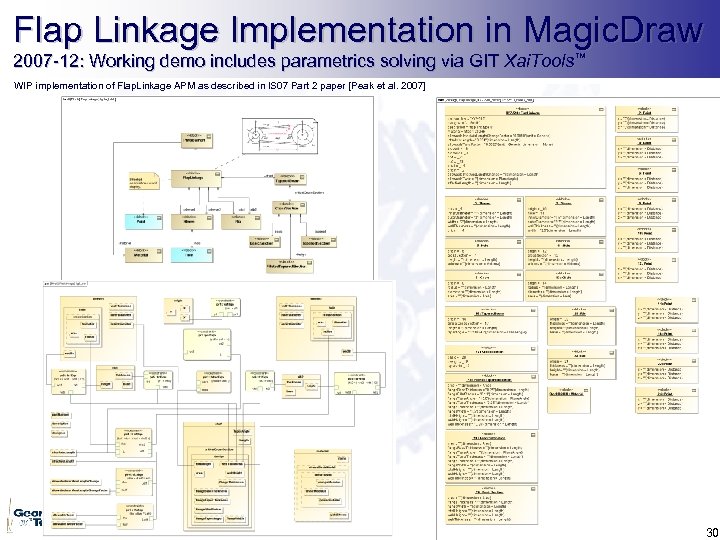 Flap Linkage Implementation in Magic. Draw 2007 -12: Working demo includes parametrics solving via GIT Xai. Tools™ WIP implementation of Flap. Linkage APM as described in IS 07 Part 2 paper [Peak et al. 2007] 30
 Sys. ML-Related Efforts at Georgia Tech • Sys. ML Focus Area web page – http: //www. pslm. gatech. edu/topics/sysml/ – Includes links to publications, applications, projects, examples, etc. • Selected projects – – – Deere: System dynamics (fluid power, . . . ) Lockheed: System design & analysis integration NASA: Enabling technology (Sys. ML, . . . ) NIST: Design-analysis interoperability (DAI) TRW Automotive: DAI/FEA (steering wheel systems. . . ) 31
 Composable Objects (COB) Requirements & Objectives Abstract This document formulates a vision for advanced collaborative engineering environments (CEEs) to aid in the design, simulation and configuration management of complex engineering systems. Based on inputs from experienced Systems Engineers and technologists from various industries and government agencies, it identifies the current major challenges and pain points of Collaborative Engineering. Each of these challenges and pain points are mapped into desired capabilities of an envisioned CEE System that will address them. Next, we present a CEE methodology that embodies these capabilities. We overview work done to date by GIT on the composable object (COB) knowledge representation as a basis for next-generation CEE systems. This methodology leverages the multi-representation architecture (MRA) for simulation templates, the user-oriented Sys. ML standard for system modeling, and standards like STEP AP 233 (ISO 10303 -233) for enhanced interoperability. Finally, we present COB representation requirements in the context of this CEE methodology. In this current project and subsequent phases we are striving to fulfill these requirements as we develop next-generation COB capabilities. Citation DR Tamburini, RS Peak, CJ Paredis, et al. (2005) Composable Objects (COB) Requirements & Objectives v 1. 0. Technical Report, Georgia Tech, Atlanta. http: //eislab. gatech. edu/projects/nasa-ngcobs/. Associated Project The Composable Object (COB) Knowledge Representation: Enabling Advanced Collaborative Engineering Environments (CEEs). http: //eislab. gatech. edu/projects/nasa-ngcobs/. 32
 Leveraging Simulation Templates & Processes with Sys. ML Applications to CAD-FEA Interoperability Abstract Sys. ML holds the promise of leveraging generic templates and processes across design and simulation. Russell Peak joins us to give an update on the latest efforts at Georgia Tech to apply this approach in various domains, including specific examples with a top-tier automotive supplier. Learn how you too may join this project and implement a similar effort within your own company to enhance modularity and reusability through a unified method that links diverse models. Russell will also highlight Sys. ML’s parametrics capabilities and usage for physics-based analysis, including integrated CAD-CAE and simulation-based requirements verification. Go to www. omgsysml. org for background on Sys. ML—a graphical modeling language based on UML 2 for specifying, designing, analyzing, and verifying complex systems. Speaker Biosketch Russell S. Peak focuses on knowledge representations that enable complex system interoperability and simulation automation. He originated composable objects (COBs), the multi-representation architecture (MRA) for CAD-CAE interoperability, and context-based analysis models (CBAMs)—a simulation template knowledge pattern that explicitly captures design-analysis associativity. This work has provided the conceptual foundation for Sys. ML parametrics and its validation. He teaches this and related material, and is principal investigator on numerous research projects with sponsors including Boeing, Do. D, IBM, NASA, NIST, Rockwell Collins, Shinko Electric, and TRW Automotive. Dr. Peak joined the GIT research faculty in 1996 to create and lead a design-analysis interoperability thrust area. Prior experience includes business phone design at Bell Laboratories and design-analysis integration exploration as a Visiting Researcher at Hitachi in Japan. Citation RS Peak (2007) Leveraging Simulation Templates & Processes with Sys. ML: Applications to CAD-FEA Interoperability. Developing a Design/Simulation Framework, CPDA Workshop, Atlanta. http: //eislab. gatech. edu/pubs/conferences/2007 -cpda-dsfw-peak/ 33
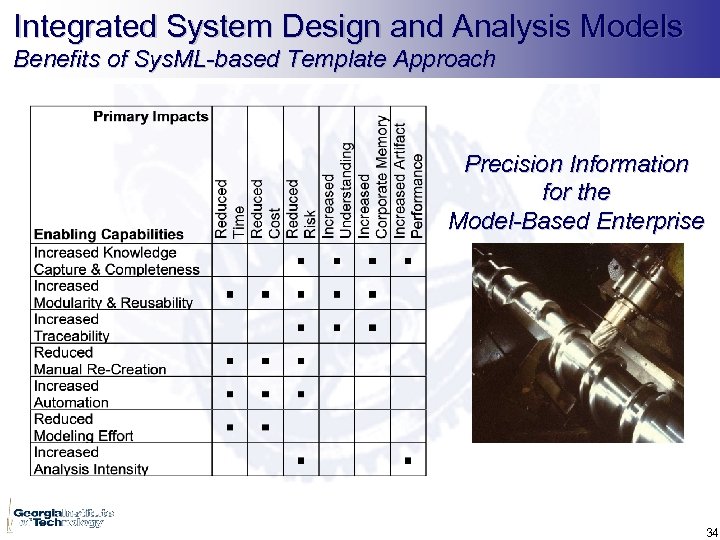 Integrated System Design and Analysis Models Benefits of Sys. ML-based Template Approach Precision Information for the Model-Based Enterprise 34