


 Скачать презентацию Oligopoly Collusion and Antitrust Instructor Zhanar Dessyupova MPA
Week 4_Oligopoly, Collusion and Antitrust.ppt
- Количество слайдов: 33
 Oligopoly, Collusion and Antitrust Instructor: Zhanar Dessyupova, MPA
 Major Topics Oligopoly Defined Oligopoly models Game Theory (Prisoners’ Dilemma) Antitrust Law Cartel Problems Herfindahl Index
 Questions What market structures lie between perfect competition and monopoly, and what are their characteristics? How is monopolistic competition different from oligopoly? Why is it difficult for oligopoly firms to cooperate?
 Oligopoly An oligopoly is an industry with small numbers of sellers. The product may be differentiated among the sellers (e. g. automobiles) or homogeneous (e. g. gasoline). Entry is often limited by legal restrictions (e. g. banking in most of the world).
 How Oligopolies Compete In an oligopoly firms know that there are only a few large competitors; competitors take account of the effects of their actions on the overall market. interdependence among firms Duopoly – only two firms that control the market
 Three Basic Oligopoly Models 1. Competition in quantities: Cournot Model 2. Competition in prices: Bertrand Model 3. Collusive oligopoly It is very useful to know some basic game theory to understand these models as well as other oligopoly models.
 The Equilibrium for an Oligopoly Nash equilibrium: a situation in which economic participants interacting with one another each choose their best strategy given the strategies that all the others have chosen Dominant strategy: a strategy that is best for a player in a game regardless of the strategies chosen by the other players
 Game Theory Game theory: the study of how people behave in strategic situations Strategic decisions are those in which each person, in deciding what actions to take, must consider how others might respond to that action Because the number of firms in an oligopolistic market is small, each firm must act strategically. Each firm knows that its profit depends not only on how much it produces but also on how much the other firms produce
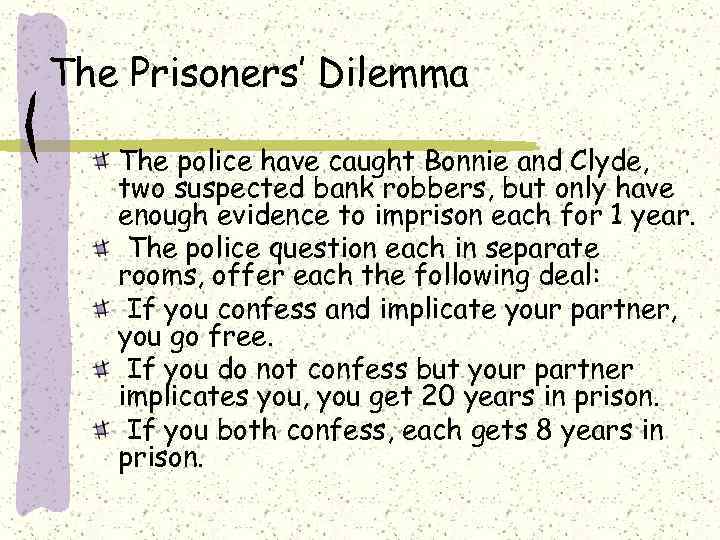 The Prisoners’ Dilemma The police have caught Bonnie and Clyde, two suspected bank robbers, but only have enough evidence to imprison each for 1 year. The police question each in separate rooms, offer each the following deal: If you confess and implicate your partner, you go free. If you do not confess but your partner implicates you, you get 20 years in prison. If you both confess, each gets 8 years in prison.
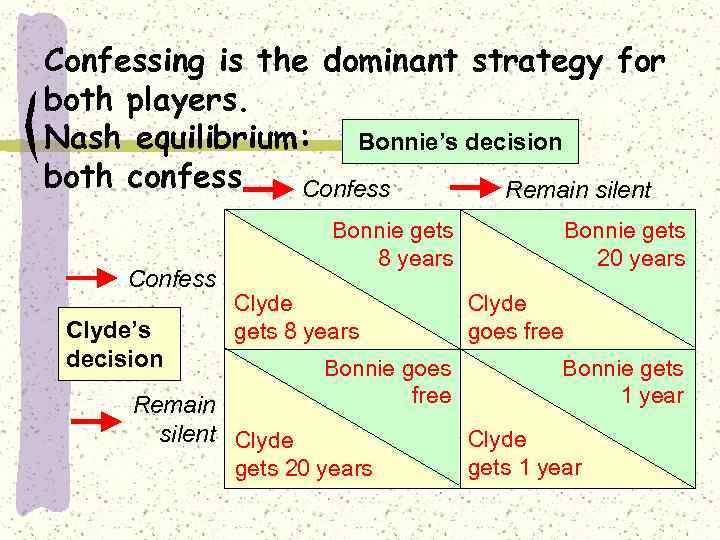 Confessing is the dominant strategy for both players. Nash equilibrium: Bonnie’s decision both confess Confess Remain silent Confess Clyde’s decision Bonnie gets 8 years Clyde gets 8 years Bonnie goes free Remain silent Clyde gets 20 years Bonnie gets 20 years Clyde goes free Bonnie gets 1 year Clyde gets 1 year
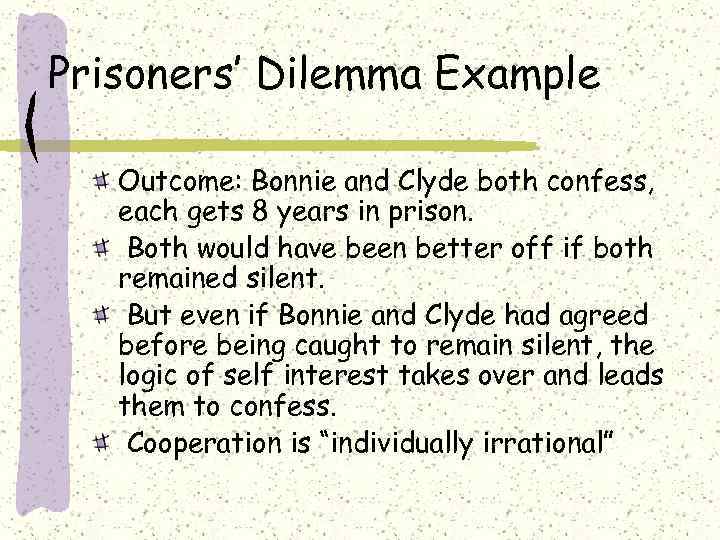 Prisoners’ Dilemma Example Outcome: Bonnie and Clyde both confess, each gets 8 years in prison. Both would have been better off if both remained silent. But even if Bonnie and Clyde had agreed before being caught to remain silent, the logic of self interest takes over and leads them to confess. Cooperation is “individually irrational”
 Cooperation is “individually irrational” Possible application: Society If you believe that people will always have self interest, what happens if you move away from market-based societies to more “cooperative” societies? People will have incentives to cheat and problems will result
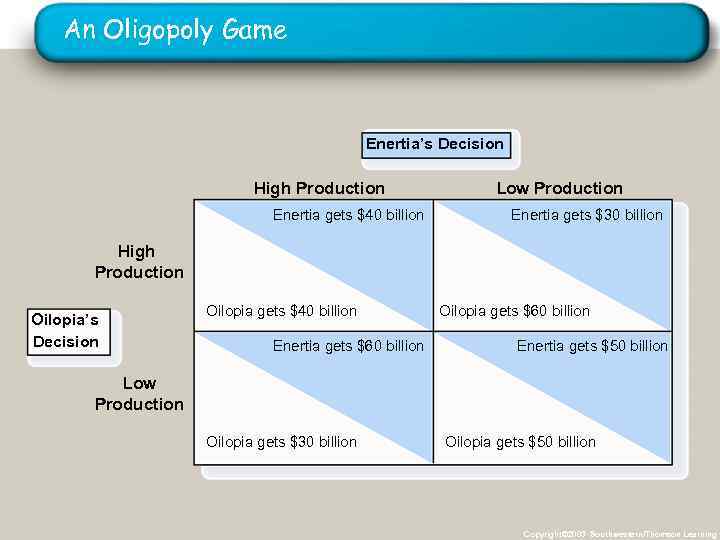 An Oligopoly Game Enertia’s Decision High Production Enertia gets $40 billion Low Production Enertia gets $30 billion High Production Oilopia’s Decision Oilopia gets $40 billion Enertia gets $60 billion Oilopia gets $60 billion Enertia gets $50 billion Low Production Oilopia gets $30 billion Oilopia gets $50 billion Copyright© 2003 Southwestern/Thomson Learning
 Oligopolies as a Prisoners’ Dilemma Again, the dominant strategy for both firms is non-cooperative, i. e. “High Production”. Self-interest makes it difficult for the oligopoly to maintain a cooperative outcome with low production, high prices, and monopoly profits. Other examples of the prisoners’ dilemma can be seen in the arms race of the Cold War, advertising in the beer market, and the exploitation of oil fields.
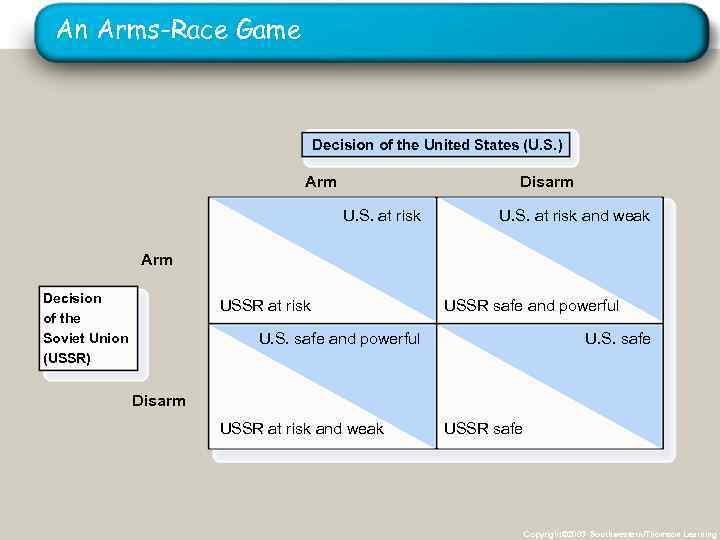 An Arms-Race Game Decision of the United States (U. S. ) Arm Disarm U. S. at risk and weak Arm Decision of the Soviet Union (USSR) USSR at risk USSR safe and powerful U. S. safe Disarm USSR at risk and weak USSR safe Copyright© 2003 Southwestern/Thomson Learning
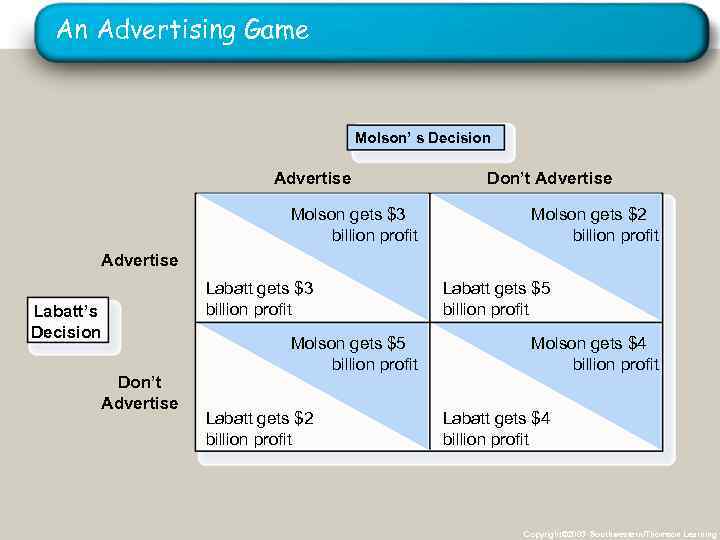 An Advertising Game Molson’ s Decision Advertise Molson gets $3 billion profit Don’t Advertise Molson gets $2 billion profit Advertise Labatt’s Decision Don’t Advertise Labatt gets $3 billion profit Molson gets $5 billion profit Labatt gets $2 billion profit Labatt gets $5 billion profit Molson gets $4 billion profit Labatt gets $4 billion profit Copyright© 2003 Southwestern/Thomson Learning
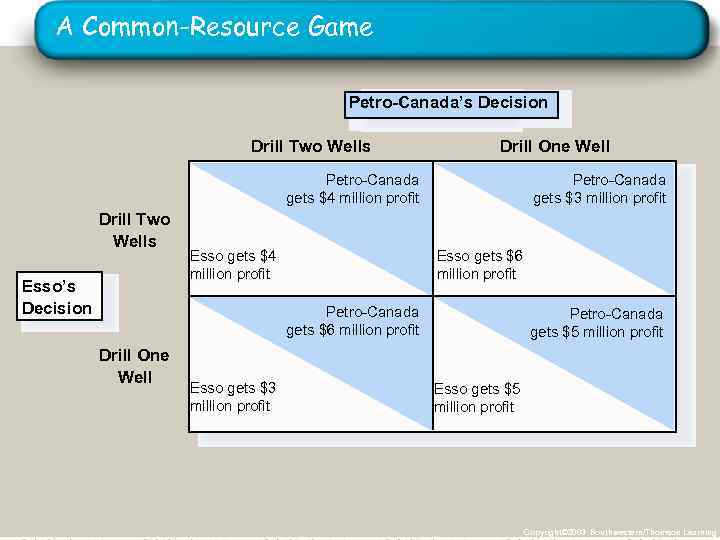 A Common-Resource Game Petro-Canada’s Decision Drill Two Wells Drill One Well Petro-Canada gets $4 million profit Drill Two Wells Esso’s Decision Esso gets $4 million profit Petro-Canada gets $3 million profit Esso gets $6 million profit Petro-Canada gets $6 million profit Drill One Well Esso gets $3 million profit Petro-Canada gets $5 million profit Esso gets $5 million profit Copyright© 2003 Southwestern/Thomson Learning
 Why People Sometimes Cooperate When the game is repeated many times, cooperation may be possible. These strategies may lead to cooperation: If your rival reneges in one round, you renege in all subsequent rounds. “Tit-for-tat” Whatever your rival does in one round (whether renege or cooperate), you do in the following round.
 Cartel Model When oligopolies form a cartel in hopes of reaching the monopoly outcome, they become players in a prisoners’ dilemma Cartel is a group of producers that typically creates a formal written agreement specifying how much each member will produce and charge
 The Cartel Model If oligopolies can limit the entry of other firms and form a cartel, they can increase the profits going to the firms in the cartel
 Cartel problems Miscoordination – difficult to reach agreement on what price to set and how demand should be allocated among cartel members Cheating problem Imperfect monitoring Potential entry
 Public Policy Toward Oligopolies Governments can sometimes improve market outcomes. In oligopolies, production is too low and prices are too high, relative to the social optimum. Role for policymakers: Promote competition, prevent cooperation to move the oligopoly outcome closer to the efficient outcome.
 Restraint of Trade and Antitrust Laws Sherman Antitrust Act (1890): Forbids collusion between competitors Clayton Antitrust Act (1914): Strengthened rights of individuals damaged by anticompetitive arrangements between firms
 Concentration Ratio (CR) CR reveals the percentage of total output produced and sold by an industry’s largest firms. If CR is bigger than 40% oligopolistic industry. Four-Firm Concentration Ratio percentage of total industry sales accounted for by the four largest firms of an industry
 Hertz Avis Example: The four largest firms in the car rental industry account for 94% of all car rentals in the U. S. So, the four-firm concentration ratio for the car rental industry is 94. National Budget
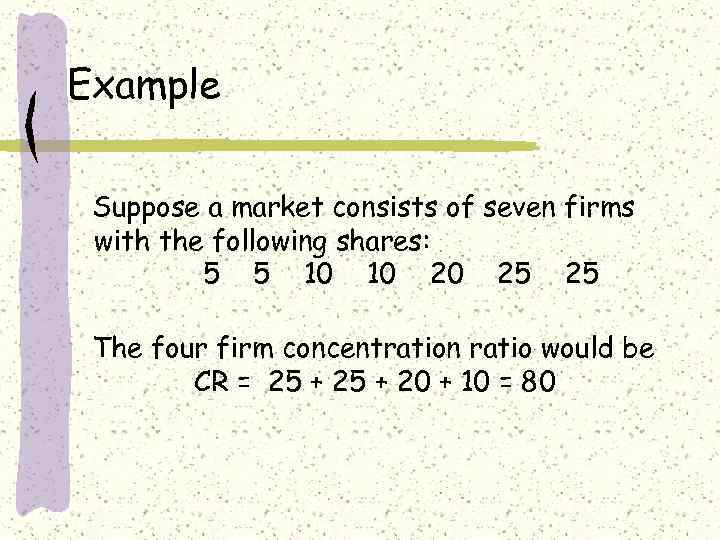 Example Suppose a market consists of seven firms with the following shares: 5 5 10 10 20 25 25 The four firm concentration ratio would be CR = 25 + 20 + 10 = 80
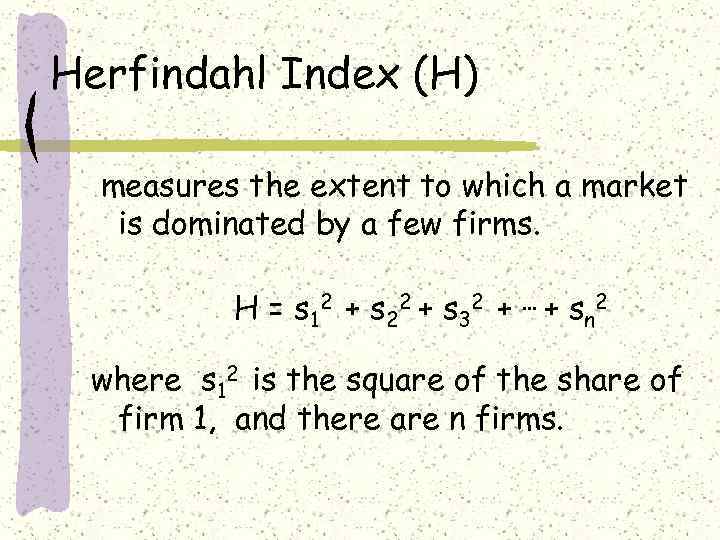 Herfindahl Index (H) measures the extent to which a market is dominated by a few firms. H = s 12 + s 22 + s 32 +. . . + sn 2 where s 12 is the square of the share of firm 1, and there are n firms.
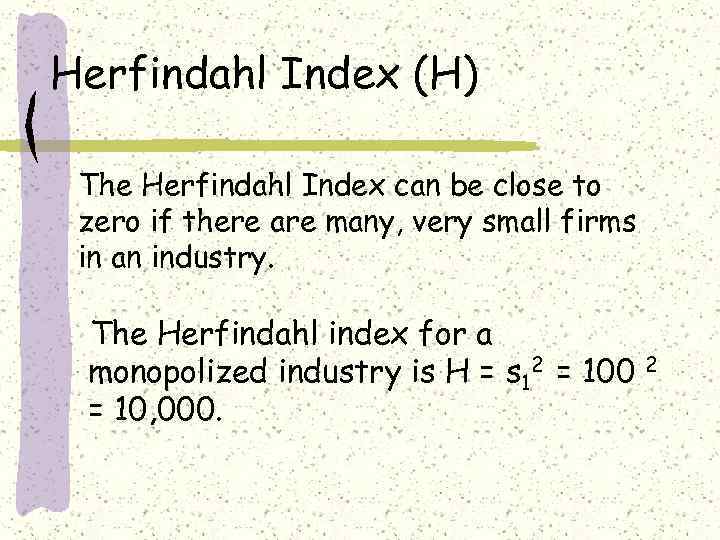 Herfindahl Index (H) The Herfindahl Index can be close to zero if there are many, very small firms in an industry. The Herfindahl index for a monopolized industry is H = s 12 = 100 = 10, 000. 2
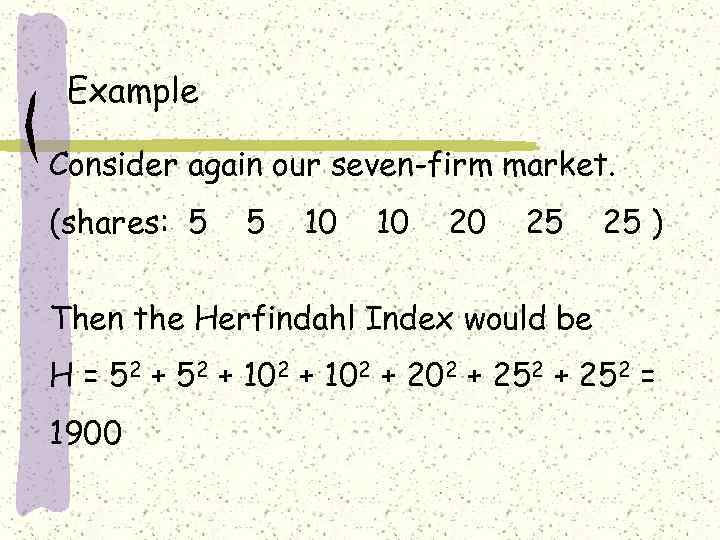 Example Consider again our seven-firm market. (shares: 5 5 10 10 20 25 25 ) Then the Herfindahl Index would be H = 52 + 102 + 202 + 252 = 1900
 Justice Department Guidelines u. A market is considered concentrated if H > 1800. u. A market is considered unconcentrated if H < 1000.
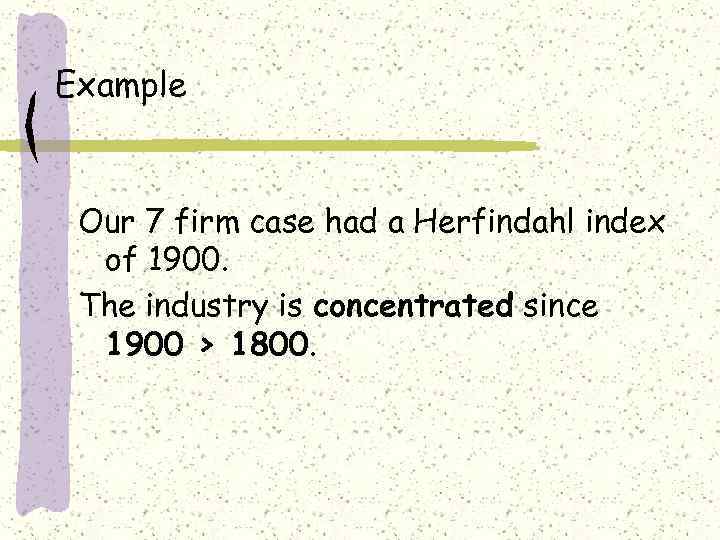 Example Our 7 firm case had a Herfindahl index of 1900. The industry is concentrated since 1900 > 1800.
 Conclusion Oligopolies can end up looking like monopolies or like competitive markets, depending on the number of firms and how cooperative they are. The prisoners’ dilemma shows how difficult it is for firms to maintain cooperation, even when doing so is in their best interest. Policy makers use the antitrust laws to regulate oligopolists’ behavior.
 Thank you for attention!!!!