 Скачать презентацию Old English Verb Ablaut In linguistics ablaut
OE Verb.pptx
- Количество слайдов: 39



Old English Verb
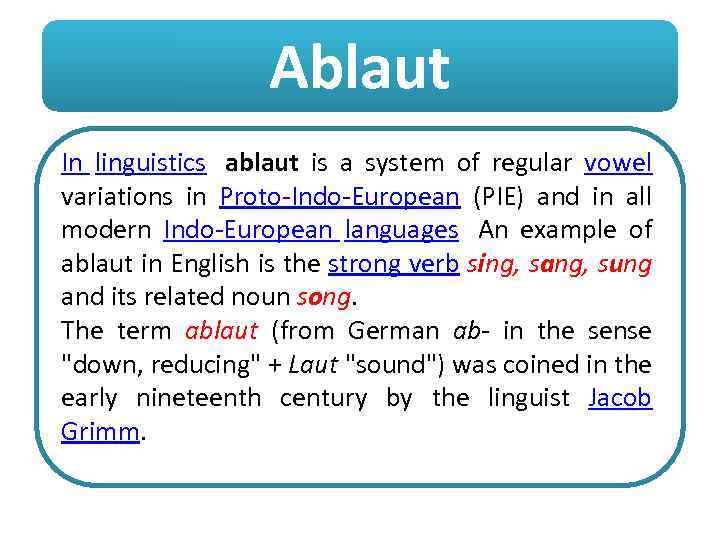
Ablaut In linguistics, ablaut is a system of regular vowel variations in Proto-Indo-European (PIE) and in all modern Indo-European languages. An example of ablaut in English is the strong verb sing, sang, sung and its related noun song. The term ablaut (from German ab- in the sense "down, reducing" + Laut "sound") was coined in the early nineteenth century by the linguist Jacob Grimm. .
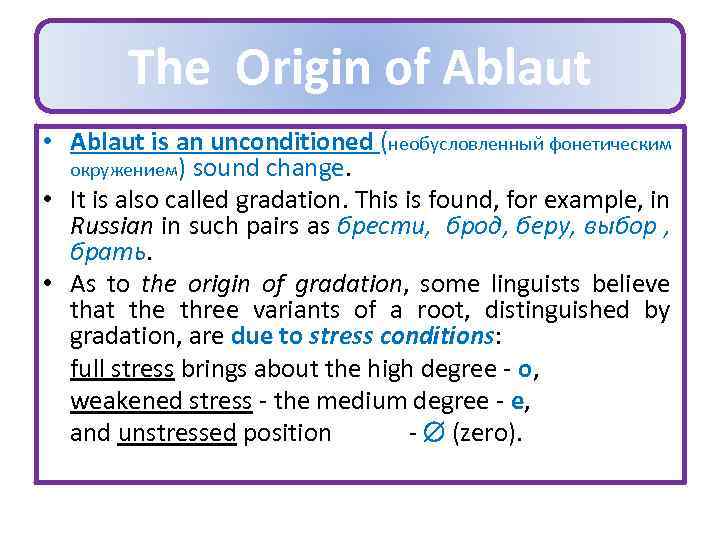
The Origin of Ablaut • Ablaut is an unconditioned (необусловленный фонетическим окружением) sound change. • It is also called gradation. This is found, for example, in Russian in such pairs as брести, брод, беру, выбор , брать. • As to the origin of gradation, some linguists believe that the three variants of a root, distinguished by gradation, are due to stress conditions: full stress brings about the high degree - o, weakened stress - the medium degree - e, and unstressed position - (zero).
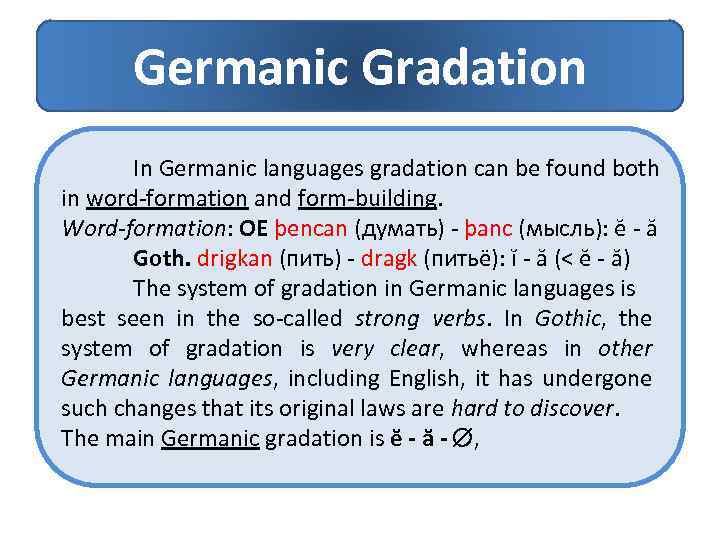
Germanic Gradation In Germanic languages gradation can be found both in word-formation and form-building. Word-formation: OE þencan (думать) - þanc (мысль): ĕ - ă Goth. drigkan (пить) - dragk (питьё): ĭ - ă (< ĕ - ă) The system of gradation in Germanic languages is best seen in the so-called strong verbs. In Gothic, the system of gradation is very clear, whereas in other Germanic languages, including English, it has undergone such changes that its original laws are hard to discover. The main Germanic gradation is ĕ - ă - ,
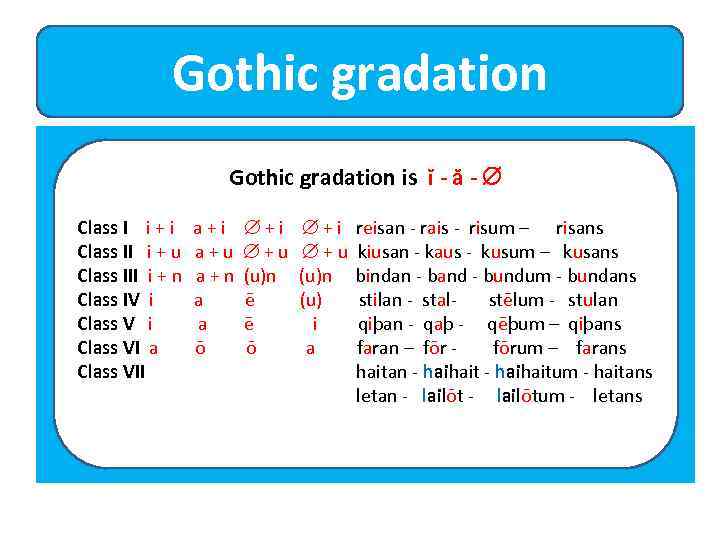
Gothic gradation is ĭ - ă - Class I i + i a + i + i reisan - rais - risum – risans Class II i + u a + u + u kiusan - kaus - kusum – kusans Class III i + n a + n (u)n bindan - band - bundum - bundans Class IV i a ē (u) stilan - stal- stēlum - stulan Class V i a ē i qiþan - qaþ - qēþum – qiþans Class VI a ō a faran – fōr - fōrum – farans Class VII haitan - haihaitum - haitans letan - lailōt - lailōtum - letans
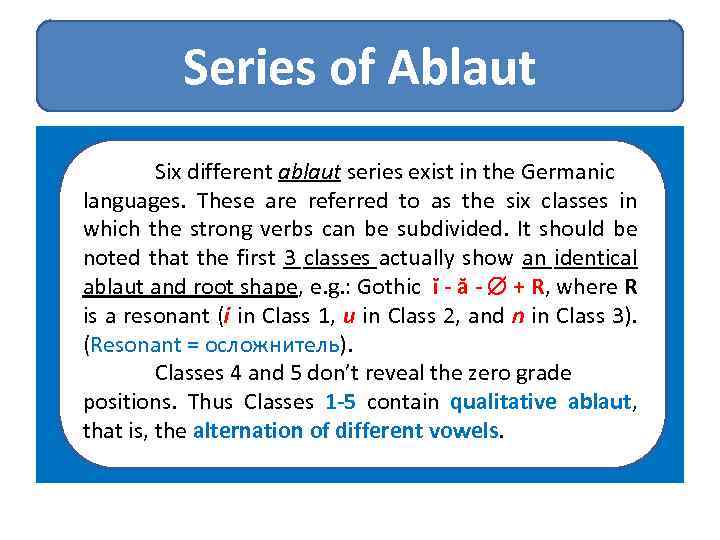
Series of Ablaut Six different ablaut series exist in the Germanic languages. These are referred to as the six classes in which the strong verbs can be subdivided. It should be noted that the first 3 classes actually show an identical ablaut and root shape, e. g. : Gothic ĭ - ă - + R, where R is a resonant (i in Class 1, u in Class 2, and n in Class 3). (Resonant = осложнитель). Classes 4 and 5 don’t reveal the zero grade positions. Thus Classes 1 -5 contain qualitative ablaut, that is, the alternation of different vowels.
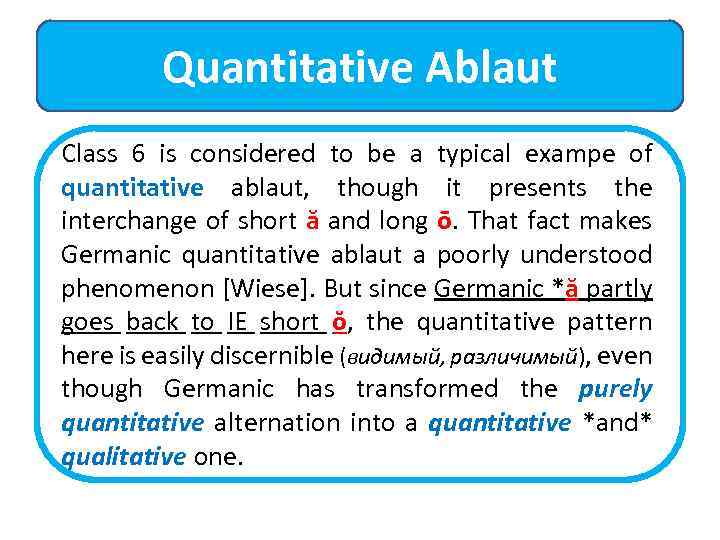
Quantitative Ablaut Class 6 is considered to be a typical exampe of quantitative ablaut, though it presents the interchange of short ă and long ō. That fact makes Germanic quantitative ablaut a poorly understood phenomenon [Wiese]. But since Germanic *ă partly goes back to IE short ŏ, the quantitative pattern here is easily discernible (видимый, различимый), even though Germanic has transformed the purely quantitative alternation into a quantitative *and* qualitative one.
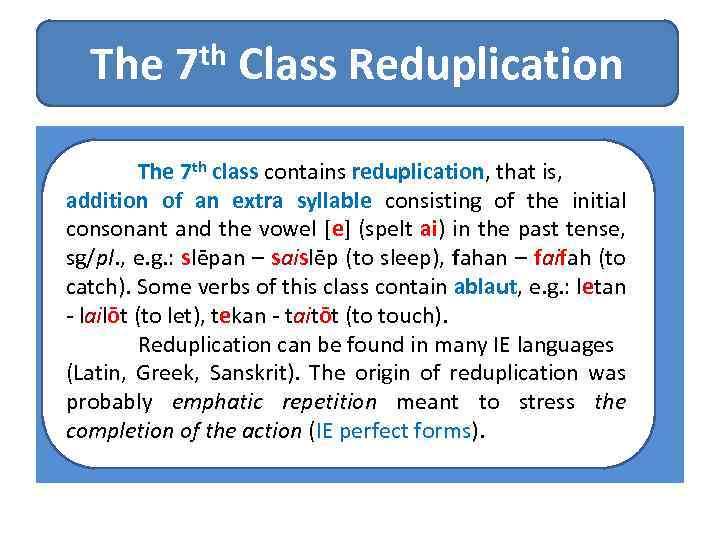
The 7 th Class Reduplication The 7 th class contains reduplication, that is, addition of an extra syllable consisting of the initial consonant and the vowel [e] (spelt ai) in the past tense, sg/pl. , e. g. : slēpan – saislēp (to sleep), fahan – faifah (to catch). Some verbs of this class contain ablaut, e. g. : letan - lailōt (to let), tekan - taitōt (to touch). Reduplication can be found in many IE languages (Latin, Greek, Sanskrit). The origin of reduplication was probably emphatic repetition meant to stress the completion of the action (IE perfect forms).
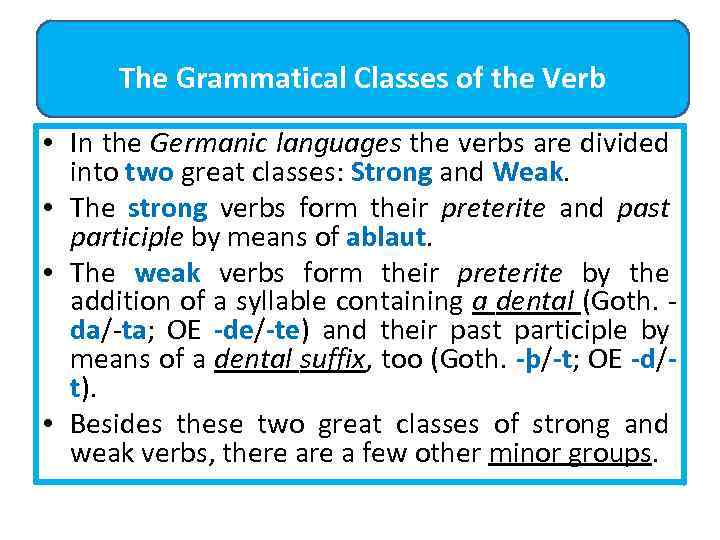
The Grammatical Classes of the Verb • In the Germanic languages the verbs are divided into two great classes: Strong and Weak. • The strong verbs form their preterite and past participle by means of ablaut. • The weak verbs form their preterite by the addition of a syllable containing a dental (Goth. da/-ta; OE -de/-te) and their past participle by means of a dental suffix, too (Goth. -þ/-t; OE -d/t). • Besides these two great classes of strong and weak verbs, there a few other minor groups.
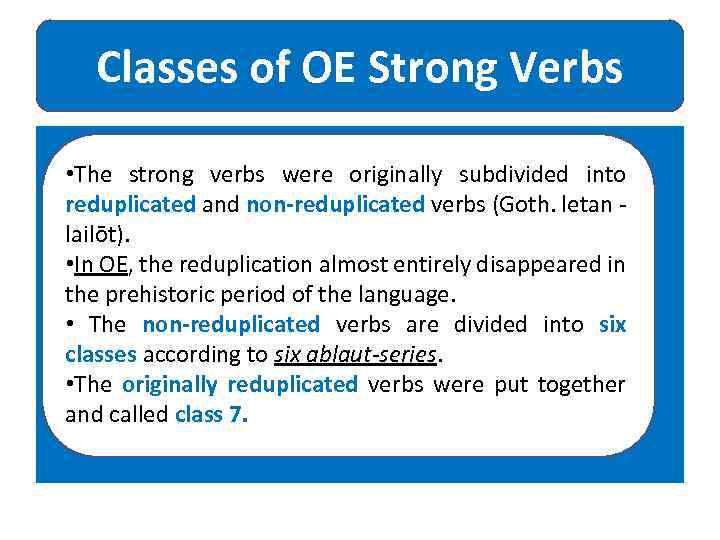
Classes of OE Strong Verbs • The strong verbs were originally subdivided into reduplicated and non-reduplicated verbs (Goth. letan - lailōt). • In OE, the reduplication almost entirely disappeared in the prehistoric period of the language. • The non-reduplicated verbs are divided into six classes according to six ablaut-series. • The originally reduplicated verbs were put together and called class 7.
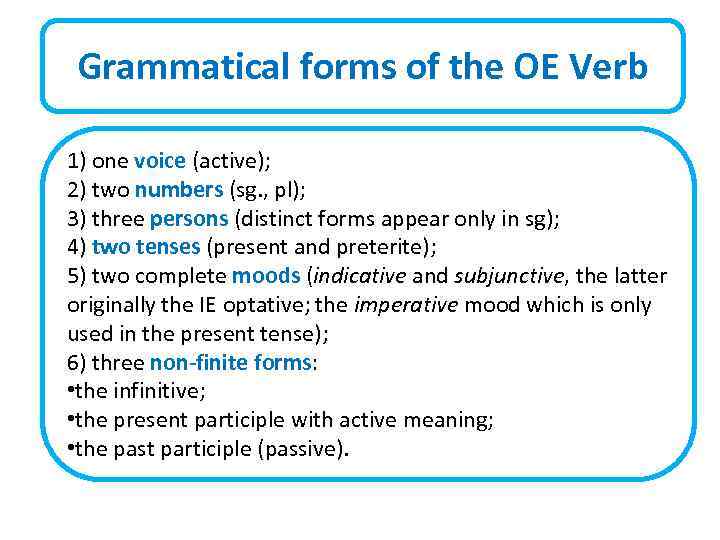
Grammatical forms of the OE Verb 1) one voice (active); 2) two numbers (sg. , pl); 3) three persons (distinct forms appear only in sg); 4) two tenses (present and preterite); 5) two complete moods (indicative and subjunctive, the latter originally the IE optative; the imperative mood which is only used in the present tense); 6) three non-finite forms: • the infinitive; • the present participle with active meaning; • the past participle (passive).
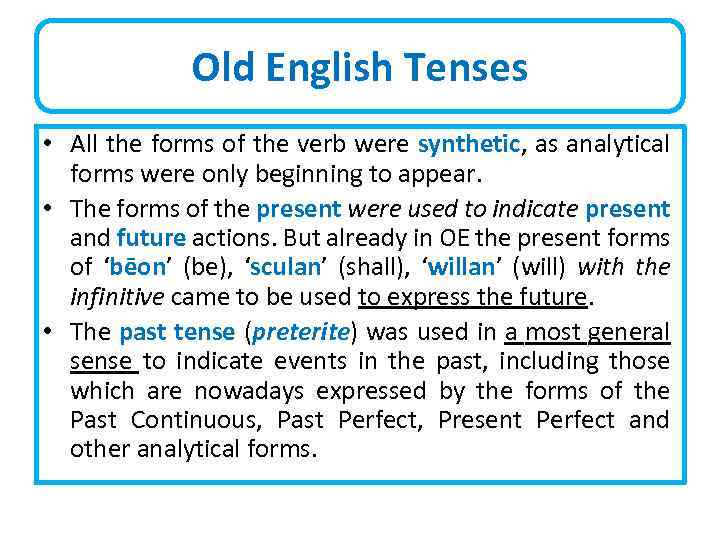
Old English Tenses • All the forms of the verb were synthetic, as analytical forms were only beginning to appear. • The forms of the present were used to indicate present and future actions. But already in OE the present forms of ‘bēon’ (be), ‘sculan’ (shall), ‘willan’ (will) with the infinitive came to be used to express the future. • The past tense (preterite) was used in a most general sense to indicate events in the past, including those which are nowadays expressed by the forms of the Past Continuous, Past Perfect, Present Perfect and other analytical forms.
Grammatical Categories of the Verb . , Grammatical categories of the verb are number, person, mood (indicative, subjunctive, imperative), tense. In addition to those categories we must mention two debatable categories: aspect and voice.
Forerunners of modern continuous and perfect forms In OE, there word combinations, including ‘habban’, ‘bēon’, ‘weorþan’ (have, become) + the past or present participle. The combinations with the present participle were used to describe a prolonged state or action; the combinations with the past participle indicated a state resulting from previous completed action (the forerunners of modern continuous and perfect forms). These combinations did not form regular oppositions with the simple forms of the verb, so some linguists say they cannot be treated as members of grammatical categories.
Category of Voice • The category of voice in OE is another debatable problem. The only trace of the old synthetic passive forms in OE is ‘hātte’ (sg); ‘hātton (pl)’ (is/was called, are/were called). Otherwise the passive voice was expressed by the forms of ‘bēon’; ‘wesan’ (to be), occasionally also ‘weorþan’ (to become), and the past participle. • During the OE period these constructions were gradually transformed into the analytical forms of the passive voice.
OE Strong Verbs Strong verbs form their preterite tense (and past participle) by means of a change of the root vowel, inherited from Proto-Indo-European, which is called vowel-gradation or ablaut. Since however there are often two different vowels in the preterite (‘ic healp’ ‘I helped’ and ‘wē hulpon’ ‘we helped’), with strong verbs it is necessary to distinguish four (instead of three as it is with the weak verbs) principal forms: • the Infinitive, or Present Indicative, Ist person, sg. • the Preterite Indicative 1 st (or 3 rd) Singular, • the Preterite Indicative Plural, • the Past Participle.
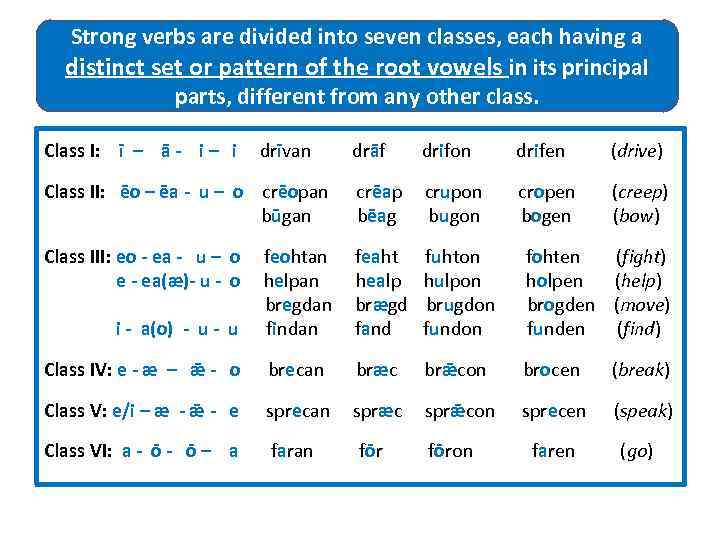
Strong verbs are divided into seven classes, each having a distinct set or pattern of the root vowels in its principal parts, different from any other class. Class I: ī – ā - i – i drīvan drāf drifon drifen (drive) Class II: ēo – ēa - u – o crēopan crēap crupon cropen (creep) būgan bēag bugon bogen (bow) Class III: eo - ea - u – o feohtan feaht fuhton fohten (fight) e - ea(æ)- u - o helpan healp hulpon holpen (help) bregdan brægd brugdon brogden (move) i - a(o) - u findan fand fundon funden (find) Class IV: e - æ – ǣ - o brecan bræc brǣcon brocen (break) Class V: e/i – æ - ǣ - e sprecan spræc sprǣcon sprecen (speak) Class VI: a - ō - ō – a faran fōron faren (go)
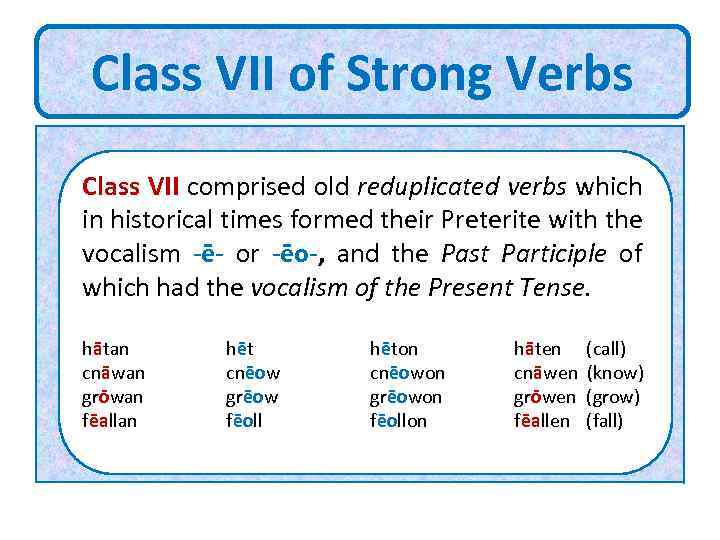
Class VII of Strong Verbs Class VII comprised old reduplicated verbs which in historical times formed their Preterite with the vocalism -ē- or -ēo-, and the Past Participle of which had the vocalism of the Present Tense. hātan cnāwan grōwan fēallan hēt cnēow grēow fēoll hēton cnēowon grēowon fēollon hāten (call) cnāwen (know) grōwen (grow) fēallen (fall)
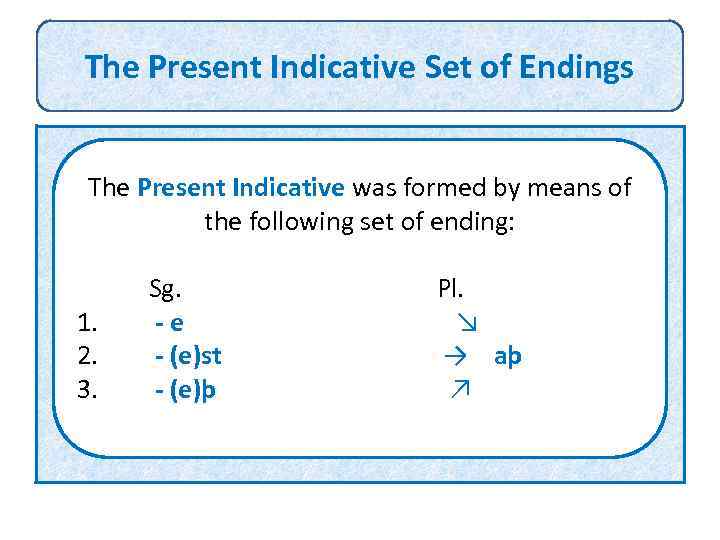
The Present Indicative Set of Endings The Present Indicative was formed by means of the following set of ending: 1. 2. 3. Sg. - e - (e)st - (e)þ Pl. ↘ → aþ ↗
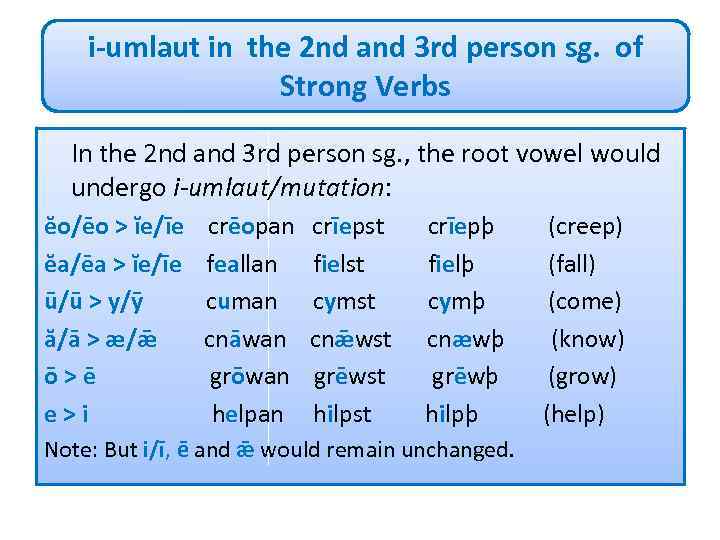
i-umlaut in the 2 nd and 3 rd person sg. of Strong Verbs In the 2 nd and 3 rd person sg. , the root vowel would undergo i-umlaut/mutation: ĕo/ēo > ĭe/īe crēopan crīepst crīepþ (creep) ĕa/ēa > ĭe/īe feallan fielst fielþ (fall) ū/ū > y/ӯ cuman cymst cymþ (come) ă/ā > æ/ǣ cnāwan cnǣwst cnæwþ (know) ō > ē grōwan grēwst grēwþ (grow) e > i helpan hilpst hilpþ (help) Note: But i/ī, ē and ǣ would remain unchanged.
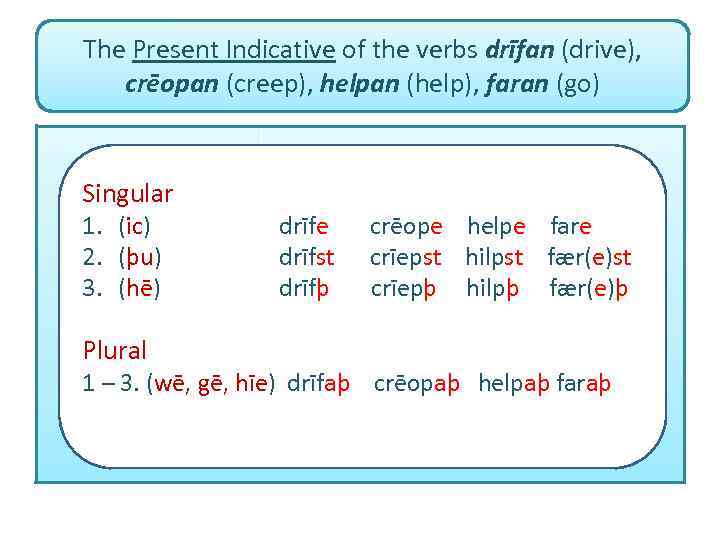
The Present Indicative of the verbs drīfan (drive), crēopan (creep), helpan (help), faran (go) Singular 1. (ic) 2. (þu) 3. (hē) Plural drīfe crēope helpe fare drīfst crīepst hilpst fær(e)st drīfþ crīepþ hilpþ fær(e)þ 1 – 3. (wē, gē, hīe) drīfaþ crēopaþ helpaþ fare
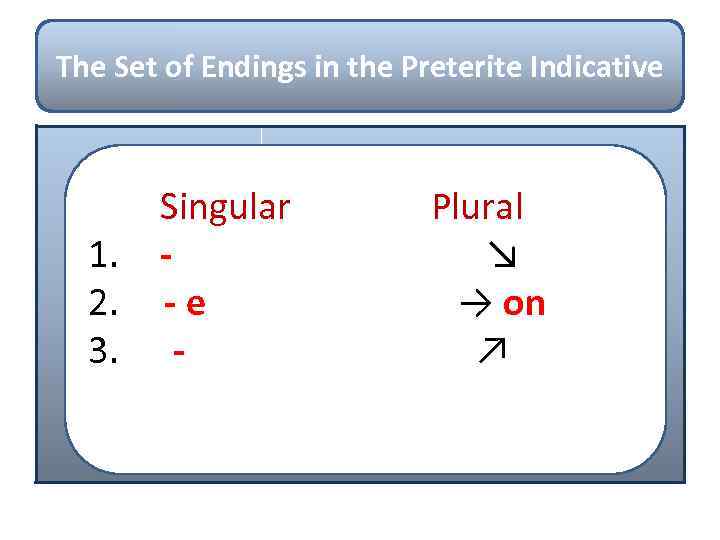
The Set of Endings in the Preterite Indicative Singular Plural 1. - ↘ 2. - e → on 3. - ↗
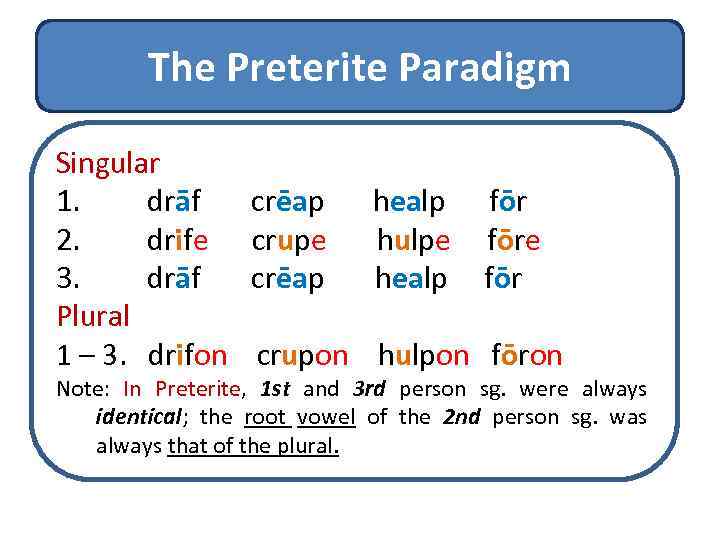
The Preterite Paradigm Singular 1. drāf crēap healp fōr 2. drife crupe hulpe fōre 3. drāf crēap healp fōr Plural 1 – 3. drifon crupon hulpon fōron Note: In Preterite, 1 st and 3 rd person sg. were always identical; the root vowel of the 2 nd person sg. was always that of the plural.
Weak Verbs The group of weak verbs was more numerous than that of strong verbs. Their number was constantly growing since all new verbs derived from other stems were conjugated weak. Among weak verbs there were many derivatives of OE nouns and adjective stems [Rastorgueva, 2001].
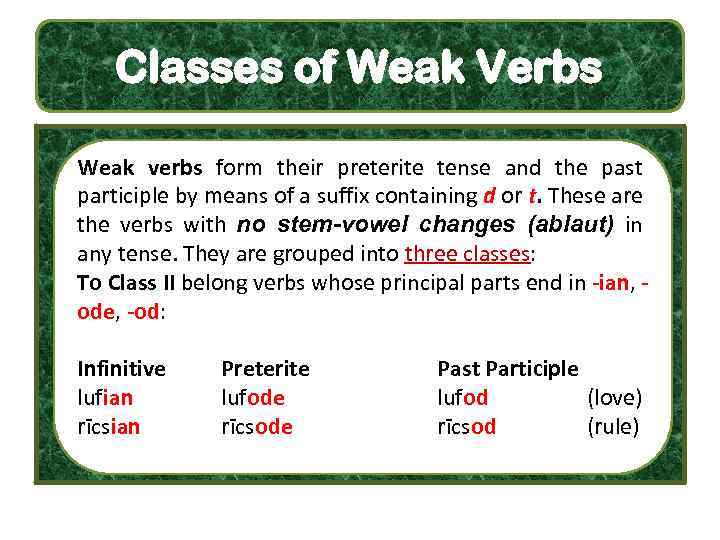
Classes of Weak Verbs Weak verbs form their preterite tense and the past participle by means of a suffix containing d or t. These are the verbs with no stem-vowel changes (ablaut) in any tense. They are grouped into three classes: To Class II belong verbs whose principal parts end in -ian, ode, -od: Infinitive lufian rīcsian Preterite lufode rīcsode Past Participle lufod (love) rīcsod (rule)
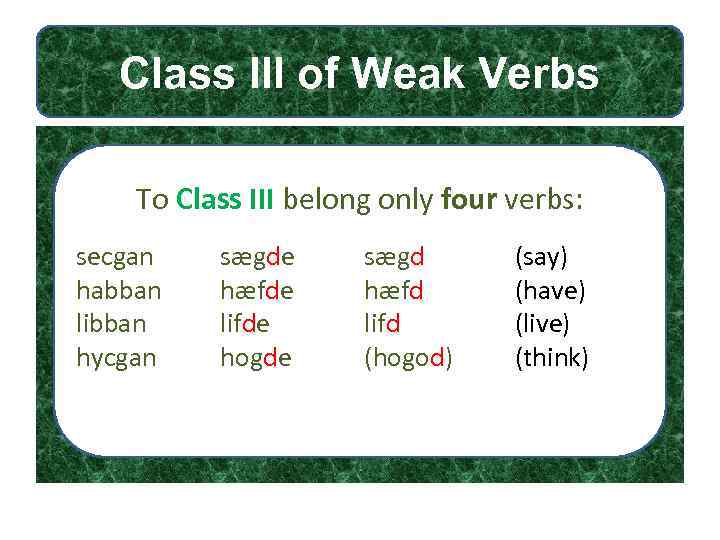
Class III of Weak Verbs To Class III belong only four verbs: secgan habban libban hycgan sægde hæfde lifde hogde sægd hæfd lifd (hogod) (say) (have) (live) (think)
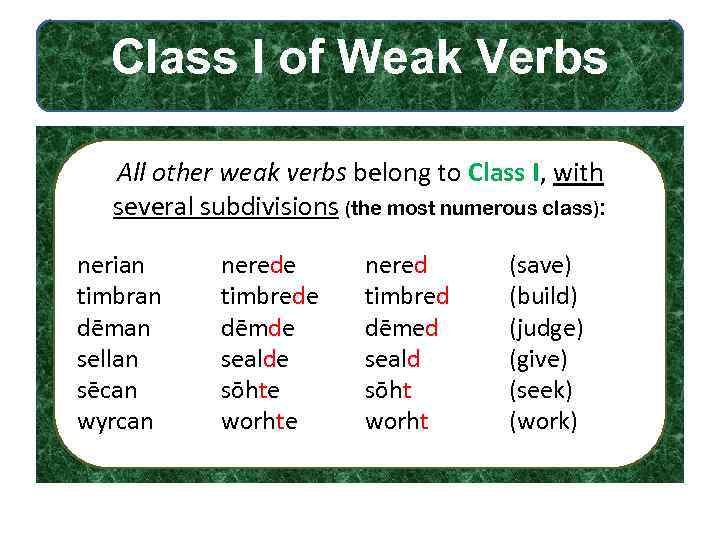
Class I of Weak Verbs All other weak verbs belong to Class I, with several subdivisions (the most numerous class): nerian timbran dēman sellan sēcan wyrcan nerede timbrede dēmde sealde sōhte worhte nered timbred dēmed seald sōht worht (save) (build) (judge) (give) (seek) (work)
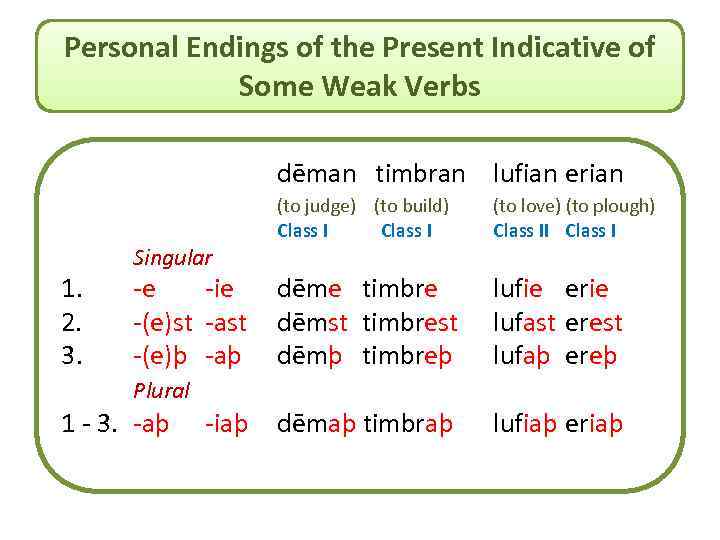
Personal Endings of the Present Indicative of Some Weak Verbs dēman timbran lufian erian (to judge) (to build) Class I (to love) (to plough) Class II Class I dēme timbre dēmst timbrest dēmþ timbreþ lufie erie lufast erest lufaþ ereþ -iaþ dēmaþ timbraþ lufiaþ eriaþ Singular 1. -e -ie 2. -(e)st -ast 3. -(e)þ -aþ Plural 1 - 3. -aþ
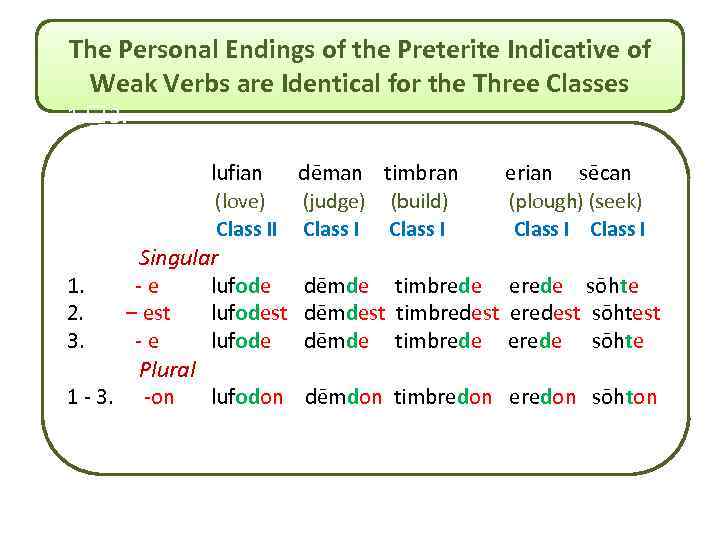
The Personal Endings of the Preterite Indicative of Weak Verbs are Identical for the Three Classes 1 3. -on lufian dēman timbran erian sēcan (love) (judge) (build) (plough) (seek) Class II Class I Singular 1. - e lufode dēmde timbrede erede sōhte 2. – est lufodest dēmdest timbredest eredest sōhtest 3. - e lufode dēmde timbrede erede sōhte Plural 1 - 3. -on lufodon dēmdon timbredon eredon sōhton
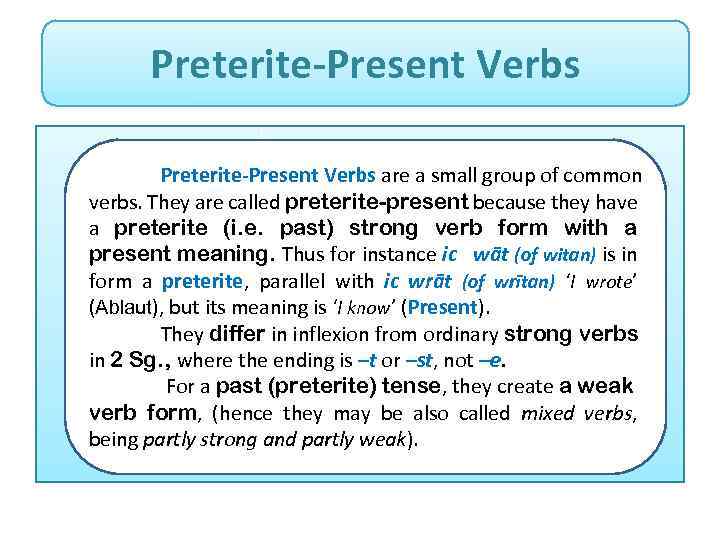
Preterite-Present Verbs are a small group of common verbs. They are called preterite-present because they have a preterite (i. e. past) strong verb form with a present meaning. Thus for instance ic wāt (of witan) is in form a preterite, parallel with ic wrāt (of wrītan) ‘I wrote’ (Ablaut), but its meaning is ‘I know’ (Present). They differ in inflexion from ordinary strong verbs in 2 Sg. , where the ending is –t or –st, not –e. For a past (preterite) tense, they create a weak verb form, (hence they may be also called mixed verbs, being partly strong and partly weak).
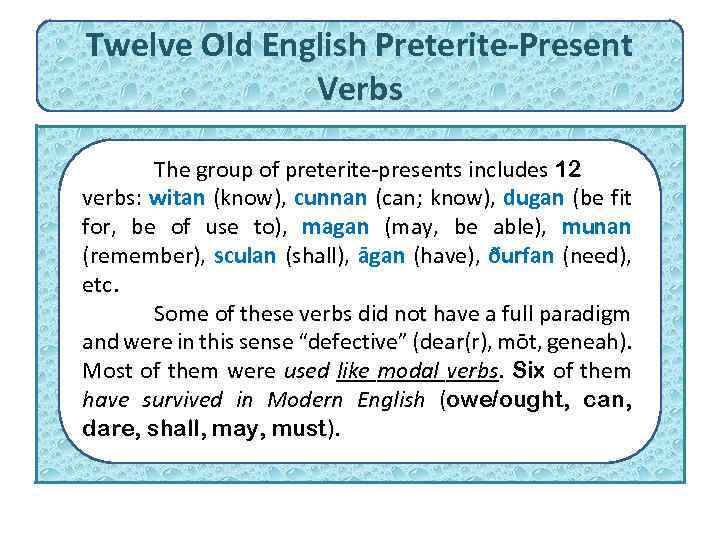
Twelve Old English Preterite-Present Verbs The group of preterite-presents includes 12 verbs: witan (know), cunnan (can; know), dugan (be fit for, be of use to), magan (may, be able), munan (remember), sculan (shall), āgan (have), ðurfan (need), etc. Some of these verbs did not have a full paradigm and were in this sense “defective” (dear(r), mōt, geneah). Most of them were used like modal verbs. Six of them have survived in Modern English (owe/ought, can, dare, shall, may, must).
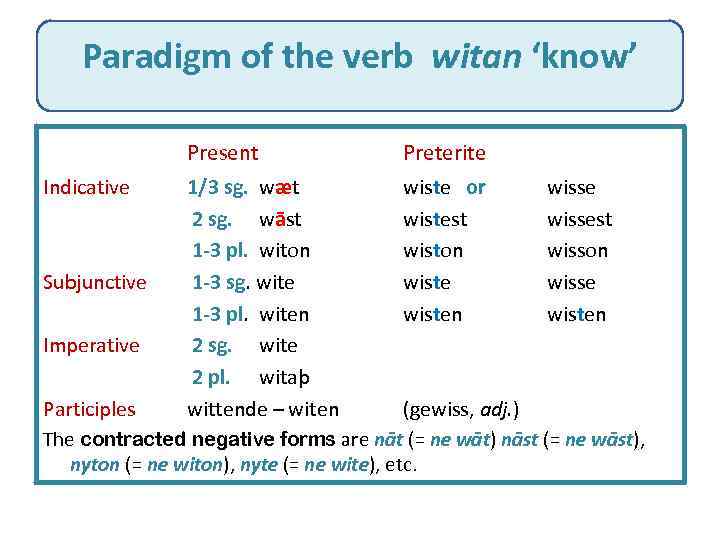
Paradigm of the verb witan ‘know’ Indicative Subjunctive Imperative Present 1/3 sg. wæt 2 sg. wāst 1 -3 pl. witon 1 -3 sg. wite 1 -3 pl. witen 2 sg. wite 2 pl. witaþ wittende – witen Preterite wiste or wistest wiston wisten wissest wisson wisse wisten Participles (gewiss, adj. ) The contracted negative forms are nāt (= ne wāt) nāst (= ne wāst), nyton (= ne witon), nyte (= ne wite), etc.
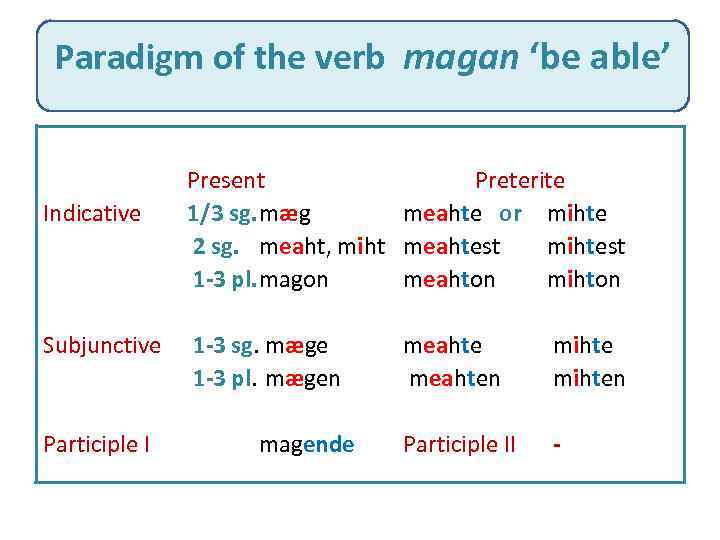
Paradigm of the verb magan ‘be able’ Indicative Subjunctive Participle I Present Preterite 1/3 sg. mæg meahte or mihte 2 sg. meaht, miht meahtest mihtest 1 -3 pl. magon meahton mihton 1 -3 sg. mæge 1 -3 pl. mægen magende meahten mihten Participle II -
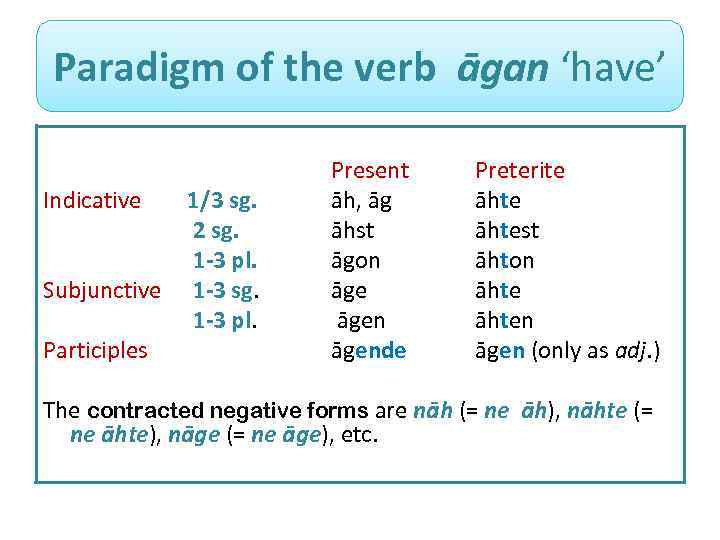
Paradigm of the verb āgan ‘have’ Indicative Subjunctive Participles 1/3 sg. 2 sg. 1 -3 pl. 1 -3 sg. 1 -3 pl. Present āh, āg āhst āgon āgende Preterite āhtest āhton āhten āgen (only as adj. ) The contracted negative forms are nāh (= ne āh), nāhte (= ne āhte), nāge (= ne āge), etc.
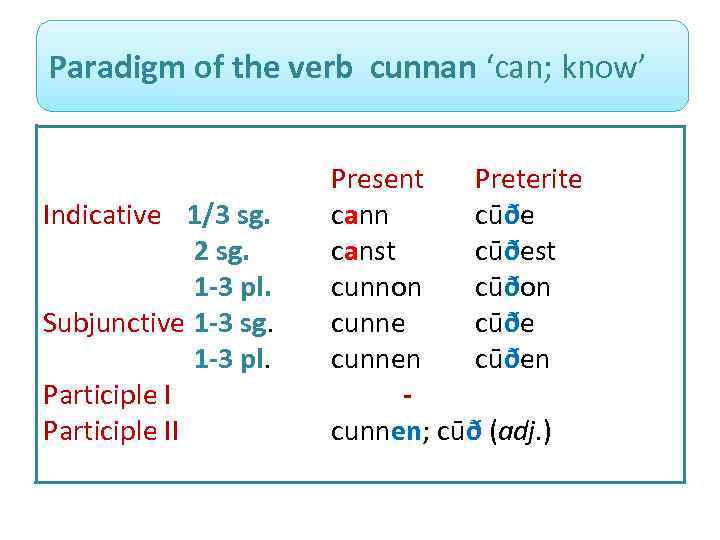
Paradigm of the verb cunnan ‘can; know’ Indicative 1/3 sg. 2 sg. 1 -3 pl. Subjunctive 1 -3 sg. 1 -3 pl. Participle II Present Preterite cann cūðe canst cūðest cunnon cūðon cunne cūðe cunnen cūðen cunnen; cūð (adj. )
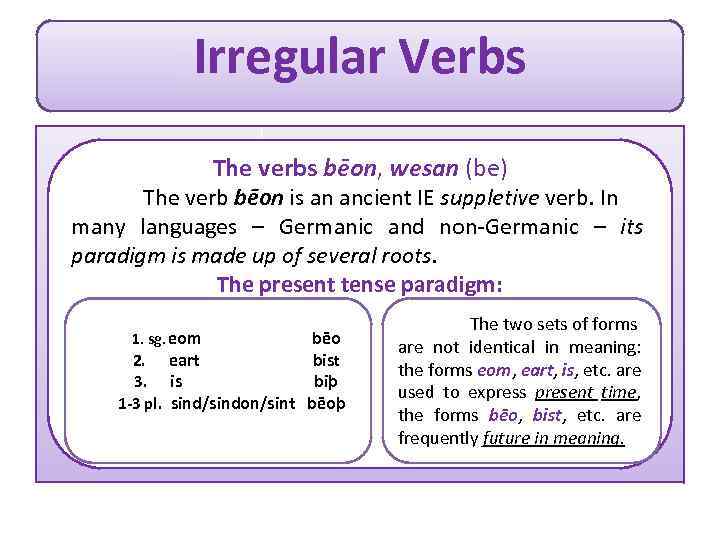
Irregular Verbs The verbs bēon, wesan (be) The verb bēon is an ancient IE suppletive verb. In many languages – Germanic and non-Germanic – its paradigm is made up of several roots. The present tense paradigm: 1. sg. eom bēo 2. eart bist 3. is biþ 1 -3 pl. sind/sindon/sint bēoþ The two sets of forms are not identical in meaning: the forms eom, eart, is, etc. are used to express present time, the forms bēo, bist, etc. are frequently future in meaning.
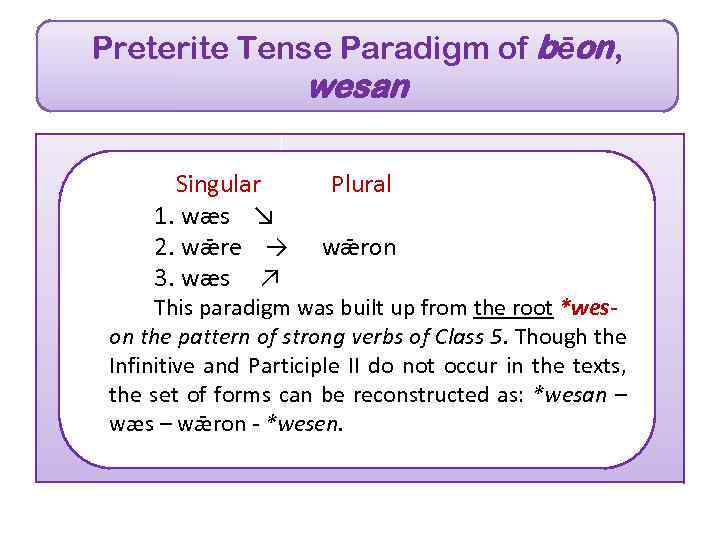
Preterite Tense Paradigm of bēon, wesan Singular Plural 1. wæs ↘ 2. wǣre → wǣron 3. wæs ↗ This paradigm was built up from the root *wes- on the pattern of strong verbs of Class 5. Though the Infinitive and Participle II do not occur in the texts, the set of forms can be reconstructed as: *wesan – wæs – wǣron - *wesen.
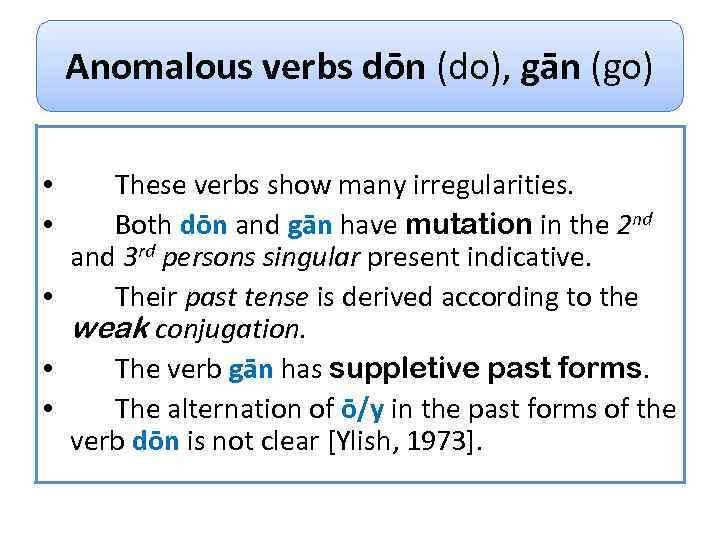
Anomalous verbs dōn (do), gān (go) These verbs show many irregularities. Both dōn and gān have mutation in the 2 nd and 3 rd persons singular present indicative. • Their past tense is derived according to the weak conjugation. • The verb gān has suppletive past forms. • The alternation of ō/y in the past forms of the verb dōn is not clear [Ylish, 1973]. • •
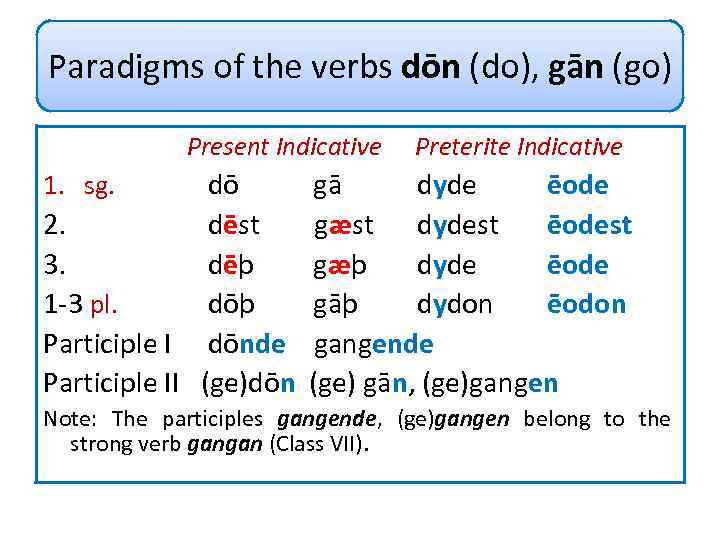
Paradigms of the verbs dōn (do), gān (go) Present Indicative Preterite Indicative dō gā dyde ēode 2. dēst gæst dydest ēodest 3. dēþ gæþ dyde ēode 1 -3 pl. dōþ gāþ dydon ēodon Participle I dōnde gangende Participle II (ge)dōn (ge) gān, (ge)gangen 1. sg. Note: The participles gangende, (ge)gangen belong to the strong verb gangan (Class VII).
Скачать презентацию Old English Verb Ablaut In linguistics ablaut
OE Verb.pptx