 Скачать презентацию Oklahoma Academic Standards and Students with Disabilities Angela
66c7b7c123d60da5272fbe6cc967edba.ppt
- Количество слайдов: 42



Oklahoma Academic Standards and Students with Disabilities Angela Kwok Special Education Specialist 405 -522 -5036 Angela. Kwok@sde. ok. gov
Objectives Today • Discuss the paradigm shift: What do the new Oklahoma Academic Standards in ELA and Math mean for students with disabilities (SWDs)? • Discuss scientifically research-based instructional strategies. • Address IEP alignment with grade level standards. • Provide general guidance for effective classroom strategies. • Recognize what access means regarding Universal Design for Learning (UDL), Assistive Technology and Accommodations. • Create an opportunity to reflect on practice.
Foundation elements of a successful school. • Accepted belief that all students have the potential to learn. • Strong leadership supports teachers, leading to student success. • Continual analysis of student data is embedded in the school’s culture. • Research-based interventions and instructional practice are used on an on-going basis. • Collaboration is the norm. Introduction: Common Values
Shifts for Mathematics • Focus strongly where the Standards have emphasis. • Coherence: Think across grades, and link to major topics within grades. • Rigor: In major topics, pursue conceptual understanding, procedural skill and fluency, and application. Paradigm Shift achievethecore. org
Shifts for ELA/Literacy • Building knowledge through content-rich nonfiction. • Reading, writing, and speaking grounded in evidence from text, both literary and informational. • Regular practice with complex text and its academic language. Paradigm Shift achievethecore. org
Why Scientifically-Based Research? Scientific Research… • Makes teaching more effective, productive, and efficient • Can be better generalized and replicated across many sites • Implementation of the research prevents potential student failure
5 Key Elements Schools must address to support the achievement of students receiving special education services: q Ownership q High Expectations q Interventions (as appropriate) q Inclusion/Collaborative Teaching q Professional Development Research Mc. Nulty and Gloeckler (2011). Fewer, Clearer, Higher Common Core State Standards: Implications for Students Receiving Special Education Services. International Center for Leadership in Education, Rexford, NY.
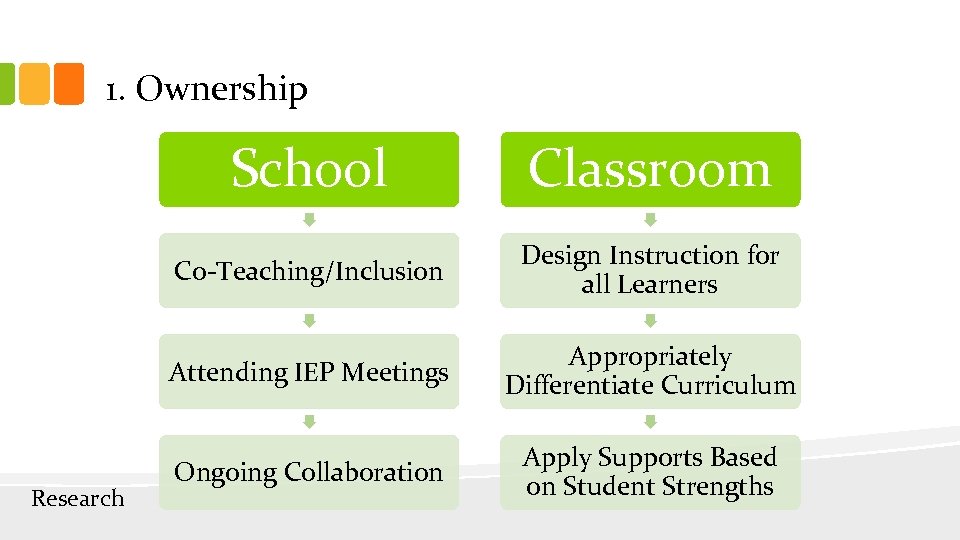
1. Ownership School Co-Teaching/Inclusion Design Instruction for all Learners Attending IEP Meetings Research Classroom Appropriately Differentiate Curriculum Ongoing Collaboration Apply Supports Based on Student Strengths
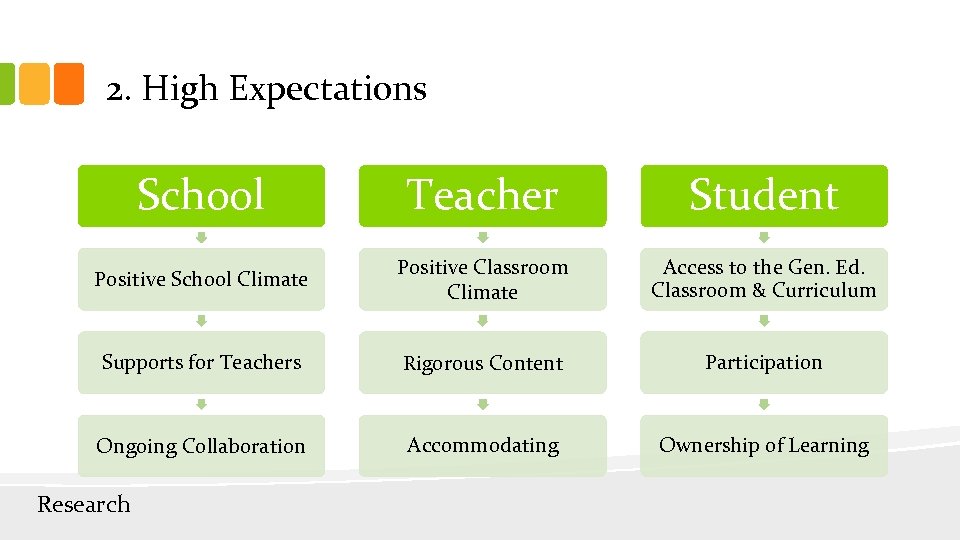
2. High Expectations School Teacher Student Positive School Climate Positive Classroom Climate Access to the Gen. Ed. Classroom & Curriculum Supports for Teachers Rigorous Content Participation Ongoing Collaboration Accommodating Ownership of Learning Research
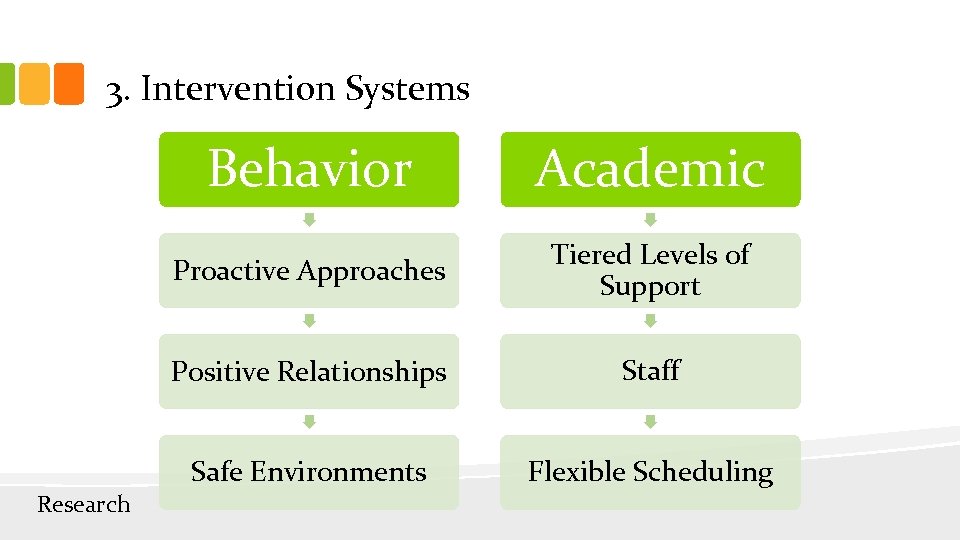
3. Intervention Systems Behavior Proactive Approaches Tiered Levels of Support Positive Relationships Staff Safe Environments Research Academic Flexible Scheduling
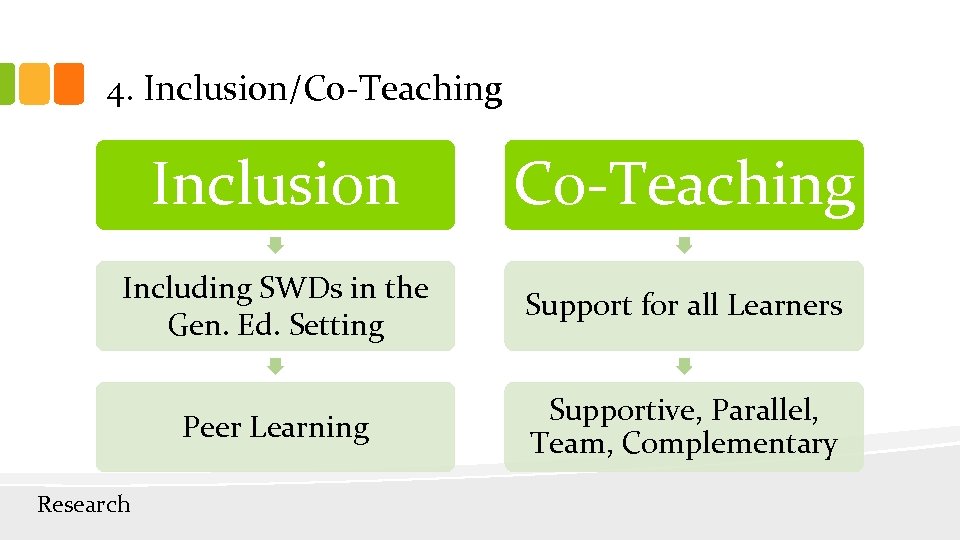
4. Inclusion/Co-Teaching Inclusion Co-Teaching Including SWDs in the Gen. Ed. Setting Support for all Learners Peer Learning Supportive, Parallel, Team, Complementary Research
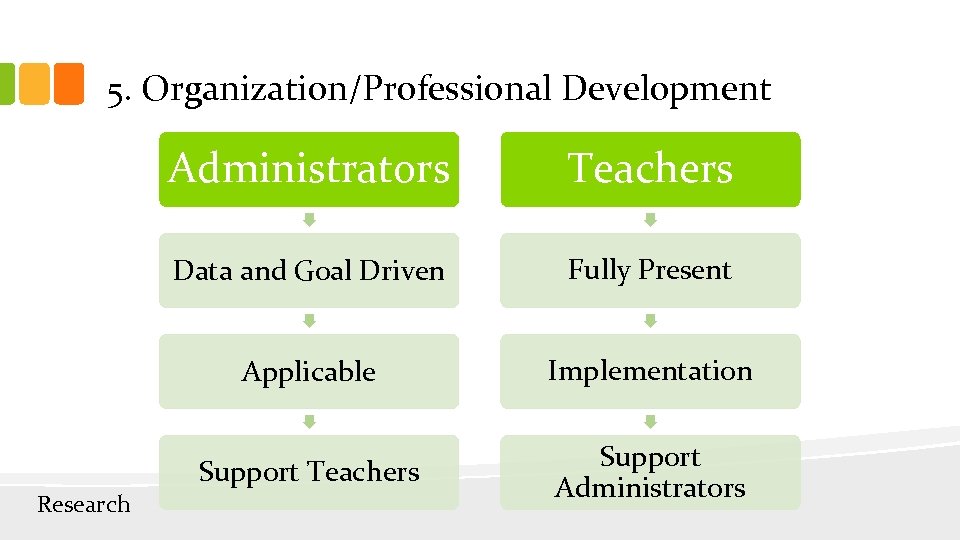
5. Organization/Professional Development Administrators Data and Goal Driven Fully Present Applicable Implementation Support Teachers Research Teachers Support Administrators
Professional Development • • • Administering assessments Analyzing and using student assessment data Comprehensive and intervention programs Evidence based strategies Instructional delivery Classroom management Research
Aligning IEPs to Standards ELA and Math: Fluencies and Priorities Alignment
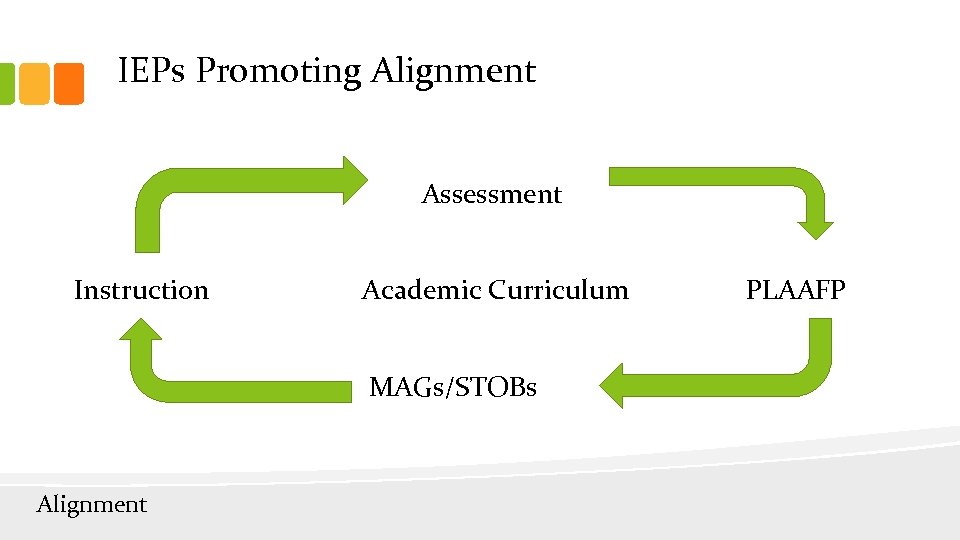
IEPs Promoting Alignment Assessment Instruction Academic Curriculum MAGs/STOBs Alignment PLAAFP
PLAAFP • The Present Level of Academic Achievement and Functional Performance is the first written statement in the IEP plan documentation of the child's ability and current achievement at the time the IEP is written. MAGs • Measurable Annual Goals are academic and functional goals to help the student make progress towards curriculum and meet other education needs. STOBs • Short term Objectives are smaller intermediate milestones to achieve when moving toward an important goal.
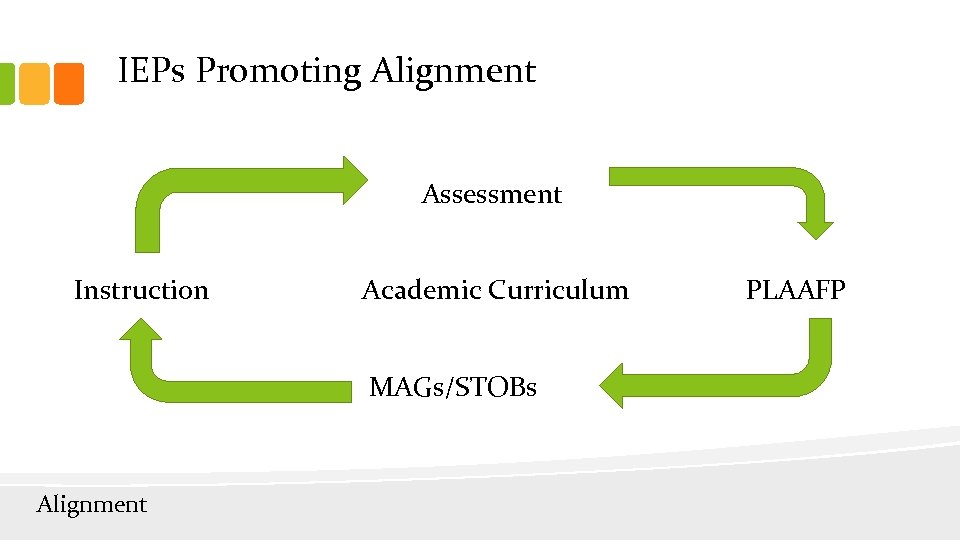
IEPs Promoting Alignment Assessment Instruction Academic Curriculum MAGs/STOBs Alignment PLAAFP
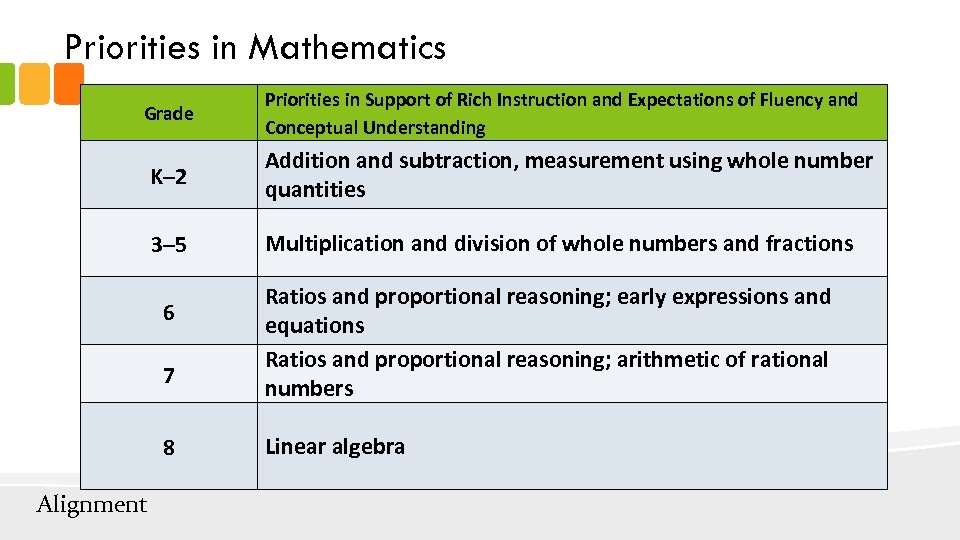
Priorities in Mathematics Grade Priorities in Support of Rich Instruction and Expectations of Fluency and Conceptual Understanding K– 2 Addition and subtraction, measurement using whole number quantities 3– 5 Multiplication and division of whole numbers and fractions 6 7 8 Alignment Ratios and proportional reasoning; early expressions and equations Ratios and proportional reasoning; arithmetic of rational numbers Linear algebra
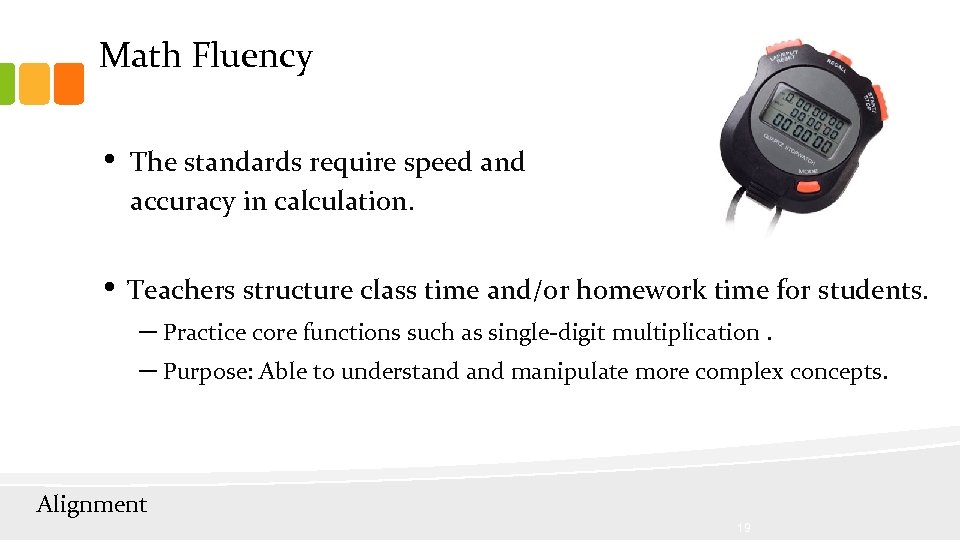
Math Fluency • The standards require speed and accuracy in calculation. • Teachers structure class time and/or homework time for students. – Practice core functions such as single-digit multiplication. – Purpose: Able to understand manipulate more complex concepts. Alignment 19
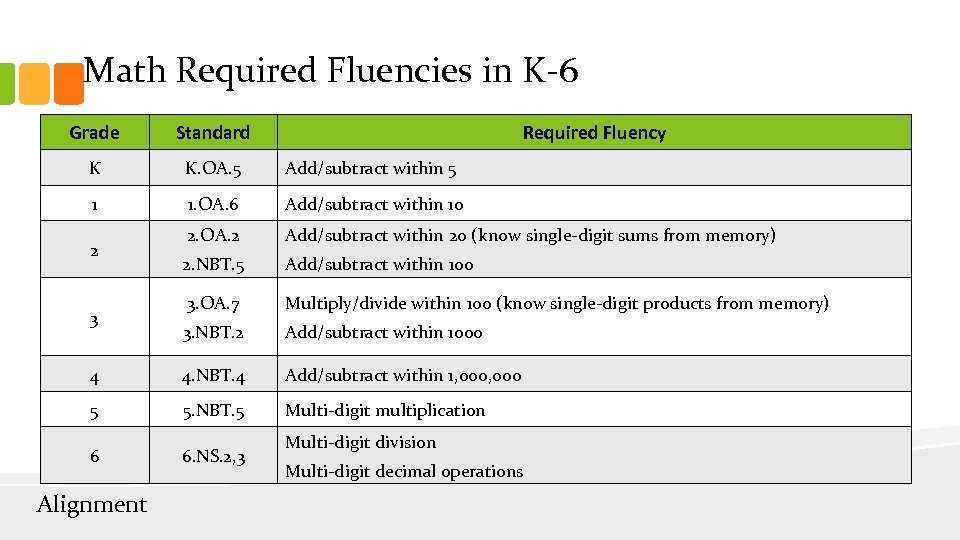
Math Required Fluencies in K-6 Grade Standard K K. OA. 5 Add/subtract within 5 1 1. OA. 6 Add/subtract within 10 2. OA. 2 Add/subtract within 20 (know single-digit sums from memory) 2. NBT. 5 Add/subtract within 100 3. OA. 7 Multiply/divide within 100 (know single-digit products from memory) 3. NBT. 2 Add/subtract within 1000 4 4. NBT. 4 Add/subtract within 1, 000 5 5. NBT. 5 Multi-digit multiplication 2 3 6 Alignment 6. NS. 2, 3 Required Fluency Multi-digit division Multi-digit decimal operations
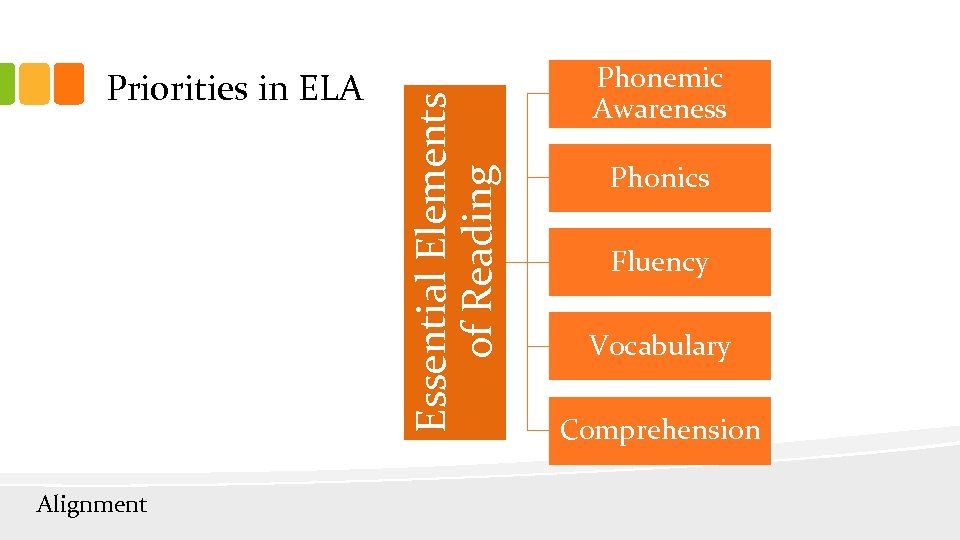
Alignment Essential Elements of Reading Priorities in ELA Phonemic Awareness Phonics Fluency Vocabulary Comprehension
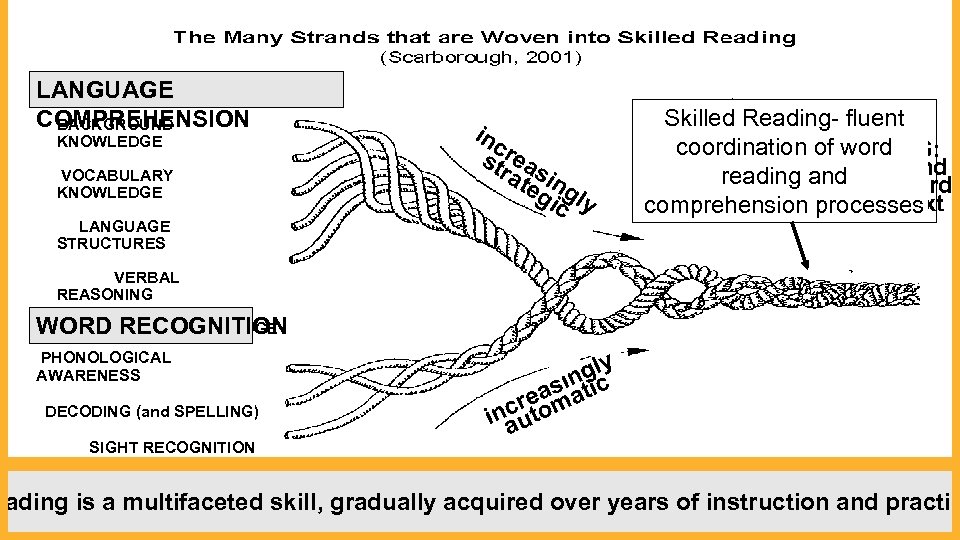
LANGUAGE COMPREHENSION BACKGROUND KNOWLEDGE VOCABULARY KNOWLEDGE LANGUAGE STRUCTURES inc strrea atesin gicgly Skilled Reading- fluent coordination of word SKILLED READING: fluent execution and reading and coordination of word recognition and text comprehension processes comprehension. VERBAL REASONING LITERACY KNOWLEDGE WORD RECOGNITION PHONOLOGICAL AWARENESS DECODING (and SPELLING) SIGHT RECOGNITION gly sin tic a creoma inaut eading is a multifaceted skill, gradually acquired over years of instruction and practic
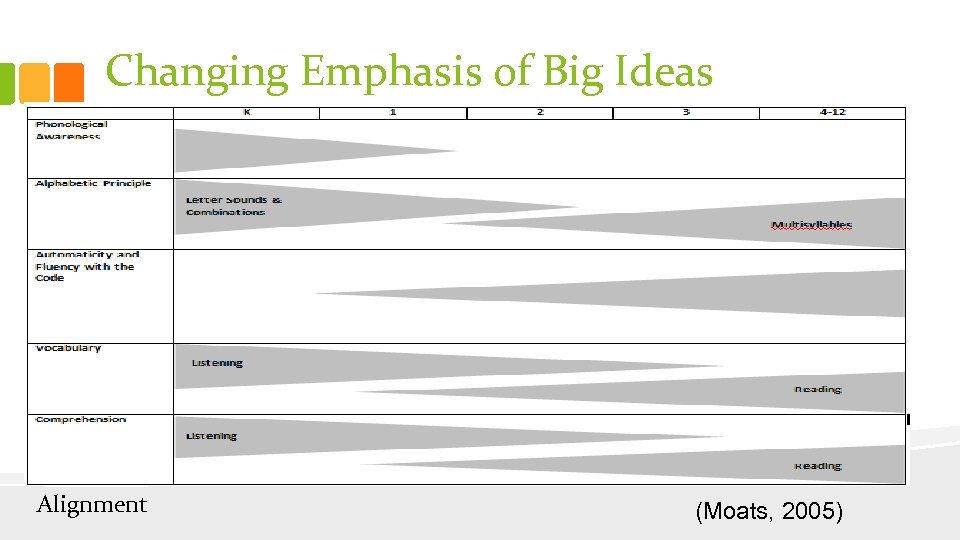
Changing Emphasis of Big Ideas Alignment (Moats, 2005)
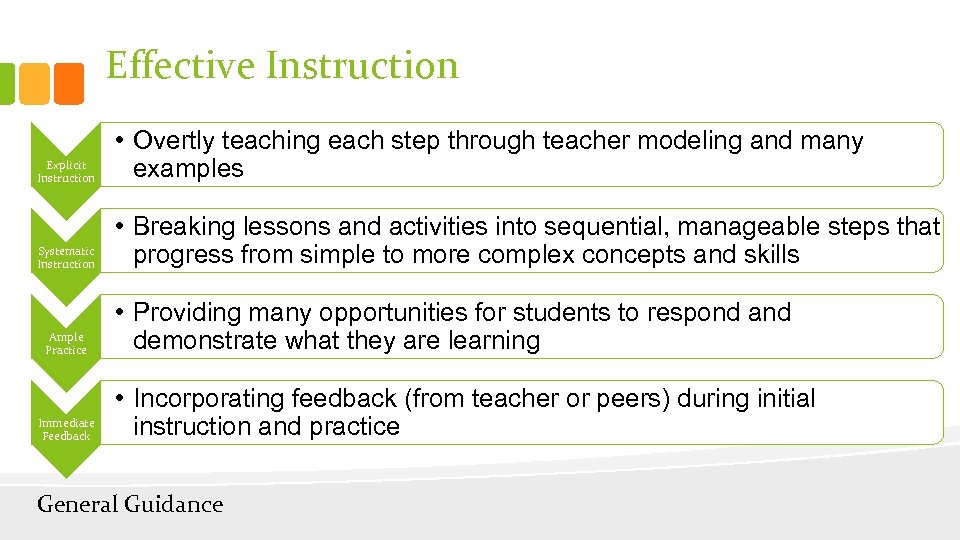
Effective Instruction Explicit Instruction • Overtly teaching each step through teacher modeling and many examples Systematic Instruction • Breaking lessons and activities into sequential, manageable steps that progress from simple to more complex concepts and skills Ample Practice Immediate Feedback • Providing many opportunities for students to respond and demonstrate what they are learning • Incorporating feedback (from teacher or peers) during initial instruction and practice General Guidance
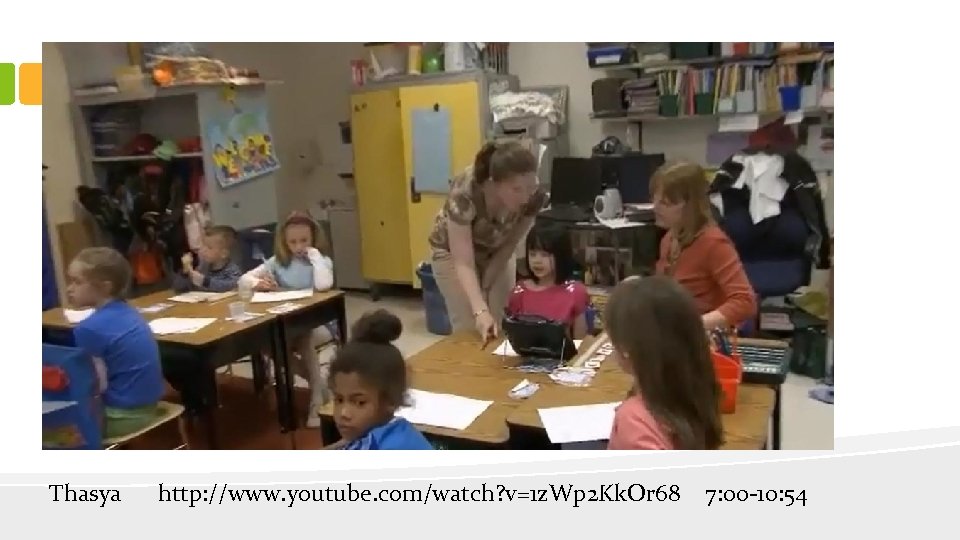
Thasya http: //www. youtube. com/watch? v=1 z. Wp 2 Kk. Or 68 7: 00 -10: 54
Instructional Strategies • Scaffolding • Fluency Strategies • Vocabulary Strategies • Literature-Based Approaches • Text Mapping Strategies • Vocabulary and Concept Mapping • Word Analysis Strategies • Explicit and systematic instruction • Model with many examples General Guidance
Instructional Strategies (continued) • Break tasks into small, manageable steps for the learners • Pace of instruction to match students’ learning needs • Scaffold instruction • Content differentiated for all learners • Qualified and effective interventionists • Small groups of 3 -5 students • Increase student response and practice opportunities • Provide precise, immediate feedback General Guidance
Lesson Delivery Questions/Self-Assessment Explicit Instruction How will I focus my students on what they need to learn? Modeled Instruction How will I show my students exactly what they are expected to do during guided practice and eventually during independent work? Guided Practice How will I provide my students with opportunities to practice what they were taught during the modeled portion of the lesson? Collaborative Learning How will I provide every member of a group to independently apply their new knowledge to a collaborative task? Independent Practice How will I help my students independently apply what they have learned during modeled and guided practice? General Guidance
Informal Student Assessments Check for understanding throughout the lesson. . . • thumbs up/down/middle • white board responses • response cards, yes/no cards • student response device • journal • board races • exit tickets General Guidance
Teacher priorities to help student mastery • Know the expected grade level academic standards. • Identify skills that are critical. • Through informal or formative assessments identify which skills the students: – have mastered – are not yet mastered • Plan instruction to match student’s needs. General Guidance
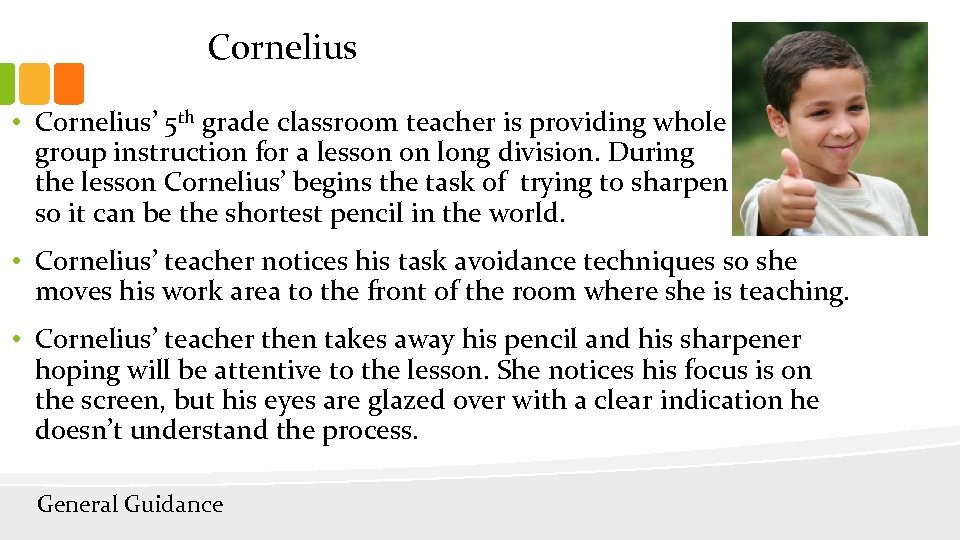
Cornelius • Cornelius’ 5 th grade classroom teacher is providing whole group instruction for a lesson on long division. During the lesson Cornelius’ begins the task of trying to sharpen his pencil so it can be the shortest pencil in the world. • Cornelius’ teacher notices his task avoidance techniques so she moves his work area to the front of the room where she is teaching. • Cornelius’ teacher then takes away his pencil and his sharpener hoping will be attentive to the lesson. She notices his focus is on the screen, but his eyes are glazed over with a clear indication he doesn’t understand the process. General Guidance
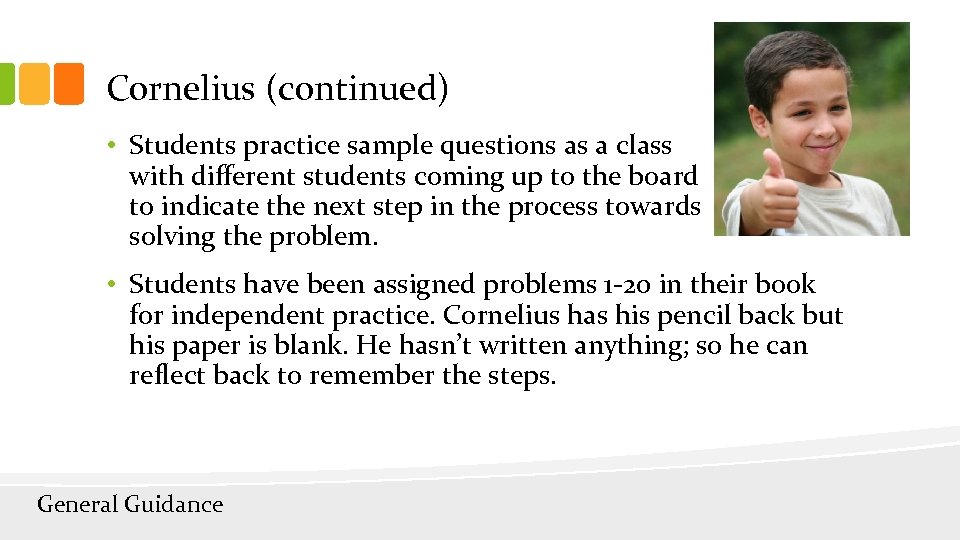
Cornelius (continued) • Students practice sample questions as a class with different students coming up to the board to indicate the next step in the process towards solving the problem. • Students have been assigned problems 1 -20 in their book for independent practice. Cornelius has his pencil back but his paper is blank. He hasn’t written anything; so he can reflect back to remember the steps. General Guidance
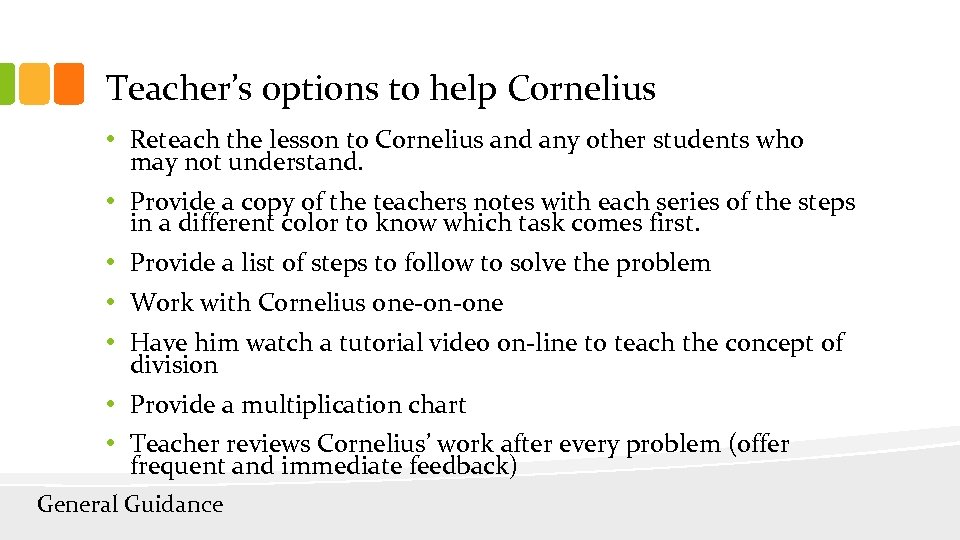
Teacher’s 0 ptions to help Cornelius • Reteach the lesson to Cornelius and any other students who may not understand. • Provide a copy of the teachers notes with each series of the steps in a different color to know which task comes first. • Provide a list of steps to follow to solve the problem • Work with Cornelius one-on-one • Have him watch a tutorial video on-line to teach the concept of division • Provide a multiplication chart • Teacher reviews Cornelius’ work after every problem (offer frequent and immediate feedback) General Guidance
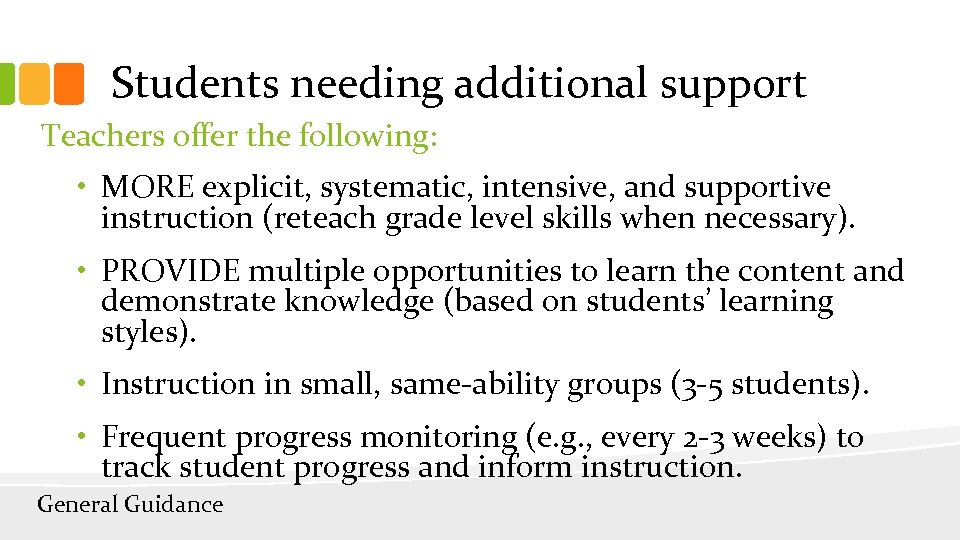
Students needing additional support Teachers offer the following: • MORE explicit, systematic, intensive, and supportive instruction (reteach grade level skills when necessary). • PROVIDE multiple opportunities to learn the content and demonstrate knowledge (based on students’ learning styles). • Instruction in small, same-ability groups (3 -5 students). • Frequent progress monitoring (e. g. , every 2 -3 weeks) to track student progress and inform instruction. General Guidance
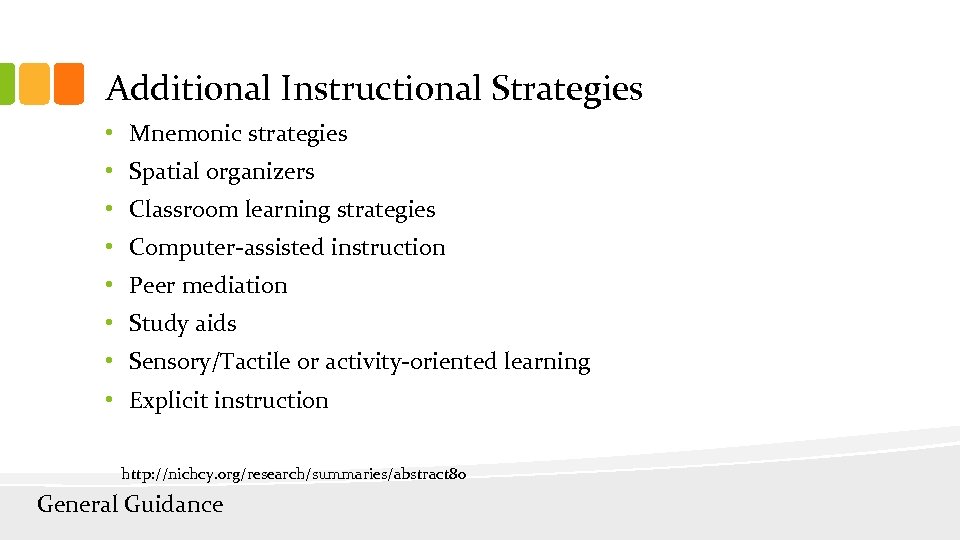
Additional Instructional Strategies • Mnemonic strategies • Spatial organizers • Classroom learning strategies • Computer-assisted instruction • Peer mediation • Study aids • Sensory/Tactile or activity-oriented learning • Explicit instruction http: //nichcy. org/research/summaries/abstract 80 General Guidance
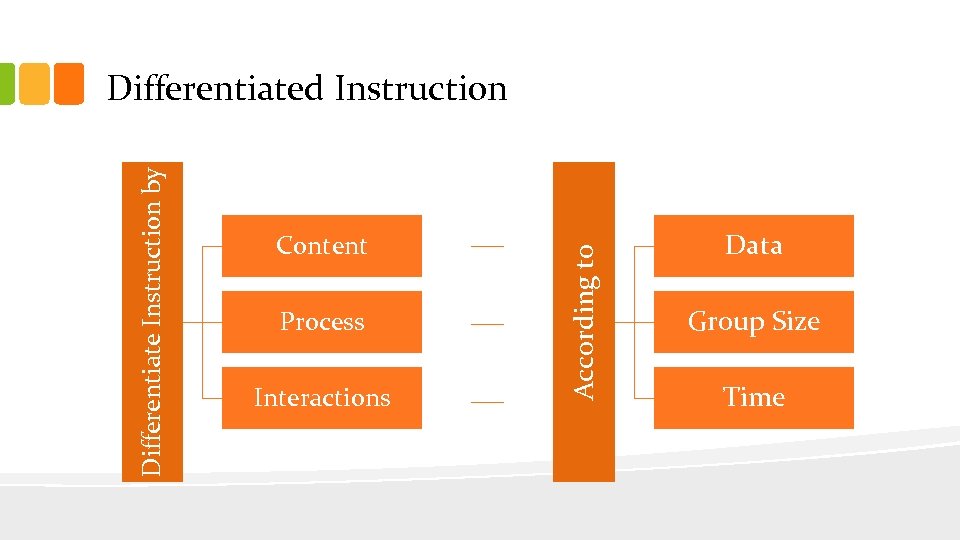
Content Process Interactions According to Differentiate Instruction by Differentiated Instruction Data Group Size Time
Implications for Students with Disabilities (SWD) • Instruction should focus on the new Oklahoma Academic Standards. – Co-Teaching – Universal Design for Learning • Placement decisions should focus on the least restrictive environment that affords a student access to the Oklahoma Academic Standards and core content curriculum. • Accommodations provide appropriate access to the curriculum that does not decrease the learning expectations. Access
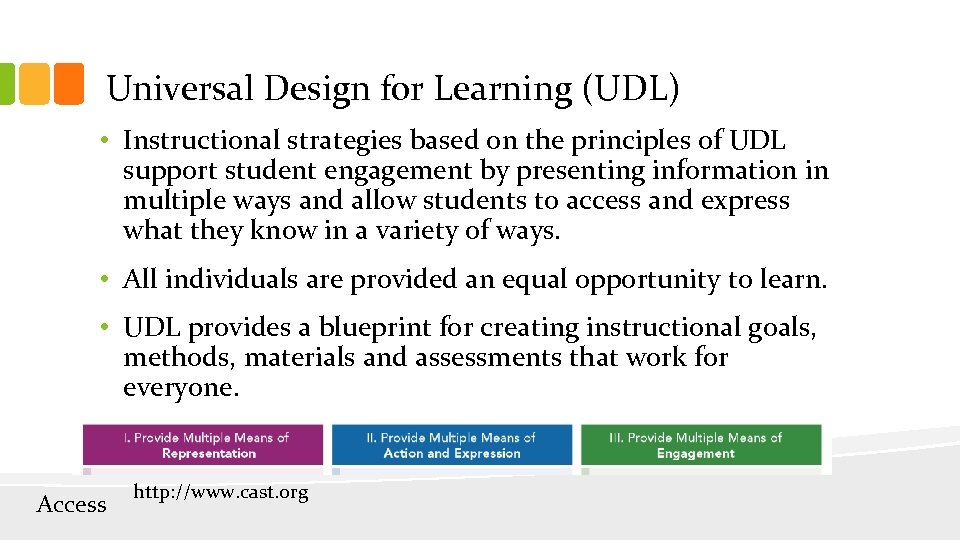
Universal Design for Learning (UDL) • Instructional strategies based on the principles of UDL support student engagement by presenting information in multiple ways and allow students to access and express what they know in a variety of ways. • All individuals are provided an equal opportunity to learn. • UDL provides a blueprint for creating instructional goals, methods, materials and assessments that work for everyone. Access http: //www. cast. org
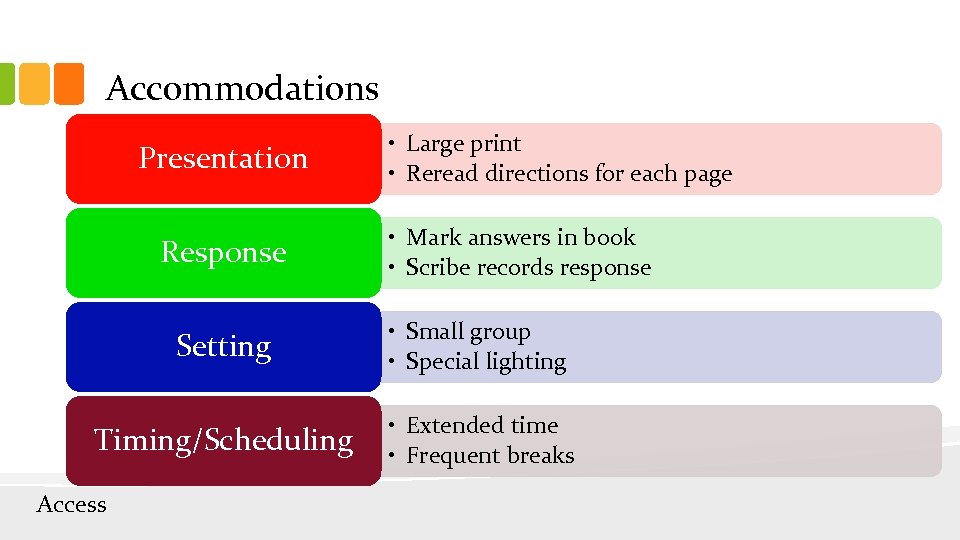
Accommodations Presentation Response • Large print • Reread directions for each page • Mark answers in book • Scribe records response Setting • Small group • Special lighting Timing/Scheduling • Extended time • Frequent breaks Access
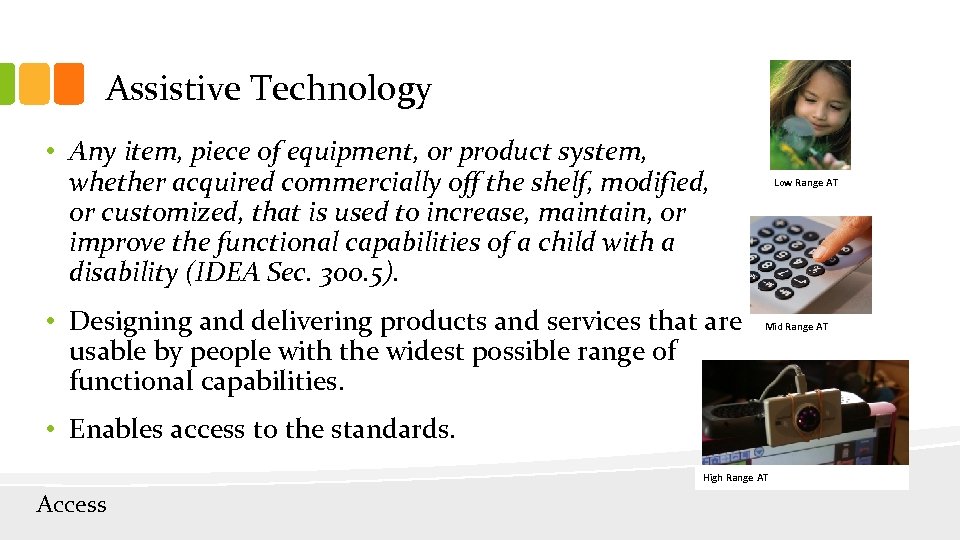
Assistive Technology • Any item, piece of equipment, or product system, whether acquired commercially off the shelf, modified, or customized, that is used to increase, maintain, or improve the functional capabilities of a child with a disability (IDEA Sec. 300. 5). • Designing and delivering products and services that are usable by people with the widest possible range of functional capabilities. Low Range AT Mid Range AT • Enables access to the standards. High Range AT Access
Reflection • Discuss with a table partner one new thing you may have learned or thought about from today’s presentation. • Reflect on this question: Someone has asked you, how will implementation of the Oklahoma Academic Standards affect Students with Disabilities? How would you respond in 1 -2 sentences? – – Reflect self reflect share with table partner (write on sticky note) post on large paper at front of room whole group share.
 Скачать презентацию Oklahoma Academic Standards and Students with Disabilities Angela
66c7b7c123d60da5272fbe6cc967edba.ppt