


 Скачать презентацию Oil exploration and sea ice projections in the
120920 - Oilandice.pptx
- Количество слайдов: 27
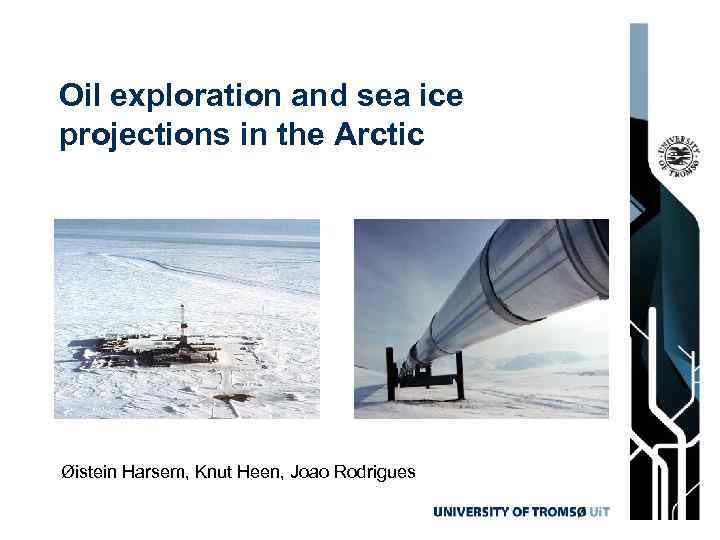 Oil exploration and sea ice projections in the Arctic Øistein Harsem, Knut Heen, Joao Rodrigues
 Current activity: • Russia: 80% of Arctic oil production, and 95% of Arctic natural gas production. • Norway: Snøhvit, Goliat • USA: Oil production in Alaska • Canada: Exploration activity is mainly in the Mackenzie Delta
 However… offshore production is very limited in the Arctic 3 09. 02. 2018
 An intensified new Arctic resource «race» ? • 22 % of the world undiscovered oil and gas resources are located in the Arctic 1 • Most are expected to be located offshore • New transportation routes • High oil prices 1. USGS (2008)
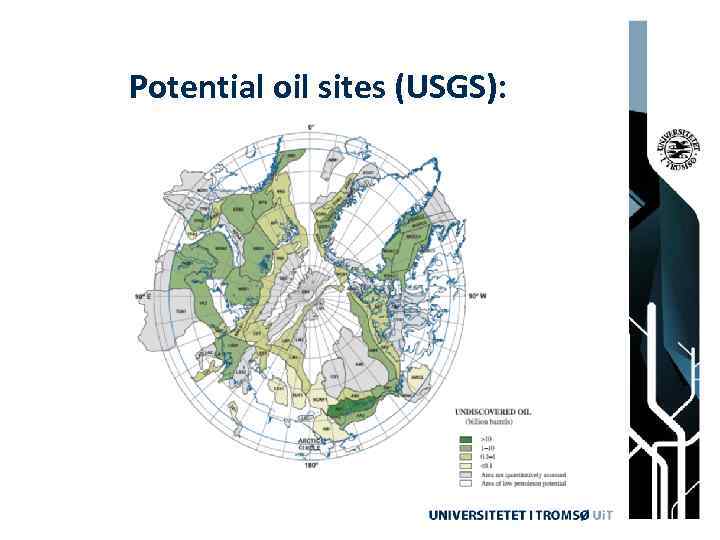 Potential oil sites (USGS):
 Research Question: Will changes in Arctic sea ice cover alter the cost of exploration and production during the next 30 years?
 Methods: • We divide the Arctic into 21 provinces • Three key variables: § Distance to land § Adequate infrastructure § Sea ice loss
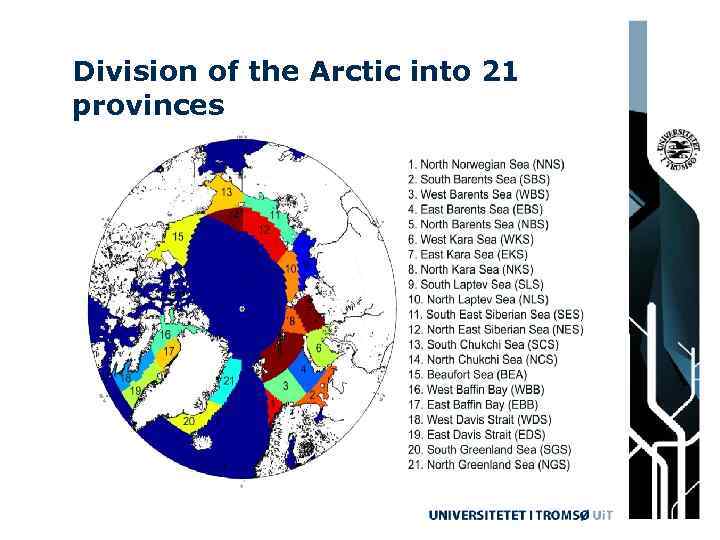 Division of the Arctic into 21 provinces
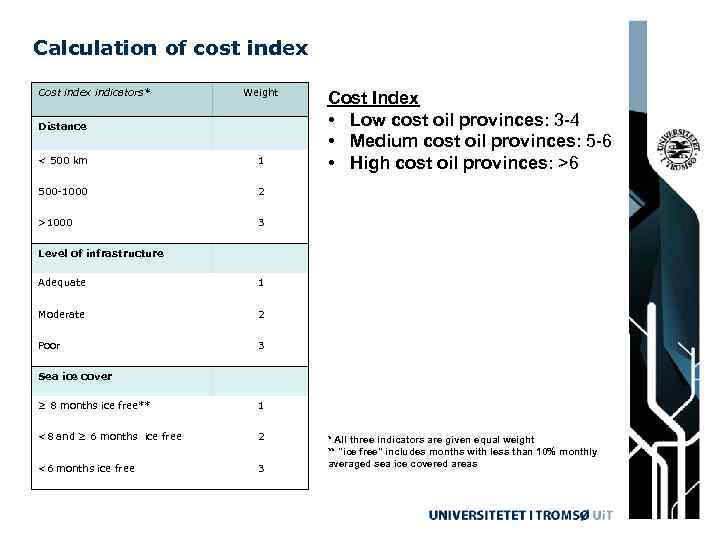 Calculation of cost index Cost index indicators* Weight Distance < 500 km 1 500 -1000 2 >1000 Cost Index • Low cost oil provinces: 3 -4 • Medium cost oil provinces: 5 -6 • High cost oil provinces: >6 3 Level of infrastructure Adequate 1 Moderate 2 Poor 3 Sea ice cover ≥ 8 months ice free** 1 <8 and ≥ 6 months ice free 2 <6 months ice free 3 * All three indicators are given equal weight ** "ice free" includes months with less than 10% monthly averaged sea ice covered areas
 Why is Arctic Sea ice an important factor for Arctic oil activity?
 Offshore Drilling in the Arctic poses extra challenges because of very low temperatures, ice conditions and darkness. Exploratory drilling usually takes place during short open water season from ice strengthened mobile drilling rigs (Shell. com)
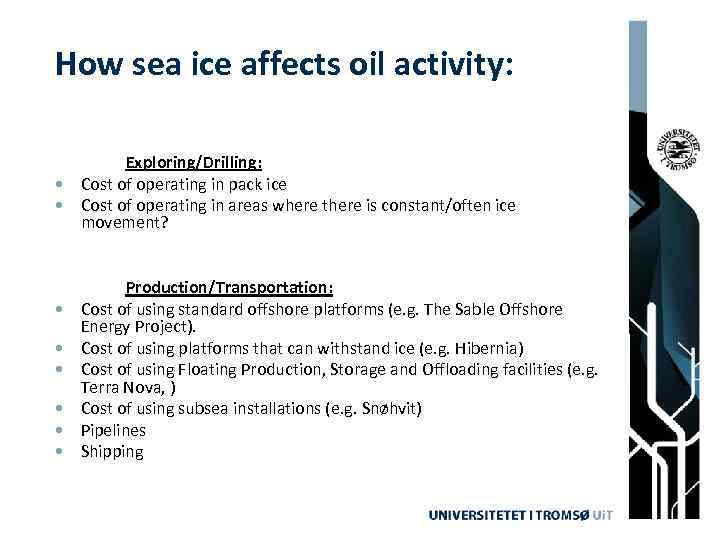 How sea ice affects oil activity: Exploring/Drilling: • Cost of operating in pack ice • Cost of operating in areas where there is constant/often ice movement? • • • Production/Transportation: Cost of using standard offshore platforms (e. g. The Sable Offshore Energy Project). Cost of using platforms that can withstand ice (e. g. Hibernia) Cost of using Floating Production, Storage and Offloading facilities (e. g. Terra Nova, ) Cost of using subsea installations (e. g. Snøhvit) Pipelines Shipping
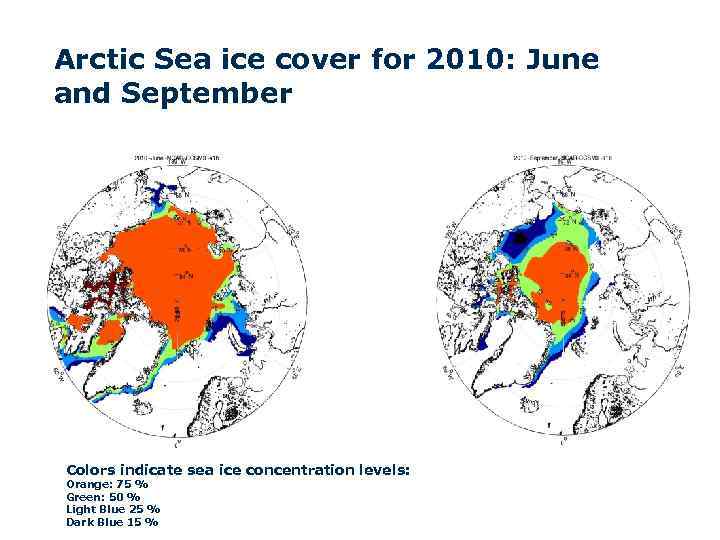 Arctic Sea ice cover for 2010: June and September Colors indicate sea ice concentration levels: Orange: 75 % Green: 50 % Light Blue 25 % Dark Blue 15 %
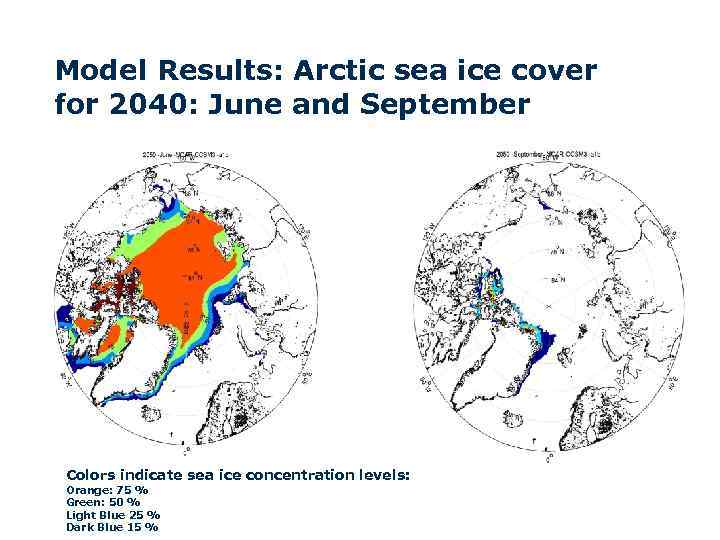 Model Results: Arctic sea ice cover for 2040: June and September Colors indicate sea ice concentration levels: Orange: 75 % Green: 50 % Light Blue 25 % Dark Blue 15 %
 Infrastructure and sea ice in various Arctic provinces: North Norwegian Sea and Barents Sea • Adequate infrastructure facilities on shore • Towns: § Harstad § Tromsø § Hammerfest § Kirkenes § Murmansk • Sea ice: § None during the summer (2010) § Present during the winter in the north and east Barents Sea (2010) § Decline in 2040 for all provinces
 Kara Seas • Small towns with fairly good infrastructure: • Towns: § Dikson § Dudenka § Amderma § Varandeya (Terminal) • Sea ice § Present from October through May for most areas (2010) § Decline up to 2040
 Laptev Sea • Lack of infrastructure • Small towns with some infrastructure: § Tiksi • Sea Ice § Present for most of the year (2010) § North Laptev is expected to loose half of its ice (2040)
 East Siberian Sea • Lack of infrastructure near land • Towns: § Pevek • Sea ice: § Present for most of the year § Significant decline in the amount of sea ice in the autumn (2040)
 Chukchi Sea • Lack of instructure near land • Towns: § Uelen (Russia) § Point Hope (USA) • Sea ice: § Sea ice during most of the year (2010) § A significant decline in october (2040)
 Beaufort Sea • Some infrastructure facilities • Lack of deep water ports 1 • Towns: § Kuparuk • Sea ice: § Big changes in the ice distribution at the beginning of the freezing season (2040) 1. AMAP (2007)
 Baffin Bay & Davis Strait • Fairly good infrastructure facilites • Towns: § Nuuk • Sea ice: § More ice in the West parts of Davis Strait and Baffin Bay than eastern parts at any time of the year (2010) § Little decline up to 2030
 West Greenland Sea • Poorly developed infrastructure • Towns: § Tasiilaq • Sea ice: § Present during winter (2010) § Decrease in the South Greenland Sea in October
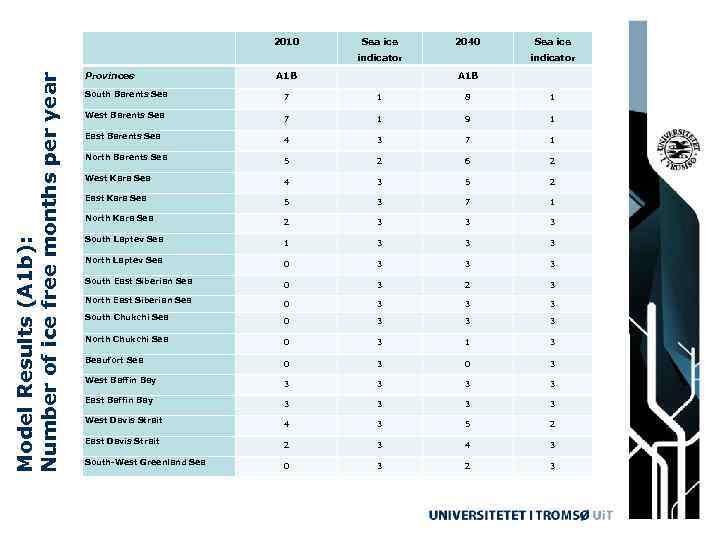 2010 Sea ice 2040 Model Results (A 1 b): Number of ice free months per year indicator Provinces Sea ice indicator A 1 B South Barents Sea 7 1 8 1 West Barents Sea 7 1 9 1 East Barents Sea 4 3 7 1 North Barents Sea 5 2 6 2 West Kara Sea 4 3 5 2 East Kara Sea 5 3 7 1 North Kara Sea 2 3 3 3 South Laptev Sea 1 3 3 3 North Laptev Sea 0 3 3 3 South East Siberian Sea 0 3 2 3 North East Siberian Sea 0 3 3 3 South Chukchi Sea 0 3 3 3 North Chukchi Sea 0 3 1 3 Beaufort Sea 0 3 West Baffin Bay 3 3 East Baffin Bay 3 3 West Davis Strait 4 3 5 2 East Davis Strait 2 3 4 3 South-West Greenland Sea 0 3 2 3
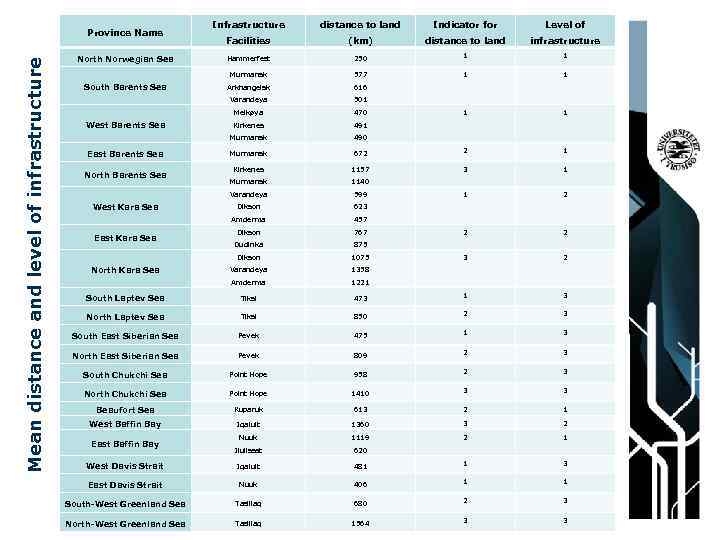 Mean distance and level of infrastructure Province Name Infrastructure distance to land Indicator for Level of Facilities (km) distance to land infrastructure 1 1 1 North Norwegian Sea Hammerfest 250 Murmansk 577 South Barents Sea Arkhangelsk 616 Varandeya 501 Melkøya 470 Kirkenes 491 Murmansk 490 Murmansk 672 2 1 Kirkenes 1157 3 1 1 2 2 2 3 2 West Barents Sea East Barents Sea North Barents Sea Murmansk 1140 Varandeya 599 Dikson 623 Amderma 457 Dikson 767 Dudinka 875 Dikson 1075 Varandeya 1358 Amderma 1221 South Laptev Sea Tiksi 473 1 3 North Laptev Sea Tiksi 850 2 3 South East Siberian Sea Pevek 475 1 3 North East Siberian Sea Pevek 809 2 3 South Chukchi Sea Point Hope 958 2 3 North Chukchi Sea Point Hope 1410 3 3 Beaufort Sea Kuparuk 613 2 1 West Baffin Bay Iqaluit 1360 3 2 2 1 West Kara Sea East Kara Sea North Kara Sea Nuuk 1119 Ilulissat 620 West Davis Strait Iqaluit 481 1 3 East Davis Strait Nuuk 406 1 1 South-West Greenland Sea Tasiilaq 680 2 3 North-West Greenland Sea Tasiilaq 1564 3 3 East Baffin Bay
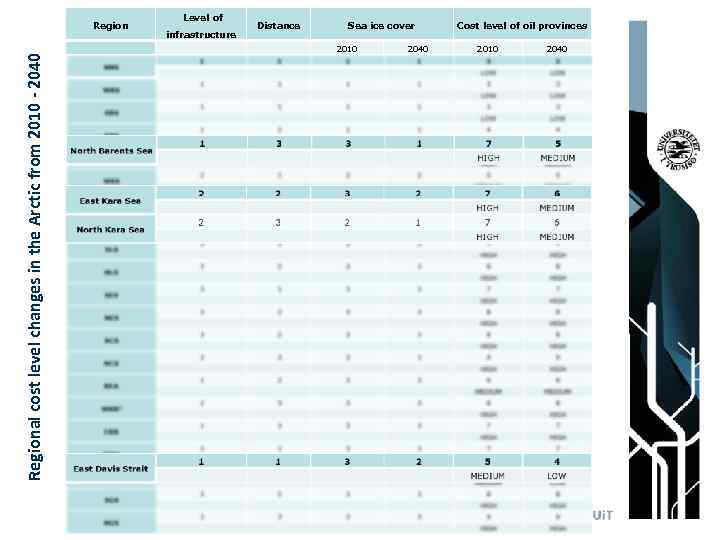 Level of Regional cost level changes in the Arctic from 2010 - 2040 Region NGS 1 3 3 LOW 1 1 1 3 3 LOW 2 1 1 4 4 LOW 3 3 1 7 5 HIGH MEDIUM 1 2 2 5 5 MEDIUM 2 3 2 7 6 HIGH MEDIUM 2 3 2 1 7 6 HIGH MEDIUM 3 1 3 3 7 7 HIGH 3 2 3 3 8 8 HIGH 3 1 3 3 7 7 HIGH 2 3 3 8 8 HIGH 3 2040 3 2 3 3 8 8 HIGH 3 3 9 9 HIGH 2 3 3 6 6 MEDIUM 1 2 3 3 3 8 8 WBB 2 SGS 1 2 NCS EDS 1 SCS WDS LOW 2 SES LOW NLS 1 SLS NKS 3 1 EKS 3 WKS 2010 1 1 NBS 2040 1 EBS 2010 1 SBS 1 WBS EBB Cost level of oil provinces NNS BEA Sea ice cover 1 NES Distance infrastructure HIGH 3 3 7 7 HIGH 1 3 3 1 3 3 7 7 HIGH 1 1 3 2 5 4 MEDIUM LOW 3 2 3 3 8 8 HIGH 3 3 9 9 HIGH
 Conclusion • Sea ice decline will not result in an significant increase in Arctic oil production • However… § A few provinces may witness an increased activity due to sea ice decline
 Thank you for your attention! Questions?