 Скачать презентацию Officer Professional Development OPD-301 Leadership Captain Bill Ratner
740d0617a864dd20239eab38caf39134.ppt
- Количество слайдов: 51



Officer Professional Development OPD-301 Leadership Captain Bill Ratner, USN (Ret. ) NHQ Representative Pacific Southwest Area
Introductions & Review of Agenda 2
OPD 301 Agenda • • • Course Concepts Leadership Expectations – 50, 000 ft View Break Leadership Expectations – Deeper Dive Leadership Concepts Leadership Resources & Tools Break Characteristics of a Strong Unit Wrap-up 3
Course Concepts • Officer Professional Development 301 • To reinforce the fundamental tenets of leadership • To educate and inspire Adult Leaders of the NSCC • Course Specifics • • Designed for NSCC Adult Leaders Focus on Command Leadership (CO/XO) Addresses Admin/Training/Division Officers Leadership Needs Seminar format: Information / data first; Discussion 4
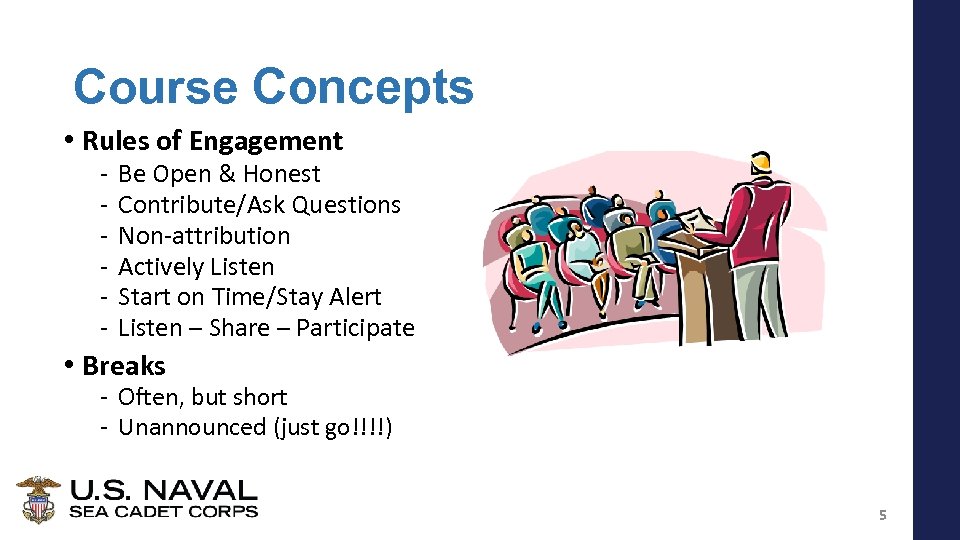
Course Concepts • Rules of Engagement - Be Open & Honest Contribute/Ask Questions Non-attribution Actively Listen Start on Time/Stay Alert Listen – Share – Participate • Breaks - Often, but short - Unannounced (just go!!!!) 5
Course Concepts • Take Aways/Course Contract - By the end of the day, you will have … • Materials you can use • Ideas you can implement • Processes you can deploy 6
Leadership Introductory Exercise 7
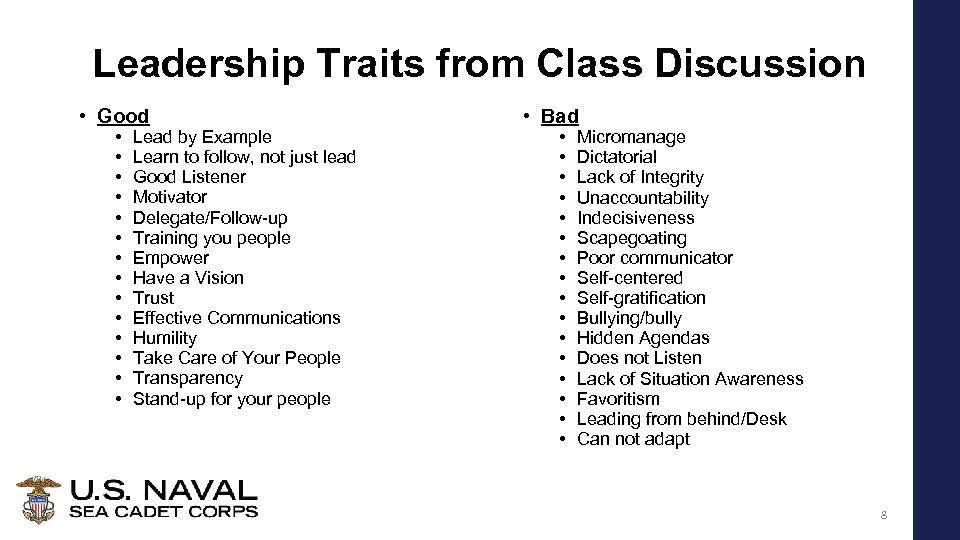
Leadership Traits from Class Discussion • Good • • • • Lead by Example Learn to follow, not just lead Good Listener Motivator Delegate/Follow-up Training you people Empower Have a Vision Trust Effective Communications Humility Take Care of Your People Transparency Stand-up for your people • Bad • • • • Micromanage Dictatorial Lack of Integrity Unaccountability Indecisiveness Scapegoating Poor communicator Self-centered Self-gratification Bullying/bully Hidden Agendas Does not Listen Lack of Situation Awareness Favoritism Leading from behind/Desk Can not adapt 8
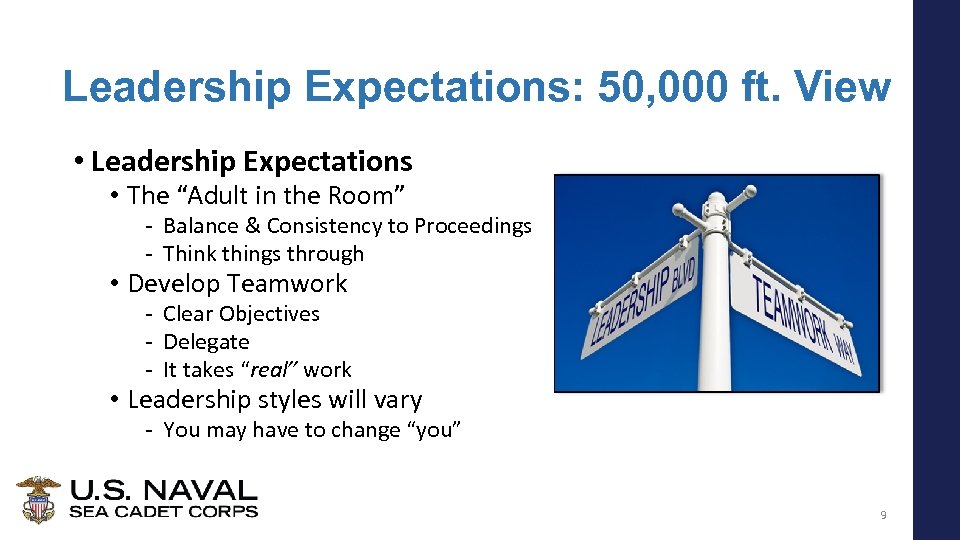
Leadership Expectations: 50, 000 ft. View • Leadership Expectations • The “Adult in the Room” - Balance & Consistency to Proceedings - Think things through • Develop Teamwork - Clear Objectives - Delegate - It takes “real” work • Leadership styles will vary - You may have to change “you” 9
Leadership Expectations: 50, 000 ft. View “The successful organization has one major attribute that sets it apart from unsuccessful organizations: Dynamic and Effective Leadership. ” “Management of Organization Behavior” Paul Hersey and Ken Blanchard 10
Leadership Expectations: Deeper Dive • What is “Dynamic & Effective Leadership”? o Depends on what is needed to fit the situation • Different Leadership Styles to fit the Situation: o o o o Military Entrepreneur Autocratic Laissez Faire Democratic/Participative Bureaucratic Other • Every Leader has a Personal Leadership Style 11
Leadership Expectations: Deeper Dive • Seven Habits for Effectivity (Steven Covey) 1. Be Pro-Active: • “Make” happen vs. “Let” happen 2. Begin with the End in Mind: • Set Objectives 3. First Things First: • Control 4. Think “Win-Win”: • Gain Buy-in 5. Seek First to Understand: • Information & Data 6. Synergize: • Get to Critical Mass 7. Sharpen the Saw: • Keep an edge 12
Leadership Expectations: Deeper Dive • Leadership Myths • Leaders are born, not made • Medieval concept – divine rule • Aptitude component • Leaders are a sum of experience and training • Good Leadership is all common sense • Then, why are there leadership problems • The only school that teaches leadership is the school of hard knocks • Accelerate learning through education 13
Leadership Expectations: Deeper Dive • Traditional View: Leadership - Responsibility - Called on to answer or account - Authority - Ability to make decisions independently - Accountability - Accepts responsibility 14
Leadership Expectations: Deeper Dive • Traditional View: Teamwork - Cooperative or coordinated effort on the part of a group of persons acting together - Basic contract within an organization among its leader and the group - Does this always work out among Leaders & the Group? If not, What Happens? 15
Group Discussion • When to use the Chain of Command when not to? • What actions does it take to delegate? • How would you go about getting “Buy-In” from Volunteers 16
Break Period 10 Minutes
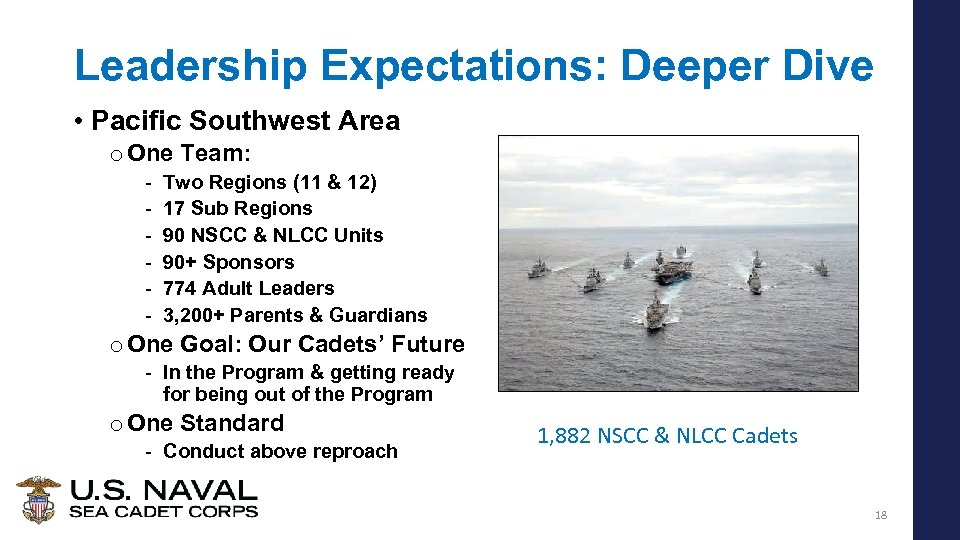
Leadership Expectations: Deeper Dive • Pacific Southwest Area o One Team: - Two Regions (11 & 12) 17 Sub Regions 90 NSCC & NLCC Units 90+ Sponsors 774 Adult Leaders 3, 200+ Parents & Guardians o One Goal: Our Cadets’ Future - In the Program & getting ready for being out of the Program o One Standard - Conduct above reproach 1, 882 NSCC & NLCC Cadets 18
Leadership Expectations: Deeper Dive • Roles & Responsibilities - NSCC definitions for each level of the Sea Cadet Organization taking into account: o Primary Functions o Division of Labor o Span of Control o Chain of Command o Accountability 19
Leadership Expectations: Deeper Dive • National Board of Directors - Responsible for determining the policies and programs of both Corps, and for the control of all funds • National Headquarters - Implements the policies established by the Board of Directors, and is responsible for the day-to-day management and administration of the NSCC and NLCC 20
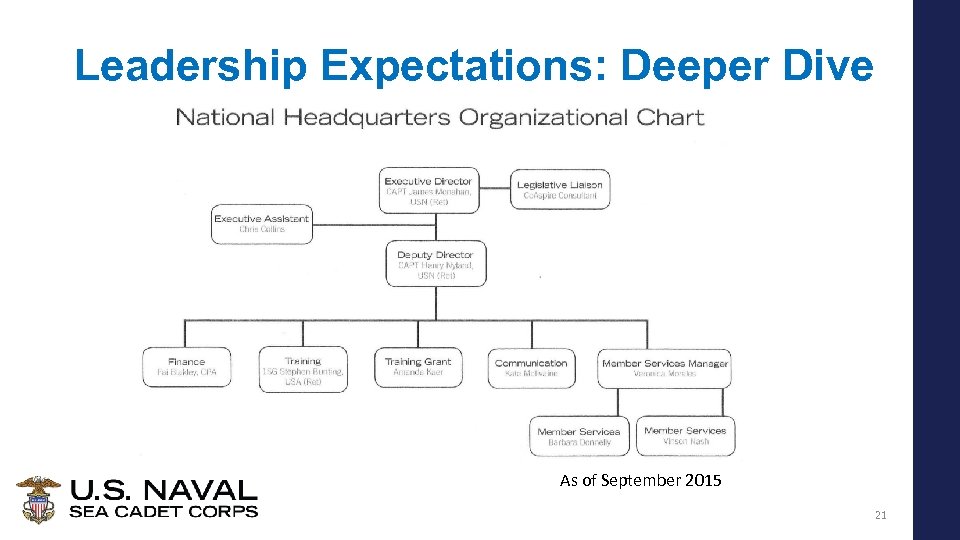
Leadership Expectations: Deeper Dive As of September 2015 21
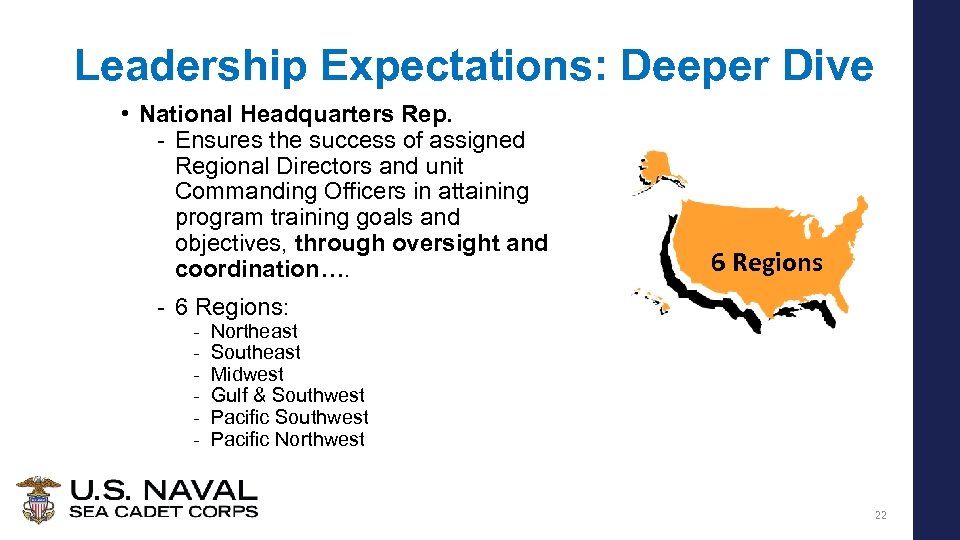
Leadership Expectations: Deeper Dive • National Headquarters Rep. - Ensures the success of assigned Regional Directors and unit Commanding Officers in attaining program training goals and objectives, through oversight and coordination…. 6 Regions - 6 Regions: - Northeast Southeast Midwest Gulf & Southwest Pacific Northwest 22
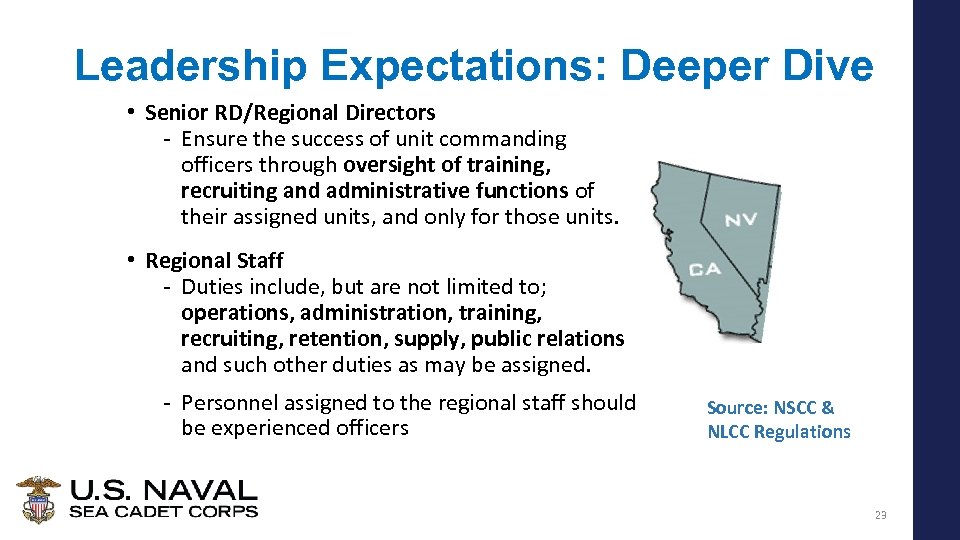
Leadership Expectations: Deeper Dive • Senior RD/Regional Directors - Ensure the success of unit commanding officers through oversight of training, recruiting and administrative functions of their assigned units, and only for those units. • Regional Staff - Duties include, but are not limited to; operations, administration, training, recruiting, retention, supply, public relations and such other duties as may be assigned. - Personnel assigned to the regional staff should be experienced officers Source: NSCC & NLCC Regulations 23
Leadership Expectations: Deeper Dive • Unit Commanding Officers - Where “the rubber meets the road” - Unit commanding officers report to the Regional Director and have direct access (when appropriate) to their respective NHQ Representatives. - The commanding officer shall direct the efforts of the unit toward attainment of the recruiting, retention and educational goals and objectives of the NSCC Source: NSCC & NLCC Regulations 24
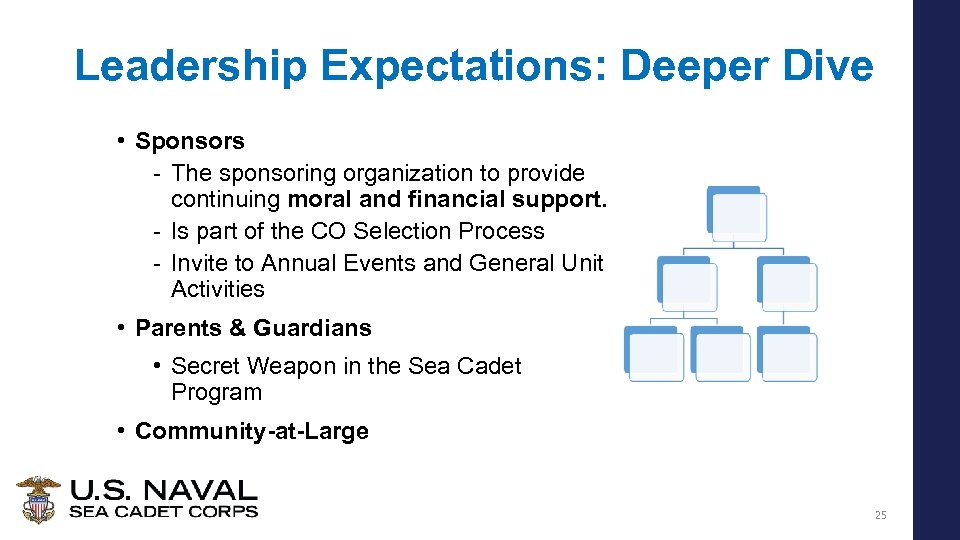
Leadership Expectations: Deeper Dive • Sponsors - The sponsoring organization to provide continuing moral and financial support. - Is part of the CO Selection Process - Invite to Annual Events and General Unit Activities • Parents & Guardians • Secret Weapon in the Sea Cadet Program • Community-at-Large 25
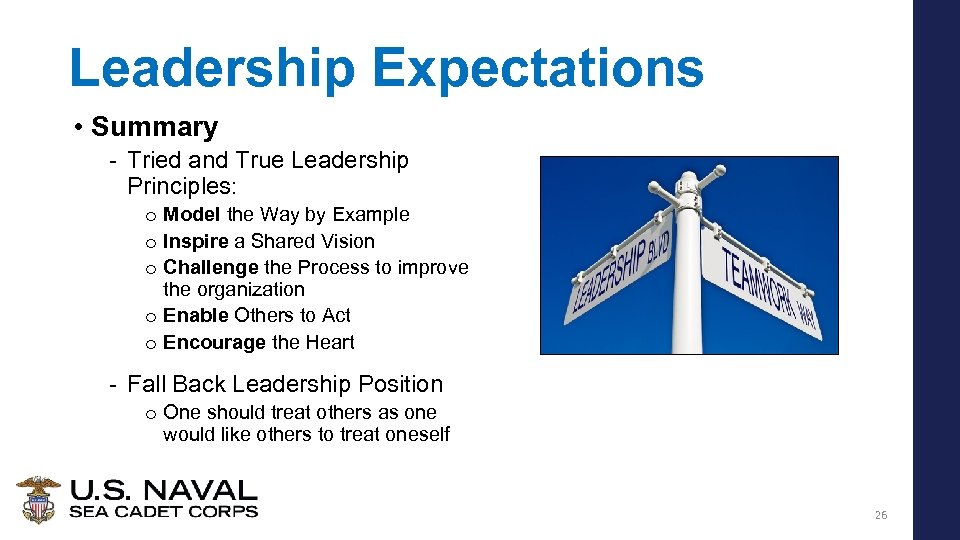
Leadership Expectations • Summary - Tried and True Leadership Principles: o Model the Way by Example o Inspire a Shared Vision o Challenge the Process to improve the organization o Enable Others to Act o Encourage the Heart - Fall Back Leadership Position o One should treat others as one would like others to treat oneself 26
Group Discussion • What is the Chain of Command used for? • What are the Benefits of the Chain of Command? • How to strengthen the Chain of Command? 27
Break Period 10 Minutes
Leadership Concepts • How to Implement Expectations • Answers: What Difference Will It Make? • Tips 29
Leadership Concepts • Leadership vs. Manager • When was leadership a “ 9 to 5”? • Developing Subordinates: • The “Next Wave” • Simple things to do: • • • Clear Assignments, Expectations out in the open, Feedback Important – like it or not, Heed then Lead, A simple THANK YOU would do. 30
Leadership Concepts • Leadership • “The process of influencing the activities of an individual or a group in efforts toward goal achievement in a given situation. ” • Paul Hersey and Ken Blanchard, Co-authors of Management of Organizational Behavior • Management • “The process of working with and through individuals and groups and other resources to accomplish organizational goals. ” • Paul Hersey and Ken Blanchard, Co-authors of Management of Organizational Behavior 31
Leadership Concepts Manager Leader • • • Creates What Works Better • Copes with Change • Looks to Future • Inspires People to Do More • Creates Long Term Goals & Objectives • Focuses on Effectiveness Copes with Complexity Ensures Things Works Worries About Today A day’s work for a day’s pay • Plans to Implement Year’s Objectives • Focus on Efficiency Vs. Need A Balance Within Region and Unit 32
Group Discussion • When would your role change from Leader to Manager? • What Leadership Style would you use to: o correct a problem? o counsel a parent? o work with a CO or RD? 33
Leadership Resources & Tools • What Leadership Resources Do We Have? o Boundaries - Natural - Relationships with Constituents - Unit Facilities - Organic - Regulation & Administration Manuals - Roles and Responsibilities - Processes + - Training - Advancement o Data - “We are only as good as our Data” - Magellan, Inspections, Attendance, Trends, etc. 34
Leadership Resources & Tools • Enables Unit Leadership Footprint o Answers the “ 5 Wise Ones” • Unit Tools o o o Plan of the Year (POY) Plan of the Month (POM) Plan of the Day (POD) Parent’s Manual or Handbook NHQ Websites & Links + 35
Leadership Resources & Tools • Data for Trends in Assessing Leadership Effectiveness o o o Annual Inspections Reports Financial Audits Yearly Evaluations Monthly Reports Unit Website + 36
Leadership Resources & Tools • Some Rules of Leadership Engagement o Communications - Recommend scheduling time between drills to plan and resolve Admin Activities before Drills o “Plan your work, then work your plan!” - Stuff Happens, Expect it o “Holding to Account” + - Start with Yourself - Create a Climate of Accountability v Managing Expectations o Ethics & Values - Sets the Tone within the Unit - “All Hands on Deck” 37
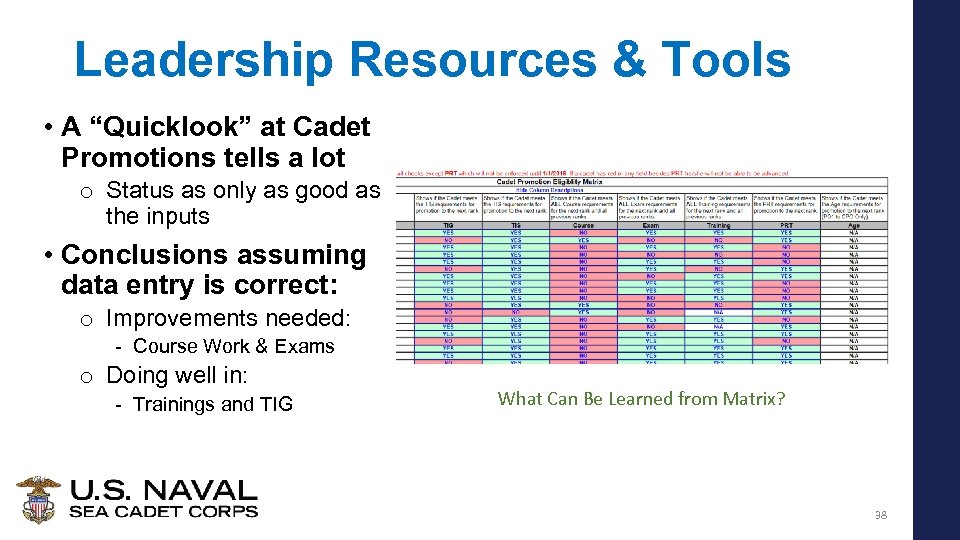
Leadership Resources & Tools • A “Quicklook” at Cadet Promotions tells a lot o Status as only as good as the inputs • Conclusions assuming data entry is correct: o Improvements needed: - Course Work & Exams o Doing well in: - Trainings and TIG What Can Be Learned from Matrix? 38
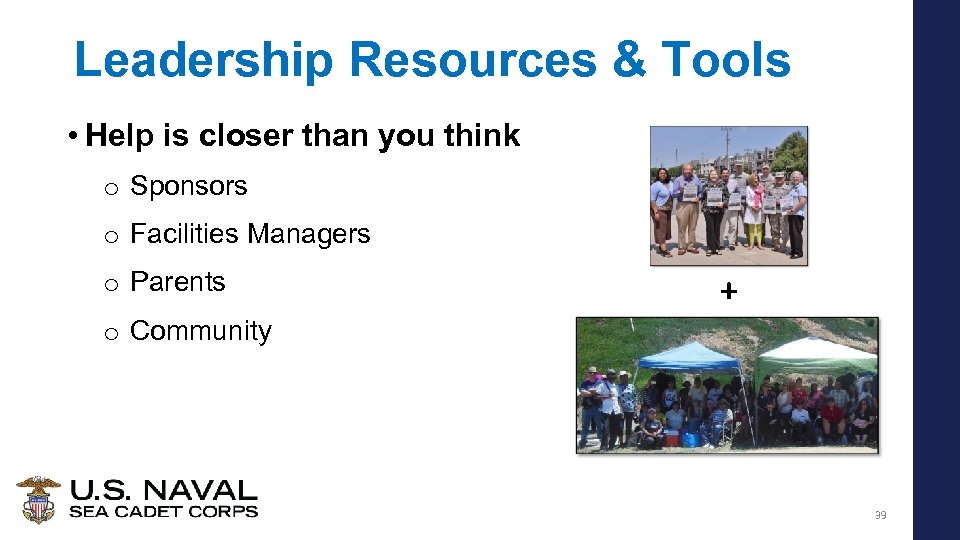
Leadership Resources & Tools • Help is closer than you think o Sponsors o Facilities Managers o Parents + o Community 39
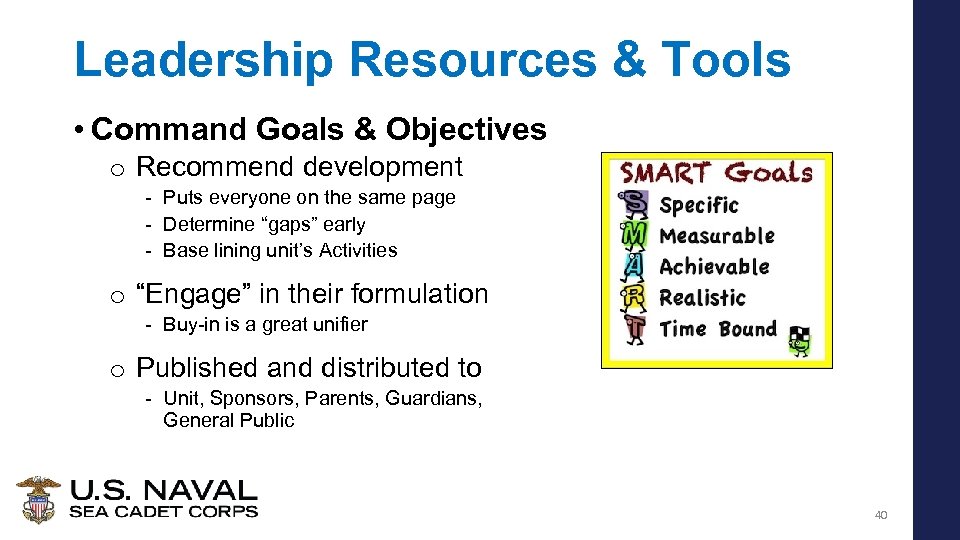
Leadership Resources & Tools • Command Goals & Objectives o Recommend development - Puts everyone on the same page - Determine “gaps” early - Base lining unit’s Activities o “Engage” in their formulation - Buy-in is a great unifier o Published and distributed to - Unit, Sponsors, Parents, Guardians, General Public 40
Group Discussion • What are some of the leading indicators of Sea Cadet Program success? • How would you get Adult Leaders and Cadets on the same page? 41
Leadership Checklist Characteristics of a Strong Unit • Exercising good leadership • from the top down • promoting a sense of teamwork • purpose among all unit members. • Doing fun things getting out of the classroom setting. • Which leads to, enjoying lots of public exposure. 42
Leadership Checklist Characteristics of a Strong Unit • Embracing joint training with other groups/organizations to break the monotony. • Promoting active recruiting programs • include such things as having cadets "bring a buddy" when they come to their first orientation visit with a unit. • Getting the word out about the NSCC. 43
Leadership Checklist Characteristics of a Strong Unit • Empowering cadets. • Cadets are given specific position and responsibility • then held responsible for carrying out duties of that position. • Cadet ownership of units. • For an evolution, event or outing, cadet is given responsibility for the unit. • Examples include taking unit to a [public service] event and being given responsibility for all aspects of getting it done • Participating in a school special event, again where the given cadet gets the entire support of his or her unit. 44
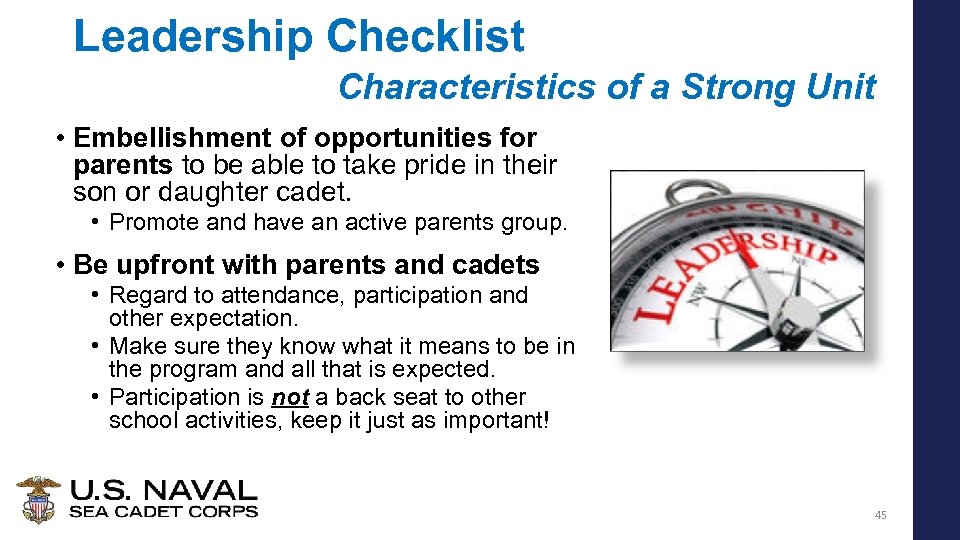
Leadership Checklist Characteristics of a Strong Unit • Embellishment of opportunities for parents to be able to take pride in their son or daughter cadet. • Promote and have an active parents group. • Be upfront with parents and cadets • Regard to attendance, participation and other expectation. • Make sure they know what it means to be in the program and all that is expected. • Participation is not a back seat to other school activities, keep it just as important! 45
Group Discussion • Are there improvements to the Characteristics of a Strong Unit? 46
47
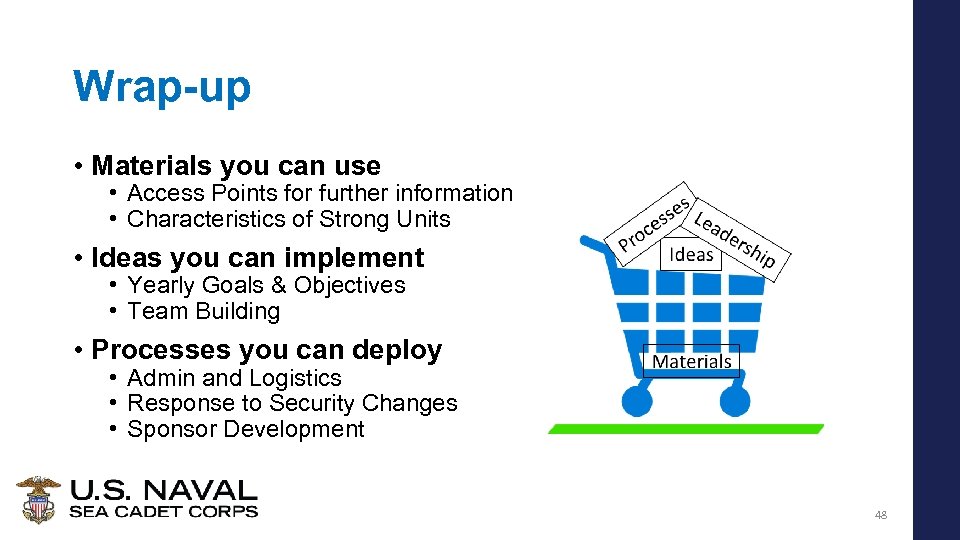
Wrap-up • Materials you can use • Access Points for further information • Characteristics of Strong Units • Ideas you can implement • Yearly Goals & Objectives • Team Building • Processes you can deploy • Admin and Logistics • Response to Security Changes • Sponsor Development 48
Expectations Review
Final Announcements 50
 Скачать презентацию Officer Professional Development OPD-301 Leadership Captain Bill Ratner
740d0617a864dd20239eab38caf39134.ppt