


 Скачать презентацию OFFICE OF SCIENCE Large Synoptic Survey Telescope News
4dd308aa5664a7187ec6ae1adf69b7a5.ppt
- Количество слайдов: 25
 OFFICE OF SCIENCE Large Synoptic Survey Telescope News since the May update Astronomy & Astrophysics Advisory Committee November 2012 Fred Borcherding/Nigel Sharp/Kathy Turner 1
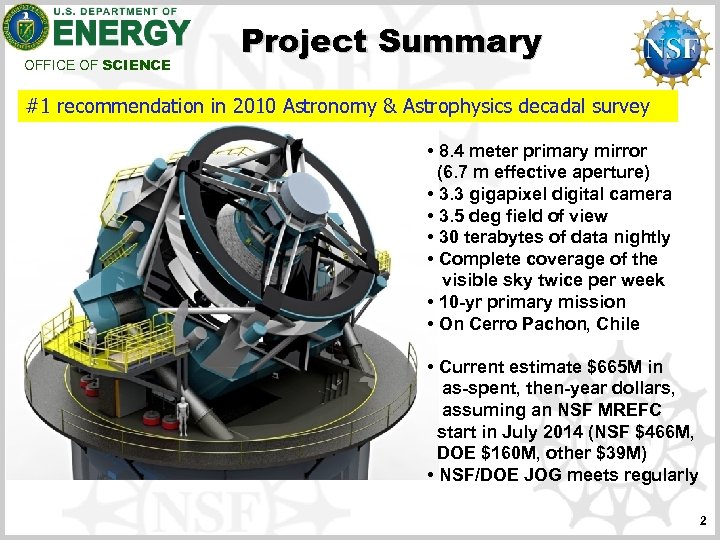 OFFICE OF SCIENCE Project Summary #1 recommendation in 2010 Astronomy & Astrophysics decadal survey • 8. 4 meter primary mirror (6. 7 m effective aperture) • 3. 3 gigapixel digital camera • 3. 5 deg field of view • 30 terabytes of data nightly • Complete coverage of the visible sky twice per week • 10 -yr primary mission • On Cerro Pachon, Chile • Current estimate $665 M in as-spent, then-year dollars, assuming an NSF MREFC start in July 2014 (NSF $466 M, DOE $160 M, other $39 M) • NSF/DOE JOG meets regularly 2
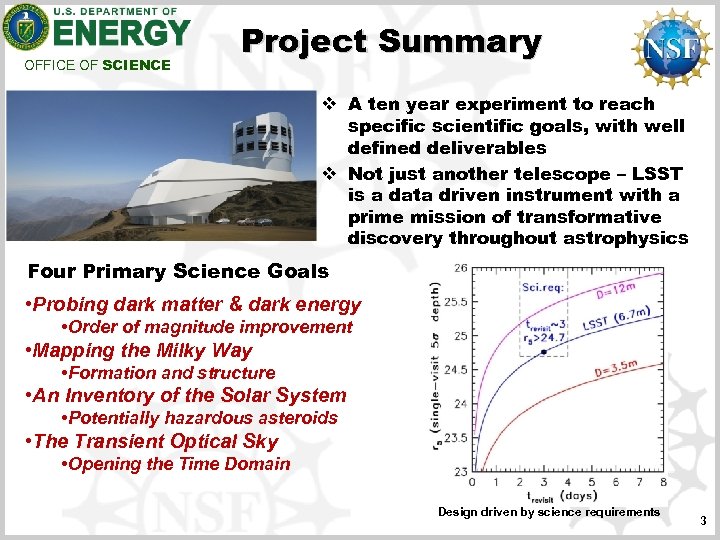 OFFICE OF SCIENCE Project Summary v A ten year experiment to reach specific scientific goals, with well defined deliverables v Not just another telescope – LSST is a data driven instrument with a prime mission of transformative discovery throughout astrophysics Four Primary Science Goals • Probing dark matter & dark energy • Order of magnitude improvement • Mapping the Milky Way • Formation and structure • An Inventory of the Solar System • Potentially hazardous asteroids • The Transient Optical Sky • Opening the Time Domain Design driven by science requirements 3
 OFFICE OF SCIENCE Project Reviews • NSF Preliminary Design Review (PDR) – included camera & interfaces from technical/managerial perspectives “The Panel considers that the LSST project has met the requirements for PDR. ” • • DOE CD-1 ‘Lehman’ review of the Camera The project met all the CD-1 prerequisites “and in some areas has even significantly exceeded them” (DOE sign-off, April 2012) Recommendations echoed by NSF’s internal MREFC process Anticipate that LSST should be the next project to receive NSF MREFC funds for construction, conditional on completion of: 1. An NSF-DOE joint systems engineering review of the whole project 6/01/2012: “LSST team has met the expected standards for this review. ” 2. A signed agreement with DOE in anticipation of a detailed Memorandum of Understanding (MOU) • MOU signed 7/12/2012 (statement of intent signed 4/16/2012) 4
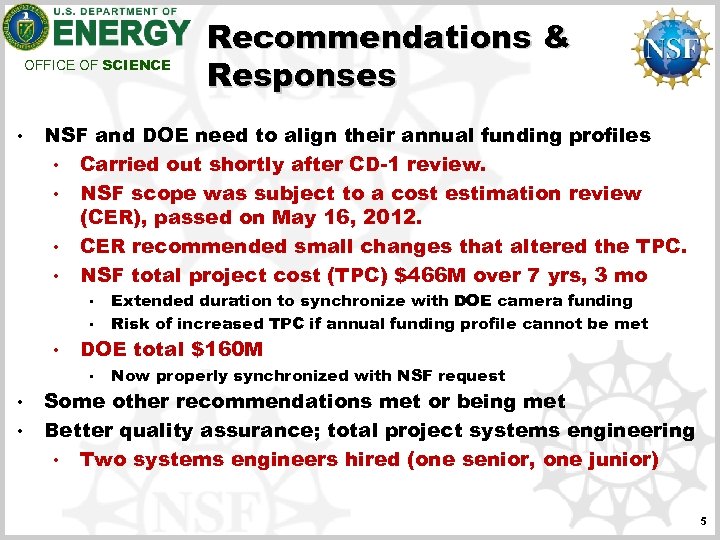 OFFICE OF SCIENCE • NSF and DOE need to align their annual funding profiles • Carried out shortly after CD-1 review. • NSF scope was subject to a cost estimation review (CER), passed on May 16, 2012. • CER recommended small changes that altered the TPC. • NSF total project cost (TPC) $466 M over 7 yrs, 3 mo • • Extended duration to synchronize with DOE camera funding Risk of increased TPC if annual funding profile cannot be met DOE total $160 M • • Recommendations & Responses Now properly synchronized with NSF request Some other recommendations met or being met Better quality assurance; total project systems engineering • Two systems engineers hired (one senior, one junior) 5
 OFFICE OF SCIENCE Result National Science Board Major Actions & Approvals at the July 17 -18, 2012 Meeting Major actions and approvals at the 427 th meeting of the Board included the following (not in priority order): 1. The Board authorized the Director, at his discretion, to include the construction of the Large Synoptic Survey Telescope (LSST) in a future budget. (NSB-12 -31) When? Stay tuned – we don’t know 6
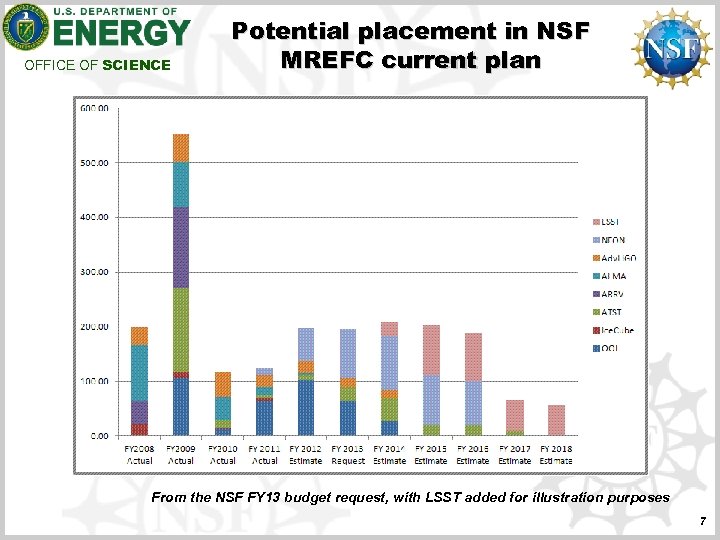 OFFICE OF SCIENCE Potential placement in NSF MREFC current plan From the NSF FY 13 budget request, with LSST added for illustration purposes 7
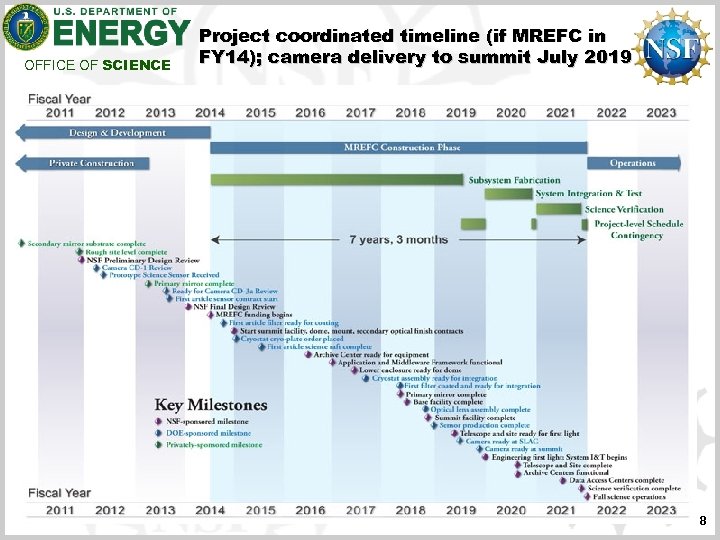 OFFICE OF SCIENCE Project coordinated timeline (if MREFC in FY 14); camera delivery to summit July 2019 8
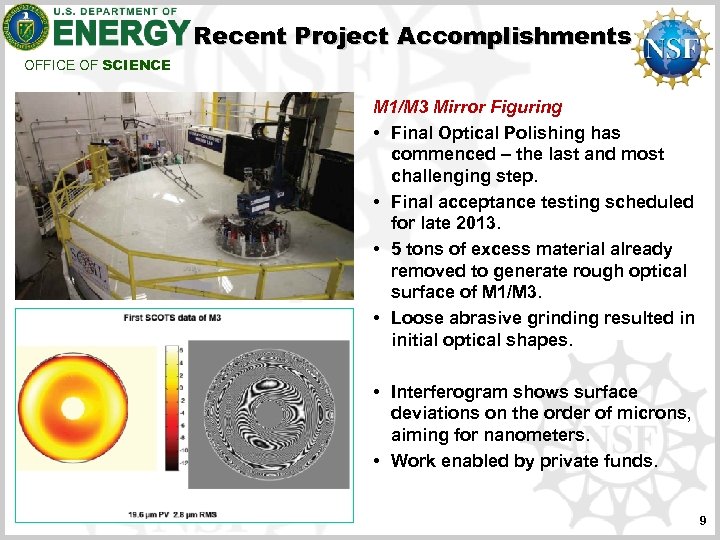 Recent Project Accomplishments OFFICE OF SCIENCE M 1/M 3 Mirror Figuring • Final Optical Polishing has commenced – the last and most challenging step. • Final acceptance testing scheduled for late 2013. • 5 tons of excess material already removed to generate rough optical surface of M 1/M 3. • Loose abrasive grinding resulted in initial optical shapes. • Interferogram shows surface deviations on the order of microns, aiming for nanometers. • Work enabled by private funds. 9
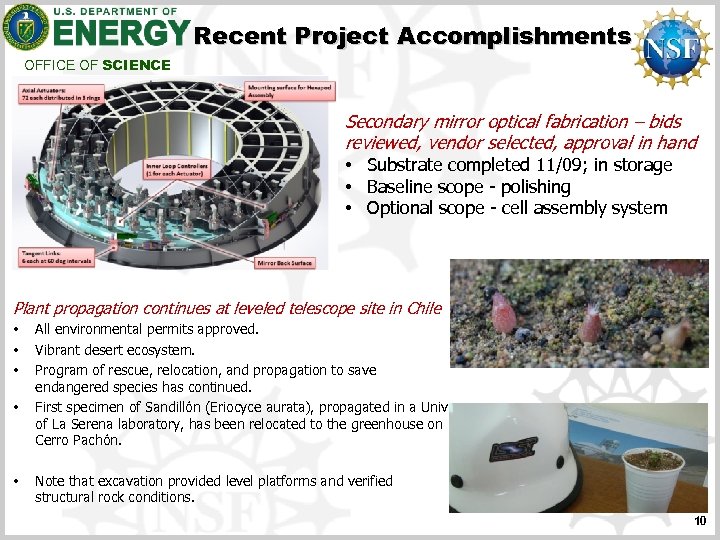 Recent Project Accomplishments OFFICE OF SCIENCE Secondary mirror optical fabrication – bids reviewed, vendor selected, approval in hand • Substrate completed 11/09; in storage • Baseline scope - polishing • Optional scope - cell assembly system Plant propagation continues at leveled telescope site in Chile • • • All environmental permits approved. Vibrant desert ecosystem. Program of rescue, relocation, and propagation to save endangered species has continued. First specimen of Sandillón (Eriocyce aurata), propagated in a Univ. of La Serena laboratory, has been relocated to the greenhouse on Cerro Pachón. Note that excavation provided level platforms and verified structural rock conditions. 10
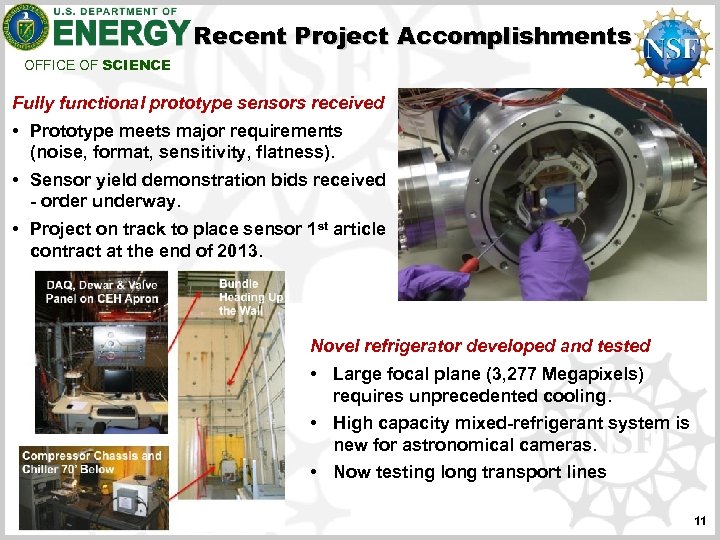 Recent Project Accomplishments OFFICE OF SCIENCE Fully functional prototype sensors received • Prototype meets major requirements (noise, format, sensitivity, flatness). • Sensor yield demonstration bids received - order underway. • Project on track to place sensor 1 st article contract at the end of 2013. Novel refrigerator developed and tested • Large focal plane (3, 277 Megapixels) requires unprecedented cooling. • High capacity mixed-refrigerant system is new for astronomical cameras. • Now testing long transport lines 11
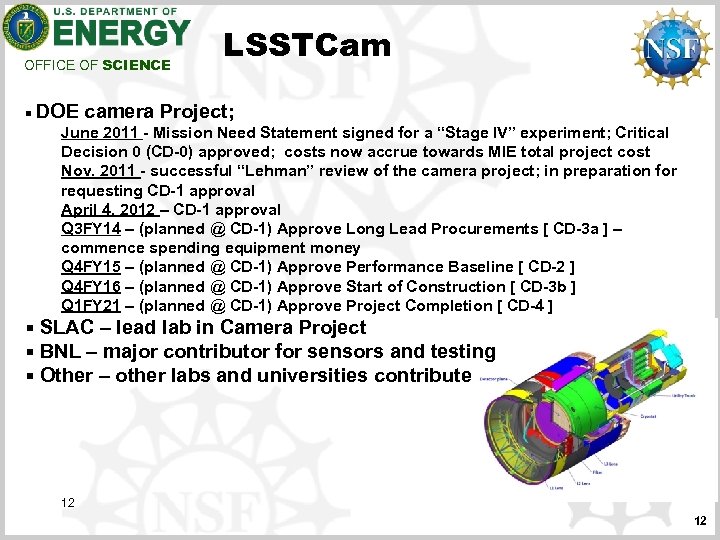 OFFICE OF SCIENCE ¡ LSSTCam DOE camera Project; June 2011 - Mission Need Statement signed for a “Stage IV” experiment; Critical Decision 0 (CD-0) approved; costs now accrue towards MIE total project cost Nov. 2011 - successful “Lehman” review of the camera project; in preparation for requesting CD-1 approval April 4, 2012 – CD-1 approval Q 3 FY 14 – (planned @ CD-1) Approve Long Lead Procurements [ CD-3 a ] – commence spending equipment money Q 4 FY 15 – (planned @ CD-1) Approve Performance Baseline [ CD-2 ] Q 4 FY 16 – (planned @ CD-1) Approve Start of Construction [ CD-3 b ] Q 1 FY 21 – (planned @ CD-1) Approve Project Completion [ CD-4 ] ¡ ¡ ¡ SLAC – lead lab in Camera Project BNL – major contributor for sensors and testing Other – other labs and universities contribute 12 12
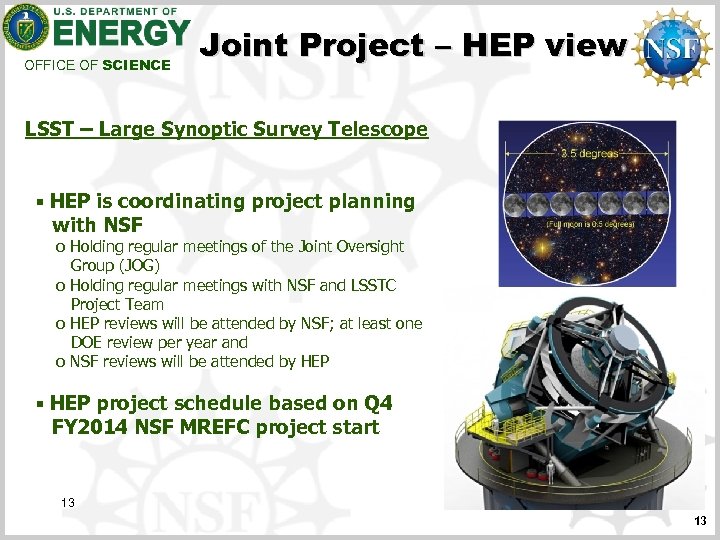 OFFICE OF SCIENCE Joint Project – HEP view LSST – Large Synoptic Survey Telescope ¡ HEP is coordinating project planning with NSF o Holding regular meetings of the Joint Oversight Group (JOG) o Holding regular meetings with NSF and LSSTC Project Team o HEP reviews will be attended by NSF; at least one DOE review per year and o NSF reviews will be attended by HEP ¡ HEP project schedule based on Q 4 FY 2014 NSF MREFC project start 13 13
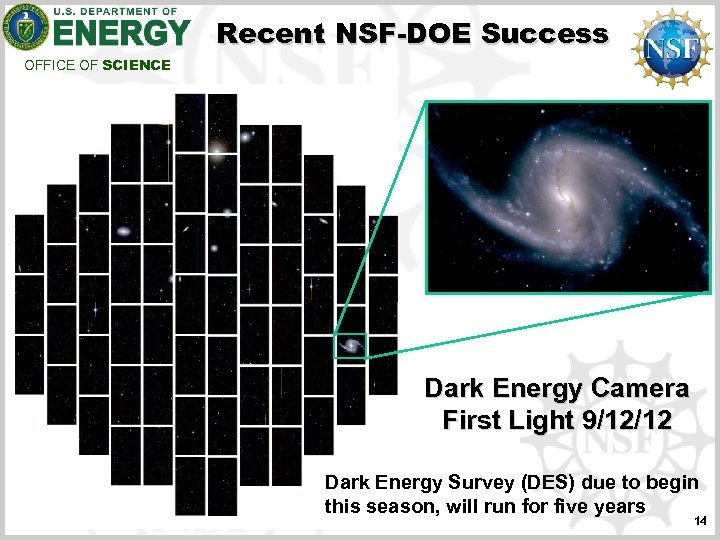 Recent NSF-DOE Success OFFICE OF SCIENCE Dark Energy Camera First Light 9/12/12 Dark Energy Survey (DES) due to begin this season, will run for five years 14
 OFFICE OF SCIENCE • • LSST data policies are still in development. Data levels: • • • Level 1 – nightly delivery of raw images and partial catalogs Level 2 – stacked images and combined catalogs Level 3 – external user-derived material Initial position: • • • LSST data policy Transients – free, open, immediate access Levels 1 and 2 available to US and Chilean institutions when produced Level 2 data may be available worldwide with an annual release Level 3 data depends on the group producing it – these are outside LSST Data access leveraged against financial contributions to annual operations cost, quid-pro-quo access to other facilities (e. g. Euclid), or other contributions to the experiment, under terms yet to be negotiated. External groups will have access levels, probably not with unrestricted rights. They will also not have redistribution rights to use LSST data for any purpose or project they like. NSF-AST and DOE-HEP reserve approval rights over all agreements. 15
 OFFICE OF SCIENCE • Current estimate of $37 M (FY 11 $) annual operating costs • • LSST Operations Costs MOU commits NSF and DOE to respective levels recommended by decadal survey, ~$19 M and ~$9 M Remaining $9 M to be covered by international partners $10. 7 M nominal in 69 letters of intent from 23 countries ($8. 2 M signed by Institute Directors or other management) • 32 participants from 29 potential international affiliates attended LSST All Hands Meeting, from 9 countries: Brazil, China, Hungary, Korea, New Zealand, Russia, Serbia, Switzerland, and the UK • Expect to convert to firm commitments, in exchange for preferred project access, possibly including data access within proprietary period, after MREFC construction approval • • Shortfalls are unlikely, but could be covered either by scope reductions (identified in PDR), or NSF/DOE decisions to increase contributions (discussed in MOU) 05/02/2012 16 16
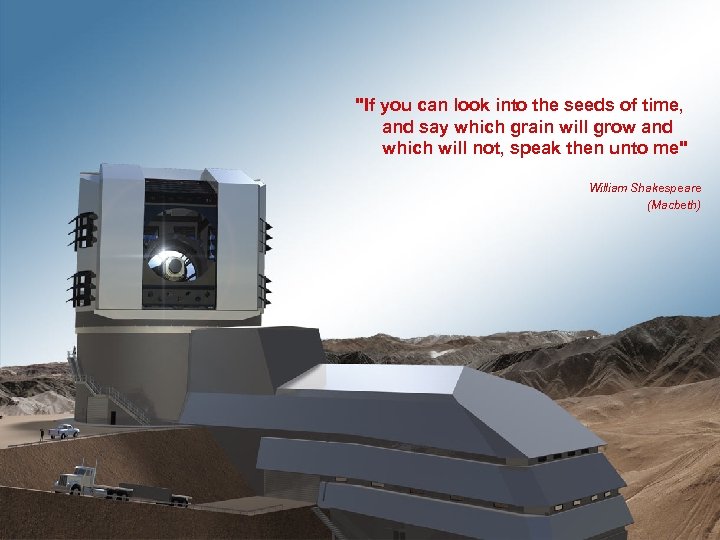 OFFICE OF SCIENCE "If you can look into the seeds of time, and say which grain will grow and which will not, speak then unto me" William Shakespeare (Macbeth) 17
 OFFICE OF SCIENCE Additional Information 18
 OFFICE OF SCIENCE NSF-DOE Memorandum of Understanding • Entered clearance at both agencies 6/8/2012 ─ Common project baseline definition of scope, budget, schedule, and risk ─ Agency oversight roles and responsibilities ─ Integrated project office ─ Development of mutually agreed data policy ─ Operations contributions ─ Exit and termination criteria • MOU was signed by DOE (Director of Office of Science) and NSF (Deputy Director) on July 12. 19
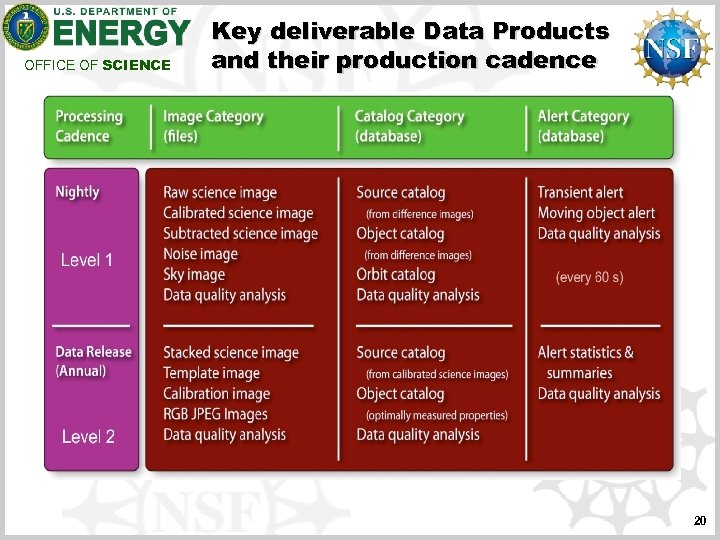 OFFICE OF SCIENCE Key deliverable Data Products and their production cadence 20
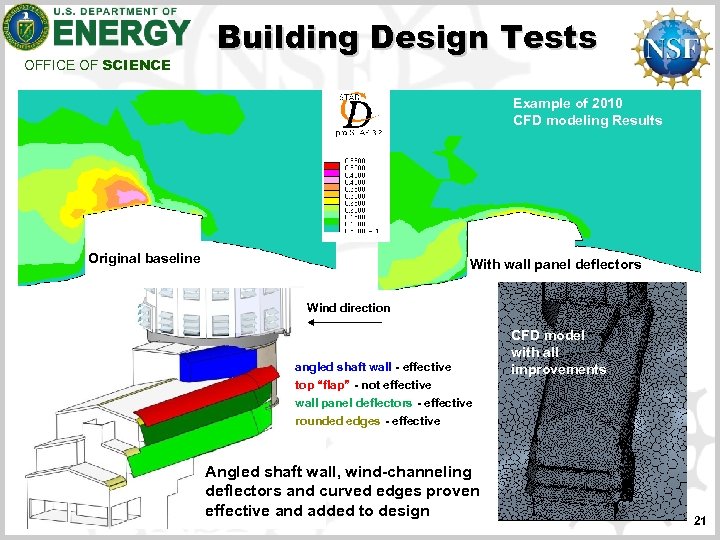 OFFICE OF SCIENCE Building Design Tests Example of 2010 CFD modeling Results Original baseline With wall panel deflectors Wind direction angled shaft wall - effective top “flap” - not effective CFD model with all improvements wall panel deflectors - effective rounded edges - effective Angled shaft wall, wind-channeling deflectors and curved edges proven effective and added to design 21
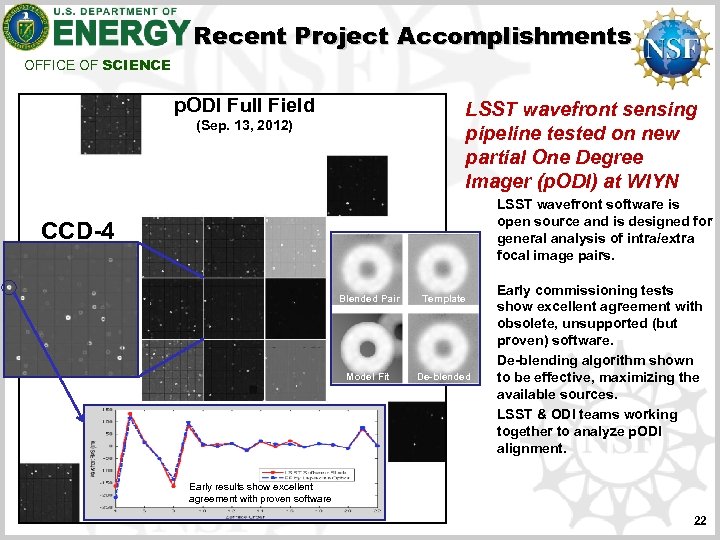 Recent Project Accomplishments OFFICE OF SCIENCE p. ODI Full Field LSST wavefront sensing pipeline tested on new partial One Degree Imager (p. ODI) at WIYN (Sep. 13, 2012) LSST wavefront software is open source and is designed for general analysis of intra/extra focal image pairs. CCD-4 Blended Pair Template Model Fit De-blended Early commissioning tests show excellent agreement with obsolete, unsupported (but proven) software. De-blending algorithm shown to be effective, maximizing the available sources. LSST & ODI teams working together to analyze p. ODI alignment. Early results show excellent agreement with proven software 22
 OFFICE OF SCIENCE LSST scalable database leverages worldwide community developments qserv • qserv packaged for easy multi-node install/admin and successfully installed by IN 2 P 3 • Demonstrated on Winter 2012 at AHM • Fine tuning qserv architecture: integrating with as alternative to • • • Valuable proof that the database architecture is RDBMS agnostic Possible performance gains (columnar vs row-based technology) Working closely with the Monet. DB team for qserv+Monet. DB prototype later this year • 150 node test accomplished last year • Large scale test on JHU hardware • • Planned scale: comparable to DR 1 (1/4 PB) Exploring option of using Im. Sim to generate test data • Very successful XLDB-2012 • 300+ attendees • Strengthened team’s worldwide leadership position in extreme scale data management and analysis • Team instrumental in defining Array. QL (a query language standard and algebra for array databases) • Announced at XLDB-2012 • Seriously exploring XLDB Consortium idea • • • Announced at XLDB-2012 Opportunity to attract serious funding ~20 companies responded so far 23
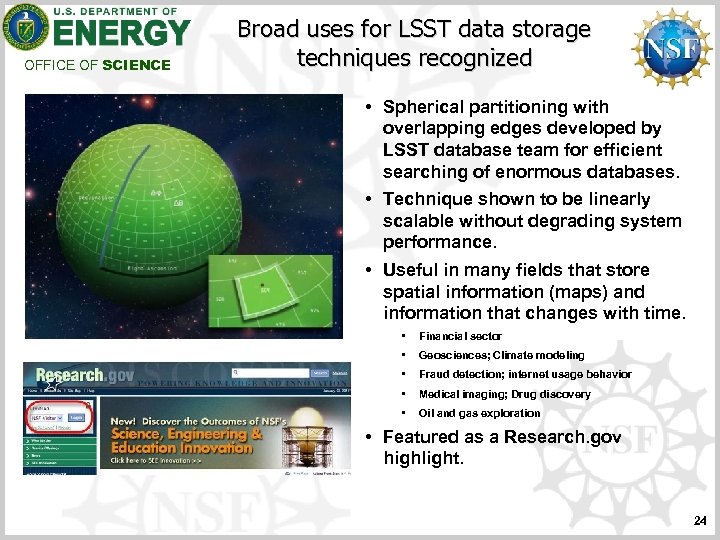 OFFICE OF SCIENCE Broad uses for LSST data storage techniques recognized • Spherical partitioning with overlapping edges developed by LSST database team for efficient searching of enormous databases. • Technique shown to be linearly scalable without degrading system performance. • Useful in many fields that store spatial information (maps) and information that changes with time. • Financial sector • Geosciences; Climate modeling • Fraud detection; internet usage behavior • Medical imaging; Drug discovery • Oil and gas exploration • Featured as a Research. gov highlight. 24
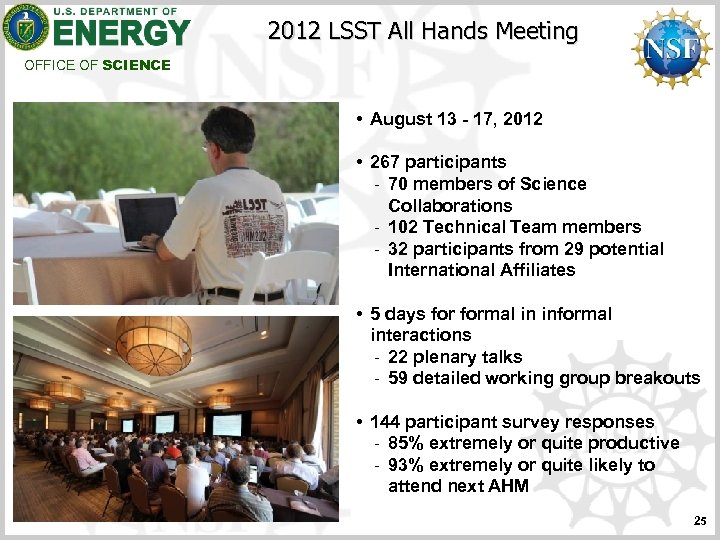 2012 LSST All Hands Meeting OFFICE OF SCIENCE • August 13 - 17, 2012 • 267 participants ‐ 70 members of Science Collaborations ‐ 102 Technical Team members ‐ 32 participants from 29 potential International Affiliates • 5 days formal in informal interactions ‐ 22 plenary talks ‐ 59 detailed working group breakouts • 144 participant survey responses ‐ 85% extremely or quite productive ‐ 93% extremely or quite likely to attend next AHM 25