


 Скачать презентацию Office of School Improvement Student Assistance Programming Creating
1e843e9be5078a4a3fbfaa2a6d6da32f.ppt
- Количество слайдов: 45
 Office of School Improvement Student Assistance Programming: Creating Conditions for Teaching and Learning Part-Two April 24, 2012 Jo Ann Burkholder -----------------------Conference call in information Phone number – 1 -866– 842 -5779 Conference Code – 3305482954 Press *6 to mute your phone Press #6 to unmute
 The ultimate goal in school improvement is for the people attached to the school to drive its continuous improvement for the sake of their own children and students. - Dr. Sam Redding
 Today’s Agenda 1. 2. 3. 4. 5. 6. Welcome Quick Review of Student Assistance Programming Evidence-based Programming Assessing Needs and Evaluating Process Community Partners Building and Sustaining Awareness
 Objectives Participants will: • Be able to incorporate evidence-based programming based on needs assessment • Be aware of assessment and evaluation processes • Have an understanding of engaging community partners • Have an understanding of the importance of informing constituents and transparency (awareness)
 Student Assistance Programming Overview o Adaptable in its scope and flexible in its implementation o Provides division administrators and principals with a proven process o Uses evidence-based curricula, programs, practices, strategies and community services o Fosters positive relationships
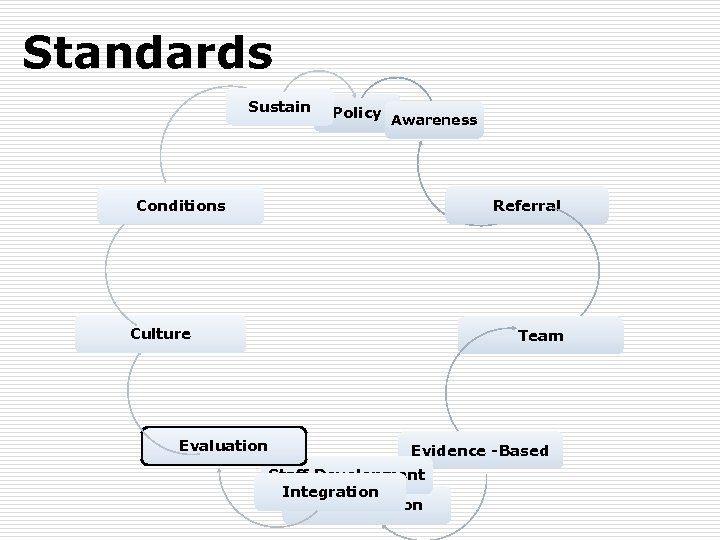 Standards Sustain Policy Awareness Conditions Referral Culture Evaluation Team Evidence -Based Staff Development Integration Collaboration
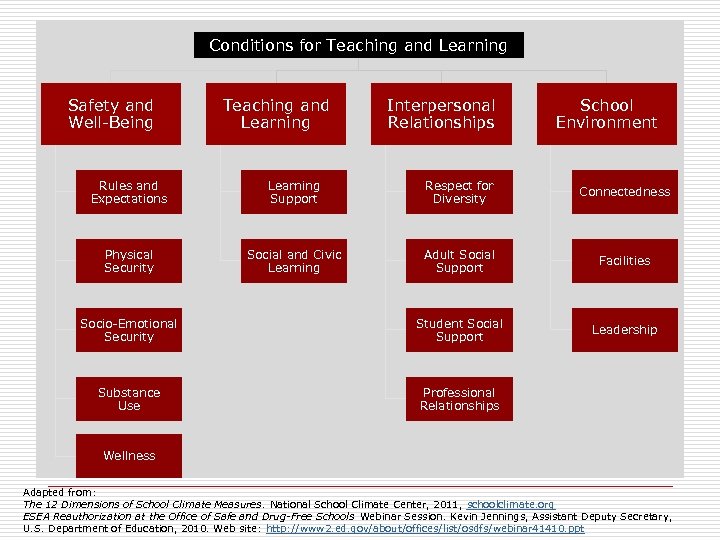 Conditions for Teaching and Learning Safety and Well-Being Teaching and Learning Interpersonal Relationships School Environment Rules and Expectations Learning Support Respect for Diversity Connectedness Physical Security Social and Civic Learning Adult Social Support Facilities Socio-Emotional Security Student Social Support Leadership Substance Use Professional Relationships Wellness Adapted from: The 12 Dimensions of School Climate Measures. National School Climate Center, 2011, schoolclimate. org ESEA Reauthorization at the Office of Safe and Drug-Free Schools Webinar Session. Kevin Jennings, Assistant Deputy Secretary, U. S. Department of Education, 2010. Web site: http: //www 2. ed. gov/about/offices/list/osdfs/webinar 41410. ppt
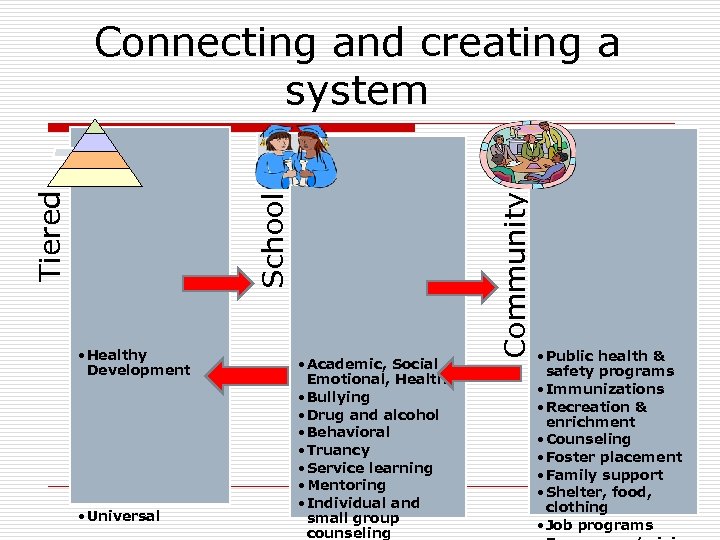 • Healthy Development • Universal • Academic, Social , Emotional, Health • Bullying • Drug and alcohol • Behavioral • Truancy • Service learning • Mentoring • Individual and small group counseling Community School Tiered Connecting and creating a system • Public health & safety programs • Immunizations • Recreation & enrichment • Counseling • Foster placement • Family support • Shelter, food, clothing • Job programs
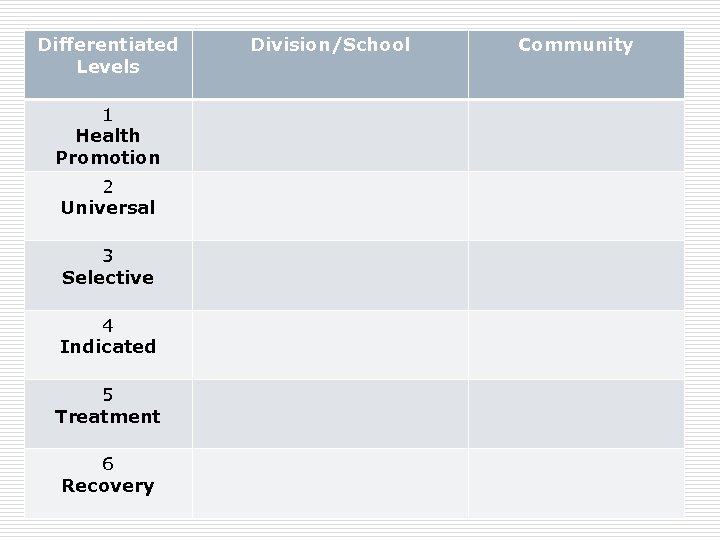 Differentiated Levels 1 Health Promotion 2 Universal 3 Selective 4 Indicated 5 Treatment 6 Recovery Division/School Community
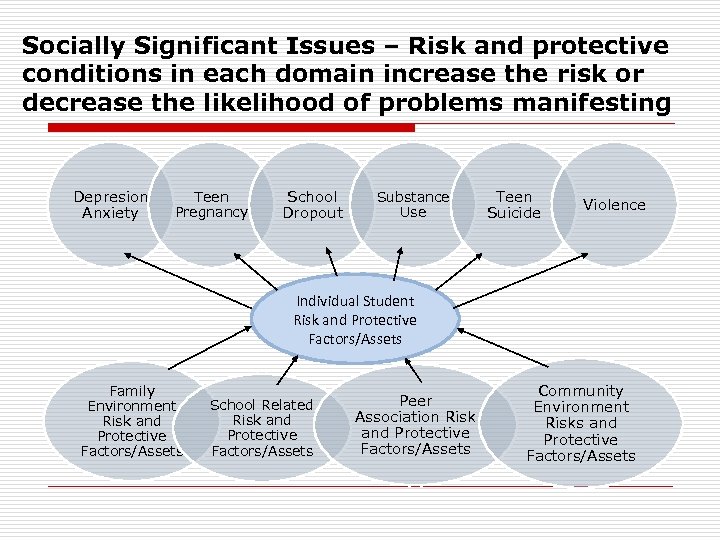 Socially Significant Issues – Risk and protective conditions in each domain increase the risk or decrease the likelihood of problems manifesting Depresion Anxiety Teen Pregnancy School Dropout Substance Use Teen Suicide Violence Individual Student Risk and Protective Factors/Assets Family Environment Risk and Protective Factors/Assets School Related Risk and Protective Factors/Assets Peer Association Risk and Protective Factors/Assets Community Environment Risks and Protective Factors/Assets
 School Improvement Teams work with other sub-groups depending on school organizational structure o Sub-teams or groups of people with specific task n Early Warning System Team – monitors and tracks students n Group that interviews students and parents, develops support plans and makes the connections with in-school and community supports (e. g. , SAP Coreteam)
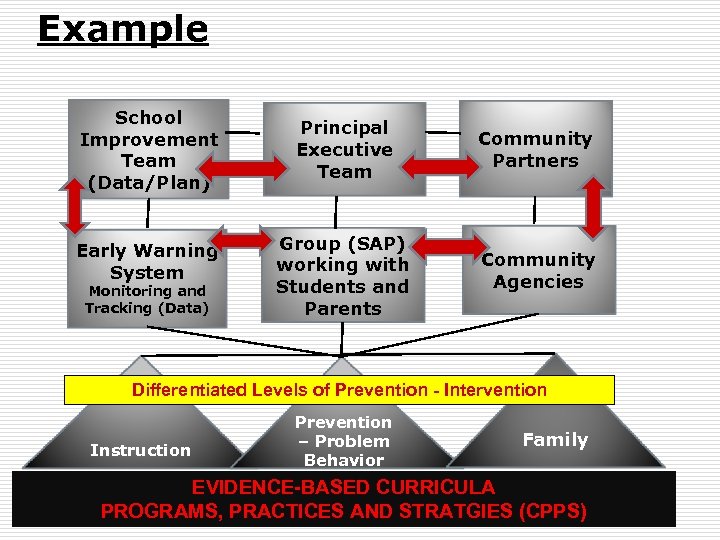 Example School Improvement Team (Data/Plan) Early Warning System Monitoring and Tracking (Data) Principal Executive Team Community Partners Group (SAP) working with Students and Parents Community Agencies Differentiated Levels of Prevention - Intervention Instruction Prevention – Problem Behavior Family EVIDENCE-BASED CURRICULA PROGRAMS, PRACTICES AND STRATGIES (CPPS)
 What is evidence-based o Instruction, program, practices or strategies that has been documented to work well n Tested under rigorous scientific conditions and is proven to improve outcomes or lower risk n Several agencies provide rating scores on programs, practices or strategies
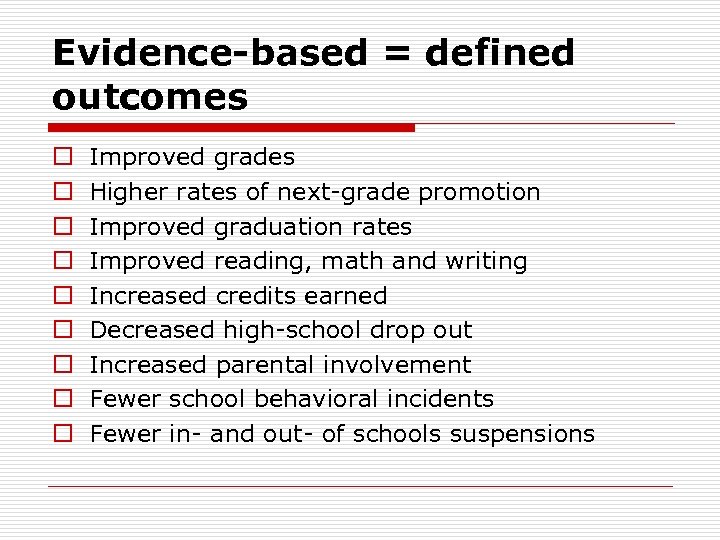 Evidence-based = defined outcomes o o o o o Improved grades Higher rates of next-grade promotion Improved graduation rates Improved reading, math and writing Increased credits earned Decreased high-school drop out Increased parental involvement Fewer school behavioral incidents Fewer in- and out- of schools suspensions
 No single evidence-based CPPS can achieve all those outcomes Stop
 How is it decided what evidencebased CPPS are needed? A. Start with an analysis of the data to determine/prioritize need B. Determine what is the best fit C. Evaluate
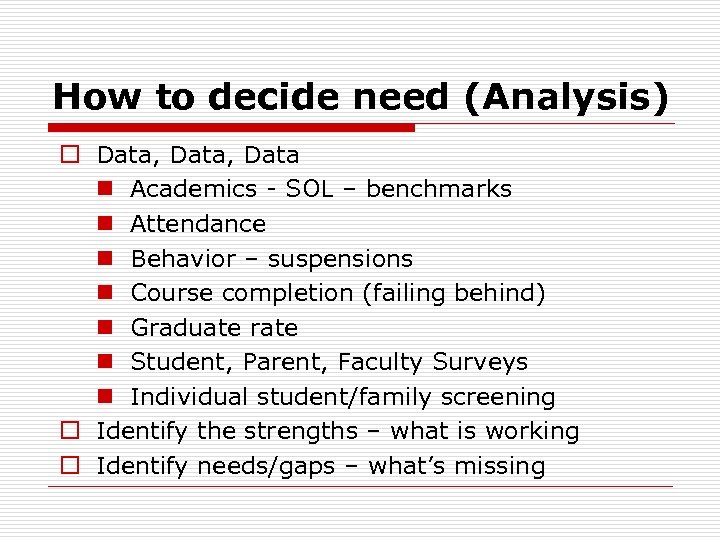 How to decide need (Analysis) o Data, Data n Academics - SOL – benchmarks n Attendance n Behavior – suspensions n Course completion (failing behind) n Graduate rate n Student, Parent, Faculty Surveys n Individual student/family screening o Identify the strengths – what is working o Identify needs/gaps – what’s missing
 Determine what is the best fit o Review evidence-based web sites n Select programs, strategies, practices (interventions) o Implement o Build in evaluation process
 Evaluate o Short-term – benchmarks, attendance, behavior (suspensions), course completion, pre/post-test (Quick wins) o Long-term – student, staff, parent surveys
 Chose an evidence-based CPPS based on: n n n Applicability to the target audience Proven measurable positive outcomes Practicality Cost effectiveness Sustainability
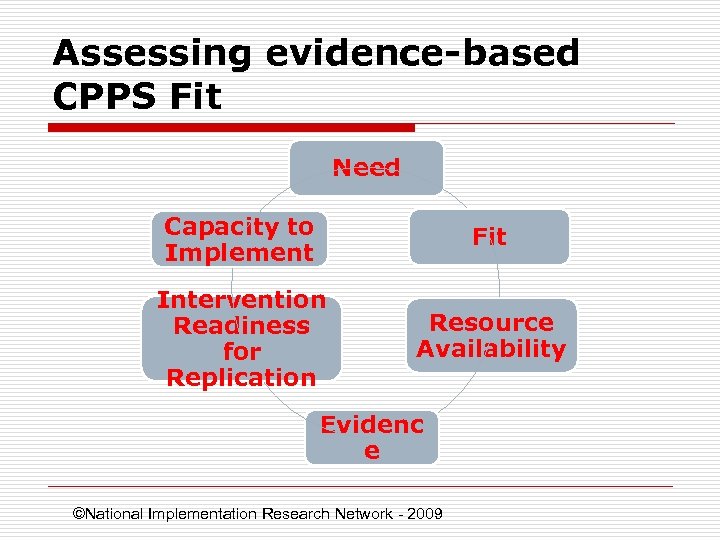 Assessing evidence-based CPPS Fit Need Capacity to Implement Fit Intervention Readiness for Replication Resource Availability Evidenc e ©National Implementation Research Network - 2009
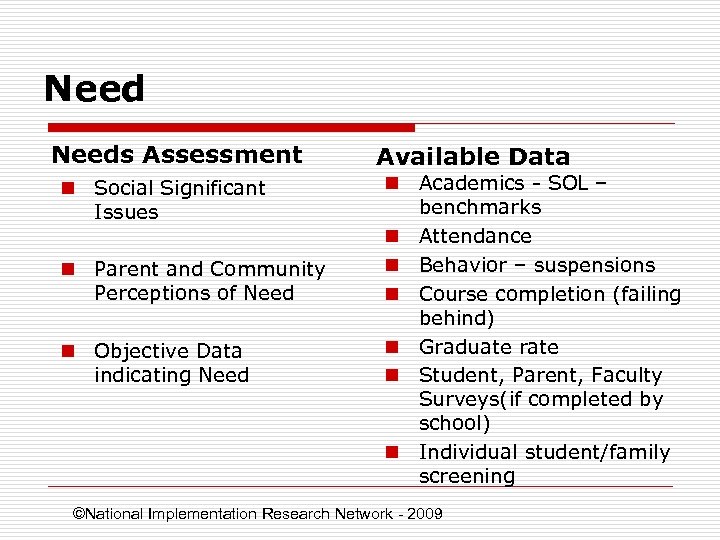 Needs Assessment n Social Significant Issues n Parent and Community Perceptions of Need n Objective Data indicating Need Available Data n Academics - SOL – benchmarks n Attendance n Behavior – suspensions n Course completion (failing behind) n Graduate rate n Student, Parent, Faculty Surveys(if completed by school) n Individual student/family screening ©National Implementation Research Network - 2009
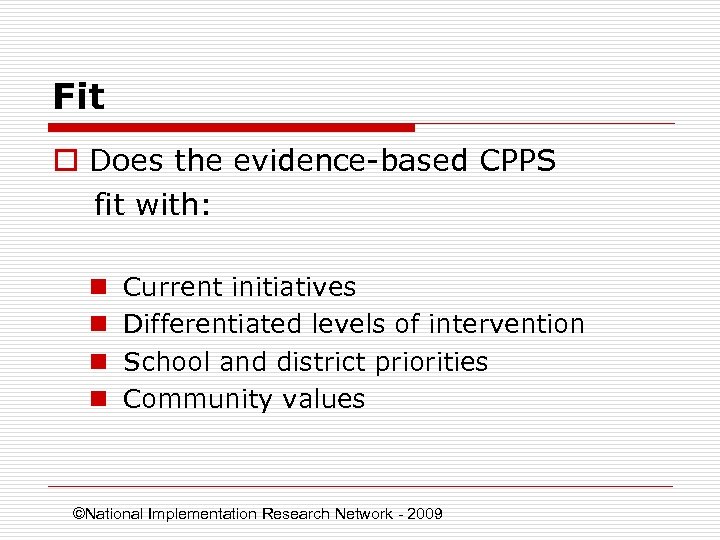 Fit o Does the evidence-based CPPS fit with: n n Current initiatives Differentiated levels of intervention School and district priorities Community values ©National Implementation Research Network - 2009
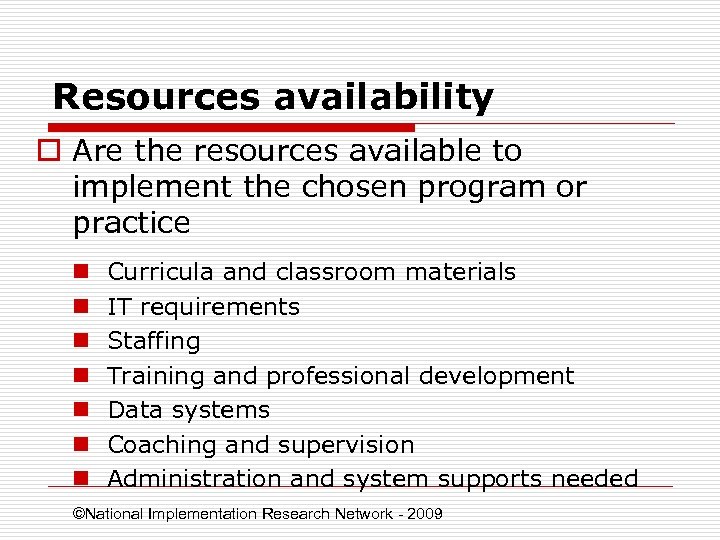 Resources availability o Are the resources available to implement the chosen program or practice n n n n Curricula and classroom materials IT requirements Staffing Training and professional development Data systems Coaching and supervision Administration and system supports needed ©National Implementation Research Network - 2009
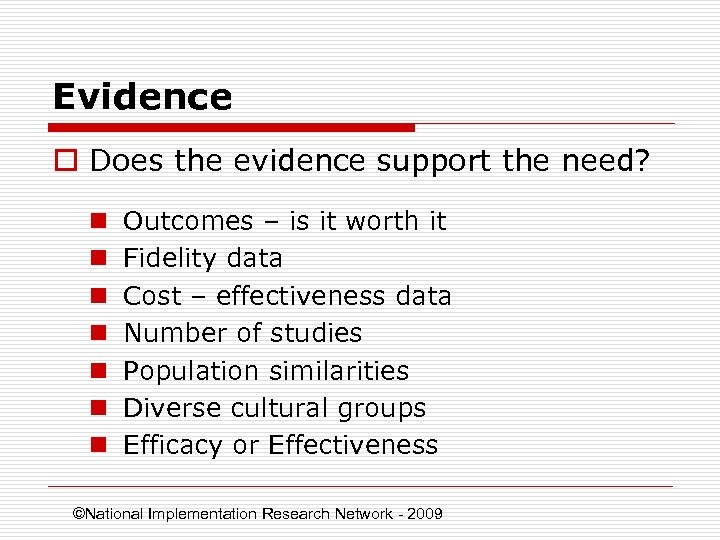 Evidence o Does the evidence support the need? n n n n Outcomes – is it worth it Fidelity data Cost – effectiveness data Number of studies Population similarities Diverse cultural groups Efficacy or Effectiveness ©National Implementation Research Network - 2009
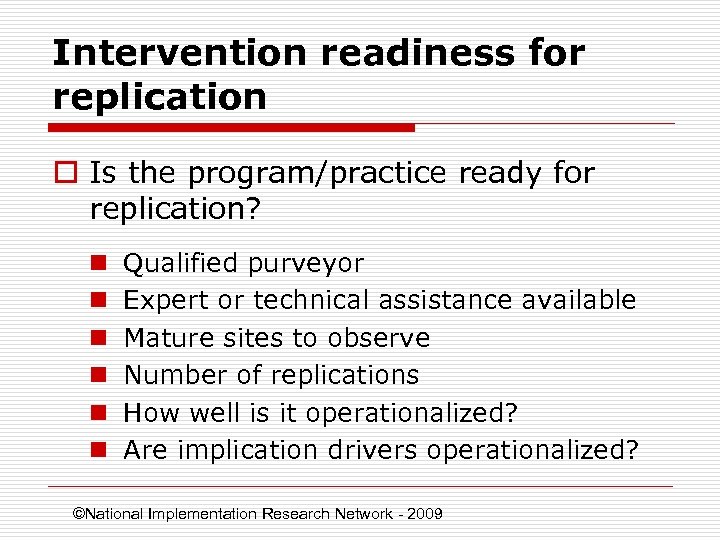 Intervention readiness for replication o Is the program/practice ready for replication? n n n Qualified purveyor Expert or technical assistance available Mature sites to observe Number of replications How well is it operationalized? Are implication drivers operationalized? ©National Implementation Research Network - 2009
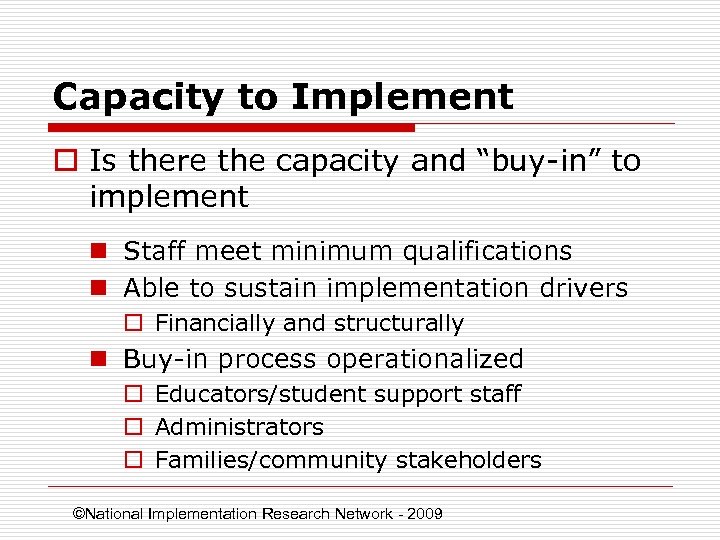 Capacity to Implement o Is there the capacity and “buy-in” to implement n Staff meet minimum qualifications n Able to sustain implementation drivers o Financially and structurally n Buy-in process operationalized o Educators/student support staff o Administrators o Families/community stakeholders ©National Implementation Research Network - 2009
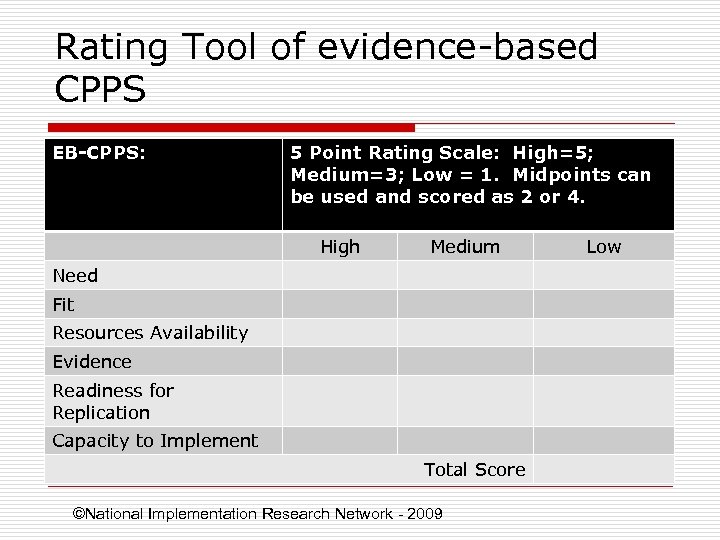 Rating Tool of evidence-based CPPS EB-CPPS: 5 Point Rating Scale: High=5; Medium=3; Low = 1. Midpoints can be used and scored as 2 or 4. High Medium Need Fit Resources Availability Evidence Readiness for Replication Capacity to Implement Total Score ©National Implementation Research Network - 2009 Low
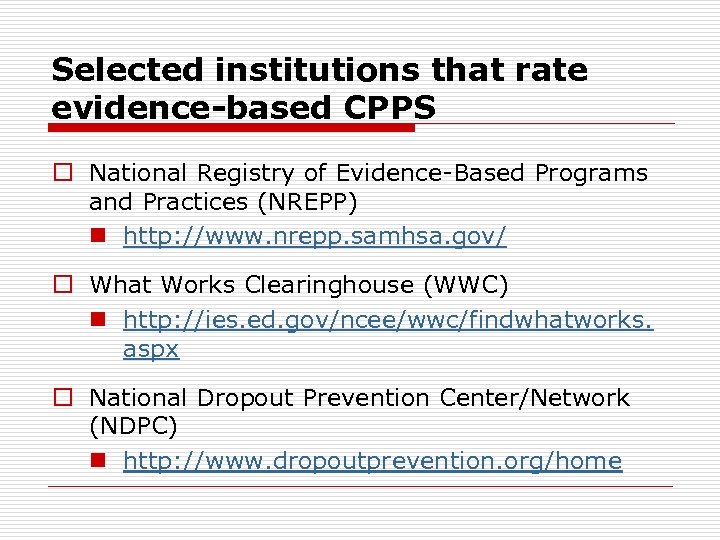 Selected institutions that rate evidence-based CPPS o National Registry of Evidence-Based Programs and Practices (NREPP) n http: //www. nrepp. samhsa. gov/ o What Works Clearinghouse (WWC) n http: //ies. ed. gov/ncee/wwc/findwhatworks. aspx o National Dropout Prevention Center/Network (NDPC) n http: //www. dropoutprevention. org/home
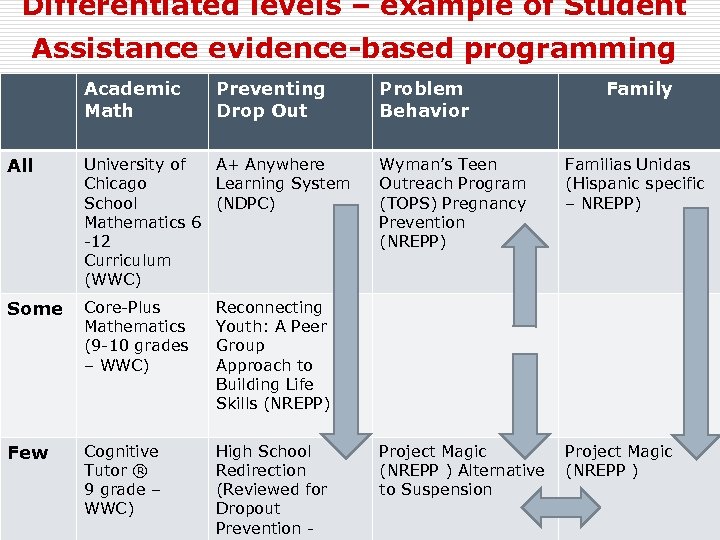 Differentiated levels – example of Student Assistance evidence-based programming Academic Math Preventing Drop Out All University of A+ Anywhere Chicago Learning System School (NDPC) Mathematics 6 -12 Curriculum (WWC) Some Core-Plus Mathematics (9 -10 grades – WWC) Cognitive Tutor ® 9 grade – WWC) High School Redirection (Reviewed for Dropout Prevention - Family Reconnecting Youth: A Peer Group Approach to Building Life Skills (NREPP) Few Problem Behavior Wyman’s Teen Outreach Program (TOPS) Pregnancy Prevention (NREPP) Familias Unidas (Hispanic specific – NREPP) Project Magic (NREPP ) Alternative (NREPP ) to Suspension
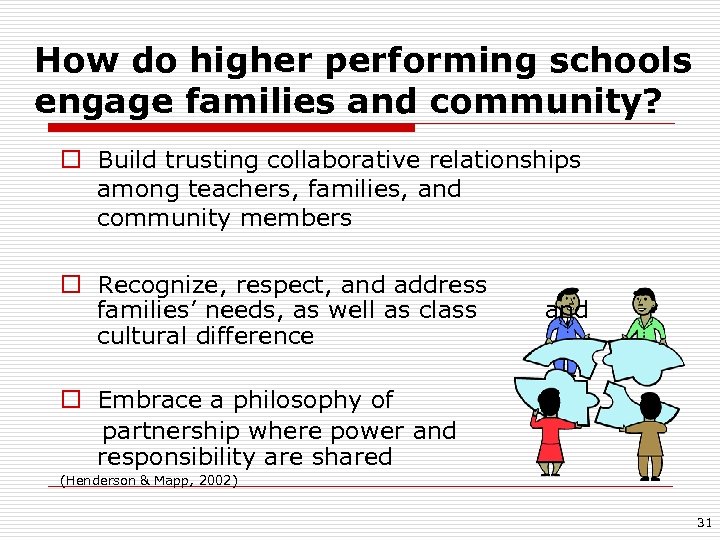 How do higher performing schools engage families and community? o Build trusting collaborative relationships among teachers, families, and community members o Recognize, respect, and address families’ needs, as well as class and cultural difference o Embrace a philosophy of partnership where power and responsibility are shared (Henderson & Mapp, 2002) 31
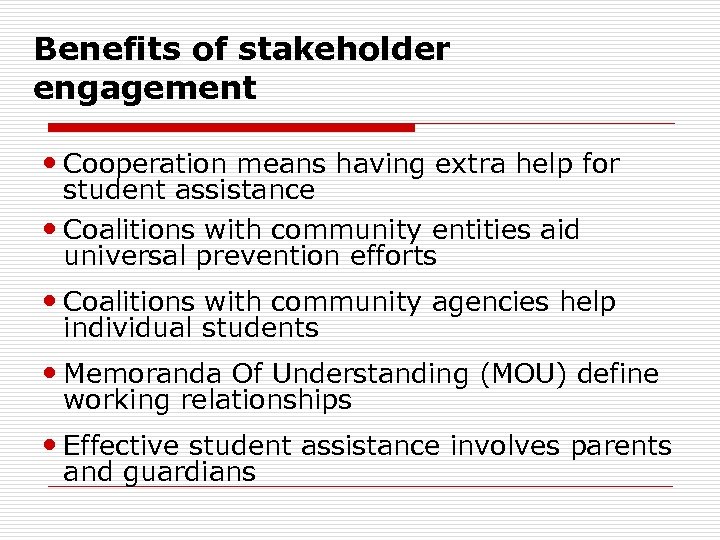 Benefits of stakeholder engagement Cooperation means having extra help for student assistance Coalitions with community entities aid universal prevention efforts Coalitions with community agencies help individual students Memoranda Of Understanding (MOU) define working relationships Effective student assistance involves parents and guardians
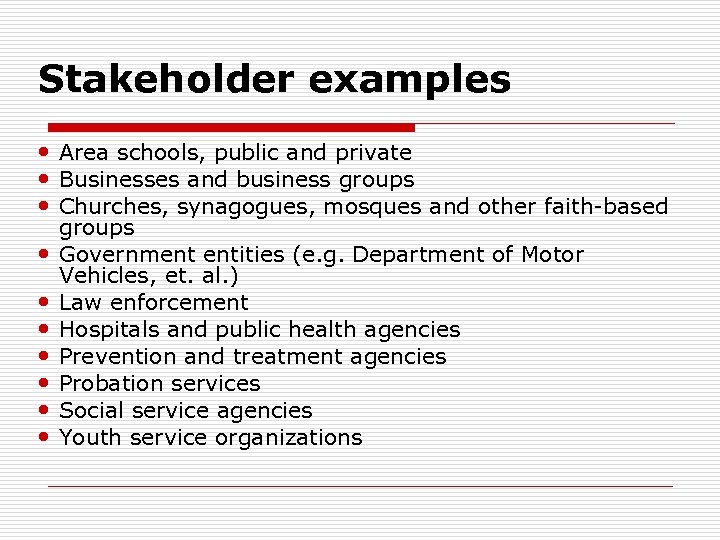 Stakeholder examples Area schools, public and private Businesses and business groups Churches, synagogues, mosques and other faith-based groups Government entities (e. g. Department of Motor Vehicles, et. al. ) Law enforcement Hospitals and public health agencies Prevention and treatment agencies Probation services Social service agencies Youth service organizations
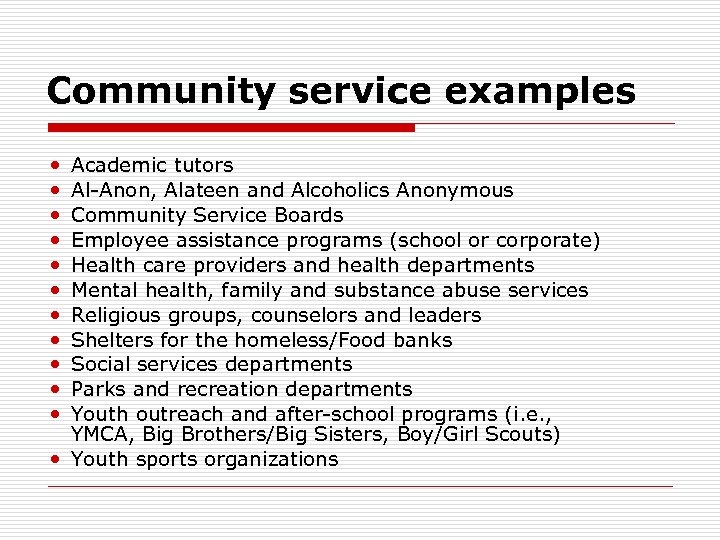 Community service examples Academic tutors Al-Anon, Alateen and Alcoholics Anonymous Community Service Boards Employee assistance programs (school or corporate) Health care providers and health departments Mental health, family and substance abuse services Religious groups, counselors and leaders Shelters for the homeless/Food banks Social services departments Parks and recreation departments Youth outreach and after-school programs (i. e. , YMCA, Big Brothers/Big Sisters, Boy/Girl Scouts) Youth sports organizations
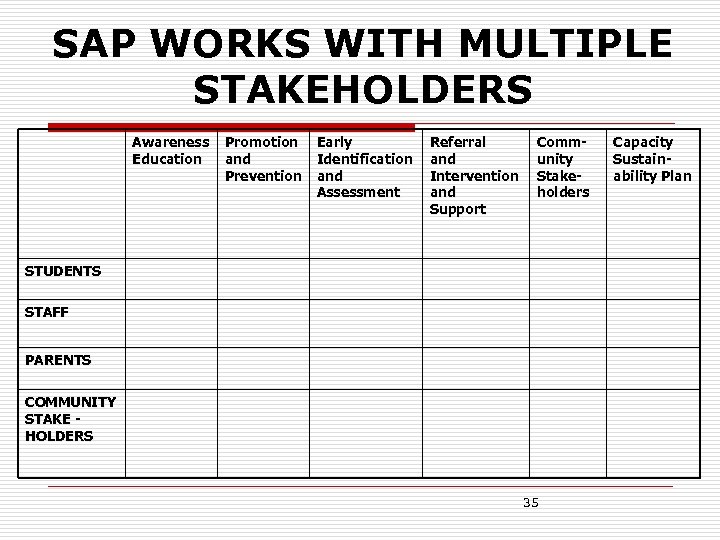 SAP WORKS WITH MULTIPLE STAKEHOLDERS Awareness Education Promotion and Prevention Early Identification and Assessment Referral and Intervention and Support Community Stakeholders STUDENTS STAFF PARENTS COMMUNITY STAKE HOLDERS 35 Capacity Sustainability Plan
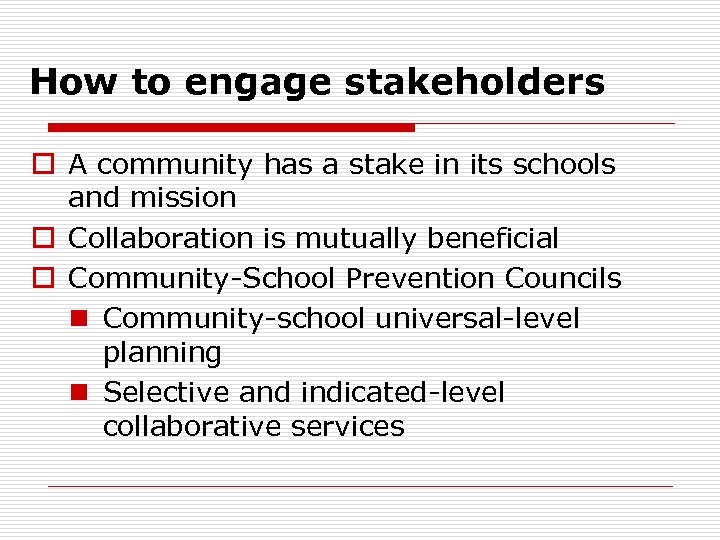 How to engage stakeholders o A community has a stake in its schools and mission o Collaboration is mutually beneficial o Community-School Prevention Councils n Community-school universal-level planning n Selective and indicated-level collaborative services
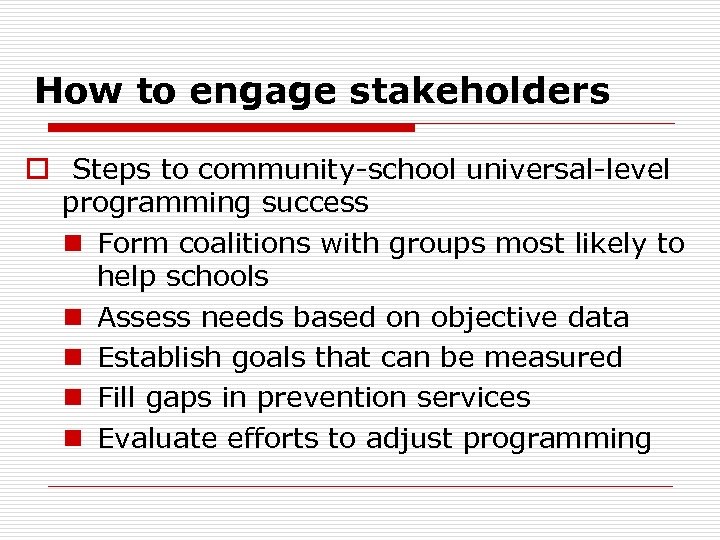 How to engage stakeholders o Steps to community-school universal-level programming success n Form coalitions with groups most likely to help schools n Assess needs based on objective data n Establish goals that can be measured n Fill gaps in prevention services n Evaluate efforts to adjust programming
 How to engage stakeholders o Know the people and groups with whom to collaborate o Know how community agencies function o Schools and stakeholders share information back and forth to better coordinate efforts o Support stakeholder initiatives
 How to engage stakeholders Develop Memoranda of Understanding (MOU) together Clarify expectations and roles Communication and coordination Confidentiality Monitoring and evaluation Review periodically and adjust
 Building and sustaining awareness/transparency o The goal of SAP is prevention for everyone and intervention for students who need assistance n Both depend on widespread awareness for success o Awareness is a two-part process: n social marketing focuses on specific problems to dispel myths n awareness events about youth issues/needs with resources n both should be informative about the SAP process and how to make referrals
 Social marketing o Dispelling myths n n School Staff Students Parents Community
 Building and Sustaining Awareness/Transparency o Awareness must begin with faculty and staff and repeated yearly o School-wide activities and events, classroom presentations are effective with students and result in referrals o Awareness/reporting survey results and outcome data n parents, public and private groups and organizations that provide prevention and assistance services or link to services within the community
 Reflections Identify: n 3 take aways n 2 things to improve n 1 thing to do
 For More Information contact Jo Ann Burkholder, Coordinator Student Assistance Systems 804 -371 -7586 E-mail – joann. burkholder@doe. virginia. gov
 A Round of Applause To You!