 Скачать презентацию OER and CC Licensing Lila Bailey Counsel cc
c7464baeef208870e4cdd6da3a6688fe.ppt
- Количество слайдов: 17



OER and CC Licensing Lila Bailey Counsel, cc. Learn April 23, 2009 This presentation is licensed:
What makes educational resources OPEN? The ability to: • Access • Share — Copy, Distribute, Display • Adapt — Perform, Translate • Derive — Remix The openness of a resource increases with the permissions given. More permissions = More open.
OER form a Network. • Teachers like to share and adapt materials for the classroom. • Students consume these materials, but they only learn by actively taking part in the process of creation. • We learn by doing what has been done before; we create by re-creating, by building off others’ work. Learning occurs through exchange of and collaboration on the expression of ideas.
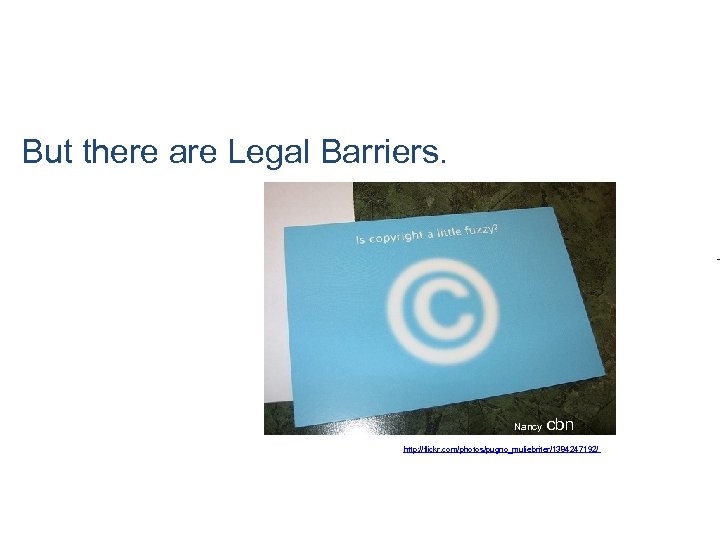
But there are Legal Barriers. T Nancy cbn http: //flickr. com/photos/pugno_muliebriter/1384247192/
Expression is often restricted. By default, expression is copyrighted at the moment of creation. Copyrighted material cannot be shared, adapted, derived, and in some circumstances, even accessed without express permission from copyright owner. When people, especially educators, put materials on the web, it is usually with the purpose of making it freely available. Unfortunately, copyright overrules this intent. And if you don’t license your work to be open, it automatically defaults to all rights reserved copyright.
Creative Commons Licenses. • CC Licenses work with copyright. They do not replace copyright, but instead grant the public permissions for certain uses that would otherwise be disallowed by law. • The author still retains her ownership of a work; she simply chooses which freedoms she wishes her work to carry automatically, without requiring permission. • This makes perfect sense in education especially, since most people want to share and build off of each other’s work.
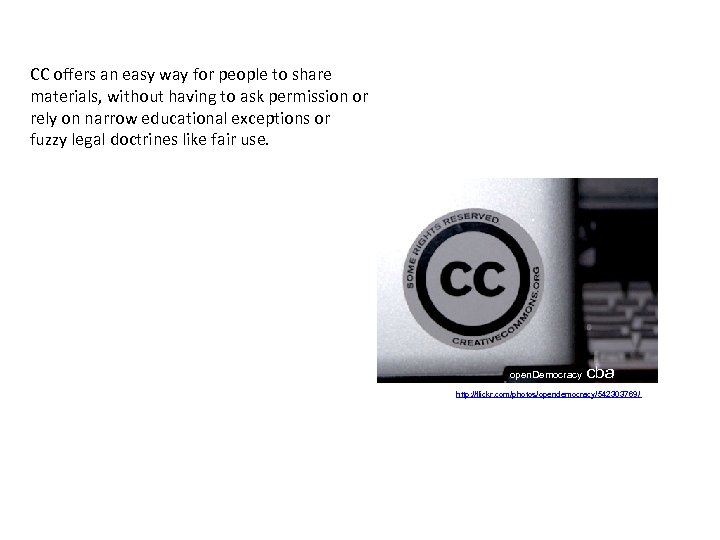
CC offers an easy way for people to share materials, without having to ask permission or rely on narrow educational exceptions or fuzzy legal doctrines like fair use. open. Democracy cba http: //flickr. com/photos/opendemocracy/542303769/
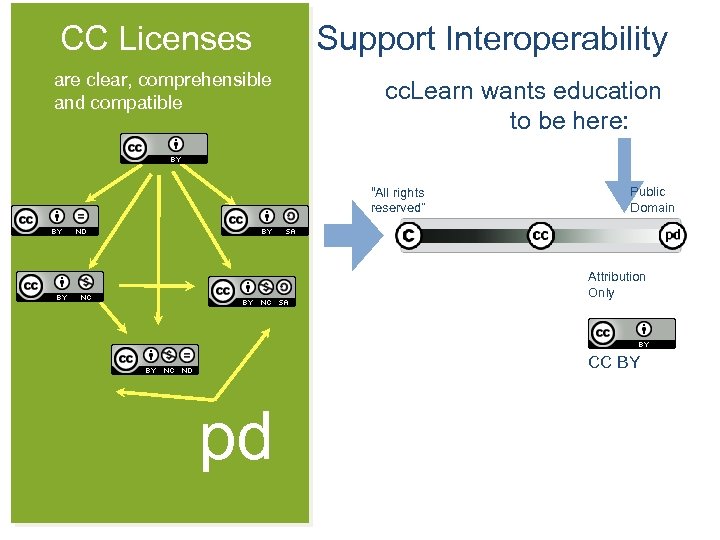
CC Licenses are clear, comprehensible and compatible Support Interoperability cc. Learn wants education to be here: “All rights reserved” Public Domain Attribution Only CC BY pd
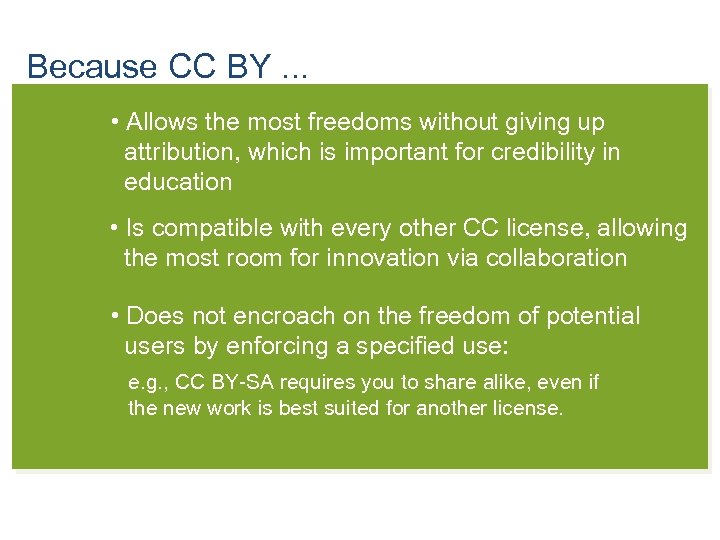
Because CC BY. . . • Allows the most freedoms without giving up attribution, which is important for credibility in education • Is compatible with every other CC license, allowing the most room for innovation via collaboration • Does not encroach on the freedom of potential users by enforcing a specified use: e. g. , CC BY-SA requires you to share alike, even if the new work is best suited for another license.
CC License Case Studies Which License should I use when?
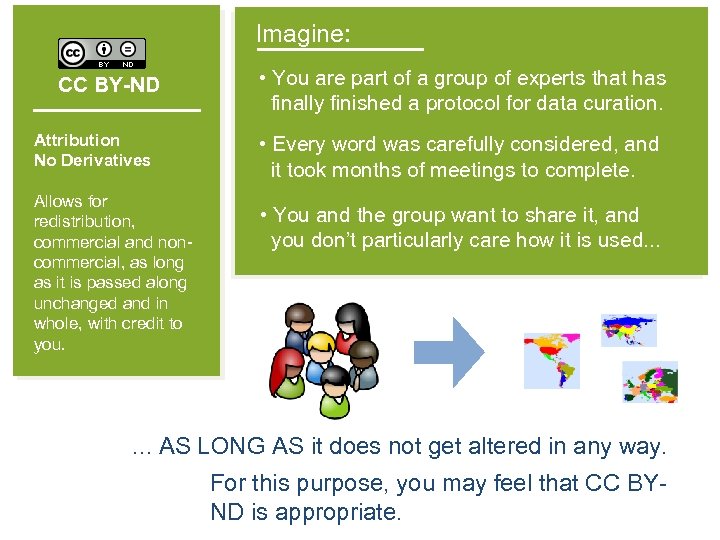
Imagine: CC BY-ND Attribution No Derivatives Allows for redistribution, commercial and noncommercial, as long as it is passed along unchanged and in whole, with credit to you. • You are part of a group of experts that has finally finished a protocol for data curation. • Every word was carefully considered, and it took months of meetings to complete. • You and the group want to share it, and you don’t particularly care how it is used. . . AS LONG AS it does not get altered in any way. For this purpose, you may feel that CC BYND is appropriate.
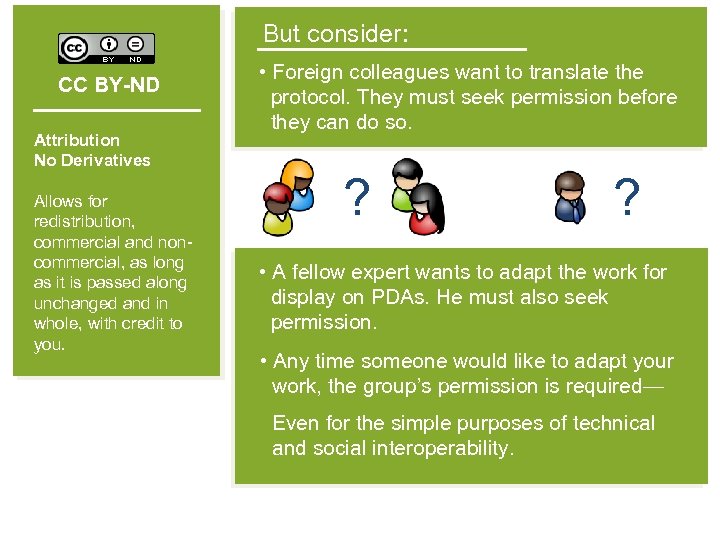
But consider: CC BY-ND Attribution No Derivatives Allows for redistribution, commercial and noncommercial, as long as it is passed along unchanged and in whole, with credit to you. • Foreign colleagues want to translate the protocol. They must seek permission before they can do so. ? ? • A fellow expert wants to adapt the work for display on PDAs. He must also seek permission. • Any time someone would like to adapt your work, the group’s permission is required— Even for the simple purposes of technical and social interoperability.
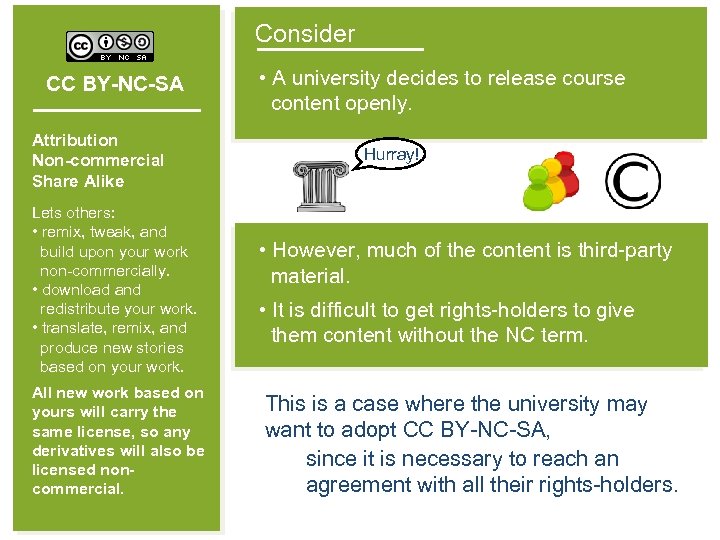
Consider CC BY-NC-SA Attribution Non-commercial Share Alike Lets others: • remix, tweak, and build upon your work non-commercially. • download and redistribute your work. • translate, remix, and produce new stories based on your work. All new work based on yours will carry the same license, so any derivatives will also be licensed noncommercial. • A university decides to release course content openly. Hurray! • However, much of the content is third-party material. • It is difficult to get rights-holders to give them content without the NC term. This is a case where the university may want to adopt CC BY-NC-SA, since it is necessary to reach an agreement with all their rights-holders.
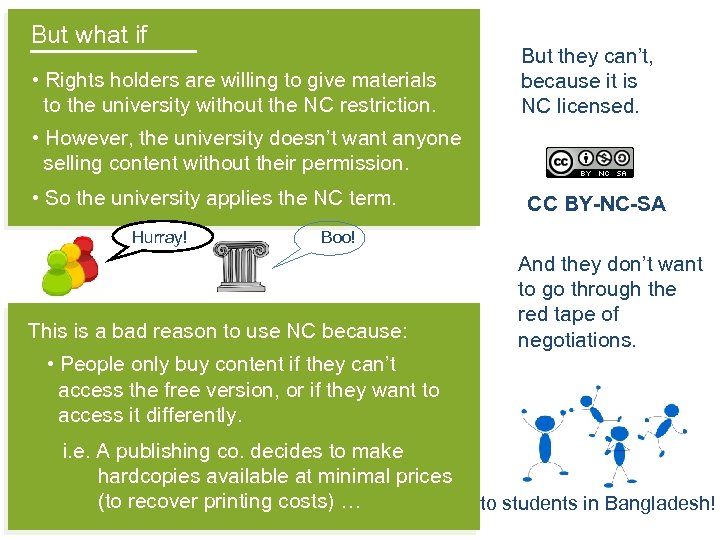
But what if • Rights holders are willing to give materials to the university without the NC restriction. But they can’t, because it is NC licensed. • However, the university doesn’t want anyone selling content without their permission. • So the university applies the NC term. Hurray! CC BY-NC-SA Boo! This is a bad reason to use NC because: And they don’t want to go through the red tape of negotiations. • People only buy content if they can’t access the free version, or if they want to access it differently. i. e. A publishing co. decides to make hardcopies available at minimal prices (to recover printing costs) … to students in Bangladesh!
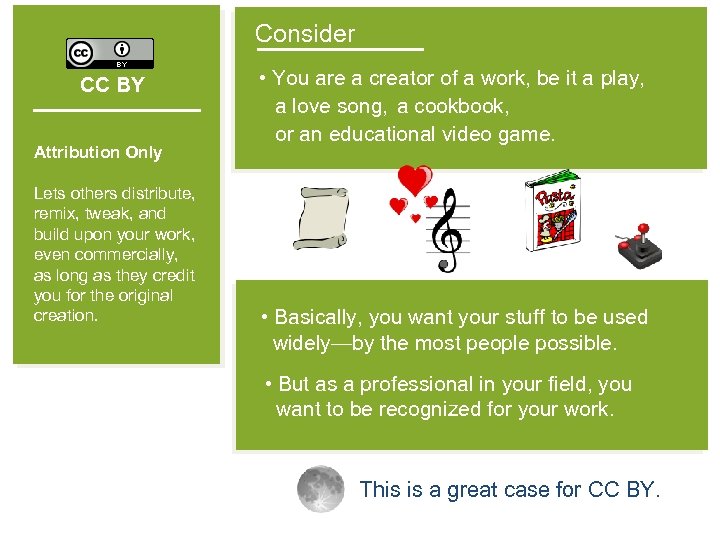
Consider CC BY Attribution Only Lets others distribute, remix, tweak, and build upon your work, even commercially, as long as they credit you for the original creation. • You are a creator of a work, be it a play, a love song, a cookbook, or an educational video game. • Basically, you want your stuff to be used widely—by the most people possible. • But as a professional in your field, you want to be recognized for your work. This is a great case for CC BY.
But what if CC BY Attribution Only Lets others distribute, remix, tweak, and build upon your work, even commercially, as long as they credit you for the original creation. • Someone takes my stuff and locks it away, defeating the purpose of making it open? That’s impossible with digital content. Even if someone remixed the work and re-licensed it under full copyright, your original work is still available, free for anybody to use. • Someone uses my stuff inappropriately, while my name is attached to it? • CC BY specifically states that you do not endorse any works derived from yours. • So it’s OK. The non-endorsement clause (and moral rights) allows you to request a take-down and seek damages anyway.
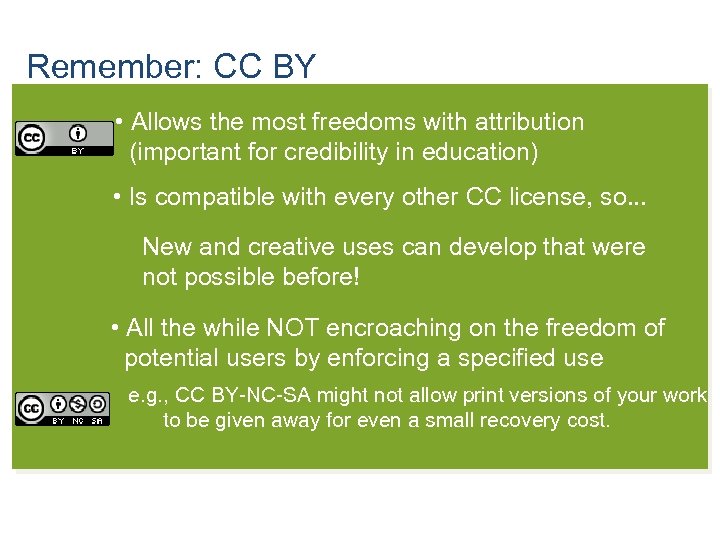
Remember: CC BY • Allows the most freedoms with attribution (important for credibility in education) • Is compatible with every other CC license, so. . . New and creative uses can develop that were not possible before! • All the while NOT encroaching on the freedom of potential users by enforcing a specified use e. g. , CC BY-NC-SA might not allow print versions of your work to be given away for even a small recovery cost.
Скачать презентацию OER and CC Licensing Lila Bailey Counsel cc
c7464baeef208870e4cdd6da3a6688fe.ppt