


 Скачать презентацию OECD LEED Reviews on Universities Entrepreneurship and Local
67f9b4c9632b800e34a60a290708fe5c.ppt
- Количество слайдов: 32
 OECD LEED Reviews on Universities, Entrepreneurship and Local Development in Moravia-Silesia The Review Team: Jaana Puukka, FR/FI Maite Martinez, ES Patrick Dubarle, FR Andrea Hofer, OECD (Tomas Karlsson, SE) (Jakob Stolt, DK) Ostrava, 8 October 2014 16/03/2018 Jaana. Puukka@innovationengage. com 1
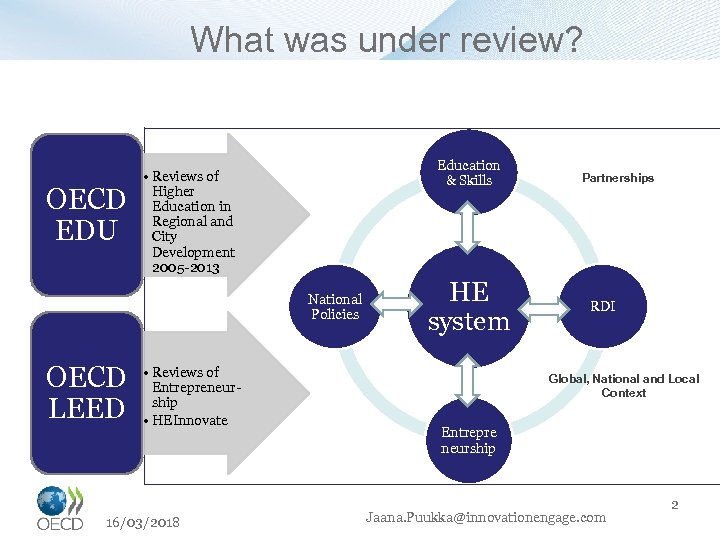 What was under review? OECD EDU Education & Skills • Reviews of Higher Education in Regional and City Development 2005 -2013 National Policies OECD LEED • Reviews of Entrepreneurship • HEInnovate 16/03/2018 HE system Partnerships RDI Global, National and Local Context Entrepre neurship Jaana. Puukka@innovationengage. com 2
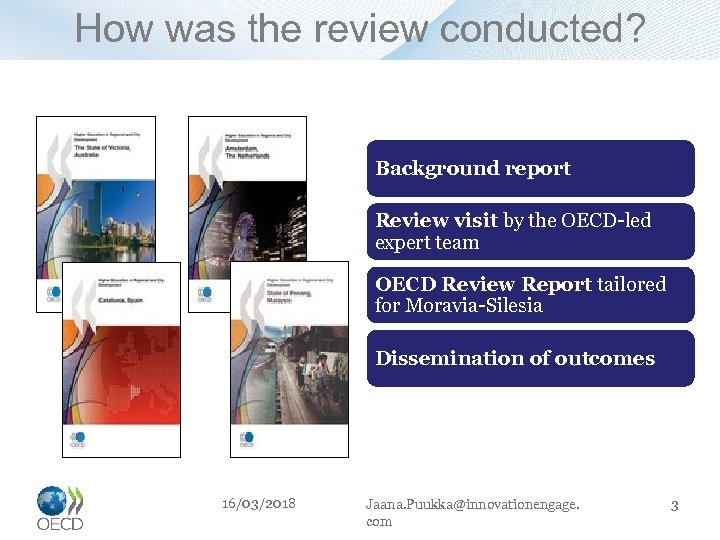 How was the review conducted? Background report Review visit by the OECD-led expert team OECD Review Report tailored for Moravia-Silesia Dissemination of outcomes 16/03/2018 Jaana. Puukka@innovationengage. com 3
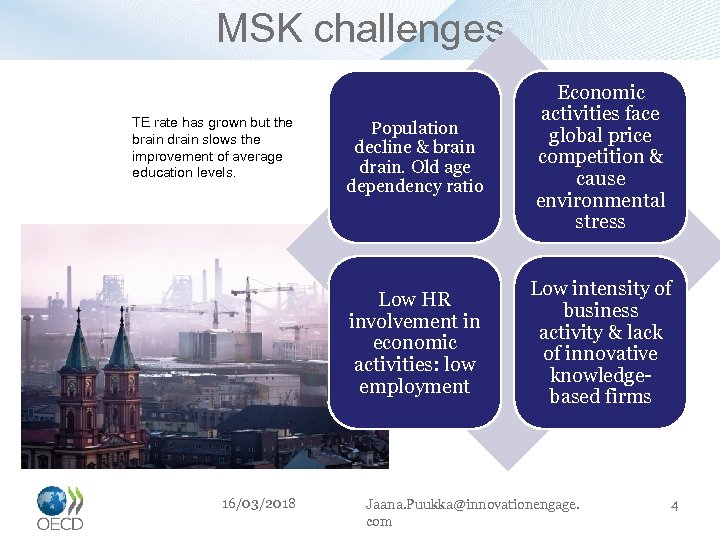 MSK challenges 16/03/2018 Population decline & brain drain. Old age dependency ratio Low HR involvement in economic activities: low employment TE rate has grown but the brain drain slows the improvement of average education levels. Economic activities face global price competition & cause environmental stress Low intensity of business activity & lack of innovative knowledgebased firms Jaana. Puukka@innovationengage. com 4
 Demographic decline global competition and economic crisis call for a greater emphasis on knowledge, new enterprise and access to relevant skills. 16/03/2018 Jaana. Puukka@innovationengage. com 5
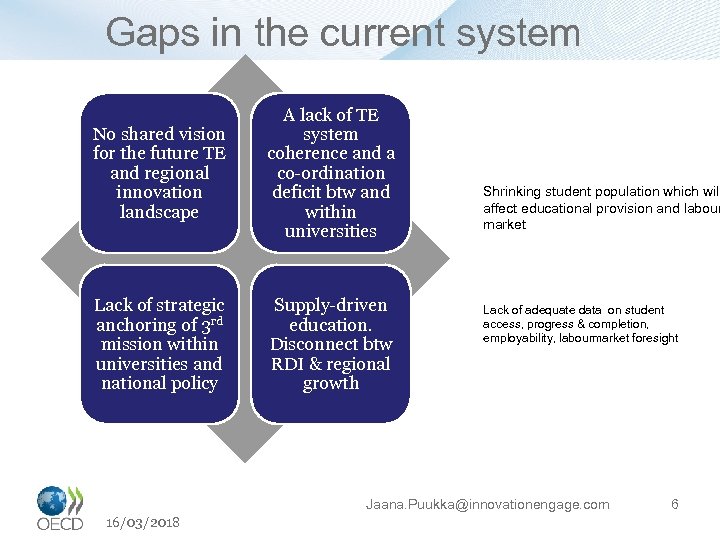 Gaps in the current system No shared vision for the future TE and regional innovation landscape A lack of TE system coherence and a co-ordination deficit btw and within universities Lack of strategic anchoring of 3 rd mission within universities and national policy Supply-driven education. Disconnect btw RDI & regional growth Shrinking student population which will affect educational provision and labour market Lack of adequate data on student access, progress & completion, employability, labourmarket foresight Jaana. Puukka@innovationengage. com 16/03/2018 6
 The Big Question To what extent the current policy framework facilitates the development of internationally competitive HE sector which • delivers relevant skills • responds to industry needs • generates new businesses • helps restructure the economy 16/03/2018 Jaana. Puukka@innovationengage. com 7
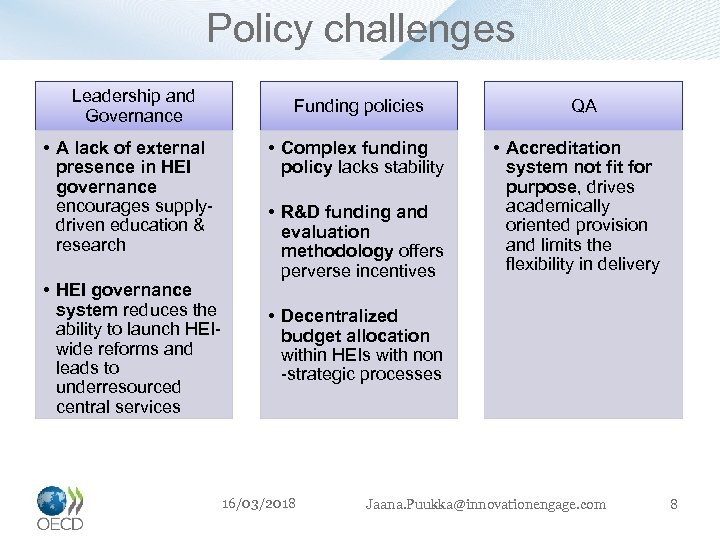 Policy challenges Leadership and Governance • A lack of external presence in HEI governance encourages supplydriven education & research • HEI governance system reduces the ability to launch HEIwide reforms and leads to underresourced central services Funding policies • Complex funding policy lacks stability • R&D funding and evaluation methodology offers perverse incentives QA • Accreditation system not fit for purpose, drives academically oriented provision and limits the flexibility in delivery • Decentralized budget allocation within HEIs with non -strategic processes 16/03/2018 Jaana. Puukka@innovationengage. com 8
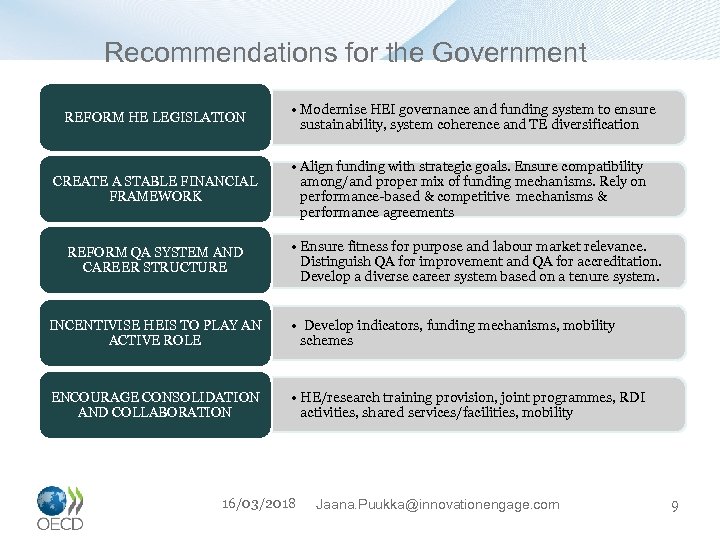 Recommendations for the Government REFORM HE LEGISLATION CREATE A STABLE FINANCIAL FRAMEWORK REFORM QA SYSTEM AND CAREER STRUCTURE • Modernise HEI governance and funding system to ensure sustainability, system coherence and TE diversification • Align funding with strategic goals. Ensure compatibility among/and proper mix of funding mechanisms. Rely on performance-based & competitive mechanisms & performance agreements • Ensure fitness for purpose and labour market relevance. Distinguish QA for improvement and QA for accreditation. Develop a diverse career system based on a tenure system. INCENTIVISE HEIS TO PLAY AN ACTIVE ROLE • Develop indicators, funding mechanisms, mobility schemes ENCOURAGE CONSOLIDATION AND COLLABORATION • HE/research training provision, joint programmes, RDI activities, shared services/facilities, mobility 16/03/2018 Jaana. Puukka@innovationengage. com 9
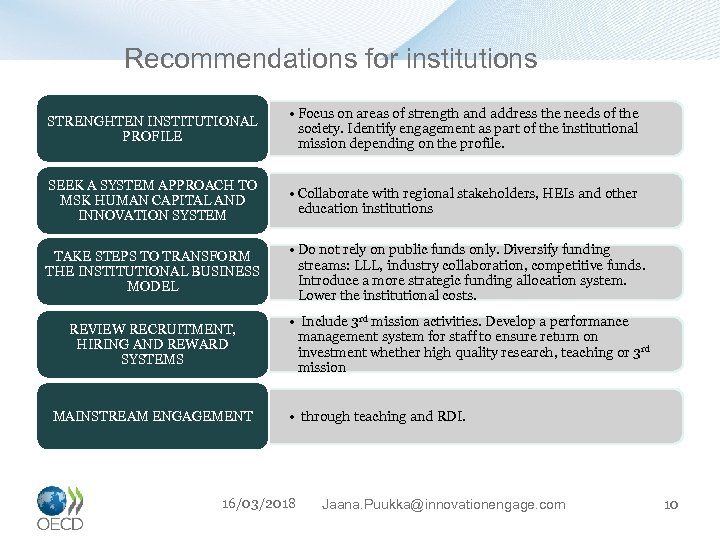 Recommendations for institutions STRENGHTEN INSTITUTIONAL PROFILE • Focus on areas of strength and address the needs of the society. Identify engagement as part of the institutional mission depending on the profile. SEEK A SYSTEM APPROACH TO MSK HUMAN CAPITAL AND INNOVATION SYSTEM • Collaborate with regional stakeholders, HEIs and other education institutions TAKE STEPS TO TRANSFORM THE INSTITUTIONAL BUSINESS MODEL • Do not rely on public funds only. Diversify funding streams: LLL, industry collaboration, competitive funds. Introduce a more strategic funding allocation system. Lower the institutional costs. REVIEW RECRUITMENT, HIRING AND REWARD SYSTEMS • Include 3 rd mission activities. Develop a performance management system for staff to ensure return on investment whether high quality research, teaching or 3 rd mission MAINSTREAM ENGAGEMENT • through teaching and RDI. 16/03/2018 Jaana. Puukka@innovationengage. com 10
 Human capital and skills development 11
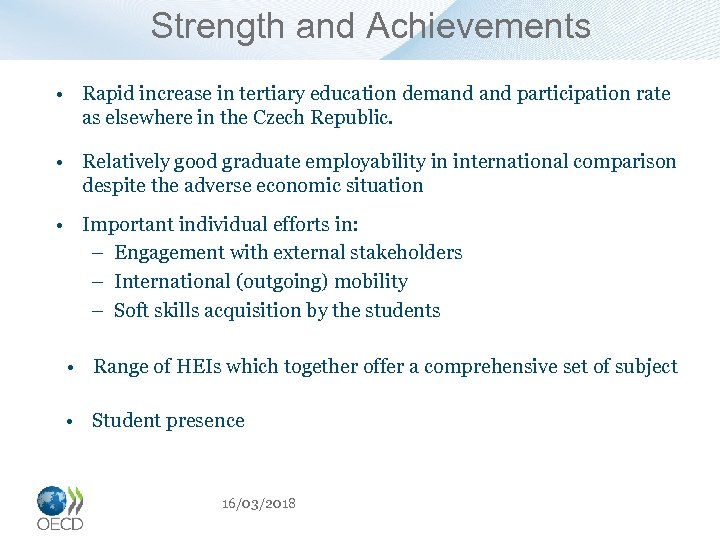 Strength and Achievements • Rapid increase in tertiary education demand participation rate as elsewhere in the Czech Republic. • Relatively good graduate employability in international comparison despite the adverse economic situation • Important individual efforts in: – Engagement with external stakeholders – International (outgoing) mobility – Soft skills acquisition by the students • Range of HEIs which together offer a comprehensive set of subject • Student presence 16/03/2018 12
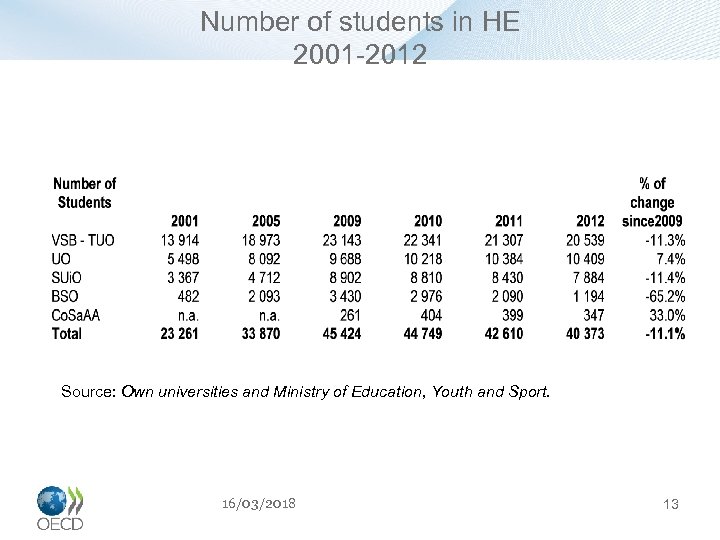 Number of students in HE 2001 -2012 Source: Own universities and Ministry of Education, Youth and Sport. 16/03/2018 13
 Challenges (I) • Emerging signs of a mismatch between the supply & demand of high skills: – Unemployment has gone down for individuals of all levels but higher education (2005 -2012). – Unemployment rates for Bachelor-level graduates are at the same level or below graduates from master and doctoral programmes. – Mismatch in the development of technical professional skills. • Insufficient HEI-level tracking of student progression and employment outcomes. 16/03/2018 14
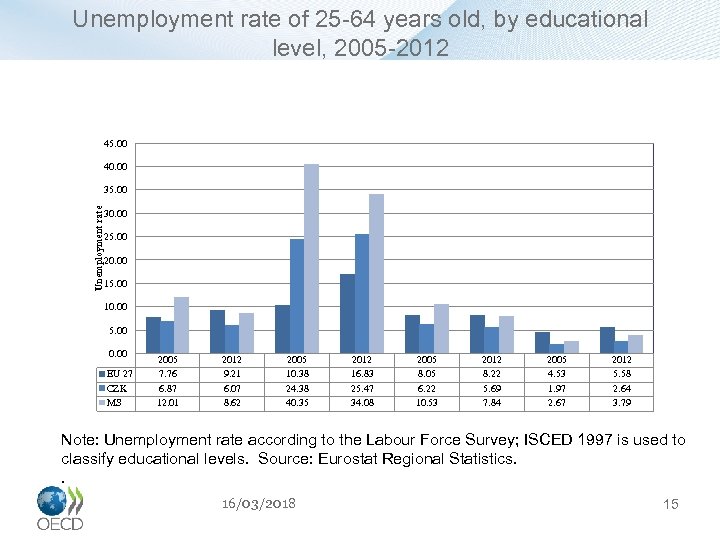 Unemployment rate of 25 -64 years old, by educational level, 2005 -2012 45. 00 40. 00 Unemployment rate 35. 00 30. 00 25. 00 20. 00 15. 00 10. 00 5. 00 0. 00 EU 27 CZK MS 2005 7. 76 6. 87 12. 01 2012 9. 21 6. 07 8. 62 2005 10. 38 24. 38 40. 35 2012 16. 83 25. 47 34. 08 2005 8. 05 6. 22 10. 53 2012 8. 22 5. 69 7. 84 2005 4. 53 1. 97 2. 67 2012 5. 58 2. 64 3. 79 Note: Unemployment rate according to the Labour Force Survey; ISCED 1997 is used to classify educational levels. Source: Eurostat Regional Statistics. . 16/03/2018 15
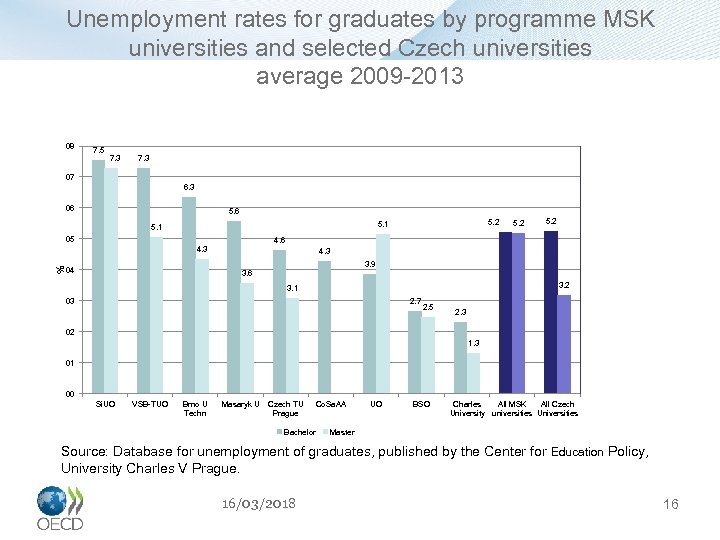 Unemployment rates for graduates by programme MSK universities and selected Czech universities average 2009 -2013 08 7. 5 7. 3 07 6. 3 06 5. 6 05 5. 2 4. 6 4. 3 % 5. 2 5. 1 4. 3 3. 9 04 3. 6 3. 2 3. 1 03 2. 7 2. 5 2. 3 02 1. 3 01 00 Si. UO VSB-TUO Brno U Techn Masaryk U Czech TU Prague Co. Sa. AA Bachelor UO BSO Charles All MSK All Czech University universities Universities Master Source: Database for unemployment of graduates, published by the Center for Education Policy, University Charles V Prague. 16/03/2018 16
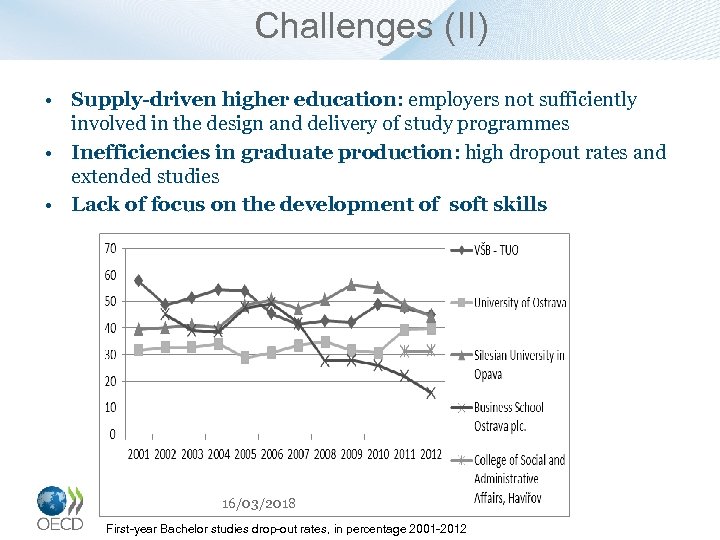 Challenges (II) • Supply-driven higher education: employers not sufficiently involved in the design and delivery of study programmes • Inefficiencies in graduate production: high dropout rates and extended studies • Lack of focus on the development of soft skills 16/03/2018 First-year Bachelor studies drop-out rates, in percentage 2001 -2012 17
 Challenges • Lack of HE collaboration • Lack of inter-disciplinarity • Lack of comprehensive internationalisation strategies that comprise teaching, research and knowledge exchange • Lack of focus on “internationalisation at home” 16/03/2018 18
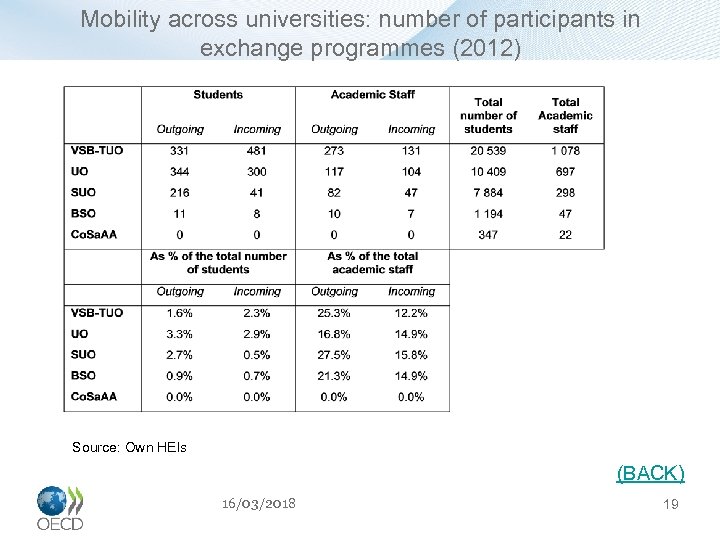 Mobility across universities: number of participants in exchange programmes (2012) Source: Own HEIs (BACK) 16/03/2018 19
 Recommendations • Respond to the mismatch in the high skills sector: introduce a HEI-level system to monitor graduate employability • Increase involvement of regional employers in the design and delivery of study programmes International example: World of Work at Liverpool John Moores University (UK) • Design and implement a systemic approach to provide internships and other work-based learning opportunities • Expand institutionalise alumni links • Systematically provide early intervention measures to enhance academic performance and monitor student progress International example: Access & Civic Engagement Service of the Dublin Institute of Technology (IR) 16/03/2018 20
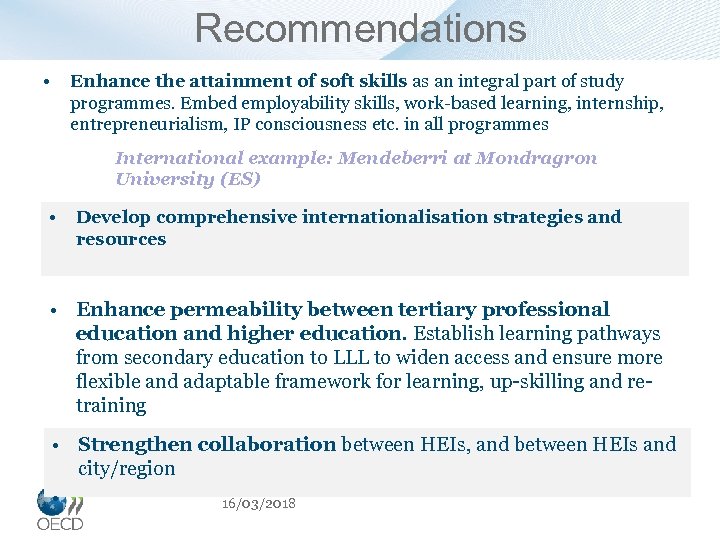 Recommendations • Enhance the attainment of soft skills as an integral part of study programmes. Embed employability skills, work-based learning, internship, entrepreneurialism, IP consciousness etc. in all programmes International example: Mendeberri at Mondragron University (ES) • Develop comprehensive internationalisation strategies and resources • Enhance permeability between tertiary professional education and higher education. Establish learning pathways from secondary education to LLL to widen access and ensure more flexible and adaptable framework for learning, up-skilling and retraining • Strengthen collaboration between HEIs, and between HEIs and city/region • 16/03/2018 21
 Research, development and innovation 16/03/2018 22
 MSK economic context • Mixed framework conditions • Industry restructuring and emergence of clusters • Big business culture • Supportive national and EU policies • Limited HEI involvement 16/03/2018 23
 Ostrava HEIs’ strengths and weaknesses • Skilled people potential • Labour market mismatch • Lack of funding and critical mass in research • Strengths in a number of niches • Internationalisation in progress 16/03/2018 24
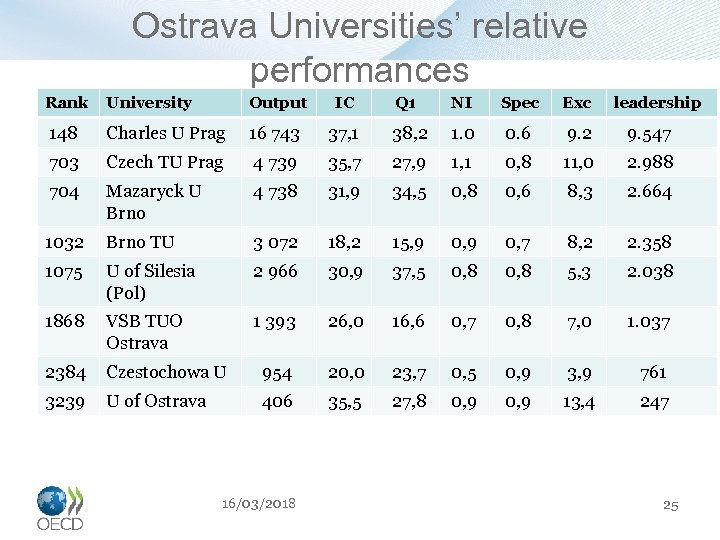 Ostrava Universities’ relative performances Rank University Output IC Q 1 NI Spec Exc 148 Charles U Prag 16 743 37, 1 38, 2 1. 0 0. 6 9. 2 9. 547 703 Czech TU Prag 4 739 35, 7 27, 9 1, 1 0, 8 11, 0 2. 988 704 Mazaryck U Brno 4 738 31, 9 34, 5 0, 8 0, 6 8, 3 2. 664 1032 Brno TU 3 072 18, 2 15, 9 0, 7 8, 2 2. 358 1075 U of Silesia (Pol) 2 966 30, 9 37, 5 0, 8 5, 3 2. 038 1868 VSB TUO Ostrava 1 393 26, 0 16, 6 0, 7 0, 8 7, 0 1. 037 2384 Czestochowa U 954 20, 0 23, 7 0, 5 0, 9 3, 9 761 3239 U of Ostrava 406 35, 5 27, 8 0, 9 13, 4 247 16/03/2018 leadership 25
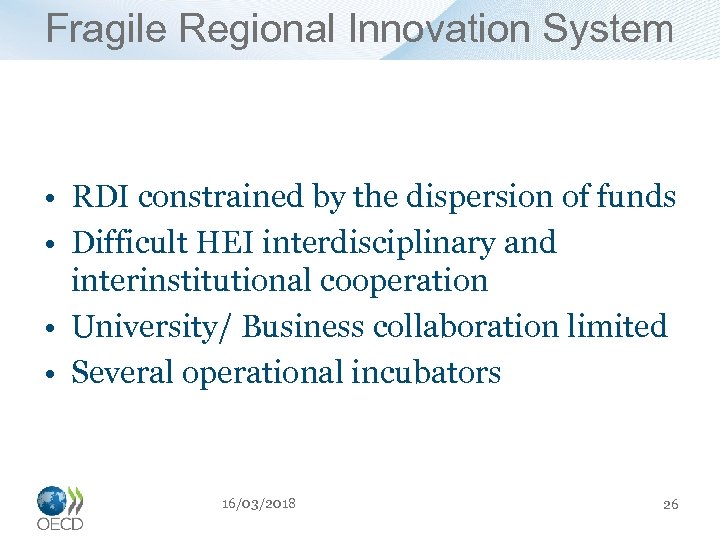 Fragile Regional Innovation System • RDI constrained by the dispersion of funds • Difficult HEI interdisciplinary and interinstitutional cooperation • University/ Business collaboration limited • Several operational incubators 16/03/2018 26
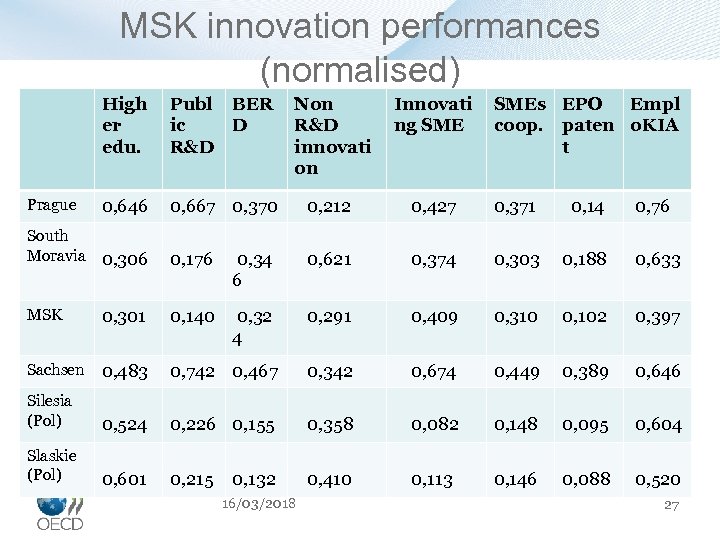 MSK innovation performances (normalised) High er edu. Non R&D innovati on Innovati ng SME 0, 667 0, 370 0, 212 0, 427 0, 371 0, 14 0, 76 South Moravia 0, 306 0, 176 0, 34 6 0, 621 0, 374 0, 303 0, 188 0, 633 MSK 0, 301 0, 140 0, 32 4 0, 291 0, 409 0, 310 0, 102 0, 397 Sachsen 0, 483 0, 742 0, 467 0, 342 0, 674 0, 449 0, 389 0, 646 Silesia (Pol) 0, 524 0, 226 0, 155 0, 358 0, 082 0, 148 0, 095 0, 604 Slaskie (Pol) 0, 601 0, 215 0, 410 0, 113 0, 146 0, 088 0, 520 Prague Publ ic R&D 0, 646 BER D 0, 132 16/03/2018 SMEs EPO Empl coop. paten o. KIA t 27
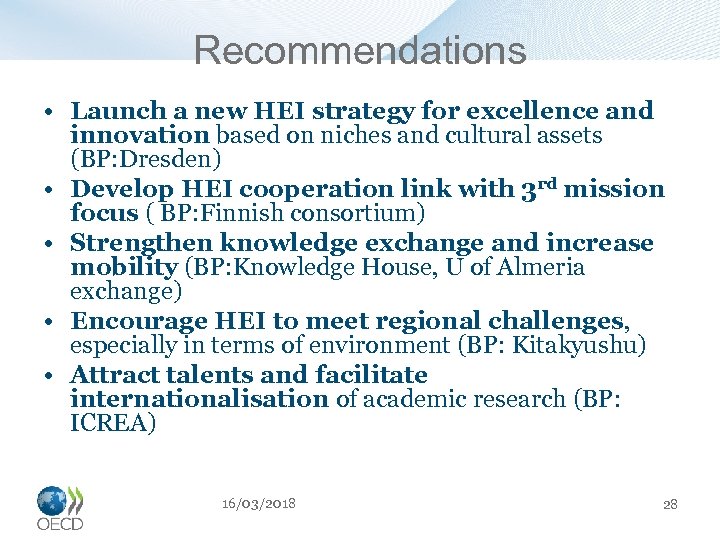 Recommendations • Launch a new HEI strategy for excellence and innovation based on niches and cultural assets (BP: Dresden) • Develop HEI cooperation link with 3 rd mission focus ( BP: Finnish consortium) • Strengthen knowledge exchange and increase mobility (BP: Knowledge House, U of Almeria exchange) • Encourage HEI to meet regional challenges, especially in terms of environment (BP: Kitakyushu) • Attract talents and facilitate internationalisation of academic research (BP: ICREA) 16/03/2018 28
 Entrepreneurship 16/03/2018 29
 Recommendations on Entrepreneurship Education • Create more academic positions for entrepreneurship • Focus entrepreneurship education activities more on regional challenges and opportunities; encourage social entrepreneurship • Increase the attention on business development and succession issues for family businesses • Make use of HEI-HEI collaboration potential 16/03/2018 30
 Recommendations on HEI start-up support provision • Develop an easily accessible system of fundamental business start-up support • Increase accessibility and effectiveness of incubation services • Promote the visibility of student and alumni start-ups • Make use of HEI-HEI collaboration potential 16/03/2018 31
 thank you for your attention 16/03/2018 Jaana. Puukka@innovationengage. com 32