


 Скачать презентацию Odontogenic Cysts and Tumors Dr Mashhor Alwrekat
Odontogenic Cysts and Tumors.ppt
- Количество слайдов: 87
 Odontogenic Cysts and Tumors Dr. Mashhor Alwrekat
 Introduction ® Variety of cysts and tumors ® Uniquely derived from tissues of developing teeth ® May present to otolaryngologist
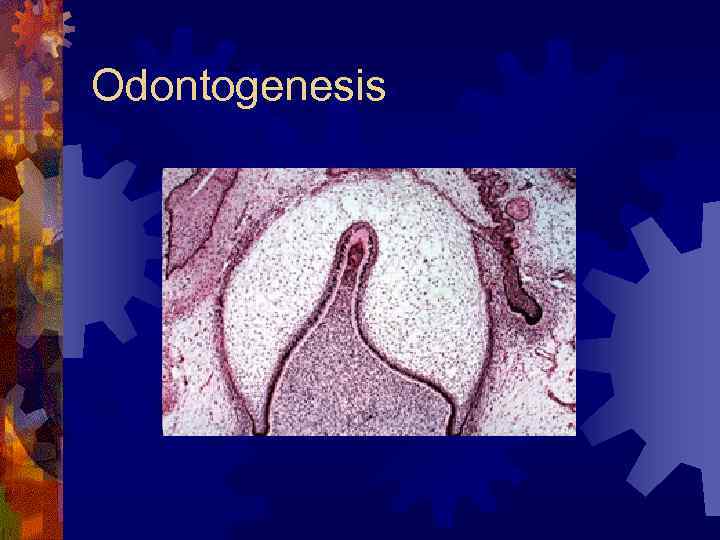
 Odontogenesis ® Projections of dental lamina into ectomesenchyme ® Layered cap (inner/outer enamel epithelium, stratum intermedium, stellate reticulum) ® Odontoblasts secrete dentin ameloblasts (from IEE) enamel ® Cementoblasts cementum ® Fibroblasts periodontal membrane
 Odontogenesis
 Diagnosis ® Complete history ® Pain, loose teeth, occlusion, swellings, dysthesias, delayed tooth eruption ® Thorough physical examination ® Inspection, palpation, percussion, auscultation ® Plain radiographs ® Panorex, ® CT dental radiographs for larger, aggressive lesions
 Diagnosis ® Differential diagnosis ® Obtain tissue ® FNA – r/o vascular lesions, inflammatory ® Excisional biopsy – smaller cysts, unilocular tumors ® Incisional biopsy – larger lesions prior to definitive therapy
 Odontogenic Cysts ® Inflammatory Radicular ® Paradental ® ® Developmental Dentigerous ® Developmental lateral periodontal ® Odontogenic keratocyst ® Glandular odontogenic ®
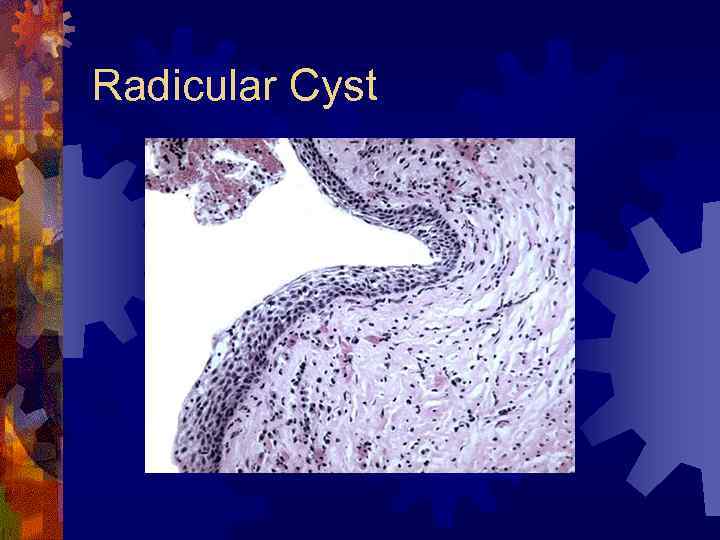
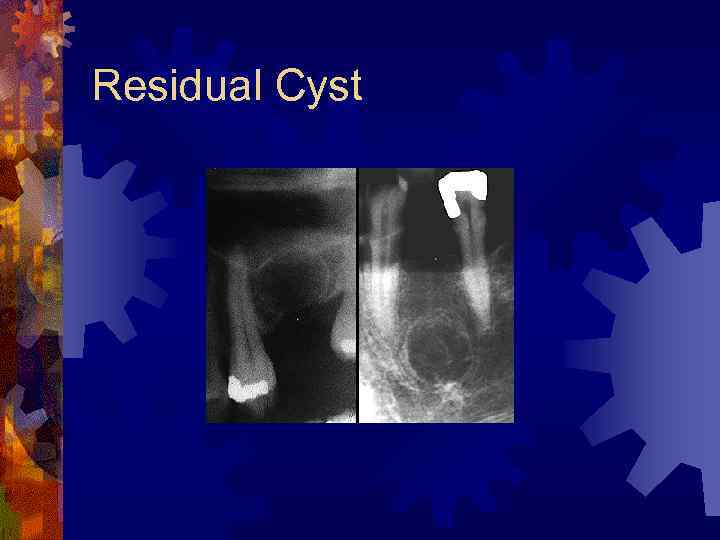
 Radicular (Periapical) Cyst ® Most common (65%) ® Epithelial cell rests of Malassez ® Response to inflammation ® Radiographic findings ® Pulpless, nonvital tooth ® Small well-defined periapical radiolucency ® Histology ® Treatment – extraction, root canal
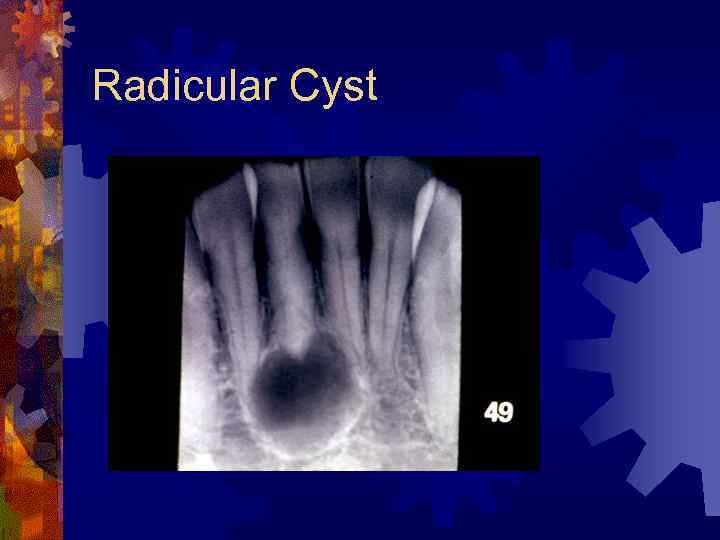 Radicular Cyst
 Radicular Cyst
 Residual Cyst
 Paradental Cyst ® Associated with partially impacted 3 rd molars ® Result of inflammation of the gingiva over an erupting molar ® 0. 5 to 4% of cysts ® Radiology – radiolucency in apical portion of the root ® Treatment – enucleation
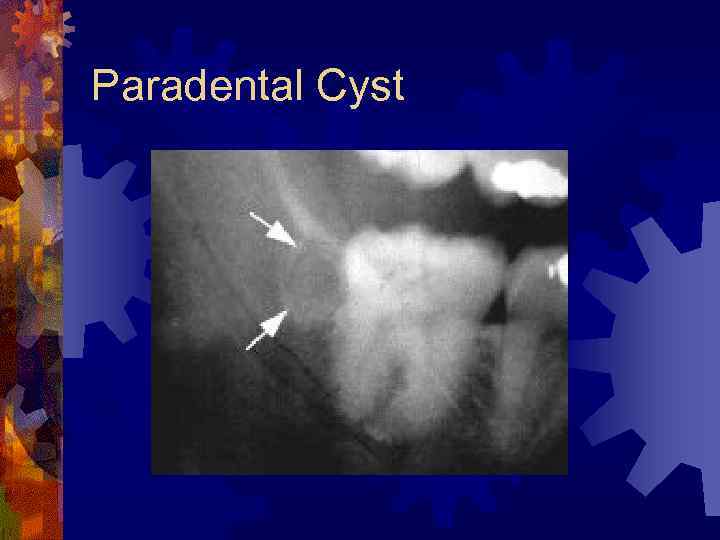 Paradental Cyst
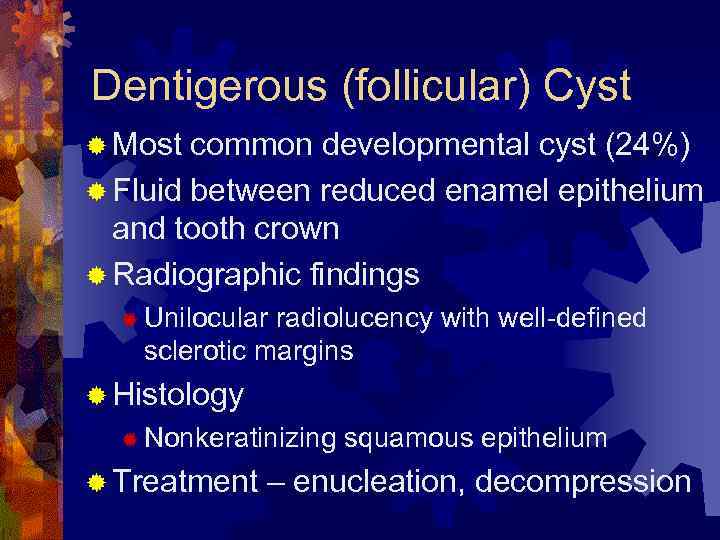 Dentigerous (follicular) Cyst ® Most common developmental cyst (24%) ® Fluid between reduced enamel epithelium and tooth crown ® Radiographic findings ® Unilocular radiolucency with well-defined sclerotic margins ® Histology ® Nonkeratinizing ® Treatment squamous epithelium – enucleation, decompression
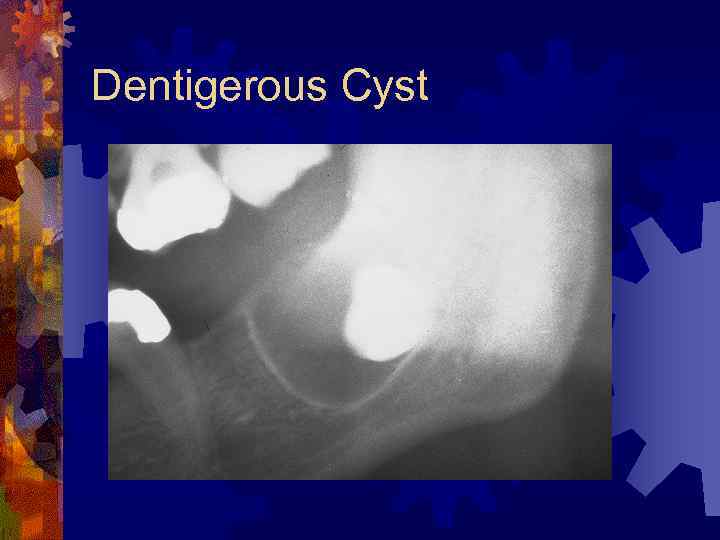 Dentigerous Cyst
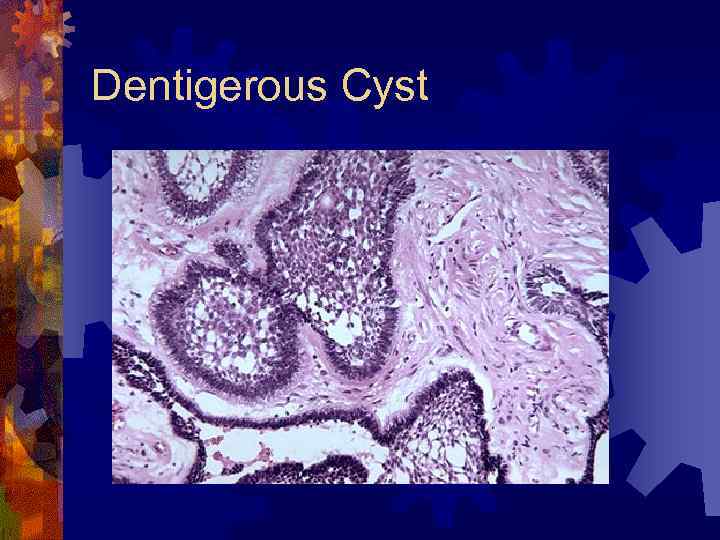 Dentigerous Cyst
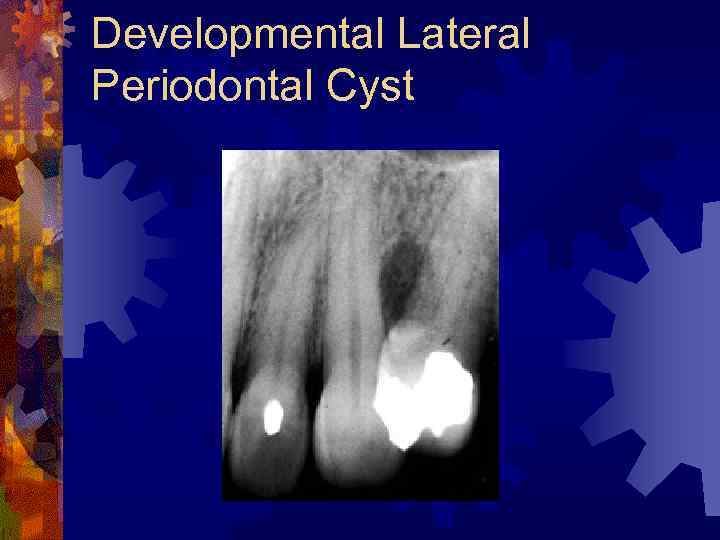
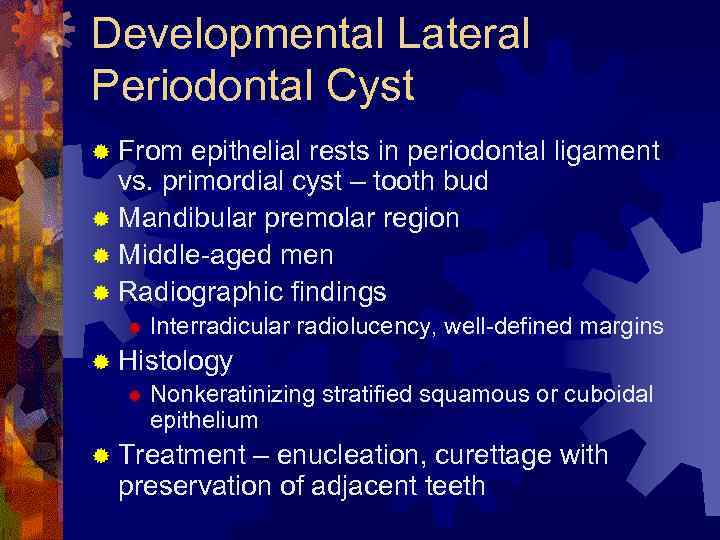 Developmental Lateral Periodontal Cyst ® From epithelial rests in periodontal ligament vs. primordial cyst – tooth bud ® Mandibular premolar region ® Middle-aged men ® Radiographic findings ® Interradicular radiolucency, well-defined margins ® Histology ® Nonkeratinizing stratified squamous or cuboidal epithelium ® Treatment – enucleation, curettage with preservation of adjacent teeth
 Developmental Lateral Periodontal Cyst
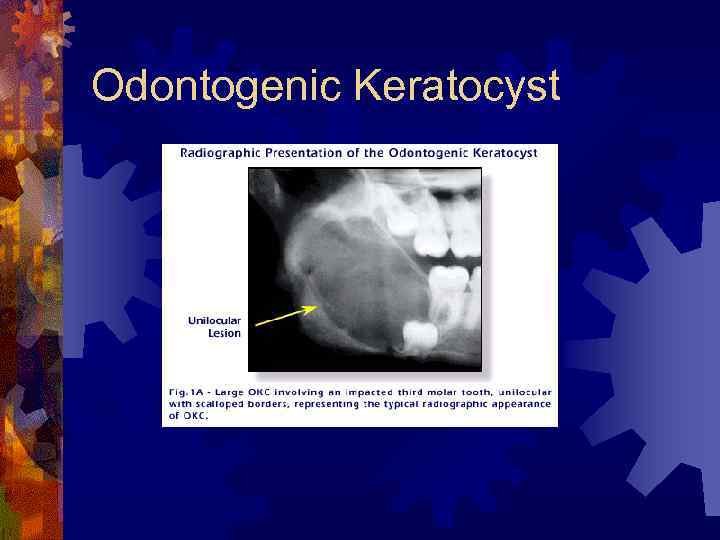
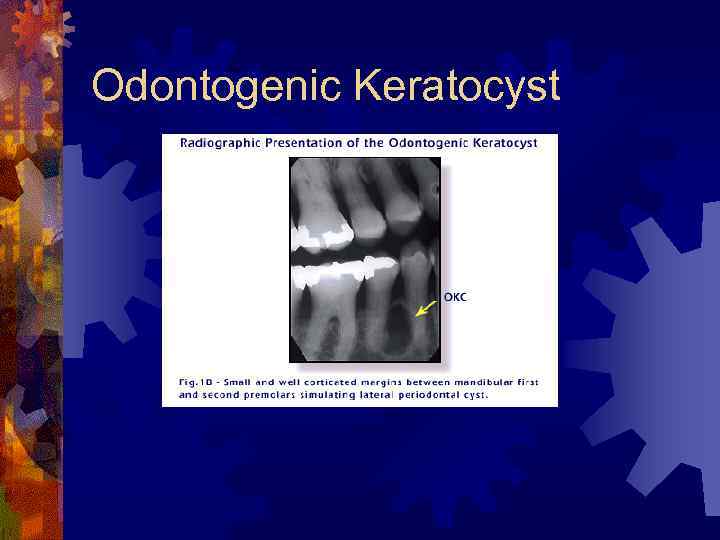
 Odontogenic Keratocyst ® 11% of jaw cysts ® May mimic any of the other cysts ® Most often in mandibular ramus and angle ® Radiographically ® Well-marginated, radiolucency ® Pericoronal, inter-radicular, or pericoronal ® Multilocular
 Odontogenic Keratocyst
 Odontogenic Keratocyst
 Odontogenic Keratocyst ® Histology ® Thin epithelial lining with underlying connective tissue (collagen and epithelial nests) ® Secondary inflammation may mask features ® High frequency of recurrence (up to 62%) ® Complete removal difficult and satellite cysts can be left behind
 Odontogenic Keratocyst
 Treatment of OKC ® Depends on extent of lesion ® Small – simple enucleation, complete removal of cyst wall ® Larger – enucleation with/without peripheral ostectomy ® Bataineh, et al, promote complete resection with 1 cm bony margins (if extension through cortex, overlying soft tissues excised) ® Long term follow-up required (5 -10 years)
 Glandular Odontogenic Cyst ® More recently described (45 cases) ® Gardner, 1988 ® Mandible (87%), usually anterior ® Very slow progressive growth (CC: swelling, pain [40%]) ® Radiographic findings ® Unilocular or multilocular radiolucency
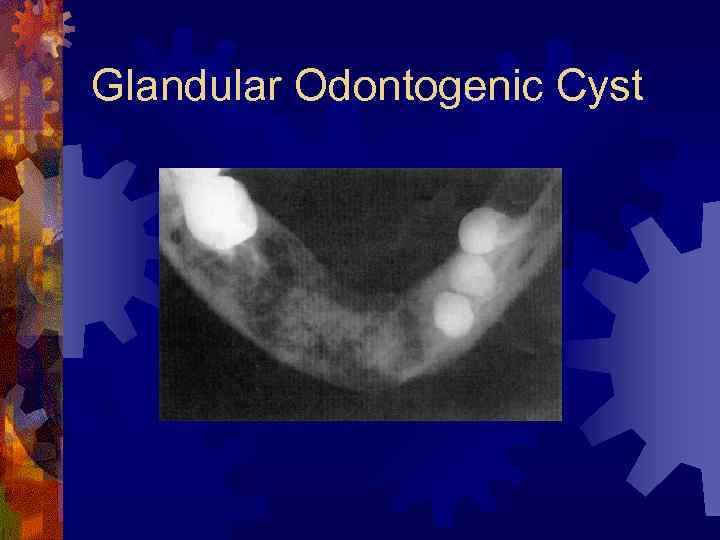 Glandular Odontogenic Cyst
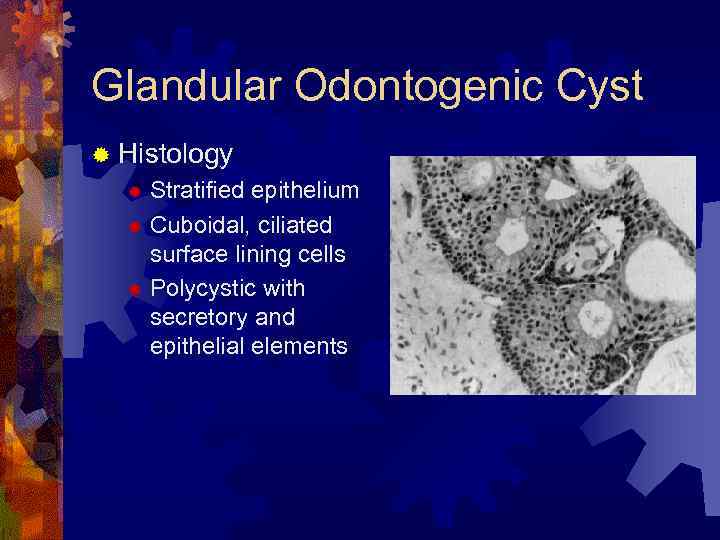 Glandular Odontogenic Cyst ® Histology Stratified epithelium ® Cuboidal, ciliated surface lining cells ® Polycystic with secretory and epithelial elements ®
 Treatment of GOC ® Considerable recurrence potential ® 25% after enucleation or curettage ® Marginal resection suggested for larger lesions or involvement of posterior maxilla ® Warrants close follow-up
 Nonodontogenic Cysts ® Incisive Canal Cyst ® Stafne Bone Cyst ® Traumatic Bone Cyst ® Surgical Ciliated Cyst (of Maxilla)
 Incisive Canal Cyst ® Derived from epithelial remnants of the nasopalatine duct (incisive canal) ® 4 th to 6 th decades ® Palatal swelling common, asymptomatic ® Radiographic findings ® Well-delineated oval radiolucency between maxillary incisors, root resorption occasional ® Histology ® Cyst lined by stratified squamous or respiratory epithelium or both
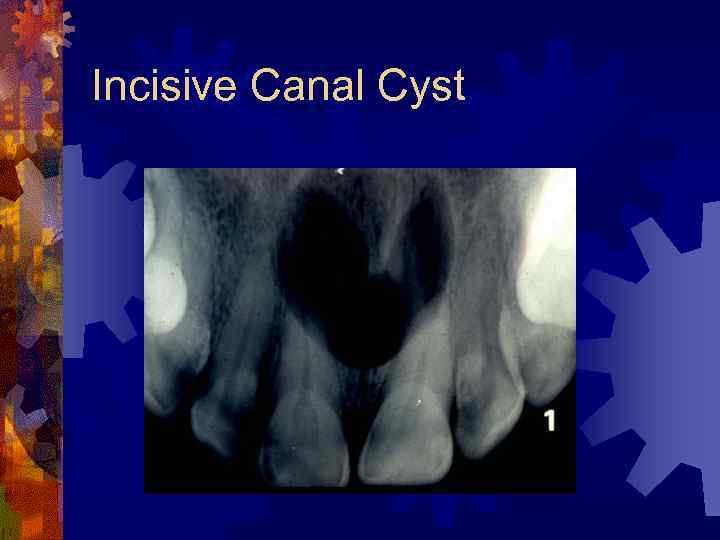 Incisive Canal Cyst
 Incisive Canal Cyst ® Treatment consists of surgical enucleation or periodic radiographs ® Progressive enlargement requires surgical intervention
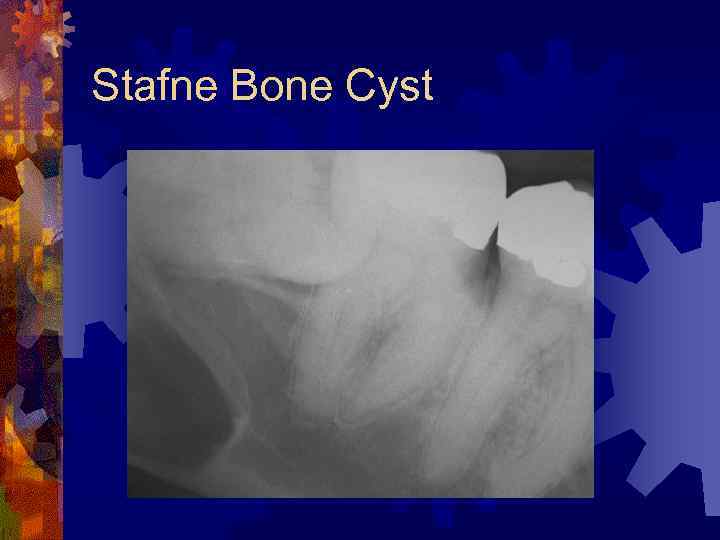
 Stafne Bone Cyst ® Submandibular salivary gland depression ® Incidental finding, not a true cyst ® Radiographs – small, circular, corticated radiolucency below mandibular canal ® Histology – normal salivary tissue ® Treatment – routine follow up
 Stafne Bone Cyst
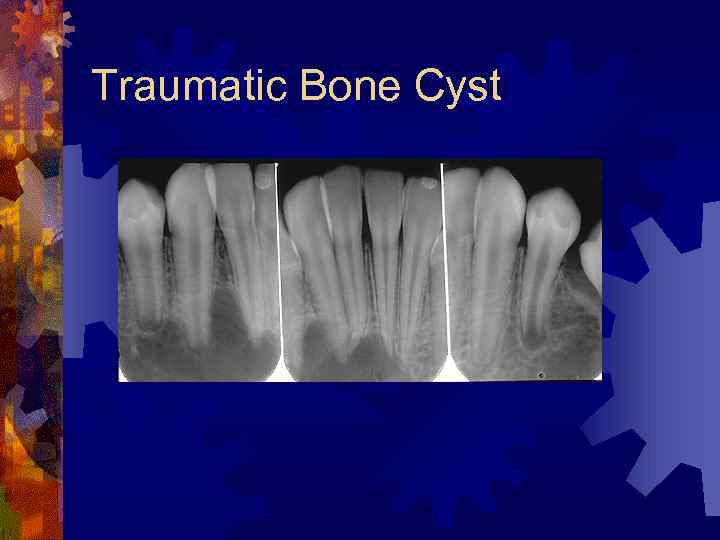
 Traumatic Bone Cyst ® Empty or fluid filled cavity associated with jaw trauma (50%) ® Radiographic findings ® Radiolucency, most commonly in body or anterior portion of mandible ® Histology – thin membrane of fibrous granulation ® Treatment – exploratory surgery may expedite healing
 Traumatic Bone Cyst
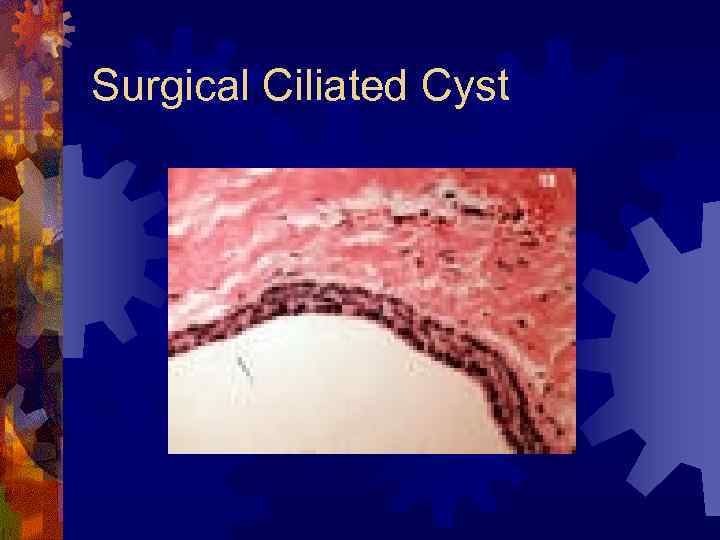
 Surgical Ciliated Cyst ® May occur following Caldwell-Luc ® Trapped fragments of sinus epithelium that undergo benign proliferation ® Radiographic findings ® Unilocular radiolucency in maxilla ® Histology ® Lining of pseudostratified columnar ciliated ® Treatment - enucleation
 Surgical Ciliated Cyst
 Odontogenic Tumors ® Ameloblastoma ® Squamous ® Calcifying Odontogenic Tumor ® Calcifying Odontogenic Cyst Epithelial Odontogenic Tumor ® Adenomatoid Odontogenic Tumor
 Ameloblastoma ® Most common odontogenic tumor ® Benign, but locally invasive ® Clinically and histologically similar to BCCa ® 4 th and 5 th decades ® Occasionally arise from dentigerous cysts ® Subtypes – multicystic (86%), unicystic (13%), and peripheral (extraosseous – 1%)
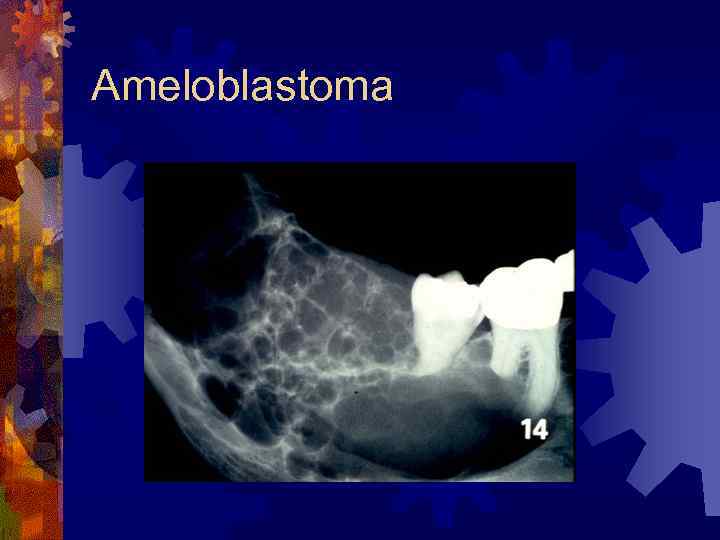
 Ameloblastoma ® Radiographic ® Classic findings – multilocular radiolucency of posterior mandible ® Well-circumscribed, soap-bubble ® Unilocular – often confused with odontogenic cysts ® Root resorption – associated with malignancy
 Ameloblastoma
 Ameloblastoma ® Histology ® Two patterns – plexiform and follicular (no bearing on prognosis) ® Classic – sheets and islands of tumor cells, outer rim of ameloblasts is polarized away from basement membrane ® Center looks like stellate reticulum ® Squamous differentiation (1%) – Diagnosed as ameloblastic carcinoma
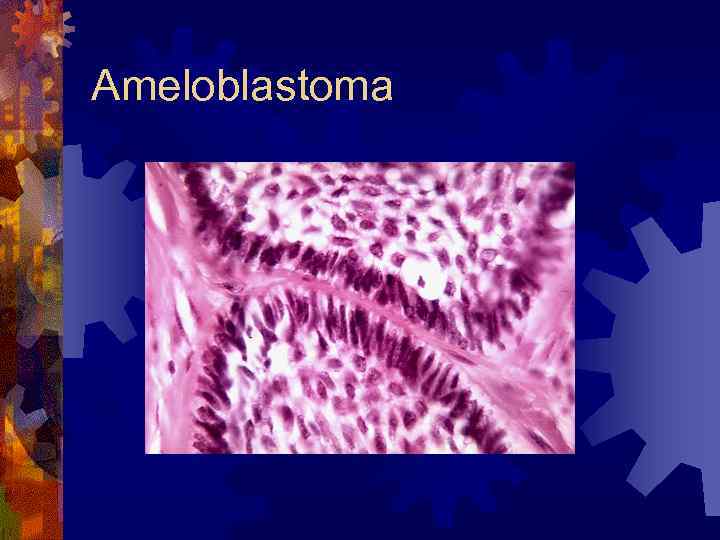 Ameloblastoma
 Treatment of Ameloblastoma ® According to growth characteristics and type ® Unicystic ® Complete removal ® Peripheral ostectomies if extension through cyst wall ® Classic infiltrative (aggressive) ® Mandibular – adequate normal bone around margins of resection ® Maxillary – more aggressive surgery, 1. 5 cm margins ® Ameloblastic carcinoma ® Radical surgical resection (like SCCa) ® Neck dissection for LAN
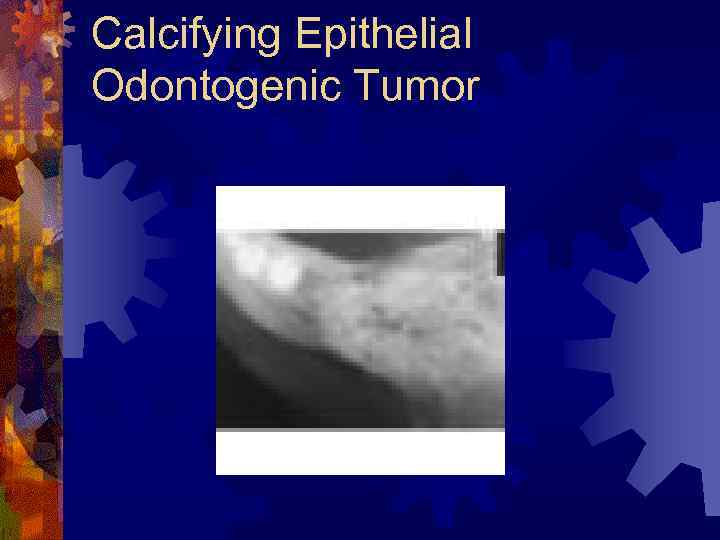
 Calcifying Epithelial Odontogenic Tumor ® a. k. a. Pindborg tumor ® Aggressive tumor of epithelial derivation ® Impacted tooth, mandible body/ramus ® Chief sign – cortical expansion ® Pain not normally a complaint
 Calcifying Epithelial Odontogenic Tumor ® Radiographic ® Expanded findings cortices in all dimensions ® Radiolucent; poorly defined, noncorticated borders ® Unilocular, multilocular, or “moth-eaten” ® “Driven-snow” appearance from multiple radiopaque foci ® Root divergence/resorption; impacted tooth
 Calcifying Epithelial Odontogenic Tumor
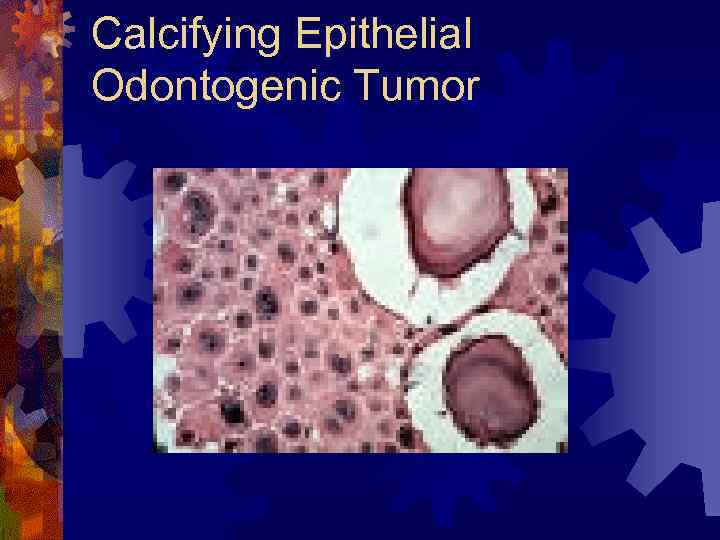
 Calcifying Epithelial Odontogenic Tumor ® Histology ® Islands of eosinophilic epithelial cells ® Cells infiltrate bony trabeculae ® Nuclear hyperchromatism and pleomorphism ® Psammoma-like calcifications (Liesegang rings)
 Calcifying Epithelial Odontogenic Tumor
 Treatment of CEOT ® Behaves like ameloblastoma ® Smaller recurrence rates ® En bloc resection, hemimandibulectomy partial maxillectomy suggested
 Adenomatoid Odontogenic Tumor ® Associated with the crown of an impacted anterior tooth ® Painless expansion ® Radiographic findings Well-defined expansile radiolucency ® Root divergence, calcified flecks (“target”) ® ® Histology ® Thick fibrous capsule, clusters of spindle cells, columnar cells (rosettes, ductal) throughout ® Treatment – enucleation, recurrence is rare
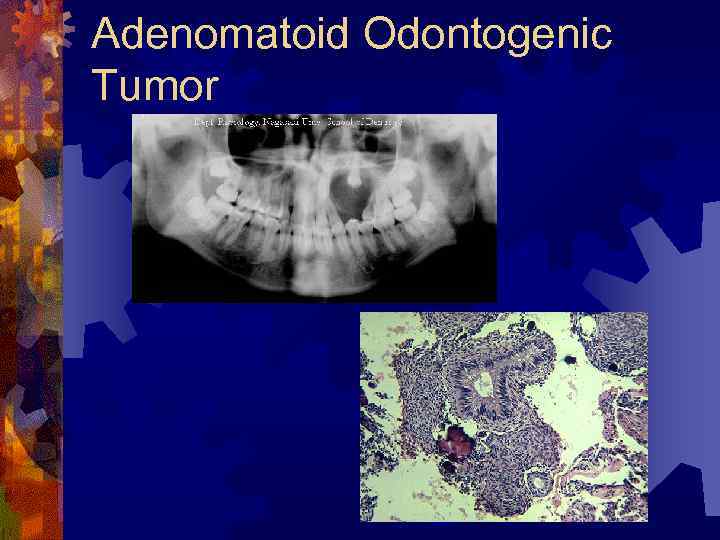 Adenomatoid Odontogenic Tumor
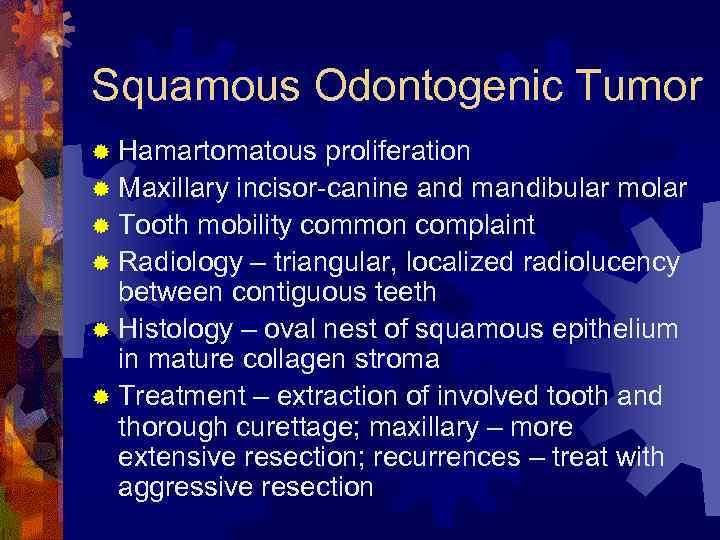 Squamous Odontogenic Tumor ® Hamartomatous proliferation ® Maxillary incisor-canine and mandibular molar ® Tooth mobility common complaint ® Radiology – triangular, localized radiolucency between contiguous teeth ® Histology – oval nest of squamous epithelium in mature collagen stroma ® Treatment – extraction of involved tooth and thorough curettage; maxillary – more extensive resection; recurrences – treat with aggressive resection
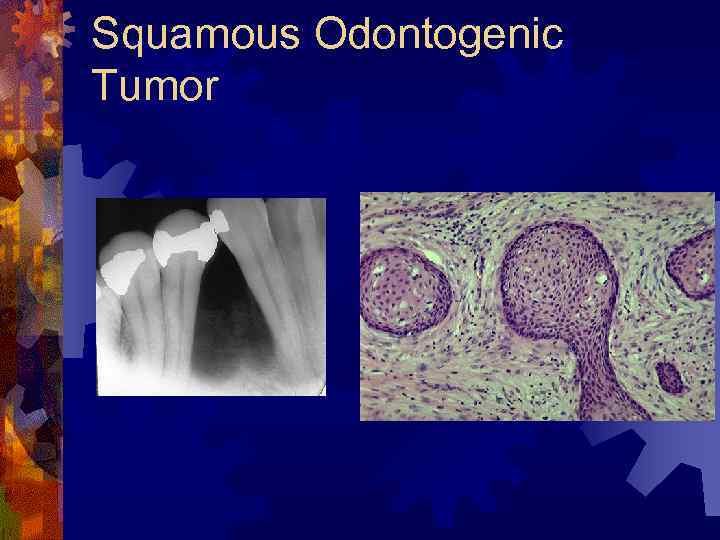 Squamous Odontogenic Tumor
 Calcifying Odontogenic Cyst ® Tumor-like cyst of mandibular premolar region ® ¼ are peripheral – gingival swelling ® Osseous lesions – expansion, vital teeth ® Radiographic findings Radiolucency with progressive calcification ® Target lesion (lucent halo); root divergence ® ® Histology ® Stratified squamous epithelial lining ® Polarized basal layer, lumen contains ghost cells ® Treatment recur – enucleation with curettage; rarely
 Mesenchymal Odontogenic Tumors ® Odontogenic Myxoma ® Cementoblastoma
 Odontogenic Myxoma ® Originates from dental papilla or follicular mesenchyme ® Slow growing, aggressively invasive ® Multilocular, expansile; impacted teeth? ® Radiology – radiolucency with septae ® Histology – spindle/stellate fibroblasts with basophilic ground substance ® Treatment – en bloc resection, curettage may be attempted if fibrotic
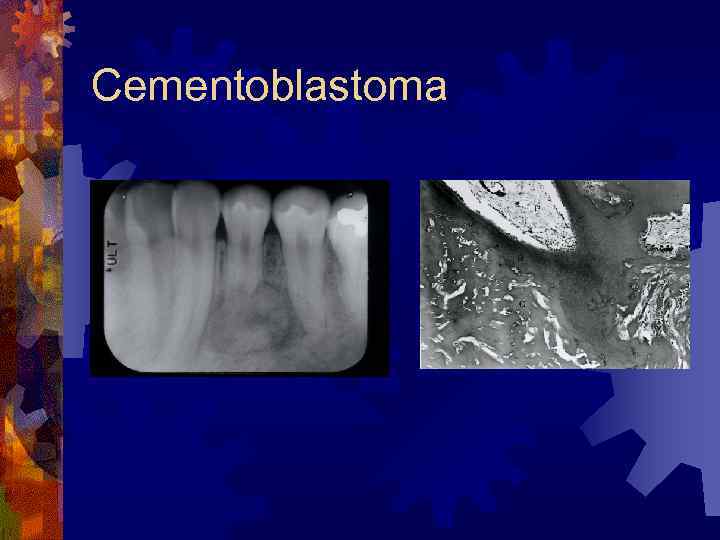
 Cementoblastoma ® True neoplasm of cementoblasts ® First mandibular molars ® Cortex expanded without pain ® Involved tooth ankylosed, percussion ® Radiology – apical mass; lucent or solid, radiolucent halo with dense lesions ® Histology – radially oriented trabeculae from cementum, rim of osteoblasts ® Treatment – complete excision and tooth sacrifice
 Cementoblastoma
 Mixed Odontogenic Tumors ® Ameloblastic fibroma, ameloblastic fibrodentinoma, ameloblastic fibroodontoma, odontoma ® Both epithelial and mesenchymal cells ® Mimic differentiation of developing tooth ® Treatment – enucleation, thorough curettage with extraction of impacted tooth ® Ameloblastic fibrosarcomas – malignant, treat with aggressive en bloc resection
 Related Jaw Lesions ® Giant Cell Lesions Central giant cell granuloma ® Brown tumor ® Aneurysmal bone cyst ® ® Fibroosseous lesions Fibrous dysplasia ® Ossifying fibroma ® ® Condensing Osteitis
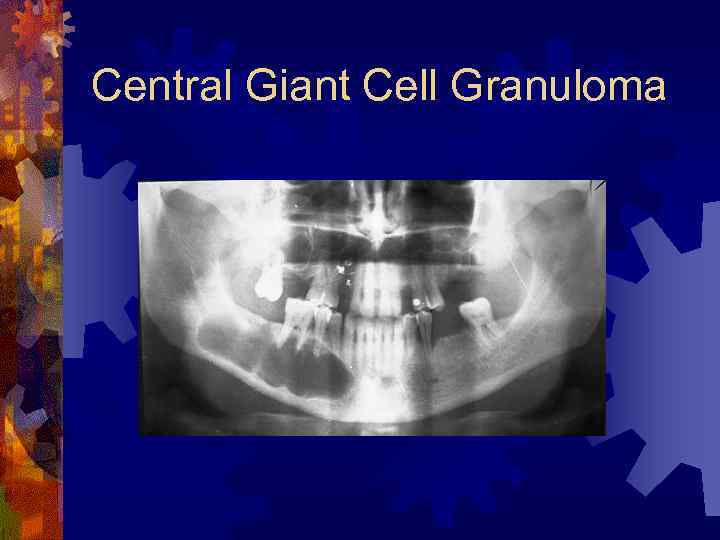
 Central Giant Cell Granuloma ® Neoplastic-like reactive proliferation ® Common in children and young adults ® Females > males (hormonal? ) ® Mandible > maxilla ® Expansile lesions – root resorption ® Slow-growing – asymptomatic swelling ® Rapid-growing – pain, loose dentition (high rate of recurrence)
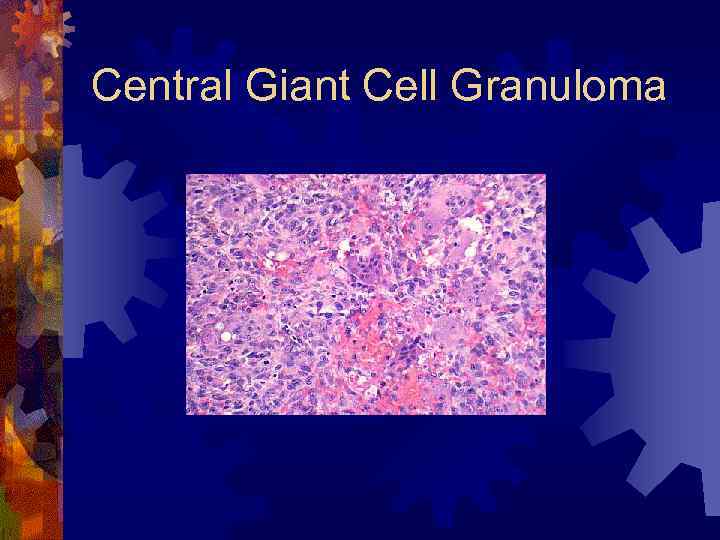
 Central Giant Cell Granuloma ® Radiographic findings ® Unilocular, multilocular radiolucencies ® Well-defined or irregular borders ® Histology ® Multinucleated giant cells, dispersed throughout a fibrovascular stroma
 Central Giant Cell Granuloma
 Central Giant Cell Granuloma
 Central Giant Cell Granuloma ® Treatment ® Curettage, segmental resection ® Radiation – out of favor (risk of sarcoma) ® Intralesional steroids – younger patients, very large lesions ® Individualized treatment depending on characteristics and location of tumor
 Brown Tumor ® Local manifestation of hyperparathyroid ® Histologically identical to CGCG ® Serum calcium and phosphorus ® More likely in older patients
 Aneurysmal Bone Cyst ® Large vascular sinusoids (no bruit) ® Not a true cyst; aggressive, reactive ® Great potential for growth, deformity ® Multilocular radiolucency with cortical expansion ® Mandible body ® Simple enucleation, rare recurrence
 Fibrous Dysplasia ® Monostotic vs. polystotic ® Monostotic ® More common in jaws and cranium ® Polystotic ® Mc. Cune-Albright’s syndrome ® Cutaneous pigmentation, hyper-functioning endocrine glands, precocious puberty
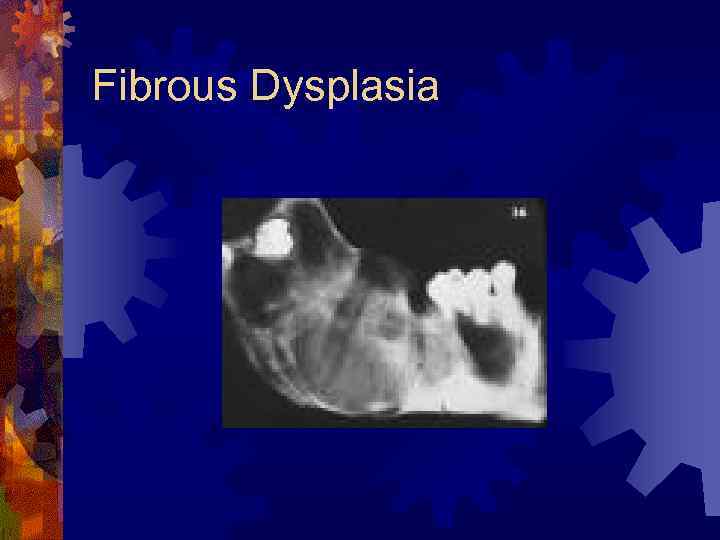
 Fibrous Dysplasia ® Painless expansile dysplastic process of osteoprogenitor connective tissue ® Maxilla most common ® Does not typically cross midline (one bone) ® Antrum obliterated, orbital floor involvement (globe displacement) ® Radiology – ground-glass appearance
 Fibrous Dysplasia
 Fibrous Dysplasia
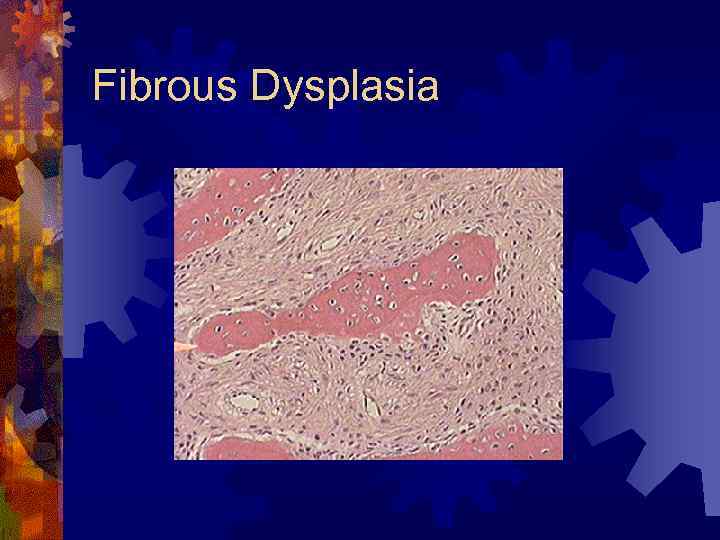
 Fibrous Dysplasia ® Histology – irregular osseous trabeculae in hypercellular fibrous stroma ® Treatment ® Deferred, if possible until skeletal maturity ® Quarterly clinical and radiographic f/u ® If quiescent – contour excision (cosmesis or function) ® Accelerated growth or disabling functional impairment - surgical intervention (en bloc resection, reconstruction)
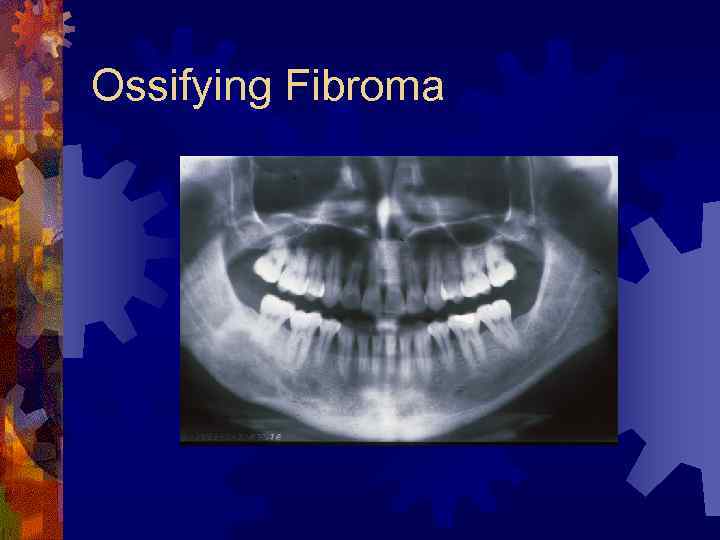
 Ossifying Fibroma ® True neoplasm of medullary jaws ® Elements of periodontal ligament ® Younger patients, premolar – mandible ® Frequently grow to expand jaw bone ® Radiology ® radiolucent lesion early, well-demarcated ® Progressive calcification (radiopaque – 6 yrs)
 Ossifying Fibroma
 Ossifying Fibroma ® Histologically similar to fibrous dysplasia ® Treatment ® Surgical excision – shells out ® Recurrence is uncommon
 Condensing Osteitis ® 4% to 8% of population ® Focal areas of radiodense sclerotic bone ® Mandible, apices of first molar ® Reactive bony sclerosis to pulp inflammation ® Irregular, radiopaque ® Stable, no treatment required
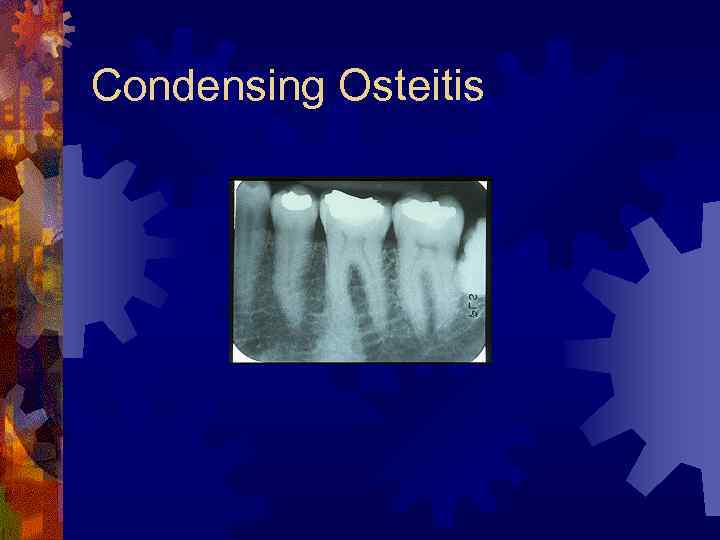 Condensing Osteitis
 Conclusion
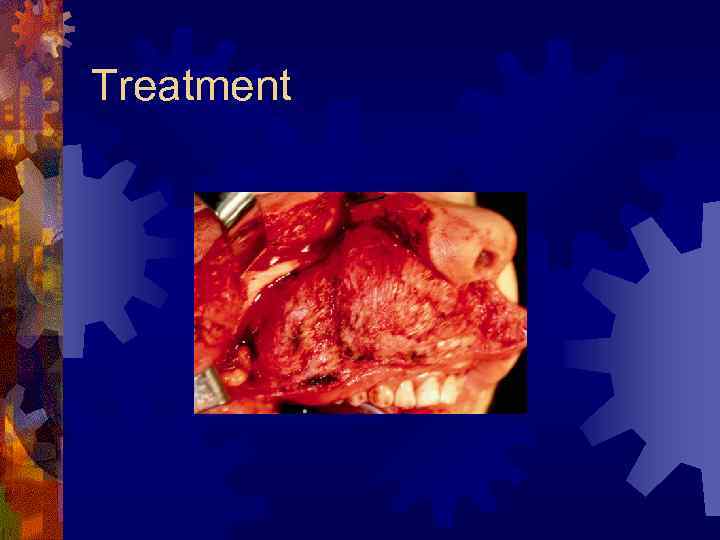
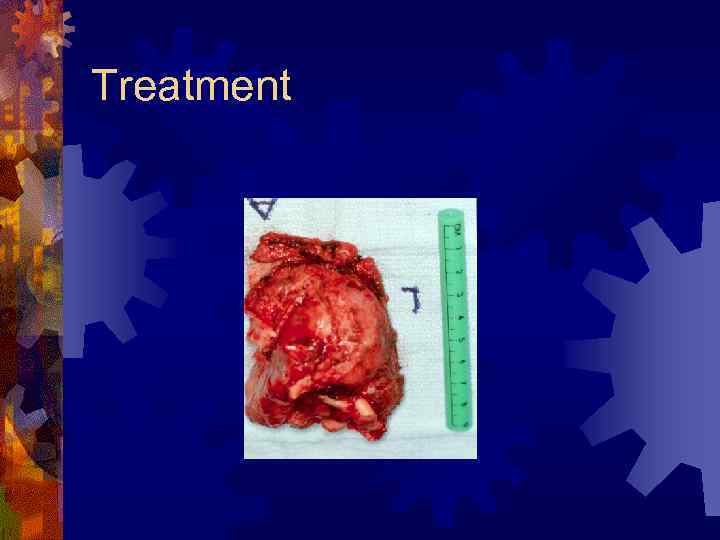
 Case Presentation ® 20 year-old hispanic female with several month history of lesion in right maxilla, treated initially by oral surgeon with multiple curettage. ® Has experienced recent onset of rapid expansion, after pregnancy, with complaints of loose dentition and pain.
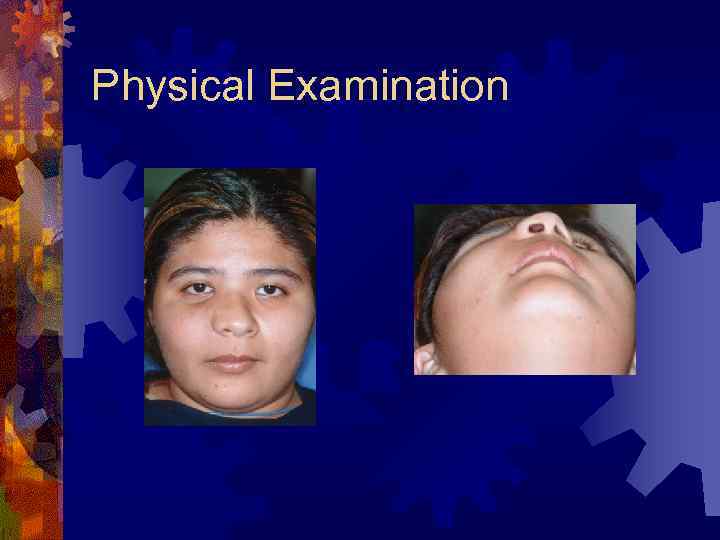 Physical Examination
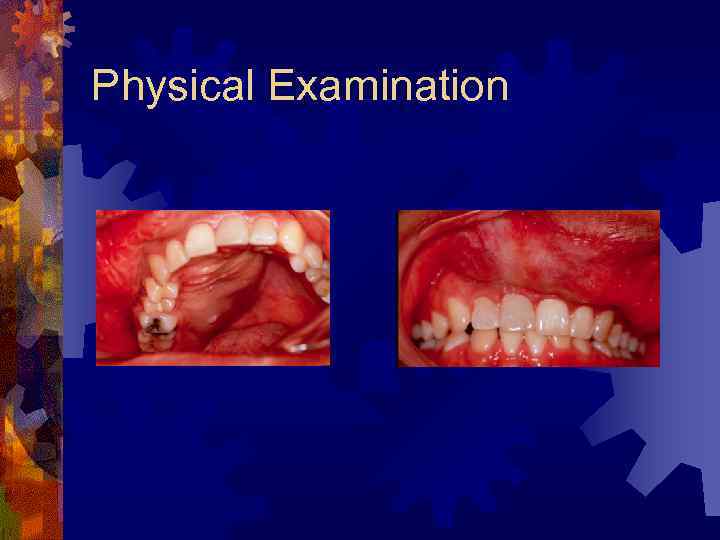 Physical Examination
 Radiographs ® Plain films – facial series ® Computerized Tomography of facial series
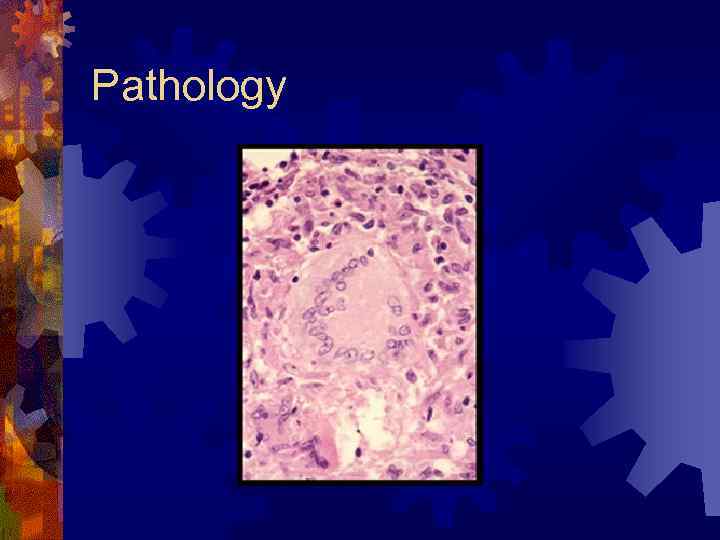 Pathology
 Treatment
 Treatment