 Скачать презентацию ODIE Toolkit NCBO Council Talk December 18 2007
3b090a87acb5e4070339d25bf45f5127.ppt
- Количество слайдов: 35



ODIE Toolkit NCBO Council Talk December 18, 2007 Rebecca Crowley crowleyrs@upmc. edu 1
Outline l Overview of the Project ü l Specific Aims from a use case approach ü ü l Aims, People, Organization, Domain, Philosophy Information Extraction Ontology Enrichment First steps, synergies, and year 1 work, working together 2
Project Overview l l Funded by National Cancer Center Develop tools for ü ü l l Information extraction from clinical text using ontologies Enrichment of ontologies using clinical text Project Period: 9/27/2007 – 7/31/2011 Collaboration with National Center for Biomedical Ontology ü ü Subcontract to Stanford (consultation on Bioportal) Subcontract to Mayo (Terminologies, NLP) 3
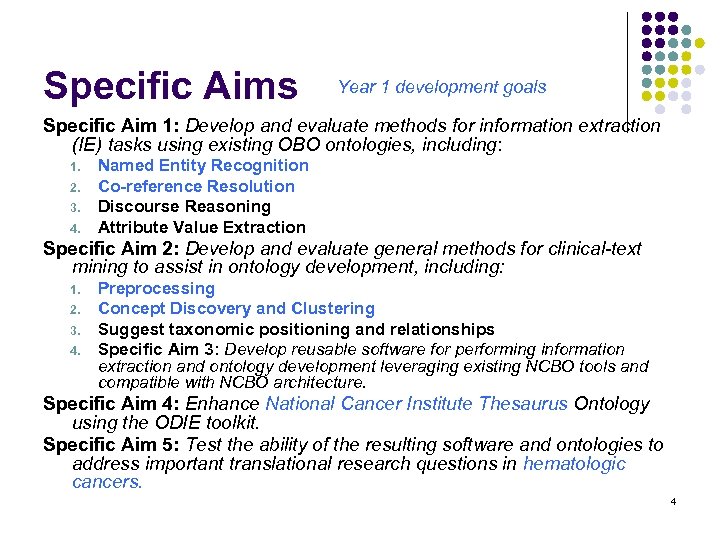
Specific Aims Year 1 development goals Specific Aim 1: Develop and evaluate methods for information extraction (IE) tasks using existing OBO ontologies, including: 1. 2. 3. 4. Named Entity Recognition Co-reference Resolution Discourse Reasoning Attribute Value Extraction Specific Aim 2: Develop and evaluate general methods for clinical-text mining to assist in ontology development, including: 1. 2. 3. 4. Preprocessing Concept Discovery and Clustering Suggest taxonomic positioning and relationships Specific Aim 3: Develop reusable software for performing information extraction and ontology development leveraging existing NCBO tools and compatible with NCBO architecture. Specific Aim 4: Enhance National Cancer Institute Thesaurus Ontology using the ODIE toolkit. Specific Aim 5: Test the ability of the resulting software and ontologies to address important translational research questions in hematologic cancers. 4
Dual Proposal Goals 5
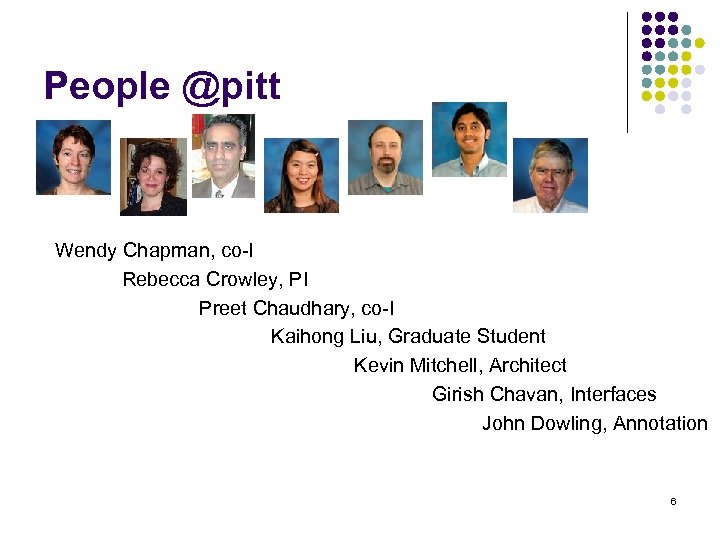
People @pitt Wendy Chapman, co-I Rebecca Crowley, PI Preet Chaudhary, co-I Kaihong Liu, Graduate Student Kevin Mitchell, Architect Girish Chavan, Interfaces John Dowling, Annotation 6
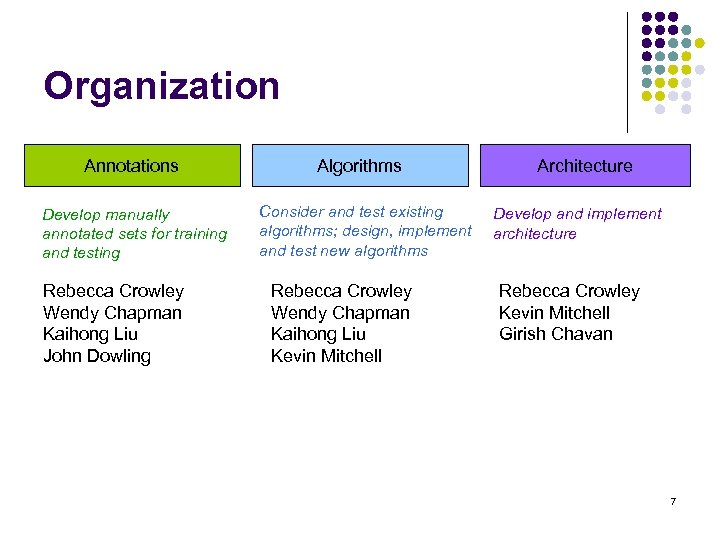
Organization Annotations Develop manually annotated sets for training and testing Rebecca Crowley Wendy Chapman Kaihong Liu John Dowling Algorithms Consider and test existing algorithms; design, implement and test new algorithms Rebecca Crowley Wendy Chapman Kaihong Liu Kevin Mitchell Architecture Develop and implement architecture Rebecca Crowley Kevin Mitchell Girish Chavan 7
Domain l l Will attempt to develop general tools whenever possible Priorities for evaluation of components in : ü ü ü Radiology and pathology reports NCIT as well as other clinically relevant OBO ontologies Cancer domains (including hematologic oncology) 8
Philosophy l l l Toolkit for developers of NLP applications and ontologies Support interaction and experimentation Package systems at the conclusion of working with ODIE Foster cycle of enrichment and extraction needed to advance development of NLP systems Ontology enrichment as opposed to denovo development Human-machine collaboration as opposed to fully automated learning 9
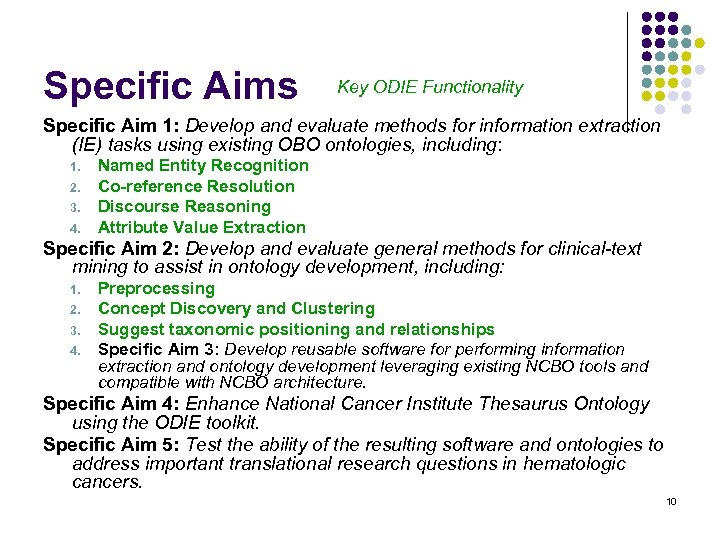
Specific Aims Key ODIE Functionality Specific Aim 1: Develop and evaluate methods for information extraction (IE) tasks using existing OBO ontologies, including: 1. 2. 3. 4. Named Entity Recognition Co-reference Resolution Discourse Reasoning Attribute Value Extraction Specific Aim 2: Develop and evaluate general methods for clinical-text mining to assist in ontology development, including: 1. 2. 3. 4. Preprocessing Concept Discovery and Clustering Suggest taxonomic positioning and relationships Specific Aim 3: Develop reusable software for performing information extraction and ontology development leveraging existing NCBO tools and compatible with NCBO architecture. Specific Aim 4: Enhance National Cancer Institute Thesaurus Ontology using the ODIE toolkit. Specific Aim 5: Test the ability of the resulting software and ontologies to address important translational research questions in hematologic cancers. 10
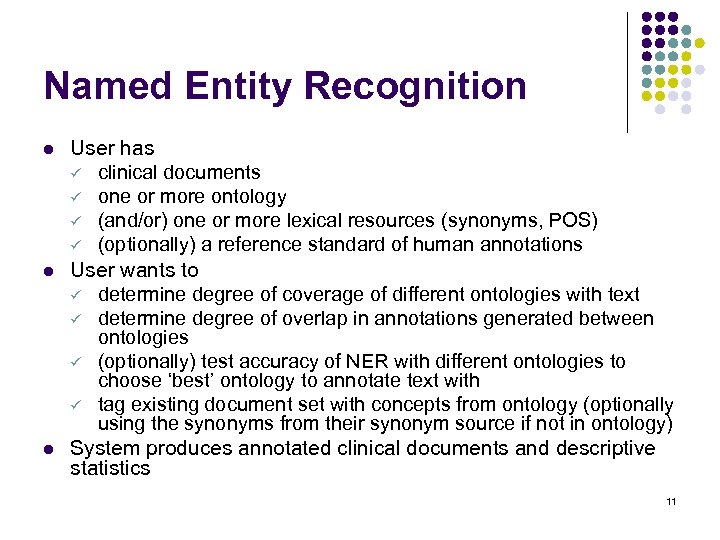
Named Entity Recognition l l l User has ü clinical documents ü one or more ontology ü (and/or) one or more lexical resources (synonyms, POS) ü (optionally) a reference standard of human annotations User wants to ü determine degree of coverage of different ontologies with text ü determine degree of overlap in annotations generated between ontologies ü (optionally) test accuracy of NER with different ontologies to choose ‘best’ ontology to annotate text with ü tag existing document set with concepts from ontology (optionally using the synonyms from their synonym source if not in ontology) System produces annotated clinical documents and descriptive statistics 11
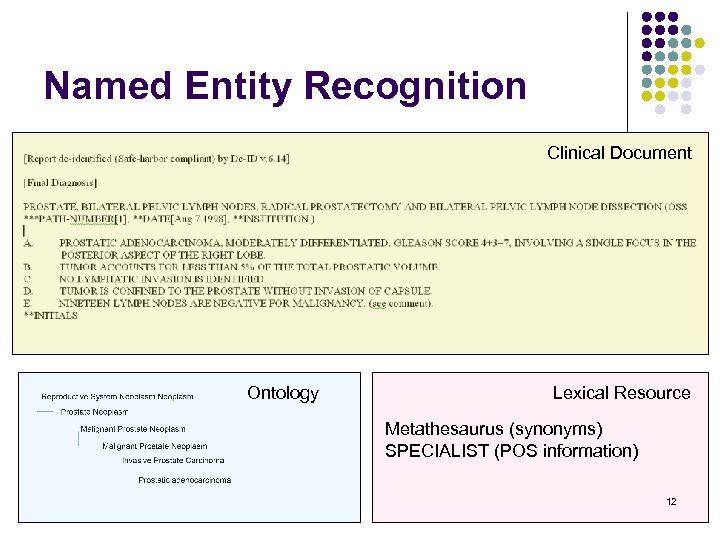
Named Entity Recognition Clinical Document Ontology Lexical Resource Metathesaurus (synonyms) SPECIALIST (POS information) 12
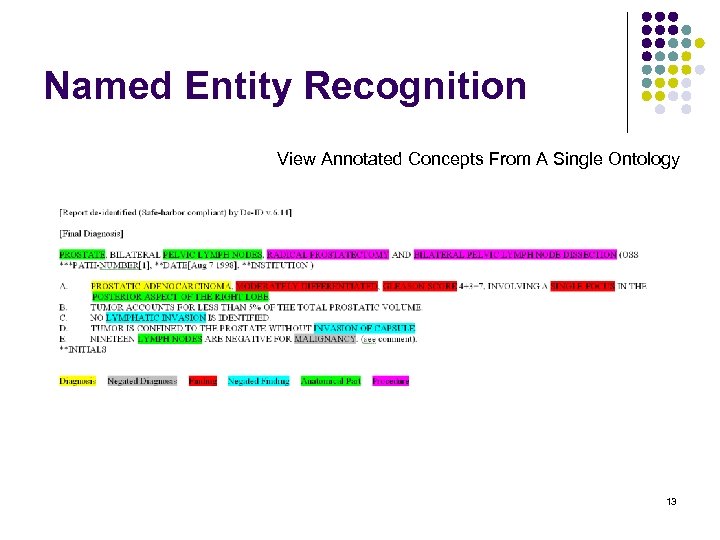
Named Entity Recognition View Annotated Concepts From A Single Ontology 13
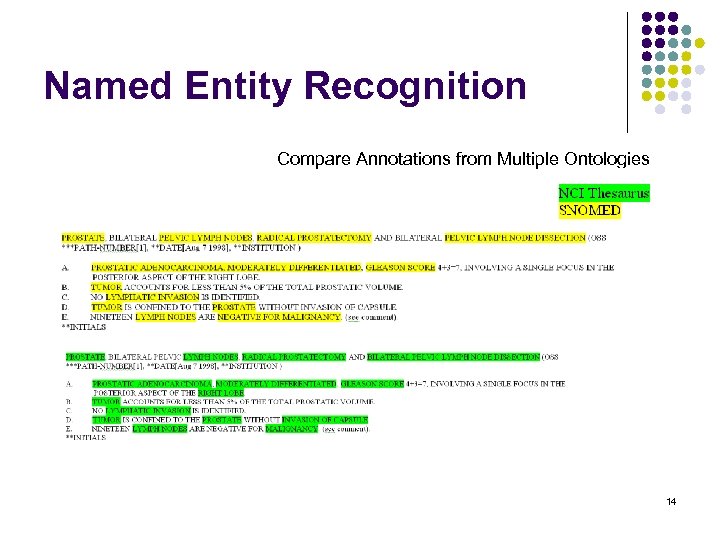
Named Entity Recognition Compare Annotations from Multiple Ontologies 14
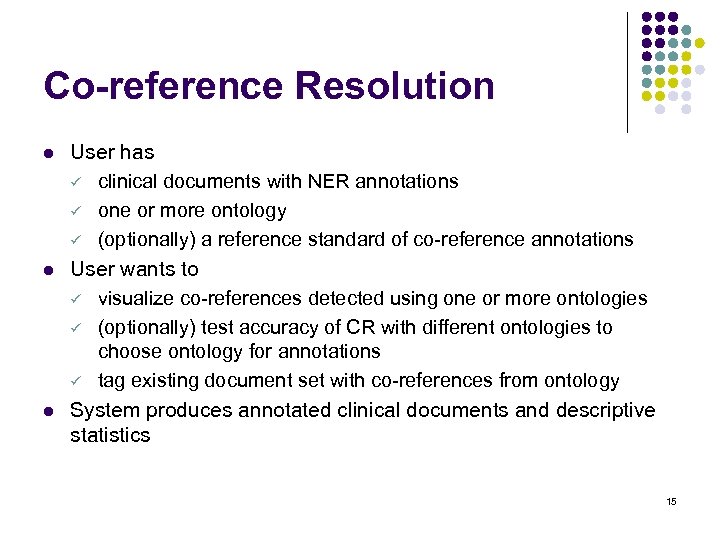
Co-reference Resolution l l l User has ü clinical documents with NER annotations ü one or more ontology ü (optionally) a reference standard of co-reference annotations User wants to ü visualize co-references detected using one or more ontologies ü (optionally) test accuracy of CR with different ontologies to choose ontology for annotations ü tag existing document set with co-references from ontology System produces annotated clinical documents and descriptive statistics 15
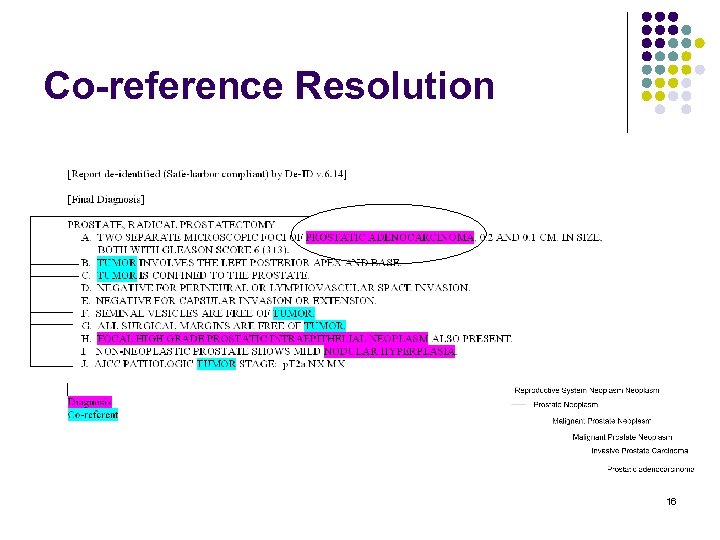
Co-reference Resolution 16
Discourse Reasoning l User has ü ü l a set of clinical documents with NER and CR annotations a set of information models about those documents User wants to ü determine which information model (or parts of them) should be used for which clinical document 17
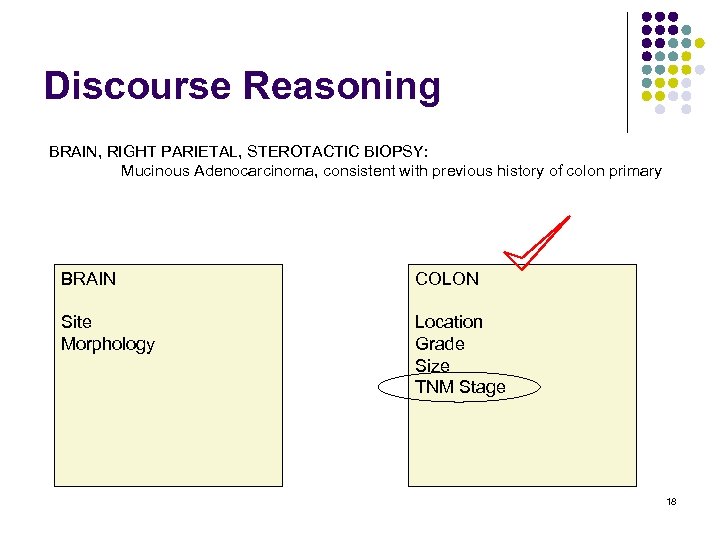
Discourse Reasoning BRAIN, RIGHT PARIETAL, STEROTACTIC BIOPSY: Mucinous Adenocarcinoma, consistent with previous history of colon primary BRAIN COLON Site Morphology Location Grade Size TNM Stage 18
Attribute Value Extraction l User has ü ü l clinical documents with NER, CR, DR annotations information model of specific subset of documents Wants to extract attributes and value from clinical text conforming to model ü ü Analyze data using common tools possible later search for particular cases 19
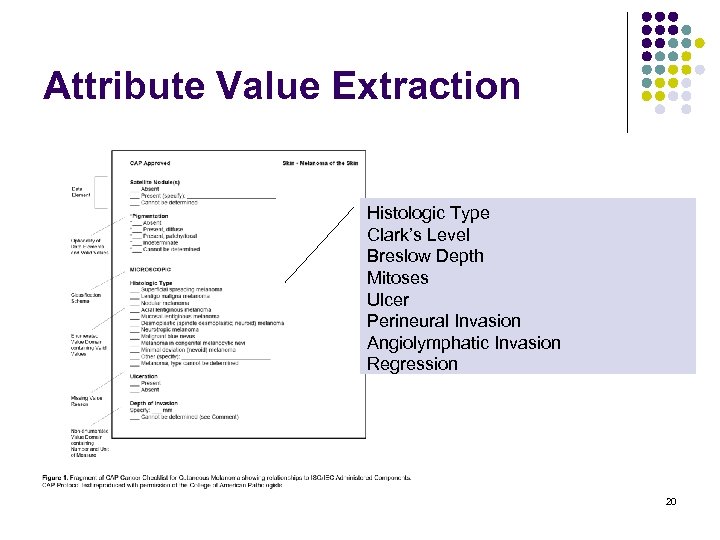
Attribute Value Extraction Histologic Type Clark’s Level Breslow Depth Mitoses Ulcer Perineural Invasion Angiolymphatic Invasion Regression 20
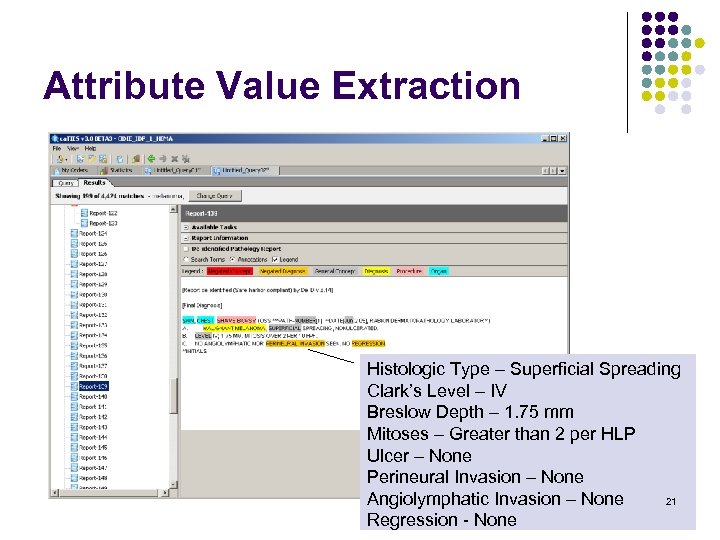
Attribute Value Extraction Histologic Type – Superficial Spreading Clark’s Level – IV Breslow Depth – 1. 75 mm Mitoses – Greater than 2 per HLP Ulcer – None Perineural Invasion – None Angiolymphatic Invasion – None 21 Regression - None
Ontology Enrichment l User has ü ü l clinical documents Ontology User wants to identify potential candidate concepts from the documents to include in the ontology ü ü ü Visualized in a manner to ease search and recognition of presence of absence of those concepts in the ontology Suggestions for where in taxonomy the concept should be placed Suggestions for relationships 22
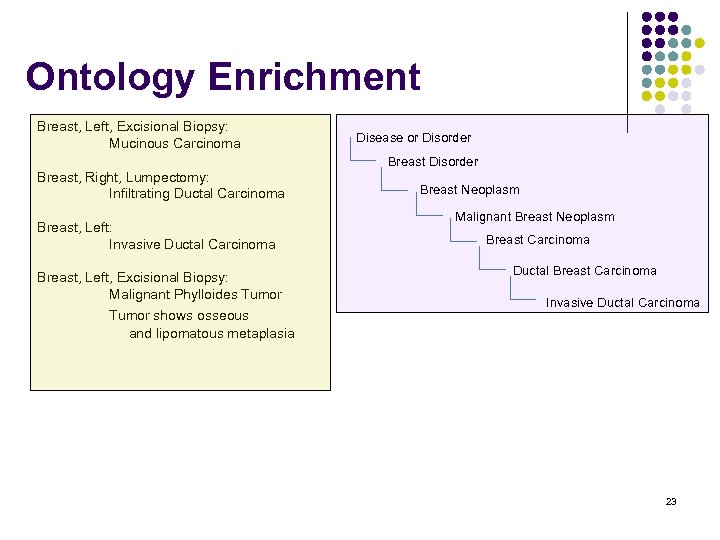
Ontology Enrichment Breast, Left, Excisional Biopsy: Mucinous Carcinoma Breast, Right, Lumpectomy: Infiltrating Ductal Carcinoma Breast, Left: Invasive Ductal Carcinoma Breast, Left, Excisional Biopsy: Malignant Phylloides Tumor shows osseous and lipomatous metaplasia Disease or Disorder Breast Neoplasm Malignant Breast Neoplasm Breast Carcinoma Ductal Breast Carcinoma Invasive Ductal Carcinoma 23
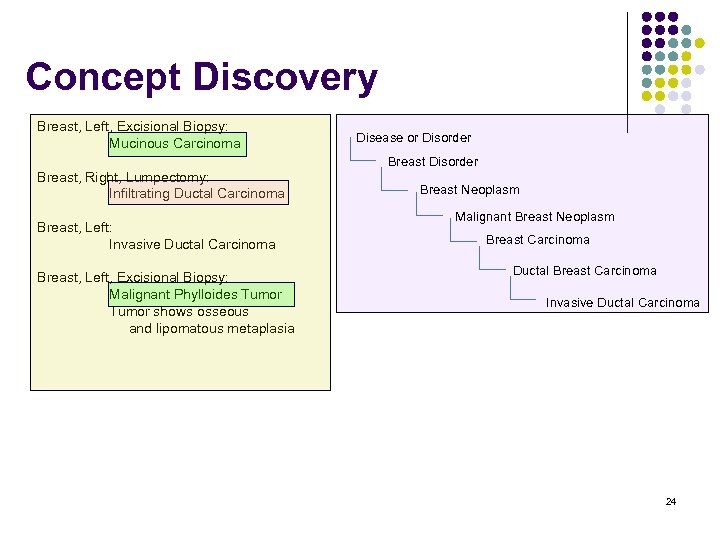
Concept Discovery Breast, Left, Excisional Biopsy: Mucinous Carcinoma Breast, Right, Lumpectomy: Infiltrating Ductal Carcinoma Breast, Left: Invasive Ductal Carcinoma Breast, Left, Excisional Biopsy: Malignant Phylloides Tumor shows osseous and lipomatous metaplasia Disease or Disorder Breast Neoplasm Malignant Breast Neoplasm Breast Carcinoma Ductal Breast Carcinoma Invasive Ductal Carcinoma 24
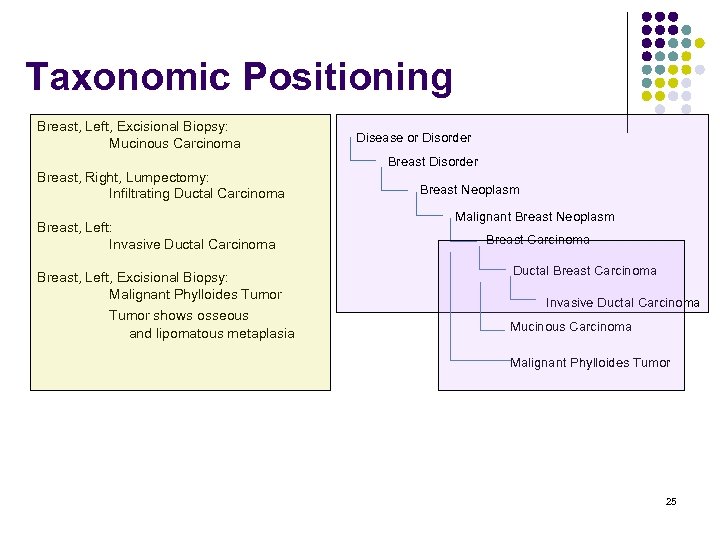
Taxonomic Positioning Breast, Left, Excisional Biopsy: Mucinous Carcinoma Breast, Right, Lumpectomy: Infiltrating Ductal Carcinoma Breast, Left: Invasive Ductal Carcinoma Breast, Left, Excisional Biopsy: Malignant Phylloides Tumor shows osseous and lipomatous metaplasia Disease or Disorder Breast Neoplasm Malignant Breast Neoplasm Breast Carcinoma Ductal Breast Carcinoma Invasive Ductal Carcinoma Mucinous Carcinoma Malignant Phylloides Tumor 25
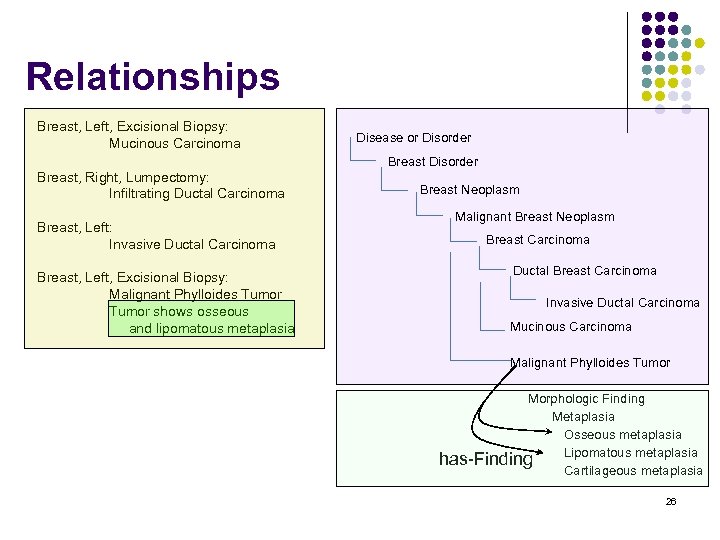
Relationships Breast, Left, Excisional Biopsy: Mucinous Carcinoma Breast, Right, Lumpectomy: Infiltrating Ductal Carcinoma Breast, Left: Invasive Ductal Carcinoma Breast, Left, Excisional Biopsy: Malignant Phylloides Tumor shows osseous and lipomatous metaplasia Disease or Disorder Breast Neoplasm Malignant Breast Neoplasm Breast Carcinoma Ductal Breast Carcinoma Invasive Ductal Carcinoma Mucinous Carcinoma Malignant Phylloides Tumor Morphologic Finding Metaplasia Osseous metaplasia Lipomatous metaplasia has-Finding Cartilageous metaplasia 26
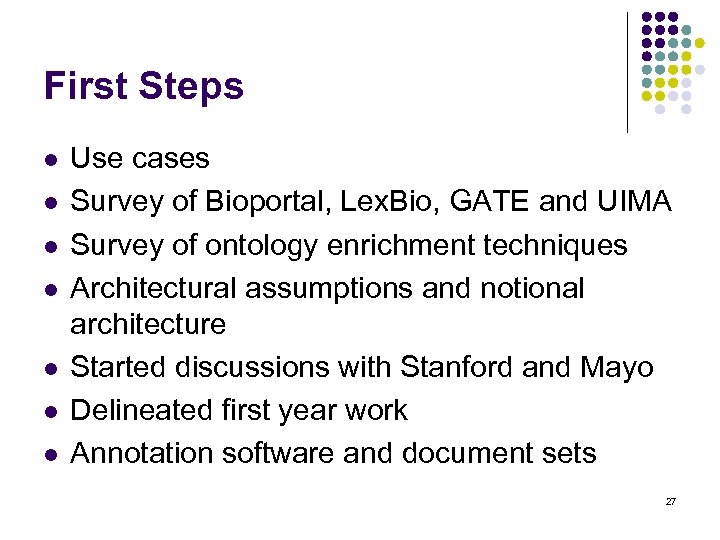
First Steps l l l l Use cases Survey of Bioportal, Lex. Bio, GATE and UIMA Survey of ontology enrichment techniques Architectural assumptions and notional architecture Started discussions with Stanford and Mayo Delineated first year work Annotation software and document sets 27
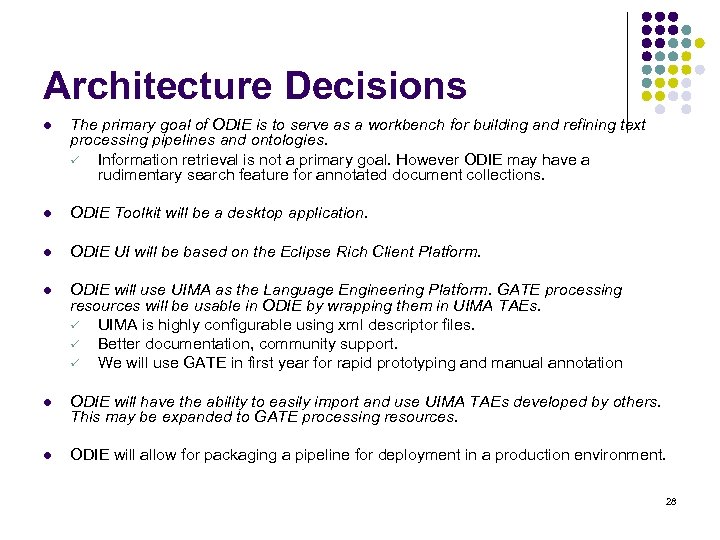
Architecture Decisions l The primary goal of ODIE is to serve as a workbench for building and refining text processing pipelines and ontologies. ü Information retrieval is not a primary goal. However ODIE may have a rudimentary search feature for annotated document collections. l ODIE Toolkit will be a desktop application. l ODIE UI will be based on the Eclipse Rich Client Platform. l ODIE will use UIMA as the Language Engineering Platform. GATE processing resources will be usable in ODIE by wrapping them in UIMA TAEs. ü UIMA is highly configurable using xml descriptor files. ü Better documentation, community support. ü We will use GATE in first year for rapid prototyping and manual annotation l ODIE will have the ability to easily import and use UIMA TAEs developed by others. This may be expanded to GATE processing resources. l ODIE will allow for packaging a pipeline for deployment in a production environment. 28
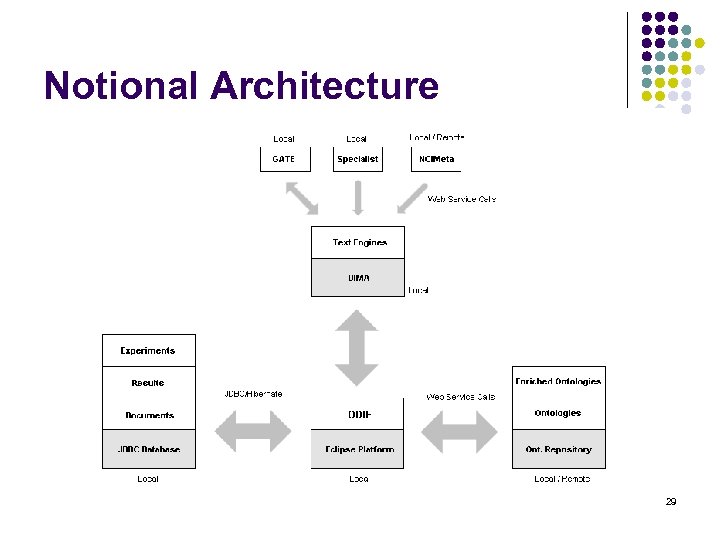
Notional Architecture 29
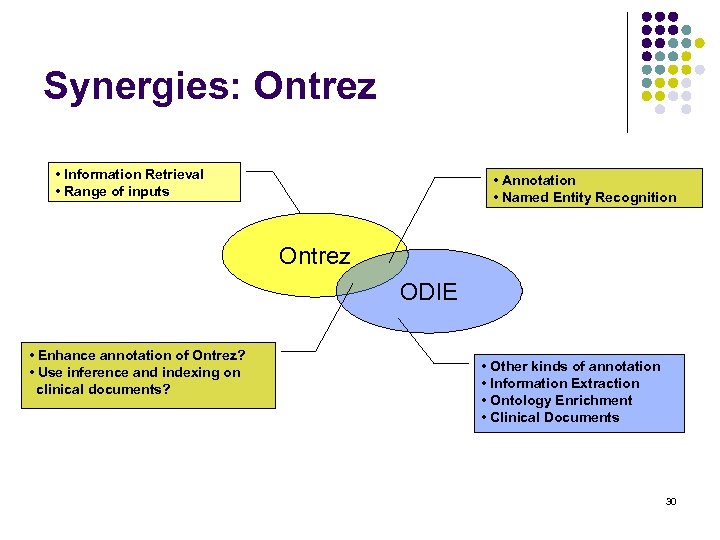
Synergies: Ontrez • Information Retrieval • Range of inputs • Annotation • Named Entity Recognition Ontrez ODIE • Enhance annotation of Ontrez? • Use inference and indexing on clinical documents? • Other kinds of annotation • Information Extraction • Ontology Enrichment • Clinical Documents 30
Synergies: Mayo l l l NER and Co-reference resolution Clustering, discovery of synonyms Lex. Grid Using similar tools, focused on larger range of document types More – to be explored 31
First Year Work l l l NER and co-reference modules Concept discovery Develop manually annotated reference standards for NER and CR Focus on testing and developing algorithms ODIE 1. 0 will include basic architecture and modules for NER, CR and concept discovery, statistics 32
Working Together l l l Work with Mayo to scope first year collaboration (NER, CR, synonym discovery) Decisions regarding terminology access Better define what NCBO resources we will use 33
Working Together l l Source. Forge site, ODIE website and Wiki All our meetings are open and we are happy to arrange teleconferences ü l l l Mondays 2 -4 pm (EST) Schedule visits with Mayo and Stanford for early spring ’ 08 Anticipate providing monthly progress updates at the ODIE website starting in January ‘ 08 Other ideas? What’s the expectation of the Council? 34
Questions? Comments? 35
Скачать презентацию ODIE Toolkit NCBO Council Talk December 18 2007
3b090a87acb5e4070339d25bf45f5127.ppt