 Скачать презентацию October 2010 NEWSLETTER CASTON CORPORATE ADVISORY SERVICES -Global
d7ddf13762a23e18f53b36ccdbffeff4.ppt
- Количество слайдов: 5




October, 2010 NEWSLETTER CASTON CORPORATE ADVISORY SERVICES -Global Risk News -Indian Commerce -Industry Circle- The WPI Mathematics -Major Economic Indicators Write to us at info@caston. co. in
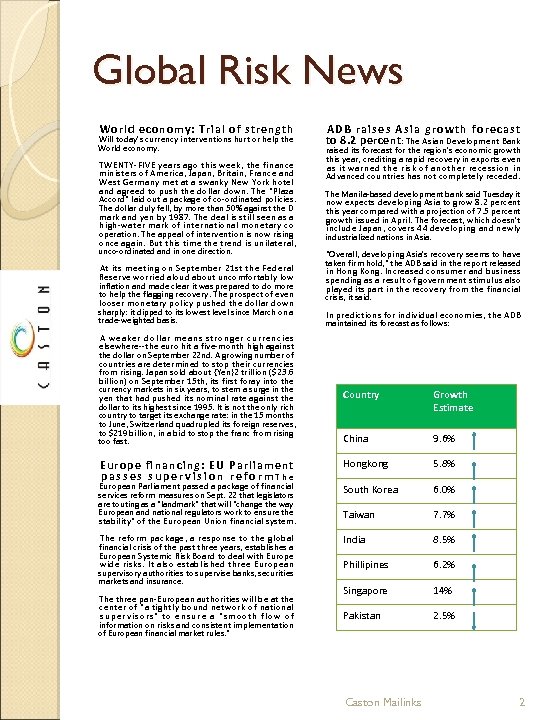
Global Risk News World economy: Trial of strength Will today's currency interventions hurt or help the World economy. TWENTY-FIVE years ago this week, the finance ministers of America, Japan, Britain, France and West Germany met at a swanky New York hotel and agreed to push the dollar down. The "Plaza Accord" laid out a package of co-ordinated policies. The dollar duly fell, by more than 50% against the D mark and yen by 1987. The deal is still seen as a high-water mark of international monetary co operation. The appeal of intervention is now rising once again. But this time the trend is unilateral, unco-ordinated and in one direction. At its meeting on September 21 st the Federal Reserve worried aloud about uncomfortably low inflation and made clear it was prepared to do more to help the flagging recovery. The prospect of even looser monetary policy pushed the dollar down sharply: it dipped to its lowest level since March on a trade-weighted basis. A we ak e r d o l l ar m e an s s t r o n g e r cu r r e n ci e s elsewhere--the euro hit a five-month high against the dollar on September 22 nd. A growing number of countries are determined to stop their currencies from rising. Japan sold about {Yen}2 trillion ($23. 6 billion) on September 15 th, its first foray into the currency markets in six years, to stem a surge in the yen that had pushed its nominal rate against the dollar to its highest since 1995. It is not the only rich country to target its exchange rate: in the 15 months to June, Switzerland quadrupled its foreign reserves, to $219 billion, in a bid to stop the franc from rising too fast. AD B rai ses Asi a g ro w th fo recast to 8. 2 percent: The Asian Development Bank raised its forecast for the region's economic growth this year, crediting a rapid recovery in exports even as it warned the risk of another recession in Advanced countries has not completely receded. The Manila-based development bank said Tuesday it now expects developing Asia to grow 8. 2 percent this year compared with a projection of 7. 5 percent growth issued in April. The forecast, which doesn't include Japan, covers 44 developing and newly industrialized nations in Asia. "Overall, developing Asia's recovery seems to have taken firm hold, " the ADB said in the report released in Hong Kong. Increased consumer and business spending as a result of government stimulus also played its part in the recovery from the financial crisis, it said. In predictions for individual economies, the ADB maintained its forecast as follows: Country Growth Estimate China 9. 6% Hongkong 5. 8% European Parliament passed a package of financial services reform measures on Sept. 22 that legislators are touting as a "landmark" that will "change the way European and national regulators work to ensure the stability" of the European Union financial system. South Korea 6. 0% Taiwan 7. 7% The reform package, a response to the global financial crisis of the past three years, establishes a European Systemic Risk Board to deal with Europe wide risks. It also established three European supervisory authorities to supervise banks, securities markets and insurance. India 8. 5% Phillipines 6. 2% Singapore 14% Pakistan 2. 5% Europe financing: EU Parliament passes supervision reform. Th e The three pan-European authorities will be at the center of "a tightly bound network of national supervisors" to ensure a "smooth flow of information on risks and consistent implementation of European financial market rules. " Caston Mailinks 2
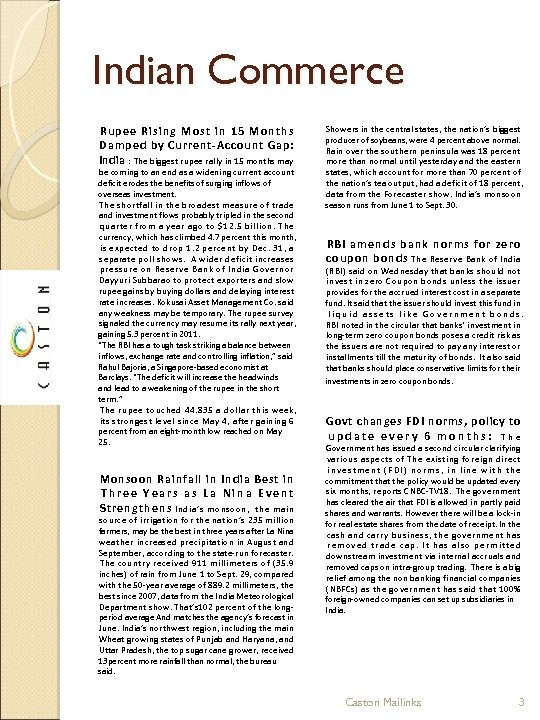
Indian Commerce Rupee Rising Most in 15 Months Damped by Current-Account Gap: India : The biggest rupee rally in 15 months may be coming to an end as a widening current account deficit erodes the benefits of surging inflows of overseas investment. The shortfall in the broadest measure of trade and investment flows probably tripled in the second quarter from a year ago to $12. 5 billion. The currency, which has climbed 4. 7 percent this month, is expected to drop 1. 2 percent by Dec. 31, a separate poll shows. A wider deficit increases pressure on Reserve Bank of India Governor Dayyuri Subbarao to protect exporters and slow rupee gains by buying dollars and delaying interest rate increases. Kokusai Asset Management Co. said any weakness may be temporary. The rupee survey signaled the currency may resume its rally next year, gaining 5. 3 percent in 2011. “The RBI has a tough task striking a balance between inflows, exchange rate and controlling inflation, ” said Rahul Bajoria, a Singapore-based economist at Barclays. “The deficit will increase the headwinds and lead to a weakening of the rupee in the short term. ” The rupee touched 44. 835 a dollar this week, its strongest level since May 4, after gaining 6 percent from an eight-month low reached on May 25. Monsoon Rainfall in India Best in Three Years as La Nina Event Stren g th en s India’s monsoon, the main source of irrigation for the nation’s 235 million farmers, may be the best in three years after La Nina weather increased precipitation in August and September, according to the state-run forecaster. The country received 911 millimeters of (35. 9 inches) of rain from June 1 to Sept. 29, compared with the 50 -year average of 889. 2 millimeters, the best since 2007, data from the India Meteorological Department show. That’s 102 percent of the longperiod average And matches the agency’s forecast in June. India’s northwest region, including the main Wheat growing states of Punjab and Haryana, and Uttar Pradesh, the top sugar cane grower, received 13 percent more rainfall than normal, the bureau said. Showers in the central states, the nation’s biggest producer of soybeans, were 4 percent above normal. Rain over the southern peninsula was 18 percent more than normal until yesterday and the eastern states, which account for more than 70 percent of the nation’s tea output, had a deficit of 18 percent, data from the Forecaster show. India’s monsoon season runs from June 1 to Sept. 30. RBI amends bank norms for zero coupon bonds The Reserve Bank of India (RBI) said on Wednesday that banks should not invest in zero Coupon bonds unless the issuer provides for the accrued interest cost in a separate fund. It said that the issuer should invest this fund in liquid assets like Government bonds. RBI noted in the circular that banks‘ investment in long-term zero coupon bonds poses a credit risk as the issuers are not required to pay any interest or installments till the maturity of bonds. It also said that banks should place conservative limits for their investments in zero coupon bonds. Govt changes FDI norms, policy to update every 6 months: Th e Government has issued a second circular clarifying various aspects of The existing foreign direct investment (FDI) norms, in line with the commitment that the policy would be updated every six months, reports CNBC-TV 18. The government has cleared the air that FDI is allowed in partly paid shares and warrants. However there will be a lock-in for real estate shares from the date of receipt. In the cash and carry business, the government has removed trade cap. It has also permitted downstream investment via internal accruals and removed caps on intra-group trading. There is a big relief among the non banking financial companies (NBFCs) as the government has said that 100% foreign-owned companies can set up subsidiaries in India. Caston Mailinks 3
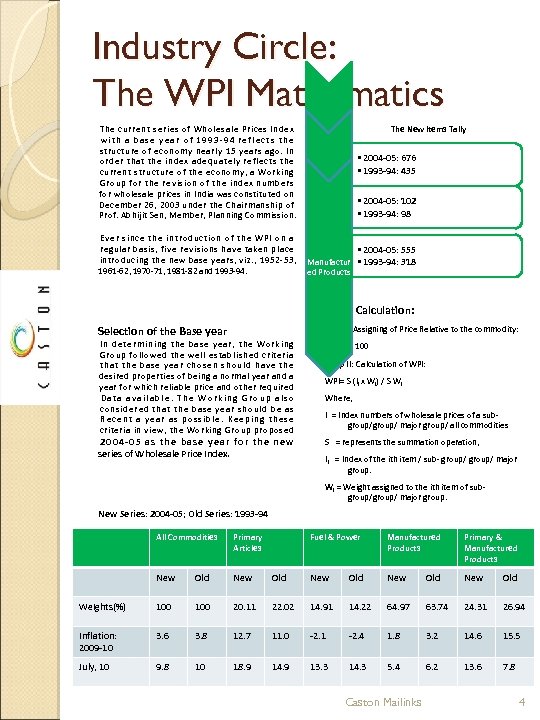
Industry Circle: The WPI Mathematics The current series of Wholesale Prices Index with a base year of 1993 -94 reflects the structure of economy nearly 15 years ago. In order that the index adequately reflects the current structure of the economy, a Working Group for the revision of the index numbers for wholesale prices in India was constituted on December 26, 2003 under the Chairmanship of Prof. Abhijit Sen, Member, Planning Commission. Ev er si nce the i ntroducti on of the WPI on a regular basis, five revisions have taken place introducing the new base years, viz. , 1952 -53, 1961 -62, 1970 -71, 1981 -82 and 1993 -94. The New Items Tally • 2004 -05: 676 • 1993 -94: 435 • 2004 -05: 102 All • 1993 -94: 98 Primary Commoditie Articles s • 2004 -05: 555 Manufactur • 1993 -94: 318 ed Products Index Calculation: Step I: Assigning of Price Relative to the commodity: Selection of the Base year In determining the base year, the Working Group followed the well established criteria that the base year chosen should have the desired properties of being a normal year and a year for which reliable price and other required Data available. The Working Group also co n si d e re d t h at t h e b ase y e ar sh o u l d b e as Recent a year as possible. Keeping these criteria in view, the Working Group proposed 2004 -05 as the base year for the new series of Wholesale Price Index. P 1/P 0 x 100 Step II: Calculation of WPI: WPI= S (Ii x Wi) / S Wi Where, I = Index numbers of wholesale prices of a subgroup/ major group/ all commodities S = represents the summation operation, Ii = Index of the ith item / sub- group/ major group. Wi = Weight assigned to the ith item of subgroup/ major group. New Series: 2004 -05; Old Series: 1993 -94 All Commodities Primary Articles Fuel & Power Manufactured Products Primary & Manufactured Products New Old New Old Weights(%) 100 20. 11 22. 02 14. 91 14. 22 64. 97 63. 74 24. 31 26. 94 Inflation: 2009 -10 3. 6 3. 8 12. 7 11. 0 -2. 1 -2. 4 1. 8 3. 2 14. 6 15. 5 July, 10 9. 8 10 18. 9 14. 9 13. 3 14. 3 5. 4 6. 2 13. 6 7. 8 Caston Mailinks 4
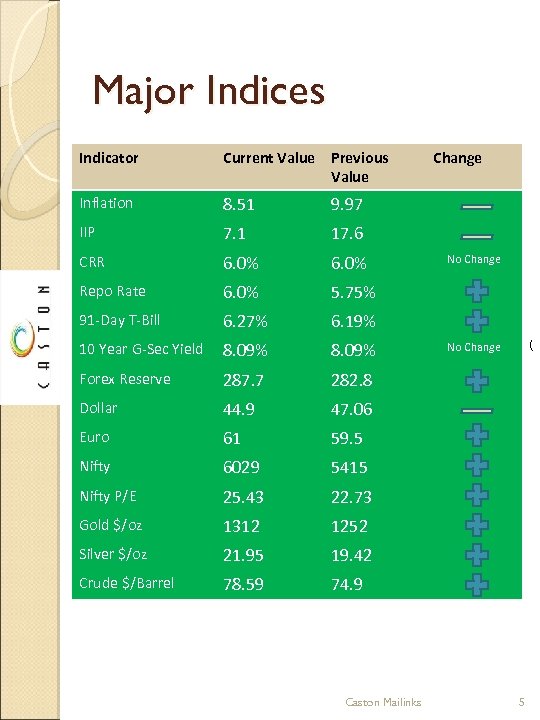
Major Indices Indicator Current Value Previous Value Inflation 8. 51 9. 97 IIP 7. 1 17. 6 CRR 6. 0% Repo Rate 6. 0% 5. 75% 91 -Day T-Bill 6. 27% 6. 19% 10 Year G-Sec Yield 8. 09% Forex Reserve 287. 7 282. 8 Dollar 44. 9 47. 06 Euro 61 59. 5 Nifty 6029 5415 Nifty P/E 25. 43 22. 73 Gold $/oz 1312 1252 Silver $/oz 21. 95 19. 42 Crude $/Barrel 78. 59 74. 9 Caston Mailinks Change No Change ( No Change 5
Скачать презентацию October 2010 NEWSLETTER CASTON CORPORATE ADVISORY SERVICES -Global
d7ddf13762a23e18f53b36ccdbffeff4.ppt