 Скачать презентацию October 2009 Geological Society of America Annual Meeting
bf4c2d57a80737972ca6e13f1a6f482e.ppt
- Количество слайдов: 33




October 2009, Geological Society of America Annual Meeting, Portland, Oregon Buying lidar data Ralph Haugerud U. S. Geological Survey c/o Earth & Space Sciences University of Washington Seattle, WA 98195 rhaugerud@usgs. gov / haugerud@u. washington. edu

How to buy lidar data • You know somebody… A known quantity. Easiest • Advertise for bids Maybe you don’t know as much as you think • NCALM (http: //www. ncalm. org/) NSF sponsored, partly subsidized, limited capacity • Participate in a consortium Economies of scale, in-place contracting structure, community of experience Geographically limited • Start your own consortium Advertise for bids …
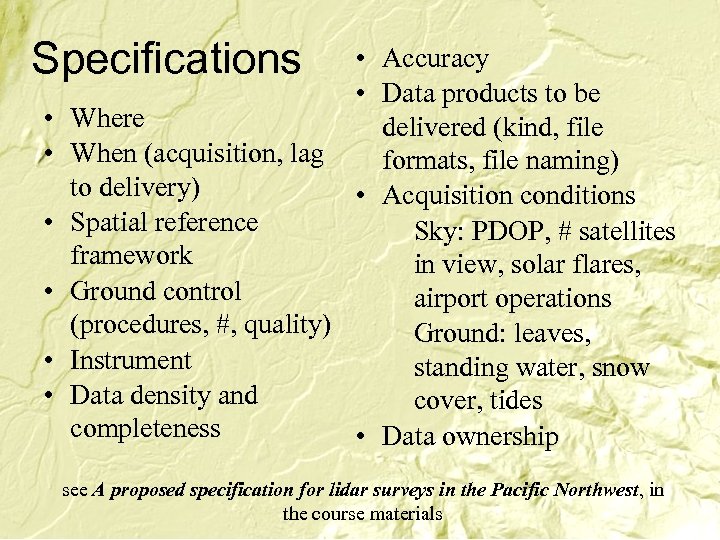
Specifications • • Accuracy • Data products to be Where delivered (kind, file When (acquisition, lag formats, file naming) to delivery) • Acquisition conditions Spatial reference Sky: PDOP, # satellites framework in view, solar flares, Ground control airport operations (procedures, #, quality) Ground: leaves, Instrument standing water, snow Data density and cover, tides completeness • Data ownership see A proposed specification for lidar surveys in the Pacific Northwest, in the course materials
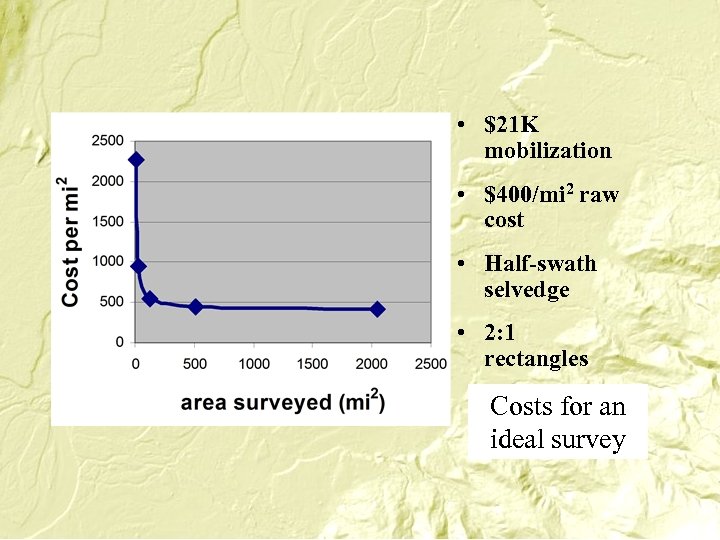
• $21 K mobilization • $400/mi 2 raw cost • Half-swath selvedge • 2: 1 rectangles Costs for an ideal survey
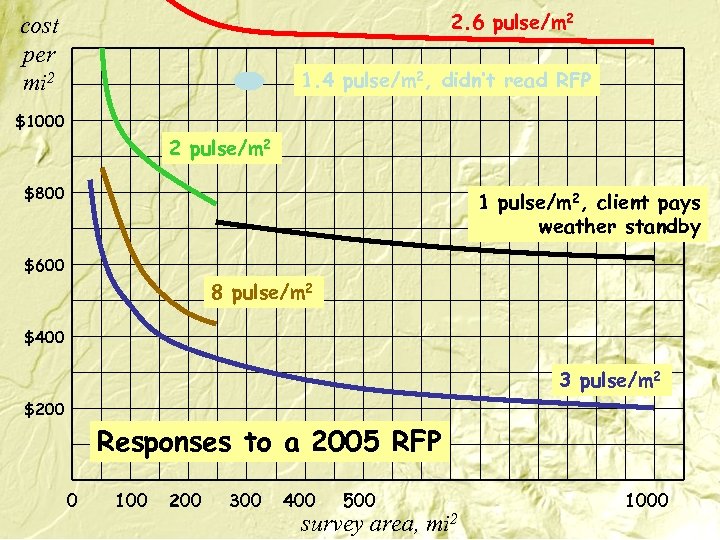
2. 6 pulse/m 2 cost per mi 2 1. 4 pulse/m 2, didn’t read RFP $1000 2 pulse/m 2 $800 1 pulse/m 2, client pays weather standby $600 8 pulse/m 2 $400 3 pulse/m 2 $200 Responses to a 2005 RFP 0 100 200 300 400 500 survey area, mi 2 1000
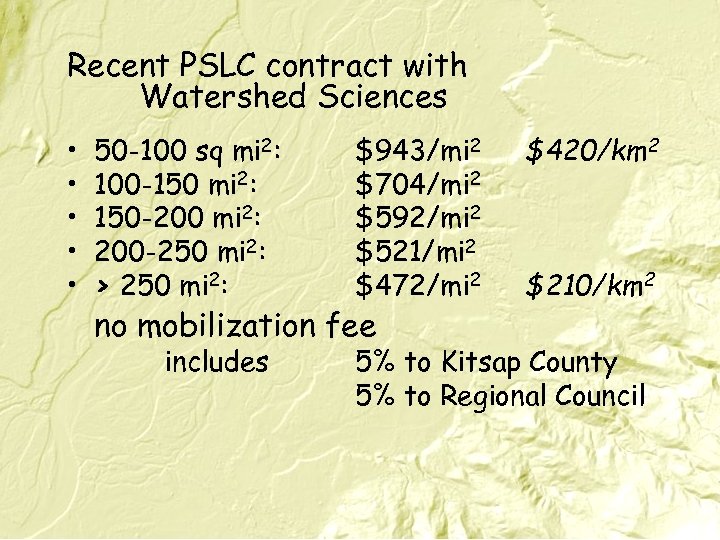
Recent PSLC contract with Watershed Sciences • • • 50 -100 sq mi 2: 100 -150 mi 2: 150 -200 mi 2: 200 -250 mi 2: > 250 mi 2: $943/mi 2 $704/mi 2 $592/mi 2 $521/mi 2 $472/mi 2 no mobilization fee includes $420/km 2 $210/km 2 5% to Kitsap County 5% to Regional Council
Data quality a Puget Sound Lidar Consortium perspective
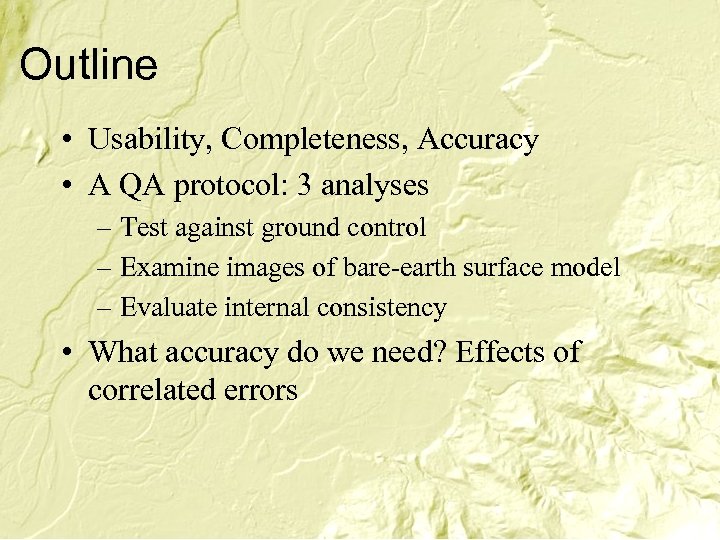
Outline • Usability, Completeness, Accuracy • A QA protocol: 3 analyses – Test against ground control – Examine images of bare-earth surface model – Evaluate internal consistency • What accuracy do we need? Effects of correlated errors
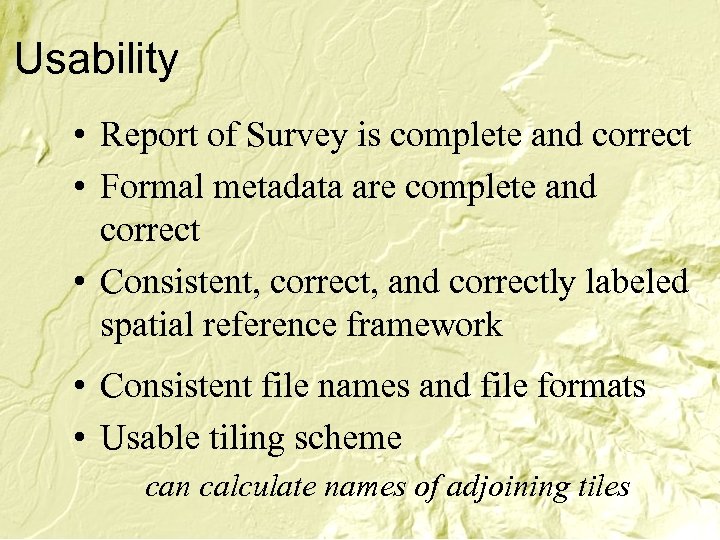
Usability • Report of Survey is complete and correct • Formal metadata are complete and correct • Consistent, correct, and correctly labeled spatial reference framework • Consistent file names and file formats • Usable tiling scheme can calculate names of adjoining tiles
Usability, continued • Fully populated data attributes GPS week OR Posix time • Consistent calibration • Consistency between data layers • No unnecessary artifacts in surface models
Completeness • Complete coverage Filling gaps requires remobilization, thus is very expensive • Adequate data density • Adequate swath overlap These are what we pay for
Accuracy is complicated • Accuracy of point measurements What the vendor can be held responsible for Evaluation requires abundant, expensive GCPs • Accuracy of DEM What we care about Evaluation requires abundant, expensive GCPs
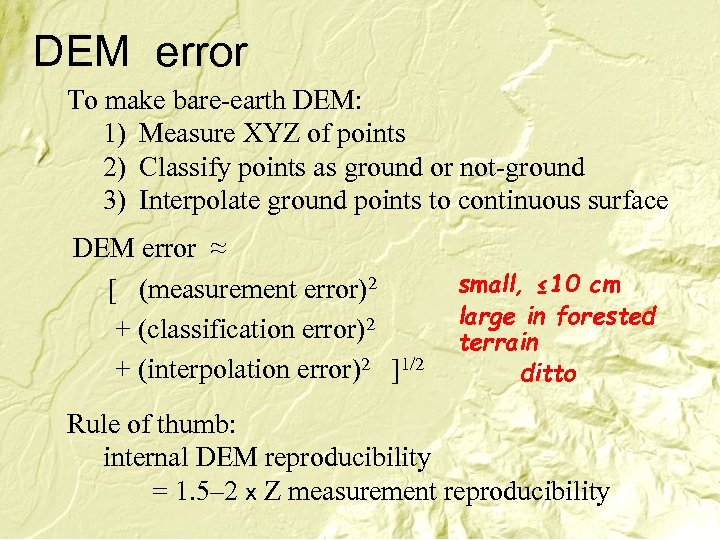
DEM error To make bare-earth DEM: 1) Measure XYZ of points 2) Classify points as ground or not-ground 3) Interpolate ground points to continuous surface DEM error ≈ [ (measurement error)2 + (classification error)2 + (interpolation error)2 ]1/2 small, ≤ 10 cm large in forested terrain ditto Rule of thumb: internal DEM reproducibility = 1. 5– 2 x Z measurement reproducibility
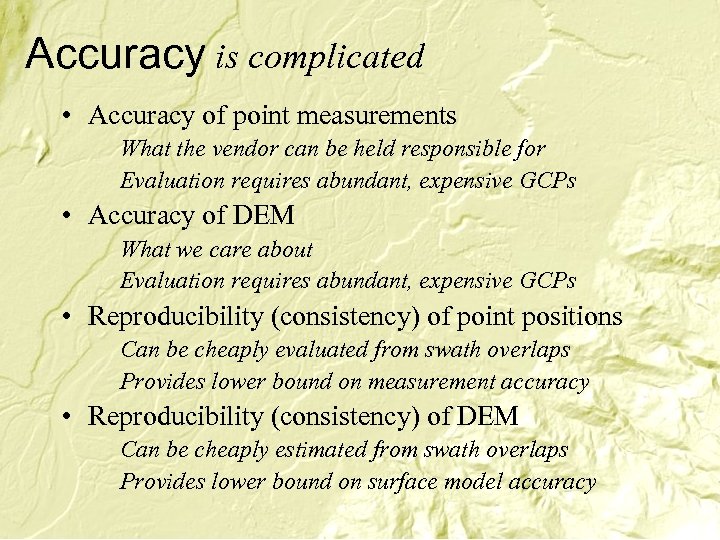
Accuracy is complicated • Accuracy of point measurements What the vendor can be held responsible for Evaluation requires abundant, expensive GCPs • Accuracy of DEM What we care about Evaluation requires abundant, expensive GCPs • Reproducibility (consistency) of point positions Can be cheaply evaluated from swath overlaps Provides lower bound on measurement accuracy • Reproducibility (consistency) of DEM Can be cheaply estimated from swath overlaps Provides lower bound on surface model accuracy
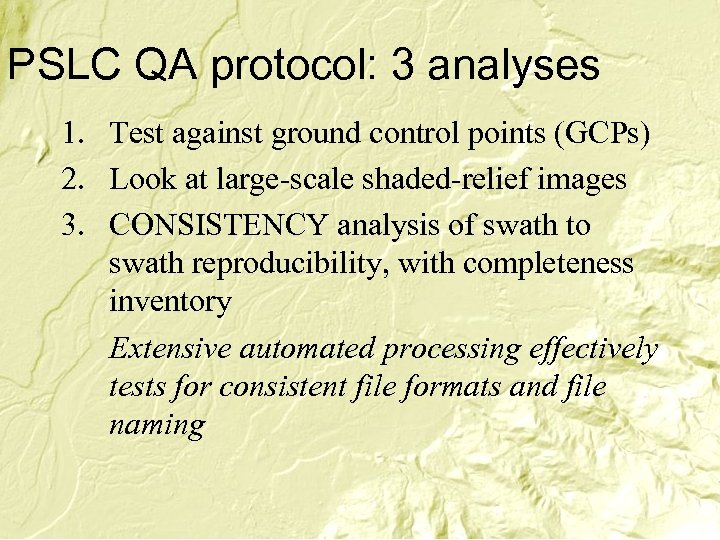
PSLC QA protocol: 3 analyses 1. Test against ground control points (GCPs) 2. Look at large-scale shaded-relief images 3. CONSISTENCY analysis of swath to swath reproducibility, with completeness inventory Extensive automated processing effectively tests for consistent file formats and file naming
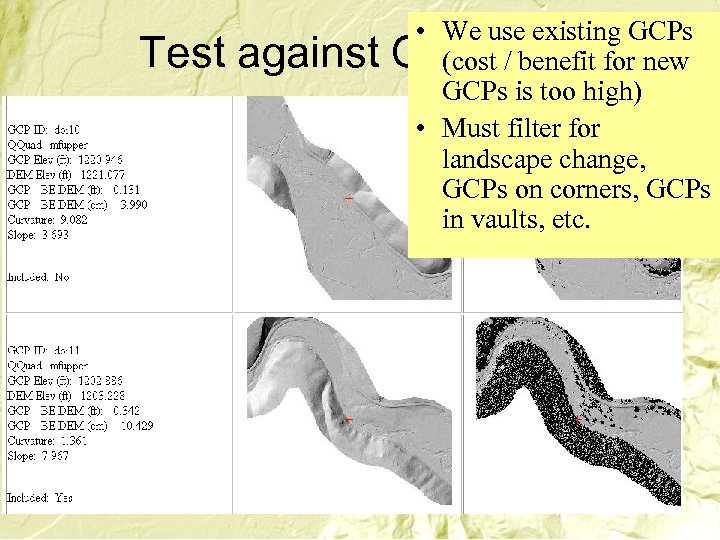
Test against • We use existing GCPs/ benefit for new (cost GCPs is too high) • Must filter for landscape change, GCPs on corners, GCPs in vaults, etc.
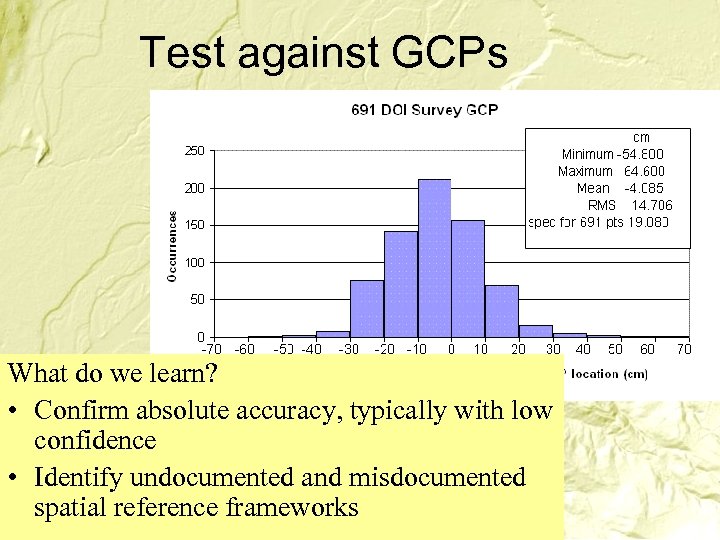
Test against GCPs What do we learn? • Confirm absolute accuracy, typically with low confidence • Identify undocumented and misdocumented spatial reference frameworks
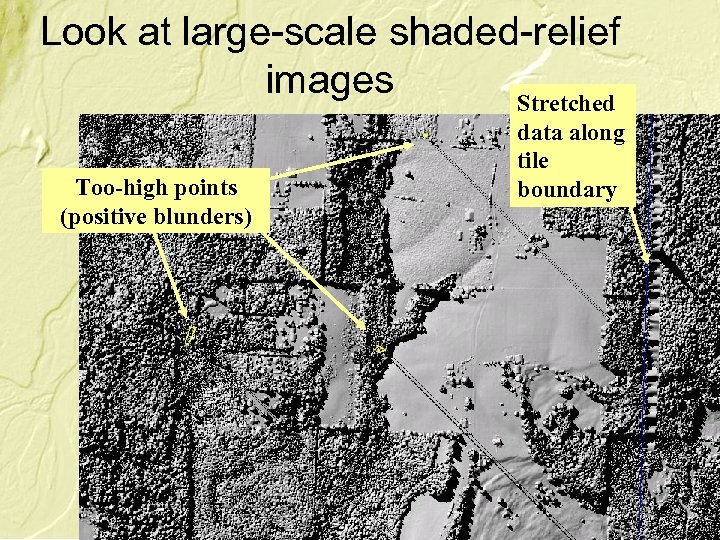
Look at large-scale shaded-relief images Stretched Too-high points (positive blunders) data along tile boundary
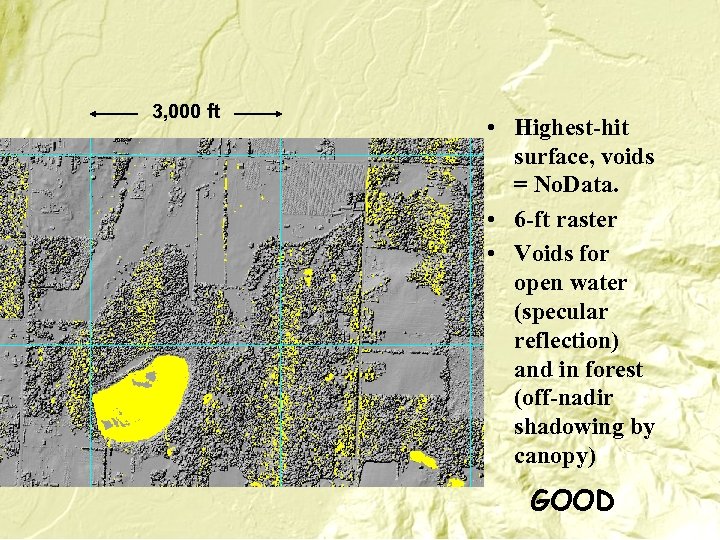
3, 000 ft • Highest-hit surface, voids = No. Data. • 6 -ft raster • Voids for open water (specular reflection) and in forest (off-nadir shadowing by canopy) GOOD
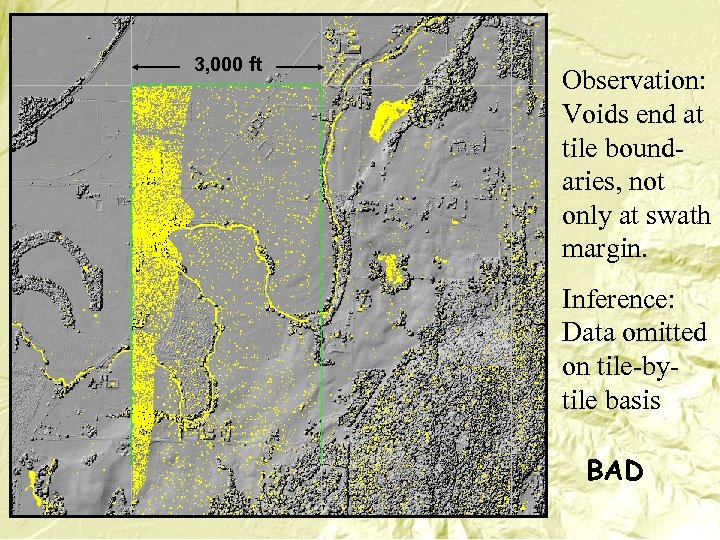
3, 000 ft Observation: Voids end at tile boundaries, not only at swath margin. Inference: Data omitted on tile-bytile basis BAD
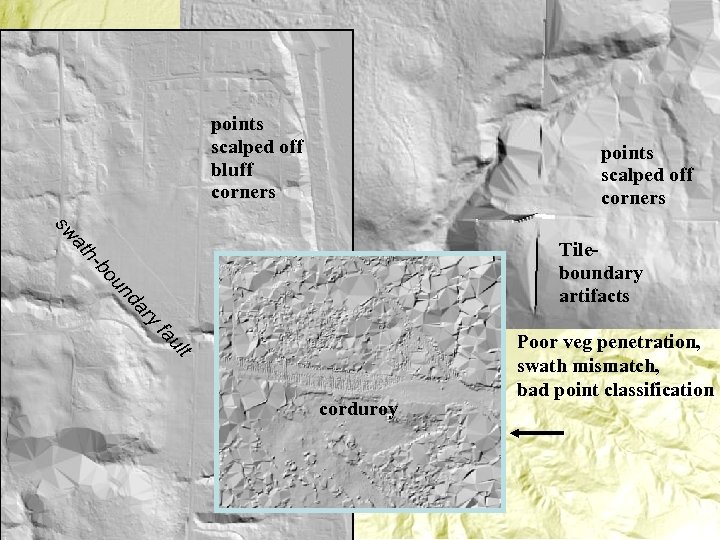
points scalped off bluff corners points scalped off corners sw ry da un bo h- at Tileboundary artifacts lt u fa corduroy Poor veg penetration, swath mismatch, bad point classification
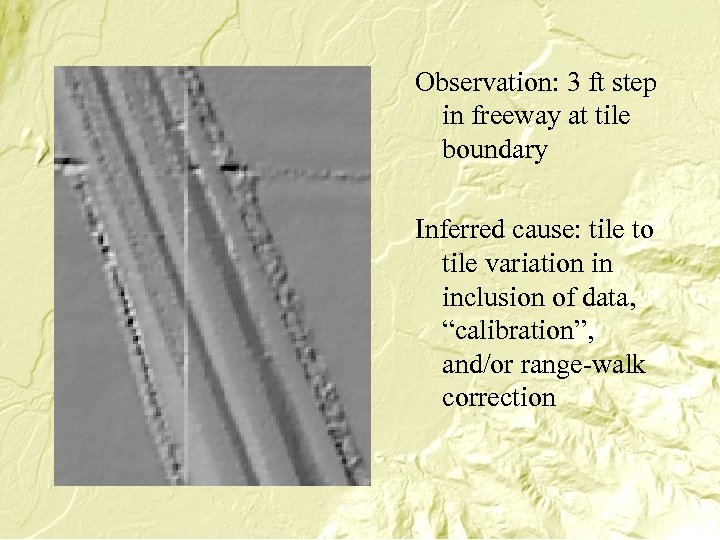
Observation: 3 ft step in freeway at tile boundary Inferred cause: tile to tile variation in inclusion of data, “calibration”, and/or range-walk correction
CONSISTENCY analysis • Start with tile of multiple-swath data • Sort on time. Split into swaths at time breaks. For each swath – Identify data areas – Build surface (1 st-return points TIN lattice) • Subtract swath surfaces, spatially merge results • Calculate curvature to identify smooth areas where interpolation is valid • Make image – – Saturated color = smooth area with overlap Unsaturated color = rough area with overlap Gray = no overlap White = no returns
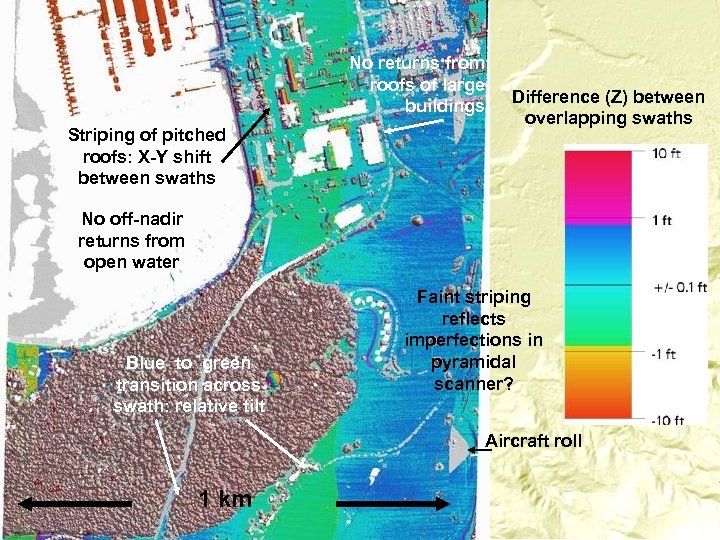
No returns from roofs of large buildings Striping of pitched roofs: X-Y shift between swaths Difference (Z) between overlapping swaths No off-nadir returns from open water Blue to green transition across swath: relative tilt Faint striping reflects imperfections in pyramidal scanner? Aircraft roll 1 km
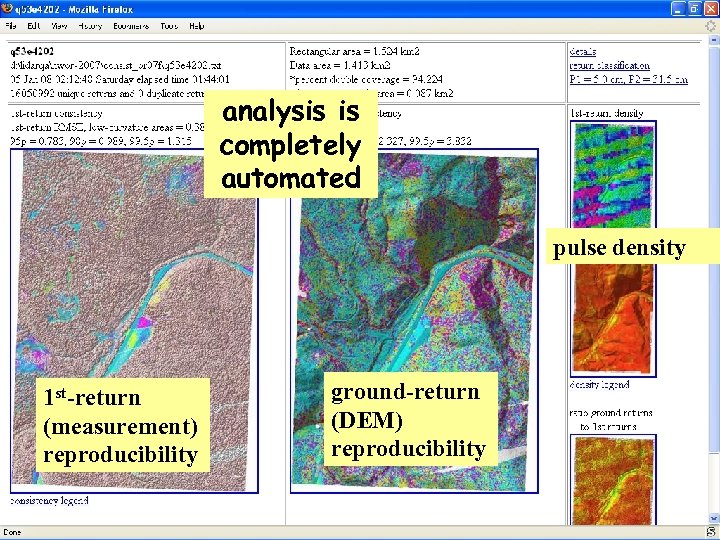
analysis is completely automated pulse density 1 st-return (measurement) reproducibility ground-return (DEM) reproducibility
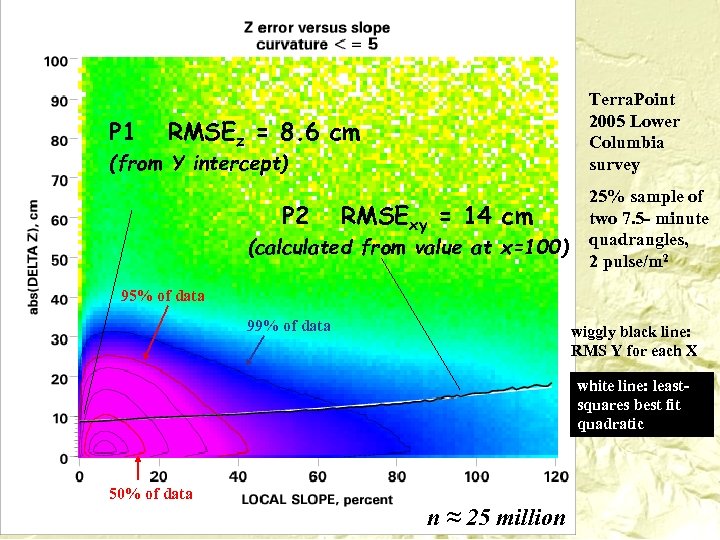
P 1 Terra. Point 2005 Lower Columbia survey RMSEz = 8. 6 cm (from Y intercept) P 2 RMSExy = 14 cm (calculated from value at x=100) 25% sample of two 7. 5 - minute quadrangles, 2 pulse/m 2 95% of data 99% of data wiggly black line: RMS Y for each X white line: leastsquares best fit quadratic 50% of data n ≈ 25 million
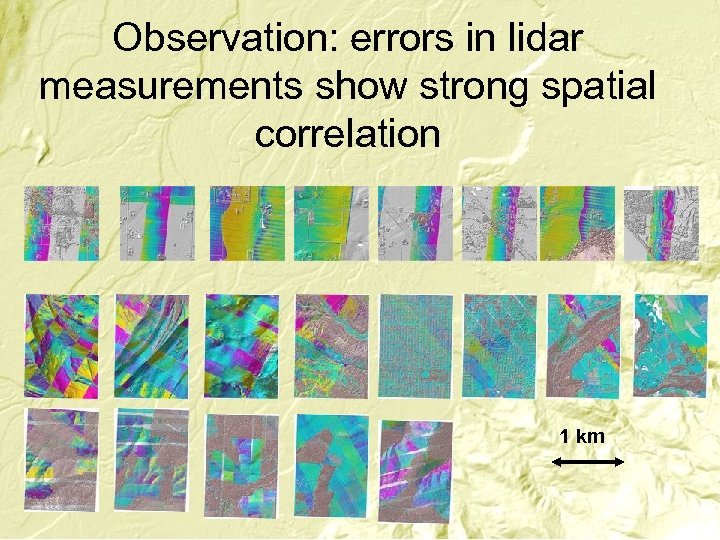
Observation: errors in lidar measurements show strong spatial correlation 1 km
Hypothesis: errors in photogrammetric DEMs have little spatial correlation Why? • Aerotriangulation and image orientation done with greater care (and more redundancy) than identification of corresponding image points • Largest source of error has no spatial correlation beyond that imposed by structure of target region
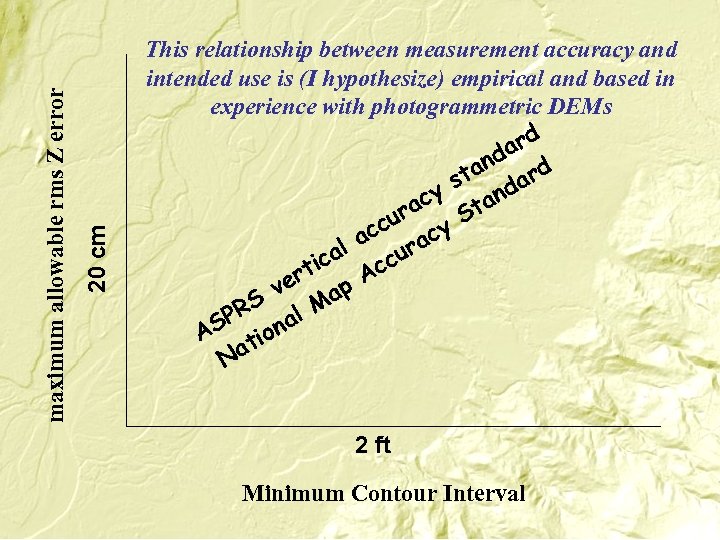
20 cm maximum allowable rms Z error This relationship between measurement accuracy and intended use is (I hypothesize) empirical and based in experience with photogrammetric DEMs rd a nd d sta dar y ac Stan r cu cy ac ra al u ic cc t er p. A v S Ma PR nal AS tio Na 2 ft Minimum Contour Interval
• Uncorrelated errors disappear upon spatial averaging • Drawing contours (and cut-and-fill calculations) involves spatial averaging • Contouring minimizes errors in photogrammetric DEMs by averaging them away • Contouring a lidar DEM, with its highly correlated errors, does NOT minimize errors by averaging
Lidar surveys for contouring (and other averaging operations) should be more accurate than suggested by ASPRS and NMAS standards Lidar surveys for feature recognition (e. g. , finding fault scarps, counting trees) can be significantly less accurate than experience might suggest, provided adequate XY resolution
Lidar data quality has 3 dimensions – Usability – Completeness – Accuracy Evaluate lidar data quality by – Testing against ground control – Looking at big images – Quantifying swath to swath reproducibility and completeness Standards for required mean accuracy need revision – Inundation modeling requires better absolute accuracy than we expect – Geomorphic mapping (feature recognition) requires less absolute accuracy
Скачать презентацию October 2009 Geological Society of America Annual Meeting
bf4c2d57a80737972ca6e13f1a6f482e.ppt