 Скачать презентацию October 11 th 2011 USATLAS Facilities Meeting
91d3da76b27647003f04f0f30eb2bdd6.ppt
- Количество слайдов: 30



October 11 th 2011 – USATLAS Facilities Meeting Shawn Mc. Kee, University of Michigan Jason Zurawski, Internet 2 DYNES PROJECT UPDATES
Agenda • • Project Management Details Demos LHCONE/NDDI Next Steps 2 – 3/18/2018, © 2011 Internet 2
DYNES Phase 1 Project Schedule • Phase 1: Site Selection and Planning (Sep‐Dec 2010) – Applications Due: December 15, 2010 – Application Reviews: December 15 2010‐January 31 2011 – Participant Selection Announcement: February 1, 2011 • 35 Were Accepted in 2 categories – 8 Regional Networks – 27 Site Networks 3 – 3/18/2018, © 2011 Internet 2
DYNES Phase 2 Project Schedule • Phase 2: Initial Development and Deployment (Jan 1‐ Jun 30, 2011) – Initial Site Deployment Complete ‐ February 28, 2011 • Caltech, Vanderbilt, University of Michigan, MAX, USLHCnet – Initial Site Systems Testing and Evaluation complete: April 29, 2011 – Longer term testing (Through July) • Evaluating move to Cent. OS 6 • New functionality in core software: – OSCARS 6 – perf. SONAR 3. 2. 1 – FDT Updates 4 – 3/18/2018, © 2011 Internet 2
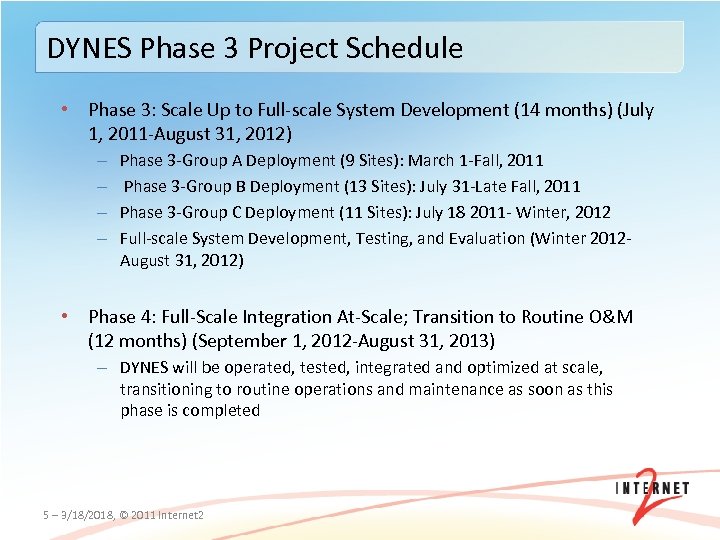
DYNES Phase 3 Project Schedule • Phase 3: Scale Up to Full‐scale System Development (14 months) (July 1, 2011‐August 31, 2012) – – Phase 3‐Group A Deployment (9 Sites): March 1‐Fall, 2011 Phase 3‐Group B Deployment (13 Sites): July 31‐Late Fall, 2011 Phase 3‐Group C Deployment (11 Sites): July 18 2011‐ Winter, 2012 Full‐scale System Development, Testing, and Evaluation (Winter 2012‐ August 31, 2012) • Phase 4: Full‐Scale Integration At‐Scale; Transition to Routine O&M (12 months) (September 1, 2012‐August 31, 2013) – DYNES will be operated, tested, integrated and optimized at scale, transitioning to routine operations and maintenance as soon as this phase is completed 5 – 3/18/2018, © 2011 Internet 2
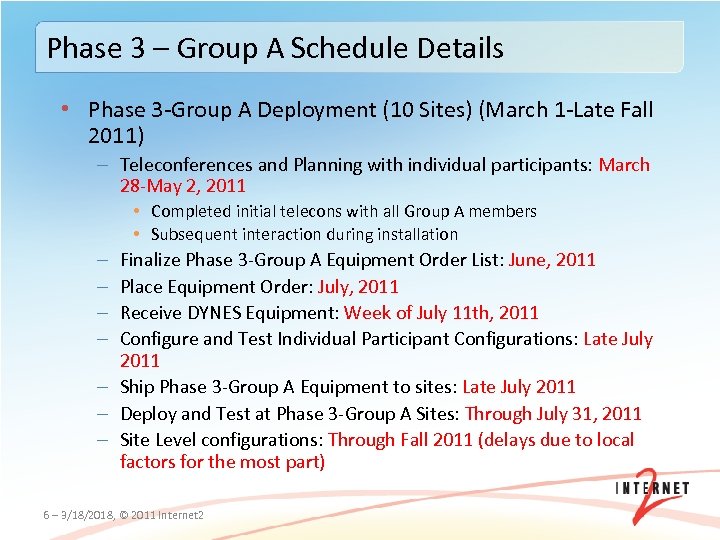
Phase 3 – Group A Schedule Details • Phase 3‐Group A Deployment (10 Sites) (March 1‐Late Fall 2011) – Teleconferences and Planning with individual participants: March 28‐May 2, 2011 • Completed initial telecons with all Group A members • Subsequent interaction during installation Finalize Phase 3‐Group A Equipment Order List: June, 2011 Place Equipment Order: July, 2011 Receive DYNES Equipment: Week of July 11 th, 2011 Configure and Test Individual Participant Configurations: Late July 2011 – Ship Phase 3‐Group A Equipment to sites: Late July 2011 – Deploy and Test at Phase 3‐Group A Sites: Through July 31, 2011 – Site Level configurations: Through Fall 2011 (delays due to local factors for the most part) – – 6 – 3/18/2018, © 2011 Internet 2
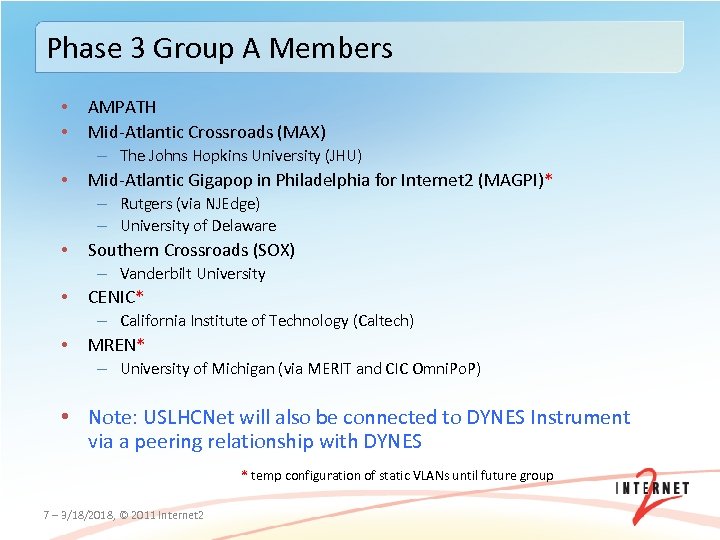
Phase 3 Group A Members • • AMPATH Mid‐Atlantic Crossroads (MAX) – The Johns Hopkins University (JHU) • Mid‐Atlantic Gigapop in Philadelphia for Internet 2 (MAGPI)* – Rutgers (via NJEdge) – University of Delaware • Southern Crossroads (SOX) – Vanderbilt University • CENIC* – California Institute of Technology (Caltech) • MREN* – University of Michigan (via MERIT and CIC Omni. Po. P) • Note: USLHCNet will also be connected to DYNES Instrument via a peering relationship with DYNES * temp configuration of static VLANs until future group 7 – 3/18/2018, © 2011 Internet 2
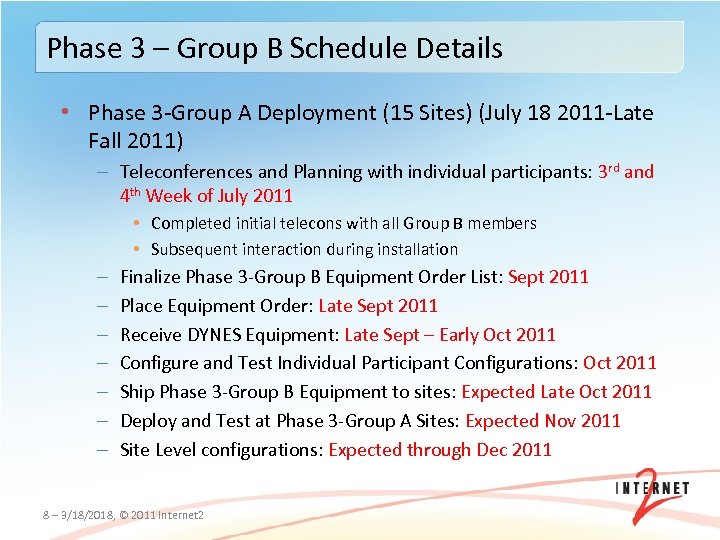
Phase 3 – Group B Schedule Details • Phase 3‐Group A Deployment (15 Sites) (July 18 2011‐Late Fall 2011) – Teleconferences and Planning with individual participants: 3 rd and 4 th Week of July 2011 • Completed initial telecons with all Group B members • Subsequent interaction during installation – – – – Finalize Phase 3‐Group B Equipment Order List: Sept 2011 Place Equipment Order: Late Sept 2011 Receive DYNES Equipment: Late Sept – Early Oct 2011 Configure and Test Individual Participant Configurations: Oct 2011 Ship Phase 3‐Group B Equipment to sites: Expected Late Oct 2011 Deploy and Test at Phase 3‐Group A Sites: Expected Nov 2011 Site Level configurations: Expected through Dec 2011 8 – 3/18/2018, © 2011 Internet 2
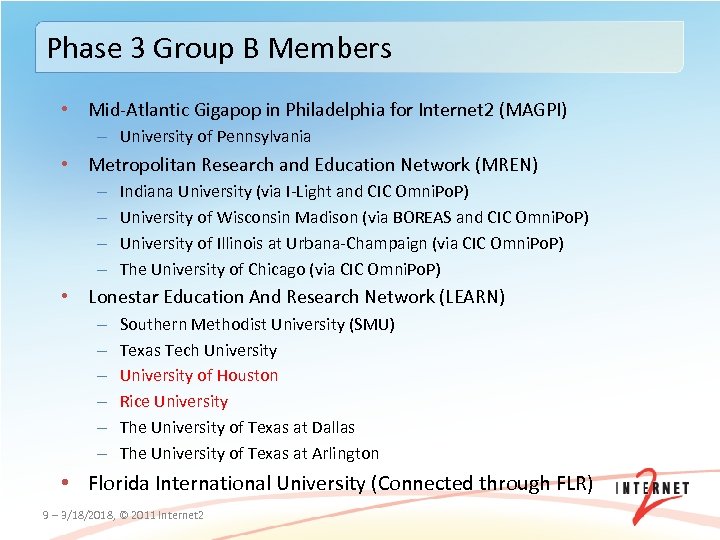
Phase 3 Group B Members • Mid‐Atlantic Gigapop in Philadelphia for Internet 2 (MAGPI) – University of Pennsylvania • Metropolitan Research and Education Network (MREN) – – Indiana University (via I‐Light and CIC Omni. Po. P) University of Wisconsin Madison (via BOREAS and CIC Omni. Po. P) University of Illinois at Urbana‐Champaign (via CIC Omni. Po. P) The University of Chicago (via CIC Omni. Po. P) • Lonestar Education And Research Network (LEARN) – – – Southern Methodist University (SMU) Texas Tech University of Houston Rice University The University of Texas at Dallas The University of Texas at Arlington • Florida International University (Connected through FLR) 9 – 3/18/2018, © 2011 Internet 2
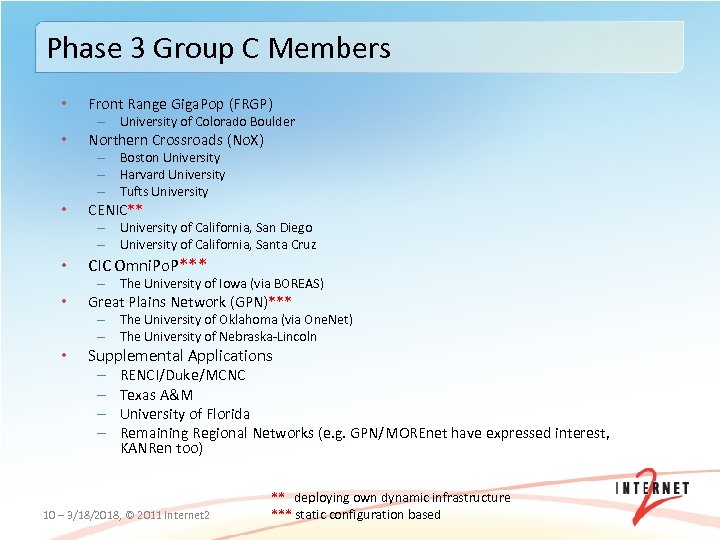
Phase 3 Group C Members • Front Range Giga. Pop (FRGP) – University of Colorado Boulder • Northern Crossroads (No. X) – Boston University – Harvard University – Tufts University • CENIC** – University of California, San Diego – University of California, Santa Cruz • CIC Omni. Po. P*** – The University of Iowa (via BOREAS) • Great Plains Network (GPN)*** – The University of Oklahoma (via One. Net) – The University of Nebraska‐Lincoln • Supplemental Applications – RENCI/Duke/MCNC – Texas A&M – University of Florida – Remaining Regional Networks (e. g. GPN/MOREnet have expressed interest, KANRen too) 10 – 3/18/2018, © 2011 Internet 2 ** deploying own dynamic infrastructure *** static configuration based
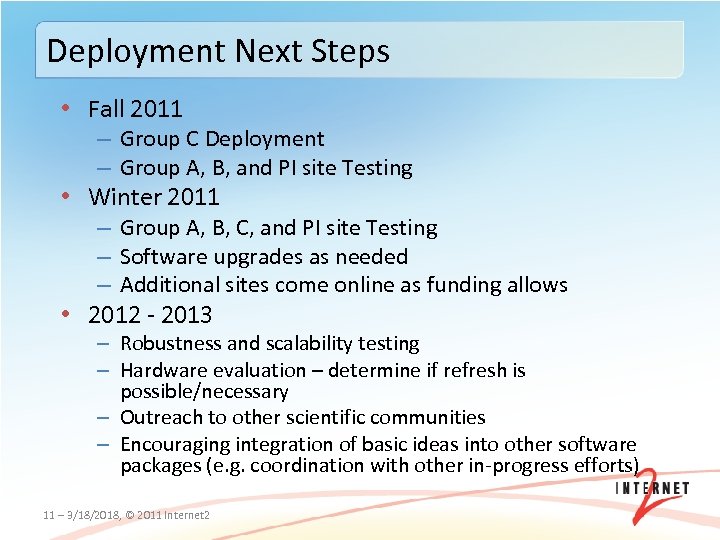
Deployment Next Steps • Fall 2011 – Group C Deployment – Group A, B, and PI site Testing • Winter 2011 – Group A, B, C, and PI site Testing – Software upgrades as needed – Additional sites come online as funding allows • 2012 ‐ 2013 – Robustness and scalability testing – Hardware evaluation – determine if refresh is possible/necessary – Outreach to other scientific communities – Encouraging integration of basic ideas into other software packages (e. g. coordination with other in‐progress efforts) 11 – 3/18/2018, © 2011 Internet 2
Agenda • • Project Management Details Demos LHCONE/NDDI Next Steps 12 – 3/18/2018, © 2011 Internet 2
Demonstrations • DYNES Infrastructure is maturing as we complete deployment groups • Opportunities to show usefulness of deployment: – How it can ‘stand alone’ for Science and Campus use cases – How it can integrate with other funded efforts (e. g. IRNC) – How it can peer with other international networks and exchange points • Examples: – GLIF 2011 – USATLAS Facilities Meeting – SC 11 13 – 3/18/2018, © 2011 Internet 2
GLIF 2011 • September 2011 • Demonstration of end‐to‐end Dynamic Circuit capabilities – International collaborations spanning 3 continents (South America, North America, and Europe) – Use of several software packages • OSCARS for inter‐domain control of Dynamic Circuits • perf. SONAR‐PS for end‐to‐end Monitoring • FDT to facilitate data transfer over IP or circuit networks – Science components – collaboration in the LHC VO (ATLAS and CMS) – DYNES, IRIS, and Dy. GIR NSF grants touted 14 – 3/18/2018, © 2011 Internet 2
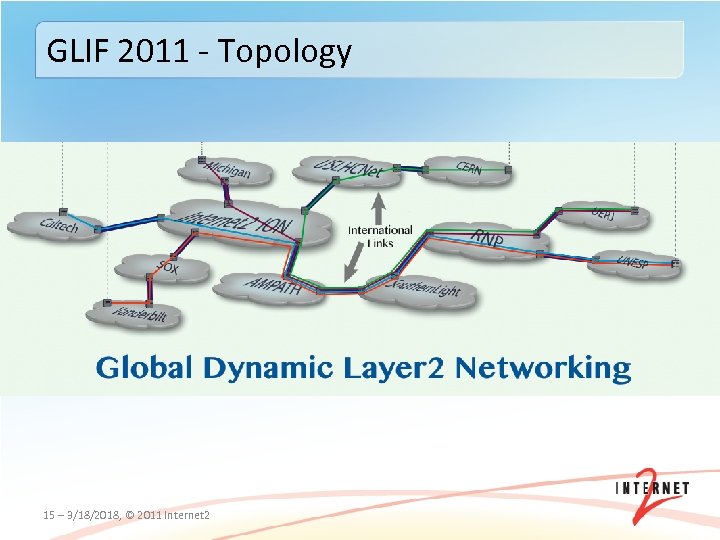
GLIF 2011 ‐ Topology 15 – 3/18/2018, © 2011 Internet 2
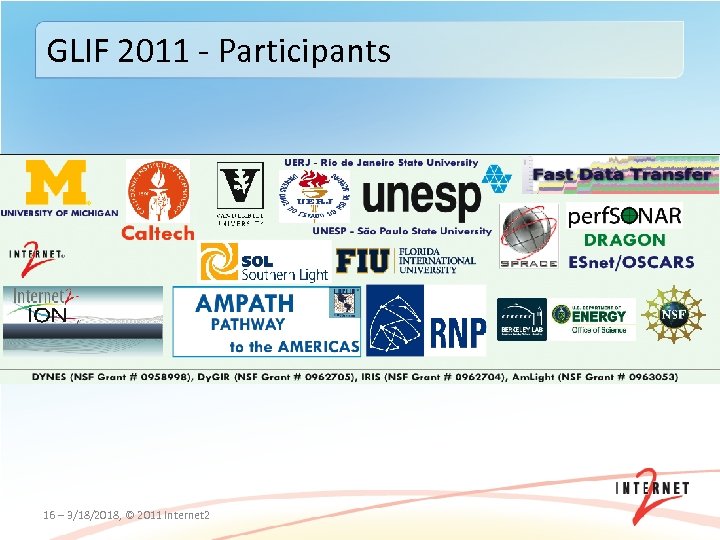
GLIF 2011 ‐ Participants 16 – 3/18/2018, © 2011 Internet 2
USATLAS Facilities Meeting • October 2011 • Similar topology to GLIF demonstration, emphasis placed on use case for ATLAS (LHC Experiment) • Important Questions: – What benefit does this offer to a large Tier 2 (e. g. UMich)? – What benefit does this offer to smaller Tier 3 (e. g. SMU)? – What benefit does the DYNES solution in the US give to national and International (e. g. SPRACE/HEPGrid in Brazil) collaborators? – Will dynamic networking solutions become a more popular method for transfer activities if the capacity is available? 17 – 3/18/2018, © 2011 Internet 2
SC 11 • November 2011 • Components: – DYNES Deployments at Group A and Group B sites – SC 11 Showfloor (Internet 2, Caltech, and Vanderbilt Booths – all are 10 G connected and feature identical hardware) – International locations (CERN, SPRACE, HEPGrid, Auto. BAHN enabled Tier 1 s and Tier 2 s in Europe) • Purpose: – Show dynamic capabilities on enhanced Internet 2 Network – Demonstrate International peerings to Europe, South America – Show integration of underlying network technology into the existing ‘process’ of LHC science – Integrate with emerging solutions such as NDDI, OS 3 E, LHCONE 18 – 3/18/2018, © 2011 Internet 2
Agenda • • Project Management Details Demos LHCONE/NDDI Next Steps 19 – 3/18/2018, © 2011 Internet 2
LHCONE and NDDI/OS 3 E • LHCONE – International effort to enhance networking at LHC facilities – LHCOPN connects CERN (T 0) and T 1 facilities worldwide – LHCONE will focus on T 2 and T 3 connectivity – Utilizes R&E networking to accomplish this goal • NDDI/OS 3 E – In addition to Internet 2’s “traditional” R&E services, develop a next generation service delivery platform for research and science to: • Deliver production layer 2 services that enable new research paradigms at larger scale and with more capacity • Enable a global scale sliceable network to support network research • Start at 2 x 10 Gbps, Possibly 1 x 40 Gbps 20 – 3/18/2018, © 2011 Internet 2
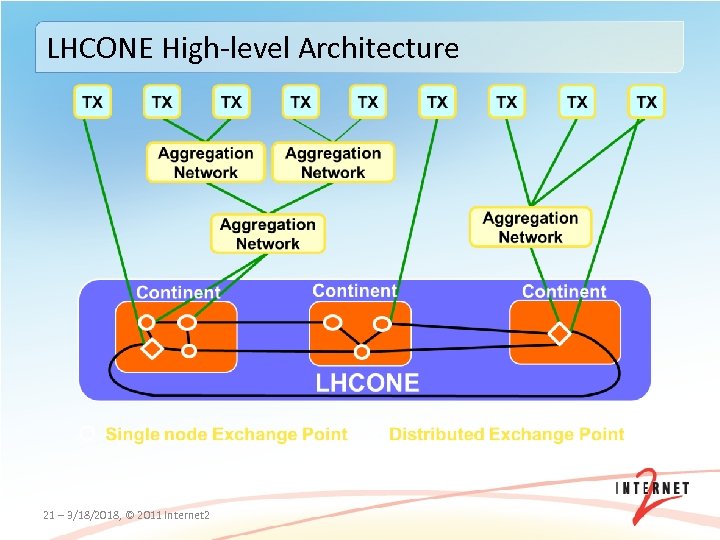
LHCONE High‐level Architecture 21 – 3/18/2018, © 2011 Internet 2
Network Development and Deployment Initiative (NDDI) Partnership that includes Internet 2, Indiana University, & the Clean Slate Program at Stanford as contributing partners. Many global collaborators interested in interconnection and extension Builds on NSF's support for GENI and Internet 2's BTOP‐funded backbone upgrade Seeks to create a software defined advanced‐ services‐capable network substrate to support network and domain research [note, this is a work in progress] 22 – 3/18/2018, © 2011 Internet 2
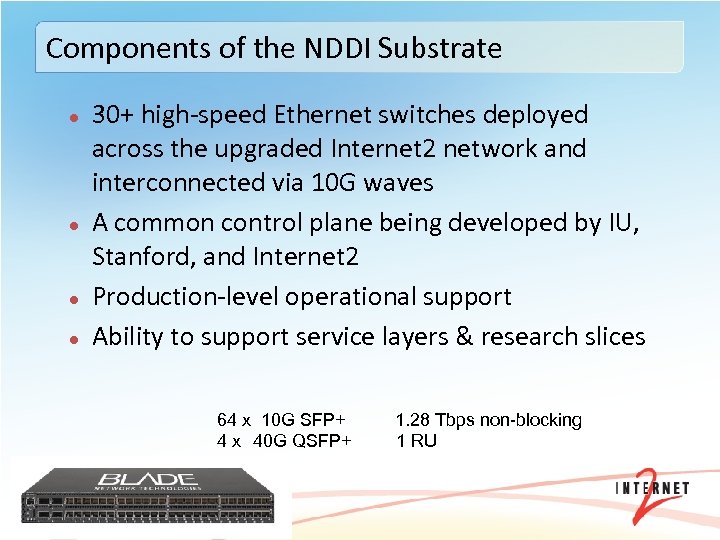
Components of the NDDI Substrate 30+ high‐speed Ethernet switches deployed across the upgraded Internet 2 network and interconnected via 10 G waves A common control plane being developed by IU, Stanford, and Internet 2 Production‐level operational support Ability to support service layers & research slices 64 x 10 G SFP+ 4 x 40 G QSFP+ 23 – 3/18/2018, © 2011 Internet 2 1. 28 Tbps non-blocking 1 RU
Support for Network Research NDDI substrate control plane key to supporting network research At‐scale, high performance, researcher‐defined network forwarding behavior virtual control plane provides the researcher with the network “LEGOs” to build a custom topology employing a researcher‐defined forwarding plane NDDI substrate will have the capacity and reach to enable large testbeds 24 – 3/18/2018, © 2011 Internet 2
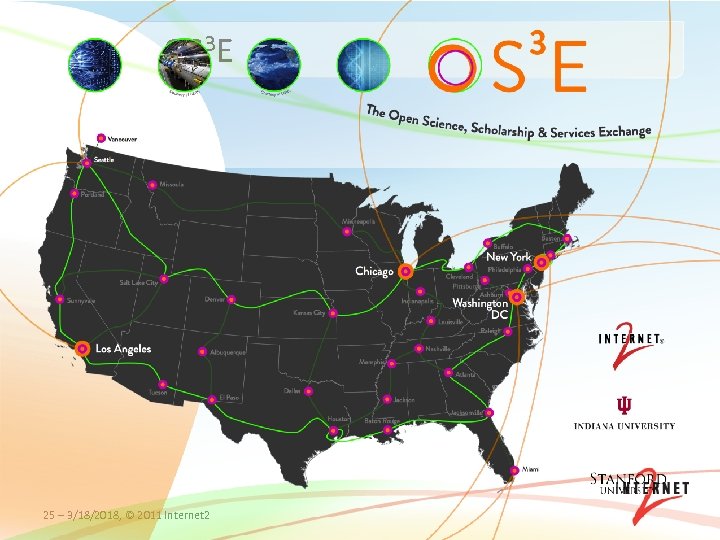
NDDI & OS 3 E 25 – 3/18/2018, © 2011 Internet 2
Deployment 26 – 3/18/2018, © 2011 Internet 2
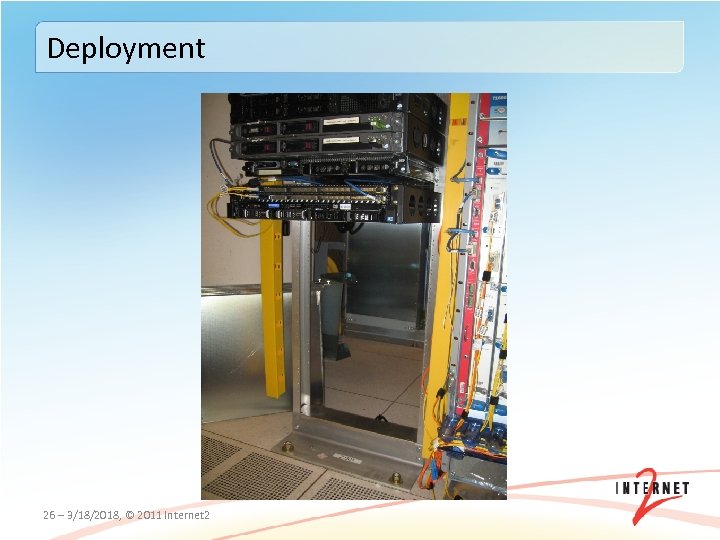
NDDI / OS 3 E Implementation Status • Deployment – NEC G 8264 switch selected for initial deployment – 4 nodes by Internet 2 FMM (e. g. Last Week ) – 5 th node (Seattle) by SC 11 (T – 1 Month and counting …) • Software – NOX Open. Flow controller selected for initial implementation – Software functional to demo Layer 2 VLAN service (OS 3 E) over Open. Flow substrate (NDDI) by FMM – Software functional to peer with ION (and other IDCs) by SC 11 – Software to peer with SRS Open. Flow demos at SC 11 – Open source software package to be made available in 2012 27 – 3/18/2018, © 2011 Internet 2
Agenda • • Project Management Details Demos LHCONE/NDDI Next Steps 28 – 3/18/2018, © 2011 Internet 2
Next Steps • Finish the deployments – Still struggling with some of Group B, need to start C – Add in others that weren't in the original set • Harden the “process” – Software can use tweaks as we get deployments done – Hardware may need refreshing – Internet 2 ION will be migrating to NDDI/OS 3 E. More capacity, and using Open. Flow • Outreach – Like minded efforts (e. g. DOE ESCPS) – International peers, to increases where we can reach – Other “Science” (e. g. traditional, as well as computational science – LSST is being targeted) 29 – 3/18/2018, © 2011 Internet 2
DYNES PROJECT UPDATES October 11 th 2011 – USATLAS Facilities Meeting Shawn Mc. Kee – University of Michigan Jason Zurawski ‐ Internet 2 For more information, visit http: //www. internet 2. edu/dynes 30 – 3/18/2018, © 2011 Internet 2
Скачать презентацию October 11 th 2011 USATLAS Facilities Meeting
91d3da76b27647003f04f0f30eb2bdd6.ppt