


 Скачать презентацию Oct 2015 Part III Faults Logical Deviations
3d218adddc29b52aac989fc8b544c7c0.ppt
- Количество слайдов: 73
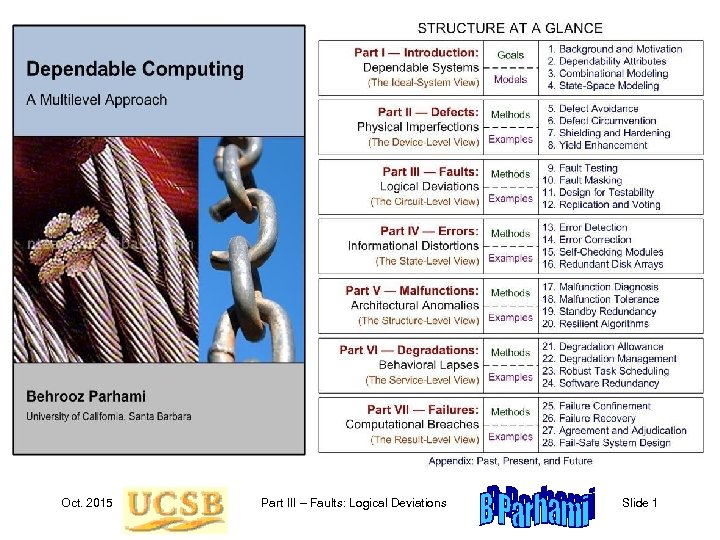 Oct. 2015 Part III – Faults: Logical Deviations Slide 1
 About This Presentation This presentation is intended to support the use of the textbook Dependable Computing: A Multilevel Approach (traditional print or on-line open publication, TBD). It is updated regularly by the author as part of his teaching of the graduate course ECE 257 A, Fault-Tolerant Computing, at Univ. of California, Santa Barbara. Instructors can use these slides freely in classroom teaching or for other educational purposes. Unauthorized uses, including distribution for profit, are strictly prohibited. © Behrooz Parhami Edition Released Revised First Sep. 2006 Oct. 2007 Oct. 2009 Oct. 2012 Oct. 2013 Jan. 2015 Oct. 2015 Part III – Faults: Logical Deviations Slide 2
 9 Fault Testing Oct. 2015 Part III – Faults: Logical Deviations Slide 3
 The good news is that the tests don’t show any other problems Oct. 2015 Part III – Faults: Logical Deviations Slide 4
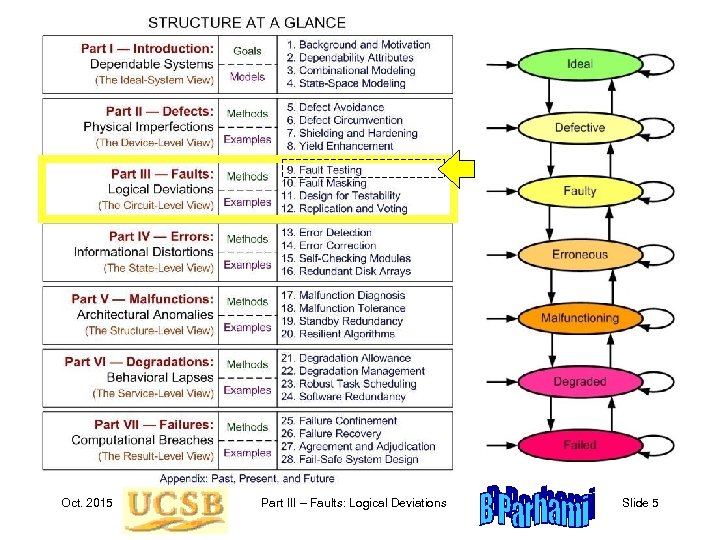 Oct. 2015 Part III – Faults: Logical Deviations Slide 5
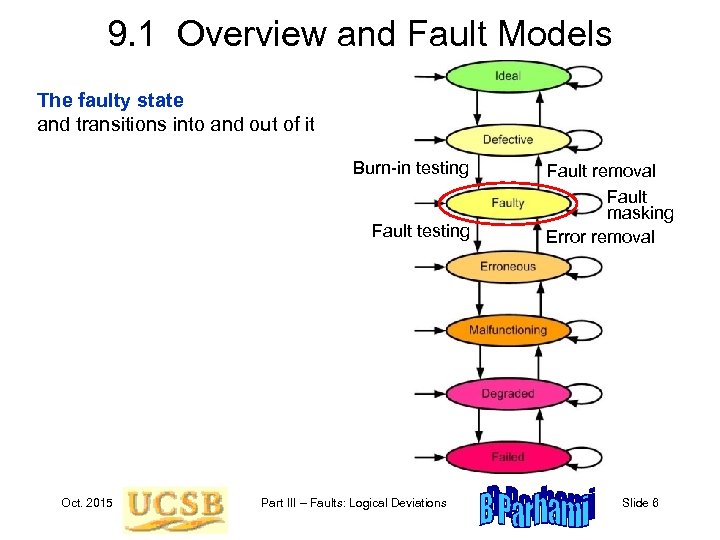 9. 1 Overview and Fault Models The faulty state and transitions into and out of it Burn-in testing Fault testing Oct. 2015 Part III – Faults: Logical Deviations Fault removal Fault masking Error removal Slide 6
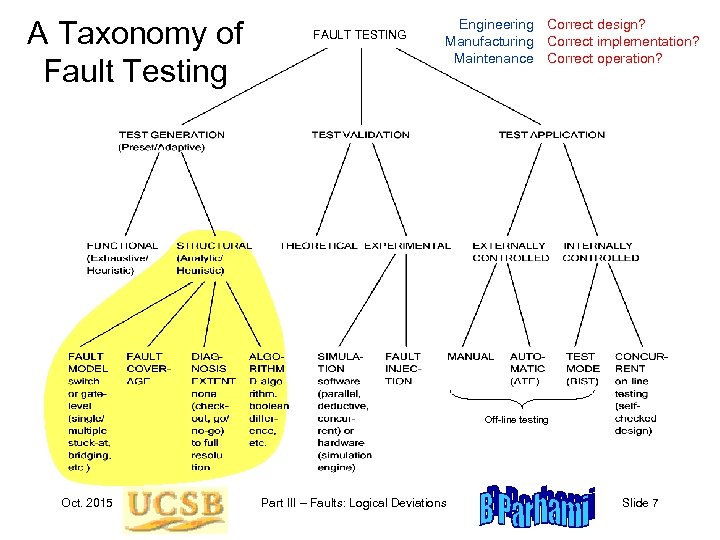 A Taxonomy of Fault Testing FAULT TESTING Engineering Correct design? Manufacturing Correct implementation? Maintenance Correct operation? Off-line testing Oct. 2015 Part III – Faults: Logical Deviations Slide 7
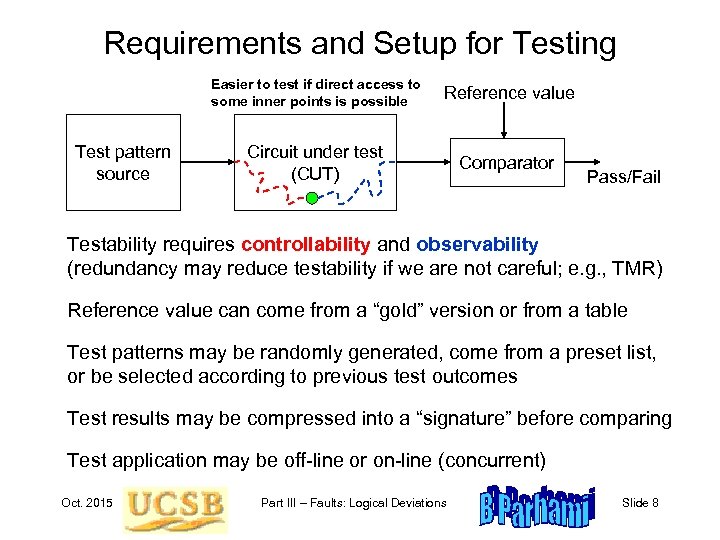 Requirements and Setup for Testing Easier to test if direct access to some inner points is possible Test pattern source Reference value Circuit under test (CUT) Comparator Pass/Fail Testability requires controllability and observability (redundancy may reduce testability if we are not careful; e. g. , TMR) Reference value can come from a “gold” version or from a table Test patterns may be randomly generated, come from a preset list, or be selected according to previous test outcomes Test results may be compressed into a “signature” before comparing Test application may be off-line or on-line (concurrent) Oct. 2015 Part III – Faults: Logical Deviations Slide 8
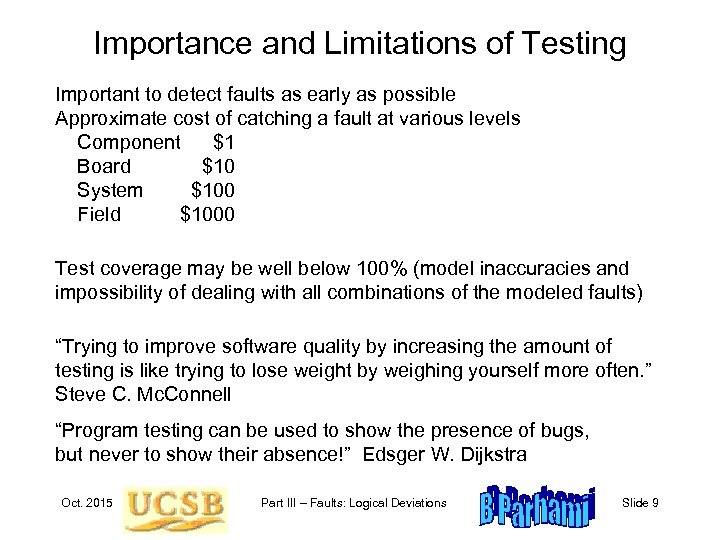 Importance and Limitations of Testing Important to detect faults as early as possible Approximate cost of catching a fault at various levels Component $1 Board $10 System $100 Field $1000 Test coverage may be well below 100% (model inaccuracies and impossibility of dealing with all combinations of the modeled faults) “Trying to improve software quality by increasing the amount of testing is like trying to lose weight by weighing yourself more often. ” Steve C. Mc. Connell “Program testing can be used to show the presence of bugs, but never to show their absence!” Edsger W. Dijkstra Oct. 2015 Part III – Faults: Logical Deviations Slide 9
 Fault Models at Different Abstraction Levels Fault model is an abstract specification of the types of deviations in logic values that one expects in the circuit under test Can be specified at various levels: transistor, gate, function, system Transistor-level faults Caused by defects, shorts/opens, electromigration, transients, . . . May lead to high current, incorrect output, intermediate voltage, . . . Modeled as stuck-on/off, bridging, delay, coupling, crosstalk faults Quickly become intractable because of the large model space Function-level faults Selected in an ad hoc manner based on the function of a block (decoder, ALU, memory) System-level faults (malfunctions, in our terminology) Will discuss later in Part V Oct. 2015 Part III – Faults: Logical Deviations Slide 10
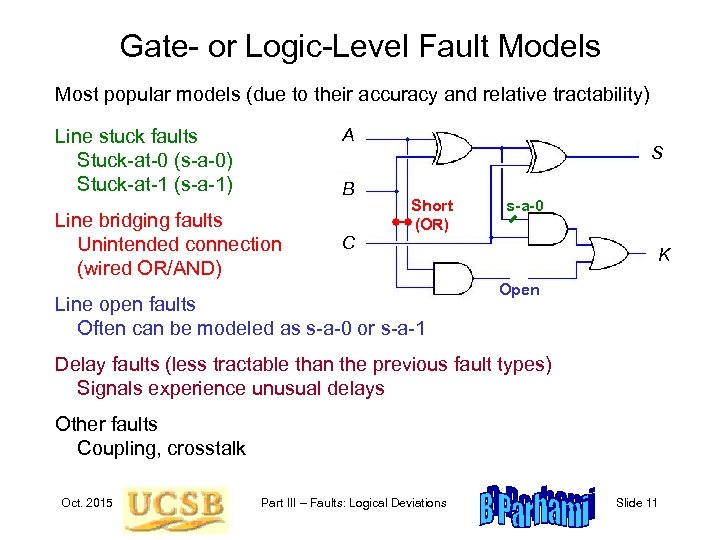 Gate- or Logic-Level Fault Models Most popular models (due to their accuracy and relative tractability) A Line stuck faults Stuck-at-0 (s-a-0) Stuck-at-1 (s-a-1) B Line bridging faults Unintended connection (wired OR/AND) C S Short (OR) Line open faults Often can be modeled as s-a-0 or s-a-1 s-a-0 K Open Delay faults (less tractable than the previous fault types) Signals experience unusual delays Other faults Coupling, crosstalk Oct. 2015 Part III – Faults: Logical Deviations Slide 11
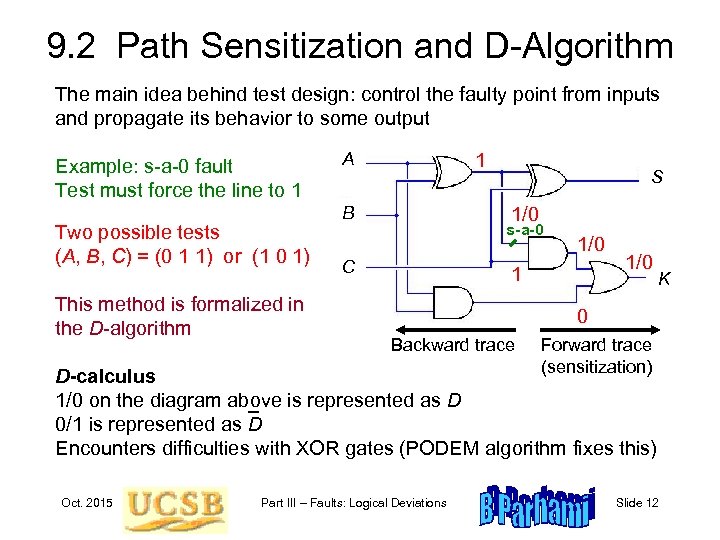 9. 2 Path Sensitization and D-Algorithm The main idea behind test design: control the faulty point from inputs and propagate its behavior to some output Example: s-a-0 fault Test must force the line to 1 Two possible tests (A, B, C) = (0 1 1) or (1 0 1) This method is formalized in the D-algorithm A 1 B S 1/0 s-a-0 C 1/0 1 1/0 K 0 Backward trace Forward trace (sensitization) D-calculus 1/0 on the diagram above is represented as D 0/1 is represented as D Encounters difficulties with XOR gates (PODEM algorithm fixes this) Oct. 2015 Part III – Faults: Logical Deviations Slide 12
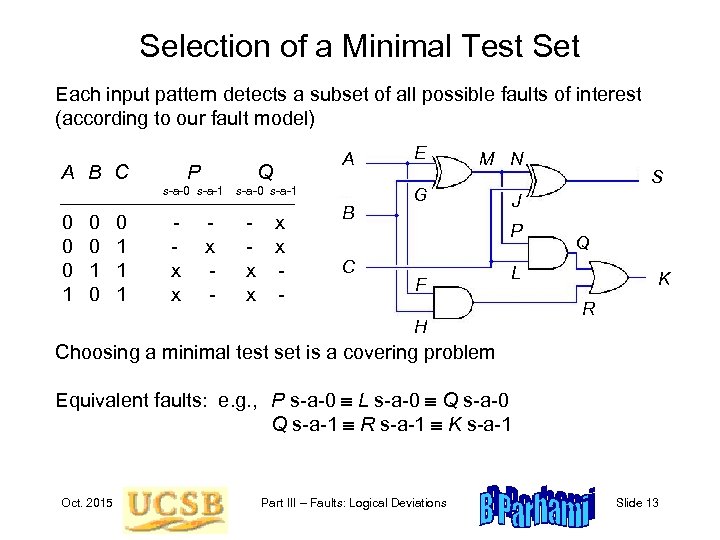 Selection of a Minimal Test Set Each input pattern detects a subset of all possible faults of interest (according to our fault model) A B C 0 0 1 1 1 Q s-a-0 s-a-1 0 0 0 1 P A s-a-0 s-a-1 x x x - - x x x - B C E M N G J P F S Q L H K R Choosing a minimal test set is a covering problem Equivalent faults: e. g. , P s-a-0 L s-a-0 Q s-a-0 Q s-a-1 R s-a-1 K s-a-1 Oct. 2015 Part III – Faults: Logical Deviations Slide 13
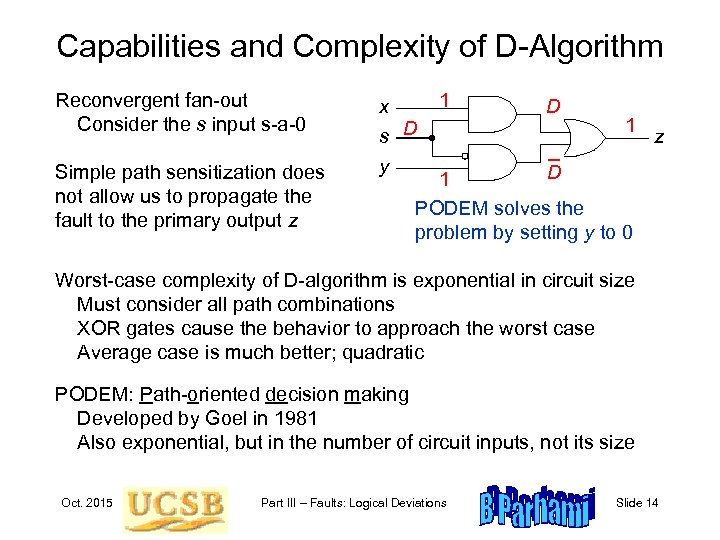 Capabilities and Complexity of D-Algorithm Reconvergent fan-out Consider the s input s-a-0 x s D Simple path sensitization does not allow us to propagate the fault to the primary output z y 1 D 1 z D 1 PODEM solves the problem by setting y to 0 Worst-case complexity of D-algorithm is exponential in circuit size Must consider all path combinations XOR gates cause the behavior to approach the worst case Average case is much better; quadratic PODEM: Path-oriented decision making Developed by Goel in 1981 Also exponential, but in the number of circuit inputs, not its size Oct. 2015 Part III – Faults: Logical Deviations Slide 14
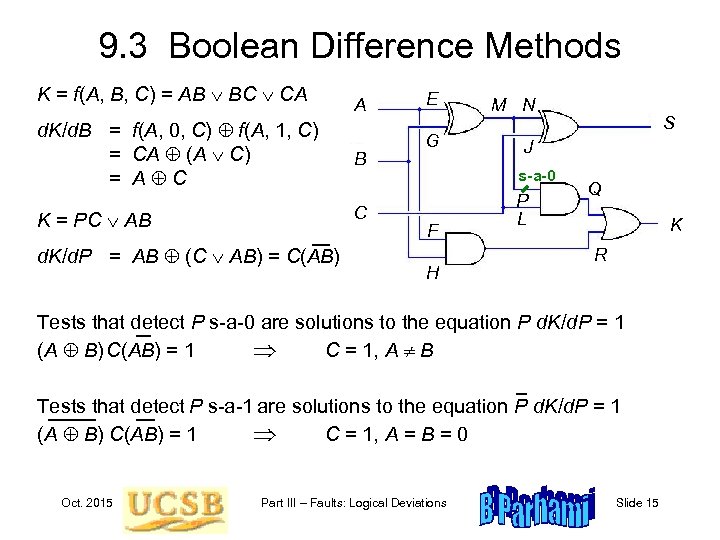 9. 3 Boolean Difference Methods K = f(A, B, C) = AB BC CA d. K/d. B = f(A, 0, C) f(A, 1, C) = CA (A C) = A C A B C K = PC AB d. K/d. P = AB (C AB) = C(AB) E G M N J s-a-0 F H S P L Q K R Tests that detect P s-a-0 are solutions to the equation P d. K/d. P = 1 (A B) C(AB) = 1 C = 1, A B Tests that detect P s-a-1 are solutions to the equation P d. K/d. P = 1 (A B) C(AB) = 1 C = 1, A = B = 0 Oct. 2015 Part III – Faults: Logical Deviations Slide 15
 9. 4 The Complexity of Fault Testing The satisfiability problem (SAT) Decision problem: Is a Boolean expression satisfiable? (i. e. , can we assign values to the variables to make the result 1? ) Theorem (Cook, 1971): SAT is NP-complete In fact, even restricted versions of SAT remain NP-complete Theorem (Cook, 1971): 3 SAT is NP-complete In 3 SAT, the logic expression is a product of 3 -term OR clauses According to the Boolean difference formulation, fault detection can be converted to SAT (find the solutions to P d. K/d. P = 1) To prove the NP-completeness of fault detection, we need to show that SAT (or another NP-complete problem) can be converted to it Proof of NP-completeness is due to Ibarra and Sahni [Ibar 75] A simple alternate proof by Fujiwara [Fuji 82] is in the textbook Oct. 2015 Part III – Faults: Logical Deviations Slide 16
 Proof that Fault Detection is NP-Complete Theorem (Cook, 1971): 3 SAT is NP-complete Theorem: Clause-monotone SAT (CM-SAT) is NP-complete CM-SAT has OR clauses each of which consists entirely of complemented or uncomplemented variables, but not both 3 SAT can be converted to CM-SAT by replacing each mixed OR clause with the product of two clauses involving a new variable Example: (xi xj x k) is replaced by (xi xj vk)(v k x k) Clause-monotone SAT can be converted to fault detection in a circuit First level has ANDs for all clauses with complemented variables Second level has ORs for all clauses with uncomplemented variables, plus an OR gate with level-1 outputs as its inputs (one input to this gate is y) Third level has one AND gate that receives all level-2 outputs as its inputs A test for y s-a-1 satisfies the original clause-monotone expression Oct. 2015 Part III – Faults: Logical Deviations Slide 17
 9. 5 Testing of Units with Memory The presence of memory expands the number of required test cases To test a sequential machine, we may need to apply different input sequences for each possible initial state Exponentially many possible input sequences Exponentially many possible machine states Oct. 2015 Part III – Faults: Logical Deviations Slide 18
 Testing of Memory Simple-minded approach: Write 000. . . 00 and 111. . . 11 into every memory word and read out to verify proper storage and retrieval Problems with the simple-minded approach: Does not test access/decoding mechanism – How do you know the intended word was written into and read from? Many memory faults are pattern-sensitive, where cell operation is affected by the values stored in nearby cells Modern high-density memories experience dynamic faults that are exposed only for specific access sequences Memory testing continues to be an active research area Built-in self test is the only viable approach in the long term Challenge: Any run time testing consumes some memory bandwidth Oct. 2015 Part III – Faults: Logical Deviations Slide 19
 9. 6 Off-Line vs. Concurrent Testing This section will be forthcoming. Oct. 2015 Part III – Faults: Logical Deviations Slide 20
 10 Fault Masking Oct. 2015 Part III – Faults: Logical Deviations Slide 21
 Oct. 2015 Part III – Faults: Logical Deviations Slide 22
 Oct. 2015 Part III – Faults: Logical Deviations Slide 23
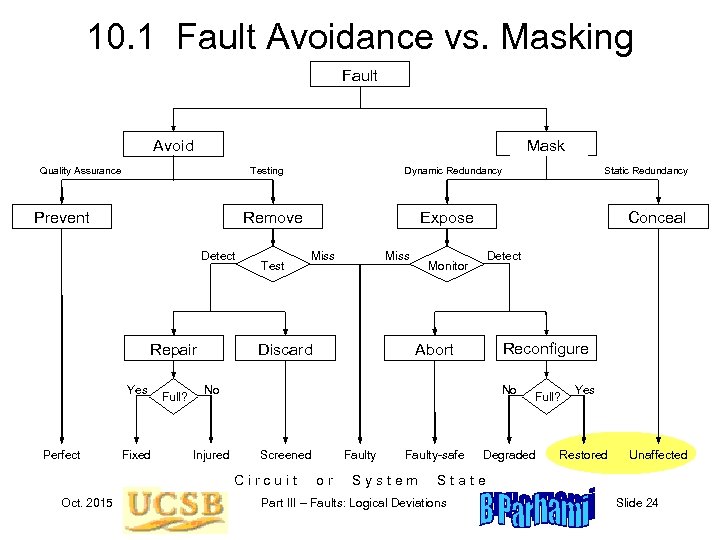 10. 1 Fault Avoidance vs. Masking Fault Avoid Tolerate Mask Quality Assurance Testing Prevent Remove Detect Repair Yes Perfect Fixed Full? Test Oct. 2015 Conceal Mask Miss Detect Monitor Reconfigure Abort No Injured Static Redundancy Expose Discard No Screened Circuit Dynamic Redundancy Faulty or Faulty-safe System Full? Degraded Yes Restored Unaffected State Part III – Faults: Logical Deviations Slide 24
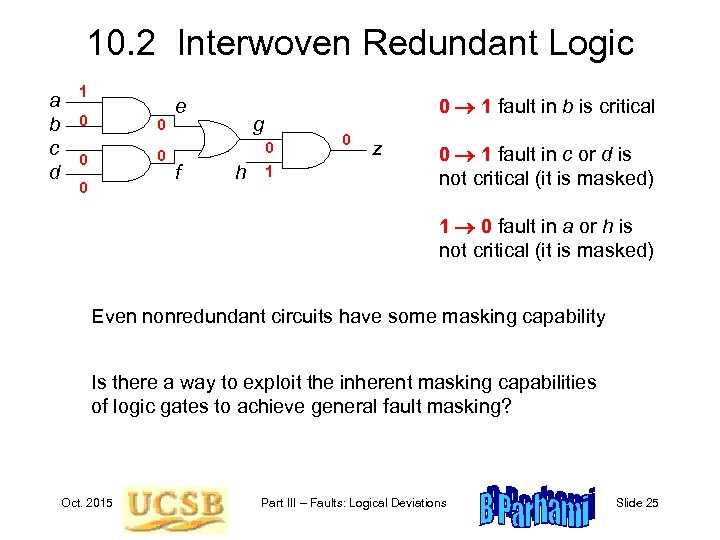 10. 2 Interwoven Redundant Logic a b c d 1 0 0 0 e 0 1 fault in b is critical g 0 f h 1 0 z 0 1 fault in c or d is not critical (it is masked) 1 0 fault in a or h is not critical (it is masked) Even nonredundant circuits have some masking capability Is there a way to exploit the inherent masking capabilities of logic gates to achieve general fault masking? Oct. 2015 Part III – Faults: Logical Deviations Slide 25
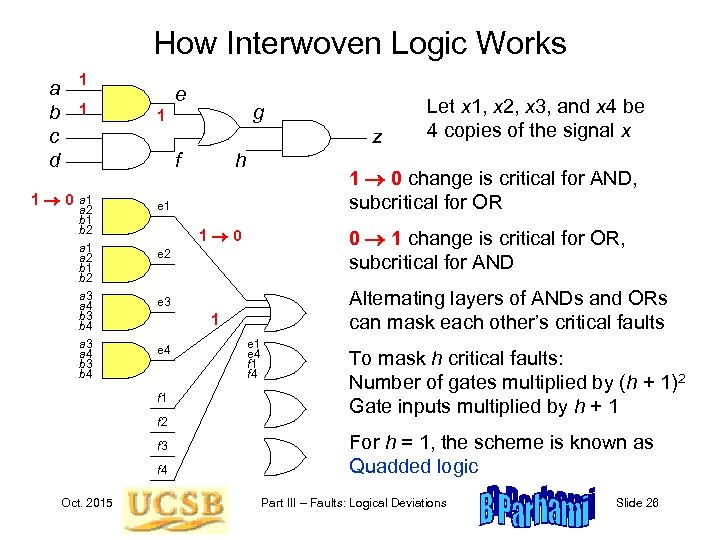 How Interwoven Logic Works 1 a b c d 1 e z f 1 0 a 1 a 2 b 1 b 2 a 3 a 4 b 3 b 4 0 1 change is critical for OR, subcritical for AND e 2 Alternating layers of ANDs and ORs can mask each other’s critical faults e 3 1 e 4 f 3 f 4 Let x 1, x 2, x 3, and x 4 be 4 copies of the signal x 1 0 change is critical for AND, subcritical for OR 1 0 f 2 Oct. 2015 h e 1 f 1 g 1 e 4 f 1 f 4 To mask h critical faults: Number of gates multiplied by (h + 1)2 Gate inputs multiplied by h + 1 For h = 1, the scheme is known as Quadded logic Part III – Faults: Logical Deviations Slide 26
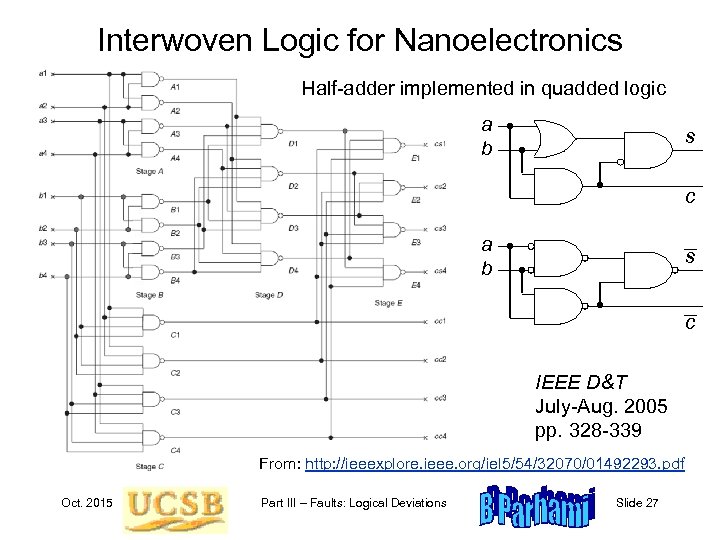 Interwoven Logic for Nanoelectronics Half-adder implemented in quadded logic a b s c IEEE D&T July-Aug. 2005 pp. 328 -339 From: http: //ieeexplore. ieee. org/iel 5/54/32070/01492293. pdf Oct. 2015 Part III – Faults: Logical Deviations Slide 27
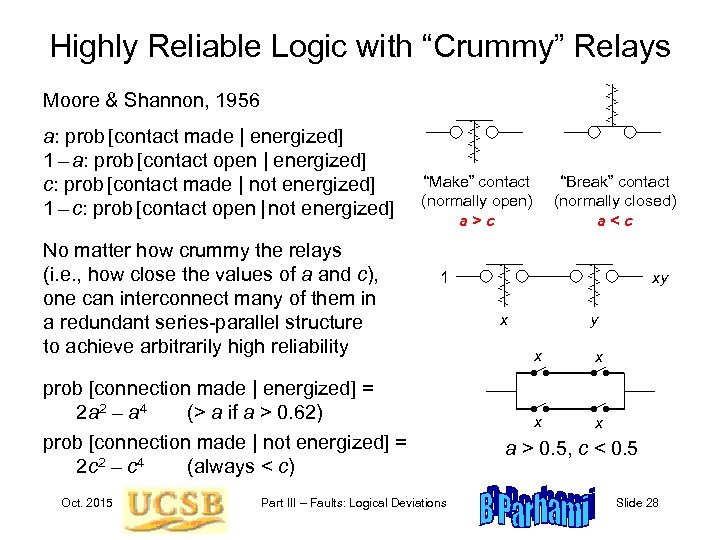 Highly Reliable Logic with “Crummy” Relays Moore & Shannon, 1956 a: prob [contact made | energized] 1 – a: prob [contact open | energized] c: prob [contact made | not energized] 1 – c: prob [contact open | not energized] No matter how crummy the relays (i. e. , how close the values of a and c), one can interconnect many of them in a redundant series-parallel structure to achieve arbitrarily high reliability “Make” contact (normally open) a>c 1 prob [connection made | energized] = 2 a 2 – a 4 (> a if a > 0. 62) prob [connection made | not energized] = 2 c 2 – c 4 (always < c) Oct. 2015 “Break” contact (normally closed) a
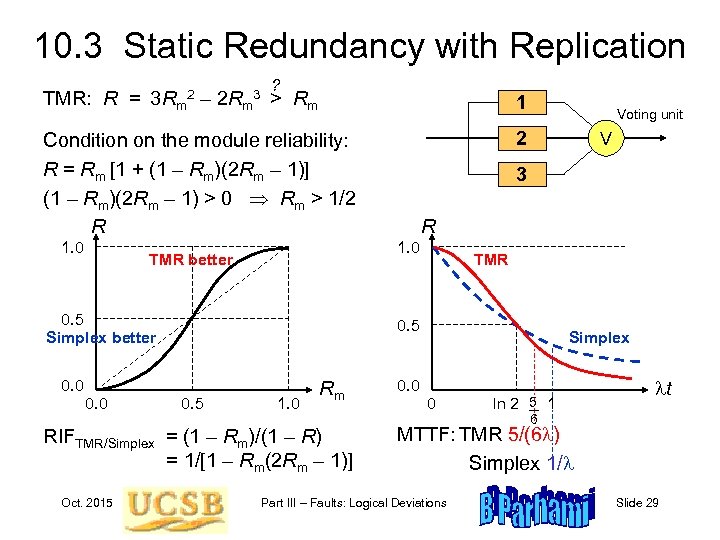 10. 3 Static Redundancy with Replication ? TMR: R = 3 Rm – 2 Rm > Rm 1 Condition on the module reliability: R = Rm [1 + (1 – Rm)(2 Rm – 1)] (1 – Rm)(2 Rm – 1) > 0 Rm > 1/2 R 2 2 1. 0 3 0. 5 Simplex better 0. 0 0. 5 1. 0 Rm RIFTMR/Simplex = (1 – Rm)/(1 – R) = 1/[1 – Rm(2 Rm – 1)] Oct. 2015 R TMR 0. 5 0. 0 V 3 1. 0 TMR better Voting unit Simplex 0. 0 0 ln 2 5 1 6 lt MTTF: TMR 5/(6 l) Simplex 1/l Part III – Faults: Logical Deviations Slide 29
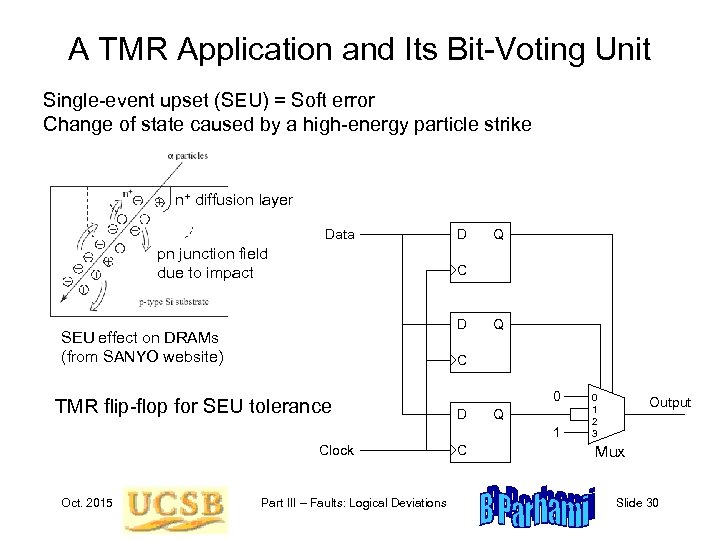 A TMR Application and Its Bit-Voting Unit Single-event upset (SEU) = Soft error Change of state caused by a high-energy particle strike n+ diffusion layer Data pn junction field due to impact D Q C D SEU effect on DRAMs (from SANYO website) Q C TMR flip-flop for SEU tolerance 0 D Q 1 Clock Oct. 2015 Part III – Faults: Logical Deviations C 0 1 2 3 Output Mux Slide 30
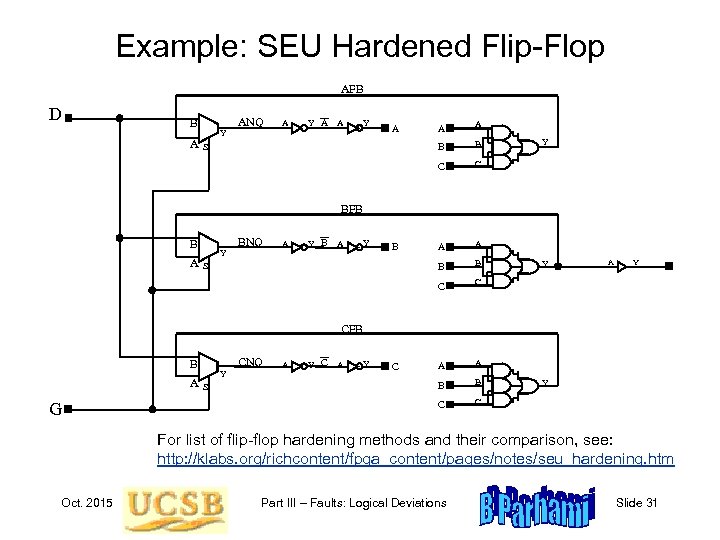 Example: SEU Hardened Flip-Flop AFB D B ANQ A Y A A Y B C A A B B C S A B A A C A Y C Y BFB B A Y BNQ A Y B S Y A Y CFB CNQ B A G Y S A Y C Y For list of flip-flop hardening methods and their comparison, see: http: //klabs. org/richcontent/fpga_content/pages/notes/seu_hardening. htm Oct. 2015 Part III – Faults: Logical Deviations Slide 31
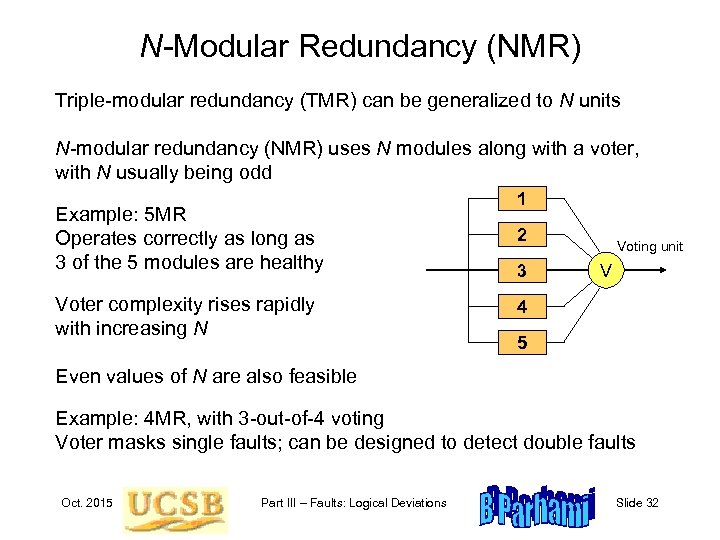 N-Modular Redundancy (NMR) Triple-modular redundancy (TMR) can be generalized to N units N-modular redundancy (NMR) uses N modules along with a voter, with N usually being odd Example: 5 MR Operates correctly as long as 3 of the 5 modules are healthy Voter complexity rises rapidly with increasing N 1 2 1 3 2 Voting unit V 4 3 5 Even values of N are also feasible Example: 4 MR, with 3 -out-of-4 voting Voter masks single faults; can be designed to detect double faults Oct. 2015 Part III – Faults: Logical Deviations Slide 32
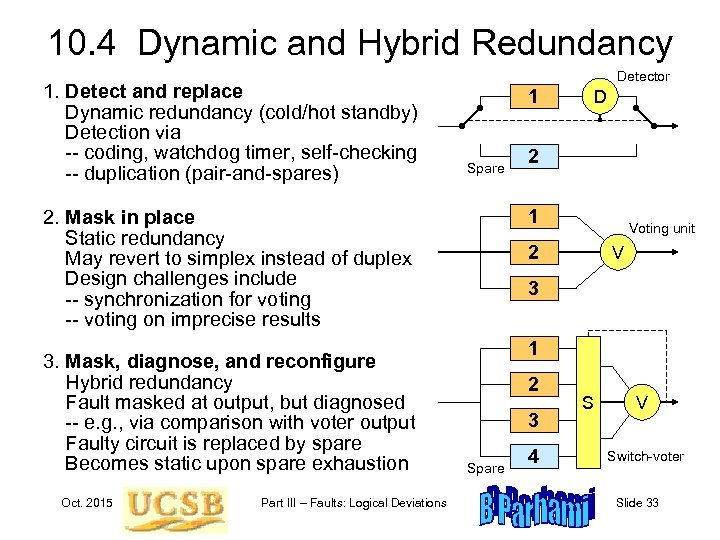 10. 4 Dynamic and Hybrid Redundancy 1. Detect and replace Dynamic redundancy (cold/hot standby) Detection via -- coding, watchdog timer, self-checking -- duplication (pair-and-spares) Detector 1 Spare Oct. 2015 Part III – Faults: Logical Deviations 2 1 2. Mask in place Static redundancy May revert to simplex instead of duplex Design challenges include -- synchronization for voting -- voting on imprecise results 3. Mask, diagnose, and reconfigure Hybrid redundancy Fault masked at output, but diagnosed -- e. g. , via comparison with voter output Faulty circuit is replaced by spare Becomes static upon spare exhaustion D Voting unit 2 V 3 1 2 3 Spare 4 S V Switch-voter Slide 33
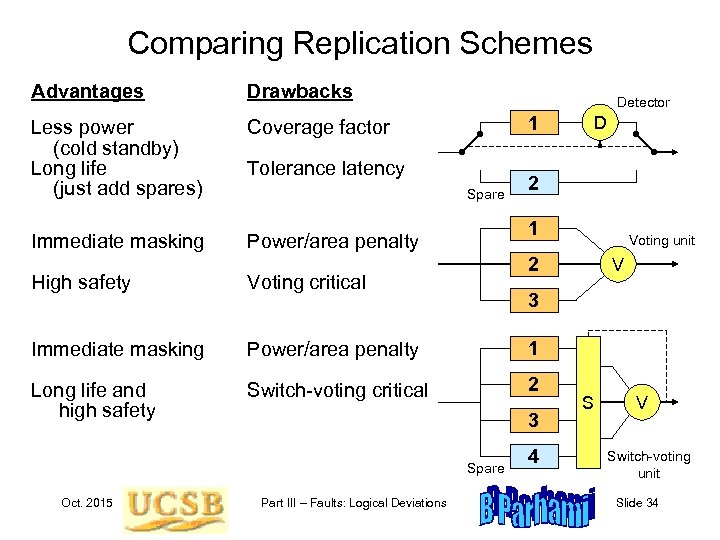 Comparing Replication Schemes Advantages Drawbacks Less power (cold standby) Long life (just add spares) Coverage factor Immediate masking Detector 1 Tolerance latency Spare 2 1 Power/area penalty Voting unit 2 High safety Voting critical Immediate masking Power/area penalty Switch-voting critical 2 V 1 Long life and high safety 3 3 Spare D Oct. 2015 Part III – Faults: Logical Deviations 4 S V Switch-voting unit Slide 34
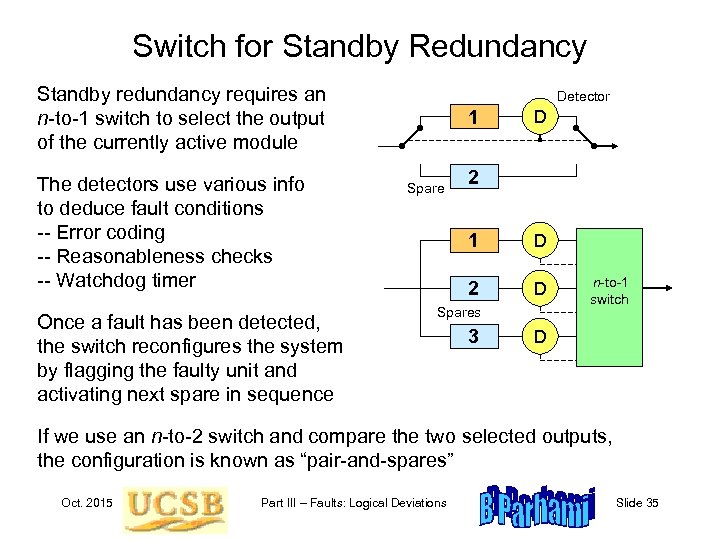 Switch for Standby Redundancy Standby redundancy requires an n-to-1 switch to select the output of the currently active module The detectors use various info to deduce fault conditions -- Error coding -- Reasonableness checks -- Watchdog timer Once a fault has been detected, the switch reconfigures the system by flagging the faulty unit and activating next spare in sequence Detector 1 Spare D 2 1 D 2 D Spares 3 n-to-1 switch D If we use an n-to-2 switch and compare the two selected outputs, the configuration is known as “pair-and-spares” Oct. 2015 Part III – Faults: Logical Deviations Slide 35
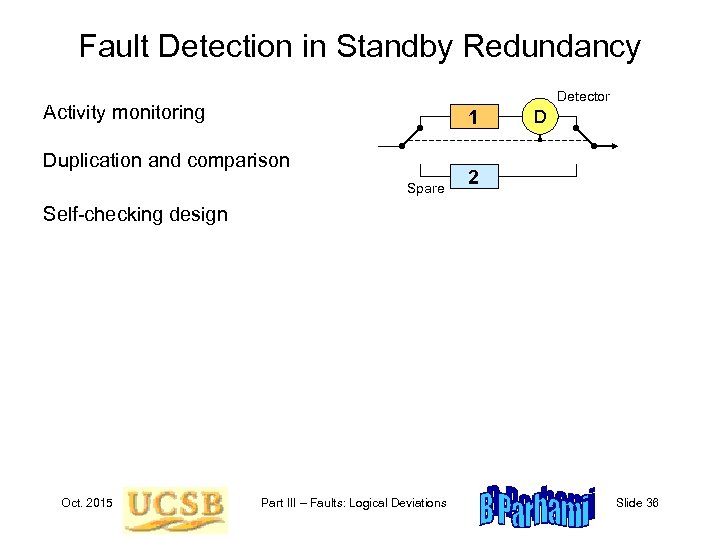 Fault Detection in Standby Redundancy Detector Activity monitoring 1 Duplication and comparison Spare D 2 Self-checking design Oct. 2015 Part III – Faults: Logical Deviations Slide 36
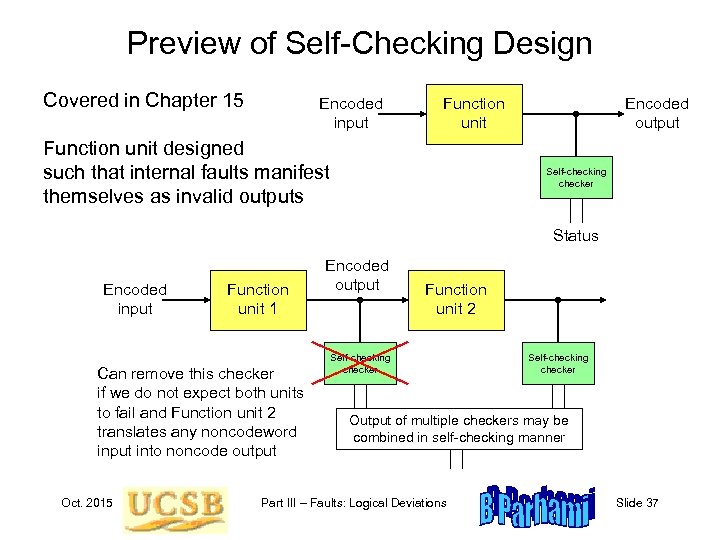 Preview of Self-Checking Design Covered in Chapter 15 Encoded input Function unit designed such that internal faults manifest themselves as invalid outputs Encoded output Self-checking checker Status Encoded input Function unit 1 Can remove this checker if we do not expect both units to fail and Function unit 2 translates any noncodeword input into noncode output Oct. 2015 Encoded output Function unit 2 Self-checking checker Output of multiple checkers may be combined in self-checking manner Part III – Faults: Logical Deviations Slide 37
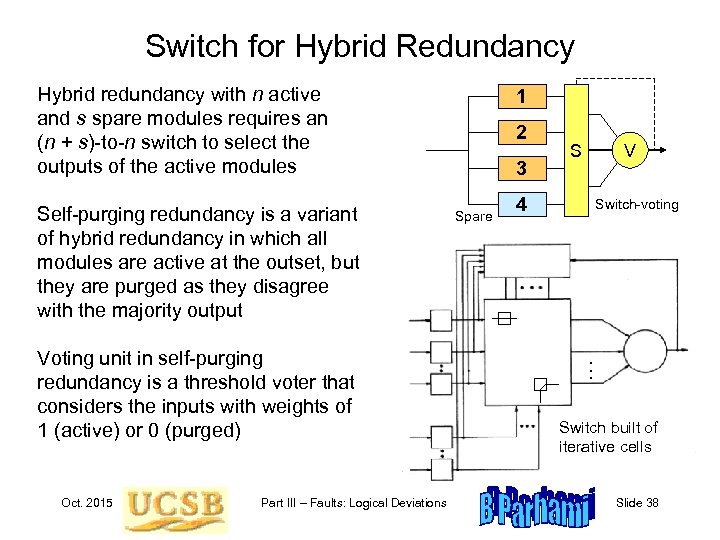 Switch for Hybrid Redundancy Hybrid redundancy with n active and s spare modules requires an (n + s)-to-n switch to select the outputs of the active modules Self-purging redundancy is a variant of hybrid redundancy in which all modules are active at the outset, but they are purged as they disagree with the majority output Voting unit in self-purging redundancy is a threshold voter that considers the inputs with weights of 1 (active) or 0 (purged) Oct. 2015 Part III – Faults: Logical Deviations 1 2 3 Spare S V 4 Switch-voting . . . Switch built of iterative cells Slide 38
 10. 5 Time Redundancy Retry upon a detected fault: particularly useful for transient faults Recomputation not useful with permanent faults Can make recomputation work by slightly changing the operands, but this is not always applicable Compute a (2 b) instead of (2 a) b Compute b + a or –(–a – b) instead of a + b Oct. 2015 Part III – Faults: Logical Deviations Slide 39
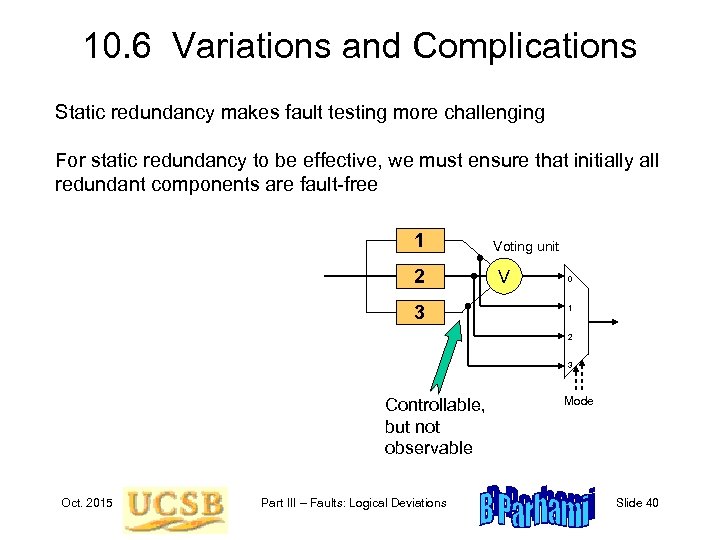 10. 6 Variations and Complications Static redundancy makes fault testing more challenging For static redundancy to be effective, we must ensure that initially all redundant components are fault-free 1 2 3 Voting unit Voting V 0 1 2 3 Controllable, but not observable Oct. 2015 Part III – Faults: Logical Deviations Mode Slide 40
 Applications of NMR and Hybrid Redundancy NASA’s Space Shuttle (retired in 2012): Used 5 -way redundancy in hardware Originally, 3 operational units + 2 spares (one warm, one cold) More recently, 4 operational + 1 spare Also, uses 2 independently developed software systems (Design diversity) Japanese Shinkansen “Bullet” Train Triple-duplex system (6 -fold redundancy) Oct. 2015 Part III – Faults: Logical Deviations Slide 41
 11 Design for Testability Oct. 2015 Part III – Faults: Logical Deviations Slide 42
 "Someone in this house flunked his earth science test because someone else in this house told him that love makes the world go around!" Oct. 2015 Part III – Faults: Logical Deviations Slide 43
 Oct. 2015 Part III – Faults: Logical Deviations Slide 44
 11. 1 The Importance of Testability A small circuit with a limited number of inputs and outputs can be tested with a reasonable amount of effort and time A complex unit, such as a microprocessor, cannot be tested solely based on its input/output behavior Hence, the need for provisions in the design to facilitate testing Oct. 2015 Part III – Faults: Logical Deviations Slide 45
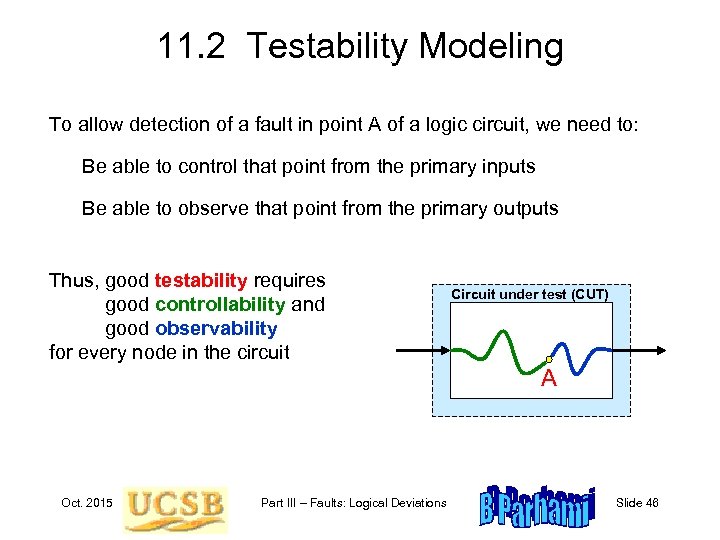 11. 2 Testability Modeling To allow detection of a fault in point A of a logic circuit, we need to: Be able to control that point from the primary inputs Be able to observe that point from the primary outputs Thus, good testability requires good controllability and good observability for every node in the circuit Circuit under test (CUT) A Oct. 2015 Part III – Faults: Logical Deviations Slide 46
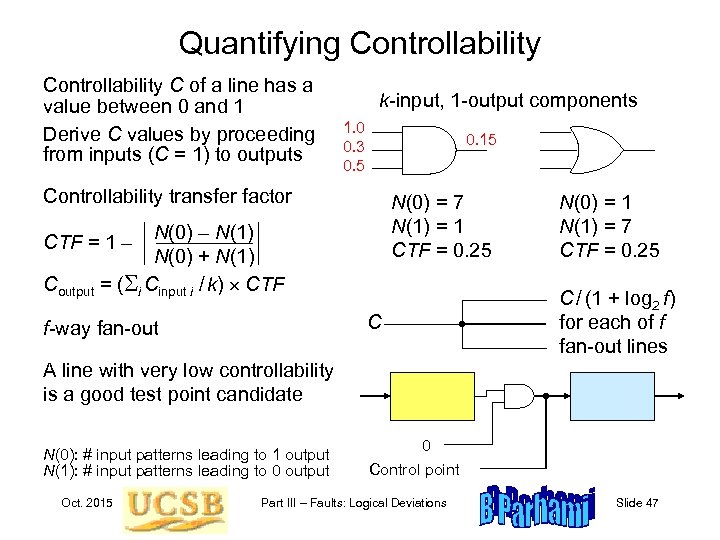 Quantifying Controllability C of a line has a value between 0 and 1 Derive C values by proceeding from inputs (C = 1) to outputs k-input, 1 -output components 1. 0 0. 3 0. 5 0. 15 Controllability transfer factor N(0) = 7 N(1) = 1 CTF = 0. 25 N(0) – N(1) N(0) + N(1) Coutput = (Si Cinput i / k) CTF = 1 – C f-way fan-out N(0) = 1 N(1) = 7 CTF = 0. 25 C / (1 + log 2 f) for each of f fan-out lines A line with very low controllability is a good test point candidate N(0): # input patterns leading to 1 output N(1): # input patterns leading to 0 output Oct. 2015 0 Control point Part III – Faults: Logical Deviations Slide 47
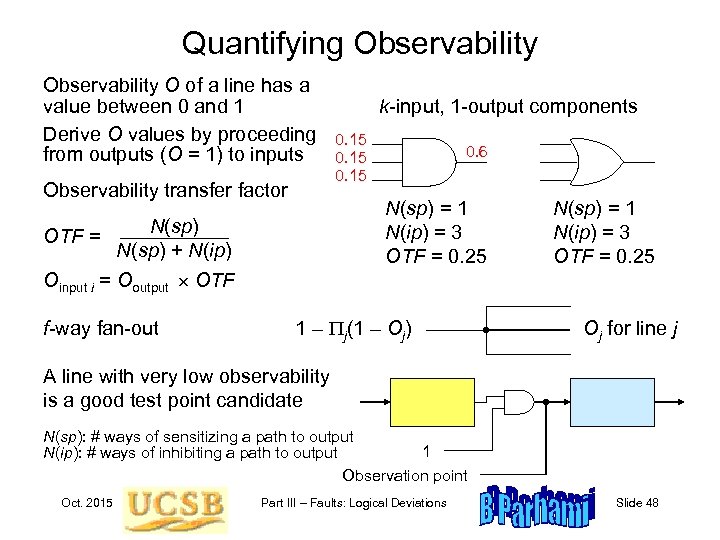 Quantifying Observability O of a line has a value between 0 and 1 Derive O values by proceeding from outputs (O = 1) to inputs Observability transfer factor 0. 15 0. 6 N(sp) = 1 N(ip) = 3 OTF = 0. 25 N(sp) + N(ip) Oinput i = Ooutput OTF = f-way fan-out k-input, 1 -output components 1 – Pj(1 – Oj) N(sp) = 1 N(ip) = 3 OTF = 0. 25 Oj for line j A line with very low observability is a good test point candidate N(sp): # ways of sensitizing a path to output 1 N(ip): # ways of inhibiting a path to output Observation point Oct. 2015 Part III – Faults: Logical Deviations Slide 48
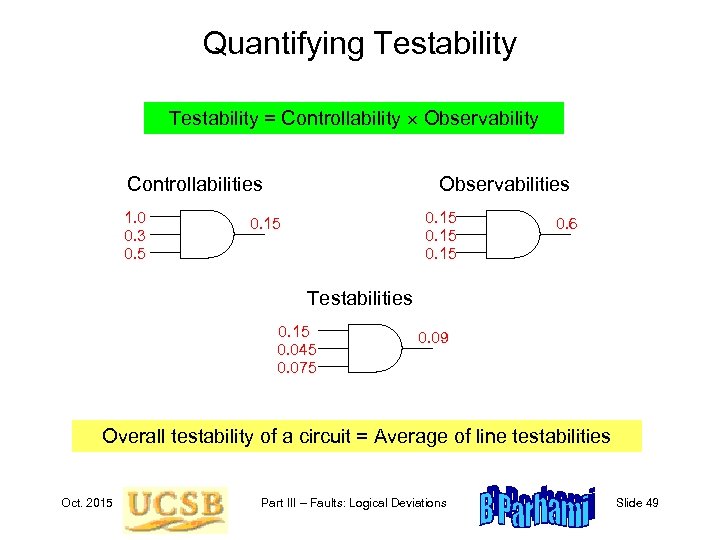 Quantifying Testability = Controllability Observability Controllabilities 1. 0 0. 3 0. 5 Observabilities 0. 15 0. 6 Testabilities 0. 15 0. 045 0. 075 0. 09 Overall testability of a circuit = Average of line testabilities Oct. 2015 Part III – Faults: Logical Deviations Slide 49
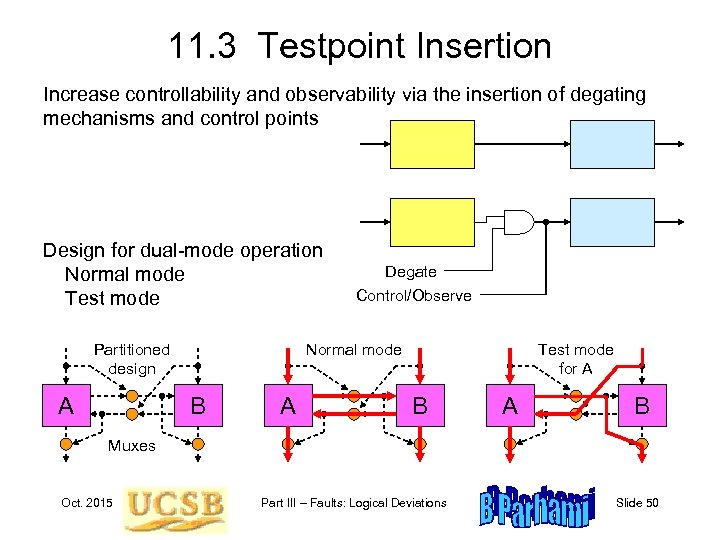 11. 3 Testpoint Insertion Increase controllability and observability via the insertion of degating mechanisms and control points Design for dual-mode operation Normal mode Test mode Normal mode Partitioned design A Degate Control/Observe B A Test mode for A B Muxes Oct. 2015 Part III – Faults: Logical Deviations Slide 50
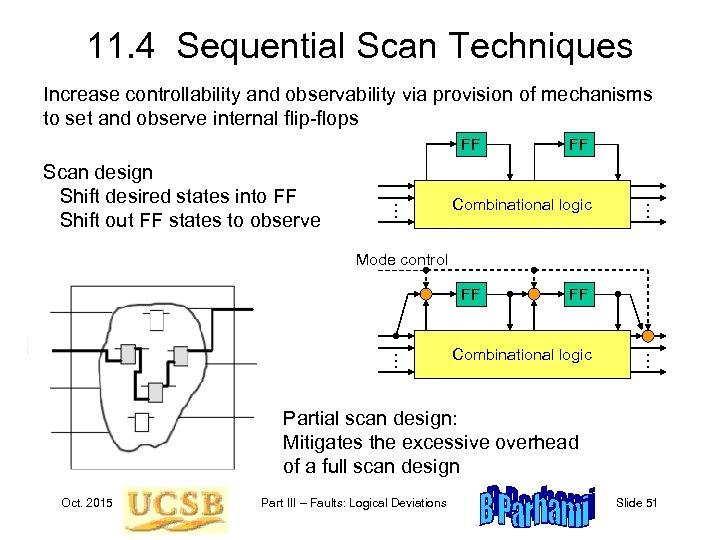 11. 4 Sequential Scan Techniques Increase controllability and observability via provision of mechanisms to set and observe internal flip-flops FF Scan design Shift desired states into FF Shift out FF states to observe . . . FF Combinational logic . . . Mode control FF. . . FF Combinational logic . . . Partial scan design: Mitigates the excessive overhead of a full scan design Oct. 2015 Part III – Faults: Logical Deviations Slide 51
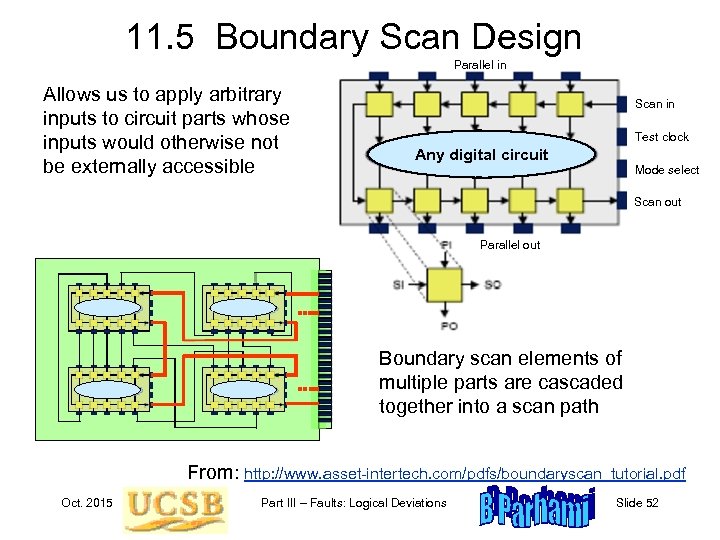 11. 5 Boundary Scan Design Parallel in Allows us to apply arbitrary inputs to circuit parts whose inputs would otherwise not be externally accessible Scan in Test clock Any digital circuit Mode select Scan out Parallel out Boundary scan elements of multiple parts are cascaded together into a scan path From: http: //www. asset-intertech. com/pdfs/boundaryscan_tutorial. pdf Oct. 2015 Part III – Faults: Logical Deviations Slide 52
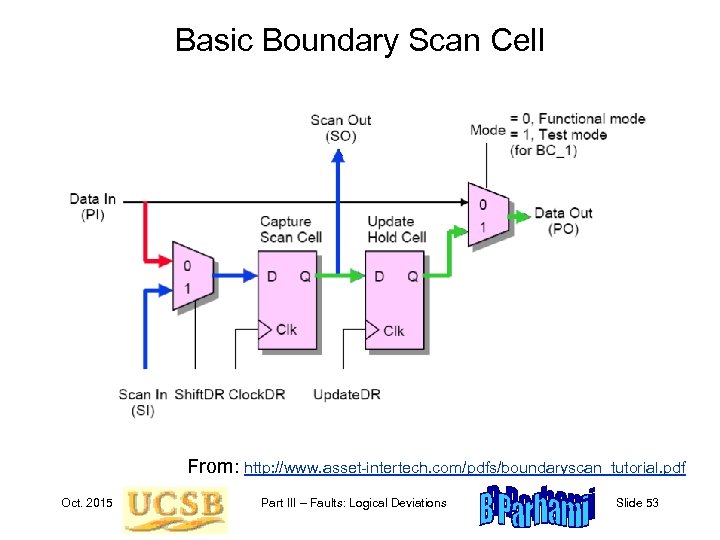 Basic Boundary Scan Cell From: http: //www. asset-intertech. com/pdfs/boundaryscan_tutorial. pdf Oct. 2015 Part III – Faults: Logical Deviations Slide 53
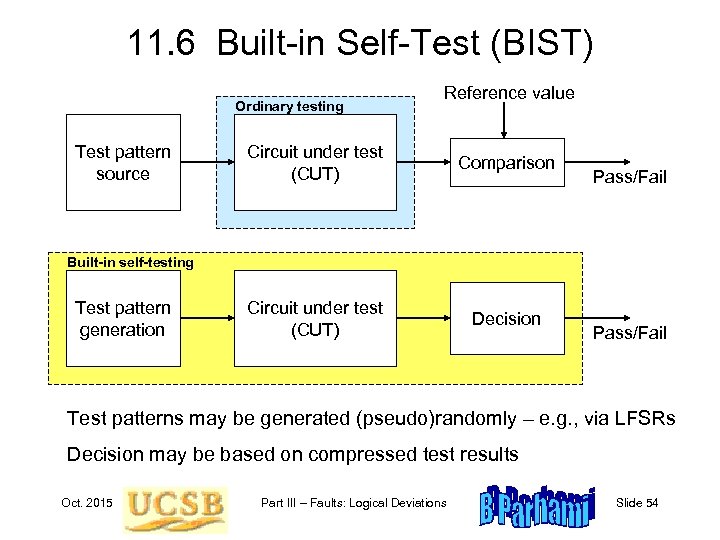 11. 6 Built-in Self-Test (BIST) Ordinary testing Test pattern source Reference value Circuit under test (CUT) Comparison Circuit under test (CUT) Decision Pass/Fail Built-in self-testing Test pattern generation Pass/Fail Test patterns may be generated (pseudo)randomly – e. g. , via LFSRs Decision may be based on compressed test results Oct. 2015 Part III – Faults: Logical Deviations Slide 54
 12 Replication and Voting Oct. 2015 Part III – Faults: Logical Deviations Slide 55
 “Fire. Bad. Those in favour? ” Oct. 2015 Part III – Faults: Logical Deviations Slide 56
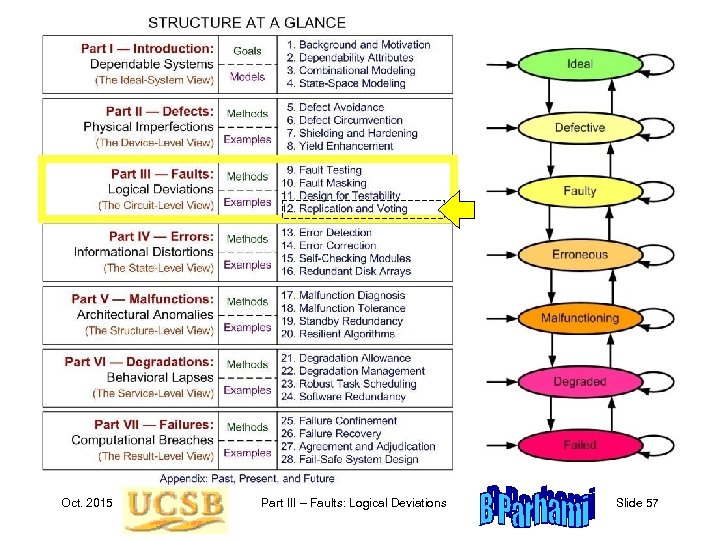 Oct. 2015 Part III – Faults: Logical Deviations Slide 57
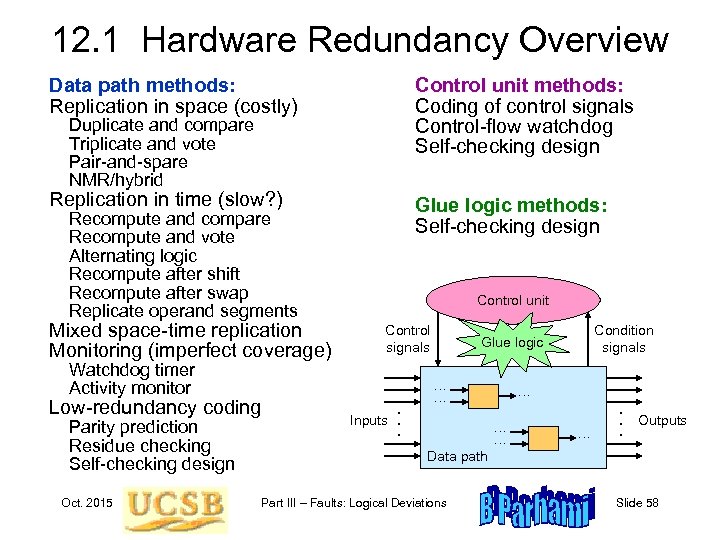 12. 1 Hardware Redundancy Overview Data path methods: Replication in space (costly) Control unit methods: Coding of control signals Control-flow watchdog Self-checking design Replication in time (slow? ) Glue logic methods: Self-checking design Duplicate and compare Triplicate and vote Pair-and-spare NMR/hybrid Recompute and compare Recompute and vote Alternating logic Recompute after shift Recompute after swap Replicate operand segments Mixed space-time replication Monitoring (imperfect coverage) Control unit Control signals Watchdog timer Activity monitor Low-redundancy coding Parity prediction Residue checking Self-checking design Oct. 2015 . Inputs. . Condition signals Glue logic … … … . . . Outputs Data path Part III – Faults: Logical Deviations Slide 58
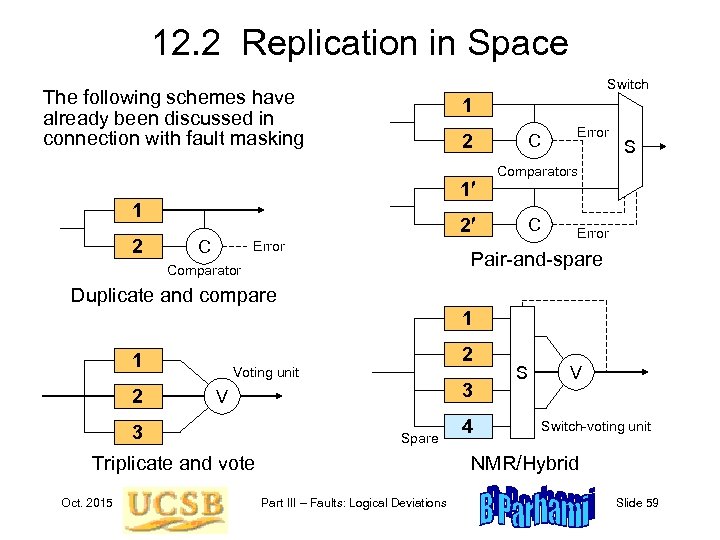 12. 2 Replication in Space Switch The following schemes have already been discussed in connection with fault masking 1 2 1 1 2 2 C Error S Comparators C Error Pair-and-spare Comparator Duplicate and compare 1 1 2 2 Voting unit 3 V 3 Spare Triplicate and vote Oct. 2015 4 S V Switch-voting unit NMR/Hybrid Part III – Faults: Logical Deviations Slide 59
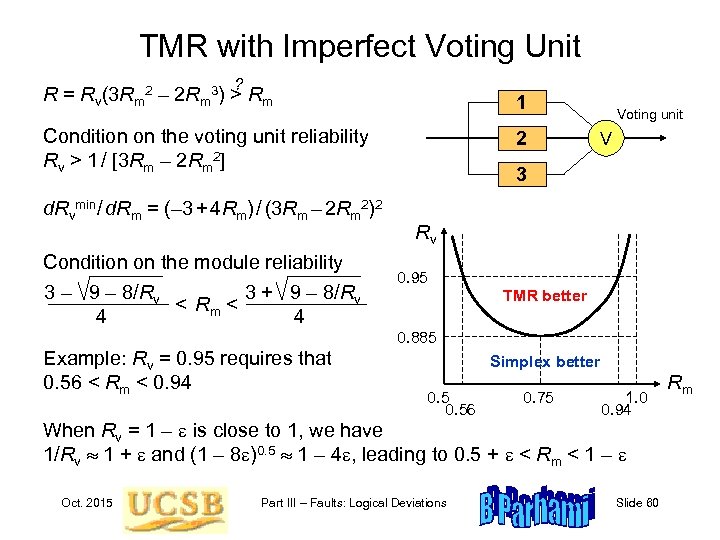 TMR with Imperfect Voting Unit ? R = Rv(3 Rm 2 – 2 Rm 3) > Rm 1 Condition on the voting unit reliability Rv > 1 / [3 Rm – 2 Rm 2] 2 d. Rvmin/ d. Rm = (– 3 + 4 Rm) / (3 Rm – 2 Rm 2)2 Condition on the module reliability 3 – 9 – 8/Rv 3 + 9 – 8/Rv < Rm < 4 4 Voting unit V 3 Rv 0. 95 TMR better 0. 885 Example: Rv = 0. 95 requires that 0. 56 < Rm < 0. 94 Simplex better 0. 56 0. 75 1. 0 0. 94 When Rv = 1 – e is close to 1, we have 1/Rv 1 + e and (1 – 8 e)0. 5 1 – 4 e, leading to 0. 5 + e < Rm < 1 – e Oct. 2015 Part III – Faults: Logical Deviations Slide 60 Rm
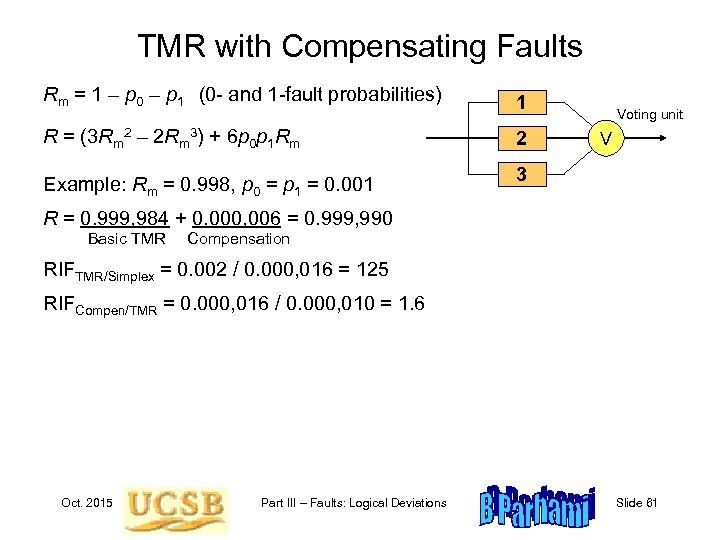 TMR with Compensating Faults Rm = 1 – p 0 – p 1 (0 - and 1 -fault probabilities) 1 R = (3 Rm 2 – 2 Rm 3) + 6 p 0 p 1 Rm 2 Example: Rm = 0. 998, p 0 = p 1 = 0. 001 3 Voting unit V R = 0. 999, 984 + 0. 000, 006 = 0. 999, 990 Basic TMR Compensation RIFTMR/Simplex = 0. 002 / 0. 000, 016 = 125 RIFCompen/TMR = 0. 000, 016 / 0. 000, 010 = 1. 6 Oct. 2015 Part III – Faults: Logical Deviations Slide 61
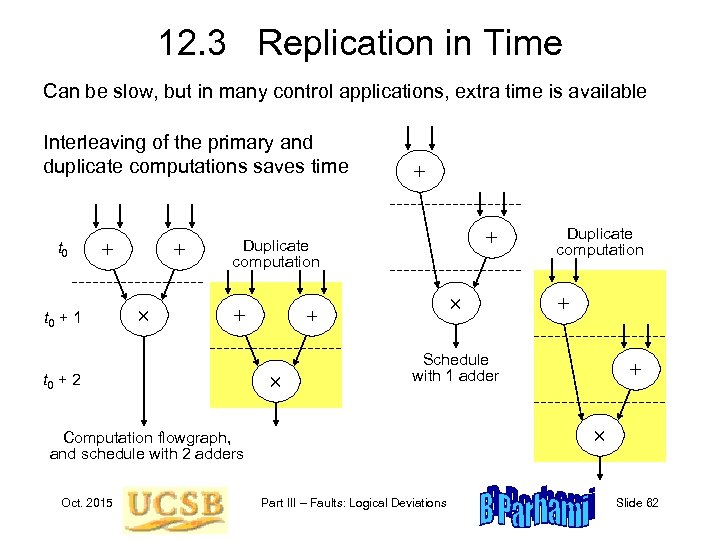 12. 3 Replication in Time Can be slow, but in many control applications, extra time is available Interleaving of the primary and duplicate computations saves time t 0 + 1 + + + Duplicate computation + t 0 + 2 + Oct. 2015 + Schedule with 1 adder + Computation flowgraph, and schedule with 2 adders Duplicate computation Part III – Faults: Logical Deviations Slide 62
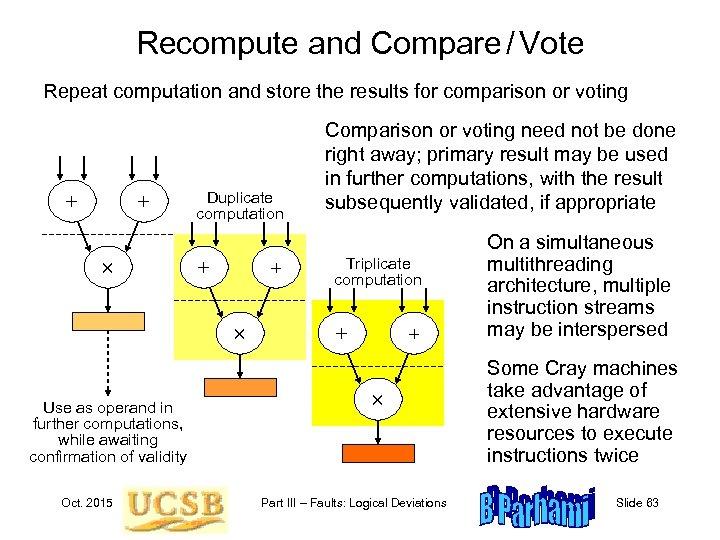 Recompute and Compare / Vote Repeat computation and store the results for comparison or voting + + Duplicate computation + + Use as operand in further computations, while awaiting confirmation of validity Oct. 2015 Comparison or voting need not be done right away; primary result may be used in further computations, with the result subsequently validated, if appropriate Triplicate computation + + Part III – Faults: Logical Deviations On a simultaneous multithreading architecture, multiple instruction streams may be interspersed Some Cray machines take advantage of extensive hardware resources to execute instructions twice Slide 63
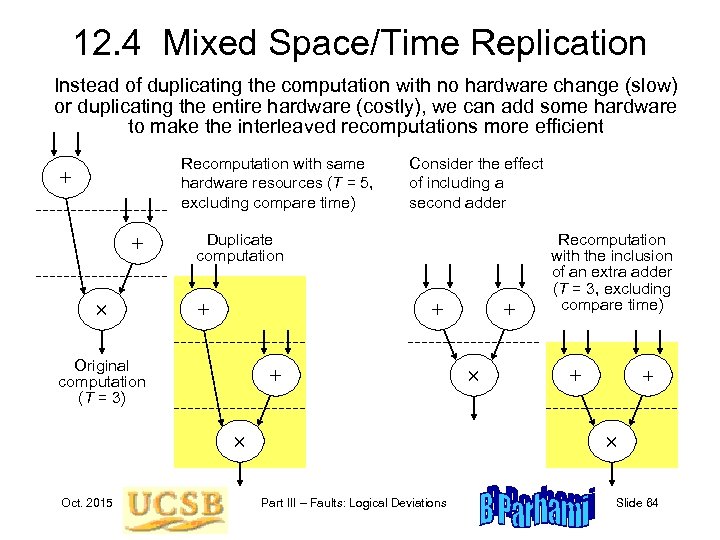 12. 4 Mixed Space/Time Replication Instead of duplicating the computation with no hardware change (slow) or duplicating the entire hardware (costly), we can add some hardware to make the interleaved recomputations more efficient Recomputation with same hardware resources (T = 5, excluding compare time) + + Consider the effect of including a second adder Duplicate computation + + Original computation (T = 3) + Oct. 2015 + Recomputation with the inclusion of an extra adder (T = 3, excluding compare time) + + Part III – Faults: Logical Deviations Slide 64
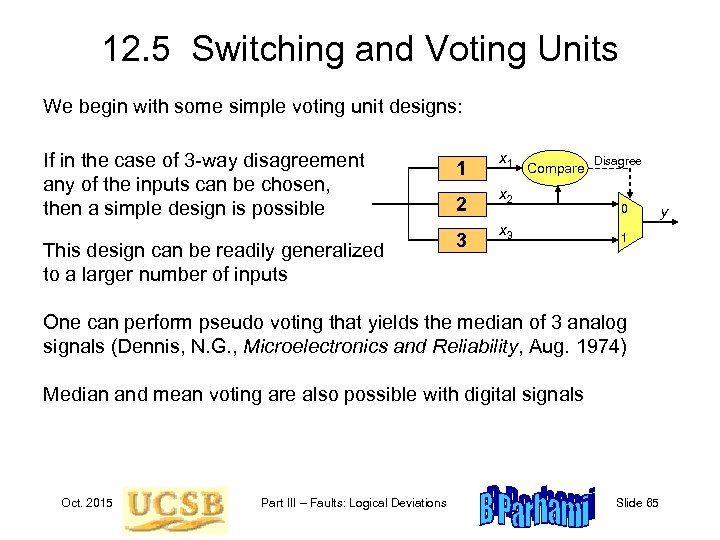 12. 5 Switching and Voting Units We begin with some simple voting unit designs: If in the case of 3 -way disagreement any of the inputs can be chosen, then a simple design is possible 1 This design can be readily generalized to a larger number of inputs 3 2 x 1 Compare x 2 x 3 Disagree 0 1 One can perform pseudo voting that yields the median of 3 analog signals (Dennis, N. G. , Microelectronics and Reliability, Aug. 1974) Median and mean voting are also possible with digital signals Oct. 2015 Part III – Faults: Logical Deviations Slide 65 y
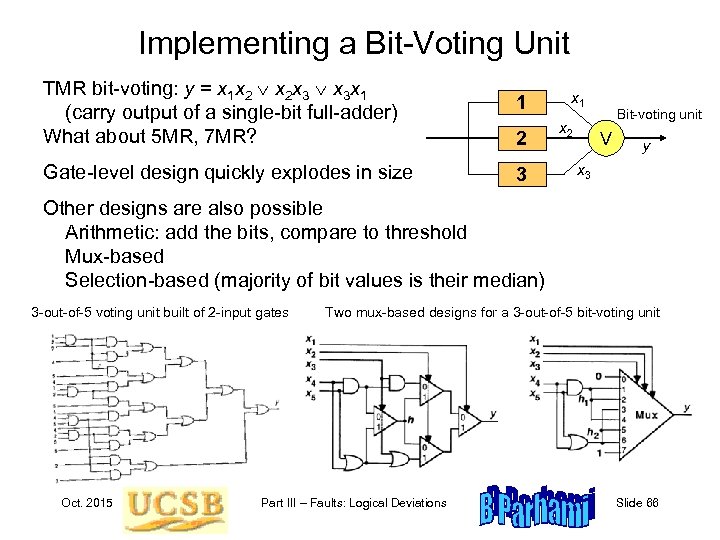 Implementing a Bit-Voting Unit TMR bit-voting: y = x 1 x 2 x 2 x 3 x 3 x 1 (carry output of a single-bit full-adder) What about 5 MR, 7 MR? 1 Gate-level design quickly explodes in size 3 2 x 1 x 2 Bit-voting unit V y x 3 Other designs are also possible Arithmetic: add the bits, compare to threshold Mux-based Selection-based (majority of bit values is their median) 3 -out-of-5 voting unit built of 2 -input gates Oct. 2015 Two mux-based designs for a 3 -out-of-5 bit-voting unit Part III – Faults: Logical Deviations Slide 66
 Complexity of Different Bit-Voting Unit Designs Cost of majority bit-voting units as a function of the number n of inputs Oct. 2015 Part III – Faults: Logical Deviations Slide 67
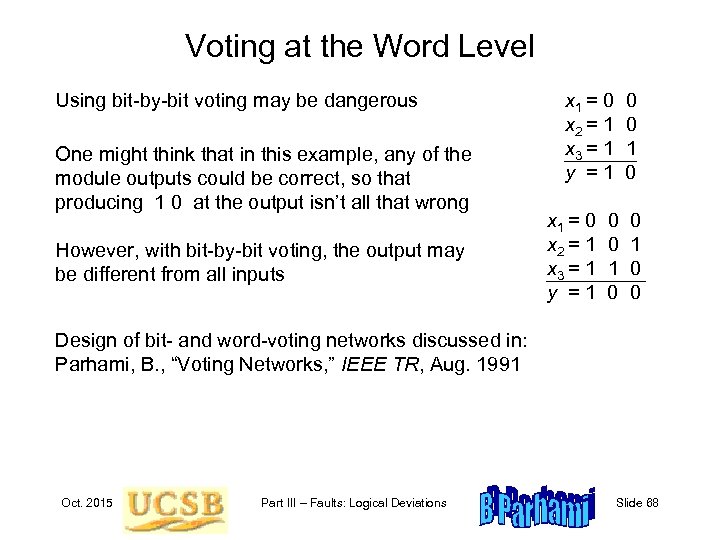 Voting at the Word Level Using bit-by-bit voting may be dangerous One might think that in this example, any of the module outputs could be correct, so that producing 1 0 at the output isn’t all that wrong However, with bit-by-bit voting, the output may be different from all inputs x 1 = 0 x 2 = 1 x 3 = 1 y =1 0 0 1 0 0 Design of bit- and word-voting networks discussed in: Parhami, B. , “Voting Networks, ” IEEE TR, Aug. 1991 Oct. 2015 Part III – Faults: Logical Deviations Slide 68
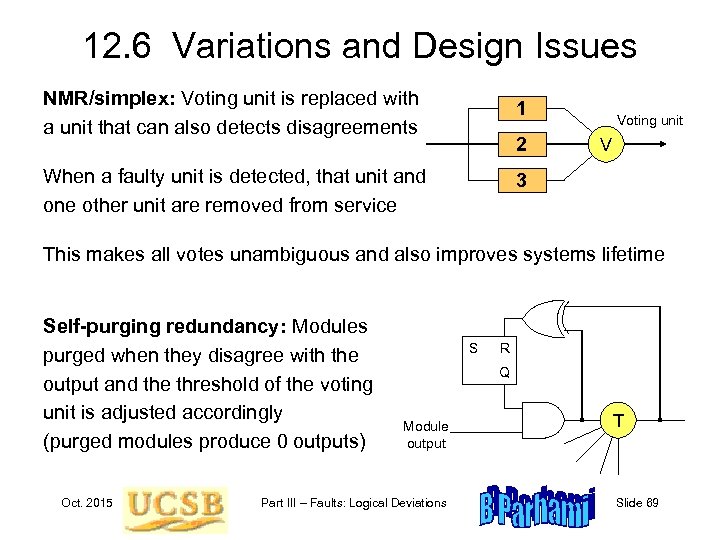 12. 6 Variations and Design Issues NMR/simplex: Voting unit is replaced with a unit that can also detects disagreements 1 When a faulty unit is detected, that unit and one other unit are removed from service 3 2 Voting unit V This makes all votes unambiguous and also improves systems lifetime Self-purging redundancy: Modules purged when they disagree with the output and the threshold of the voting unit is adjusted accordingly (purged modules produce 0 outputs) Oct. 2015 S R Q Module output Part III – Faults: Logical Deviations T Slide 69
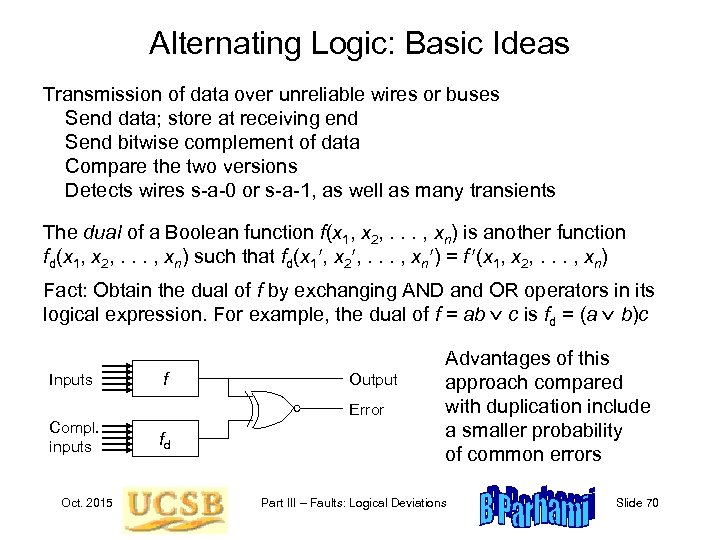 Alternating Logic: Basic Ideas Transmission of data over unreliable wires or buses Send data; store at receiving end Send bitwise complement of data Compare the two versions Detects wires s-a-0 or s-a-1, as well as many transients The dual of a Boolean function f(x 1, x 2, . . . , xn) is another function fd(x 1, x 2, . . . , xn) such that fd(x 1 , x 2 , . . . , xn ) = f (x 1, x 2, . . . , xn) Fact: Obtain the dual of f by exchanging AND and OR operators in its logical expression. For example, the dual of f = ab c is fd = (a b)c Inputs f Output Error Compl. inputs Oct. 2015 fd Advantages of this approach compared with duplication include a smaller probability of common errors Part III – Faults: Logical Deviations Slide 70
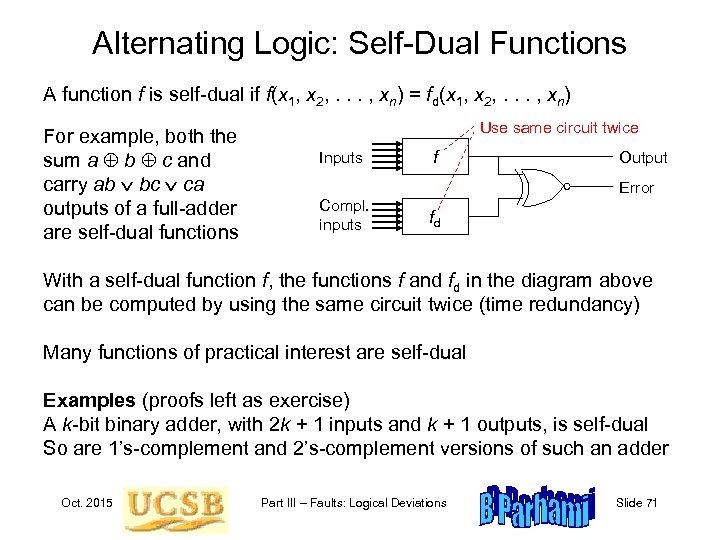 Alternating Logic: Self-Dual Functions A function f is self-dual if f(x 1, x 2, . . . , xn) = fd(x 1, x 2, . . . , xn) For example, both the sum a b c and carry ab bc ca outputs of a full-adder are self-dual functions Use same circuit twice Inputs f Output Error Compl. inputs fd With a self-dual function f, the functions f and fd in the diagram above can be computed by using the same circuit twice (time redundancy) Many functions of practical interest are self-dual Examples (proofs left as exercise) A k-bit binary adder, with 2 k + 1 inputs and k + 1 outputs, is self-dual So are 1’s-complement and 2’s-complement versions of such an adder Oct. 2015 Part III – Faults: Logical Deviations Slide 71
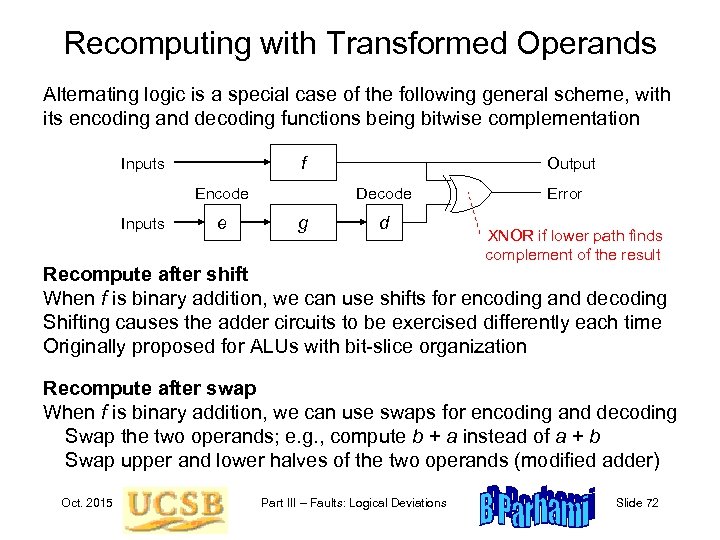 Recomputing with Transformed Operands Alternating logic is a special case of the following general scheme, with its encoding and decoding functions being bitwise complementation f Inputs Encode Inputs e Output Decode g d Error XNOR if lower path finds complement of the result Recompute after shift When f is binary addition, we can use shifts for encoding and decoding Shifting causes the adder circuits to be exercised differently each time Originally proposed for ALUs with bit-slice organization Recompute after swap When f is binary addition, we can use swaps for encoding and decoding Swap the two operands; e. g. , compute b + a instead of a + b Swap upper and lower halves of the two operands (modified adder) Oct. 2015 Part III – Faults: Logical Deviations Slide 72
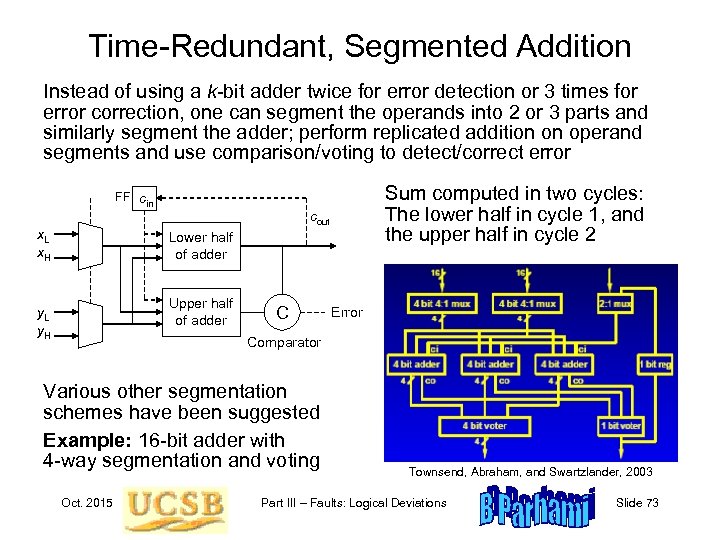 Time-Redundant, Segmented Addition Instead of using a k-bit adder twice for error detection or 3 times for error correction, one can segment the operands into 2 or 3 parts and similarly segment the adder; perform replicated addition on operand segments and use comparison/voting to detect/correct error FF cin x. L x. H cout Lower half of adder Upper half of adder y. L y. H C Error Comparator Various other segmentation schemes have been suggested Example: 16 -bit adder with 4 -way segmentation and voting Sum computed in two cycles: The lower half in cycle 1, and the upper half in cycle 2 Oct. 2015 Townsend, Abraham, and Swartzlander, 2003 Part III – Faults: Logical Deviations Slide 73