 Скачать презентацию OCLC Online Computer Library Center Towards the webification
0e4355b3f1d659bcde940675a701813f.ppt
- Количество слайдов: 25



OCLC Online Computer Library Center Towards the “webification” of controlled subject vocabulary A case study involving the Dewey Decimal Classification Michael Panzer Global Product Manager, Taxonomy Serivces OCLC 6 th European NKOS Workshop September 21, 2007 Budapest
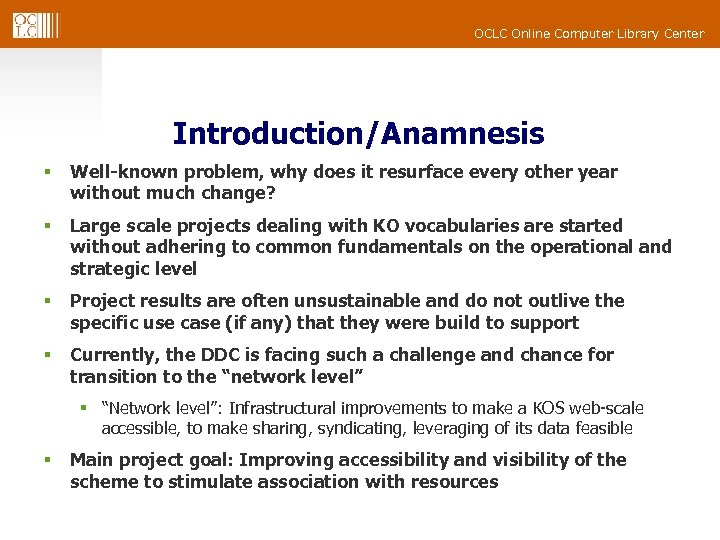
OCLC Online Computer Library Center Introduction/Anamnesis § Well-known problem, why does it resurface every other year without much change? § Large scale projects dealing with KO vocabularies are started without adhering to common fundamentals on the operational and strategic level § Project results are often unsustainable and do not outlive the specific use case (if any) that they were build to support § Currently, the DDC is facing such a challenge and chance for transition to the “network level” § “Network level”: Infrastructural improvements to make a KOS web-scale accessible, to make sharing, syndicating, leveraging of its data feasible § Main project goal: Improving accessibility and visibility of the scheme to stimulate association with resources
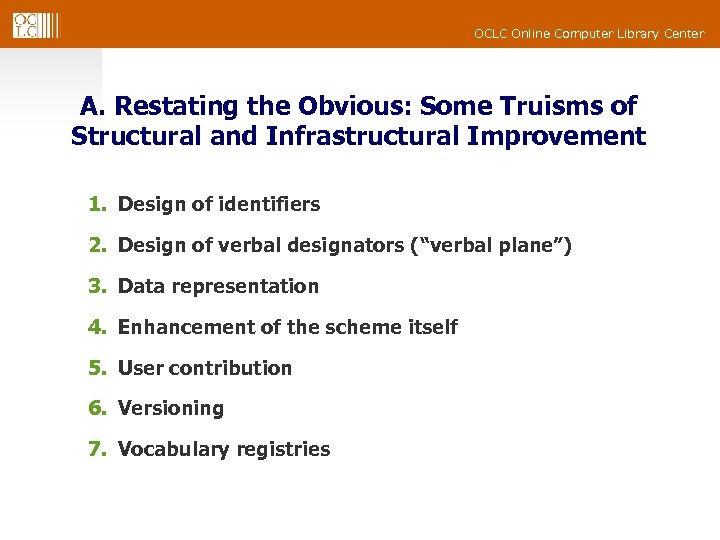
OCLC Online Computer Library Center A. Restating the Obvious: Some Truisms of Structural and Infrastructural Improvement 1. Design of identifiers 2. Design of verbal designators (“verbal plane”) 3. Data representation 4. Enhancement of the scheme itself 5. User contribution 6. Versioning 7. Vocabulary registries
OCLC Online Computer Library Center A. Restating the Obvious: Some Truisms of Structural and Infrastructural Improvement 1. Design of identifiers 2. Design of verbal designators (“verbal plane”) 3. Data representation 4. Enhancement of the scheme itself 5. User contribution 6. Versioning 7. Vocabulary registries
OCLC Online Computer Library Center 1. Identification § Addressability and reference as problem for the web at large § Rigorous semantic engineering (“subject landscaping, ” G. Dunsire) in KOS often not fronted for outside use § Landscaping becomes just baroque gardening, withdrawing the horticultured space from the landscape at large
OCLC Online Computer Library Center (CC) licensed 2007 e. Boy
OCLC Online Computer Library Center 2. Verbal designation § Scant research about what to show end-users and how to do it § Primarily treated not as a question of semantics, but usability § Usability usually not an attribute of terminologies, but their user-facing services (front-ends) § Starting from scratch not possible, and transformation not trivial § intricate interdependencies and contextual configurations of infons/taxons in the KO systems
OCLC Online Computer Library Center 3. Data representation Different levels of disarray, different aggregate states: § Printed form, proprietary formats, spreadsheets § Accessibility limited to specific communities § But: emerging standards (SKOS, OWL-DL) are often under consideration for adoption § Again: crosswalking is all but trivial; sometimes conceptual properties of the KOS have to be adapted
OCLC Online Computer Library Center B. Webifying the DDC § URI design § Caption design § Format considerations (the first steps)
OCLC Online Computer Library Center It‘s the URI, stupid! Premise: § To summon a demon, you need to know its name (or vice versa: if you want to be summoned, you should try to get your name out there) Importance of URIs: § Easy to remember § Easy to share § (Relatively) easy to compare § Best practice formats (RDF, SKOS) are URI centric
OCLC Online Computer Library Center URIs for the DDC Design goals: § Common locator for Dewey concepts and associated resources for use in web services and web applications § Use-case-driven, but outlasting and not directly related to a specific use case (persistency) § Retraceable path to a concept rather than an abstract identification, reusing a means of identification that is already present in the DDC and available in existing metadata
OCLC Online Computer Library Center URIs: Basic Format http: //dewey. info/{aspect}/{object}/{locale}/{type}/{version}/{resource} {aspect} is the aspect associated with an {object}—the current value set of aspect contains “concept”, “scheme”, and “index”; additional ones are under exploration {object} is a type of {aspect} {locale} identifies a Dewey translation {type} identifies a Dewey edition type and contains, at a minimum, the values “edn” for the full edition or “abr” for the abridged edition {version} identifies a Dewey edition version {resource} identifies a resource associated with an {object} in the context of {locale}, {type}, and {version}
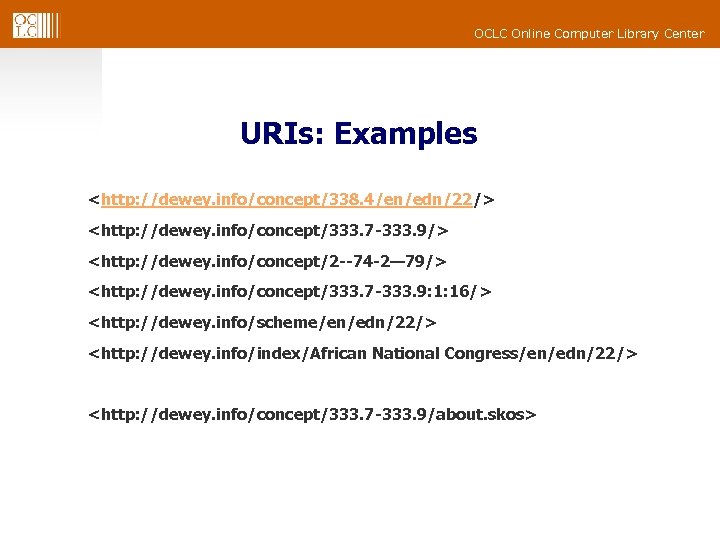
OCLC Online Computer Library Center URIs: Examples <http: //dewey. info/concept/338. 4/en/edn/22/> <http: //dewey. info/concept/333. 7 -333. 9/> <http: //dewey. info/concept/2 --74 -2— 79/> <http: //dewey. info/concept/333. 7 -333. 9: 1: 16/> <http: //dewey. info/scheme/en/edn/22/> <http: //dewey. info/index/African National Congress/en/edn/22/> <http: //dewey. info/concept/333. 7 -333. 9/about. skos>
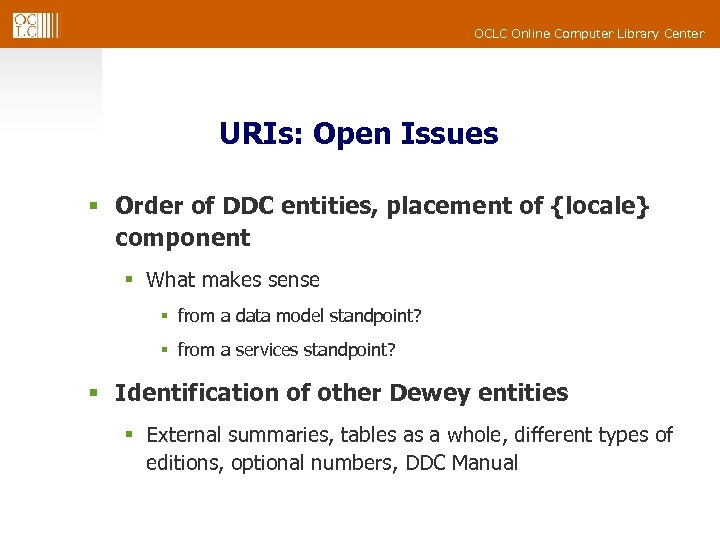
OCLC Online Computer Library Center URIs: Open Issues § Order of DDC entities, placement of {locale} component § What makes sense § from a data model standpoint? § from a services standpoint? § Identification of other Dewey entities § External summaries, tables as a whole, different types of editions, optional numbers, DDC Manual
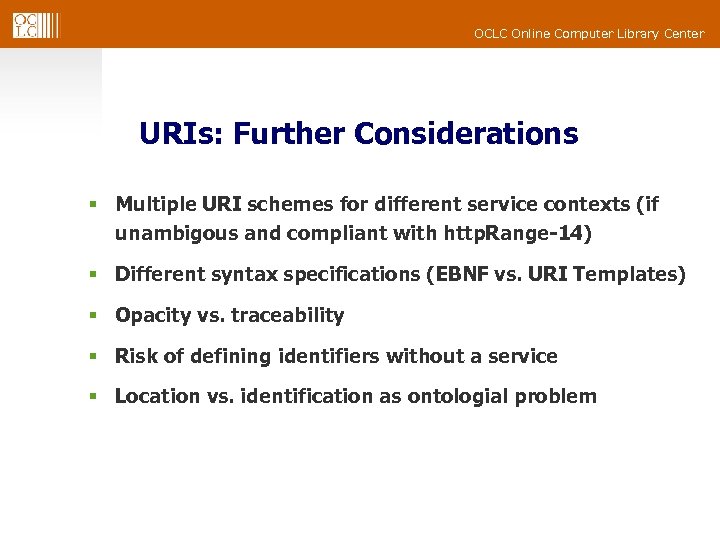
OCLC Online Computer Library Center URIs: Further Considerations § Multiple URI schemes for different service contexts (if unambigous and compliant with http. Range-14) § Different syntax specifications (EBNF vs. URI Templates) § Opacity vs. traceability § Risk of defining identifiers without a service § Location vs. identification as ontologial problem
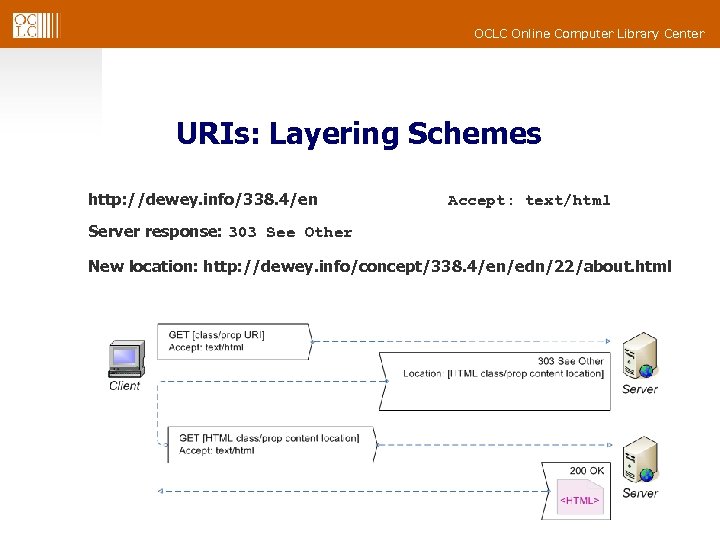
OCLC Online Computer Library Center URIs: Layering Schemes http: //dewey. info/338. 4/en Accept: text/html Server response: 303 See Other New location: http: //dewey. info/concept/338. 4/en/edn/22/about. html
OCLC Online Computer Library Center Caption design § Problems specific to schemes depending on hierarchy § Display context has to be taken into account § Two different modes of display § First level: Optimized for glanceability § Second level: Aggregated information from different sources § Process has to be at least “Pareto-automatic” (80/20) § Improving captions by aggregation and mining of own and associated data
OCLC Online Computer Library Center Caption Design: Fundamentals § Comprehensibility of Dewey class headings highly dependent on the context of presentation § Context is fixed in existing web applications, fluid (unknown) for web services § Prediction of necessary information to give good impression of scope and meaning is not trivial
OCLC Online Computer Library Center Caption Design: Hierarchy I § Dependence on hierarchy to indicate discipline § Folding parts of an hierarchical array back into the caption § Smooshing the context to become useful for enriching the caption, without either flattening it completely or displaying it entirely § Avoiding the drawbacks of a classic breadcrumbs display
OCLC Online Computer Library Center Caption Design: Hierarchy II 025. 349 [Cataloging, Classification, Indexing of] Other special materials § Framing by discipline derived from the Relative Index: 025. 349 Cataloging of other special materials § Other strategies to acquire relevant contextual terminology: § Relationship types in hierarchical array § Associated resources (and co-occurring subject vocabulary) § Mapped vocabulary
OCLC Online Computer Library Center Caption Design: Heading types § “Other” headings § Node labels § Hook numbers § Centered entries § Brief headings § ‘Deweyisms’ § Homonymity/polysemy in headings § Standard subdivisions and other technical vocabulary
OCLC Online Computer Library Center Format considerations I: MARC 21 § DDC migrating from proprietary format to MARC 21 Classification and Authorities (http: //www. loc. gov/marc/marbi/2007 -dp 06. html) § Revamping of 082 field for better subject access (provisions for assigning internal table notation, external table notation, identification of standard/optional numbers) § Provision for additional Dewey numbers as access numbers § Inclusion of component parts of numbers in bibliographic records using a new 085 field § Identification of notation in internal add tables and (where not already provided) in Tables 1– 6 § MARC is at the epicenter of OCLC expertise § Starting/transition point for a variety of crosswalks
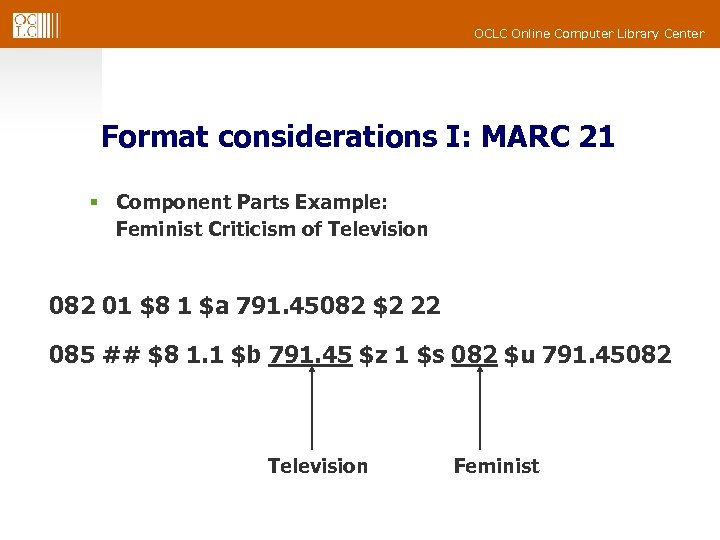
OCLC Online Computer Library Center Format considerations I: MARC 21 § Component Parts Example: Feminist Criticism of Television 082 01 $8 1 $a 791. 45082 $2 22 085 ## $8 1. 1 $b 791. 45 $z 1 $s 082 $u 791. 45082 Television Feminist
OCLC Online Computer Library Center Format considerations II: SKOS Feasibility of providing a SKOS version of Dewey: § Solving of the identifier issue § Minor standard issues: collections, note types § Concept versioning § Representing the Relative Index § Revitalizing SKOS Mapping Vocabulary Spec
OCLC Online Computer Library Center Thanks for participating! Questions, comments, discussion: Michael A. Panzer, panzerm@oclc. org
Скачать презентацию OCLC Online Computer Library Center Towards the webification
0e4355b3f1d659bcde940675a701813f.ppt