


 Скачать презентацию OCIP CCIP Wrap Up Construction Projects q
aea0cc9e284b8b04b6ab473c415a5843.ppt
- Количество слайдов: 114
 OCIP / CCIP “Wrap Up” Construction Projects q The webinar will begin shortly q There is no audio at this time q This presentation is being recorded for your viewing pleasure at a future 100% Participation in Polling Questions is required to receive credit for this class. Even if you do not intend to receive credit, please participate in the polls. date q The attendance and proctor forms are available under ‘Materials’ in the Webinar’s Console to the right q The Power. Point presentation is also available under ‘Materials’ q You will receive the course number for your state near the end of class q University Insurance Community Use the ‘chat’ window for questions
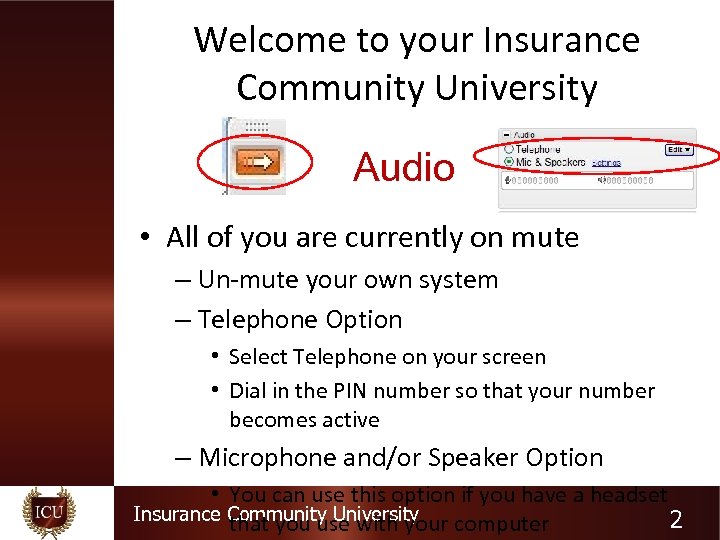 Welcome to your Insurance Community University Audio • All of you are currently on mute – Un-mute your own system – Telephone Option • Select Telephone on your screen • Dial in the PIN number so that your number becomes active – Microphone and/or Speaker Option • You can use this option if you have a headset Insurance Community University 2 that you use with your computer
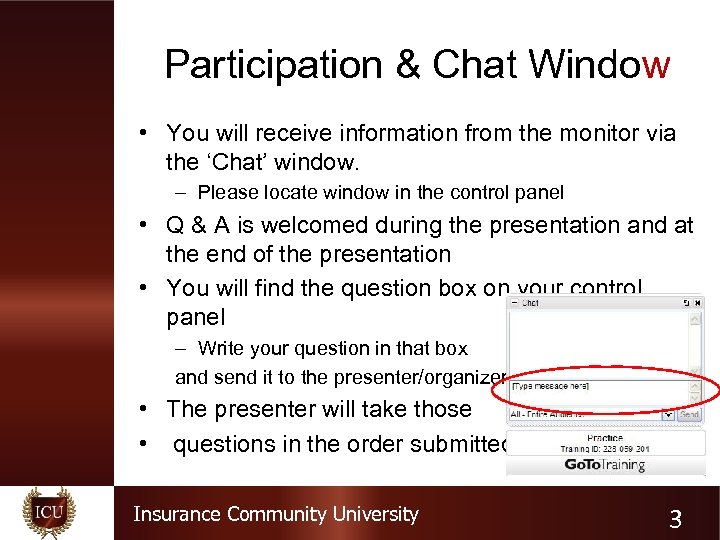 Participation & Chat Window • You will receive information from the monitor via the ‘Chat’ window. – Please locate window in the control panel • Q & A is welcomed during the presentation and at the end of the presentation • You will find the question box on your control panel – Write your question in that box and send it to the presenter/organizer • The presenter will take those • questions in the order submitted Insurance Community University 3
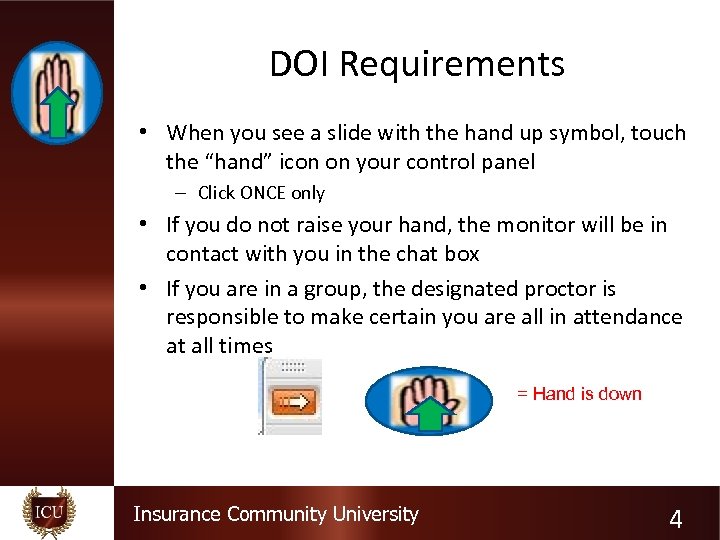 DOI Requirements • When you see a slide with the hand up symbol, touch the “hand” icon on your control panel – Click ONCE only • If you do not raise your hand, the monitor will be in contact with you in the chat box • If you are in a group, the designated proctor is responsible to make certain you are all in attendance at all times = Hand is down Insurance Community University 4
 Polling • Throughout the class we will be conducting periodic polls • We need 100% participation on the polls • The polls are intended to check participation but also to create discussion topics throughout the presentation Insurance Community University 5
 Forms To Complete for CE • After class ends – Return attendance form – Proctors – return your form to email address • Email address is in chat window or in email sent to you today Insurance Community University 6
 DOI Requirements • We will file your hours with the DOI after the completion of this webinar and we have received the attendance form. • You have 48 hours to return the form • You will be sent a Certificate of Attendance/Completion by email. Please retain this for your records for five years. Insurance Community University 7
 Internet Disruption • If the presenter looses internet connection STAY ON THE LINE • The administrators will communicate with you Insurance Community University
 Internet Failure • If the internet fails and all participants are kicked off line by Go To Training or other source then the seminar will be terminated • You will receive instructions by email as to how we will proceed • This is a precautionary notice, only Insurance Community University 9
 This class is being recorded • Available in the University • Does NOT qualify for CE Insurance Community University
 Disclaimer Insurance forms and endorsements vary based on insurance company; changes in edition dates; regulations; court decisions; and state jurisdiction. This instructional materials provided by Insight is intended as a general guideline and any interpretations provided by Insight do not modify or revise insurance policy language. The authors of these materials, Insight Insurance Consultants is a division of Insight Consulting and Management Inc. In providing these materials, Insight assumes neither liability nor responsibility to any person or business with respect to any loss that is alleged to be caused directly or indirectly as a result of the instructional materials provided. Copyright 2010 – 2011 All Rights Reserved www. insurancecommunitycenter. com Laurie: 714. 803. 5830 laurie@insurancecommunitycenter. com Marjorie: 714. 206. 9583 Marjorie@insurancecommunitycenter. com Insurance Community University 11
 Your Instructor Today Robert J. Marshburn, CRM, CIC, ARM, CRIS, CISC Founder and Principal R. J. Marshburn & Associates www. certifiedriskmanagers. com Senior Educational Consultant to Insurance Community Center/University Insurance Community University 12
 Overview of Wraps Insurance Community University 13
 Polling Question #1 14 Insurance Community University
 CIP Consolidated Insurance Program • Wraps put insurance coverages and all eligible insureds together under a single policy for specific project(s) and location(s) • Typically written for a specific job • When written for multiple jobs (for the Owner or Contractor) it is called a “rolling wrap” (ROCIP) Insurance Community University 15
 CIP • Original use developed for very large municipal works jobs as a method to control Workers’ Compensation costs and utilize proper loss control • At its genesis, the job sizes eligible for Wraps exceeded $250 million. Over the past decade, the job size for eligibility has reduced dramatically Insurance Community University 16
 CIP • Later, CIPs included General Liability • In today’s construction environment, CIPS are used to provide Workers’ Compensation and Commercial General Liability for municipal works, large private works, smaller commercial projects and, most recently, residential construction Insurance Community University 17
 CIP • One of the main reasons for this change has been the difficulties in placing traditional insurance, particularly Commercial General Liability coverages, for contractors involved in residential construction, especially condos • Commercial and residential wrap policies are quite different – Rolling wraps add to the confusion Insurance Community University 18
 CIP Wrap Policies are NOT standardized—each one MUST be carefully reviewed for coverage! • Insurance Contract language and coverage used may create serious gaps and limitations Insurance Community University 19
 Important Terms • Owner Controlled Insurance Program (OCIP) • Contractor Controlled Insurance Program (CCIP) • Project Manager – The party charged with overall responsibility for the job completion Insurance Community University 20
 Important Terms • CIP Manager – The party responsible for the design and administration of the CIP – Reports to the Project Manager • SIR – Self Insured Retention Insurance Community University 21
 Typical Participants • Project Owner / Developer • GC • Most Wraps will include: – Subs and Sub-subs • Size of job • Type of work • Below SIR threshold • Some Wraps may include Suppliers - most do NOT • Insurance Community University 22
 Typically Included Coverages • Workers’ Compensation – States regulate OCIPS/CCIPS – Not allowed in all states, particularly monopolistic • Commercial General Liability – Off-site exposures excluded Insurance Community University 23
 Typically Included Coverages • Umbrella / Excess Liability – Off-site exposures excluded • Builder’s Risk – Direct property loss and consequential loss Insurance Community University 24
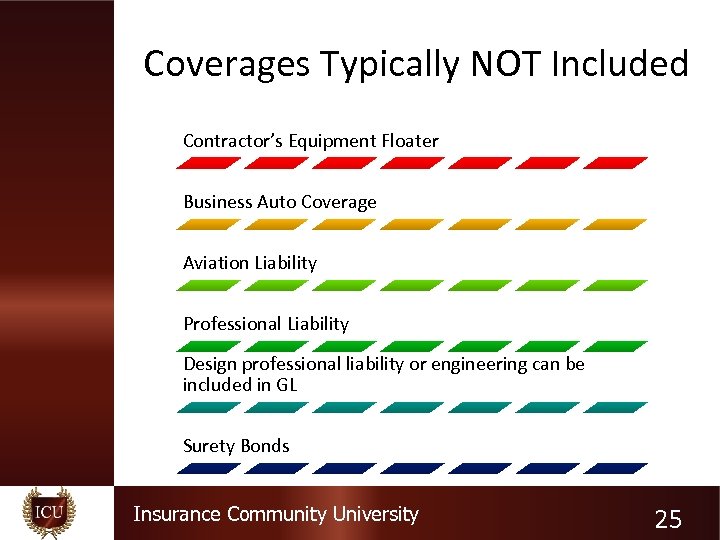 Coverages Typically NOT Included Contractor’s Equipment Floater Business Auto Coverage Aviation Liability Professional Liability Design professional liability or engineering can be included in GL Surety Bonds Insurance Community University 25
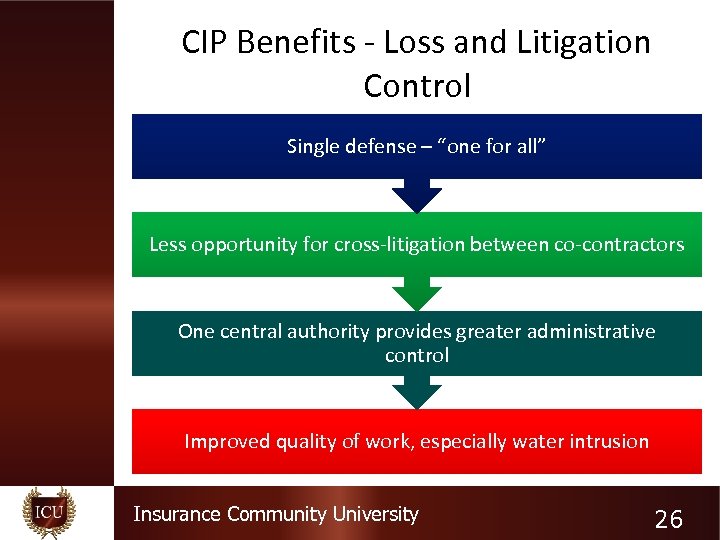 CIP Benefits - Loss and Litigation Control Single defense – “one for all” Less opportunity for cross-litigation between co-contractors One central authority provides greater administrative control Improved quality of work, especially water intrusion Insurance Community University 26
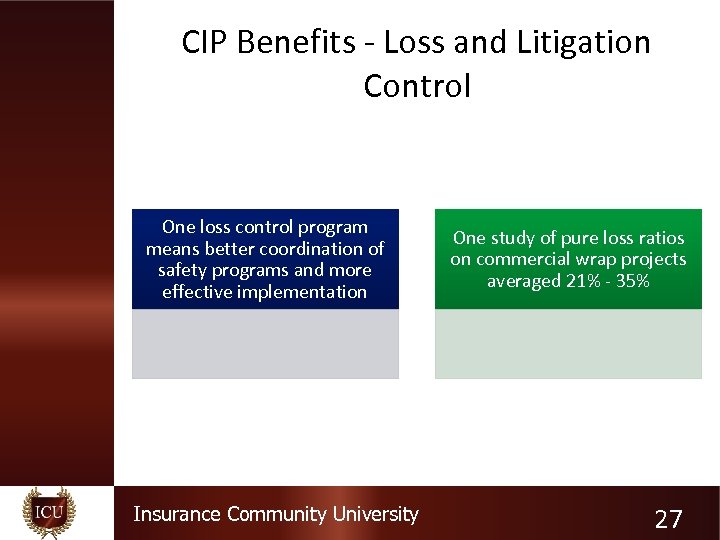 CIP Benefits - Loss and Litigation Control One loss control program means better coordination of safety programs and more effective implementation Insurance Community University One study of pure loss ratios on commercial wrap projects averaged 21% - 35% 27
 CIP Benefits - Loss and Litigation Control • Bridges, tunnels, dams construction may yield a higher savings margin • One of the more difficult areas to predict are the cost savings of reduced on the job injuries Insurance Community University 28
 CIP Benefits - Loss and Litigation Control • Dividend and cost-sharing plans predict expected losses and IBNR – Final adjustment several months after the close of the project • The project owner can lose even more monetary advantage if having to pay substantial portions of the WC premium up front • The time value of money is diluted with a long adjustment time Insurance Community University 29
 CIP Benefits to Project Owner • Lower construction costs • Reduced cost of multiple policies for contractor and subs • Reduced cost of losses • Proper loss control reduces application of deductibles or retentions • Exposures limited to location or project; not collective for all work Insurance Community University 30
 CIP Benefits to Project Owner • Better buying power with insurance companies to – Negotiate lower premiums – Negotiate fewer exclusions and more favorable policy wording • Periodic payment of premiums provides for better cash flow Insurance Community University 31
 CIP Benefits to Project Owner • Elimination of multiple managerial / administrative supervisors • Better coordination of loss control, safety and security, record keeping • Coverage availability in the insurance market - especially residential Insurance Community University 32
 CIP Benefits to Project Owner • May provide insurance otherwise unavailable • On large Wraps, usually written as profit sharing plans Insurance Community University 33
 CIP Benefits to GC • Same benefits as above as a CCIP • Potentially higher limits of insurance • Potentially broader coverage for a specific contract • Contractor’s own insurance program is protected from losses • Reduced employee injury due to loss control and safety measures Insurance Community University 34
 Disadvantages of Using a Wrap • Payroll auditing procedures create additional work and costs to Owner • Participation disrupts GC’s insurance programs • Diminishes bargaining power with own insurance company over rates and coverages • Can create gaps in coverage when project is over Insurance Community University 35
 Disadvantages to Sub Contractors • Complicated insurance procedures and specialized wording • No one is protecting Sub’s interests in the project • Separate Payroll and auditing procedures create additional work and administrative costs Insurance Community University 36
 Disadvantages to Sub Contractors • Participation disrupts Sub’s insurance program • Shrinks payroll and receipts with own insurance company • Can increase rates and result in less coverage Insurance Community University 37
 Disadvantages to Sub Contractors • Minimum & deposit or flat rate premiums • Experience Modification can be affected if reports are not made separately and timely • Injury to Sub’s employee will still affect their own loss ratio • Sub has no control over claim – payments, response or problems Insurance Community University 38
 Disadvantages to Sub Contractors • Sub’s broker does work with no compensation • Loss of control • Charge back premium for Workers’ Compensation costs may be at a higher amount if Sub has a low Ex. Mod Insurance Community University 39
 Administration • Causes increased paperwork and expense • Sub’s broker does work relating to wrap quote, analysis, coverage, insurance, and administration—all with no compensation Insurance Community University 40
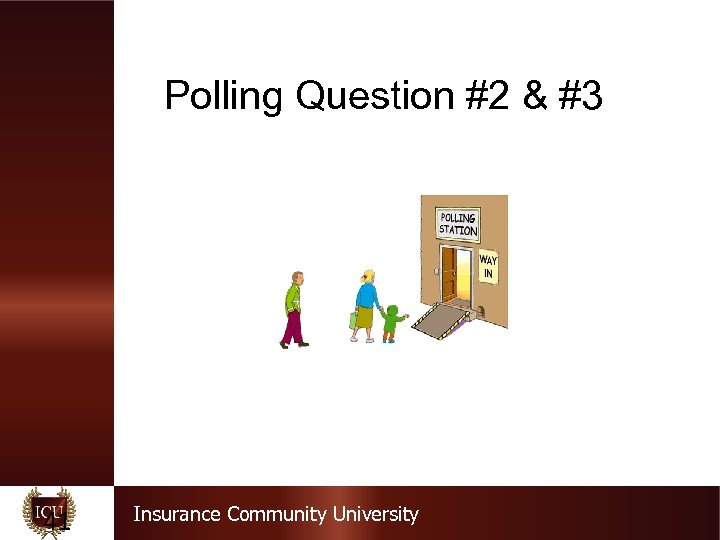 Polling Question #2 & #3 41 Insurance Community University
 Administration • Fee based service • Precise description in all CIP documents, including off-site locations used for jobrelated activities (directly & exclusively related to work to be performed at the project) Insurance Community University 42
 Administration • Contract and bid documents – CIP must be fully designed before the bid requests are distributed • If the Project is controlled by the Project Owner is the GC allowed a copy of the CIP contract? (AB 2738 in California) • Are Subs allowed a copy of the CIP contract? (AB 2738 requires as of 1. 1. 2009) Insurance Community University 43
 Owner, Developer, GC, & Administrator Exposures • Procedural & Substantive – Devising, controlling, placing, and administering wrap & insurance coverages • Responsibility for uninsured events – Uninsurable losses – Insurance policy exclusions Insurance Community University 44
 Owner, Developer, GC, & Administrator Exposures • Responsibility for safety and claims reporting • Compulsory participation usually required unless proof of acceptable Insurance provided by Sub • Enrollment issues—best to provide Broad Named Insured language for “all eligible participants” to avoid unenrolled Contractor exposure Insurance Community University 45
 Owner, Developer, GC, & Administrator Exposures • Denial of representation • Fraud - “illusory coverage” – Excess coverage, not primary – Inadequate completed ops time period – Inadequate limits for project(s) – Coverage exclusions – Company specific forms – There is NO Standard Wrap Policy! Insurance Community University 46
 Owner, Developer, GC, & Administrator Exposures • Wraps have little or no case law or statutory clarity in some states • Will courts expose GL coverage to uncovered ‘wrap’ damages for construction defect? • Disclosure, disclaimer, and indemnification from CIP Insurance Community University 47
 CIP Contract Provisions • Typical Binding Contract Provisions • Contract stipulations (cooperation clauses) that all contractors and subs will cooperate with CIP requirements • Compliance with safety standards, including materials, equipment and methods of construction Insurance Community University 48
 CIP Contract Provisions • Compliance with loss control • Compliance with minimum safety standards • Reporting necessary payroll, loss and other information Insurance Community University 49
 CIP Contract Provisions • Indemnification of owner and project manager for injuries to employees • Does not eliminate tort liability from owner/manager • Sends coverage back to CGL via actionover Insurance Community University 50
 CIP Contract Provisions • Indemnification for other losses of CIP participants • Additional Insured status – Parties to be provided that status – 2013 ISO forms are Only to the extent allowed by law, and – Only to the extent required by written Contract or agreement Insurance Community University 51
 CIP Contract Provisions • Participants in CIP usually relinquish any claim to dividends, retro refunds, profit sharing or any other form of refund, credit or audit reduction • All such monies to remain with project controller (AB 2738 in California does not allow profit from Wrap Insurance program) Insurance Community University 52
 Typical Binding Contract Provisions • Party responsible for all uninsured property losses (AB 2738 not allow for residential wraps) – Often placed on the Subs – Negligent acts by Sub or Sub-sub – Intentional acts – Regardless of cause Insurance Community University 53
 Necessary To Purchase Builder’s Risk Coverage • Why necessary? – No PD liability with Wrap covering all contractors • Limit • Deductible • Waiver of subrogation to be included for all Builder’s Risk policy loss payments, which will be paid to project manager Insurance Community University 54
 Polling Question #4 55 Insurance Community University
 Indemnification Agreement • Requirements for one party to pay costs for another party’s liability • Parties affected by the Indemnity language – Owner / Developer – Architect / Engineer – GC / Subs / Sub-Subs – Suppliers Insurance Community University 56
 Indemnification Agreement • Broad indemnity? – For whom? – Regardless of fault? – How broad? Insurance Community University 57
 Indemnification Agreement • Can be for all tort liability except sole or willful (varies by state) • Statutory law can differ between commercial projects and residential projects (dramatically so in California) • Does the contract specify costs to be paid? Insurance Community University 58
 Indemnification Agreement • Does the contract specify a maximum dollar amount? • Does the contract specify a time limit? • How long does indemnification last? • Can it extend beyond the contract term? Insurance Community University 59
 Indemnification Agreement • Is the Insurance language compliant with state statutory and case law • The contract will contain language, typically toward the back of the agreement, that will indicate the state that will have jurisdiction over the contract • Attorney specializing in wraps needs to provide opinion Insurance Community University 60
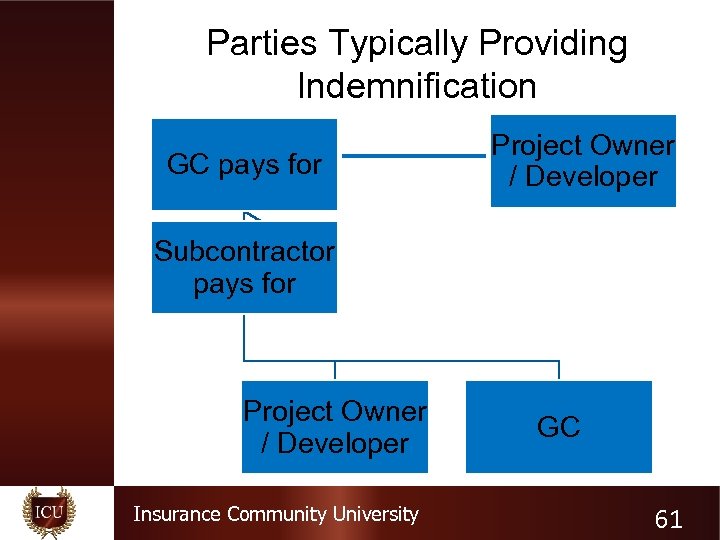 Parties Typically Providing Indemnification GC pays for Project Owner / Developer Subcontractor pays for Project Owner / Developer Insurance Community University GC 61
 Indemnity • For sub’s own work, or others, i. e. Builder & other subs? • Active or passive or both – Active—what you did that caused the harm – Passive—What you did not do, but should have, that caused the harm • Active and passive only of Sub, or • Active and/or Passive of GC, Owner, and other Subs? Insurance Community University • 62
 Basic Indemnity Concepts and Types of Indemnity Agreements • Broad – The Sub agrees to indemnify the GC for all liability, including that caused solely by GC. • Intermediate – The Sub agrees to indemnify the GC for all liability, except those caused solely by GC. • Limited – The Sub agrees to indemnify the GC only for acts of the Sub Insurance Community University 63
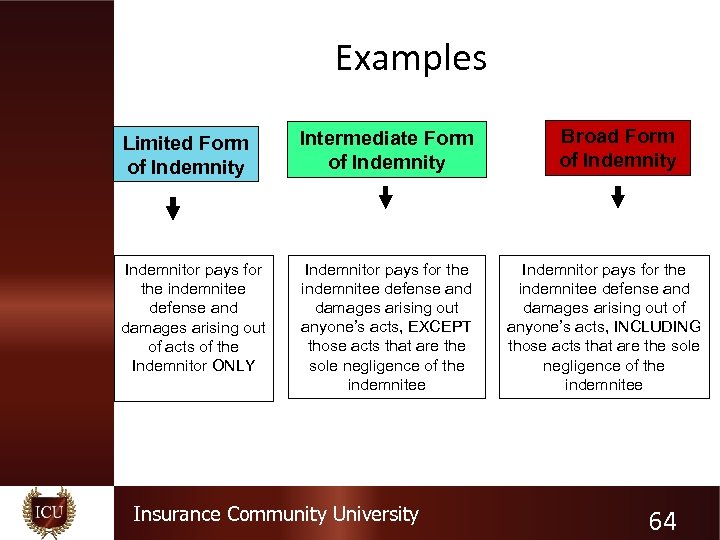 Examples Limited Form of Indemnity Intermediate Form of Indemnity Indemnitor pays for the indemnitee defense and damages arising out of acts of the Indemnitor ONLY Indemnitor pays for the indemnitee defense and damages arising out anyone’s acts, EXCEPT those acts that are the sole negligence of the indemnitee Insurance Community University Broad Form of Indemnity Indemnitor pays for the indemnitee defense and damages arising out of anyone’s acts, INCLUDING those acts that are the sole negligence of the indemnitee 64
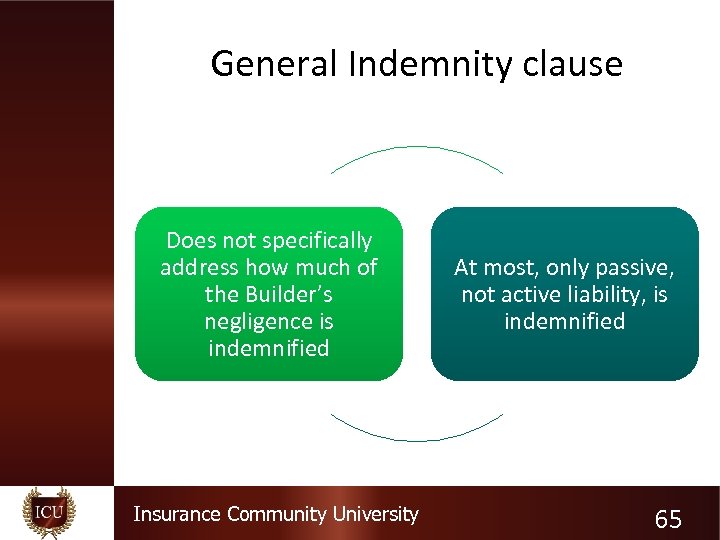 General Indemnity clause Does not specifically address how much of the Builder’s negligence is indemnified Insurance Community University At most, only passive, not active liability, is indemnified 65
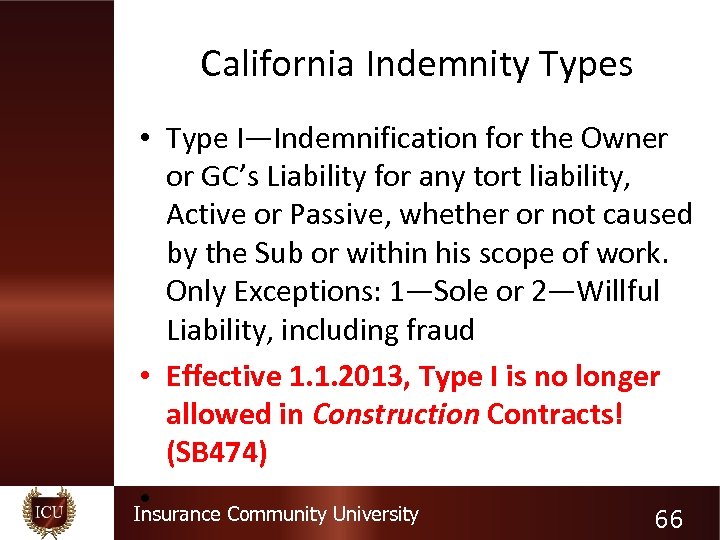 California Indemnity Types • Type I—Indemnification for the Owner or GC’s Liability for any tort liability, Active or Passive, whether or not caused by the Sub or within his scope of work. Only Exceptions: 1—Sole or 2—Willful Liability, including fraud • Effective 1. 1. 2013, Type I is no longer allowed in Construction Contracts! (SB 474) • Insurance Community University 66
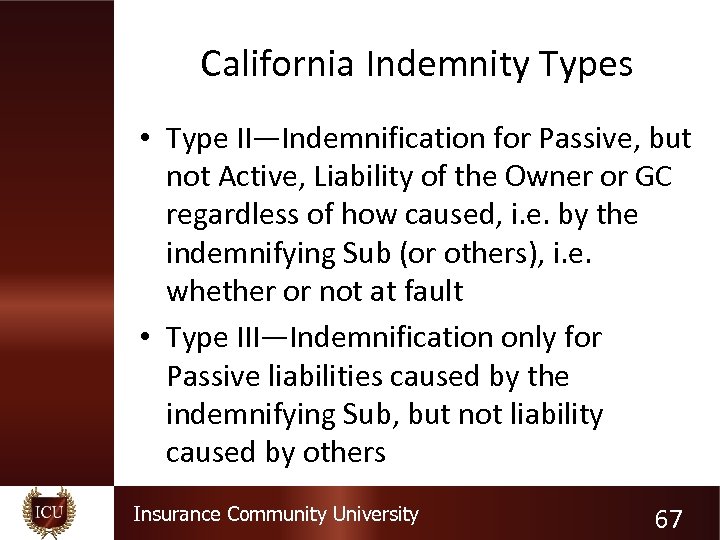 California Indemnity Types • Type II—Indemnification for Passive, but not Active, Liability of the Owner or GC regardless of how caused, i. e. by the indemnifying Sub (or others), i. e. whether or not at fault • Type III—Indemnification only for Passive liabilities caused by the indemnifying Sub, but not liability caused by others Insurance Community University 67
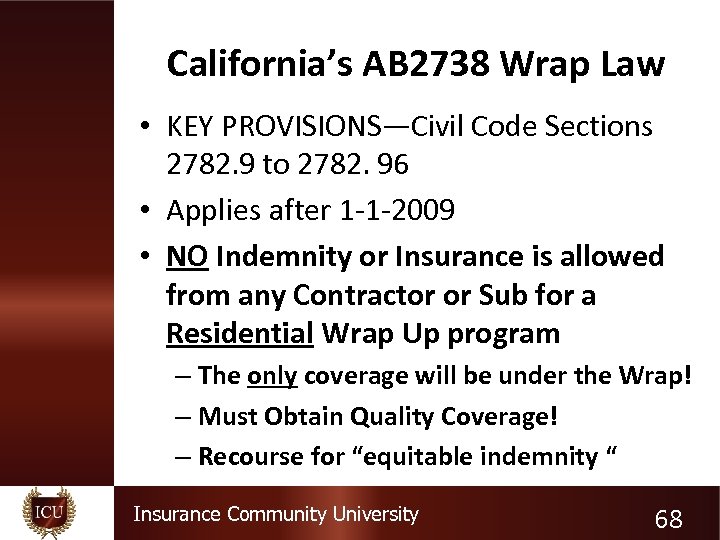 California’s AB 2738 Wrap Law • KEY PROVISIONS—Civil Code Sections 2782. 9 to 2782. 96 • Applies after 1 -1 -2009 • NO Indemnity or Insurance is allowed from any Contractor or Sub for a Residential Wrap Up program – The only coverage will be under the Wrap! – Must Obtain Quality Coverage! – Recourse for “equitable indemnity “ Insurance Community University 68
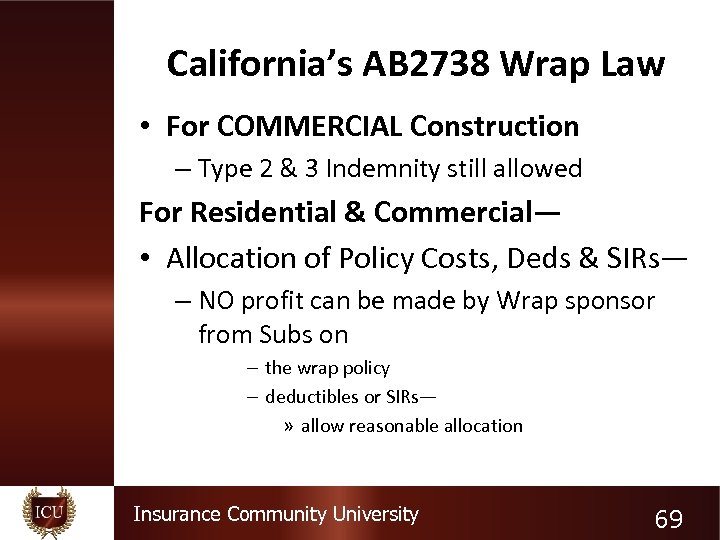 California’s AB 2738 Wrap Law • For COMMERCIAL Construction – Type 2 & 3 Indemnity still allowed For Residential & Commercial— • Allocation of Policy Costs, Deds & SIRs— – NO profit can be made by Wrap sponsor from Subs on – the wrap policy – deductibles or SIRs— » allow reasonable allocation Insurance Community University 69
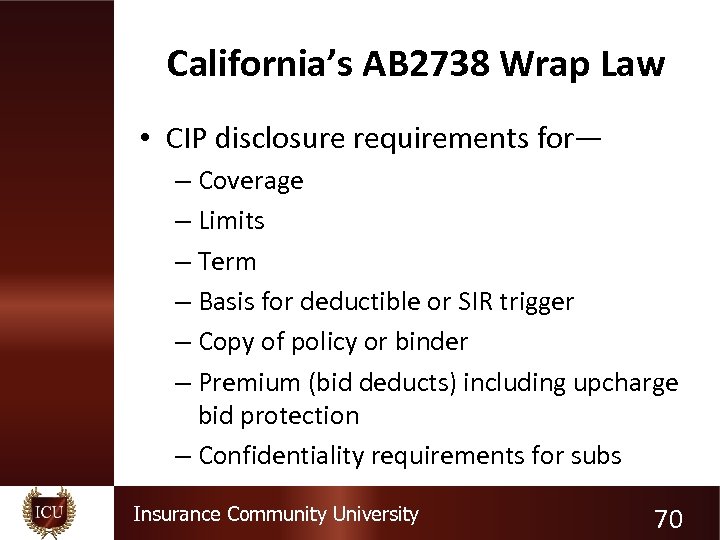 California’s AB 2738 Wrap Law • CIP disclosure requirements for— – Coverage – Limits – Term – Basis for deductible or SIR trigger – Copy of policy or binder – Premium (bid deducts) including upcharge bid protection – Confidentiality requirements for subs Insurance Community University 70
 California’s AB 2738 Wrap Law • The CIP contract must be reviewed for proper language • Work with experienced Wrap Attorney and TPA Insurance Community University 71
 Polling Question #5 72 Insurance Community University
 Liability Standard • Negligence or strict liability • Developer = Strict (only need to prove causation of damage, not negligence) • Subs = Negligence (must prove breach of prudent person standard resulting in damage) – When the Sub Indemnifies Developer, what happens to the Sub’s liability standard? – Must the sub be negligent to require indemnification of the GC? Insurance Community University 73
 Liability Indemnity Coverage • Sub’s coverage for indemnity agreements – No Contractual Liability coverage under own CGL due to Wrap exclusion – CIP won’t cover Contractual Liability of the Subs Insurance Community University 74
 Bid Process • Bids usually separate insurance costs from costs, labor and profit • Referred to as a “Credit” or “Bid Deduct” on insurance Insurance Community University 75
 Bid Process • Determining the charge • The CIP documents should specify method – Standard amount for all Subs, or – Tiered cost by class, or – Based on Sub’s own cost under their CGL or – Another disclosed method – If not, make provision for upcharge outside California Insurance Community University 76
 Bid Process • Do bid specs reserve right to do as a CIP, but quote as regular job? – Used to avoid “padding” of bid • Is there a copy of the coverages available for the contractor (or Subs) to review and retain for their records? – If not, make provision for withdrawal conditions with no penalty for unacceptable coverage outside California Insurance Community University 77
 Bid Process • Is there a disclaimer and indemnification relating to your independent review and approval of coverages and/or program Insurance Community University 78
 Coverage Issues Affect Owner, GC and Sub Insurance Community University 79
 Coverage Issues • There is no standard wrap policy, although most use a standard ISO CGL as its nucleus – Caution! Some do not, and are completely manuscripted • The General Liability section can be broader in coverage than standard forms, particularly with commercial projects Insurance Community University 80
 Coverage Issues • The General Liability section can be more restrictive than standard forms, sometimes for commercial, but especially when writing for a residential project • The Workers’ Compensation portion typically follows statutory benefits and provides Employer’s Liability coverage Insurance Community University 81
 Coverage Issues - Project Owner • A structure that will be sold upon completion creates potential problems for the owner • The CIP General Liability program is intended to be the only coverage that responds to present and future losses brought by new owner, occupants, or other third parties Insurance Community University 82
 Coverage Issues - Project Owner • Any damage to the property while it is under construction is excluded from the CGL – Must be covered by a properly designed Builder’s Risk policy, which may (should) be included in the CIP coverage portfolio – The agent/broker for the Project Owner must review coverage requirements in the construction agreement to verify proper language has been included Insurance Community University 83
 Coverage Issues – Builder’s Risk • The agent/broker must also review the Builder’s Risk policy, regardless of the party required to provide the policy • The Builder’s Risk coverage ends when the project is completed according to the terms of the Builder’s Risk policy and so will be of no help for loss to the project after construction is complete Insurance Community University 84
 Coverage Issues – Builder’s Risk • The agent/broker for the GC must review coverage requirements in the construction agreement to verify proper language has been included • The agent/broker for the Sub must review coverage requirements in the construction agreement to verify proper language has been included Insurance Community University 85
 Coverage Issues – Builder’s Risk • The construction agreement should state clearly that the Builder’s Risk policy will be the sole source of remedy for loss or damage to the project while under construction • The Project Owner will bear any loss not covered as well as the deductible Insurance Community University 86
 Coverage Issues – Builder’s Risk • If the construction agreement attempts to pro-rate the payment of deductible among the GC and Subs, then the contract does not contain a true exculpatory agreement • Note that in many jurisdictions a party cannot waive rights against another party when the loss is caused by intentional acts Insurance Community University 87
 Integration of CIP and Contractor’s Insurance Program • CG 21 54 01 96 – Designated Operations Covered By A Consolidated Insurance Program – Standard ISO exclusion of work done under a wrap – The standard exclusion does NOT remove coverage for all operations, but rather those that are included in the wrap coverage Insurance Community University 88
 Integration of CIP and Contractor’s Insurance Program • The language used in the endorsement is less than clear and could be subject to differing interpretations • Other company specific endorsements can be less or more restrictive • Manuscript Contingent endorsement on CGL should exclude “insured losses” only (not work) and apply on excess policy basis Insurance Community University 89
 Coordination of Liability Coverages • Can add off site locations to wrap policy as covered location • Any damage to the property while it is under construction is excluded from the CGL – Solution? Insurance Community University 90
 Completed Operations Coverage under the Wrap Up • Since there are no renewals, Wrap policy must cover into the future • How long? – Check individual state statute as they all vary – California 10 years is not enough for residential • SB 800 definitions extend time (Residential only) – Escrow, not date of substantial completion – Turn over of ownership to HOA from Developer Insurance Community University 91
 Coordination of Liability Coverages • Contractual liability coverage – Usually NO coverage on CIP • Are some requirements met by Wrap? By sub’s CGL? Or neither? – Indemnity coverage from “insured contract” coverage typically removed from the CIP – Coverage provided in the general’s or sub’s policy, but not for Wrap due to exclusion Insurance Community University 92
 Coordination of Liability Coverages • “Insured contract” definition in CGL – “That part of any other contract or agreement pertaining to your business under which you assume the tort liability of another party to pay for "bodily injury" or "property damage" to a third person or organization” Insurance Community University 93
 Coordination of Liability Coverages • CG 24 26 07 04 Amendment of Insured Contract Definition adds: – “…provided the “bodily injury” or “property damage” is caused, in whole or in part, by you or those acting on your behalf”. Insurance Community University 94
 Off Site Coverage • CIP will usually not include the coverage, nor the GC or Sub’s General Liability (Wrap exclusion) • Events away from, but connected to site • Manufactured, partially assembled, or fabricated off site, then installed on site i. e. windows, concrete, mechanical, cabinets, walls, framing, plumbing, etc. • Products, assembly, fabrication, etc. —any “work” • Property in transit (suppliers, vendor, & dealers who furnish materials) • Add off site locations to wrap policy Insurance Community University 95
 Coordination of Liability Coverages • Additional Coverage Limitations • CG 22 94 & CG 22 95 remove exception to “your work” exclusion; translation = no coverage for GC for Subs work • For GC everything is “your work” and would be excluded • On sub’s policy GC would be additional insured for coverage, but is not due to Wrap exclusion Insurance Community University 96
 Additional Liability Coverage Concerns Insurance Community University 97
 Adequacy of Limits • Number of subs / Size of project • Number of projects and locations • Duration of project and exposure to injury or damage occurrences • Is Sub’s liability capped according to prorata share of coverage or other method • Is excess limits coverage provided under sub’s CGL (Wrap Exclusion) Insurance Community University 98
 Defense Costs • Inside or outside the limit? – Whom does the single defense really cover – Is there a severability of interest clause (separation of insureds) – Defense for each insured – For what issues – Is coverage provided under sub’s CGL (Wrap Exclusion) Insurance Community University 99
 Deductibles / SIRs • • Who pays? Is it allocated? Is it specifically allocated? Is that allowed by state statute? Size of deductible / SIR Standard amount for all Subs, or Based on Sub’s own deductible under their CGL, or Insurance Community University 100
 Deductibles / SIRs • Deductible per Occurrence, Claim, Unit, or Component, or • Tiered deductible by class • If multiple deductibles are allowed under the wrap; how many – 50 subs times $10, 000 equals $500, 000 • Are deductibles assigned with out fault or is a connection to the sub’s negligence or scope of work required? Insurance Community University 101
 Severability of Interest Clause • A provision that each insured will be treated as if separately covered under the policy—defense and coverage • Coverage included in standard CGL, but often not on wraps • Potential liability between different entities named on a single policy—Is there a Cross liability exclusion? Insurance Community University 102
 Builder’s Risk • This policy is the solution for damage to the structure and non-attached materials and supplies ONLY during construction • Must subs and suppliers be named individually —danger if omitted – – Whose property is it? When? What coverage applies Is there a need for Installation Floater If Builder’s Risk covers all, avoids “ 1 st party liability” issues Insurance Community University 103
 Additional Liability Lines • Automobile liability – Limit sub coverage to on-site only and provide excess over other valid and collectible insurance • Aircraft Liability – Non-owned is an exposure to be considered if used to assist in construction – Indemnification agreements from aircraft owner – Additional Insured – Non-owner aviation coverage, excess Insurance Community University 104
 Additional Liability Lines • Umbrella/Excess Policy issues – Exclusions, terms, and conditions can vary from underlying and leave gaps – All of the issues above need to be considered for the Excess Policy (ies) Insurance Community University 105
 Excess Liability Endorsement Language (Over the CIP Insurance) • With respect to “bodily injury”, “property damage”, “personal or advertising injury”, arising out of either your ongoing operations or operations included within the “productscompleted operations hazard” at the location described in the Schedule of this endorsement, the policy to which this endorsement is attached shall apply as excess insurance over any coverage available under a consolidated (wrap-up) insurance program. Insurance Community University 106
 Excess Liability Endorsement Language (Over the CIP Insurance) • This language would need to be negotiated on the contractor’s insurance program from the time of the wrap-up forward. Insurance Community University 107
 READ THE CIP CONTRACT AND ALL DOCUMENTS! • Review the contract requirements – Who do they apply to? – What do they apply to? – When do they apply? – How do they apply? • Indemnification • Insurance Community University 108
 READ THE CIP CONTRACT AND ALL DOCUMENTS! • Does the insurance match the contract requirements? – The wrap coverages – The insured’s own policies • Synchronize as much as possible the contract requirements with insurance Insurance Community University 109
 READ THE CIP CONTRACT AND ALL DOCUMENTS! • Insured could be responsible for substantial money out of their own pocket • Negotiate – Contractors, especially Subs, do not know whether or not they have any power until they try Insurance Community University 110
 READ THE CIP CONTRACT AND ALL DOCUMENTS! • Have Risk Manager, Agent or Broker and Legal Counsel with expertise in specific area of Wrap ups, contracts, coverage, and risk review and approve for your specific circumstances. Insurance Community University 111
 Attendance Check!! Insurance Community University 112
 Summary • Challenging coverage/risk area • You can try your best and still get it wrong – Get a mentor • Read everything • Analyze everything • Keep your fingers crossed (for at least the time of the statute of repose) Insurance Community University 113
 Upcoming Classes Upcoming University/Paid CE FREE to University Members Classes $50. 00/charge for non university members 7/24 and 25 Errors and Omissions 7/30 Personal Auto Policy Problems & Solutions 8/8 Insight on Product Liability and Products Recall Upcoming Community Classes FREE to University Members $25. 00/charge for non university members 8/6 PEO and What You Need to Know Join the University TODAY. www. insurancecommunitycenter. com Click Join University at the top of the bar Insurance Community University 114