


 Скачать презентацию Oceans Portal Workshop Oceans March Project 30 th
725ea530ca12dfba918b5c1586632ca4.ppt
- Количество слайдов: 17
 Oceans Portal Workshop Oceans March Project 30 th Portal 2004 Ocean Biodiversity Informatics Conference Healthy oceans: cared for, understood and used wisely for the benefit of all, now. November 2004 Hamburg, 29 - 1 and in the future healthy oceans: cared for, understood and use wisely for the benefit of all, now and in the future healthy Kim Finney C. I. O. National Oceans Office
 Outline • Australia’s Oceans Policy & Regional Marine Planning • Why initiate An Oceans Portal Project ? • Key Ingredients For Success • Implementation
 Australia’s Oceans Policy • • • Launched December 1998 Maintenance of healthy and productive ecosystems Science-based planning and management Precautionary Economic, environmental, social and cultural aspirations accommodated through integrated planning and management “Healthy oceans: cared for, understood and used wisely for the benefit of all, now and in the future”
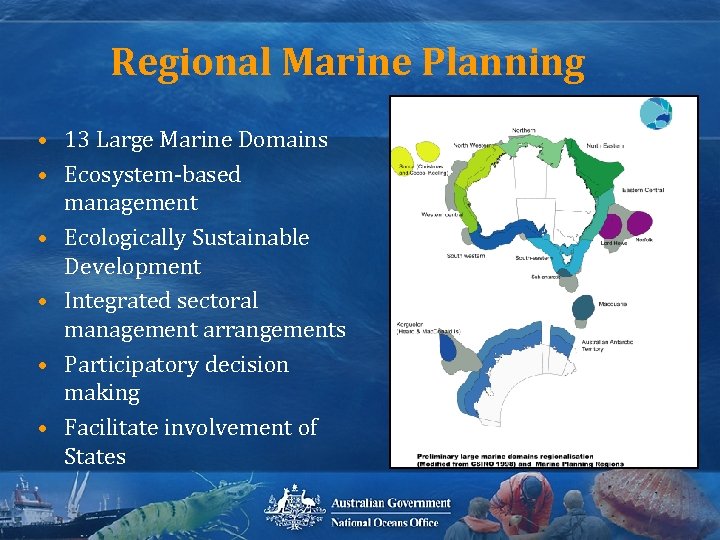 Regional Marine Planning • 13 Large Marine Domains • Ecosystem-based management • Ecologically Sustainable Development • Integrated sectoral management arrangements • Participatory decision making • Facilitate involvement of States
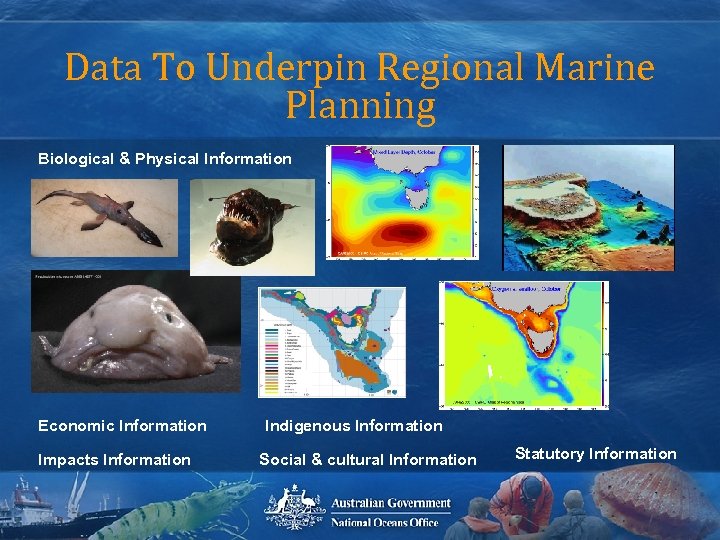 Data To Underpin Regional Marine Planning Biological & Physical Information Economic Information Impacts Information Indigenous Information Social & cultural Information Statutory Information
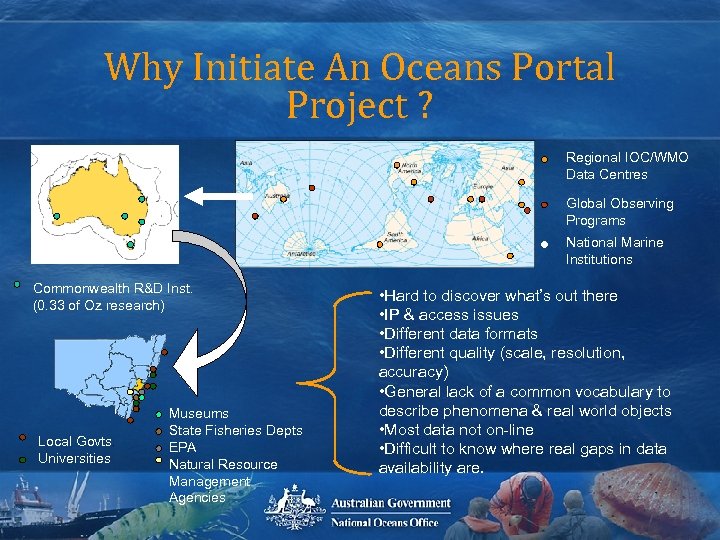 Why Initiate An Oceans Portal Project ? Regional IOC/WMO Data Centres Global Observing Programs National Marine Institutions Commonwealth R&D Inst. (0. 33 of Oz research) Local Govts. Universities Museums State Fisheries Depts EPA Natural Resource Management Agencies • Hard to discover what’s out there • IP & access issues • Different data formats • Different quality (scale, resolution, accuracy) • General lack of a common vocabulary to describe phenomena & real world objects • Most data not on-line • Difficult to know where real gaps in data availability are.
 Why Initiate An Oceans Portal Project ? • Given issues – what do we need to achieve and how ? • An immediate improvement in access to those national marine fundamental datasets that are needed to underpin marine management decisions and marine research activities, • A networked platform ripe for scientific exploitation in terms of: · accessing and sharing up-to-date multi-disciplinary data; · deploying tools and models; · communicating and conceptualising using multi-media 2 & 3 D visualisations; · facilitating collaborations across agencies and across scientific disciplines, and · greater leverage of our existing collective IT infrastructure and agency -based capabilities.
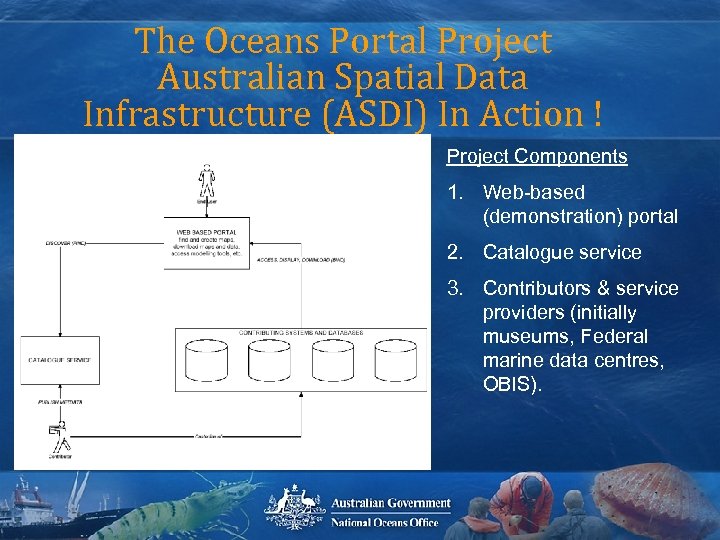 The Oceans Portal Project Australian Spatial Data Infrastructure (ASDI) In Action ! Project Components 1. Web-based (demonstration) portal 2. Catalogue service 3. Contributors & service providers (initially museums, Federal marine data centres, OBIS).
 Key Ingredients For Success • • Community of interest Agency-level support Funding Governance Arrangements Architecture Standards/protocols Content (semantic interoperability)
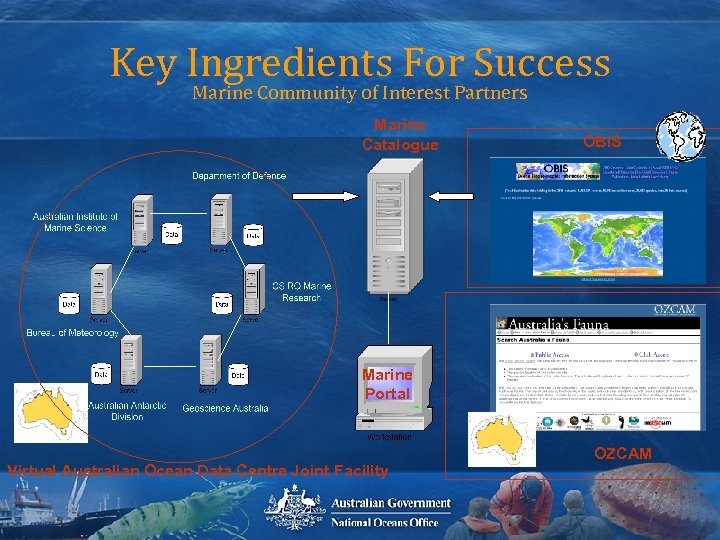 Key Ingredients For Success Marine Community of Interest Partners Marine Catalogue OBIS Marine Portal Virtual Australian Ocean Data Centre Joint Facility OZCAM
 Key Ingredients For Success Agency-level Support & Funding • Lobbying agency heads – high level support • Oceans Policy Science Advisory Group – answers to a Ministerial Board • Workshops, agency visits, presentations, established project advisory group, • NOO – built Project into first RMP as a key deliverable • Core funding from NOO – conditional on in-kind support from agencies • Implementation Plan – sign-off at agency head level
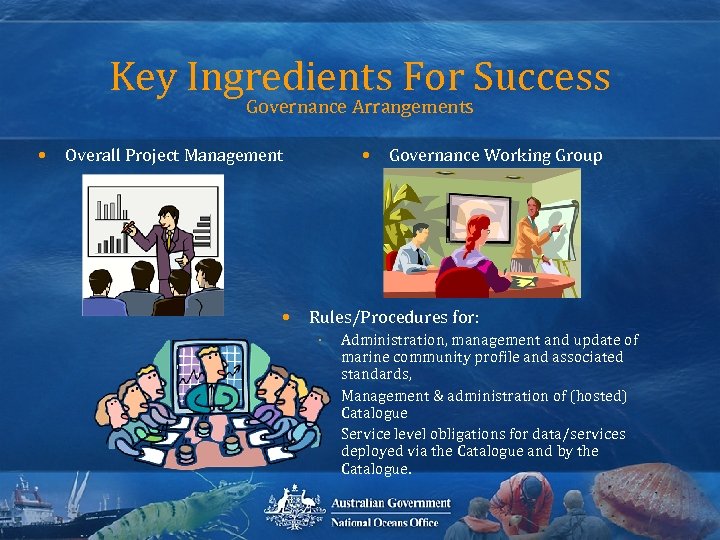 Key Ingredients For Success Governance Arrangements • • Overall Project Management • Governance Working Group Rules/Procedures for: · · · Administration, management and update of marine community profile and associated standards, Management & administration of (hosted) Catalogue Service level obligations for data/services deployed via the Catalogue and by the Catalogue.
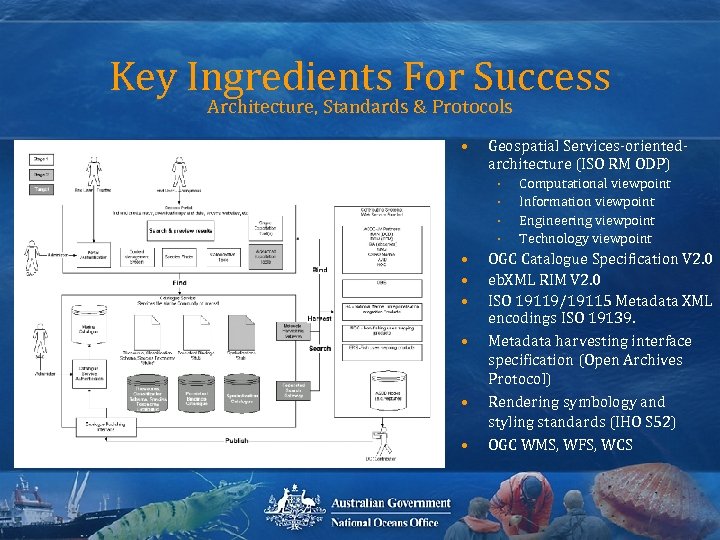 Key Ingredients For Success Architecture, Standards & Protocols • Geospatial Services-orientedarchitecture (ISO RM ODP) · · • • • Computational viewpoint Information viewpoint Engineering viewpoint Technology viewpoint OGC Catalogue Specification V 2. 0 eb. XML RIM V 2. 0 ISO 19119/19115 Metadata XML encodings ISO 19139. Metadata harvesting interface specification (Open Archives Protocol) Rendering symbology and styling standards (IHO S 52) OGC WMS, WFS, WCS
 Key Ingredients For Success Content Semantic Interoperability • Developing a marine community application profile · Metadata model – dataset descriptions and services (not tackling feature types initially). ISO 19115/19119 · Which metadata elements should be core ? · Which code lists should we extend/add ? – marine keywords (GCMD ? ), – thesauri & dictionary of terms (BODC parameter list ? ? ), – species taxonomies (Catalogue of Life or Codes For Australian Aquatic Biota [CAAB] ? ? ), – marine location names (IHO, AAD, GA), • Commence R&D work on marine data modelling, GML application profiles and feature catalogues (Marine XML - NERC Data Grid ? ? – relationship to IOC Feature Type Catalogue ? )
 Implementation • Scoping Report, high level Technical Specification & Implementation Plan already developed, • RFT to be let in December – buy/build Catalogue and Portal (separately deployed) · Evaluation of COTS – shows no truly OGC compliant Catalogue software yet ! • 6 Working Groups have been established: · · · Governance, Symbology/styling Metadata Application Profile Species Finder Service OPENDAP (R&D) Data Modelling/Feature Type Catalogue (R&D) • Catalogue developers to work in tandem with WGs – WGs have kicked off first. • Project Advisory Committee
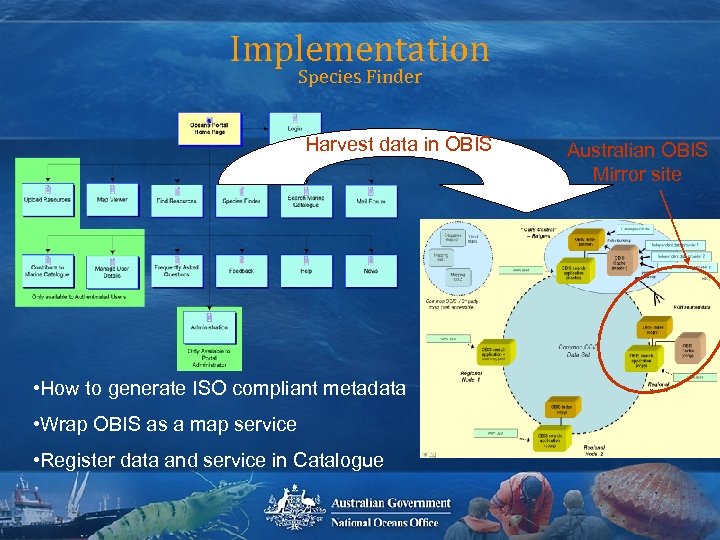 Implementation Species Finder Harvest data in OBIS • How to generate ISO compliant metadata • Wrap OBIS as a map service • Register data and service in Catalogue Australian OBIS Mirror site
 Conclusion • Ambitious project in that it is genuinely a development by a “community of interest”. • Lead the way in developing some key Australian Spatial Data Infrastructure technologies and standards, • Requires national and international collaboration, • Will need to expand partnership once runs are on the board. • Catalogue will be accessible by anyone. • All standards and specifications will be public.