


 Скачать презентацию OCEANOGRAFIA 1 Anno Accademico 2014 -2015 Docente Renzo
a954c4e7ef72534461717286d027e1b5.ppt
- Количество слайдов: 36
 OCEANOGRAFIA 1 Anno Accademico 2014 -2015 Docente: Renzo Mosetti rmosetti@ogs. trieste. it
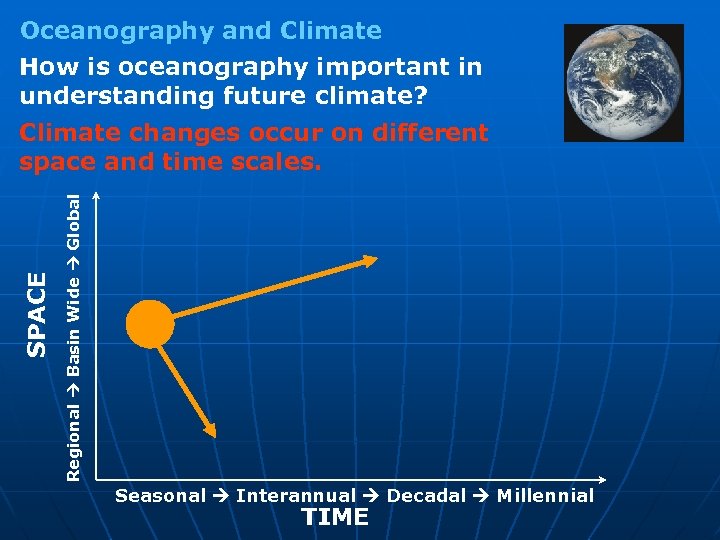 Oceanography and Climate How is oceanography important in understanding future climate? Regional Basin Wide Global SPACE Climate changes occur on different space and time scales. Seasonal Interannual Decadal Millennial TIME
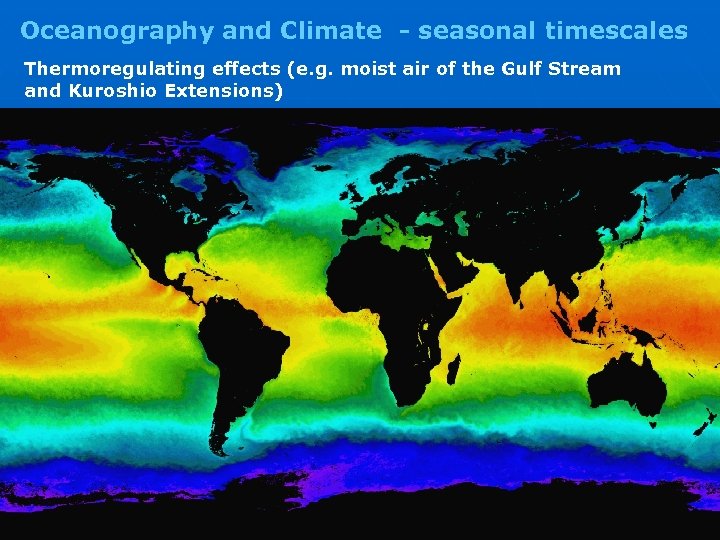 Oceanography and Climate - seasonal timescales Thermoregulating effects (e. g. moist air of the Gulf Stream and Kuroshio Extensions)
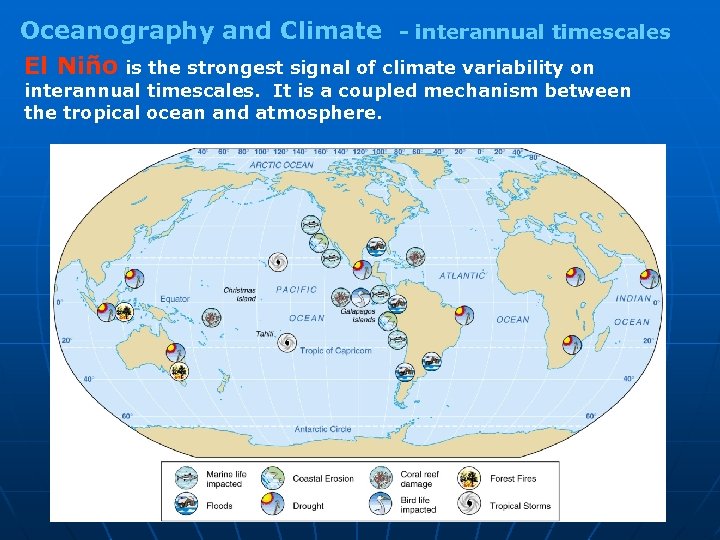 Oceanography and Climate - interannual timescales El Niño is the strongest signal of climate variability on interannual timescales. It is a coupled mechanism between the tropical ocean and atmosphere.
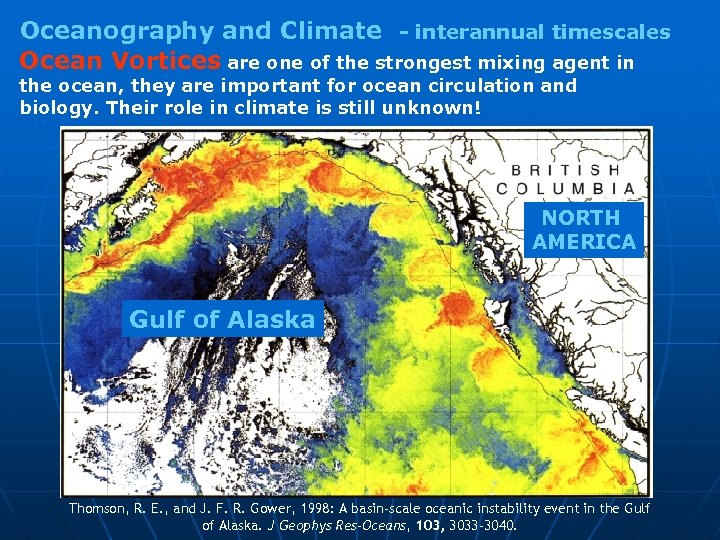 Oceanography and Climate - interannual timescales Ocean Vortices are one of the strongest mixing agent in the ocean, they are important for ocean circulation and biology. Their role in climate is still unknown! NORTH AMERICA Gulf of Alaska Thomson, R. E. , and J. F. R. Gower, 1998: A basin-scale oceanic instability event in the Gulf of Alaska. J Geophys Res-Oceans, 103, 3033 -3040.
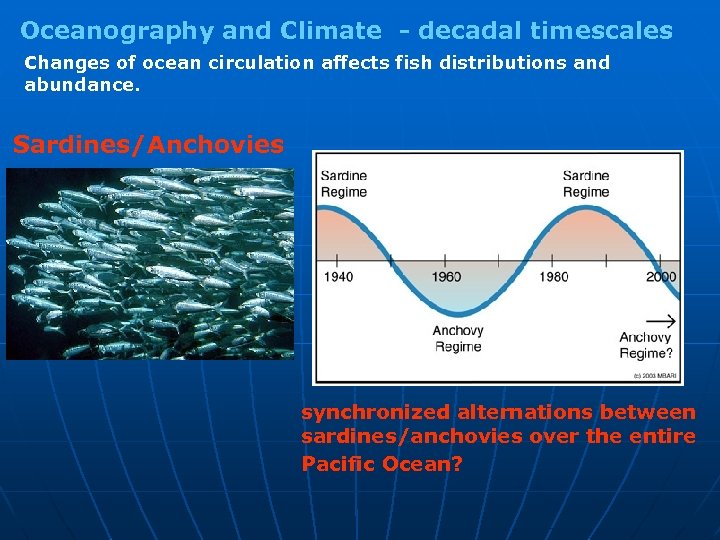 Oceanography and Climate - decadal timescales Changes of ocean circulation affects fish distributions and abundance. Sardines/Anchovies synchronized alternations between sardines/anchovies over the entire Pacific Ocean?
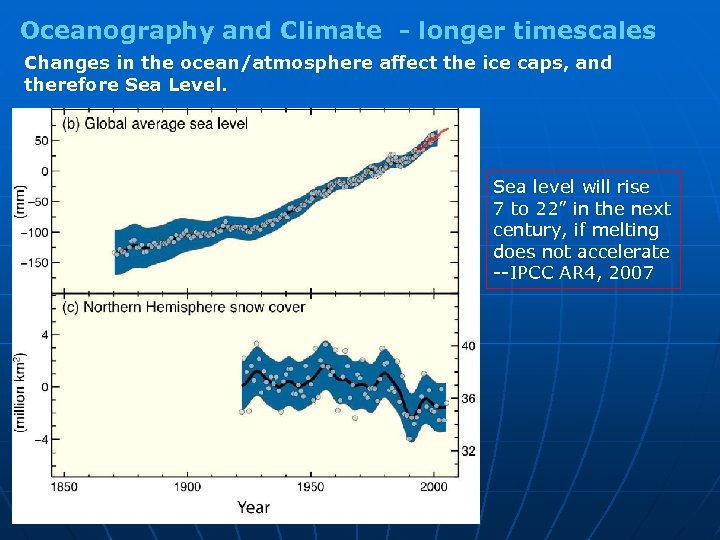 Oceanography and Climate - longer timescales Changes in the ocean/atmosphere affect the ice caps, and therefore Sea Level. Sea level will rise 7 to 22” in the next century, if melting does not accelerate --IPCC AR 4, 2007
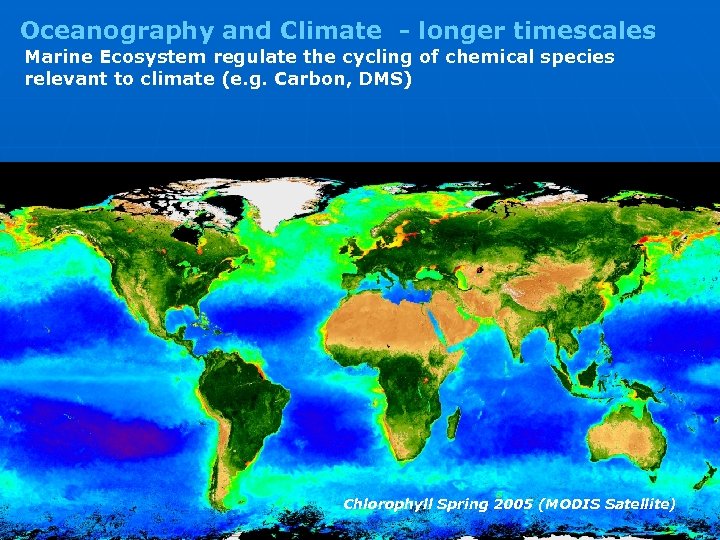 Oceanography and Climate - longer timescales Marine Ecosystem regulate the cycling of chemical species relevant to climate (e. g. Carbon, DMS) Chlorophyll Spring 2005 (MODIS Satellite)
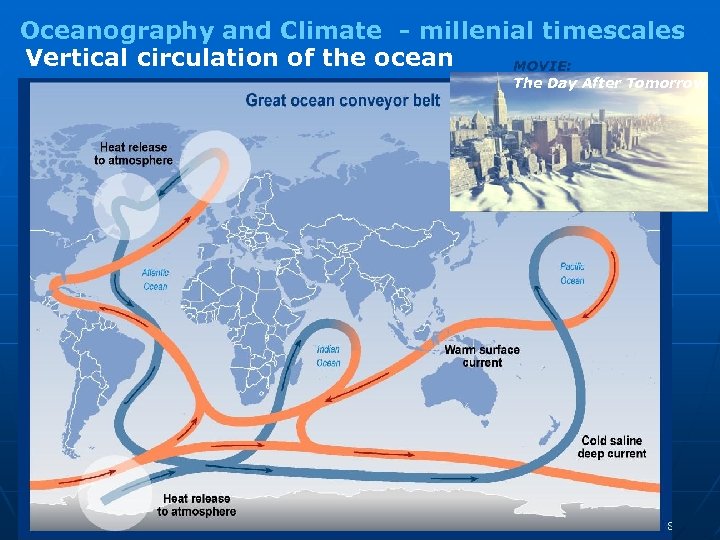 Oceanography and Climate - millenial timescales Vertical circulation of the ocean MOVIE: The Day After Tomorrow
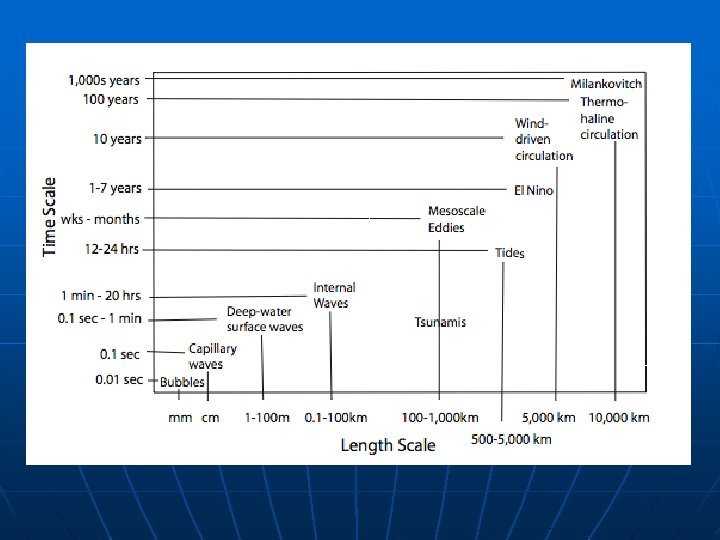 3. Length and time scales
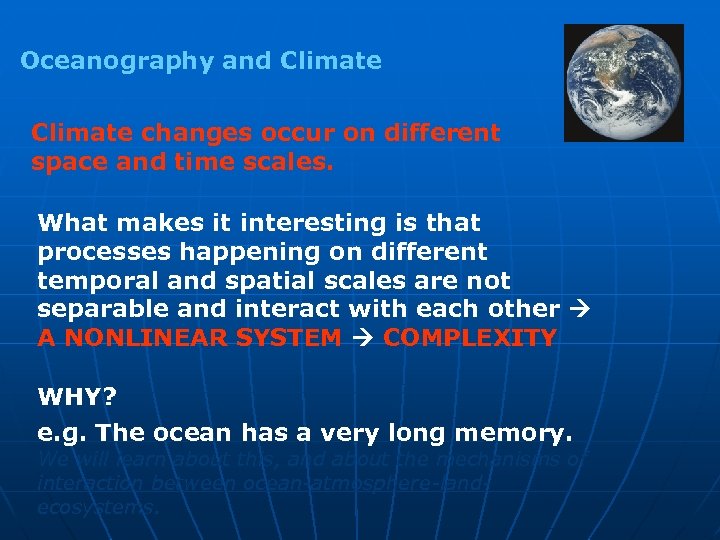 Oceanography and Climate changes occur on different space and time scales. What makes it interesting is that processes happening on different temporal and spatial scales are not separable and interact with each other A NONLINEAR SYSTEM COMPLEXITY WHY? e. g. The ocean has a very long memory. We will learn about this, and about the mechanisms of interaction between ocean-atmosphere-landecosystems.
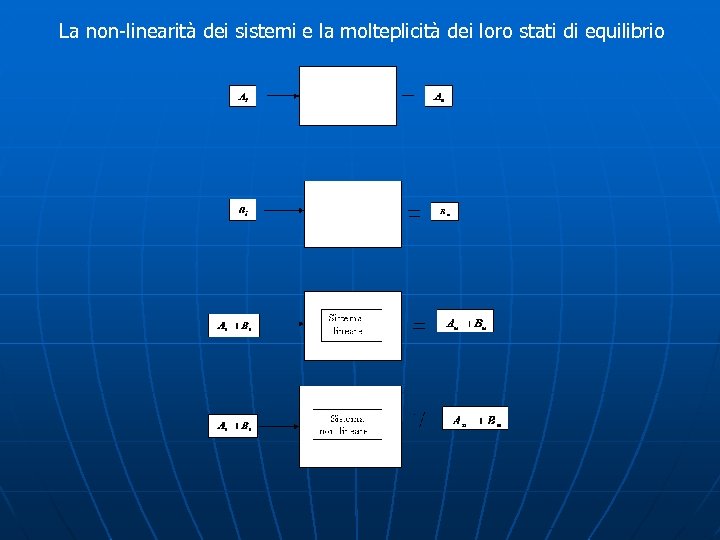 La non-linearità dei sistemi e la molteplicità dei loro stati di equilibrio
 Resources in the Ocean and Economy What aspects of ocean sciences are relevant to the economy? Geological Resources extraction of petroleum, gas, metals, carbon sequestration? , etc. Ecological Resources mainly food from fisheries and maricultures Energy Resources extraction of power from waves, tides, currents and heat content Chemical Resources e. g. development of new drugs, salts, etc. Recreational Resources of coastal areas, e. g. beaches and more Oceanographic studies helped discover these resources and help to manage them (e. g. coastal processes and beaches, and many more…)
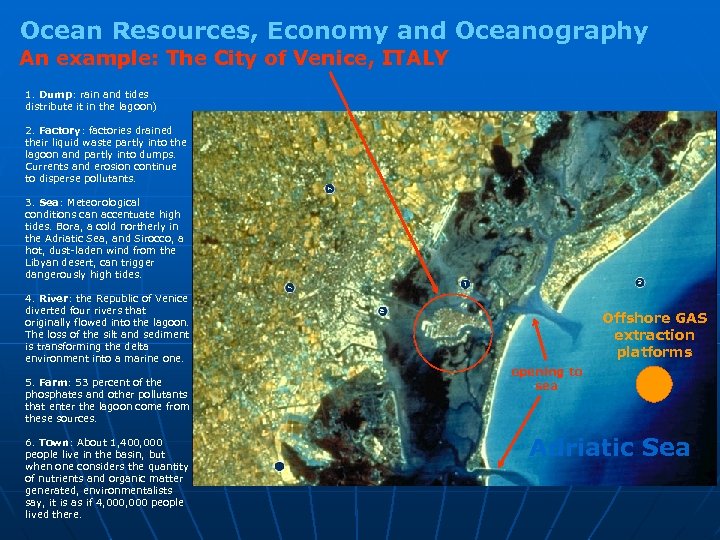 Ocean Resources, Economy and Oceanography An example: The City of Venice, ITALY 1. Dump: rain and tides distribute it in the lagoon) 2. Factory: factories drained their liquid waste partly into the lagoon and partly into dumps. Currents and erosion continue to disperse pollutants. 3. Sea: Meteorological conditions can accentuate high tides. Bora, a cold northerly in the Adriatic Sea, and Sirocco, a hot, dust-laden wind from the Libyan desert, can trigger dangerously high tides. 4. River: the Republic of Venice diverted four rivers that originally flowed into the lagoon. The loss of the silt and sediment is transforming the delta environment into a marine one. 5. Farm: 53 percent of the phosphates and other pollutants that enter the lagoon come from these sources. 6. Town: About 1, 400, 000 people live in the basin, but when one considers the quantity of nutrients and organic matter generated, environmentalists say, it is as if 4, 000 people lived there. Offshore GAS extraction platforms opening to sea Adriatic Sea
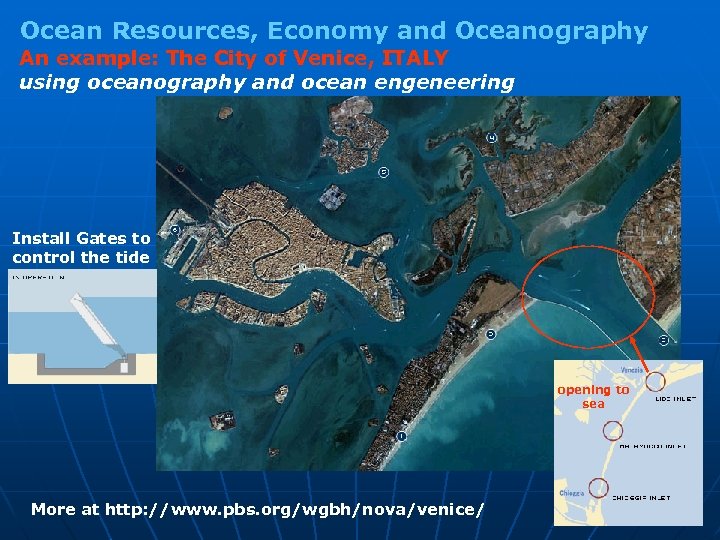 Ocean Resources, Economy and Oceanography An example: The City of Venice, ITALY using oceanography and ocean engeneering Install Gates to control the tide opening to sea Adriatic Sea More at http: //www. pbs. org/wgbh/nova/venice/
 Humans impacts on the Ocean and Climate How can humans impact the ocean and climate? Alterations: chemical (e. g. mercury, aerosols, green house gases, oil) dying corals, poison fish, global warming biological (e. g. introducing new faunas, phosphate from changes in land use, overfishing …) cholera in India, changes in Mediterranean species physical/geological (e. g. shoreline interventions …) city of venice was an example
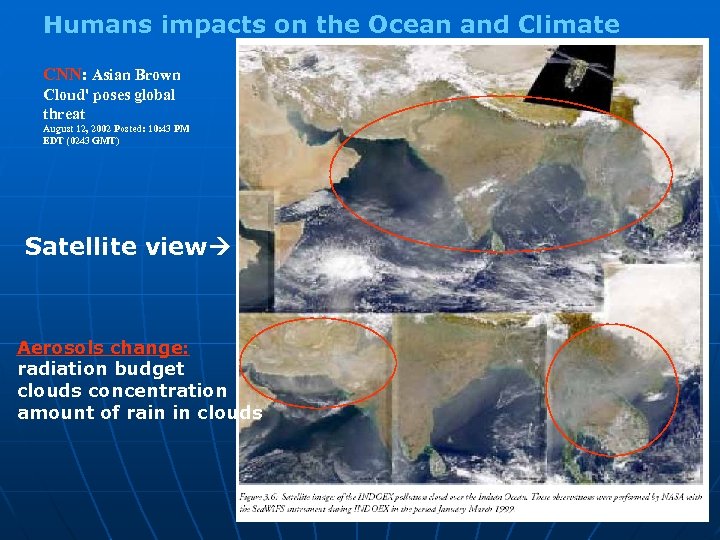 Humans impacts on the Ocean and Climate CNN: Asian Brown Cloud' poses global threat August 12, 2002 Posted: 10: 43 PM EDT (0243 GMT) Satellite view Aerosols change: radiation budget clouds concentration amount of rain in clouds
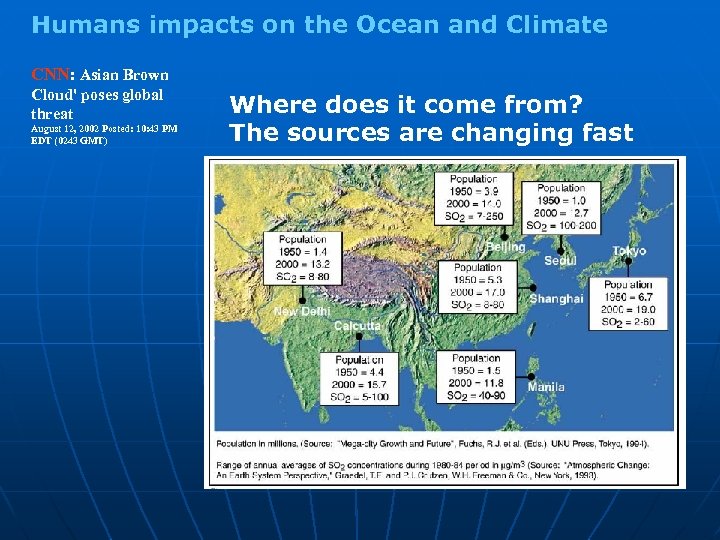 Humans impacts on the Ocean and Climate CNN: Asian Brown Cloud' poses global threat August 12, 2002 Posted: 10: 43 PM EDT (0243 GMT) Where does it come from? The sources are changing fast
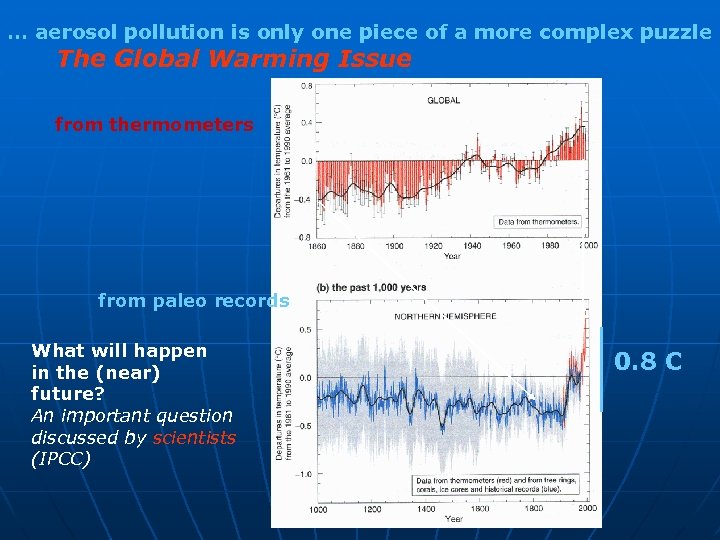 … aerosol pollution is only one piece of a more complex puzzle The Global Warming Issue from thermometers from paleo records What will happen in the (near) future? An important question discussed by scientists (IPCC) 0. 8 C
 QUICK TOUR THROUGH PHYSICAL OCEANOGRAPHIC PHENOMENA
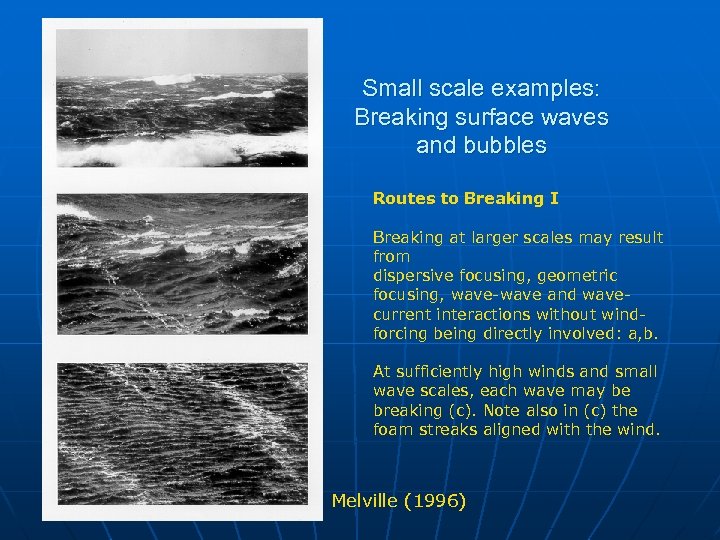 Small scale examples: Breaking surface waves and bubbles Routes to Breaking I Breaking at larger scales may result from dispersive focusing, geometric focusing, wave-wave and wavecurrent interactions without windforcing being directly involved: a, b. At sufficiently high winds and small wave scales, each wave may be breaking (c). Note also in (c) the foam streaks aligned with the wind. Melville (1996)
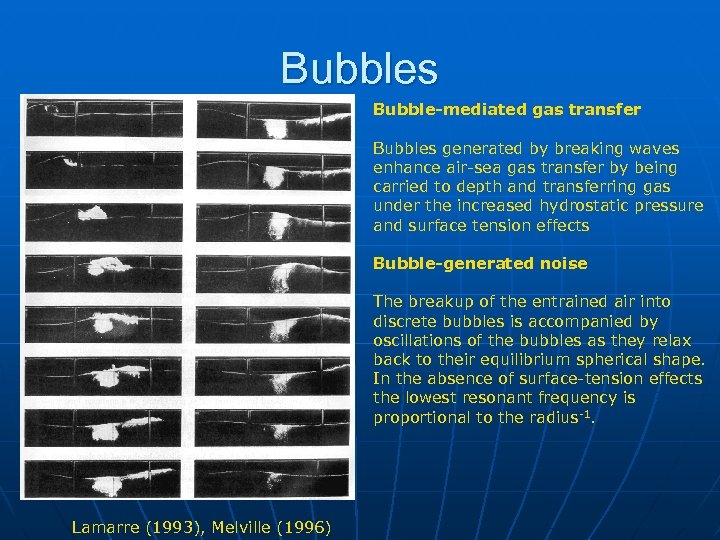 Bubbles Bubble-mediated gas transfer Bubbles generated by breaking waves enhance air-sea gas transfer by being carried to depth and transferring gas under the increased hydrostatic pressure and surface tension effects Bubble-generated noise The breakup of the entrained air into discrete bubbles is accompanied by oscillations of the bubbles as they relax back to their equilibrium spherical shape. In the absence of surface-tension effects the lowest resonant frequency is proportional to the radius-1. Lamarre (1993), Melville (1996)
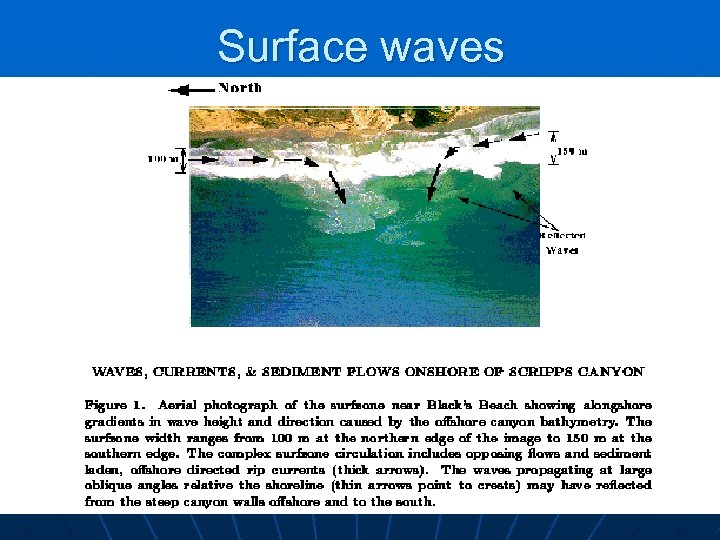 Surface waves 100 m 150 m Reflected waves
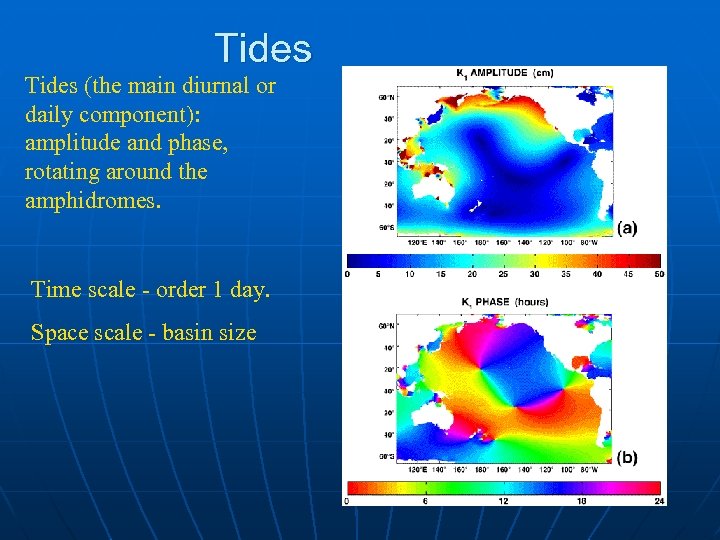 Tides (the main diurnal or daily component): amplitude and phase, rotating around the amphidromes. Time scale - order 1 day. Space scale - basin size
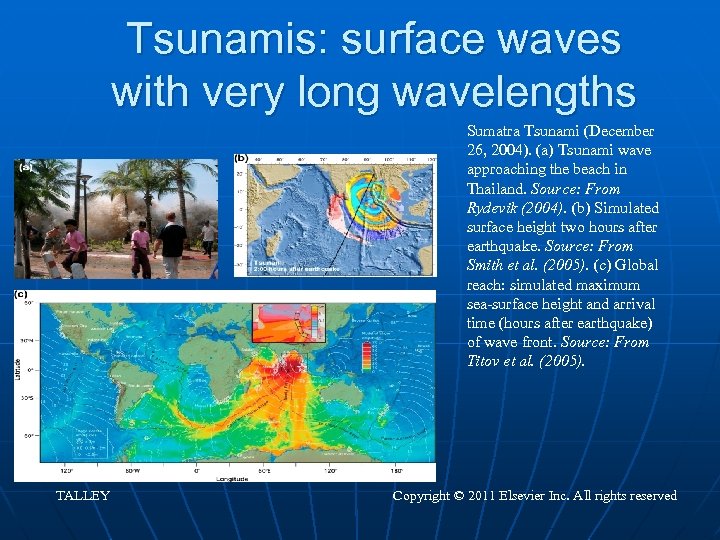 Tsunamis: surface waves with very long wavelengths Sumatra Tsunami (December 26, 2004). (a) Tsunami wave approaching the beach in Thailand. Source: From Rydevik (2004). (b) Simulated surface height two hours after earthquake. Source: From Smith et al. (2005). (c) Global reach: simulated maximum sea-surface height and arrival time (hours after earthquake) of wave front. Source: From Titov et al. (2005). TALLEY Copyright © 2011 Elsevier Inc. All rights reserved
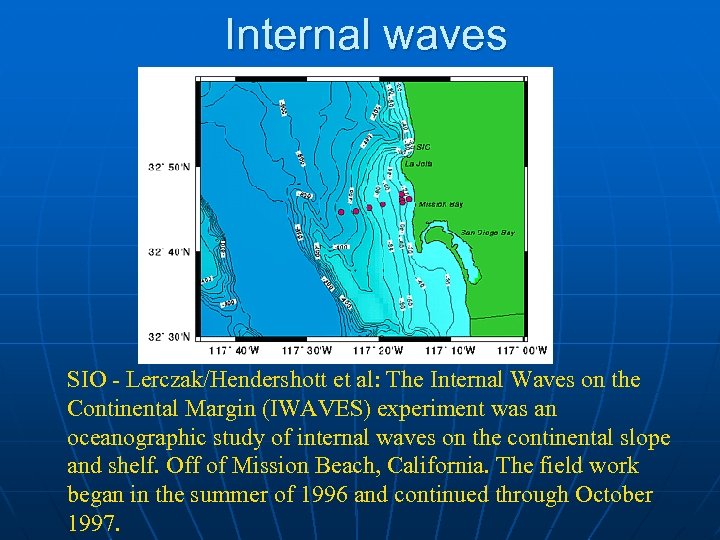 Internal waves SIO - Lerczak/Hendershott et al: The Internal Waves on the Continental Margin (IWAVES) experiment was an oceanographic study of internal waves on the continental slope and shelf. Off of Mission Beach, California. The field work began in the summer of 1996 and continued through October 1997.
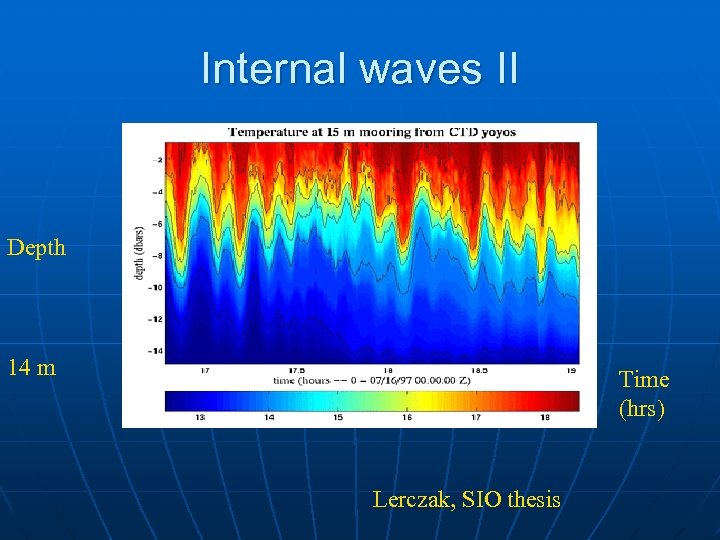 Internal waves II Depth 14 m 17 19 Lerczak, SIO thesis Time (hrs)
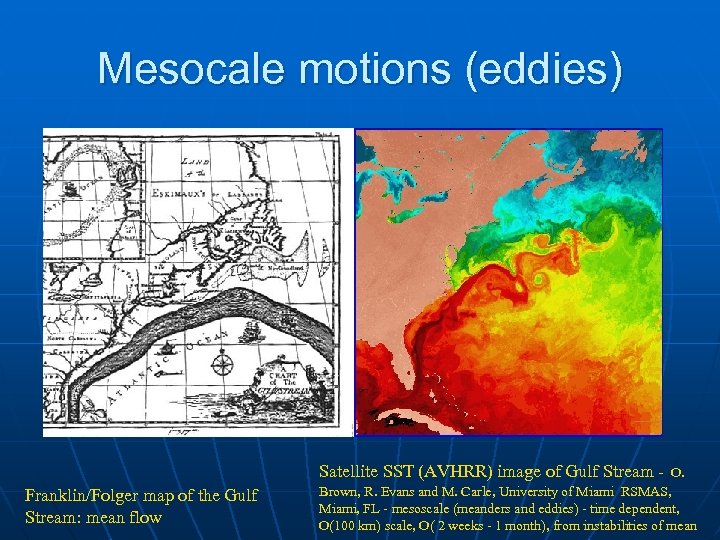 Mesocale motions (eddies) Satellite SST (AVHRR) image of Gulf Stream Franklin/Folger map of the Gulf Stream: mean flow O. Brown, R. Evans and M. Carle, University of Miami RSMAS, Miami, FL - mesoscale (meanders and eddies) - time dependent, O(100 km) scale, O( 2 weeks - 1 month), from instabilities of mean
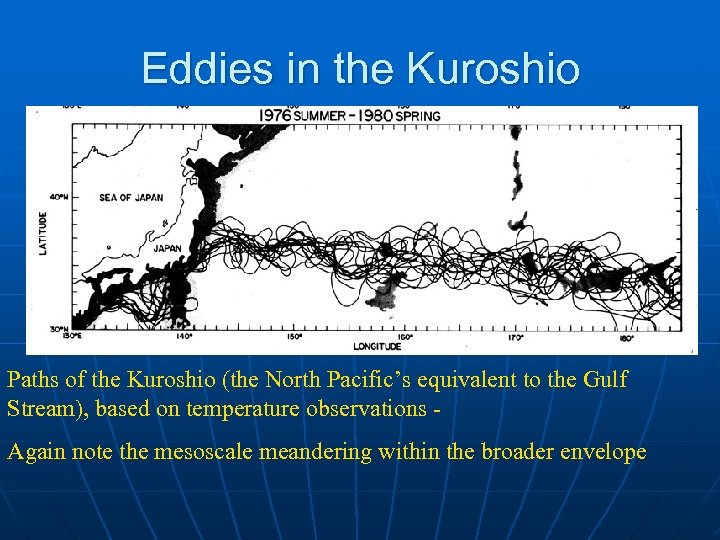 Eddies in the Kuroshio Paths of the Kuroshio (the North Pacific’s equivalent to the Gulf Stream), based on temperature observations Again note the mesoscale meandering within the broader envelope
 Mean and anomaly The next several slides show “anomalies”. ean: the average of a series of measurements (or model output) over a fixed time interval such as a week, a month, a year, etc, or over a specific spatial interval (square kilometer, a 1 degree square, a five degree square, etc. ). Anomaly: the difference between an observation and the mean value, however the mean value is defined. Therefore, by definition, the observed value = mean + anomaly (“Observed”, or “instantaneous”, or “synoptic”)
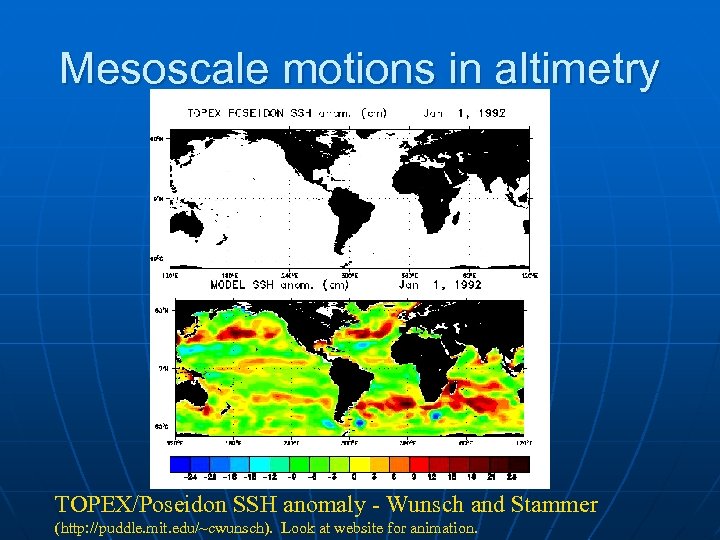 Mesoscale motions in altimetry TOPEX/Poseidon SSH anomaly - Wunsch and Stammer (http: //puddle. mit. edu/~cwunsch). Look at website for animation.
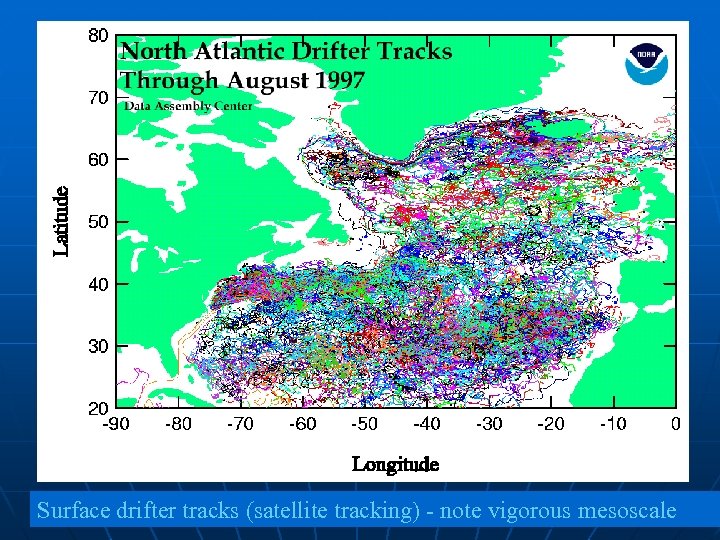 Eddies in surface drifter tracks Surface drifter tracks (satellite tracking) - note vigorous mesoscale
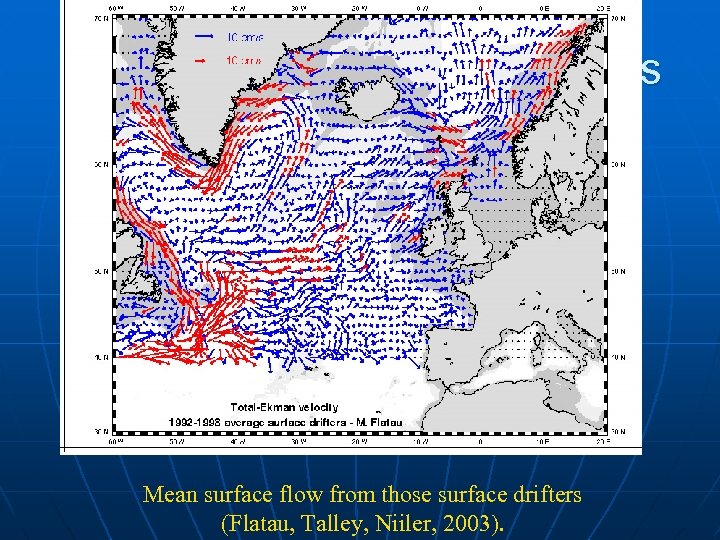 Mean flow from surface drifters Mean surface flow from those surface drifters (Flatau, Talley, Niiler, 2003).
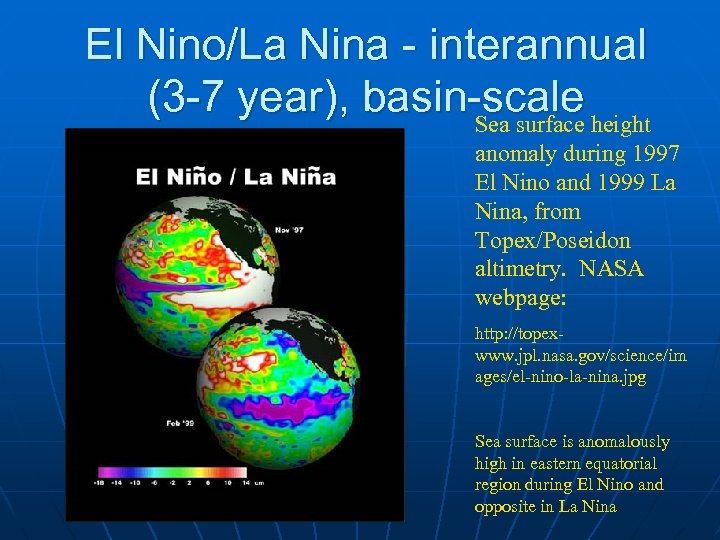 El Nino/La Nina - interannual (3 -7 year), basin-scale height Sea surface anomaly during 1997 El Nino and 1999 La Nina, from Topex/Poseidon altimetry. NASA webpage: http: //topexwww. jpl. nasa. gov/science/im ages/el-nino-la-nina. jpg Sea surface is anomalously high in eastern equatorial region during El Nino and opposite in La Nina
 Contenuti del Corso n n n n Caratteristiche fisiche degli oceani; Proprietà fisiche dell’acqua di mare; L’influenza dell’atmosfera; Il bilancio termico degli oceani; Le equazioni del moto; Il concetto di vorticità; Le correnti geostrofiche; Risposta dell’oceano superficiale al vento; La circolazione Oceanica indotta dal vento; Processi equatoriali: El Nino Onde da vento e onde lunghe, Processi costieri e maree Sistemi osservativi e analisi dei dati
 Testo di Base n R. H. Steward: Introduction to Physical Oceanography Scaricabile liberamente dal sito: http: //oceanworld. tamu. edu/resources/ocng_textbook/PDF_files/ book_pdf_files. html