


 Скачать презентацию Occupational Therapy 1940 — 1969 The 1940
942039fc02cd5f84751b43f8ce07ee6e.ppt
- Количество слайдов: 45
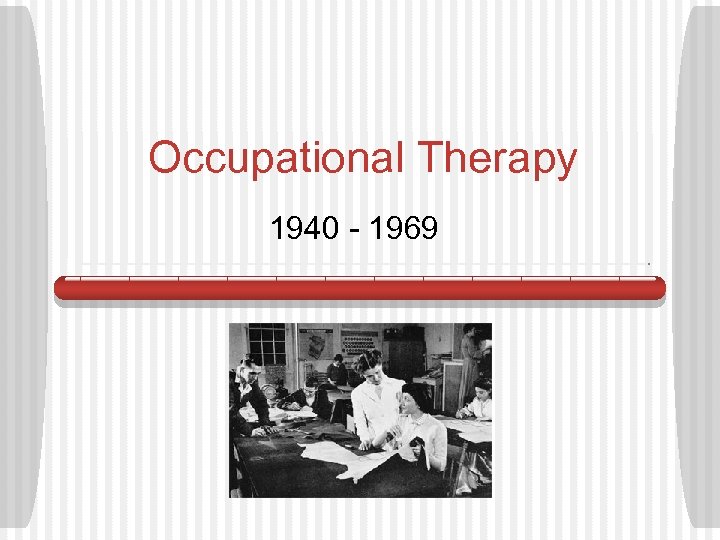 Occupational Therapy 1940 - 1969
 The 1940 s • World War II- increased demand for OTs • Changes in Occupational Therapy Education • The Structure and Focus of Occupational Therapy • Medical Advancements • Important Individuals: Clare Spackman, Helen Willard, Wilma West
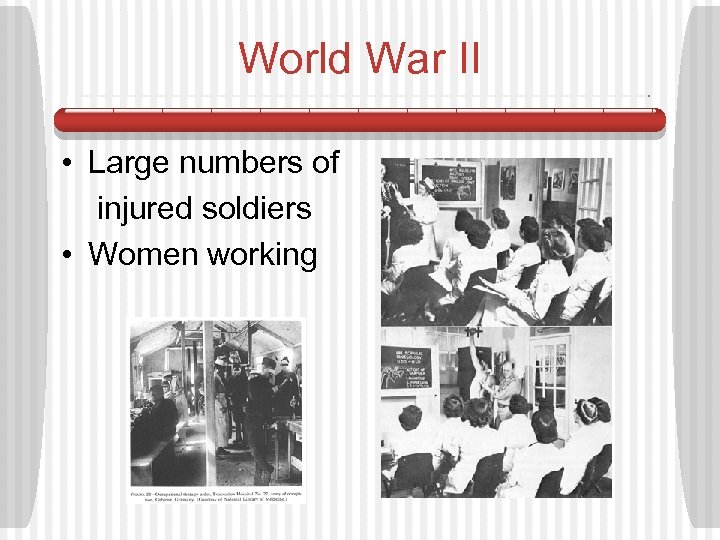 World War II • Large numbers of injured soldiers • Women working
 Growth in OT schools • Accreditation • Expansion- 1947: USC introduces first Master’s Degree program • Revision of Essentials for accreditation § More flexibility in specialties
 Occupational Therapy • Move away from Arts & Crafts Movement § Positive attitude towards work • Patients are motivated through personal interests & material goods § Goals: • 1. Meet person’s interests and abilities • 2. Use activity with physical/mental objective
 Medical Model • Disability is deficiency or abnormality • Disability is negative • Disability is in the individual body • Remedy for disability-related problems: cure or normalization • Change strategy: surgery, medication, medical technology and intervention • Agent of remedy: the professional • Independence seen as individual physical, cognitive, and mental ability to perform and capacity to make decisions (Willard & Spackman, p. 871)
 OT Practical Design • By 1940, the medical model’s influence on the practical outlook of healthcare had begun to exert pressure on occupational therapy. • Self-repair through activity was discounted in favor of applications that had more of a base in psychology, physiology and anatomy. • Over the next decade, occupational therapy redefined its mission, integrating practice with a new paradigm and professional culture built upon a scientific approach and fact.
 1940 s Advances in Medicine • Antibiotics- penicillin and streptomyocin • Vaccinations- eradication of many childhood diseases • Improvement in quality of healthcare • Federal government funds research and passes laws regarding delivery of healthcare • Life expectancy increases
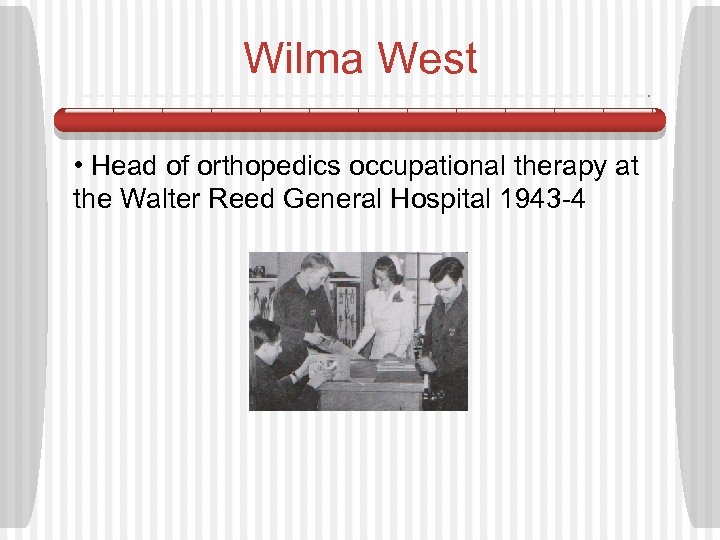 Wilma West • Head of orthopedics occupational therapy at the Walter Reed General Hospital 1943 -4
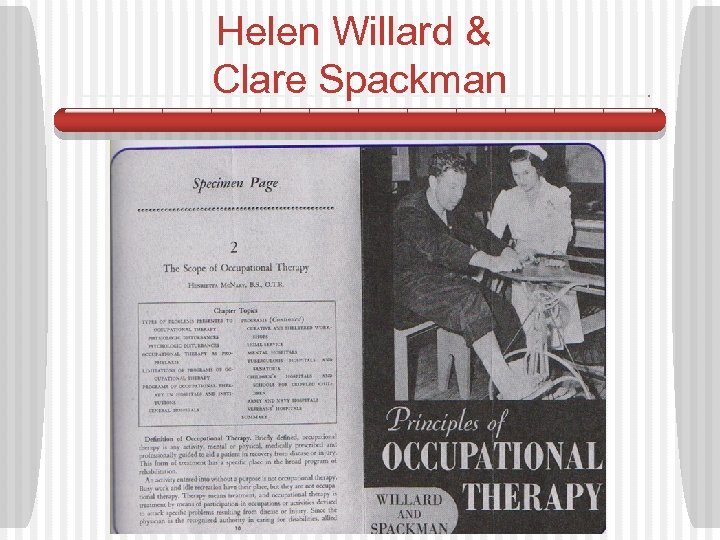 Helen Willard & Clare Spackman
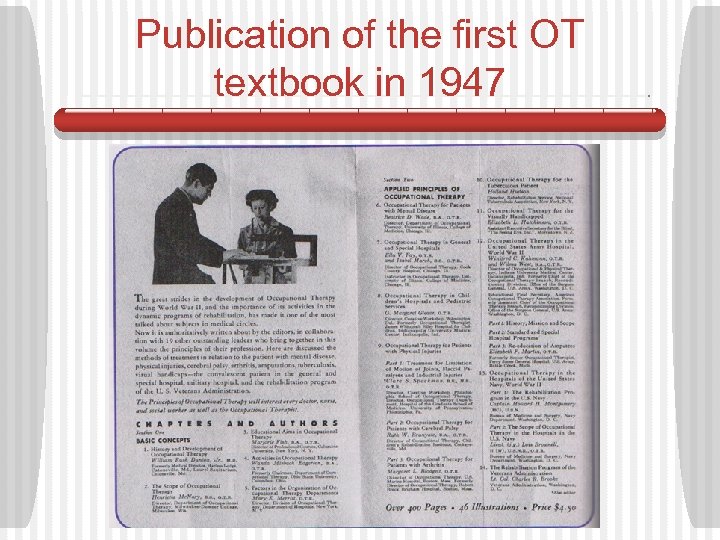 Publication of the first OT textbook in 1947
 IT’S QUIZ TIME!
 The 1950 s • Post-war Effects • Social Context: Women’s Roles, Civil Rights Movement • Polio Epidemic • The Structure and Focus of Occupational Therapy • Treatment of Mental Health • WFOT • Important Individuals: Sister Elizabeth Kenny
 Post-war Effects • Baby boom • Economic prosperity
 Women’s Roles • Housewife- ideal of femininity • Discouraged from working • Continued to work, mostly in low paying jobs (“pink-collared work”)
 Civil Rights Movement early 1950 s • Korean War- desegregation of armed forces • 1954: Brown v. Board of Education- Supreme Court rules segregation unconstitutional, desegregation of schools • Non-violent protests § Civil disobedience • 1955 -56: Rosa Parks and Montgomery Bus boycotts
 Poliomyelitis • Known as Infantile Paralysis • Most cases of polio are symptom-free • When the virus enters the blood stream, it attacks the CNS • causes muscle weakness & paralysis of the legs • Bulbar polio affects nerves responsible for breathing, swallowing and speech
 Polio in the Media
 “Plague Season” • In 1952, there were 57, 000 cases of polio in the US • Targeted children from 5 -9 years old • 21, 000 permanent paralysis • 3, 000 deaths • 1955: the Salk Vaccine is distributed in mass quantities • Children of the 1950’s are today’s baby boomers
 OT Practical Design • The Mechanistic Paradigm emerges • Confidence was instilled in the profession as treatment objectives encompassed more Freudianbased psychological conceptualization informing treatment of patients. • The occupational therapist became a vehicle for resolution, a mechanism for the patient to utilize. • Disability was seen as the abnormal expression of repression within • Incorporation of neurological knowledge into practice
 OT Methodology Change • Over the course of this decade, the practice of splinting and prescribing adaptive devices flourished. • Discrete analysis of requirements needed for activity became more integral to practice • Medical model adherence promoted the emphasis on the patient returning to healthy functioning • Respect for objective measurement and scientific precision was gained • Knowledge of how internal processes and body structure informed function expanded
 Working with Mental Patients • Do not work on causative factors of behaviors—correct symptoms • Do not stress activity over relationship with patient • Use graduation & persuasion to overcome distasteful habits • Select tasks within ability level to assure success • Give patient choice of activity • Develop patient’s sense of responsibility • Hold “community sing”
 Video • Mental Health Rehabilitation in 1950 s
 World Federation of Occupational Therapists • Founded in 1952 • 1959: WFOT entered into relations with WHO Mission: v. To promote occupational therapy as an art and science v. To develop and use occupational therapy worldwide v. International cooperation
 WFOT Focus Program Areas: • Education & research • Standards & quality • International Cooperation • Executive programs • Promotion & development
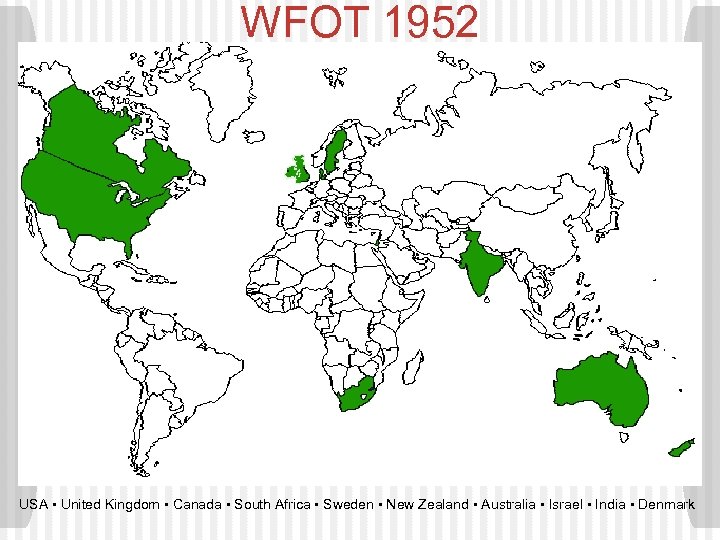 WFOT 1952 USA • United Kingdom • Canada • South Africa • Sweden • New Zealand • Australia • Israel • India • Denmark
 WFOT 1969 USA • United Kingdom • Canada • South Africa • Sweden • New Zealand • Australia • Israel • India • Denmark • Belgium • France • Germany • Netherlands • Norway • Philippines • Portugal • Switzerland • Venezuela
 1950 s OT changes • 1956: Certified Occupational Therapy Assistant (COTA) position created • 1958: Pi Epsilon Theta founded at UNH
 IT’S QUIZ TIME!
 The 1960 s • Social Context: Civil Rights Movement Continues, Women’s Empowerment • The Structure and Focus of Occupational Therapy • Medicare/Medicaid • Important Individuals: Gail Fidler, Mary Reilly, Wilma West, Elizabeth Yerxa, A. Jean Ayres
 Civil Rights Movement • Presidents Kennedy and Johnson set tone by making civil rights a priority of their administration • Nonviolent protests continue § 1960: sit-in protests • 1964: Civil Rights Act passed- outlaws discrimination based on race
 Women’s Liberation Movement • 1964: Civil Rights Act- outlaws sex discrimination • Empowerment of women § More educated § More economically secure § More willing speak up about their ideas
 OT Practical Design • By the end of the 1960 s, occupational therapy’s role in mediating client illness and disability was clarified in accordance with the medical model. The psychology of the effect of pathological conditions on patients was better understood by the profession and the use of technology to intercede with dysfunction increased.
 OT Practical Conflict • This embrace of practical shift in the profession enhanced practice but also threw the field into conflict • As therapeutic interventions focused less on confidence building activity through participation in occupational interests, the field turned from its holistic foundation to therapy based in concrete scientific rationale • The interventions previously focused on balanced living became mechanized and lost meaning in favor of achieving purpose
 Call for a new Paradigm? • Therapists used to practicing under the original, moral paradigm of practice had difficulty adjusting to the more concrete scientific approach of the medical model • A realization by practitioners that the profession needed to ameliorate its differences was recognized • By the end of this era, occupational therapy was valued with respect to conformity with the medical model but practitioners were not united • As the times dictated, social upheaval, redefining roles and the importance placed on science informed occupational therapy practice
 Wilma West • President of AOTA from 1961 to 1964 • Wanted to address changing needs of society and adapt OT accordingly • Wanted OT to have a new role of “health agent” in order to focus on prevention in the health care system
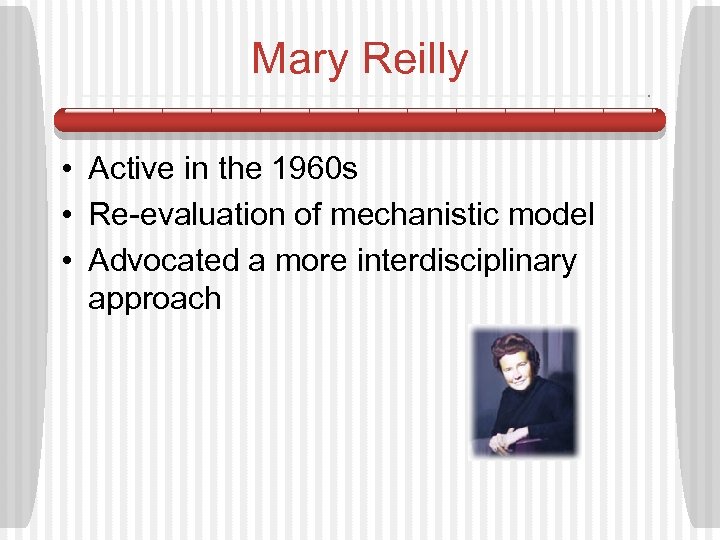 Mary Reilly • Active in the 1960 s • Re-evaluation of mechanistic model • Advocated a more interdisciplinary approach
 1960 s Changes • More work with pediatrics and developmental delays • Beginning of de-institutionalization § Working to integrate formerly institutionalized clients into society as independent and productive members
 Medicare/Medicaid • Established in 1965 - Inpatient occupational therapy services covered
 Elizabeth Yerxa • “the scientific attitude is not incompatible with concern for the client as a human being but may be one of the best foundations for acting upon that concern” • Advocate of client choices
 Gail Fidler • Wanted to recognize the professional commitment to learning, critical thinking, and creativity • Advocated teaching more than just technical skills
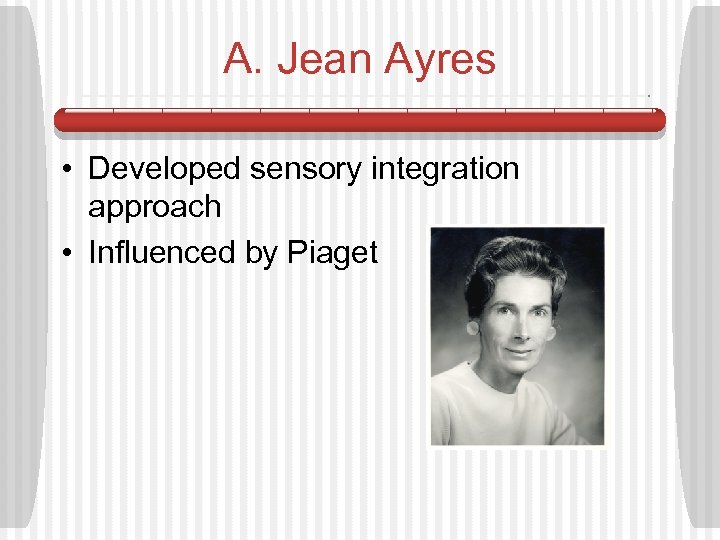 A. Jean Ayres • Developed sensory integration approach • Influenced by Piaget
 Influences from the 40 s-60 s that we see today • Occupation-based therapy • Client has choices • De-institutionalization
 IT’S QUIZ TIME!
 Questions?