


 Скачать презентацию Occupational Exposure of Finnish farmers Introduction Linko
cd9203866dce2fc3fcf330d2eb6425d5.ppt
- Количество слайдов: 19
 Occupational Exposure of Finnish farmers Introduction: * Linko (1947) published a case of farmers’ lung * first study at the end of 1970', “farmers exposure to microbes” in Kuopio Regional Institute of Occupational Health * since the year 1980 several studies have been published concerning chemical, physical and biological agents in different types of environments in agriculture FIOH/Kyösti Louhelainen, Kuopio twinning Tarto 6/2003 1
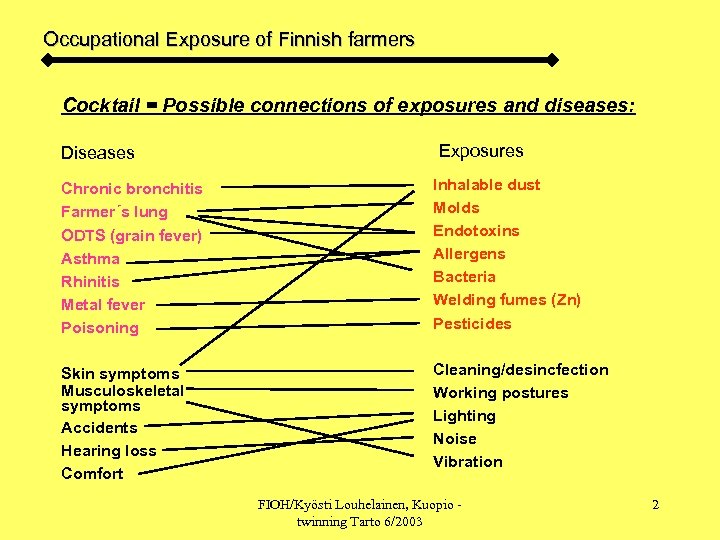 Occupational Exposure of Finnish farmers Cocktail = Possible connections of exposures and diseases: Diseases Exposures Chronic bronchitis Farmer´s lung ODTS (grain fever) Asthma Rhinitis Metal fever Poisoning Inhalable dust Molds Endotoxins Allergens Bacteria Welding fumes (Zn) Pesticides Skin symptoms Musculoskeletal symptoms Accidents Hearing loss Comfort Cleaning/desincfection Working postures Lighting Noise Vibration FIOH/Kyösti Louhelainen, Kuopio twinning Tarto 6/2003 2
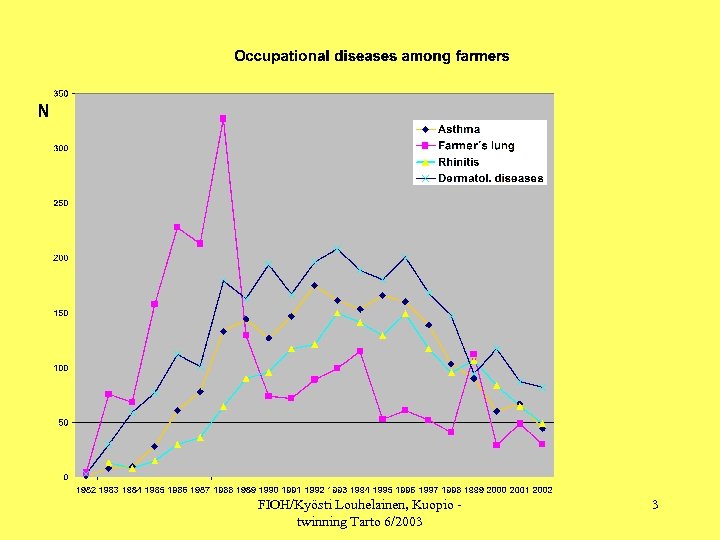 N FIOH/Kyösti Louhelainen, Kuopio twinning Tarto 6/2003 3
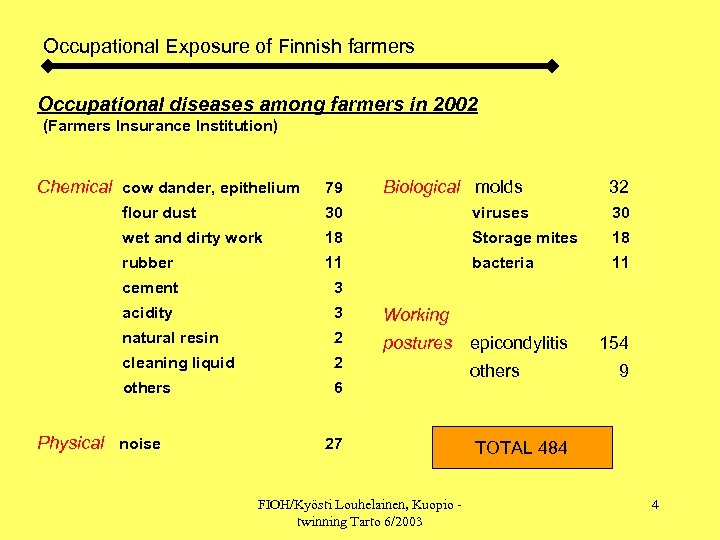 Occupational Exposure of Finnish farmers Occupational diseases among farmers in 2002 (Farmers Insurance Institution) Chemical cow dander, epithelium 79 Biological molds 32 flour dust 30 viruses 30 wet and dirty work 18 Storage mites 18 rubber 11 bacteria 11 cement 3 acidity 3 Working natural resin 2 postures epicondylitis cleaning liquid 2 others 6 Physical noise 27 FIOH/Kyösti Louhelainen, Kuopio twinning Tarto 6/2003 others 154 9 TOTAL 484 4
 Occupational Exposure of Finnish farmers Why to measure occupational factors ? - occupational diseases are common among farmers in Finland so it is important to decrease he number - Number of accidents are numerous and also fatal injuries occur - Through research we can find solutions to control methods FIOH/Kyösti Louhelainen, Kuopio twinning Tarto 6/2003 5
 Occupational Exposure of Finnish farmers Microbes, molds, bacteria Exposure at cow farms : * at 70’s and 80’s quite high * during 90’s decreasing and still going downward * Analysis: - mold specific cultivating petri dishes - total number with filter sampling and staining * result: knowledge (? ) of hazardous species, means for mold control (hay dryers, chemical treatment of hay, grain, etc) Exposure at swine farms : * usually higher than cow farms FIOH/Kyösti Louhelainen, Kuopio twinning Tarto 6/2003 6
 Occupational Exposure of Finnish farmers Total dust Inorganic during outdoor work * high concentrations during tilling, sowing, harvesting Organic dust indoors * cow farms; (next slide) * swines; usually higher than in cow farms * poultry; at the same level as in swine houses OEL: organic dust 5 mg/m 3, inorganic 10 mg/m 3 FIOH/Kyösti Louhelainen, Kuopio twinning Tarto 6/2003 7
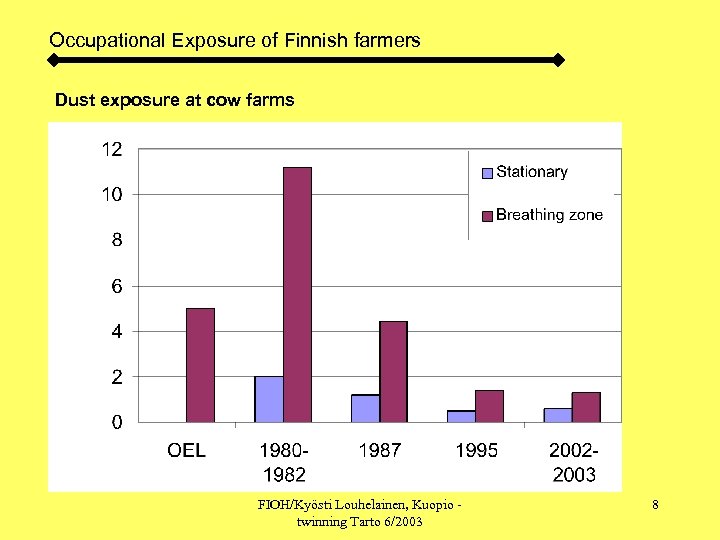 Occupational Exposure of Finnish farmers Dust exposure at cow farms FIOH/Kyösti Louhelainen, Kuopio twinning Tarto 6/2003 8
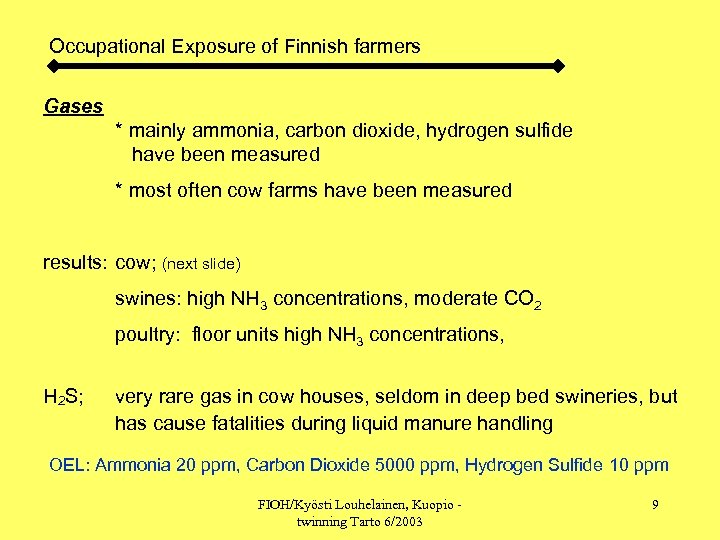 Occupational Exposure of Finnish farmers Gases * mainly ammonia, carbon dioxide, hydrogen sulfide have been measured * most often cow farms have been measured results: cow; (next slide) swines: high NH 3 concentrations, moderate CO 2 poultry: floor units high NH 3 concentrations, H 2 S; very rare gas in cow houses, seldom in deep bed swineries, but has cause fatalities during liquid manure handling OEL: Ammonia 20 ppm, Carbon Dioxide 5000 ppm, Hydrogen Sulfide 10 ppm FIOH/Kyösti Louhelainen, Kuopio twinning Tarto 6/2003 9
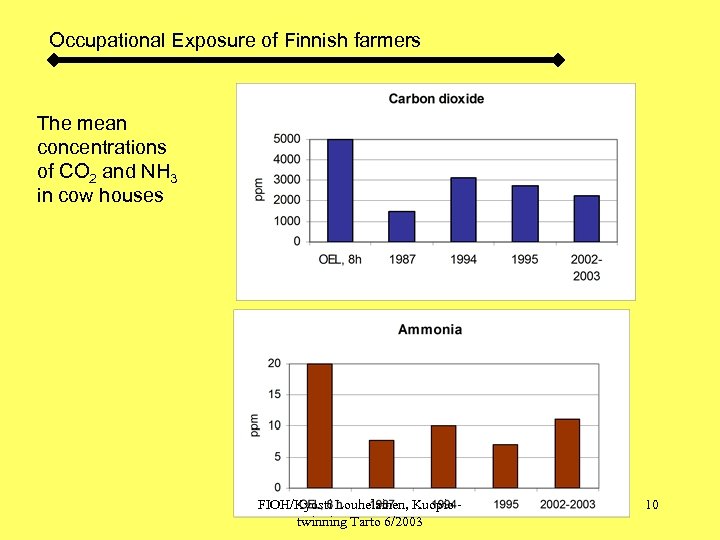 Occupational Exposure of Finnish farmers The mean concentrations of CO 2 and NH 3 in cow houses FIOH/Kyösti Louhelainen, Kuopio twinning Tarto 6/2003 10
 Occupational Exposure of Finnish farmers Pesticides: - Average farmer´s exposure to pesticides is quite low in Finland * small amounts of pesticides are used, 1 -2 days / summer * effective low-portion liquids * farmers are afraid of poisons - More exposure to potato, sugar beet, carrot farmers, tens of days in summer, typical types are herbicides, insecticides - Biomonitoring blood or urine: farmers are involved quite seldom - Testing of sprayers and the test of farmer every 5 years, every 10 years for extremely dangerous pesticides FIOH/Kyösti Louhelainen, Kuopio twinning Tarto 6/2003 11
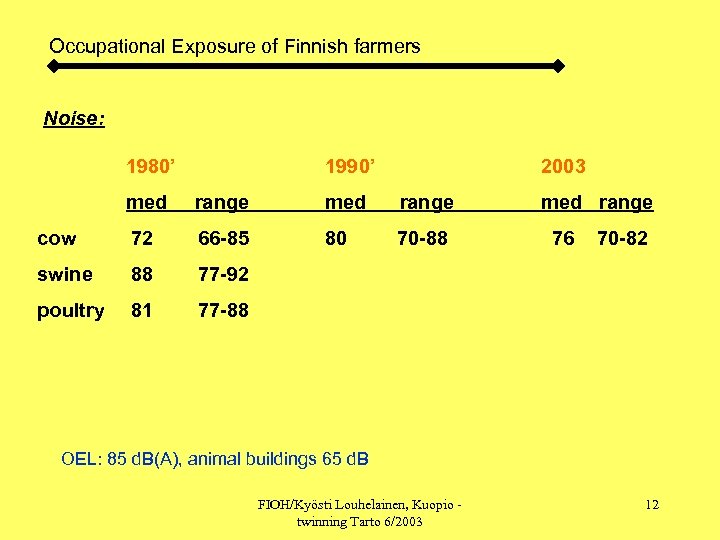 Occupational Exposure of Finnish farmers Noise: 1980’ 1990’ 2003 med range cow 72 66 -85 80 70 -88 swine 88 77 -92 poultry 81 med range 77 -88 76 70 -82 OEL: 85 d. B(A), animal buildings 65 d. B FIOH/Kyösti Louhelainen, Kuopio twinning Tarto 6/2003 12
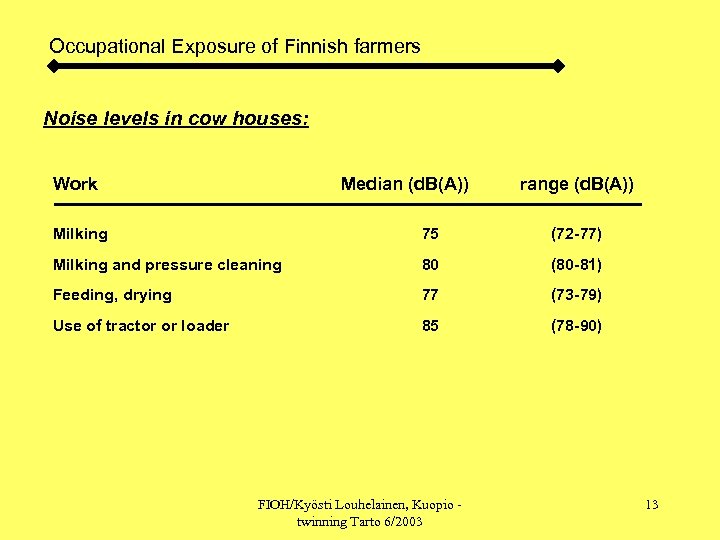 Occupational Exposure of Finnish farmers Noise levels in cow houses: Work Median (d. B(A)) range (d. B(A)) Milking 75 (72 -77) Milking and pressure cleaning 80 (80 -81) Feeding, drying 77 (73 -79) Use of tractor or loader 85 (78 -90) FIOH/Kyösti Louhelainen, Kuopio twinning Tarto 6/2003 13
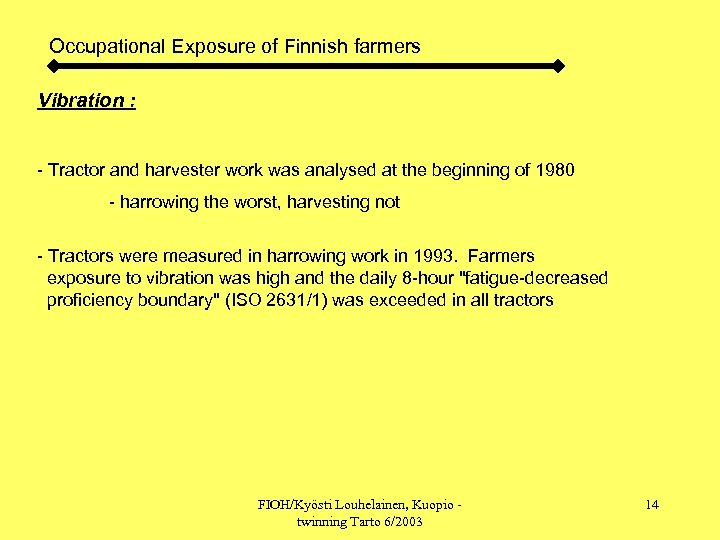 Occupational Exposure of Finnish farmers Vibration : - Tractor and harvester work was analysed at the beginning of 1980 - harrowing the worst, harvesting not - Tractors were measured in harrowing work in 1993. Farmers exposure to vibration was high and the daily 8 -hour "fatigue-decreased proficiency boundary" (ISO 2631/1) was exceeded in all tractors FIOH/Kyösti Louhelainen, Kuopio twinning Tarto 6/2003 14
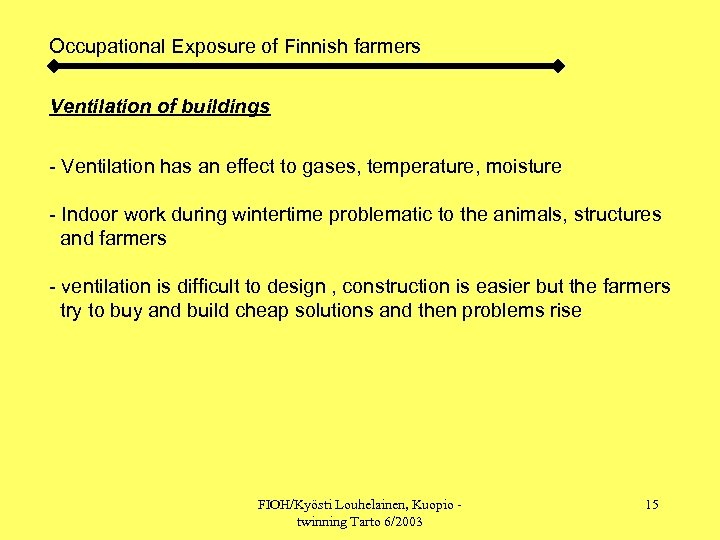 Occupational Exposure of Finnish farmers Ventilation of buildings - Ventilation has an effect to gases, temperature, moisture - Indoor work during wintertime problematic to the animals, structures and farmers - ventilation is difficult to design , construction is easier but the farmers try to buy and build cheap solutions and then problems rise FIOH/Kyösti Louhelainen, Kuopio twinning Tarto 6/2003 15
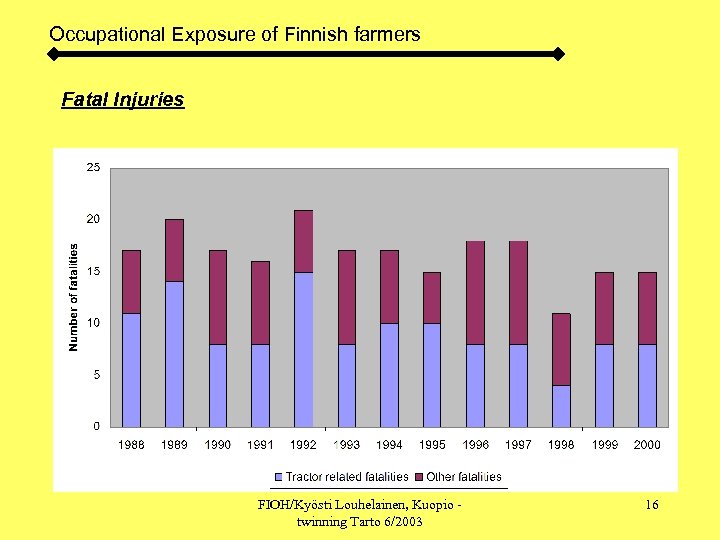 Occupational Exposure of Finnish farmers Fatal Injuries FIOH/Kyösti Louhelainen, Kuopio twinning Tarto 6/2003 16
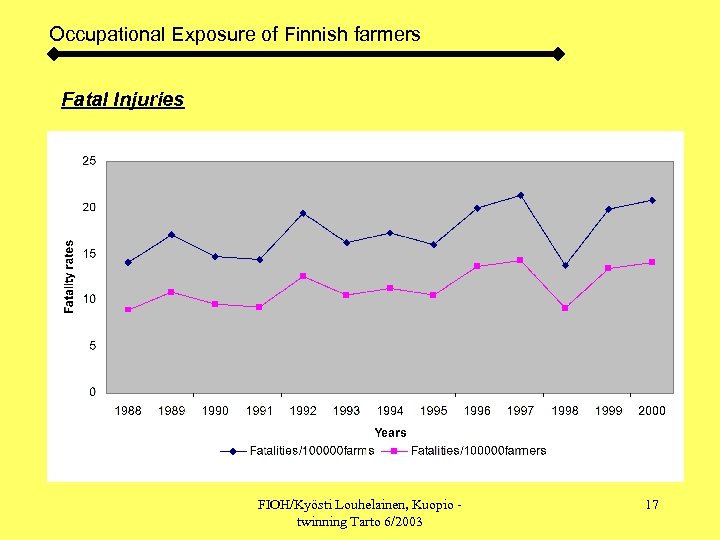 Occupational Exposure of Finnish farmers Fatal Injuries FIOH/Kyösti Louhelainen, Kuopio twinning Tarto 6/2003 17
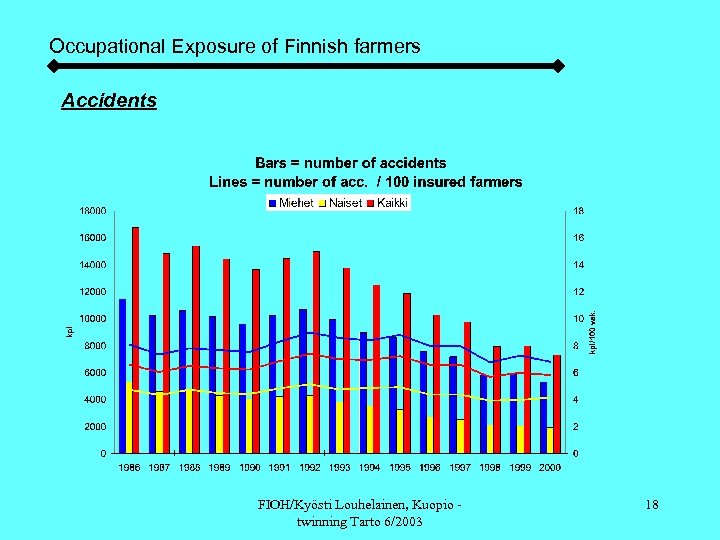 Occupational Exposure of Finnish farmers Accidents FIOH/Kyösti Louhelainen, Kuopio twinning Tarto 6/2003 18
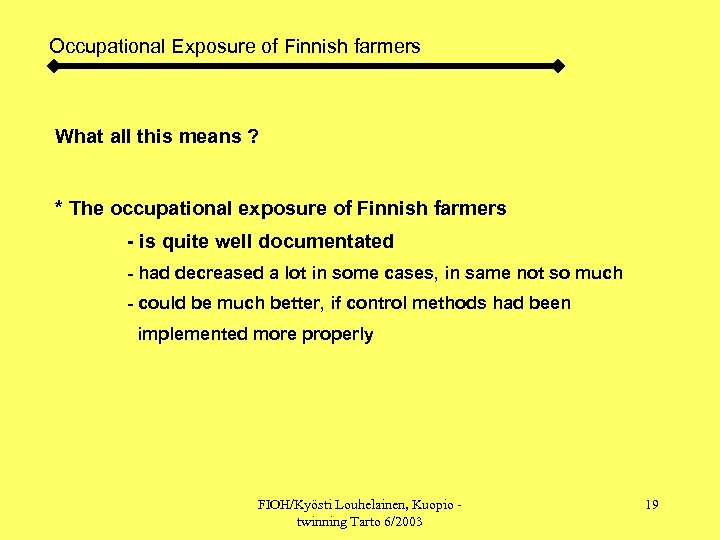 Occupational Exposure of Finnish farmers What all this means ? * The occupational exposure of Finnish farmers - is quite well documentated - had decreased a lot in some cases, in same not so much - could be much better, if control methods had been implemented more properly FIOH/Kyösti Louhelainen, Kuopio twinning Tarto 6/2003 19