 Скачать презентацию Общая цель Быть способным сформулировать предварительный опухолей почек
Опухоли почек.ppt
- Количество слайдов: 39



Общая цель Быть способным сформулировать предварительный опухолей почек и мочевого пузыря 1
Студенты должны быть способны : • Изучить основные этиологические причины рака почки и мочевого пузыря • Описать основные симптомы заболеваний • Описать как диагностируются, лечатся и профилактика рака почки и мочевого пузыря. 2
Почечно-клеточный рак • Около 2% всех раков • Во всем мире ежегодный прирост от 1. 5 – 5. 9% • Преобладание мужчин над женщинами от 1. 5 – 3. 1 • Смертность возрастает от 54, 000 смертей в 1985 до 102, 000 смертей в 2007 • 25 – 30% пациентов на момент постановки диагноза имеют метастазы • 5 -летняя выживаемость колеблется от 50 – 90% при локализованном заболевании, уменьшается до 0 – 13% при распространенном 3
Классификация • ПКР составляет 90% всех злокачественных новообразований почек И представлен : переходноклеточный тумор, не эпителиальный рак и опухоль Вильмса. 4

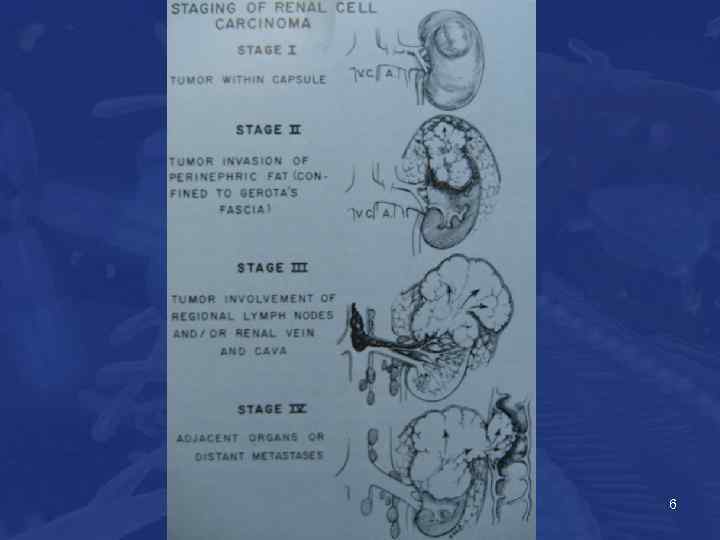
Классификация (TNM) • T 1 опухоль размерами до 7 • T 2 опухоль размерами >7 cm • T 3 опухоль вовлекает большие сосуды или надпочечник • T 4 опухоль распространяется за проделы Gerot’s fascia • N 1 вовлечен один лимфоузел • N 2 более одного 5
6

Опухоль почки Диагностика • Клинические симптомы: гематурия, пальпируемое образование, боль в поясничной области • Гемоглобин и СОЕ : прогноз • Креатинин: почечная функция • Щелочная фосфатаза: метастазы в печень, костные метастазы. 7
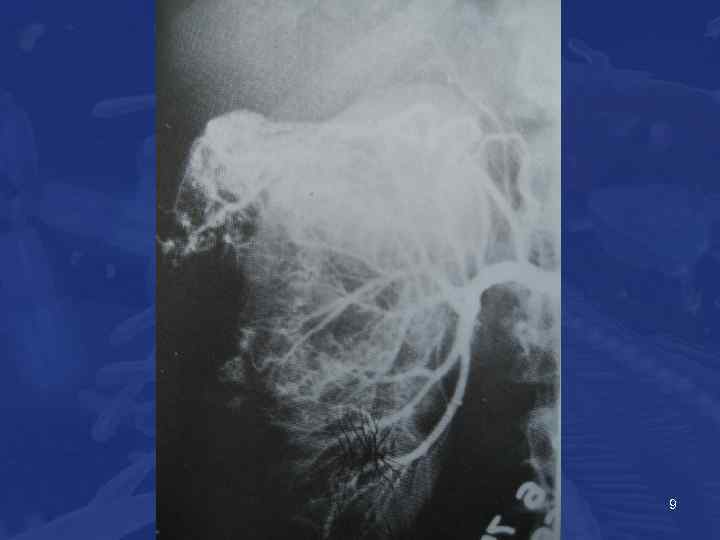
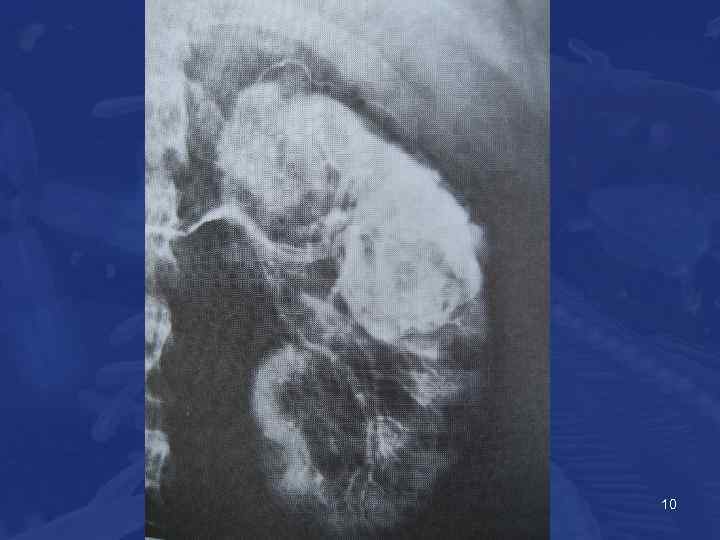
Опухоль почки Диагностика • • УЗИ CT-scan МРТ Ангиография 8
9
10
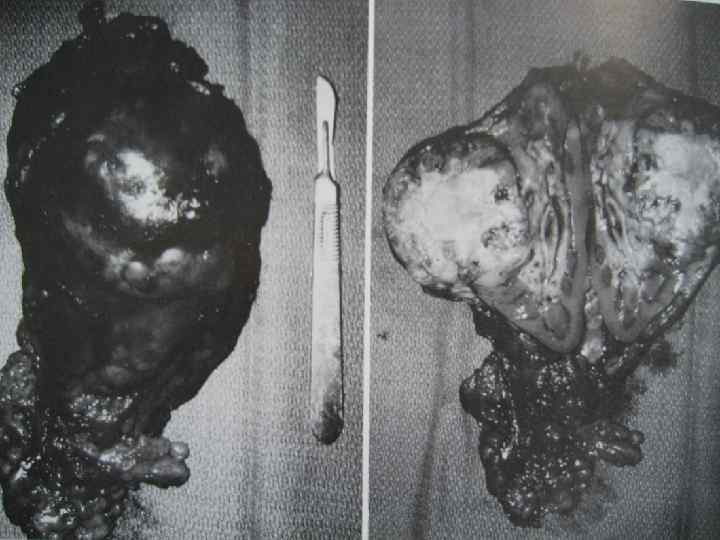
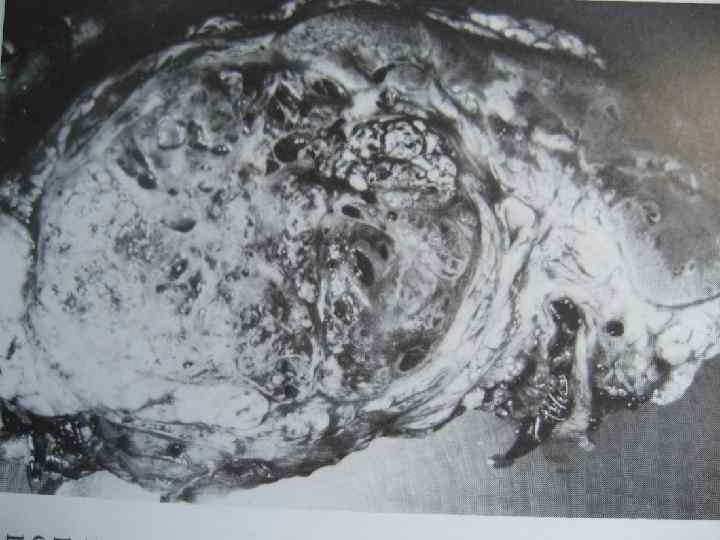
Опухоль почки Лечение • Только радикальная нефрэктомия позволяет добиться хорошей выживаемости • Стандартная оперативная техника должна включать удаление фасции Герота 11
12
13
Опухоль почки • • • Определить местный рецидив болезни и отдаленные метастазы как можно раньше Повторный осмотр через 4 -6 недель: Общий осмотр Сывороточный креатинин Гемоглобин В течении 3 лет: Chest X-ray CT-scan 14
Опухоли мочевого пузыря • Частота выявления рака м/п с каждым годом увеличивается. • 75 -85% пациентов имеют опухоль ограниченную слизистой • 15 -25% имеют мишечноинвазивную опухоль 15
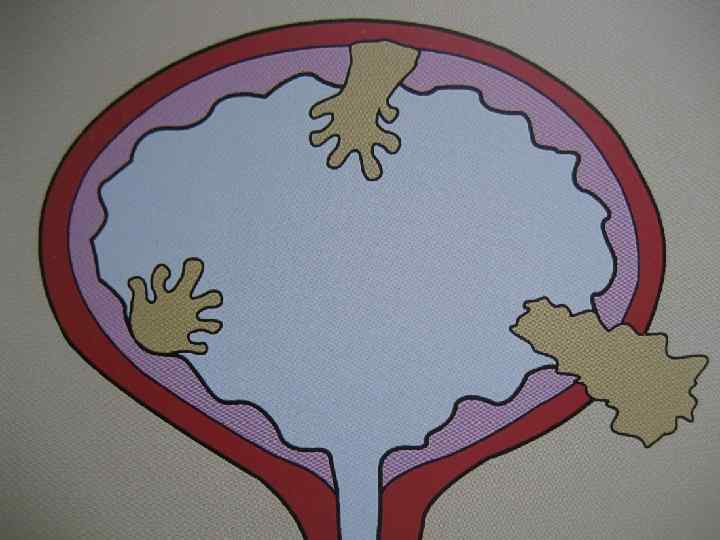
• • Bladder cancer Classification (TNM 97) Ta Non-invasive papillary Tis In situ: 'flat tumour' T 1 Subepithelial connective tissue T 2 Muscularis T 2 a Inner half T 2 b Outer half • T 3 Beyond muscularis T 3 a Microscopically T 3 b Extravesical mass • T 4 Other adjacent structures T 4 a Prostate, uterus, vagina T 4 b Pelvic wall, abdominal wall 16
17
Опухоль м/п Факторы риска • Ароматические амины • Печатное производство • Металургия • Лако-красящее производство • Курение 18

19
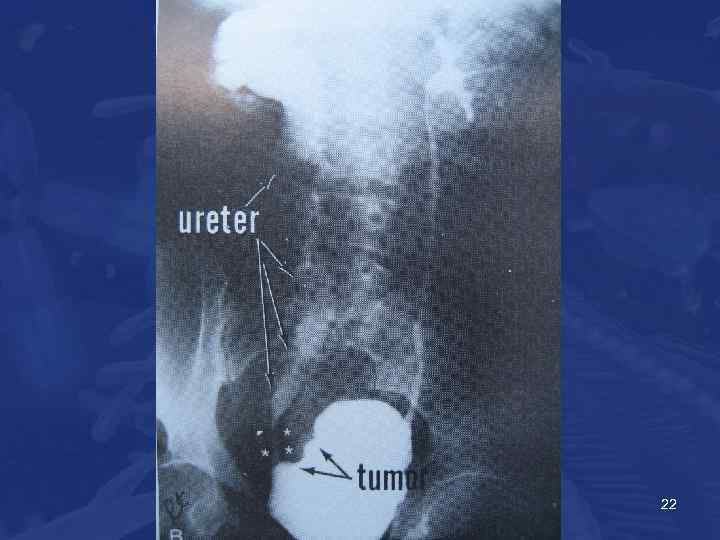
• • Опухоль м/п Диагностика Гематурия Учащенное мочеиспускание Осмотр пациента Дополнительные методы: ВВУ УЗИ СT Сканирование костей • Цитология мочи • Цистоскоция и ТУР 20

21
22
23
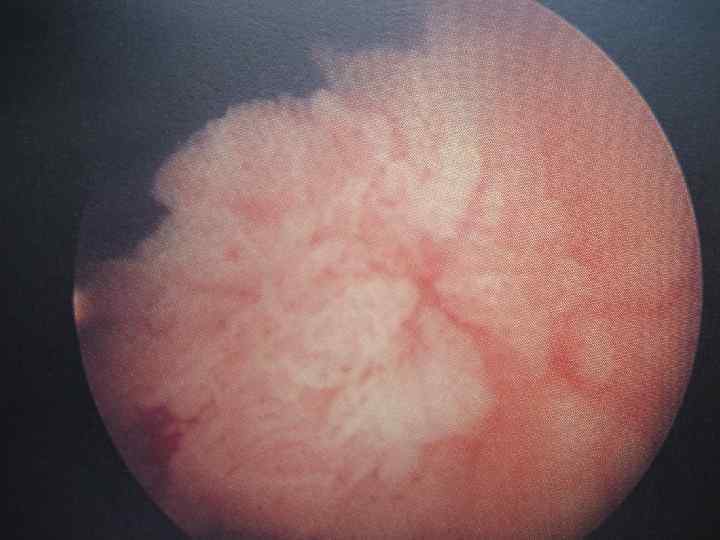
Опухоль м/п Recomendations • Physical examination (including digital rectal and pelvic examination) • Renal and bladder ultrasonography and/or IVP • Cystoscopy with description of the tumour: size, site, appearance (a diagram of the bladder should be included) • Urinalysis • Urinary cytology • TUR with: • biopsy of the underlying tissue • random biopsies in the presence of positive cytology, large or non-papillary tumour • biopsy of the prostatic urethra in cases of Tis or suspicion of it 24
Bladder cancer Recomendations • • Chest X-ray IVP and/or abdominal/pelvic CT scan Liver ultrasonography Bone scan if symptoms are present or alkaline phosphatase level is elevated 25
Опухоль м/п Лечение • После установления диагноза необходимо определить стадию заболевания- поверхностная опухоль (Ta-T 1), CIS или инвазивная опухоль (more than T 1). Потому что лечение и наблюдение при этих трех стадия отличается. 26
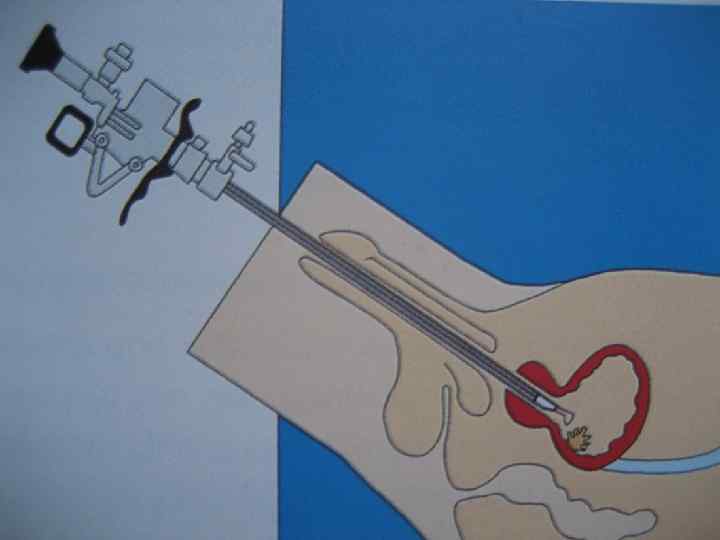
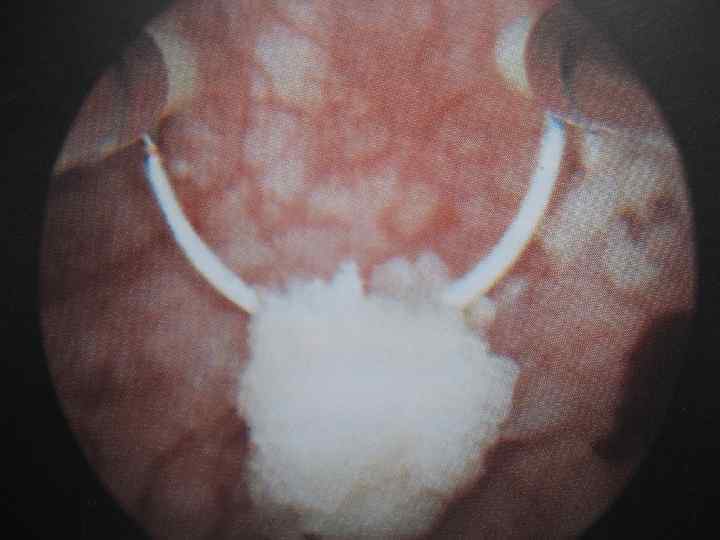
Bladder cancer Treatment • • Ta-T 1 are superficial bladder tumours. Treatment will be directed towards the prevention of recurrence and progression. Tis is a potentially highly malignant disease that can still be treated, with bladder instillations of bacillus Calmette. Guerin (BCG). A cystectomy is necessary when this fails to cure the disease after two cycles of 6 -8 weekly instillations. Tumours of T 2 or higher category are infiltrating tumours and cystectomy will be necessary in the majority of cases. Bladder preservation can be an option in selected cases. N+ and metastatic disease require additional therapeutic approaches. 27
Bladder cancer Treatment of Ta-T 1 lesions • Prognostic factors: Number of tumours Recurrence rate in the previous period Size of the tumour • One single chemotherapeutic instillation immediately after TUR by epirubicin or mitomycin • A 4 -8 week course followed by monthly instillation with chemotherapeutic agents in intermediate- and high-risk tumours • Chemotherapeutic agents used for bladder instillations 28
29
30
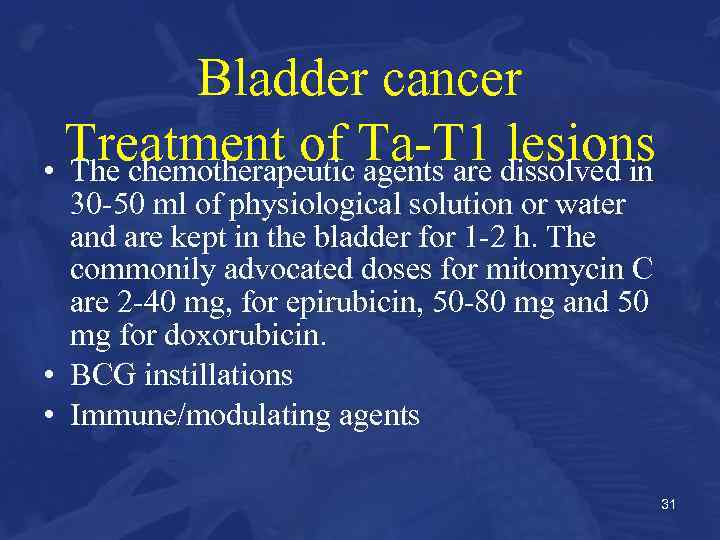
Bladder cancer Treatment of Ta-T 1 dissolved in lesions • The chemotherapeutic agents are 30 -50 ml of physiological solution or water and are kept in the bladder for 1 -2 h. The commonily advocated doses for mitomycin C are 2 -40 mg, for epirubicin, 50 -80 mg and 50 mg for doxorubicin. • BCG instillations • Immune/modulating agents 31
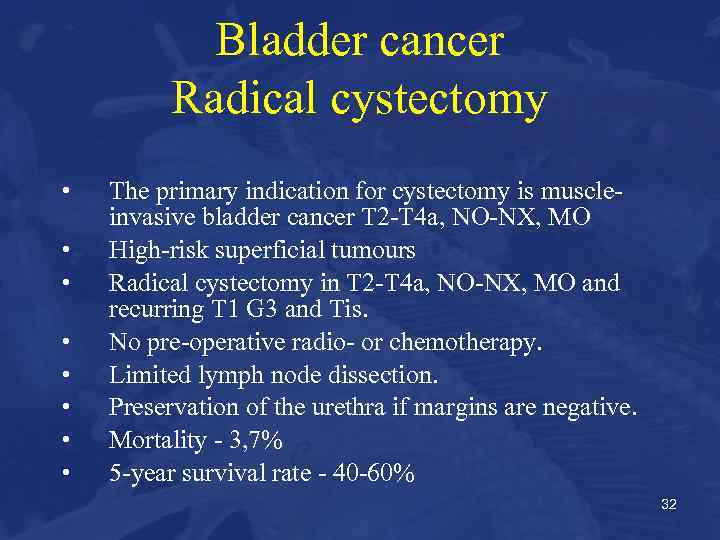
Bladder cancer Radical cystectomy • • The primary indication for cystectomy is muscleinvasive bladder cancer T 2 -T 4 a, NO-NX, MO High-risk superficial tumours Radical cystectomy in T 2 -T 4 a, NO-NX, MO and recurring T 1 G 3 and Tis. No pre-operative radio- or chemotherapy. Limited lymph node dissection. Preservation of the urethra if margins are negative. Mortality - 3, 7% 5 -year survival rate - 40 -60% 32
Urinary diversion after radical cystectomy • Three treatment options are presently considered after cystectomy: – An ileal conduit – A continent pouch – A bladder reconstruction 33
Urinary diversion after radical cystectomy Ileal conduit • The ileal conduit is a reliable treatment option with established efficacy. After long-term follow-up, however, 20% of patients develop stomal complications. The disadvantage of the ileal conduit is mainly cosmetic. 34
Urinary diversion after radical cystectomy Continent pouch • The principle of bowel detubularization • An anti-reflux and continence mechanism • The use of self-catheterization 35
Urinary diversion after radical cystectomy Bladder reconstruction • Bladder reconstruction or the orthotopic bladder operation has been performed in men for more than a decade, and also, more recently, in women. The reservoir is anastomized to the top of the urethra and the main advantage is that no stoma is necessary 36
Radiotherapy • Radiotherapy with curative intent and the aim of bladder preservation is performed in T 1 -T 4, NO, MO transitional cell bladder cancer • Patients who are suitable for this treatment should have: adequate bladder capacity; normal bladder function; and no recurrent urinary infections, previous inflammation or surgery of the true pelvis with consecutive adhesion 37
Prognostic factors • The 5 -year survival rate after definitive external beam radiotherapy is reported for: – T 1 – 60 -80% – T 2 – 26 -59% – T 3 – 20 -38% 38
Chemotherapy • Following cystectomy for muscle-invasive bladder carcinoma, up to 50% of patients may develop metastases. This most often occurs within 2 years. Most patients relapse at distant sites; one-fourth of patients relapse at the pelvis alone. Response rates of 40 -70% with cisplatin-containing combination regimens have led to their use for the treatment of locally invasive disease in combination with cystectomy or radiotherapy, either as neo-adjuvant or adjuvant therapy. 39
Скачать презентацию Общая цель Быть способным сформулировать предварительный опухолей почек
Опухоли почек.ppt