 Скачать презентацию Observe-Analyze-Act Paradigm for Storage System Resource Arbitration Li
ac64a031959a05bc5c8361dd71d646f7.ppt
- Количество слайдов: 23



Observe-Analyze-Act Paradigm for Storage System Resource Arbitration Li Yin 1 Email: yinli@eecs. berkeley. edu Joint work with: Sandeep Uttamchandani 2 Guillermo Alvarez 2 John Palmer 2 Randy Katz 1 1: University of California, Berkeley 2: IBM Almaden Research Center
Outline l Observe-analyze-act in storage system: CHAMELEON ¡ ¡ l Observe-analyze-act in other scenarios ¡ l Motivation System model and architecture Design details Experimental results Example: network applications Future challenges
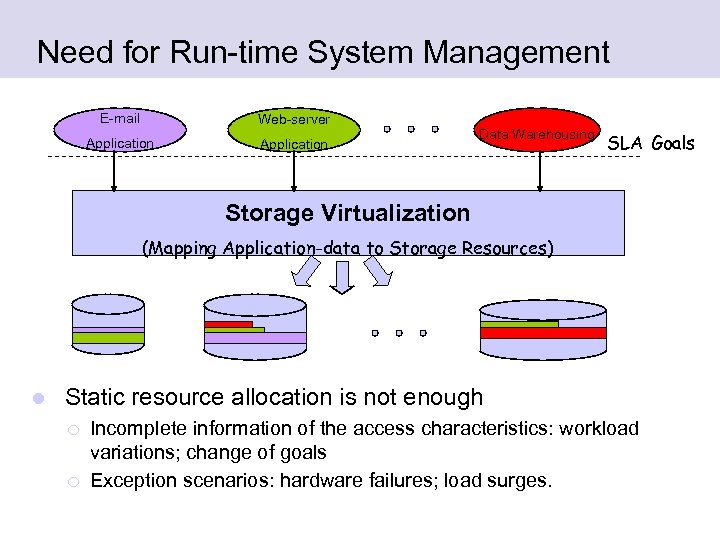
Need for Run-time System Management E-mail Web-server Application Data Warehousing SLA Goals Storage Virtualization (Mapping Application-data to Storage Resources) l Static resource allocation is not enough ¡ ¡ Incomplete information of the access characteristics: workload variations; change of goals Exception scenarios: hardware failures; load surges.
Approaches for Run-time Storage System Management Today: Administrator observe-analyze-act l Automate the observe-analyze-act: l ¡ Rule-based system l l ¡ Pure feedback-based system l ¡ Complexity Brittleness Infeasible for real-world multi-parameter tuning Model-based approaches l Challenges: • How to represent system details as models? • How to create/evolve models? • How to use models for decision making?
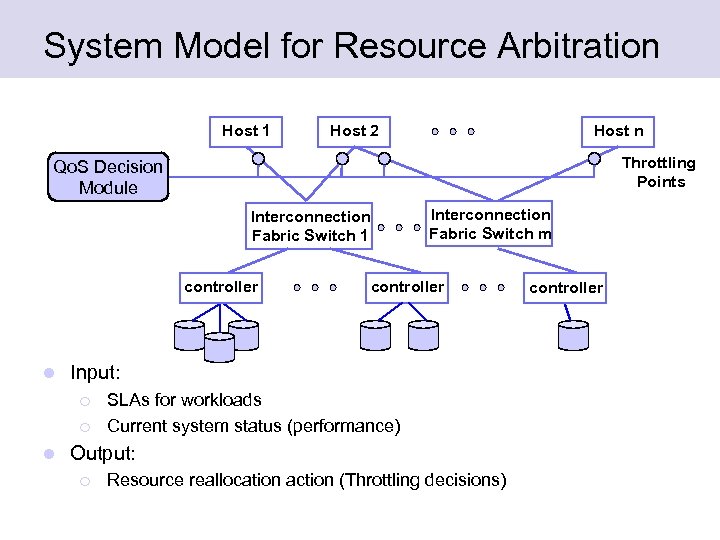
System Model for Resource Arbitration Host 1 Host 2 Host n Throttling Points Qo. S Decision Module Interconnection Fabric Switch 1 controller l controller Input: ¡ ¡ l Interconnection Fabric Switch m SLAs for workloads Current system status (performance) Output: ¡ Resource reallocation action (Throttling decisions) controller
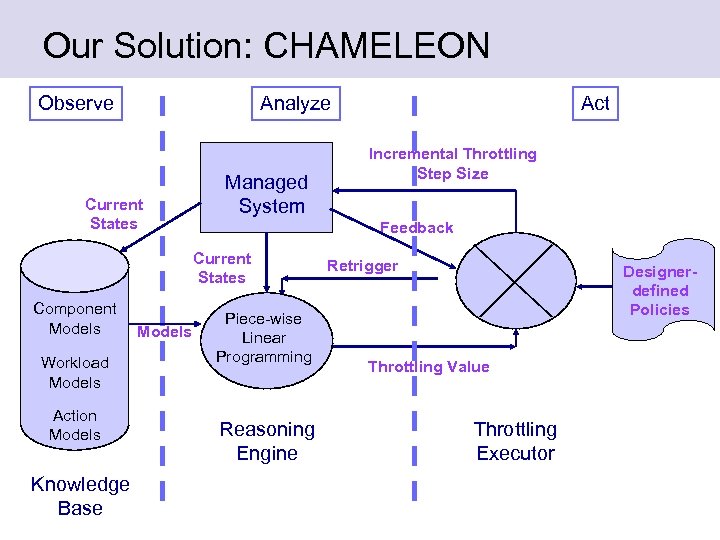
Our Solution: CHAMELEON Observe Analyze Current States Managed System Workload Models Action Models Knowledge Base Models Incremental Throttling Step Size Feedback Current States Component Models Act Piece-wise Linear Programming Reasoning Engine Retrigger Designerdefined Policies Throttling Value Throttling Executor
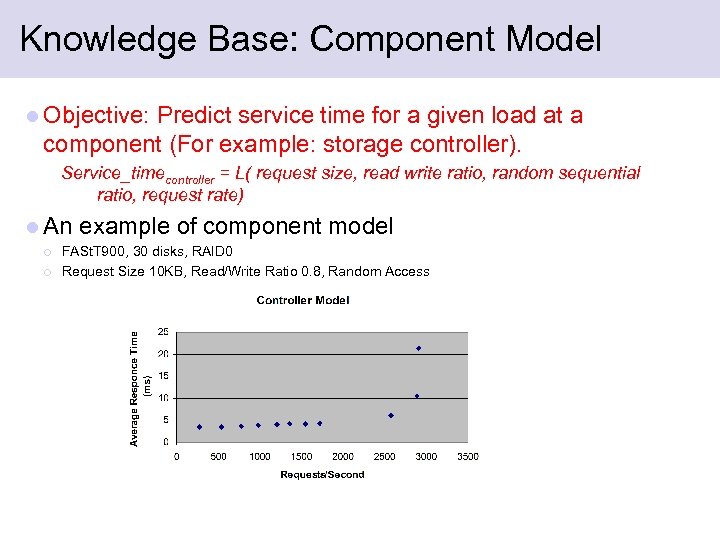
Knowledge Base: Component Model l Objective: Predict service time for a given load at a component (For example: storage controller). Service_timecontroller = L( request size, read write ratio, random sequential ratio, request rate) l An ¡ ¡ example of component model FASt. T 900, 30 disks, RAID 0 Request Size 10 KB, Read/Write Ratio 0. 8, Random Access
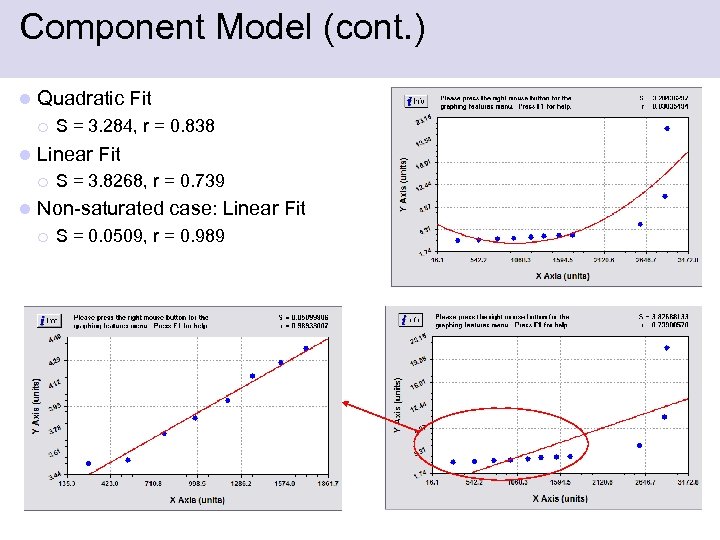
Component Model (cont. ) l Quadratic Fit ¡ l Linear Fit ¡ l S = 3. 284, r = 0. 838 S = 3. 8268, r = 0. 739 Non-saturated case: Linear Fit ¡ S = 0. 0509, r = 0. 989
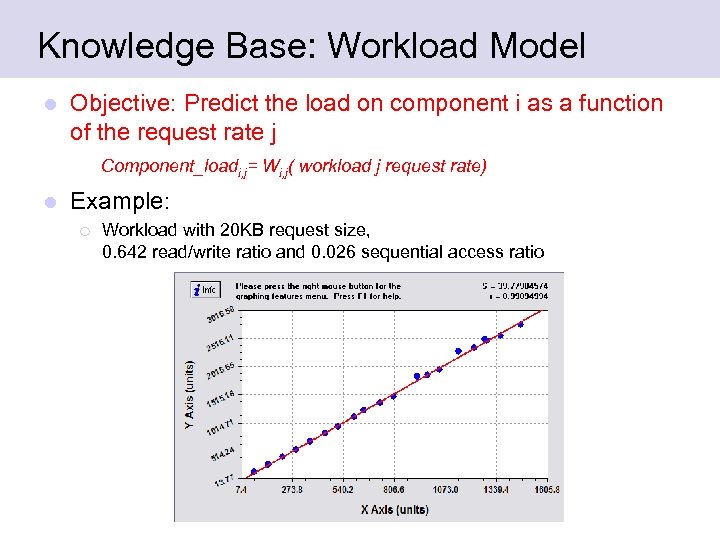
Knowledge Base: Workload Model l Objective: Predict the load on component i as a function of the request rate j Component_loadi, j= Wi, j( workload j request rate) l Example: ¡ Workload with 20 KB request size, 0. 642 read/write ratio and 0. 026 sequential access ratio
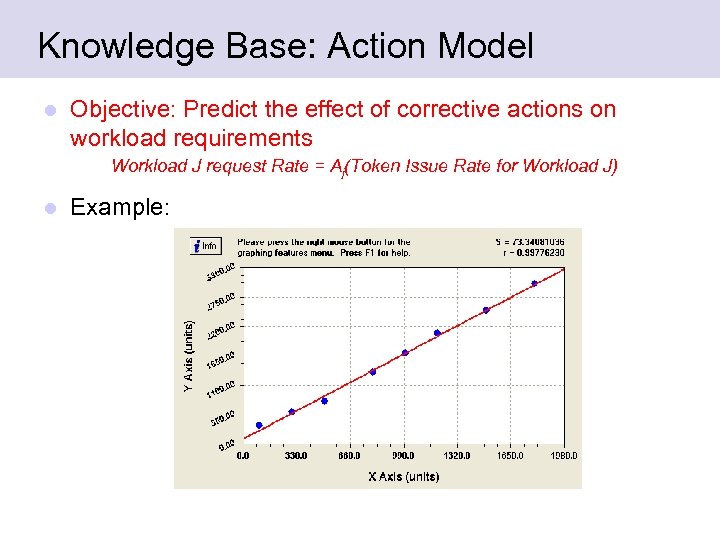
Knowledge Base: Action Model l Objective: Predict the effect of corrective actions on workload requirements Workload J request Rate = Aj(Token Issue Rate for Workload J) l Example:
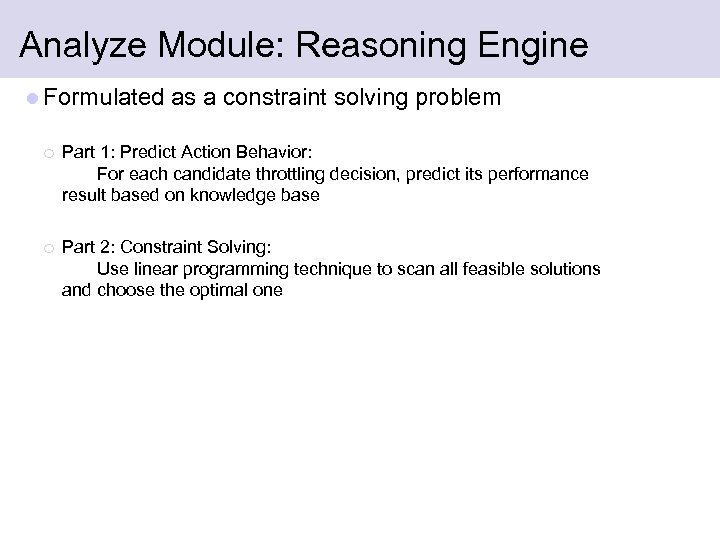
Analyze Module: Reasoning Engine l Formulated as a constraint solving problem ¡ Part 1: Predict Action Behavior: For each candidate throttling decision, predict its performance result based on knowledge base ¡ Part 2: Constraint Solving: Use linear programming technique to scan all feasible solutions and choose the optimal one
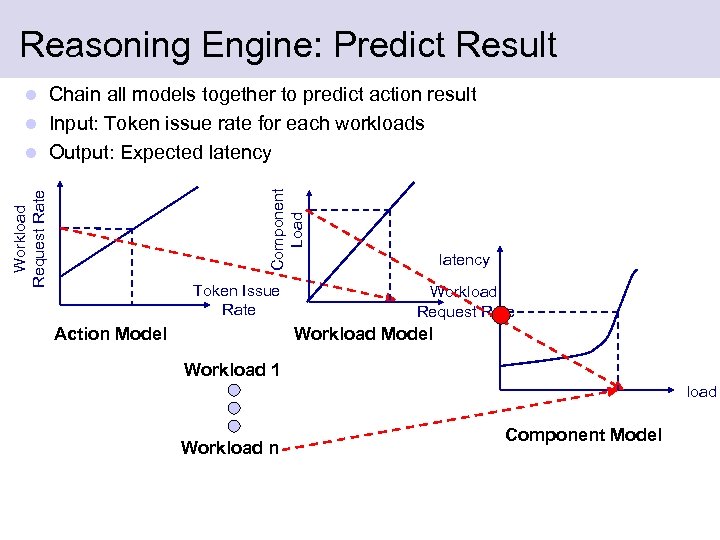
Reasoning Engine: Predict Result Chain all models together to predict action result l Input: Token issue rate for each workloads l Output: Expected latency Workload Request Rate Component Load l Token Issue Rate Action Model latency Workload Request Rate Workload Model Workload 1 load Workload n Component Model
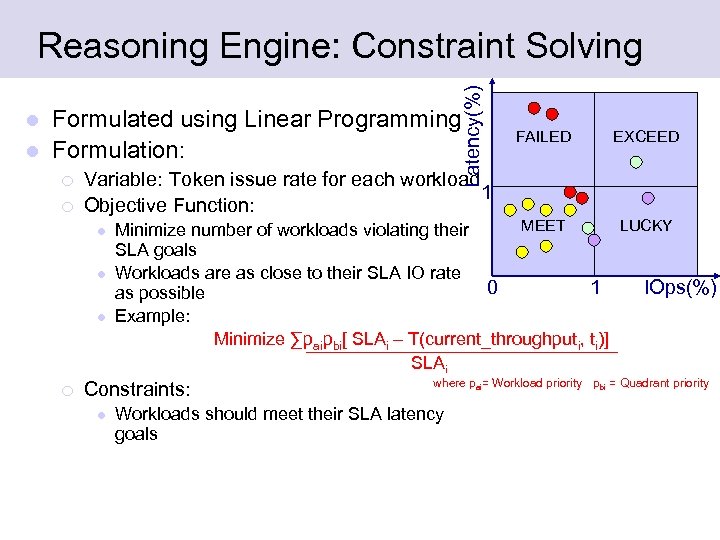
Latency(%) Reasoning Engine: Constraint Solving Formulated using Linear Programming l Formulation: l ¡ ¡ EXCEED Variable: Token issue rate for each workload 1 Objective Function: l l l ¡ FAILED MEET LUCKY Minimize number of workloads violating their SLA goals Workloads are as close to their SLA IO rate 1 IOps(%) 0 as possible Example: Minimize ∑paipbi[ SLAi – T(current_throughputi, ti)] SLAi Constraints: l where pai= Workload priority pbi = Quadrant priority Workloads should meet their SLA latency goals
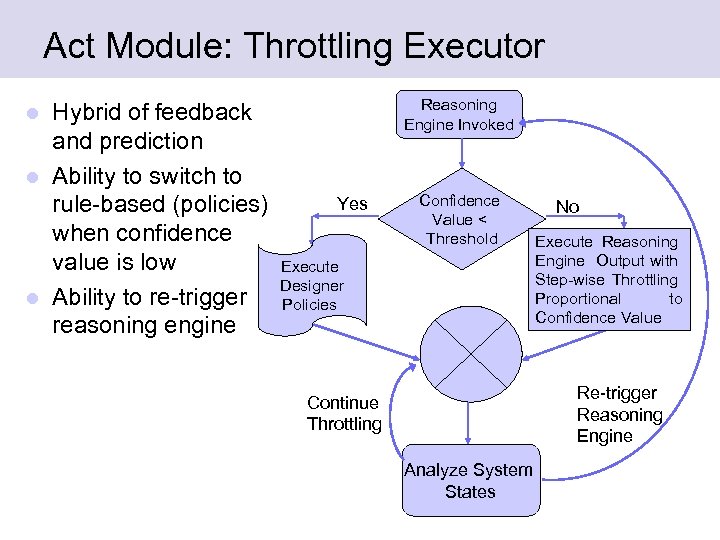
Act Module: Throttling Executor Hybrid of feedback and prediction l Ability to switch to rule-based (policies) when confidence value is low l Ability to re-trigger reasoning engine Reasoning Engine Invoked l Yes Confidence Value < Threshold Execute Designer Policies No Execute Reasoning Engine Output with Step-wise Throttling Proportional to Confidence Value Re-trigger Reasoning Engine Continue Throttling Analyze System States
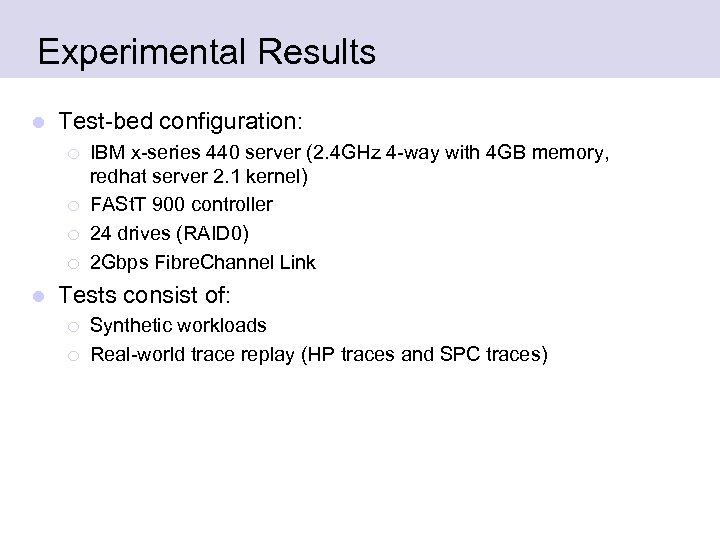
Experimental Results l Test-bed configuration: ¡ ¡ l IBM x-series 440 server (2. 4 GHz 4 -way with 4 GB memory, redhat server 2. 1 kernel) FASt. T 900 controller 24 drives (RAID 0) 2 Gbps Fibre. Channel Link Tests consist of: ¡ ¡ Synthetic workloads Real-world trace replay (HP traces and SPC traces)
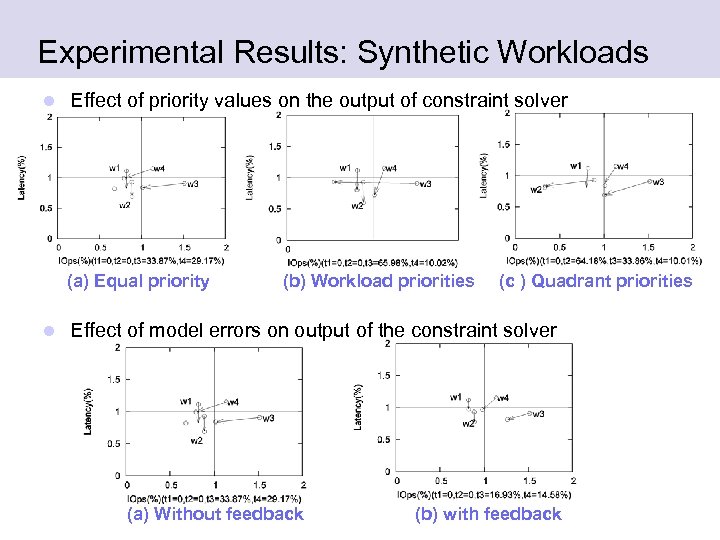
Experimental Results: Synthetic Workloads l Effect of priority values on the output of constraint solver (a) Equal priority l (b) Workload priorities (c ) Quadrant priorities Effect of model errors on output of the constraint solver (a) Without feedback (b) with feedback
Experiment Result: Real-world Trace Replay Real-world block-level traces from HP (cello 96 trace) and SPC (web server) l A phased synthetic workload acts as the third flow l Test goals: l ¡ ¡ ¡ Do they converge to SLAs? How reactive the system is? How does CHAMELEON handle unpredictable variations?
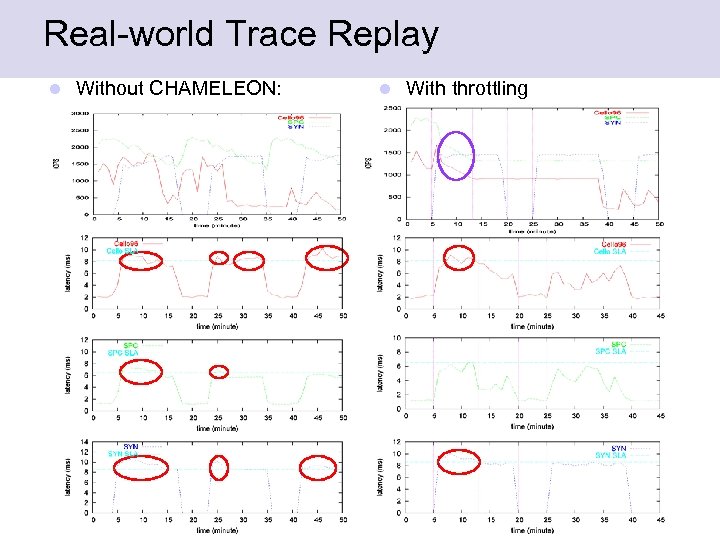
Real-world Trace Replay l Without CHAMELEON: l With throttling
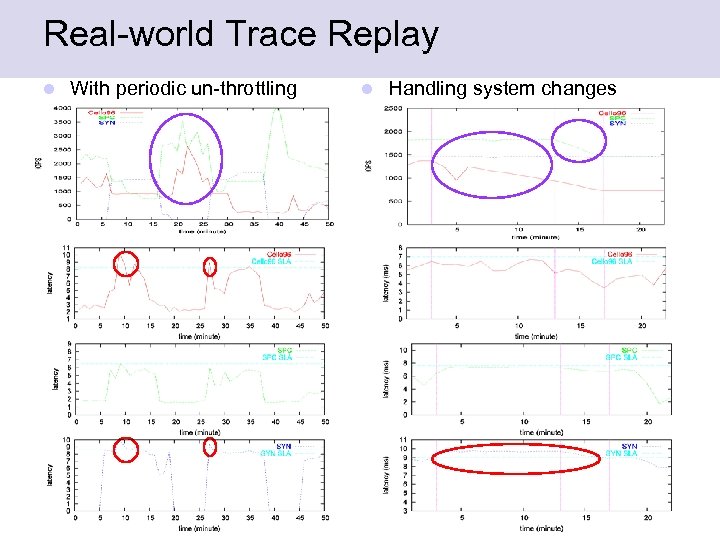
Real-world Trace Replay l With periodic un-throttling l Handling system changes
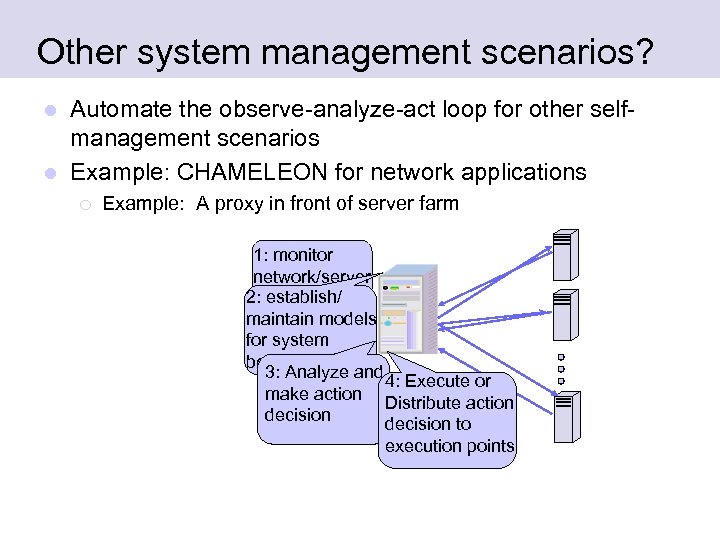
Other system management scenarios? Automate the observe-analyze-act loop for other selfmanagement scenarios l Example: CHAMELEON for network applications l ¡ Example: A proxy in front of server farm 1: monitor network/server 2: establish/ behaviors maintain models for system behaviors 3: Analyze and 4: Execute or make action Distribute action decision to execution points
Future Work l l l Better methods to improve model accuracy More general constraint solver Combining with other actions CHAMELEON in other scenarios CHAMELEON for reliability and failure
References L. Yin, S. Uttamchandani, J. Palmer, R. Katz, G. Agha, “AUTOLOOP: Automated Action Selection in the ``Observe-Analyze-Act’’ Loop for Storage Systems”, submitted for publication, 2005 l S. Uttamchandani, L. Yin, G. Alvarez, J. Palmer, G. Agha, “CHAMELEON: a self-evovling, fully-adaptive resource arbitrator for storage systems”, to appear in USENIX Annual Technical Conference (USENIX’ 05), 2005 l S. Uttamchandani, K. Voruganti, S. Srinivasan, J. Palmer , D. Pease, “Polus: Growing Storage Qo. S Management beyond a 4 -year old kid”, 3 rd USENIX Conference on File and Storage Technologies (FAST’ 04), 2004 l

Questions? Email: yinli@eecs. berkeley. edu
Скачать презентацию Observe-Analyze-Act Paradigm for Storage System Resource Arbitration Li
ac64a031959a05bc5c8361dd71d646f7.ppt