 Скачать презентацию Obligations of Contractors and Their Employees under the
1a264f529a564c78cc59d836f914daf8.ppt
- Количество слайдов: 46



Obligations of Contractors and Their Employees under the FARs (and the Effect of Same on Federal Government Employees) Randy L. New Kitchens New Cleghorn LLC, Attorneys at Law November 13, 2013
Purpose of this Presentation l l Educate Contractors and their employees so that they better know: – The legal and ethical obligations that those contractors owe to the USG. – The business rules and processes that must be established and must exist inside their own organizations to prevent employee misconduct. – The civil and criminal penalties that exist for failure to act ethically and in accordance with law. Educate federal government procurement officers and employees so that they know: – The key ethical obligations that all government contractors owe the USG and its officers and employees. – The obligations which responsible government contractors should have communicated to their employees. – How to help government contractors help themselves to not violate the rules.
The Actors in the USG Contracting Universe l l l The USG and its procurement focused personnel. The USG contractor. The contractor’s employees, whether following instructions or violating company policy.
The Value of the USG as a Customer l l l It is (or believes it is) THE Marquee Client. The USG Client Further Ratifies the Contractors Services and Products to Commercial Customers. Significant Revenue Potential (perhaps margin limited). Longer Term Contracts and High Contract Stability. No Credit Risk.
BUT, the USG Customer Presents a Unique Set of Challenges for Contractors l l The Federal Acquisition Regulations (FARs) govern the award and administration of USG contracts for services and products. The FARs provide extensive rules for the conduct of USG contracting by all federal agencies and by all contractors. The USG contracting officer has some discretion about what FAR rules apply BUT not much. USG contractors have NO discretion at all to comply with applicable FARs.
The FARs’ Effect on the Normal Contractor Business Model is Large l l The FARs override and supplement the terms and condition in contractors “normal” contracts and commercial paper. The FARs impose public policy obligations upon contractors. The FARs forbid the types of relationshipdevelopment activities with USG clients that are common in the commercial markets. The FARs impose criminal and civil penalties for noncompliance with its provisions.
The FARs Comprehensively Restructure “Normal Business Behavior” of Contractors and EVEN Subcontractors of a Contractor l l One federal contract of any size triggers the FARs requirements. The FARs apply to any subcontractors of USG contractors. Indeed, a federal contractor MUST flow down all FARs requirements that it has accepted to ALL of its subcontractors. “Subcontract” means any contract entered into by a subcontractor to furnish supplies or services “for performance of” a prime contract or a subcontract. “Subcontractor” means any supplier, distributor, vendor, or firm that furnished supplies or services to or for a prime contractor or another subcontractor.
How the FARs Affect Contractors 1. 2. 3. 4. Implied contract terms. Mandated contract processes. Mandated social contract obligations. Business governance requirement.
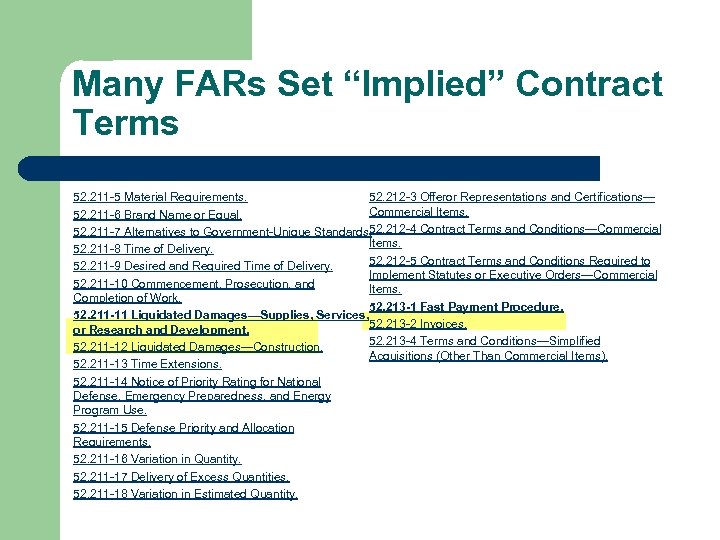
Many FARs Set “Implied” Contract Terms 52. 212 -3 Offeror Representations and Certifications— 52. 211 -5 Material Requirements. Commercial Items. 52. 211 -6 Brand Name or Equal. 52. 212 -4 Contract Terms and Conditions—Commercial 52. 211 -7 Alternatives to Government-Unique Standards. Items. 52. 211 -8 Time of Delivery. 52. 212 -5 Contract Terms and Conditions Required to 52. 211 -9 Desired and Required Time of Delivery. Implement Statutes or Executive Orders—Commercial 52. 211 -10 Commencement, Prosecution, and Items. Completion of Work. 52. 213 -1 Fast Payment Procedure. 52. 211 -11 Liquidated Damages—Supplies, Services, 52. 213 -2 Invoices. or Research and Development. 52. 213 -4 Terms and Conditions—Simplified 52. 211 -12 Liquidated Damages—Construction. Acquisitions (Other Than Commercial Items). 52. 211 -13 Time Extensions. 52. 211 -14 Notice of Priority Rating for National Defense, Emergency Preparedness, and Energy Program Use. 52. 211 -15 Defense Priority and Allocation Requirements. 52. 211 -16 Variation in Quantity. 52. 211 -17 Delivery of Excess Quantities. 52. 211 -18 Variation in Estimated Quantity.
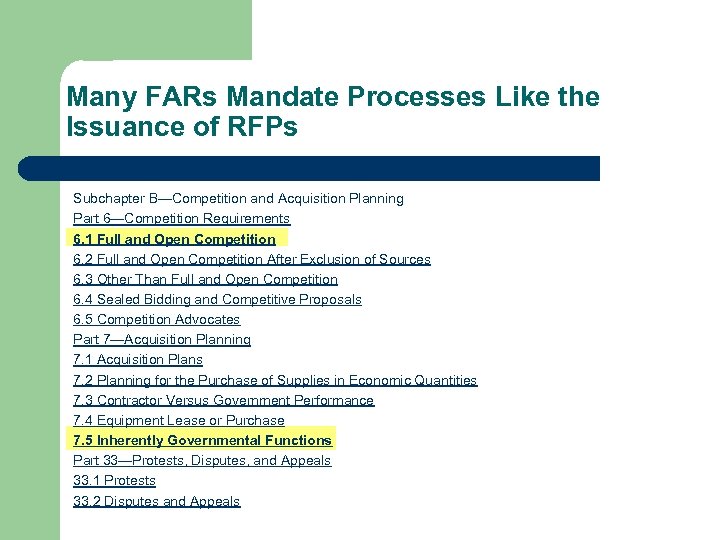
Many FARs Mandate Processes Like the Issuance of RFPs Subchapter B—Competition and Acquisition Planning Part 6—Competition Requirements 6. 1 Full and Open Competition 6. 2 Full and Open Competition After Exclusion of Sources 6. 3 Other Than Full and Open Competition 6. 4 Sealed Bidding and Competitive Proposals 6. 5 Competition Advocates Part 7—Acquisition Planning 7. 1 Acquisition Plans 7. 2 Planning for the Purchase of Supplies in Economic Quantities 7. 3 Contractor Versus Government Performance 7. 4 Equipment Lease or Purchase 7. 5 Inherently Governmental Functions Part 33—Protests, Disputes, and Appeals 33. 1 Protests 33. 2 Disputes and Appeals
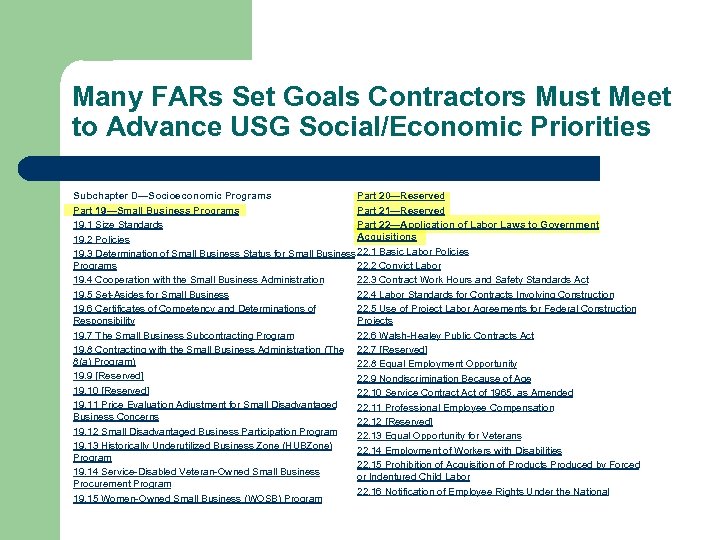
Many FARs Set Goals Contractors Must Meet to Advance USG Social/Economic Priorities Subchapter D—Socioeconomic Programs Part 20—Reserved Part 19—Small Business Programs Part 21—Reserved Part 22—Application of Labor Laws to Government 19. 1 Size Standards Acquisitions 19. 2 Policies 19. 3 Determination of Small Business Status for Small Business 22. 1 Basic Labor Policies 22. 2 Convict Labor Programs 22. 3 Contract Work Hours and Safety Standards Act 19. 4 Cooperation with the Small Business Administration 22. 4 Labor Standards for Contracts Involving Construction 19. 5 Set-Asides for Small Business 22. 5 Use of Project Labor Agreements for Federal Construction 19. 6 Certificates of Competency and Determinations of Projects Responsibility 22. 6 Walsh-Healey Public Contracts Act 19. 7 The Small Business Subcontracting Program 19. 8 Contracting with the Small Business Administration (The 22. 7 [Reserved] 8(a) Program) 22. 8 Equal Employment Opportunity 19. 9 [Reserved] 22. 9 Nondiscrimination Because of Age 19. 10 [Reserved] 22. 10 Service Contract Act of 1965, as Amended 19. 11 Price Evaluation Adjustment for Small Disadvantaged 22. 11 Professional Employee Compensation Business Concerns 22. 12 [Reserved] 19. 12 Small Disadvantaged Business Participation Program 22. 13 Equal Opportunity for Veterans 19. 13 Historically Underutilized Business Zone (HUBZone) 22. 14 Employment of Workers with Disabilities Program 22. 15 Prohibition of Acquisition of Products Produced by Forced 19. 14 Service-Disabled Veteran-Owned Small Business or Indentured Child Labor Procurement Program 22. 16 Notification of Employee Rights Under the National 19. 15 Women-Owned Small Business (WOSB) Program
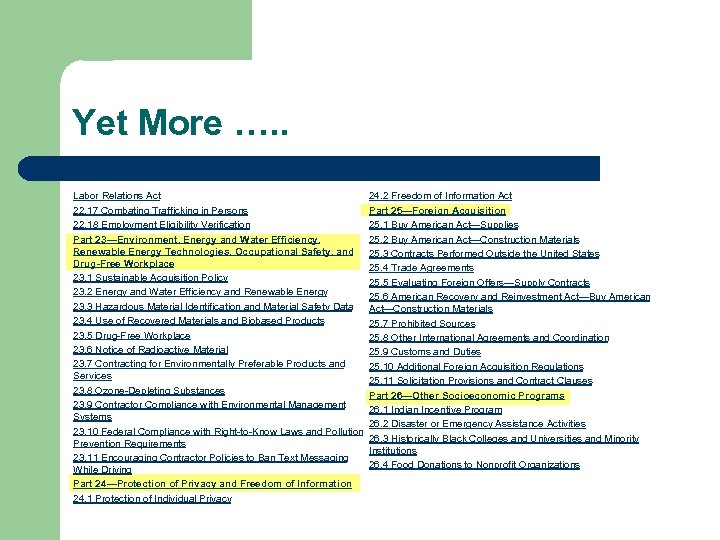
Yet More …. . Labor Relations Act 22. 17 Combating Trafficking in Persons 22. 18 Employment Eligibility Verification Part 23—Environment, Energy and Water Efficiency, Renewable Energy Technologies, Occupational Safety, and Drug-Free Workplace 23. 1 Sustainable Acquisition Policy 23. 2 Energy and Water Efficiency and Renewable Energy 23. 3 Hazardous Material Identification and Material Safety Data 23. 4 Use of Recovered Materials and Biobased Products 23. 5 Drug-Free Workplace 23. 6 Notice of Radioactive Material 23. 7 Contracting for Environmentally Preferable Products and Services 23. 8 Ozone-Depleting Substances 23. 9 Contractor Compliance with Environmental Management Systems 23. 10 Federal Compliance with Right-to-Know Laws and Pollution Prevention Requirements 23. 11 Encouraging Contractor Policies to Ban Text Messaging While Driving Part 24—Protection of Privacy and Freedom of Information 24. 1 Protection of Individual Privacy 24. 2 Freedom of Information Act Part 25—Foreign Acquisition 25. 1 Buy American Act—Supplies 25. 2 Buy American Act—Construction Materials 25. 3 Contracts Performed Outside the United States 25. 4 Trade Agreements 25. 5 Evaluating Foreign Offers—Supply Contracts 25. 6 American Recovery and Reinvestment Act—Buy American Act—Construction Materials 25. 7 Prohibited Sources 25. 8 Other International Agreements and Coordination 25. 9 Customs and Duties 25. 10 Additional Foreign Acquisition Regulations 25. 11 Solicitation Provisions and Contract Clauses Part 26—Other Socioeconomic Programs 26. 1 Indian Incentive Program 26. 2 Disaster or Emergency Assistance Activities 26. 3 Historically Black Colleges and Universities and Minority Institutions 26. 4 Food Donations to Nonprofit Organizations
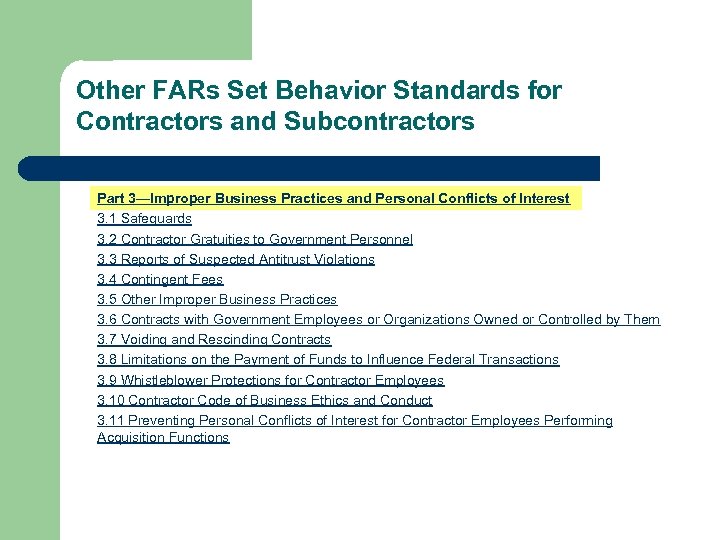
Other FARs Set Behavior Standards for Contractors and Subcontractors Part 3—Improper Business Practices and Personal Conflicts of Interest 3. 1 Safeguards 3. 2 Contractor Gratuities to Government Personnel 3. 3 Reports of Suspected Antitrust Violations 3. 4 Contingent Fees 3. 5 Other Improper Business Practices 3. 6 Contracts with Government Employees or Organizations Owned or Controlled by Them 3. 7 Voiding and Rescinding Contracts 3. 8 Limitations on the Payment of Funds to Influence Federal Transactions 3. 9 Whistleblower Protections for Contractor Employees 3. 10 Contractor Code of Business Ethics and Conduct 3. 11 Preventing Personal Conflicts of Interest for Contractor Employees Performing Acquisition Functions
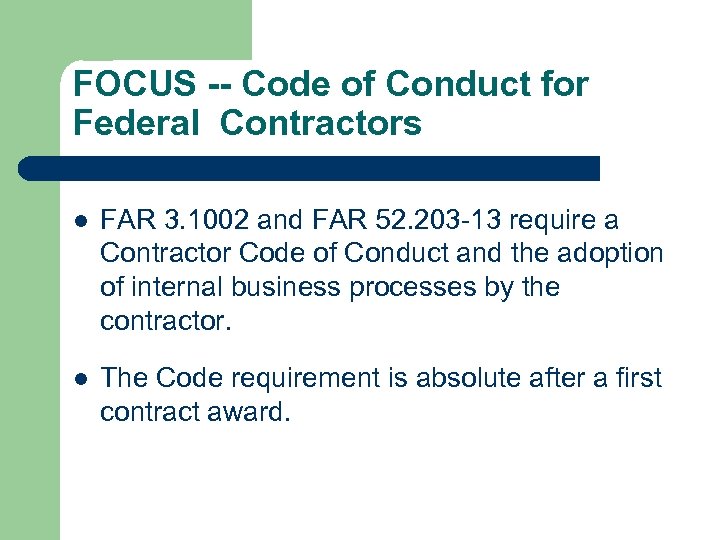
FOCUS -- Code of Conduct for Federal Contractors l FAR 3. 1002 and FAR 52. 203 -13 require a Contractor Code of Conduct and the adoption of internal business processes by the contractor. l The Code requirement is absolute after a first contract award.
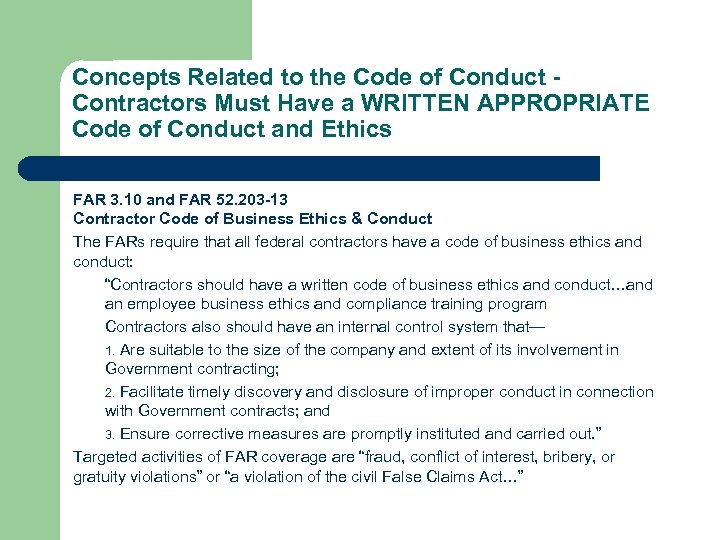
Concepts Related to the Code of Conduct Contractors Must Have a WRITTEN APPROPRIATE Code of Conduct and Ethics FAR 3. 10 and FAR 52. 203 -13 Contractor Code of Business Ethics & Conduct The FARs require that all federal contractors have a code of business ethics and conduct: “Contractors should have a written code of business ethics and conduct…and an employee business ethics and compliance training program Contractors also should have an internal control system that— 1. Are suitable to the size of the company and extent of its involvement in Government contracting; 2. Facilitate timely discovery and disclosure of improper conduct in connection with Government contracts; and 3. Ensure corrective measures are promptly instituted and carried out. ” Targeted activities of FAR coverage are “fraud, conflict of interest, bribery, or gratuity violations” or “a violation of the civil False Claims Act…”
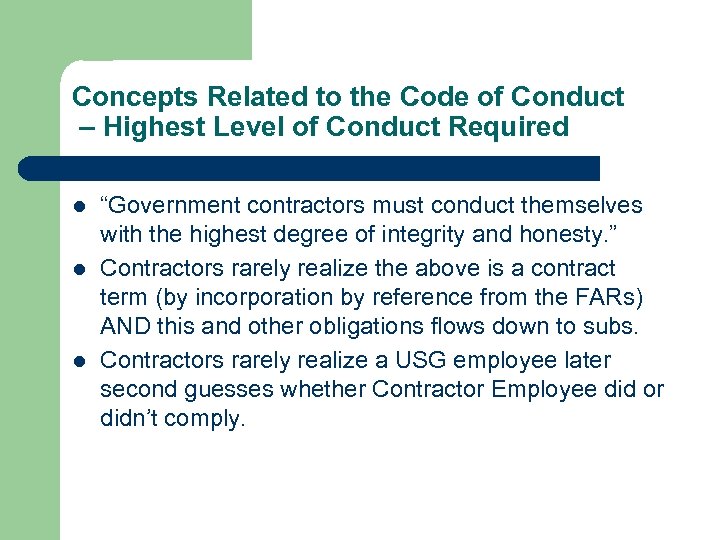
Concepts Related to the Code of Conduct – Highest Level of Conduct Required l l l “Government contractors must conduct themselves with the highest degree of integrity and honesty. ” Contractors rarely realize the above is a contract term (by incorporation by reference from the FARs) AND this and other obligations flows down to subs. Contractors rarely realize a USG employee later second guesses whether Contractor Employee did or didn’t comply.
Concepts Related to the Code of Conduct– Code of Conduct of Contractor is Required Reading by Employees l Contractors must always be ready to attest that their employees have read the Code of Conduct of Contractor and have agreed to follow same. l Note: Contractors also believe that having a Code of Conduct and making sure that every employee knows it and uses it affects the enforcement attitude of the USG when problems arise.
An Illustrative Code of Ethics <<Insert name of contractor>> (the “Company”) has adopted this Code of Ethics and Business Conduct (this “Code”) in accordance with Section 406(c) of the Sarbanes-Oxley Act of 2002 and NASDAQ Rule 4350(n) to establish standards of legal and ethical conduct for the officers, directors and employees of the Company and its subsidiaries. This Code applies to the Company’s Chief Executive Officer, Chief Financial Officer, Controller, financial managers and any person performing similar finance and accounting functions (collectively, the “Covered Executives”) as well as to all other officers, directors and employees of the company and its subsidiaries (collectively, the “Covered Personnel”). The Covered Executives hold an important and elevated role in corporate governance. They are uniquely positioned and empowered to ensure that the interest of the company and its stockholders are appropriately balanced, protected and preserved. This Code provides principles that the Covered Executives and Covered Personnel must adhere to, promoting honest and ethical conduct, proper disclosure of financial information in the Company’s periodic reports, and compliance with all applicable rules, law, and regulations.
An Illustrative Code of Ethics --General Obligations for Covered Executives and Covered Personnel In performing his or her duties, each of the Covered Executives and Covered Personnel should: l Act honestly and ethically, including without limitation, with regard to all conflicts of interest, whether actual or apparent, between personnel and professional relationships, and refrain from using his or her position for personal gain or competing directly or indirectly with the Company. l Disclose to the Compliance Officer or the Chief Executive Officer, in advance, if possible, any material relationship or transaction that could reasonably be expected to give rise to a conflict of interest. l Produce full, fair, accurate, complete, objective, timely and understandable disclosure in reports and documents that the Company files with, or submits to, the SEC, NASDAQ or any other government agency or self-regulatory organization, and in other public communications made by the Company or its subsidiaries. l Require that all Company financial practices concerning accounting, internal accounting controls and auditing matters meet the highest standards of professionalism, transparency and honesty.
An Illustrative Code of Ethics --General Obligations for Covered Executives and Covered Personnel In performing his or her duties, each of the Covered Executives and Covered Personnel should: l Take all reasonable measures to safeguard the confidentiality of non-public information about the company and its customers acquired in the course of employment, except when authorized or otherwise legally obligated to disclose. Confidential Information obtained in the course of work will not be used for personal advantage. l Act in good faith, responsibly, with due care, competence, diligence and without knowingly misrepresenting material facts or allowing his or her better judgment to be subordinated. l Comply with all applicable rules and regulations of federal, state and local governments, the SEC, NASDAQ and other appropriate private and public regulatory agencies. l Comply with the Company’s policies and procedures. l Responsibly use and control assets and other resources employed or entrusted to his or her supervision. l Promptly report any known violation of this code to the Compliance Officer.
Concepts Related to the Code of Conduct–– Training on the FAR Conduct Requirements is Mandatory Contractors must be able to attest that: 1. 2. All employees touching its USG business were trained as an employee who is involved in USG contracting; and If the employees had questions, their questions were asked answered.
Concepts Related to the Code of Conduct– Types of Training l l Extensive training is required on behaviors that are perfectly appropriate in business. Sales people in particular have to retrain on selling techniques.
Other Ethics-Related Prohibitions Overlay Contractor Behaviors l Numerous “Do’s and Don’ts” exist: l Contractor employee training is a constant requirement/burden.
Do’s and Don’ts – No Gratuities to USG Employees l l Contractor Employee cannot buy or provide to a USG employee anything of value. Common industry “rule” --- not so much as a cup of coffee. Note more generally that FARs can be used with “common” state and federal violations and crimes like bribery. Better contractors’ rule: No exceptions without general counsel and supervisor approval in advance.
Do’s and Don’ts – Antitrust Type Violations, Part 1 l l l Contractor Employee and employees cannot violate the antitrust laws without also violating the FARs and breaching the contract with the USG. “Agencies are required by 41 U. S. C. 253 b(i) and 10 U. S. C. 2305(b)(9) to report to the Attorney General any bids or proposals that evidence a violation of the antitrust laws. ” Note that the vagueness of antitrust laws means that competitors can use the FARs to their advantage.
Do’s and Don’ts – Antitrust Type Violations, Part 2 Practices or events that may evidence violations of the antitrust laws include— (1) The existence of an “industry price list” or “price agreement” to which contractors refer in formulating their offers; (2) A sudden change from competitive bidding to identical bidding; (3) Simultaneous price increases or follow-the-leader pricing; (4) Rotation of bids or proposals, so that each competitor takes a turn in sequence as low bidder, or so that certain competitors bid low only on some sizes of contracts and high on other sizes; (5) Division of the market, so that certain competitors bid low only for contracts let by certain agencies, or for contracts in certain geographical areas, or on certain products, and bid high on all other jobs;
Do’s and Don’ts – Antitrust Type Violations, Part 3 Practices or events that may evidence violations of the antitrust laws include— (6) Establishment by competitors of a collusive price estimating system; (7) The filing of a joint bid by two or more competitors when at least one of the competitors has sufficient technical capability and productive capacity for contract performance; (8) Any incidents suggesting direct collusion among competitors, such as the appearance of identical calculation or spelling errors in two or more competitive offers or the submission by one firm of offers for other firms; and (9) Assertions by the employees, former employees, or competitors of offerers, that an agreement to restrain trade exists.
Do’s and Don’ts – Contingency Payments to Any Person l l l Employees cannot engage any person to help with a USG contract using a contingency fee arrangement. “Contingent fee” means any commission, percentage, brokerage, or other fee that is contingent upon the success that a person or concern has in securing a USG contract. So, how do federal contractors pay sales people a commission?
Do’s and Don’ts – Contingency Payments to Any Person l There is an exception for bona fide employees and bona fide agencies: – – – “Bona fide employee” means a person, employed by a contractor and subject to the contractor’s supervision and control as to time, place, and manner of performance, who neither exerts nor proposes to exert improper influence to solicit or obtain USG contracts nor holds out as being able to obtain any USG contract or contracts through improper influence. “Bona fide agency” means an established commercial or selling agency, maintained by a contractor for the purpose of securing business, that neither exerts nor proposes to exert improper influence to solicit or obtain USG contracts nor holds itself out as being able to obtain any USG contract or contracts through improper influence. “Improper influence” means any influence that induces or tends to induce a USG employee or officer to give consideration or to act regarding a USG contract on any basis other than the merits of the matter.
Do’s and Don’ts – Buying In l l Contractor Employee cannot “buy in. ” What is buying in? “Buying in” is submitting an offer to the USG expecting later to: – 1. Increase the contract amount after award (e. g. , through unnecessary or excessively priced change orders); or – 2. Receive follow-on contracts at artificially high prices to recover losses incurred on the buy-in contract.
Do’s and Don’ts – Kickbacks l l Contractor Employee cannot offer a subcontractor a kickback if the contractors are prime to them. What is a kickback? “Kickback” means any money, fee, commission, credit, gift, gratuity, thing of value, or compensation of any kind which is provided, directly or indirectly, to any prime contractor, prime contractor employee, subcontractor, or subcontractor employee for the purpose of improperly obtaining or rewarding favorable treatment in connection with a prime contract or in connection with a subcontract relating to a prime contract. l Note that state and federal law can reach other types of kickbacks under common criminal actions.
Do’s and Don’ts – Prohibiting Direct Sales l A prime cannot “unreasonably” preclude a sub from making direct sales to the USG though the contractor can “otherwise assert rights otherwise authorized by law or regulation. ” l The stated exception would rarely apply.
Do’s and Don’ts – Government Employee Owned Companies l A contracting officer of the USG cannot knowingly award business to a company owned or controlled by a USG employee or employees. l And Contractor Employee cannot assist same.
A “Don’t” in the FARs and A Separate Statute - the False Claim Act 31 U. S. C. §§ 3729 -3733 and FAR 3. 1003(a)(2) require federal contractors to comply with and report violations of the civil False Claims Act. = A “false claim” is a demand or request for payment sent to the USG that is factually wrong in amount or description or for services that have not been delivered or which includes work from a subcontractor that is similarly wrong or inflated. =
Qui Tam: Making Plaintiffs’ Lawyers Drool Since 1863 = = = The Civil False Claims Act is different from other suspected violations Contractor Employee must report because under its “qui tam” provision, the law also allows private individuals to SECRETLY file a fraud suit if they have good cause to suspect fraud. Once the suit is filed, the Dept. of Justice investigates, and THEN notifies the company about the suit. (Surprise!) If the court finds there was fraud, the USG gives that individual up to 30% of whatever the government collects as a reward for providing information and participating in the case.
THE FLIP SIDE OF THE CONTRACTOR FOCUS l What do government employees hear about the risks of interacting with USG contractors?
Government and Contractor Employee Interaction: Appropriate and Effective Interaction with Our AFSPC Mission Partners HQ AFSPC/MSK August 2005 37
Facts, Rules and Risks • Inappropriate gov’t/contractor relationships may cause: – – – Contractors to “over-offer” in order to generate business Government employee to inadvertently commit the Government Embarrassment to Commands during a ratification Legal implications, to include lawsuits IMPACT TO MISSION resulting from misused funds and wasted resources on ratifications or disciplinary action – p. s. This symbol in this presentation denotes a key point • Uniformed and civil service employees must keep an “arms length” relationship with contractor employees. • The APPEARANCE of inappropriate behavior is the same as the behavior itself. Perception can be reality.
Who’s Who in the Workplace: Contractor ID Contractor identification is key to avoiding problems Contractor personnel must wear obvious identification. Nearly all service contracts specifically require contractor personnel to wear conspicuous badges. If Contractor Employee don’t know, ASK! Identify contractors in telephone conversations, meetings and all written correspondence, including e-mail (per AFI 33 -119, paragraph 5. 3). Many contractor personnel are retired military/civil service employees. Both government employees and contractors must realize their professional relationship has changed - especially when dealing with sensitive or “FOUO” information.
Ramifications That May Be Triggered • • Misuse of Appropriations (Anti-deficiency Act violations) Trade Secrets Act Violations Procurement Integrity Act Violations Standards of Conduct Violations – – – Conflicts of Interest Gift rules Preferential treatment Unauthorized commitments Endorsements Preserve and protect government property/resources
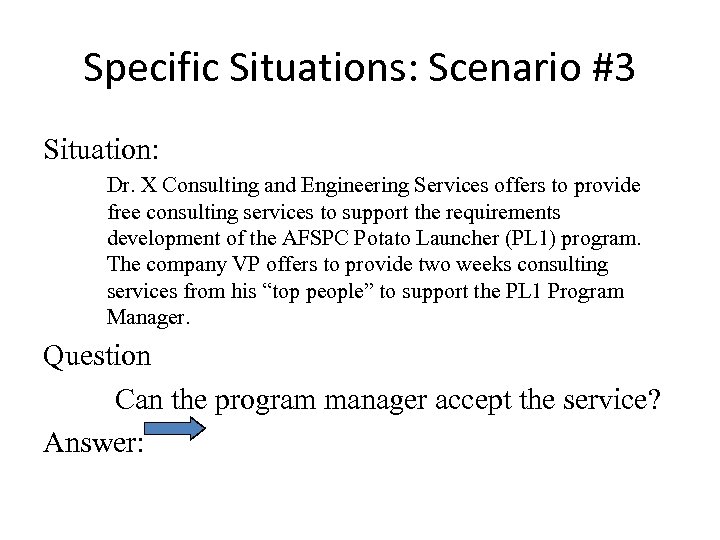
Specific Situations: Scenario #3 Situation: Dr. X Consulting and Engineering Services offers to provide free consulting services to support the requirements development of the AFSPC Potato Launcher (PL 1) program. The company VP offers to provide two weeks consulting services from his “top people” to support the PL 1 Program Manager. Question Can the program manager accept the service? Answer:
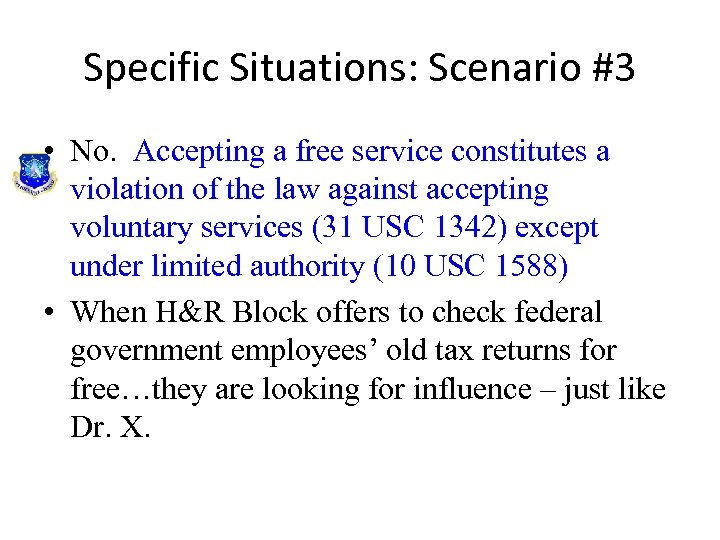
Specific Situations: Scenario #3 • No. Accepting a free service constitutes a violation of the law against accepting voluntary services (31 USC 1342) except under limited authority (10 USC 1588) • When H&R Block offers to check federal government employees’ old tax returns for free…they are looking for influence – just like Dr. X.
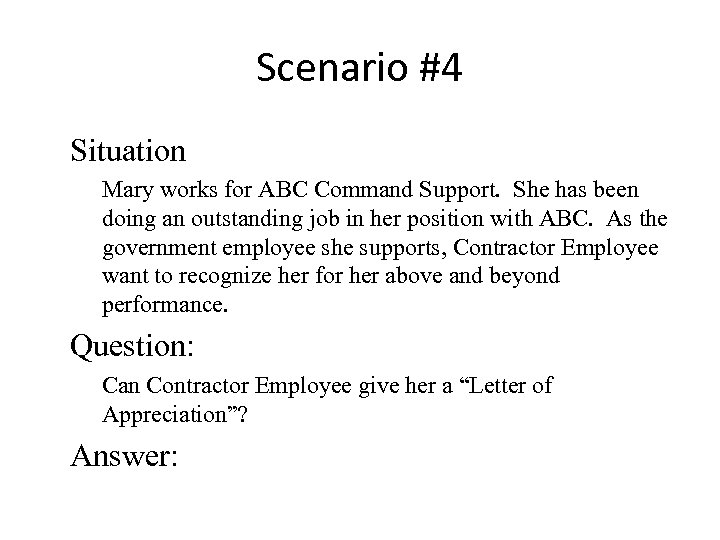
Scenario #4 Situation Mary works for ABC Command Support. She has been doing an outstanding job in her position with ABC. As the government employee she supports, Contractor Employee want to recognize her for her above and beyond performance. Question: Can Contractor Employee give her a “Letter of Appreciation”? Answer:
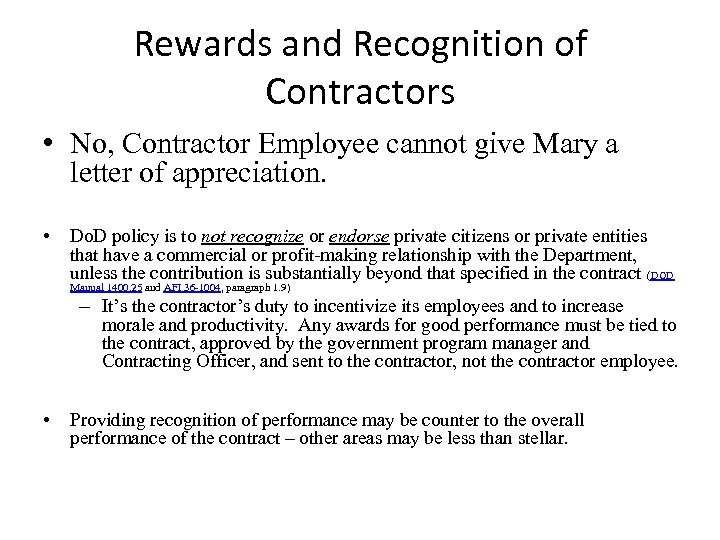
Rewards and Recognition of Contractors • No, Contractor Employee cannot give Mary a letter of appreciation. • Do. D policy is to not recognize or endorse private citizens or private entities that have a commercial or profit-making relationship with the Department, unless the contribution is substantially beyond that specified in the contract (DOD Manual 1400. 25 and AFI 36 -1004, paragraph 1. 9) – It’s the contractor’s duty to incentivize its employees and to increase morale and productivity. Any awards for good performance must be tied to the contract, approved by the government program manager and Contracting Officer, and sent to the contractor, not the contractor employee. • Providing recognition of performance may be counter to the overall performance of the contract – other areas may be less than stellar.
The Basics
Questions?
Скачать презентацию Obligations of Contractors and Their Employees under the
1a264f529a564c78cc59d836f914daf8.ppt