 Скачать презентацию Objectives To master the vocabulary of personality
22a0d0efe198817ebff3626007c92b26.ppt
- Количество слайдов: 102



Objectives • To master the vocabulary of personality description & to gain an in-depth view of your personality • To reflect on your weak points to improve your personality • To improve reading, speaking, translating and writing skills in activities related to theme of personality
Personality
What will we do today? Knowledge: ---to know the vocabulary of personalities ---to know the terms in western zodiacs Skills ---to describe significant personalities for each zodiac ---to learn translation of past participle structure
Task : Can star signs tell our personality traits? Do you know which zodiac sign you were born under? Take a look at the following pictures
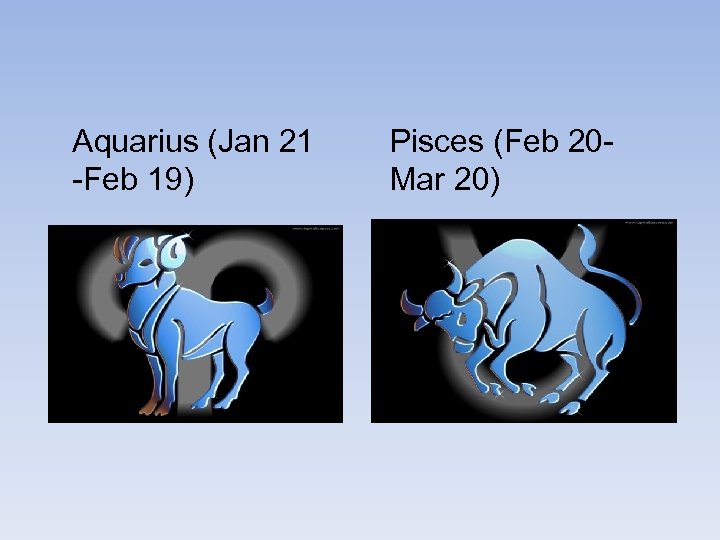
Aquarius (Jan 21 -Feb 19) Pisces (Feb 20 Mar 20)
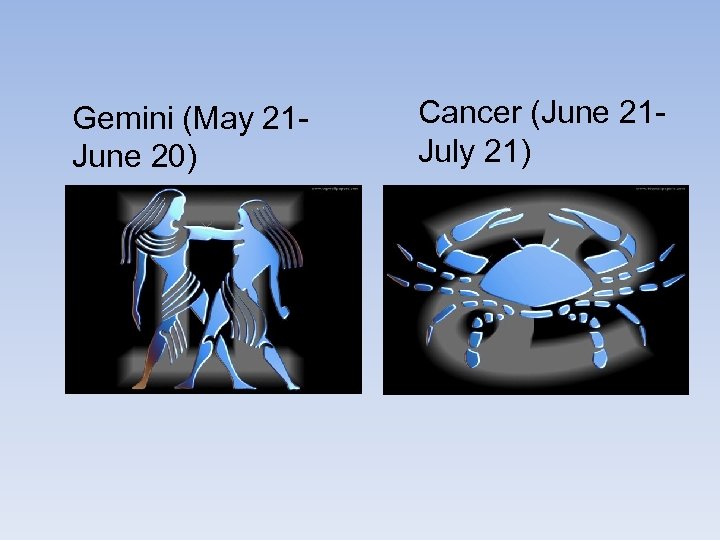
Gemini (May 21 June 20) Cancer (June 21 July 21)
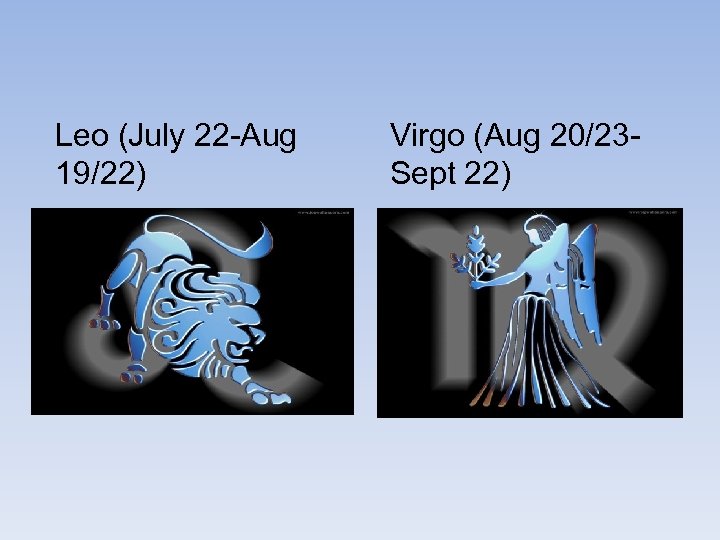
Leo (July 22 -Aug 19/22) Virgo (Aug 20/23 Sept 22)
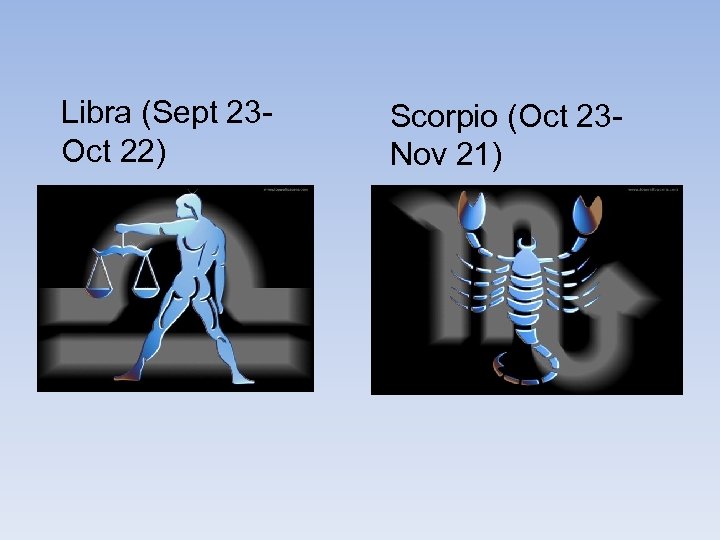
Libra (Sept 23 Oct 22) Scorpio (Oct 23 Nov 21)
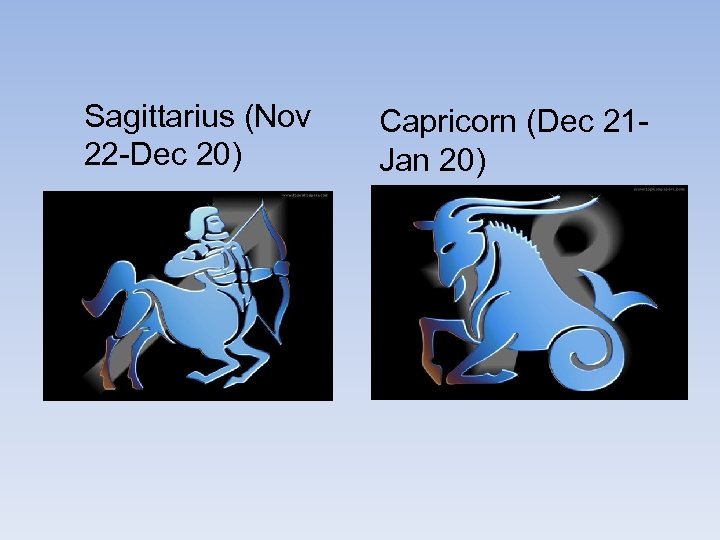
Sagittarius (Nov 22 -Dec 20) Capricorn (Dec 21 Jan 20)
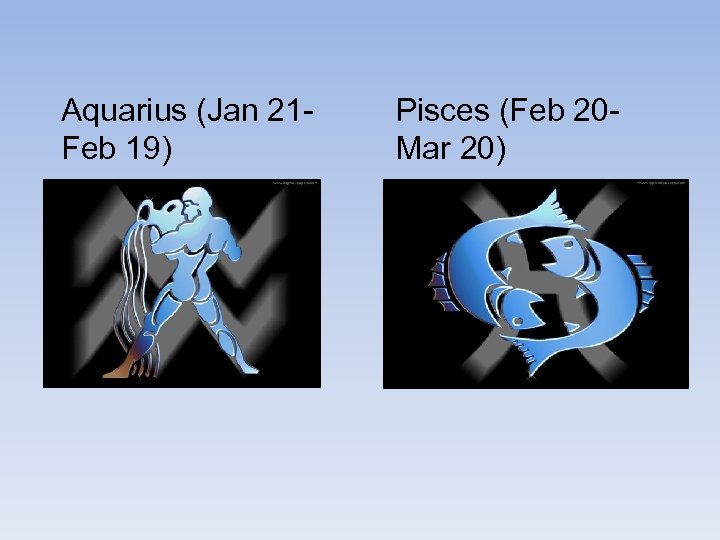
Aquarius (Jan 21 Feb 19) Pisces (Feb 20 Mar 20)
![Aries [eəri: z] 白羊座 Taurus /to: ris/ 金牛座 Gemini /d{zh}eminai/ 双子座 Cancer 巨蟹座 Leo](https://present5.com/presentation/22a0d0efe198817ebff3626007c92b26/image-11.jpg "Aries [eəri: z] 白羊座 Taurus /to: ris/ 金牛座 Gemini /d{zh}eminai/ 双子座 Cancer 巨蟹座 Leo")
Aries [eəri: z] 白羊座 Taurus /to: ris/ 金牛座 Gemini /d{zh}eminai/ 双子座 Cancer 巨蟹座 Leo [li: əu] 狮子座 Virgo [v{3}: gəu]处女座 Libra [li: brə]天秤座 Scorpio [sk{o}: piəu]天蝎座 Sagittarius [səd{zh}itǽries]人马 座 Capricorn [kǽprik{o}: n] 摩羯座 Aquarius [əkweəriəs; ] 水瓶座 Pisces双鱼座 [paisi: z] March 21 - April 19 April 20 - May 20 May 21 - June 21 June 22 - July 22 July 23 - August 22 August 23 - September 22 September 23 - October 22 October 23 - November 21 – December 21 December 22 - January 19 January 20 - February 18 February 19 - March 20
Step 1: • Sit with the classmates who are under the same zodiac sign with you. MOVE!!!!!! • Each of you gives a 1 -minute speech to your group members, briefly introducing yourself---- appearance, characters, likes, dislikes, especially the positive and negative traits of your personality etc • The other group members have to take notes • Group discussion: find out your similarities of the whole group with the same zodiac sign.
Step 2: • Then, choose one person to sum up the similarities of the group and report to the group. (use adj. s you’ve learned to describe your personalities). The other members listen and add to the list. • Some students will be invited to come to the blackboard to report to the class. (including positive and negative personality traits)
Step 3 can we improve our personality Discuss and propose specific and practical advice about how to get rid of those negative traits in personality of your star signs. For example: Advice for selfish people: Advice for impatient people: Advice for dishonest people: ……
Advice for the selfish person Make a point of thinking of other person’s feelings. Make a point of sharing more often Think of kind things to do for your friends. Be helpful to other people. Remember that if you help and are kind to others, others will return your kindness. • Ask yourself whether you would like to make friends with a selfish person. • Ask yourself why you always think of yourself first. • • •
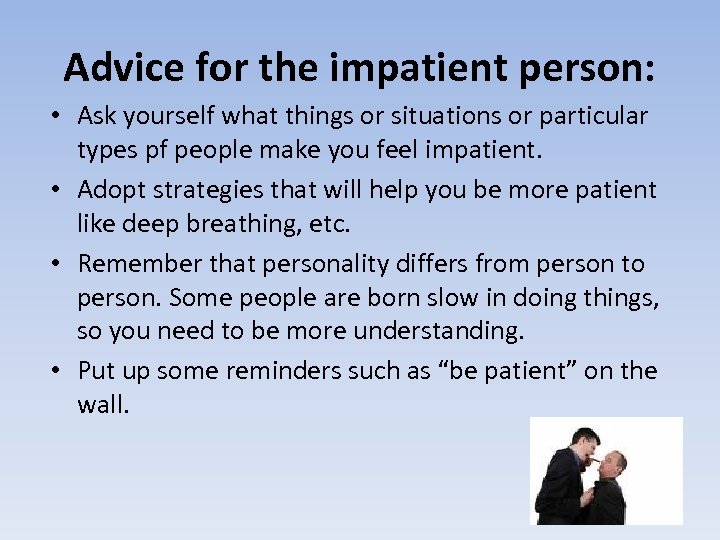
Advice for the impatient person: • Ask yourself what things or situations or particular types pf people make you feel impatient. • Adopt strategies that will help you be more patient like deep breathing, etc. • Remember that personality differs from person to person. Some people are born slow in doing things, so you need to be more understanding. • Put up some reminders such as “be patient” on the wall.
Advice for the person who is dishonest • Make friends with an honest person • Ask yourself the advantages of being honest • Record when and why you were dishonest. Think about the time when you were punished for being dishonest • Remember the famous saying: honest is the best policy. • …
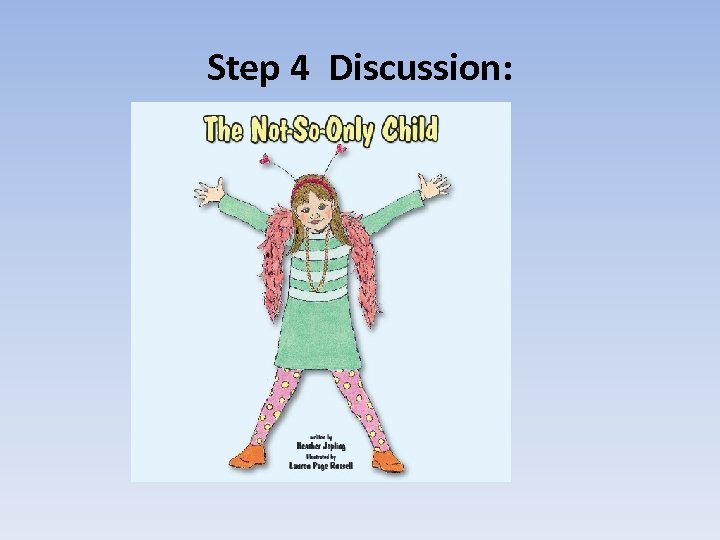
Step 4 Discussion:
1. Are you the only child in your family? 2. Do you think your personality development is influenced by the position as the only child? 3. Talk to your partner about the positive and negative traits of only children. 4. If you are not the only child in the family, how is your personality different from only children?
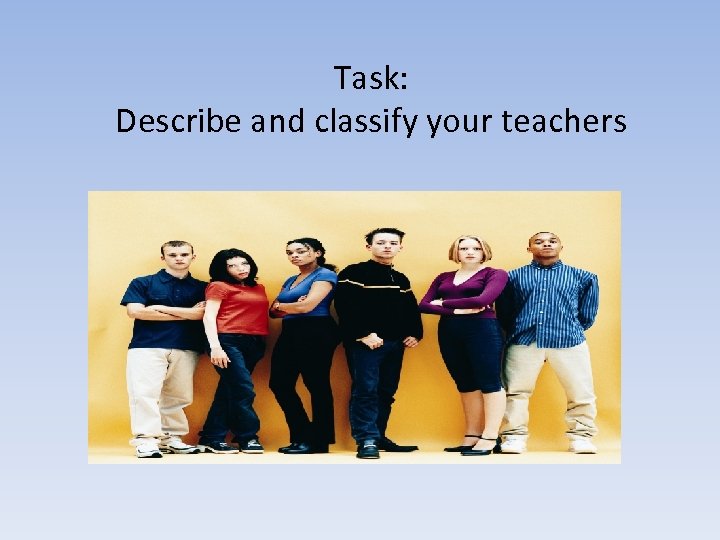
Task: Describe and classify your teachers
Steps: Students work in groups, One acting as host/hostess, others presenting ideas. Host/hostess: 1. Starts the conversation with introductory remarks 2. Guides the conversation with questions for different students. 3. Listen to other members very carefully and make a summary of all opinions at last.
Other members: 1. Describe and classify teachers according to different criteria, such as personality, teaching styles, attitudes toward students, etc. 2. Should be able to give reasons for your decision 3. Hoped to use new vocabulary in discussion. Click to open the video clip
What are your personality traits? Read the words and choose the traits which reflect your greatest strengths. Conduct the dialogue as following: Example: Student A: I never tells any lies! Do you know who I am? Student B: I guess you are Mr. Truthful!
• Accurate: Work free from error or mistakes; careful, precise; detailed • Active: Lively; agile; high energy; busy • Adventurous: Try new things; take risks • Analytical: Examine and separate the parts of something to find its essential meaning • Artistic: Appreciation of or ability in the arts • Attentive: Listen well; pay close attention to verbal and non-verbal messages • Astute: Perceptive; clever; insightful
• Calm: Remain peaceful, composed, and serene under pressure • Cautious: Careful; prudent; exercise forethought • Compassionate: Considerate; sympathetic; humane • Collaborative: Working as a team • Competent: Skilled; qualified; capable • Competitive: Strive to win; oppose a rival • Conceptual: Intuitive; abstract or reflective thinking • Concerned: Care and high regard • Creative: Imaginative; inventive; original
• Decisive: Show firm determination in using judgment to make decisions • Diplomatic: Tactful; skillful at negotiating • Discreet: Showing good judgment; keeping confidences • Dynamic: Energetic; vigorous
• Empathetic: Sensitive to or identify with the feelings of others; warm • Enthusiastic: Show interest and excitement; expressive • Firm: Unlikely to change mind; adamant; certain • Flexible: Adaptable; versatile • Foresighted: Realize what is likely to happen in the future • Honest: Truthful; genuine; having integrity; straightforward • Logical: Rational; analytical; reasonable
• Open-minded: Impartial; receptive to new ideas; free from prejudice or bigotry • Organized: Structured; orderly; systematic • Outgoing: Sociable; friendly • Perceptive: Observant; keen insight or awareness • Persistent: Refuse to give up; persevere • Persuasive: Influence or lead others • Practical: Realistic; pragmatic; down-to-earth
• Responsible: Dependable; trustworthy; reliable; loyal • Sensible: Showing good sense; sound judgment • Sophisticated: Cultured; world-wise • Strong: Powerful
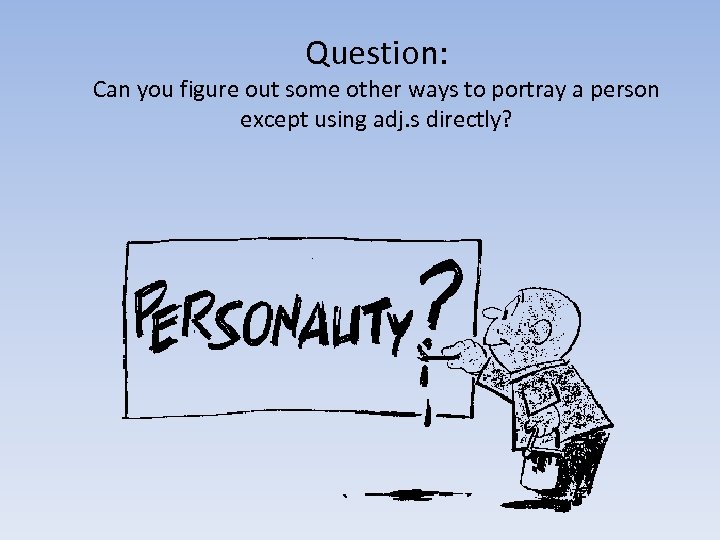
Question: Can you figure out some other ways to portray a person except using adj. s directly?
• Gentle, dedicated, considerate, adventurous, calm, aggressive, critical, energetic, selfish, ambitious, self-confident, easygoing, truthful, outgoing, frank, sensitive, bossy, patient, talkative, persuasive, sympathetic, emotional
Communicating & writing skill: Indirection description To make a character portrait convincing, we can also adopt methods of indirect description by providing anecdotes, examples, quotes, comparison and contrast, etc.
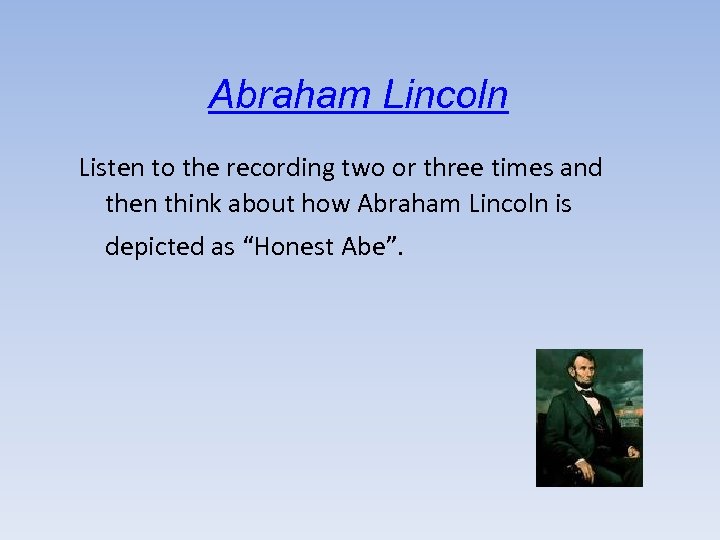
Abraham Lincoln Listen to the recording two or three times and then think about how Abraham Lincoln is depicted as “Honest Abe”.

Script for listening Y o u h a v e h e a r d a b o u t A b r a h a m Lincoln, the 16 th president of the United States, haven't you? He came from a poor family, but rose to become one of the most fondly remembered presidents in his country's history. There are many stories about him. Here is one of them.

When Abraham Lincoln was young he worked in a store. As a clerk he proved honest and efficient. One day a woman came into the store and bought some articles. They added up to two dollars and six and a quarter cents, or the young clerk thought they did. The bill was paid, and the woman was entirely satisfied. But the young store-keeper, not feeling quite sure as to the accuracy of his calculation, added up the items once more. To his dismay he found that the sum total should have been only two dollars. "I've made her pay six and a quarter cents too much, " said Abe, disturbed. It was a very small sum, and many clerks would have dismissed it as such. But Abe was too conscientious to forget about the overcharge.

"The money must be paid back, " he decided. This would have been easy enough had the woman lived just around the corner, but, as the young man knew, she lived two or three miles away. This, however, did not alter the matter. It was night, but he closed and locked the store, and walked to the home of his customer. Having arrived there, he explained the matter, paid over the six and a quarter cents, and returned satisfied. This anecdote won him a new name: Honest Abe.

Task 2. Personality and Job Discuss with your partner and decide the personality traits that you think would make an ideal person for the following jobs. You must think of at least three words for each job by referring to the words you have learned or using your imagination.

STEP TWO -1 salesman or saleswoman hard-working, boastful, shrewd, acute, tricky teacher humorous, bossy, patient, tolerant, talkative doctor patient, calm, independent, careful, sympathetic policeman brave, alert, independent accountant careful, honest, cautious

STEP TWO -2 lawyer persuasive, expressive, eloquent, serious tour guide enthusiastic, talkative, expressive, energetic host or hostess of a show emotional, expressive, optimistic, easygoing reporter curious, extroverted, open-minded, adventurous secretary easygoing, tolerant, sensitive, frank, thorough spokesman intelligent, talkative, diplomatic, matter-of-fact


Work in groups to answer the following questions. Why do most people describe themselves as shy? Sample Because they are excessively concerned with their own appearance and actions. They are anxious and selfconscious.

Would you please list some ways mentioned in the text to overcome shyness? Sample Firstly we should remember that nobody can be perfect. We should recognize our personal strengths and weaknesses. Secondly we should set reasonable goals. Thirdly we should accept criticism thoughtfully. The most important thing is to study hard and read widely to enrich our knowledge, try to make more friends, and encourage ourselves to get involved in more activities in school. In this way we’ll become popular and not shy any more.

The author has listed some ways in the text to overcome shyness. Which one is practical and useful to you ? Sample The writer has mentioned ten ways to overcome shyness. To me, the first and the second are very important. First, we should recognize our personal strengths and weaknesses. By knowing our strengths we can build selfconfidence and improve ourselves. Secondly, setting reasonable goal will prevent us from feeling upset and frustrated when we fail. Thirdly we should accept criticism thoughtfully and know that everyone experiences some failures and disappointments.


Introduction (Para. 1) Shyness is the cause of much unhappiness for a great many people.

Reasons why shyness can have a negative effect (Para. 2 -3) People’s self-concept has a profound effect on all areas of their lives. People with high self-esteem usually act with confidence. People with low self-esteem are likely to be passive and easily influenced by others.

Ways of overcoming shyness (Para. 4 -15) Conclusion (Para. 16) The better we understand ourselves, the easier it becomes to live up to our full potential.


It is obvious that such uncomfortable feelings must affect people adversely. (Line 7) 译 文 语 法 训 练 must + 动词原型: to be likely or certain to do 对现在情况的推测、推论。表示根据情况推断、 认定某事是必然的。

Example You must feel tired after walking such a long distance. 走了这么长的路,你必定是累了。 必定是累了 I don’t get a good picture on my TV set. There must be something wrong. 我的电视机图像不好, 肯 定有故障。 定有故障

Translation I can’t date that house exactly, but it must be very old. 我不能确切地说出那所房子的年 代,但一定是很古老的。 一定是很古老的 The light went out. The electricity must be off. 灯熄了,一定是停电了。 电了 我考试失败了。你一定认为我很笨吧。 你一定认为 I failed the examination. You must think I am stupid.

It is obvious that such uncomfortable feelings must affect people adversely. (Line 7) 很显然这种不安的感觉会 译 文 对人们产生不利的影响。

In contrast, shy people, having low self-esteem, are likely to be passive and easily influenced by others. (Line 18) 译 文 in/by contrast 句 型 应 用 固定短语。意为“与……相反;与……形成对 比;相比之下”。用来表示对比。如果后面接 宾语,要用in contrast with/to 或 by contrast with。

Example Coal, gas, oil, nuclear power, or water power can all generate electricity for an electric train. In contrast, diesel trains run only on diesel oil. In contrast to your belief that we will fail, I am confident that we will succeed.

Translation 与从前不同,这个地区今天已成为一个繁华的、丰 富多彩的水果和鲜花市场。 Today, in/by contrast, the area is a lively and colorful fruit, vegetable, and flower market. 与你的悲观看法相反,我宁愿采取积极的态度。 相反 In contrast with your pessimistic point of view, I would rather take a positive attitude.

In contrast, shy people, having low self-esteem, are likely to be passive and easily influenced by others. (Line 18) 译 文 相比之下,羞怯的人自尊心 较弱,往往消极被动并且容易受 他人影响。

It is clear that, while self-awareness is a healthy quality, overdoing it is detrimental, or harmful. (Line 23) 译 文 难 句 分 析 此句it是形式主语。overdoing it is detrimental or harmful是真正的主语 。while引导的句子作后一 句子的让步状语从句。

It is clear that, while self-awareness is a healthy quality, overdoing it is detrimental, or harmful. (Line 23) It is clear that while…, + 主语从句 句 意为“尽管/虽然…… ,但是……是显而易见的”“很 型 显然,尽管/虽然…… , ……仍…… 。” 应 句型中的clear也可换成obvious, evident, true, 用 necessary, important等。具体翻译时有所不同。

Example It is true that while yours is a good idea, I am afraid it will be hard to put into practice. 你的主意确实很好,但我恐怕它很难付诸实践。 It is clear that while he understands what you say, he can’t agree with you. 显然,尽管他理解你说的话,但是他并不赞同。

It is clear that, while self-awareness is a healthy quality, overdoing it is detrimental, or harmful. (Line 23) 译 文 显然,尽管自我意识是一种 健康的品质,过分的自我意识却 是不利、有害的。

The better we understand ourselves, the easier it becomes to live up to our full potential. (Line 74) 译 文 句 型 应 用 the better …, the easier属于the more …, the more 句 型的用法。 The more …, the more 表示比较,“越…… ……”。 ,越

Example The better the girls liked the moving story, the more it made them cry. 女孩子越喜欢感人的故事,越容易 被故事弄得哭哭啼啼。 The more carbon the steel contains and the quicker the cooling is, the harder the steel becomes. 钢含碳的成分越多,冷却得越快,那么钢就越硬。

The better we understand ourselves, the easier it becomes to live up to our full potential. (Line 74) 我们对自己了解得越多, 译 文 就越容易充分发挥自己的潜力。


excessively (adv. ) (Line 3, Para. 1) in an excessive amount, to an excessive degree 过分地,过度地,非常地 Translation 我不多喝酒。 I don’t drink excessively. 晚会的噪音非常地大。 The noise from the party is excessively loud.

词汇扩充 excessive (adj. ) 过多的,过分的,额外的 excess (n. ) 过度,剩余,超额,超过 exceed (v. ) 超过,胜过 Exercise 请选择以上词汇完成句子。 守门员因持球时间过长而受罚。 持球时间过长 The goal-keeper was excessive possession for punished of ball __________. 他吃得很好,但不过多。 过多 He ate well, but notto excess _____. 你拆阅那些信件是越权行为。 越权 You areexceeding your duty _________ in opening those letters.

profound (adj. ) (Line 10, Para. 2) 1) deep; complete 深切的,极度的,极 深的(比deep正式) 2) having, showing, or using thorough knowledge and deep understanding 知识渊博的;深奥的

Exercise 请完成下面的句子。 空无一人的教堂里寂静无声。 There was a ________ profound silence in the empty church. 他知识渊博,深受人们喜爱。 He is a man of _________, deeply profound knowledge beloved by people.

请熟悉下面的表达或搭配。 a profound sigh 深长的叹息 profound knowledge 渊博的知识 profound regret 极为遗憾 a profound sleep 酣睡
![confirm (vt. ) (Line 20, Para. 3) [+ that] support; make certain; give proof](https://present5.com/presentation/22a0d0efe198817ebff3626007c92b26/image-70.jpg "confirm (vt. ) (Line 20, Para. 3) [+ that] support; make certain; give proof")
confirm (vt. ) (Line 20, Para. 3) [+ that] support; make certain; give proof (of) 支持;确 实;证实 Translation 请给我来封信以便证实你在电话 中传达的消息。 Please confirm your telephone message by letter. 我们打电话给那家旅馆以确认我们的房间已订妥。 们打电话给那家旅馆以 We confirmed the reservation by calling the hotel.

请熟悉下面的表达。 confirm a rumor 证实谣言 confirm one’s belief 坚定信念 confirm a contract 批准合同 confirm a theory 证实一个理论 形近词认知 conform 遵照,符合,一致,后面常跟to或with affirm , 断言,声明

inferiority (n. ) (Line 20, Para. 3) the quality of condition of being inferior; lower rank or state 低劣 inferior (adj. ) (常与 to 连用,无比较级、最高 级形式)次的;劣等的;较劣的 Exercise 请完成下面的句子。 我发现难以摆脱一种社会自卑感。 I found it difficult to shake off ____________. a sense of social inferiority 巴特曾非常自卑,以至于觉得自己不如见过的任何 一个受过教育的人。 Barter had been so humiliated that he felt himself _______ every educated man he met. to be inferior to

compliment (Line 21, Para. 3) n. 1) expression of admiration, approval, ect, . 恭维之表示;敬意; 赞扬 2) (pl. ) (formal) greetings 问候; 致意;道贺 v. express admiration, approval 恭维;赞扬

Exercise 请用下面的提示词造句。 称赞 我的画 (pay sb. a compliment/compliment sb. on sth. ) She paid me a very charming compliment on my paintings. She complimented me on my paintings. 她接受他对……的称赞 She accepted his compliment about her dress with a smile.

eliminate (v. ) (Line 25, Para. 4) eliminate from: remove 除去;删除;淘汰 Exercise 请完成下面的句子。 他已被取消了游泳比赛资格, 因为他在训练中没有得到名次。 He has been _______________ eliminated from the swimming race because he did not win any of the practice races. 那位建筑师在估算房子的价格时未曾把家具考虑 师在估算房子的价格时 在内。 eliminated the cost of furniture The architect _____________ in figuring the cost of the house.

近义词辨析 eliminate (vt. ) remove or get rid of completely 消除 reduce (vt. ) make less in size, amount, price, degree 减少,降低 diminish (vt. vi. ) (cause to ) become less in size or importance 减少,降低……重要性

Exercise 请选择 eliminate, reduce 或 diminish 的适 当形式填空。 We can’t ____ the use of paper but we can eliminate certainly ______ the amount of paper we waste. reduce I _______ my weight by going on a diet. reduced I don’t want to ____ her achievements, but diminish she did have a lot of help. The threat of nuclear war has _____. diminished

dwell (vi. ) (dwelt or dwelled) (Line 31, Para. 4) 1) dwell in /at: reside 居住 , 2) dwell on / upon: think, speak or write at length about 凝思;详细; 论述;仔细研究 Exercise 请完成下面的句子。 不要过分沉溺在痛苦的回忆之中。 不要 Don’t ________ painful memories dwell too much on 我们的眼睛凝视着美丽的夕阳。 们的眼睛 Our eyes _____ the beautiful sunset. dwelled on My grandma dwells in the country. 我奶奶_____乡下。 住在

reasonable (adj. ) (Line 42, Para. 7) 1) having ordinary common sense; able to reason 有普通常识的 ;能推 理的;合乎做事道理的 2) moderate 适度的;不多不少的 Translation 你认为让人们每周 作 60小时以 上是合理的吗? 上是 Do you think it reasonable to expect people to work more than 60 hours a week? 她不得不给自己的迟到找一个合理的借口。 给自己的迟到找一个 She cannot but find a reasonable excuse for her being late.

rejection (n. ) (Line 55, Para. 10) the action or process of rejecting a thing or person 抵制;拒绝;抑制, 排斥 reject (v. ) (Line 63, Para. 12) Exercise 请完成下面的句子。 因为害怕被拒绝,他从不敢向她求婚。 He was never able to ask her to marry him out of _______. fear of rejection 他后悔拒绝了那个年轻人提供的帮助。 绝了 帮助 rejecting the offer of help He regretted ___________ from the young man.

remove (v. ) (Line 66, Para. 13) remove from 1) take off or away from the place occupied 移动;拿开 2) get rid of 除去;排除 Translation 愤怒之余,他从打字机上取走了 打了一半的那一页。 Out of rage, he removed the half-finished page from the typewriter. What do you advise for removing ink stains from clothes? 你有什么好办法祛除衣服上的墨渍吗? 祛除

have sth. at heart (Line 67, Para. 13) be deeply concerned about 对……深切关心 Translation 他深切地关心穷人的福利问题。 He has the welfare of the poor at heart. Private employment agencies may not have your best interests at heart. 私有雇佣代理机构不会将你的最大利益放在心上。

请熟悉下面的表达或搭配。 be the heart and soul of 是 ……的 核 心 人 物 ; 是……的灵魂 have a broken heart 伤心, 绝望, 心碎 learn by heart 默诵;默记 from one’s heart 真诚地;衷心地;从 心底里 have a heart of gold [口 ] 有 一 颗 金 子 般 的 心, 心地善良


令人烦恼的想法一直在我的脑海中盘旋。 Worrisome thoughts are constantly swirling in my mind. 他的批评证实了我比别人差。 His criticism confirms my inferiority. 你这么说只是为了让我感觉好一些。 You’re just saying that to make me feel good. 坚持不懈的努力 determined and patient effort

老是想那些不可能的事情会令自己觉得无能。 Dwelling on the impossible leads to a sense of inadequacy. 认清自己的优缺点。 Recognize your personal strengths and weaknesses. 感到羞愧是无济于事的。 Feeling ashamed accomplishes nothing. 所有问题都有许多种解决办法。 There are numerous approaches to all issues.

Translating Activities 被动语态的主动与被动译法 – 英语被动句转换成汉语主动句 – 英语被动句译成汉语被动句

被动语态的主动与被动译法 在很多场合下,英语中被动语态使用的 频率非常高。比如,在不必说出主动者,无 从说出主动者或者为了便于上下文语式、语 气和结构的连贯情况下,往往都用被动语态。 在英译汉的过程中对被动语态可按两大途径 处理。 将英语被动句译成汉语主动句; 将英语被动句译成汉语被动句。

英语被动句转换成汉语主动句: 将英语被动结构的句子译成汉语主动 句时,可分以下几类处理: 原文中的主语在译文中做主语; 原文中的主语在译文中作宾语; 原文中被动结构句译成汉语中带有“的”字 的主动句; 增添或不显示主语处理英语常用被动句型。

The sense of inferiority (自卑感) that he got in his youth has never been totally cleared up. 他在青少年时期留下的自卑感,还没有完全消除。(主语) Studies perfect nature, and are perfected by experience. 读书补天然不足,经验又补读书之不足。(宾语) Time can always be found to do things one wants to do. 只要想干,总是可以找到时间。(表语) It will be seen from this that he must be a weak leader. (人们)由此可见他一定是一个能力欠缺的领导。 (增添主语或无主语)

英语被动句译成汉语被动句: 汉语有时也用被动形式来 表达意思,但是往往会借助于 一些具有被动意义的词语,如: “被”、“遭受”、“由”、“把”、 “受到”或“予以”等,即将英语 被动句译成汉语被动句。

She was blamed for everything her sisters did. 她因为妹妹所做的事而遭受谴责。 Most letters from his wife are read to him by the nurse in the hospital. 妻子给他的信件,大多数是由医院 里的护士念给他听。 It must be dealt with at the proper time with proper means. 这种事情必须在适当的时候用适当的手段予以处理。

Writing skills • 写作实践: 影响作文得分的常见错误 • 例文: A Letter to a Former Classmate

影响作文得分的常见错误 拼写错误多。 句子主要成份不全。 句子主谓不一致。 谓语时态混乱。 用词不当。 上下文指代不清。 语态与语气渗杂混用。 句型误用汉语式的句子。

集中精力、大量背诵优秀范文。使尽可能 多的地道英语句子在脑海中刻下深深的烙印, 以期减少作文在句子层次上的语言错误。 尤其要注意拼写方面的错误。 分清大小写 减少书写笔误 避免用缩写或不规范拼写 不会写的单词不要随意处理 正确使用英文标点符号

Directions: For this part, you are allowed 30 minutes to write a composition on the topic: A Letter to a Former Classmate. You should write at least 120 words according to the given information below: 最近,你收到了一封高中同班同学的来信。他 正在你们原来的高中复读。又一年的高考临近,因 为在去年的高考中失利,这位同学不免有些担忧。 请写一封回信来鼓励这位同学。

A Letter to a Former Classmate Dear Li Ming, I am glad to hear from you. How have you been recently? How time flies! At the same time last year, we both were striving for our dreams. Now, I have been in college for almost a year, and this year’s National College Entrance Exam is drawing near. I sincerely hope that everything goes well in your life, especially in your study. Meanwhile, I firmly believe that you will achieve a satisfactory result on the coming exam.

In your letter, you told me that your failure on last year’s College Entrance Exam has always haunted you, and you doubted your ability to do well in the coming one. What I want to tell you is that you shouldn't be discouraged by last year’s failure. Everyone has experienced failures and disappointments, so don’t blame yourself too much. Instead, you should learn to interpret failure in a positive way and profit from the failure as a learning experience. You also told me that you felt anxious sometimes since the exam date is approaching, and you wondered whether you could realize your dream this time.

To be frank, at this point, I had the same feeling last year before I took the exam. All these worries are inevitable but unnecessary. Instead, you should think about your strengths and build up selfconfidence. You are a boy with great potential. Just do your best and forget about these worries and troubles. Remember, misfortune will not last long. Well, I have to stop. Try to keep a smiling face and have a positive attitude toward life. A smile may make things easier and better. All your hard work will pay off. Keep in mind that tomorrow is a new day. Best wishes! Yours Sincerely, Zhang Hua
![I. [GRE作文题目 I ] “The way students and scholars interpret the materials they work](https://present5.com/presentation/22a0d0efe198817ebff3626007c92b26/image-100.jpg "I. [GRE作文题目 I ] “The way students and scholars interpret the materials they work")
I. [GRE作文题目 I ] “The way students and scholars interpret the materials they work with in their academic fields is more a matter of personality than of training. Different interpretations come about when people with different personalities look at exactly the same objects, facts, data, or events and see different things. ”
![II. [GRE作文题目 II ] Thirteen years ago, researchers studied a group of 25 infants](https://present5.com/presentation/22a0d0efe198817ebff3626007c92b26/image-101.jpg "II. [GRE作文题目 II ] Thirteen years ago, researchers studied a group of 25 infants")
II. [GRE作文题目 II ] Thirteen years ago, researchers studied a group of 25 infants who showed signs of mild distress when exposed to unfamiliar stimuli such as an unusual odor or a tape recording of an unknown voice. They discovered that these infants were more likely than other infants to have been conceived in early autumn, a time when their mothers' production of melatonin — a hormone known to affect some brain functions — would naturally increase in response to decreased daylight. In a follow-up study conducted earlier this year, more than half of these children — now teenagers — who had shown signs of distress identified themselves as shy. Clearly, increased levels of melatonin before birth cause shyness during infancy and this shyness continues into later life.

Thanks for Your Attention !
Скачать презентацию Objectives To master the vocabulary of personality
22a0d0efe198817ebff3626007c92b26.ppt