 Скачать презентацию Objectives of the course Ø Develop an in
Course Sept 2014 Ind Values.pptx
- Количество слайдов: 48



Objectives of the course Ø Develop an in depth understanding of the nature of basic human values Ø Original theory of 10 values (10000+ citations) Ø Refined theory of 19 values (2012) Ø Develop ability to measure basic values Ø Develop ability to use values to understand, explain, and predict attitudes and behavior Ø Get ideas for MA thesis guided through lab Ø Using survey data available Ø Using constructs & gathering new data
Basic Values Beliefs about the importance of abstract goals as guiding principles in life Freedom wealth equality security pleasure obedience tradition helping When activated, become infused with emotion
Why are basic values important? Ømotivate choice of behavior--what we do Øjustify past behavior--why we do it Østandards to evaluate people & events-who and what we like, underlie our attitudes Ødirect attention and perception--what we notice Øcan serve as social indicators—reflect fundamental societal change
Defining Characteristics of Basic Values freedom, wealth, equality, security, pleasure, obedience Ø Shared Ø beliefs about the desirable Ø motivational goals Ø transcend specific actions and situations Ø criteria of judgment Ø hierarchical order: priorities Ø Differentiated Ø type of motivation—goal pursued
Questions Toward a Universal Scheme Ø How derive a set of basic values, criteria? Ø What does it mean to say a value is universal? Ø What overall function do values fulfill that enable individuals to survive? Ø How insure values considered basic are likely to be universal? Ø Give examples of things that are not values
Exercise Ø Complete the PVQ-RR to measure 10 values Ø Work quickly, nothing gained by deliberating Ø We will learn to interpret and use it later Ø Be sure to keep it available through the end of the course
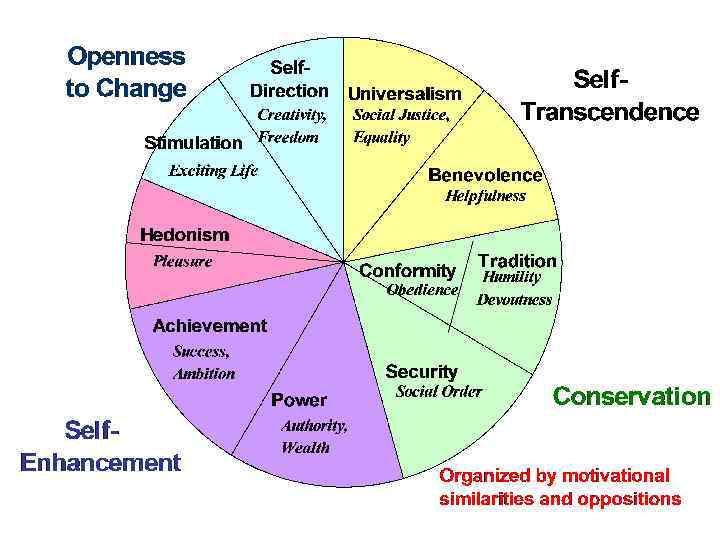
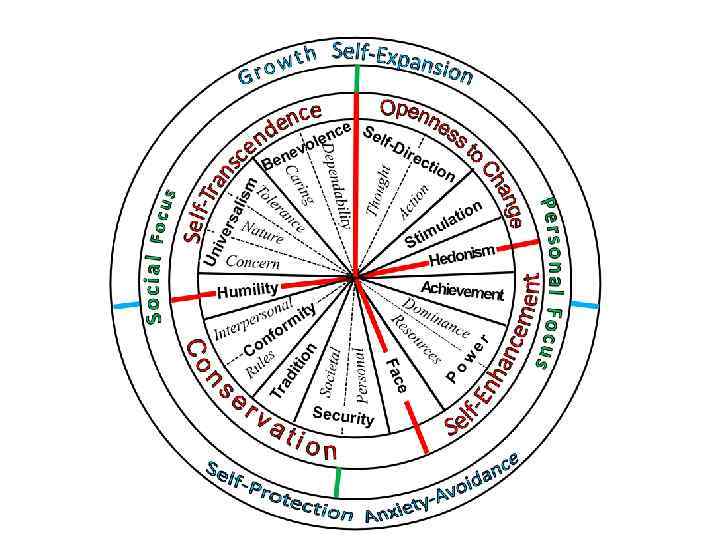
Motivational Continuum Ø 10 values split arbitrary scientific convenience Ø Could be more splits or fewer e. g. Ø UN 3: nature, social concern, tolerance Ø SE 2: close (family, clean), societal (nation, order) Ø 4 higher order Ø Splits across higher order ØSE/PO—uncertainty control ØBE/CO—relationship maintenance Ø Theory about universal order of motivations, not typology—cf. color circle Ø Continuum supported in 350+ samples using various instruments
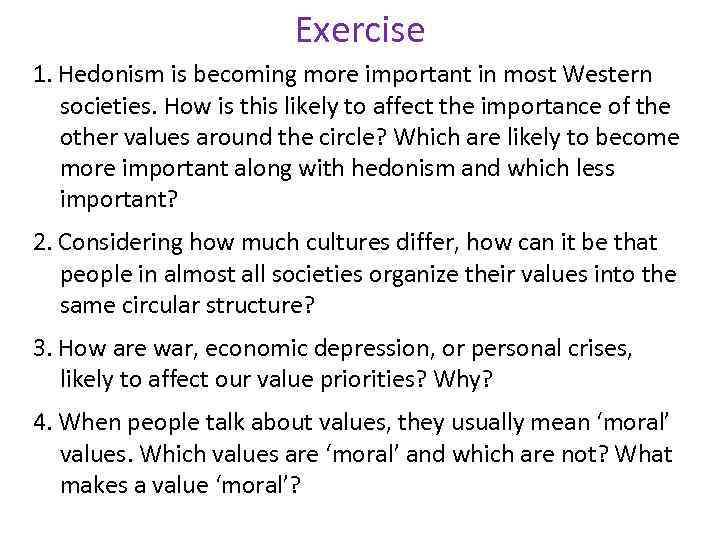
Exercise 1. Hedonism is becoming more important in most Western societies. How is this likely to affect the importance of the other values around the circle? Which are likely to become more important along with hedonism and which less important? 2. Considering how much cultures differ, how can it be that people in almost all societies organize their values into the same circular structure? 3. How are war, economic depression, or personal crises, likely to affect our value priorities? Why? 4. When people talk about values, they usually mean ‘moral’ values. Which values are ‘moral’ and which are not? What makes a value ‘moral’?
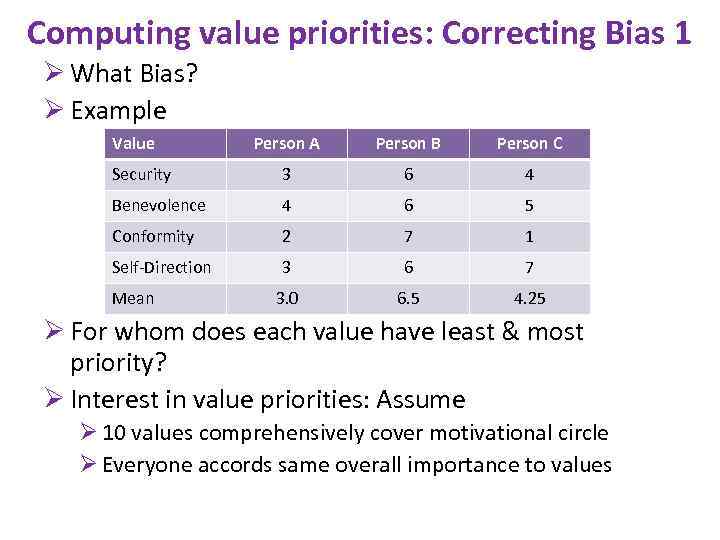
Computing value priorities: Correcting Bias 1 Ø What Bias? Ø Example Value Person A Person B Person C Security 3 6 4 Benevolence 4 6 5 Conformity 2 7 1 Self-Direction 3 6 7 3. 0 6. 5 4. 25 Mean Ø For whom does each value have least & most priority? Ø Interest in value priorities: Assume Ø 10 values comprehensively cover motivational circle Ø Everyone accords same overall importance to values
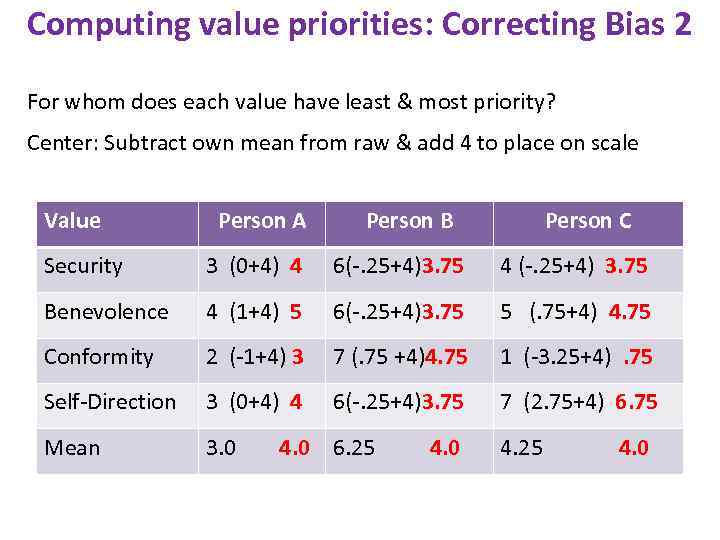
Computing value priorities: Correcting Bias 2 For whom does each value have least & most priority? Center: Subtract own mean from raw & add 4 to place on scale Value Person A Person B Person C Security 3 (0+4) 4 6(-. 25+4)3. 75 4 (-. 25+4) 3. 75 Benevolence 4 (1+4) 5 6(-. 25+4)3. 75 5 (. 75+4) 4. 75 Conformity 2 (-1+4) 3 7 (. 75 +4)4. 75 1 (-3. 25+4) . 75 Self-Direction 3 (0+4) 4 6(-. 25+4)3. 75 7 (2. 75+4) 6. 75 Mean 3. 0 4. 0 6. 25 4. 0 4. 25 4. 0
![Scoring PVQ-RR for Individual Values Standard Indexes [items with cross-nationally equivalent meaning] Compute mean](https://present5.com/presentation/96885543_349343306/image-12.jpg "Scoring PVQ-RR for Individual Values Standard Indexes [items with cross-nationally equivalent meaning] Compute mean")
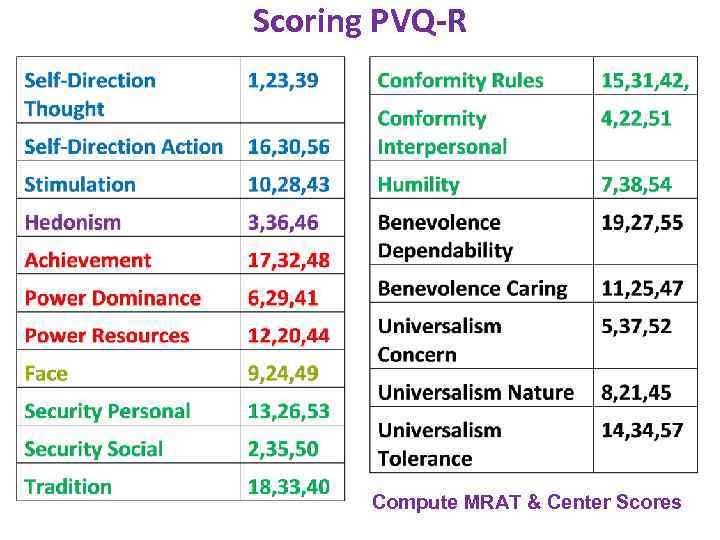
Scoring PVQ-RR for Individual Values Standard Indexes [items with cross-nationally equivalent meaning] Compute mean for each of 10 values—Own hierarchy To compare across individuals or groups Compute mean rating across all 57 items (MRAT) Subtract MRAT from each value mean & add 4. 0 Value PVQ items Security 2, 13, 26, 35, 50, 53 Value PVQ items Self-Direction 1, 16, 23, 30, 39, 56 Conformity 4, 15, 22, 31, 42, 51 Stimulation 10, 28, 43 Tradition Hedonism 3, 36, 46 7, 18, 33, 38, 40, 54 Benevolence 11, 19, 25, 27, 47, 55 Achievement 17, 32, 48 Universalism 5, 8, 14, 21, 34, 37, 45, 52, 57 Power 6, 12, 20, 29, 41, 44
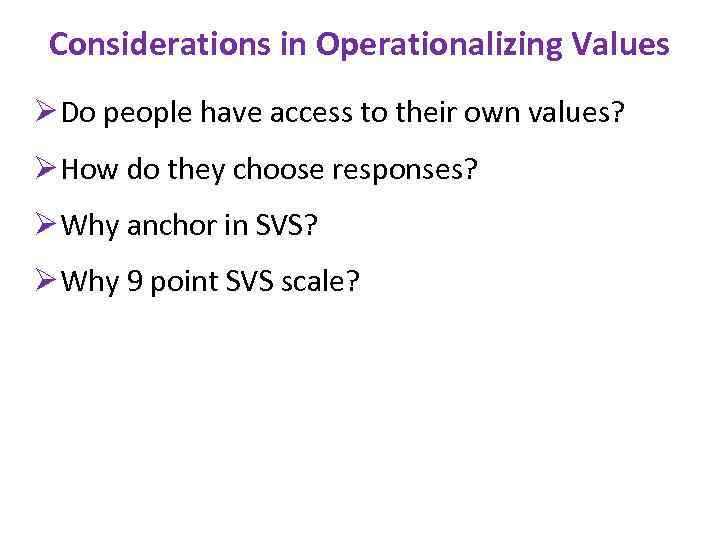
Considerations in Operationalizing Values Ø Do people have access to their own values? Ø How do they choose responses? Ø Why anchor in SVS? Ø Why 9 point SVS scale?
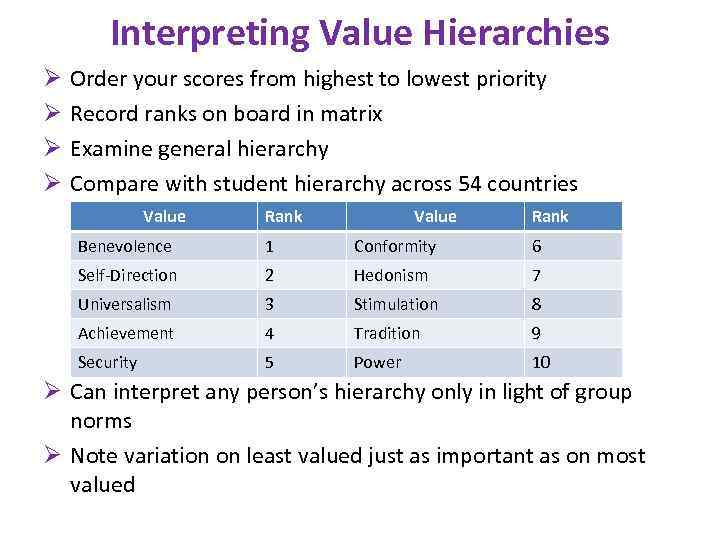
Interpreting Value Hierarchies Ø Ø Order your scores from highest to lowest priority Record ranks on board in matrix Examine general hierarchy Compare with student hierarchy across 54 countries Value Rank Benevolence 1 Conformity 6 Self-Direction 2 Hedonism 7 Universalism 3 Stimulation 8 Achievement 4 Tradition 9 Security 5 Power 10 Ø Can interpret any person’s hierarchy only in light of group norms Ø Note variation on least valued just as important as on most valued
Behavior Entails Value Trade-Offs Trust in Colleagues, Russia 2012 ØЯ доверяю своим коллегам по работе ØАбсолютно Не согласен (1)…. . Абсолютно согласен (5) ØWhich values most positive? Most negative? ØDiscuss in small groups ØTrade-off between SD/ST/HE (openness) vs. BE/TR/CO/SE (conventionality) ØSee sinusoid curve in overhead
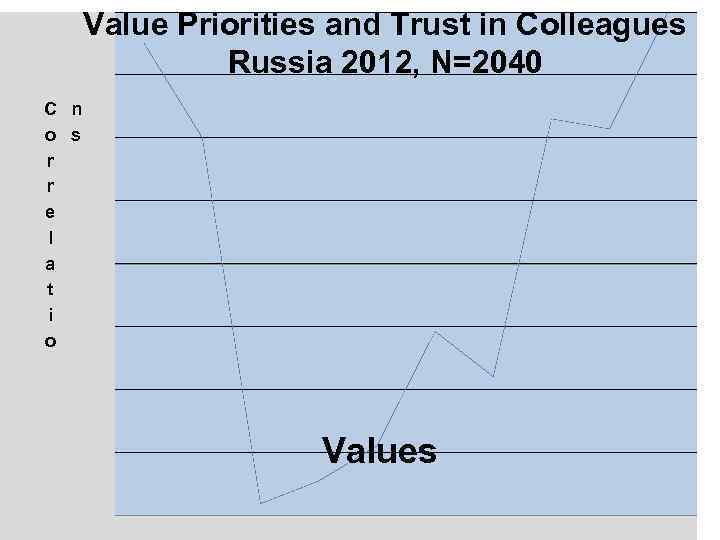
Value Priorities and Trust in Colleagues Russia 2012, N=2040 C n o s r r e l a t i o Values
Political Activism: 20 European Countries 2002 -3 • There are different ways of trying to improve things or to stop things from going wrong in [Russia]. During the last 12 months, have you done any of the following? Ø Contacted a politician, government or local government official Ø Worked in a political party or action group Ø Worked in another organisation or association Ø Worn or displayed a campaign badge/sticker Ø Signed a petition Ø Taken part in a lawful public demonstration Ø Boycotted certain products Ø Deliberately bought certain products for political, ethical or environmental reasons Ø Donated money to a political organisation or group
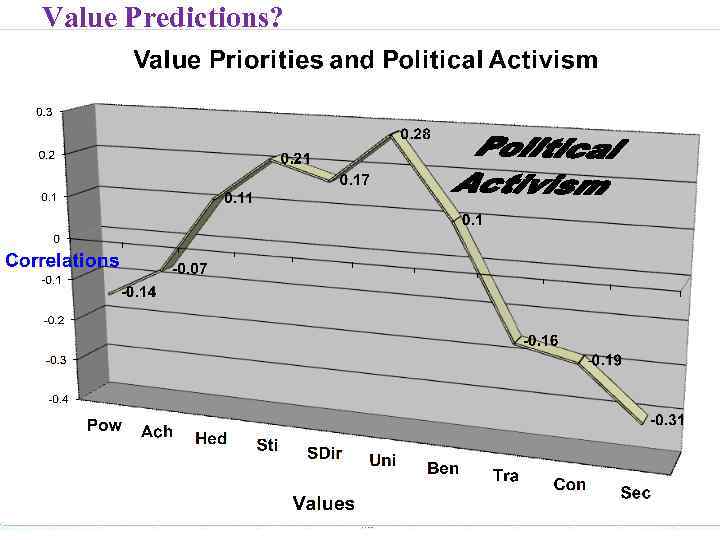
Value Predictions?
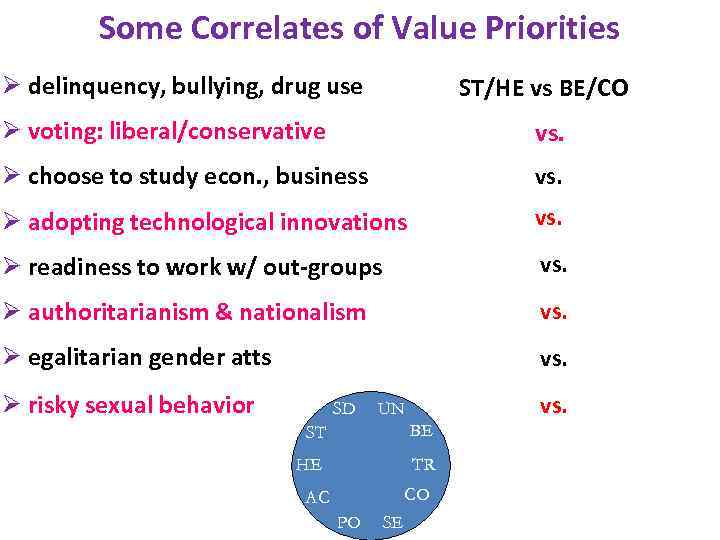
Some Correlates of Value Priorities Ø delinquency, bullying, drug use ST/HE vs BE/CO Ø voting: liberal/conservative vs. Ø choose to study econ. , business vs. Ø adopting technological innovations vs. Ø readiness to work w/ out-groups vs. Ø authoritarianism & nationalism vs. Ø egalitarian gender atts vs. Ø risky sexual behavior SD vs. UN ST BE HE TR CO AC PO SE
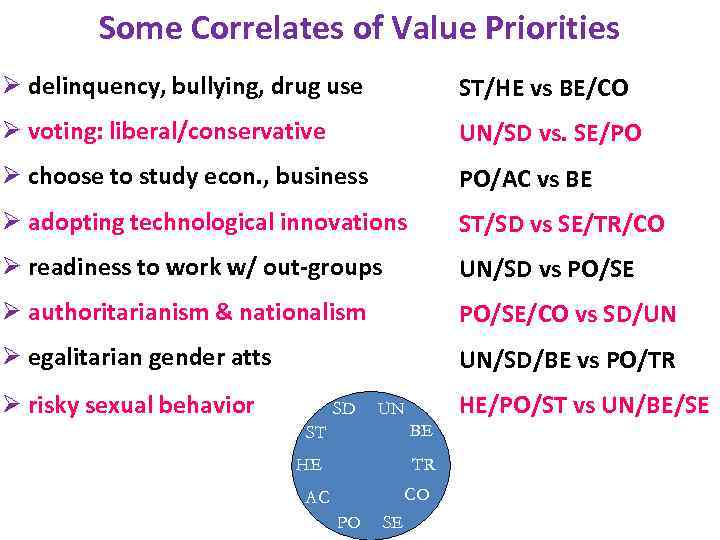
Some Correlates of Value Priorities Ø delinquency, bullying, drug use ST/HE vs BE/CO Ø voting: liberal/conservative UN/SD vs. SE/PO Ø choose to study econ. , business PO/AC vs BE Ø adopting technological innovations ST/SD vs SE/TR/CO Ø readiness to work w/ out-groups UN/SD vs PO/SE Ø authoritarianism & nationalism PO/SE/CO vs SD/UN Ø egalitarian gender atts UN/SD/BE vs PO/TR Ø risky sexual behavior SD HE/PO/ST vs UN/BE/SE UN ST BE HE TR CO AC PO SE
Determinants of Strength of Value Associations Ø Value-expressive vs. -ambivalent behaviors or attitudes Ø Expressive: compatible primarily with adjacent values and incompatible with the opposing values in the circle Ø Power values predict manipulative behaviors [vs. universalism] Ø Stimulation values predict risky behaviors [vs. security] Ø Ambivalent: compatible with mutually conflicting values Ø Stimulation and conformity might motivate agreeing to friends’ invitation to go hiking Ø Security and universalism might inhibit risky sexual behavior Ø Instantiation: knowing (thought about )specific ways to express an abstract value in real-life situations Ø How express Equality? Tolerance? Creativity? Conformity? Ø Self-direction in army? In classroom? In family?
Processes Linking Values to Behavior Ø Value Activation ØPriming values accidentally or intentionally ØReading story about social worker/manager & cooperation ØFocusing attention on self (mirror, name) Ø Motivation ØInduce +/- valences on objects (actions, people, etc. ) ØCan be automatic, without consciousness
Processes Linking Values to Behavior Ø Cognition guided by values (chronic goals) ØAttend to value relevant aspects of situation (ST vs. SE political demonstration) ØDefine and interpret situation based on values (PO/AC vs. HE demanding job) ØGive more weight to value congruent alternatives (CO vs. SD choice of study major) Ø Value importance increases planning of action ØPlanning focuses on pros not cons action attractiveness ØPlanning increases self-efficacy beliefs action ØPlanning increases persistence in face of obstacles & distractions
Exercise: Predicting & Explaining Complex Value/Behavior Relations Generate a prediction and explanation regarding the values that underlie the following behavior Describe its pattern of relations to the whole value system (any deviations from sinusoid? [draw curve]) The amount of time and activity fathers spend in caring for their 6 -36 month old children The amount of time and activity mothers spend in caring for their 6 -36 month old children
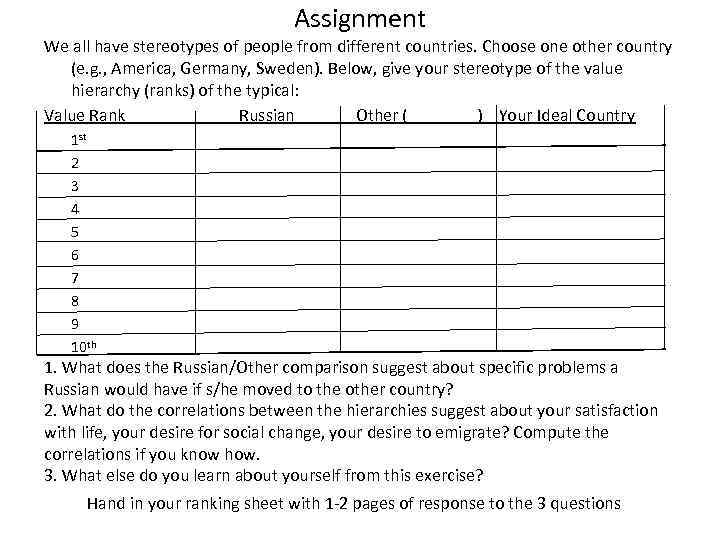
Assignment We all have stereotypes of people from different countries. Choose one other country (e. g. , America, Germany, Sweden). Below, give your stereotype of the value hierarchy (ranks) of the typical: Value Rank Russian Other ( ) Your Ideal Country 1 st 2 3 4 5 6 7 8 9 10 th 1. What does the Russian/Other comparison suggest about specific problems a Russian would have if s/he moved to the other country? 2. What do the correlations between the hierarchies suggest about your satisfaction with life, your desire for social change, your desire to emigrate? Compute the correlations if you know how. 3. What else do you learn about yourself from this exercise? Hand in your ranking sheet with 1 -2 pages of response to the 3 questions
Refining the Values Theory: Why? Ø Theory arbitrarily split circular continuum Ø Objectives in modifying theory ØIncrease precision of explanation ØIncrease predictive power Ø Better capture the motivational circle of values Ø 10 values combined diverse facets (e. g. , security) Øe. g. , Measure in millimeters, not centimeters
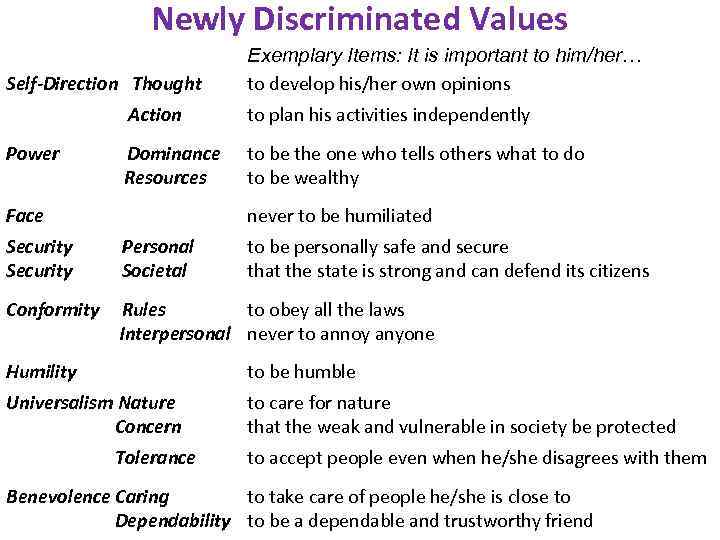
Newly Discriminated Values Self-Direction Thought Action Exemplary Items: It is important to him/her… to develop his/her own opinions to plan his activities independently Power Dominance Resources to be the one who tells others what to do to be wealthy Face never to be humiliated Security Personal Societal to be personally safe and secure that the state is strong and can defend its citizens Conformity Rules to obey all the laws Interpersonal never to annoy anyone Humility to be humble Universalism Nature Concern to care for nature that the weak and vulnerable in society be protected Tolerance to accept people even when he/she disagrees with them Benevolence Caring to take care of people he/she is close to Dependability to be a dependable and trustworthy friend
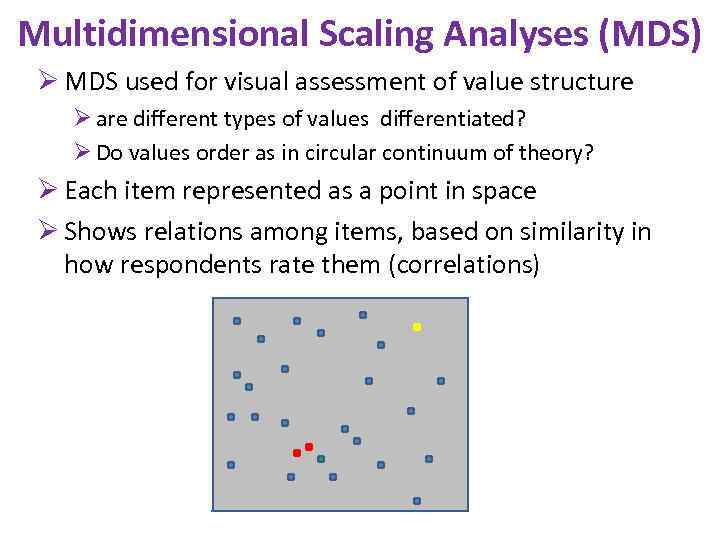
Multidimensional Scaling Analyses (MDS) Ø MDS used for visual assessment of value structure Ø are different types of values differentiated? Ø Do values order as in circular continuum of theory? Ø Each item represented as a point in space Ø Shows relations among items, based on similarity in how respondents rate them (correlations)
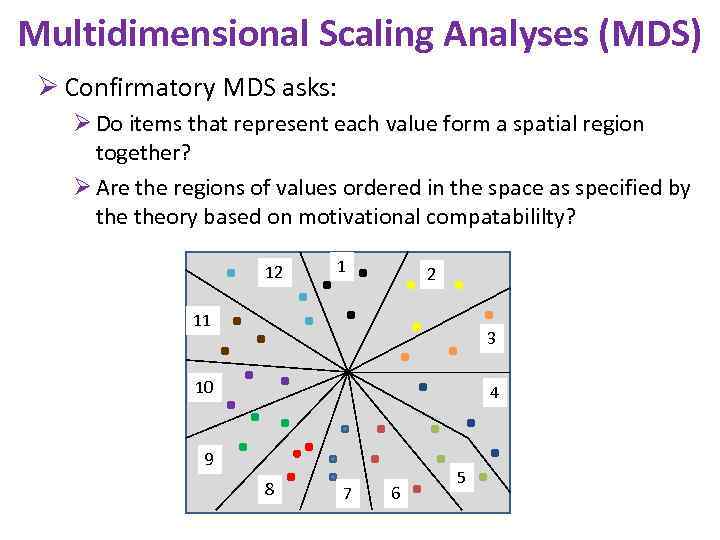
Multidimensional Scaling Analyses (MDS) Ø Confirmatory MDS asks: Ø Do items that represent each value form a spatial region together? Ø Are the regions of values ordered in the space as specified by theory based on motivational compatabililty? 12 1 2 11 3 10 4 9 8 7 6 5
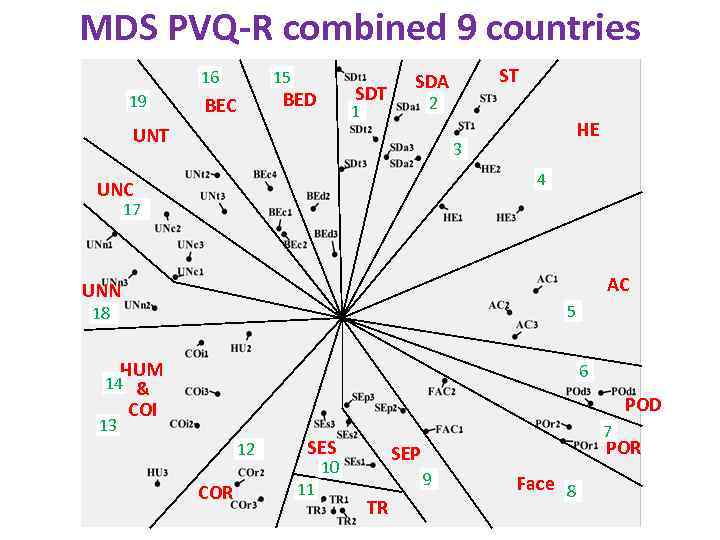
MDS PVQ-R combined 9 countries 16 19 15 SDT BED BEC ST SDA 2 1 UNT HE 3 4 UNC 17 AC UNN 5 18 HUM 6 14 & 13 POD COI 12 COR SES 11 7 POR SEP 10 9 TR Face 8
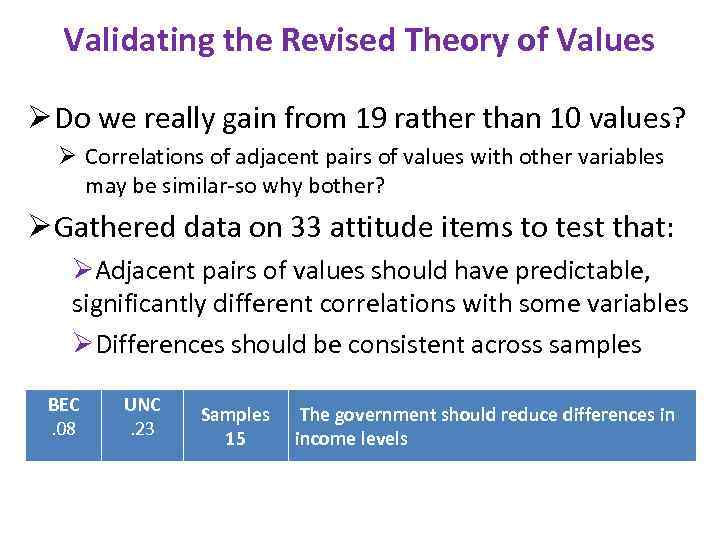
Validating the Revised Theory of Values Ø Do we really gain from 19 rather than 10 values? Ø Correlations of adjacent pairs of values with other variables may be similar-so why bother? Ø Gathered data on 33 attitude items to test that: ØAdjacent pairs of values should have predictable, significantly different correlations with some variables ØDifferences should be consistent across samples BEC. 08 UNC. 23 Samples 15 The government should reduce differences in income levels
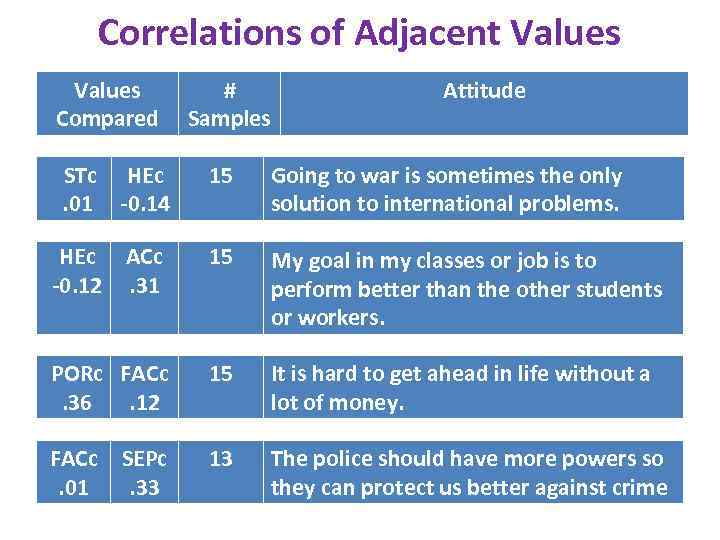
Correlations of Adjacent Values Compared # Samples Attitude 15 Going to war is sometimes the only solution to international problems. HEc ACc -0. 12. 31 15 My goal in my classes or job is to perform better than the other students or workers. PORc FACc. 36. 12 15 It is hard to get ahead in life without a lot of money. FACc SEPc. 01. 33 13 The police should have more powers so they can protect us better against crime STc HEc. 01 -0. 14
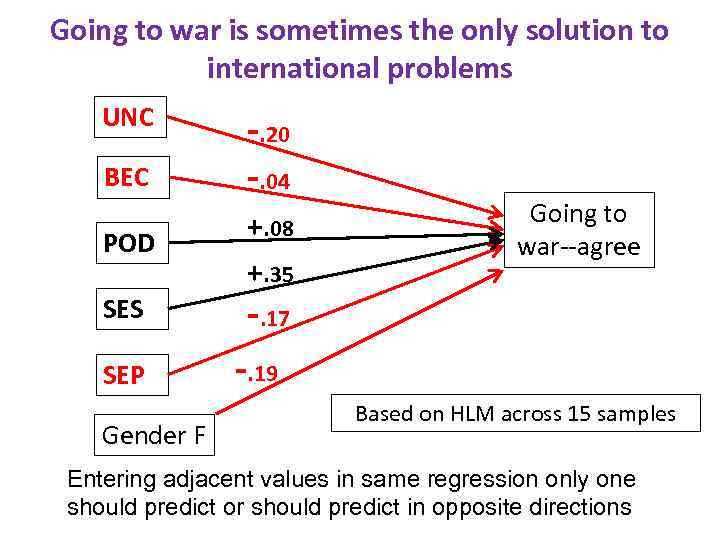
Going to war is sometimes the only solution to international problems UNC BEC POD SES SEP Gender F -. 20 -. 04 +. 08 +. 35 Going to war--agree -. 17 -. 19 Based on HLM across 15 samples Entering adjacent values in same regression only one should predict or should predict in opposite directions
Scoring PVQ-R Compute MRAT & Center Scores
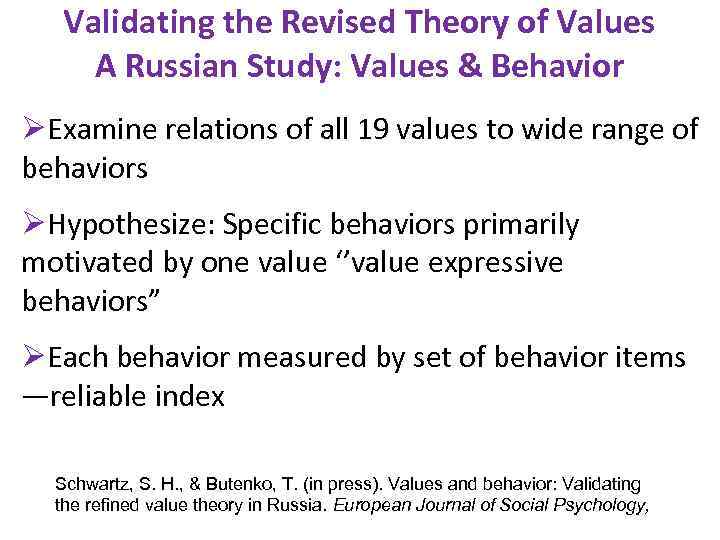
Validating the Revised Theory of Values A Russian Study: Values & Behavior ØExamine relations of all 19 values to wide range of behaviors ØHypothesize: Specific behaviors primarily motivated by one value ‘’value expressive behaviors” ØEach behavior measured by set of behavior items —reliable index Schwartz, S. H. , & Butenko, T. (in press). Values and behavior: Validating the refined value theory in Russia. European Journal of Social Psychology,
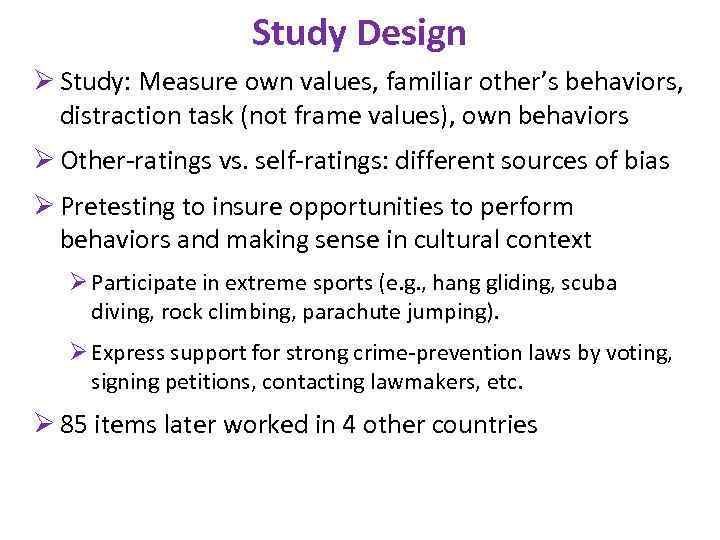
Study Design Ø Study: Measure own values, familiar other’s behaviors, distraction task (not frame values), own behaviors Ø Other-ratings vs. self-ratings: different sources of bias Ø Pretesting to insure opportunities to perform behaviors and making sense in cultural context Ø Participate in extreme sports (e. g. , hang gliding, scuba diving, rock climbing, parachute jumping). Ø Express support for strong crime-prevention laws by voting, signing petitions, contacting lawmakers, etc. Ø 85 items later worked in 4 other countries
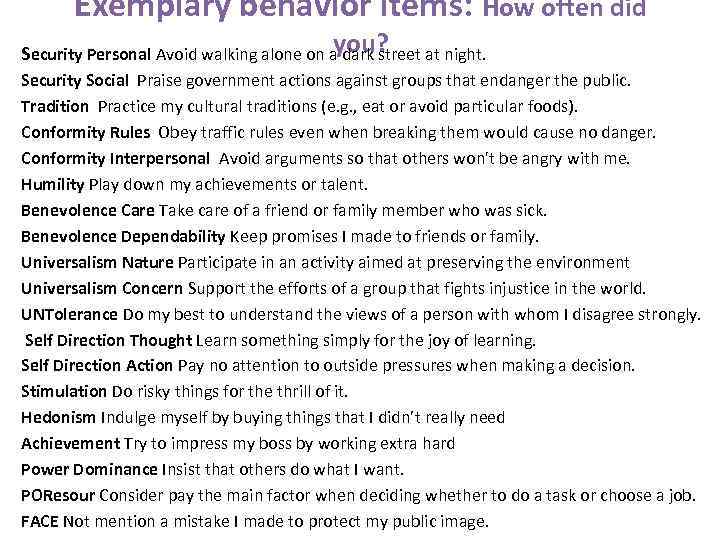
Exemplary behavior items: How often did you? Security Personal Avoid walking alone on a dark street at night. Security Social Praise government actions against groups that endanger the public. Tradition Practice my cultural traditions (e. g. , eat or avoid particular foods). Conformity Rules Obey traffic rules even when breaking them would cause no danger. Conformity Interpersonal Avoid arguments so that others won't be angry with me. Humility Play down my achievements or talent. Benevolence Care Take care of a friend or family member who was sick. Benevolence Dependability Keep promises I made to friends or family. Universalism Nature Participate in an activity aimed at preserving the environment Universalism Concern Support the efforts of a group that fights injustice in the world. UNTolerance Do my best to understand the views of a person with whom I disagree strongly. Self Direction Thought Learn something simply for the joy of learning. Self Direction Action Pay no attention to outside pressures when making a decision. Stimulation Do risky things for the thrill of it. Hedonism Indulge myself by buying things that I didn’t really need Achievement Try to impress my boss by working extra hard Power Dominance Insist that others do what I want. POResour Consider pay the main factor when deciding whether to do a task or choose a job. FACE Not mention a mistake I made to protect my public image.
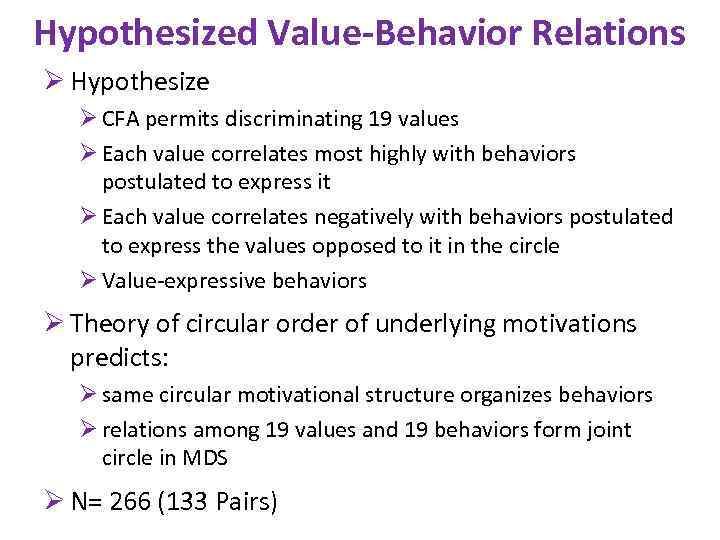
Hypothesized Value-Behavior Relations Ø Hypothesize Ø CFA permits discriminating 19 values Ø Each value correlates most highly with behaviors postulated to express it Ø Each value correlates negatively with behaviors postulated to express the values opposed to it in the circle Ø Value-expressive behaviors Ø Theory of circular order of underlying motivations predicts: Ø same circular motivational structure organizes behaviors Ø relations among 19 values and 19 behaviors form joint circle in MDS Ø N= 266 (133 Pairs)
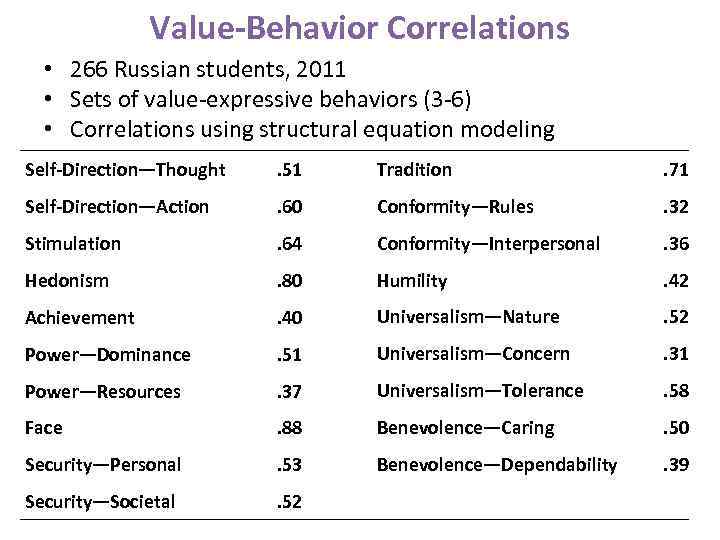
Value-Behavior Correlations • 266 Russian students, 2011 • Sets of value-expressive behaviors (3 -6) • Correlations using structural equation modeling Self-Direction—Thought . 51 Tradition . 71 Self-Direction—Action . 60 Conformity—Rules . 32 Stimulation . 64 Conformity—Interpersonal . 36 Hedonism . 80 Humility . 42 Achievement . 40 Universalism—Nature . 52 Power—Dominance . 51 Universalism—Concern . 31 Power—Resources . 37 Universalism—Tolerance . 58 Face . 88 Benevolence—Caring . 50 Security—Personal . 53 Benevolence—Dependability . 39 Security—Societal . 52
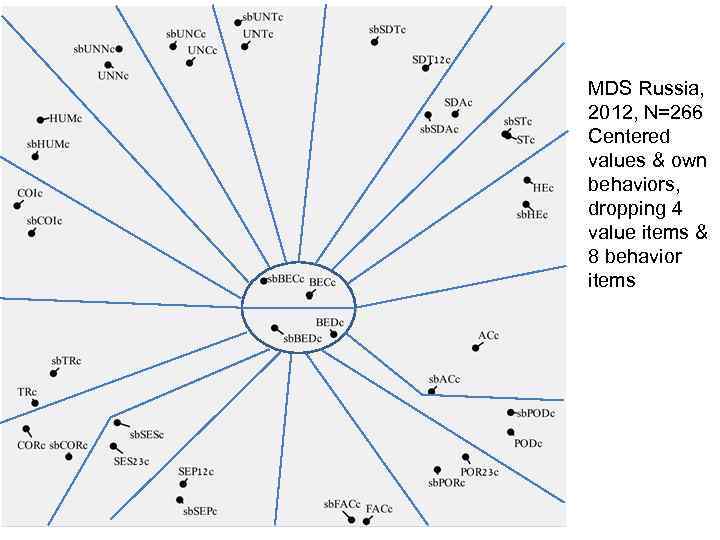
MDS Russia, 2012, N=266 Centered values & own behaviors, dropping 4 value items & 8 behavior items
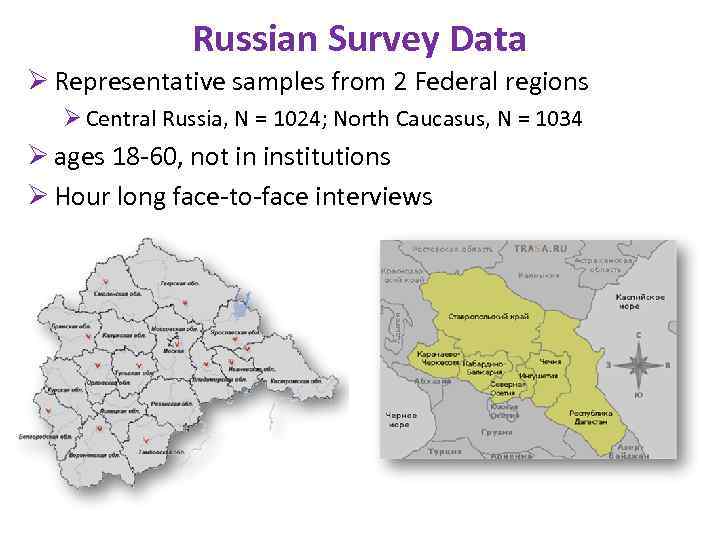
Russian Survey Data Ø Representative samples from 2 Federal regions Ø Central Russia, N = 1024; North Caucasus, N = 1034 Ø ages 18 -60, not in institutions Ø Hour long face-to-face interviews
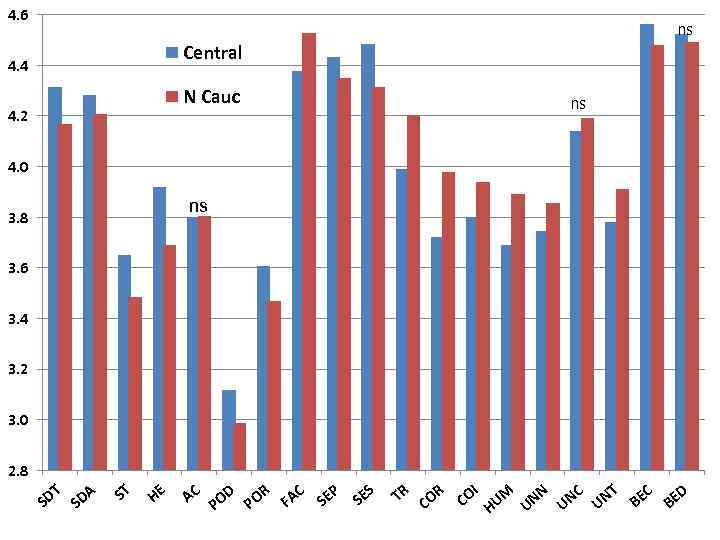
Predicting & Explaining with Personal Values in New Survey Ø Groups of 2 -3 assigned variable to relate to values Ø Regional differences in value priorities: Central vs. N. Caucasus Ø Age Ø Gender Ø Education—highest level completed Ø Patriotism Ø Religiosity Ø Generalized trust in people Ø Trust in government Ø Cheating on taxes, govt. benefits, bribes justified Ø Increase government ownership of business and industry
4. 6 ns Central 4. 4 N Cauc 4. 2 ns 4. 0 ns 3. 8 3. 6 3. 4 3. 2 3. 0 2. 8 T A SD SD ST HE AC POD POR FAC P SE SE S TR COR I T C N CO HUM UN UN UN C D BE BE
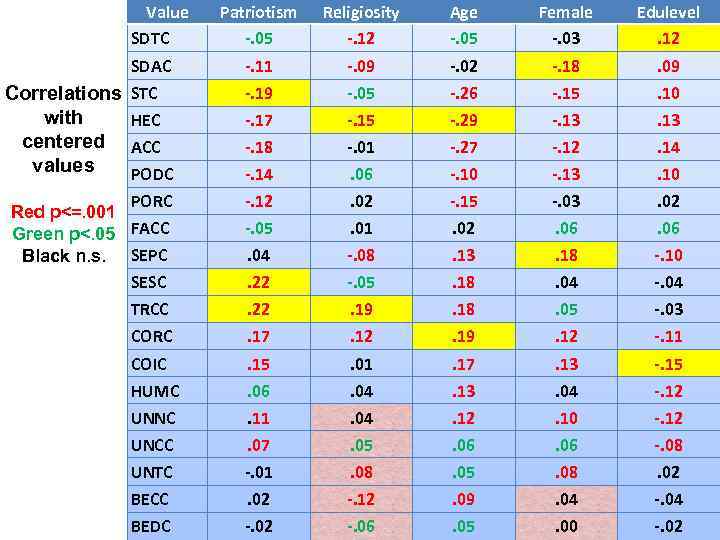
Value SDTC Patriotism -. 05 Religiosity -. 12 Age -. 05 Female -. 03 Edulevel. 12 SDAC -. 11 -. 09 -. 02 -. 18 . 09 STC -. 19 -. 05 -. 26 -. 15 . 10 HEC -. 17 -. 15 -. 29 -. 13 ACC -. 18 -. 01 -. 27 -. 12 . 14 PODC -. 14 . 06 -. 10 -. 13 . 10 PORC Red p<=. 001 Green p<. 05 FACC Black n. s. SEPC SESC -. 12 . 02 -. 15 -. 03 . 02 -. 05 . 01 . 02 . 06 . 04 -. 08 . 13 . 18 -. 10 . 22 -. 05 . 18 . 04 -. 04 TRCC . 22 . 19 . 18 . 05 -. 03 CORC . 17 . 12 . 19 . 12 -. 11 COIC . 15 . 01 . 17 . 13 -. 15 HUMC . 06 . 04 . 13 . 04 -. 12 UNNC . 11 . 04 . 12 . 10 -. 12 UNCC . 07 . 05 . 06 -. 08 UNTC -. 01 . 08 . 05 . 08 . 02 BECC . 02 -. 12 . 09 . 04 -. 04 BEDC -. 02 -. 06 . 05 . 00 -. 02 Correlations with centered values
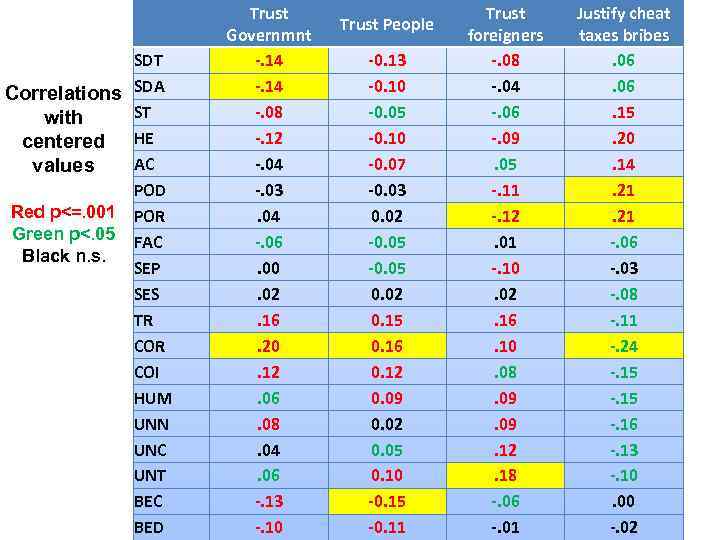
SDT Correlations SDA ST with centered HE AC values POD Red p<=. 001 POR Green p<. 05 FAC Black n. s. SEP SES TR COI HUM UNN UNC UNT BEC BED Trust Governmnt -. 14 -. 08 -. 12 -. 04 -. 03. 04 -. 06. 00. 02. 16. 20. 12. 06. 08. 04. 06 -. 13 -. 10 Trust People -0. 13 -0. 10 -0. 05 -0. 10 -0. 07 -0. 03 0. 02 -0. 05 0. 02 0. 15 0. 16 0. 12 0. 09 0. 02 0. 05 0. 10 -0. 15 -0. 11 Trust foreigners -. 08 -. 04 -. 06 -. 09. 05 -. 11 -. 12. 01 -. 10. 02. 16. 10. 08. 09. 12. 18 -. 06 -. 01 Justify cheat taxes bribes. 06. 15. 20. 14. 21 -. 06 -. 03 -. 08 -. 11 -. 24 -. 15 -. 16 -. 13 -. 10. 00 -. 02
Applications Ø 19 values permit detailed prediction & explanation of attitudes & behavior Ø Other research topics with values (selected) Ø Relations to personality, subjective & objective well-being Ø Value change & transmission (generational, immigration, etc. ) Ø Person-environment fit; value congruence & social cohesion Ø Childhood development of value structure & priorities Ø Value measurement—instruments, reliability, invariance Ø Genetic bases of value priorities Ø Values as mediators and moderators (e. g. ) Ø Mediate: Do values mediate effects of age on voting? Gender on violence? Ø Moderate: Does the association of patriotism with life satisfaction depend on the level of conformity-rules values?

Continuing Work Ø Develop your own projects [main topics of lab not included in what we examined] Ø Address questions by analyzing data from the Russian survey Shalom. schwartz@mail. huji. ac. il
Скачать презентацию Objectives of the course Ø Develop an in
Course Sept 2014 Ind Values.pptx