 Скачать презентацию Objective 2 03 Analyze financial and legal aspects
ef0a6dec4c915553acf8d57973278d9e.ppt
- Количество слайдов: 16



Objective 2. 03 Analyze financial and legal aspects of home ownership
So you want to buy a house… • In order to buy a home most people will need to borrow money. This is called a mortgage • A mortgage is a contract outlining the terms of a loan between the lender and the borrower.
Fixed Rate Mortgages (interest rate and monthly payment are constant) 1. Conventional: borrower pays a fixed interest rate for the length of the loan 2. FHA-insured: guarantees mortgages made by the bank to people with low-medium credit – FHA = Federal Housing Administration 3. 4. VA loan: buyers who serve or have served in the military may qualify for a loan guaranteed by the Veterans Administration Terms of Loans: loans are repaid monthly over a term of 15 -30 years.
Estimating What You Can Afford • Multiply two-and-one-half times your annual gross income (income before deductions) – Gross income X 2. 5 = price of house you can afford • Buyers must also have a down payment of at least 5%. This is a part of the purchase price that must be paid in cash!
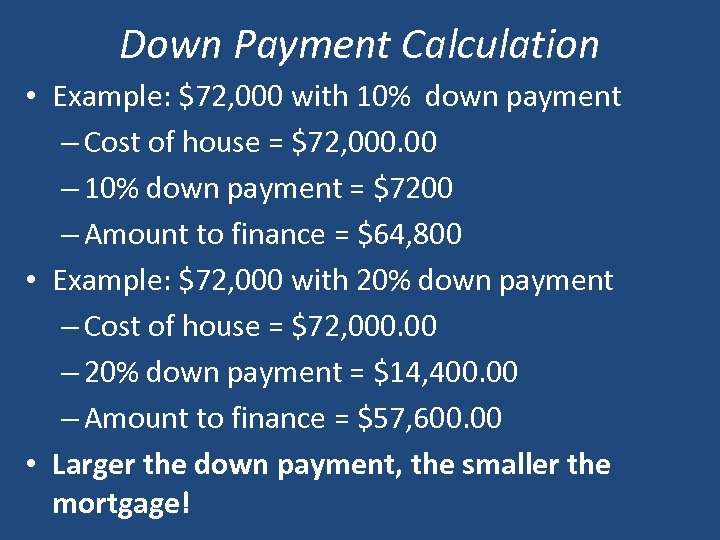
Down Payment Calculation • Example: $72, 000 with 10% down payment – Cost of house = $72, 000. 00 – 10% down payment = $7200 – Amount to finance = $64, 800 • Example: $72, 000 with 20% down payment – Cost of house = $72, 000. 00 – 20% down payment = $14, 400. 00 – Amount to finance = $57, 600. 00 • Larger the down payment, the smaller the mortgage!
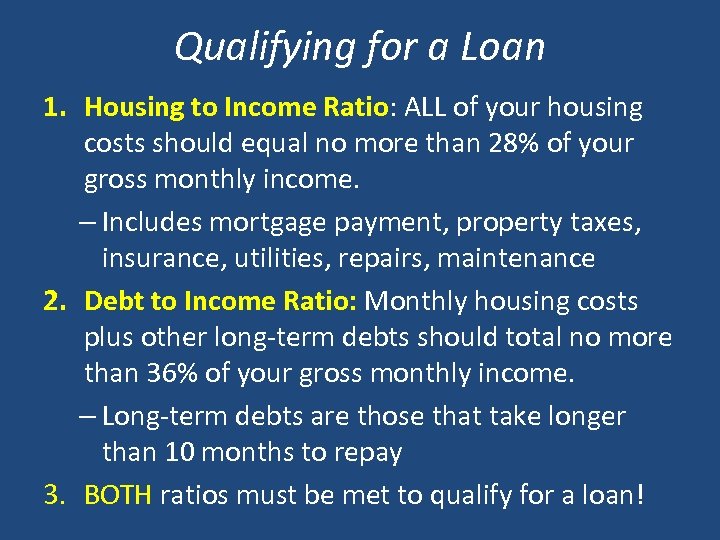
Qualifying for a Loan 1. Housing to Income Ratio: ALL of your housing Ratio costs should equal no more than 28% of your gross monthly income. – Includes mortgage payment, property taxes, insurance, utilities, repairs, maintenance 2. Debt to Income Ratio: Monthly housing costs plus other long-term debts should total no more than 36% of your gross monthly income. – Long-term debts are those that take longer than 10 months to repay 3. BOTH ratios must be met to qualify for a loan!

Stop here
The Purchasing Process 1. Agreement of sale: – Also called a purchase agreement, sales agreement, or contract of purchase – Legal agreement between the seller and the buyer – States all the conditions of the sale.
2. Earnest Money: – Money a potential buyer pays to show that they are serious about buying a home – Money is held and applied to the cost of the house or refunded if the buyer cannot get a loan.
3. Abstract of title: – Also called a title search – A search of public records to make sure the seller is the true owner of the house – Makes sure there are no debts on the house 4. Survey: – Makes sure property lines are accurate.
5. Inspections: –General home inspection (roof, heating and cooling systems, structural problems, safety issues) –Termite inspection 6. Secure a mortgage – Now, most buyers will become preapproved for a mortgage.
7. Closing: – Closing is when the buyer takes ownership of the property – It involves the seller, the buyer, lawyers, and real estate agents – Closing costs are paid. This is cash paid by the buyer to cover the legal and financial costs of purchasing a home.
Closing costs can include: – Origination fees: fee paid to the lender fees for processing the loan; usually 1% of mortgage – Appraisal fee: fee paid for determining the value of the property – Other fees for lawyers, real estate agents, etc. Some of the money will be held in escrow - money held in trust by a third party until a specified time - usually for property taxes and insurance.
Advantages of Owning a Home • Sense of freedom and independence • Financial advantages: – Helps establish a good credit record in order to qualify for future loans – Interest and property taxes are deductible – Houses usually increase in value – this is called equity.
Equity Example – Mary owns a house. She currently owes $90, 000 on her mortgage. She has decided to sell her house and buy a new one – Mary’s real estate agent sells Mary’s house for $140, 000 (market value) – Mary paid off her mortgage of $90, 000 – How much money did Mary make when she sold her house? – Mary made $50, 000. This is called equity. – Mary used her equity as a down payment on a new home.
Disadvantages of Owning a Home • Strain on finances- property taxes, insurance, and maintenance • Uses up lots of your free time • Foreclosure if you get behind on monthly payments • Limited mobility.
Скачать презентацию Objective 2 03 Analyze financial and legal aspects
ef0a6dec4c915553acf8d57973278d9e.ppt