 Скачать презентацию OBJECTIONS Why How and When To Object Litigation
1ee86ce3537337e10bccaeb80fc594b8.ppt
- Количество слайдов: 94



OBJECTIONS! Why, How and When To Object Litigation Department Training Module - Part of ACCRA Training Module Based on a CD Game First time to be presented in public Lecture CD/DVD Quiz Open forum
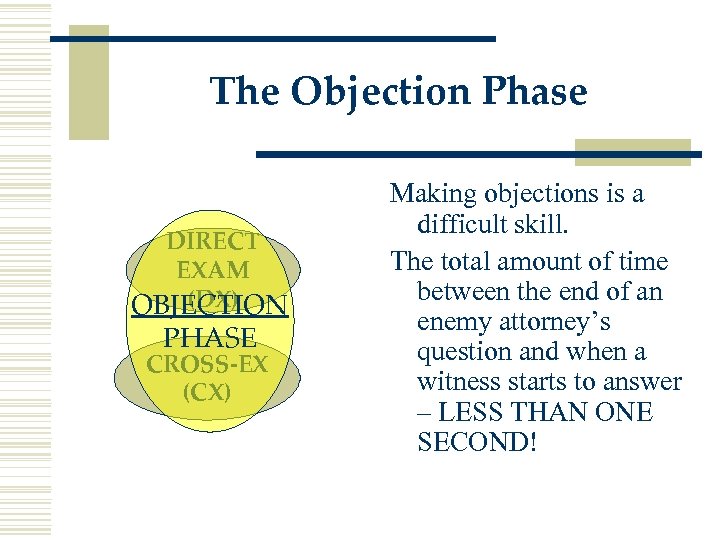
The Objection Phase DIRECT EXAM (DX) OBJECTION PHASE CROSS-EX (CX) Making objections is a difficult skill. The total amount of time between the end of an enemy attorney’s question and when a witness starts to answer – LESS THAN ONE SECOND!
Reasons for Objecting 1. Stop an enemy from hurting your case – PRINCIPAL REASON 2. Establish your record on appeal. (e. g. Admission of “privilege letter” over your objection) 3. Neutralize or oppose an improper statement. “ungrateful partner” 4. Establish your presence or the other side of the coin (esp. Defendant). 5. Throw an enemy off balance. - loss of concentration/focus (importance of notes/tick marks)
Reasons for Not Objecting 1. Not to delay the trial 2. May give enemy attorney & witness more time to think 3. May suggest to the enemy how to ask a proper question 4. Answer may be favorable to you 5. Irrelevant questions & answers are not critical to your case 6. Objectionable questions (Formal but not Substantive) may be rephrased anyway
Style 1. SPEAK UP WITH AUTHORITY. Everybody (i. e. , judge, enemy attorney, witness) should hear you. Shift or project the interruption. to the enemy (enemy attorney is asking objectionable questions; enemy witness is given objectionable answers).
2. STAND UP. Avoid the jumping bean style. Reserve the “standing objections” for the most damaging testimony. Certain judges require the lawyer to stand up whenever he speaks or objects.
3. NEVER SHOW PHONY INDIGNATION. 4. MAKE SPECIFIC OBJECTIONS. State one-word objections rather than giving a speech (unless really important). If there is more than one basis for the objection, state them.
Timing is critical. If you object too soon, the judge would tell you this: Counsel, let the opposing counsel finish his question. Be seated! If you object too long, the enemy attorney would have finished the question and the witness may have answered.
If you fail to timely object to the question, MOVE TO STRIKE the answer. Disadvantages: 1. Everybody already heard the answer 2. Damage had been done 3. Low probability that the answer will be stricken off
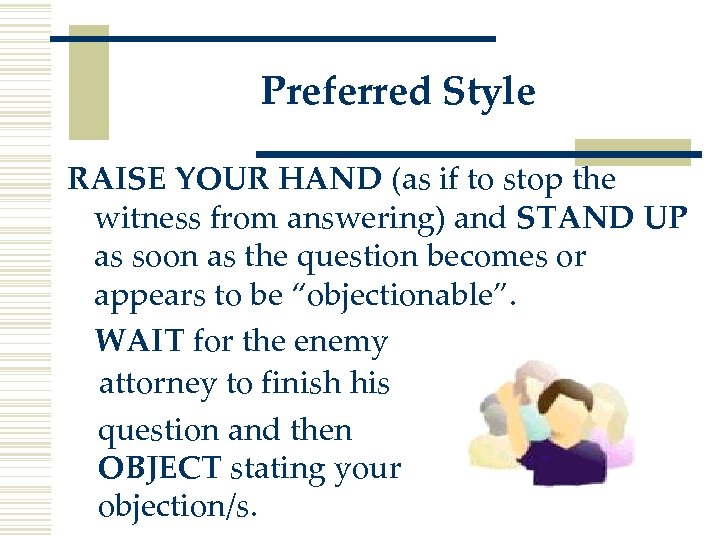
Preferred Style RAISE YOUR HAND (as if to stop the witness from answering) and STAND UP as soon as the question becomes or appears to be “objectionable”. WAIT for the enemy attorney to finish his question and then OBJECT stating your objection/s.
Classification w APPLICABILITY – Used in either, both, or all Direct Examination (DX), Cross-Examination (CX), Redirect Examination (RD), Re-cross-examination (RX) w NATURE – Formal or Substantive n Formal – addresses the MANNER by which evidence is elicited – could be corrected by rephrasing the questions n Substantive – addressed the UNDERLYING ADMISSIBILITY of the evidence w BASIS OR TARGET – Question-based (QB) or Answer-based (AB)
1. ARGUMENTATIVE w Formal objection w Used in both direct examination & cross-examination (DX/CX) w Only question-based (QB) w Links – Repetitive, Misleading
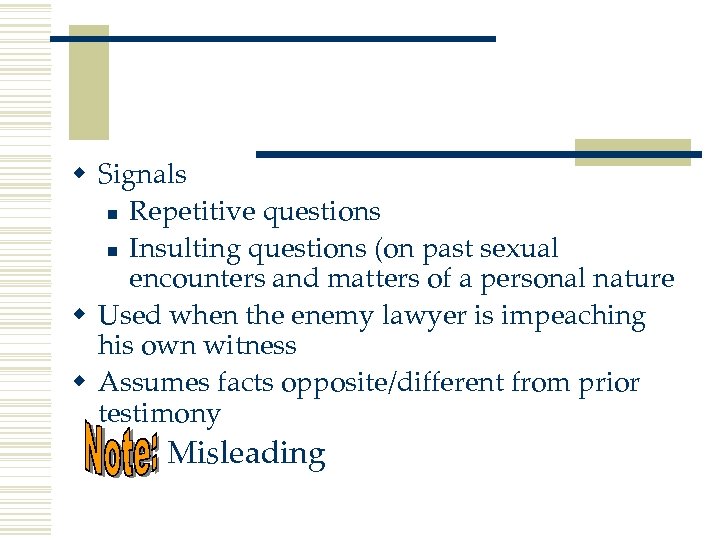
w Signals n Repetitive questions n Insulting questions (on past sexual encounters and matters of a personal nature w Used when the enemy lawyer is impeaching his own witness w Assumes facts opposite/different from prior testimony Misleading
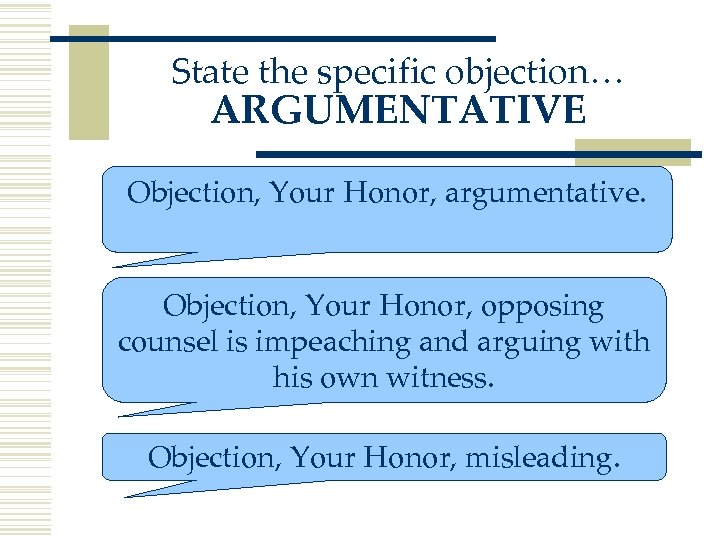
State the specific objection… ARGUMENTATIVE Objection, Your Honor, argumentative. Objection, Your Honor, opposing counsel is impeaching and arguing with his own witness. Objection, Your Honor, misleading.
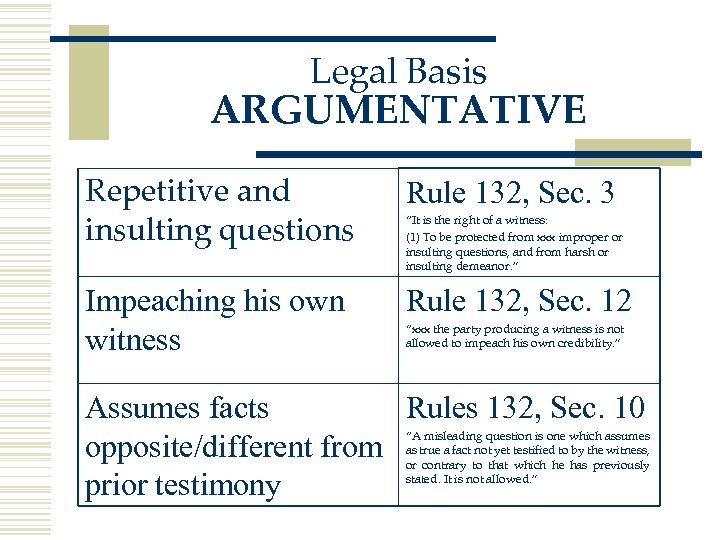
Legal Basis ARGUMENTATIVE Repetitive and insulting questions Rule 132, Sec. 3 Impeaching his own witness Rule 132, Sec. 12 “It is the right of a witness: (1) To be protected from xxx improper or insulting questions, and from harsh or insulting demeanor. ” “xxx the party producing a witness is not allowed to impeach his own credibility. ” Assumes facts Rules 132, Sec. 10 opposite/different from prior testimony “A misleading question is one which assumes as true a fact not yet testified to by the witness, or contrary to that which he has previously stated. It is not allowed. ”
2. BEST EVIDENCE w Substantive objection w Used in both direct examination & cross-examination (DX/CX) w Both question-based & answer-based (QB/AB) w Links – Hearsay, Speculative
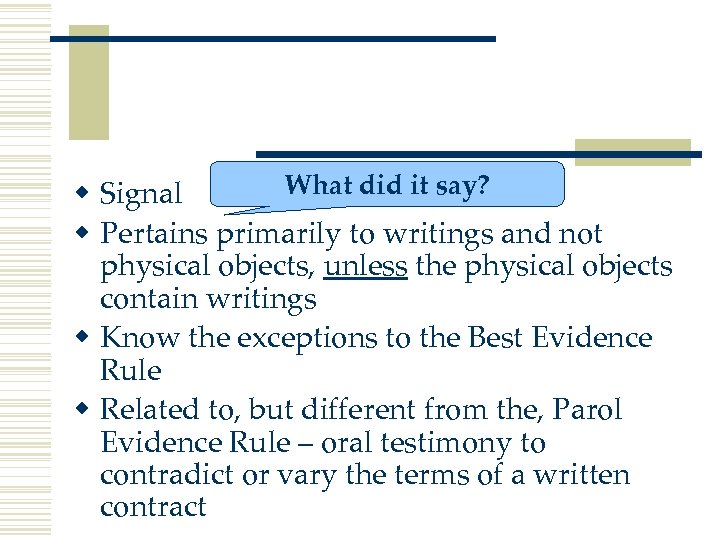
What did it say? w Signal w Pertains primarily to writings and not physical objects, unless the physical objects contain writings w Know the exceptions to the Best Evidence Rule w Related to, but different from the, Parol Evidence Rule – oral testimony to contradict or vary the terms of a written contract
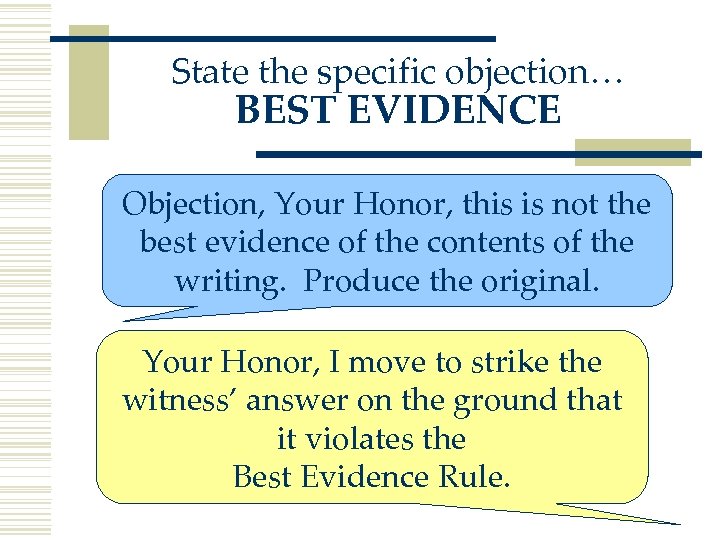
State the specific objection… BEST EVIDENCE Objection, Your Honor, this is not the best evidence of the contents of the writing. Produce the original. Your Honor, I move to strike the witness’ answer on the ground that it violates the Best Evidence Rule.
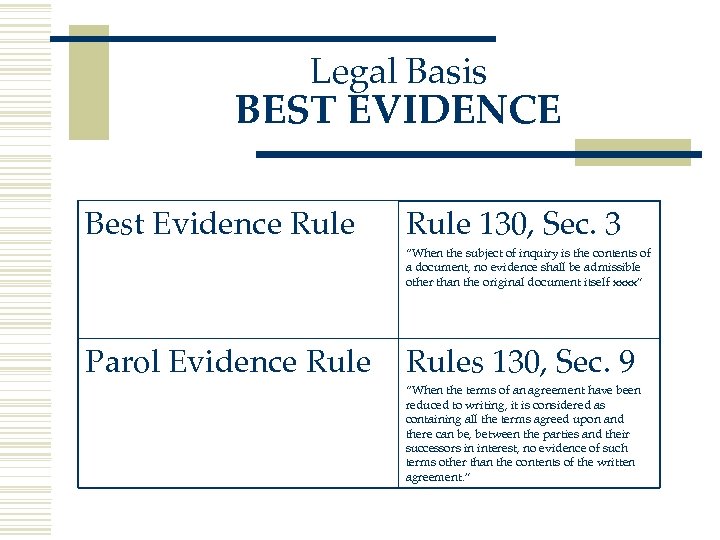
Legal Basis BEST EVIDENCE Best Evidence Rule 130, Sec. 3 “When the subject of inquiry is the contents of a document, no evidence shall be admissible other than the original document itself xxxx” Parol Evidence Rules 130, Sec. 9 “When the terms of an agreement have been reduced to writing, it is considered as containing all the terms agreed upon and there can be, between the parties and their successors in interest, no evidence of such terms other than the contents of the written agreement. ”
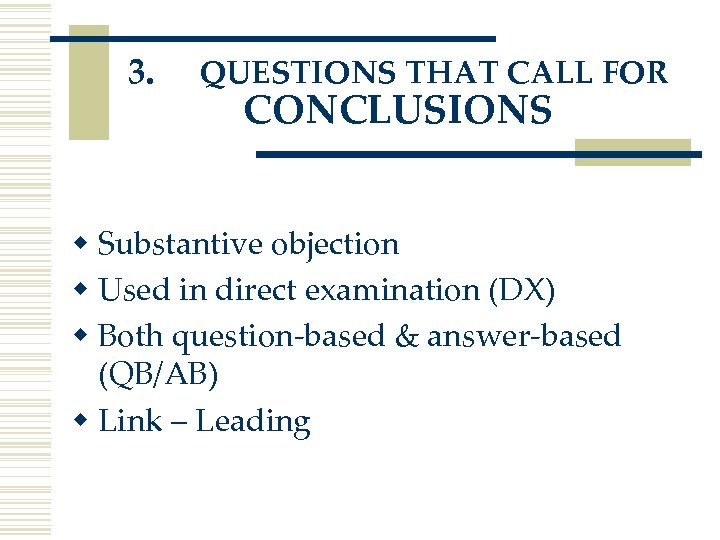
3. QUESTIONS THAT CALL FOR CONCLUSIONS w Substantive objection w Used in direct examination (DX) w Both question-based & answer-based (QB/AB) w Link – Leading
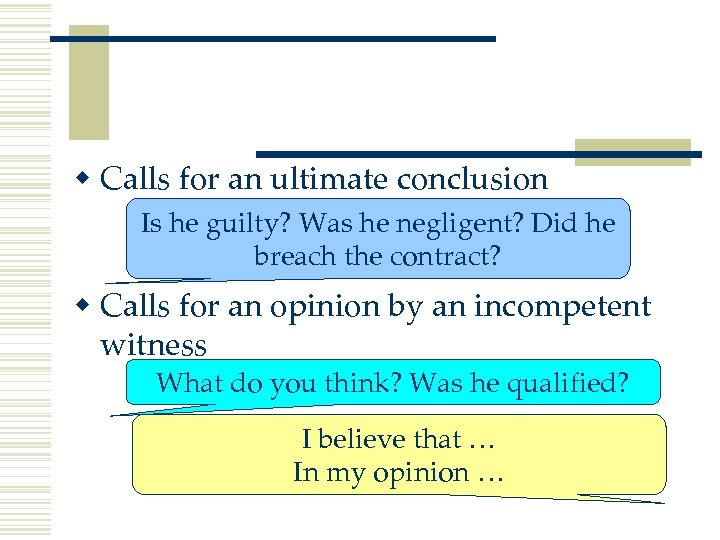
w Calls for an ultimate conclusion Is he guilty? Was he negligent? Did he breach the contract? w Calls for an opinion by an incompetent witness What do you think? Was he qualified? I believe that … In my opinion …
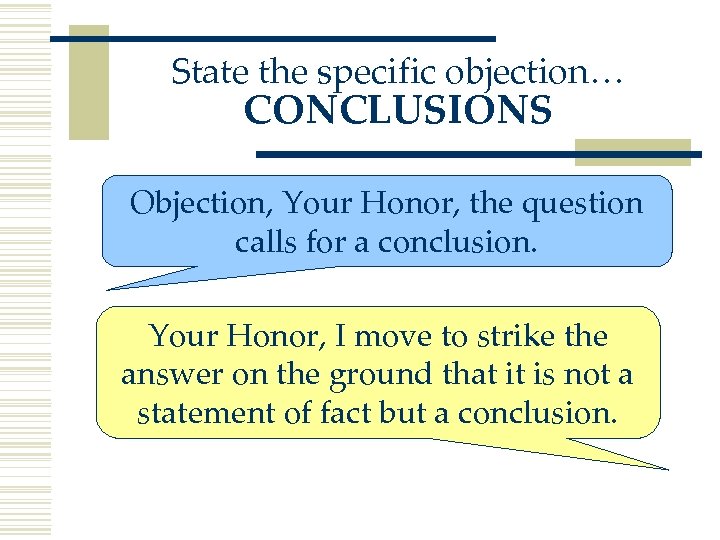
State the specific objection… CONCLUSIONS Objection, Your Honor, the question calls for a conclusion. Your Honor, I move to strike the answer on the ground that it is not a statement of fact but a conclusion.
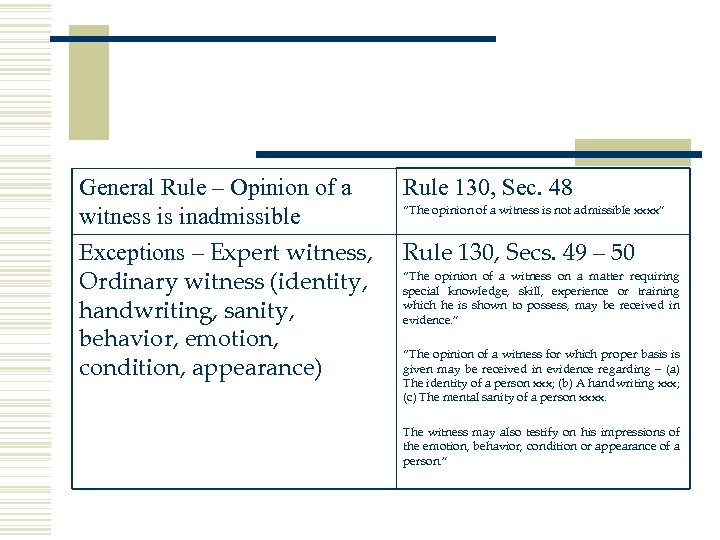
General Rule – Opinion of a witness is inadmissible Rule 130, Sec. 48 Exceptions – Expert witness, Ordinary witness (identity, handwriting, sanity, behavior, emotion, condition, appearance) Rule 130, Secs. 49 – 50 “The opinion of a witness is not admissible xxxx” “The opinion of a witness on a matter requiring special knowledge, skill, experience or training which he is shown to possess, may be received in evidence. ” “The opinion of a witness for which proper basis is given may be received in evidence regarding – (a) The identity of a person xxx; (b) A handwriting xxx; (c) The mental sanity of a person xxxx. The witness may also testify on his impressions of the emotion, behavior, condition or appearance of a person. ”
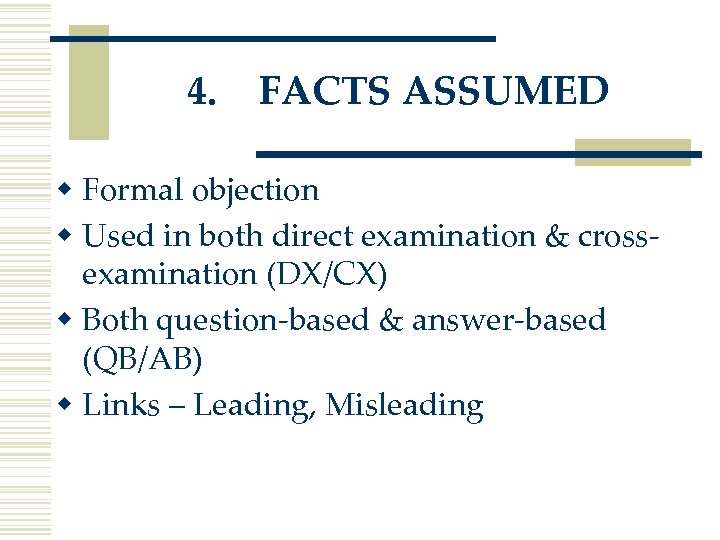
4. FACTS ASSUMED w Formal objection w Used in both direct examination & crossexamination (DX/CX) w Both question-based & answer-based (QB/AB) w Links – Leading, Misleading
w Signals – Watch out for questions that: n n Are very long i. e. takes 10– 15 seconds to ask Contain too much information Make assumptions Tends to advance the enemy’s case through the attorney w Also known as “assuming-facts-not-in-evidence”; also used as “no basis” or “lacks basis” w Could also be “misleading” if fact assumed misstates the evidence or misquotes the witness
State the specific objection… FACTS ASSUMED Objection, Your Honor, the question assumes facts not in evidence. Objection, Your Honor, the question is misleading and assumes facts contrary to the evidence that has preceded. Objection, Your Honor, I move to strike the answer because it is misleading and it is contradictory to what is stated in the document.
Legal Basis FACTS ASSUMED Definition of a misleading Rule 132, Sec. 10, question – one which assumes last par. as true a fact not yet testified, “A misleading question is one which assumes as true a fact not yet testified to by the witness, or contrary to that which he has or contrary to that which he previously stated xxxx” has previously stated
5. HEARSAY w Substantive objection w Used in both direct examination & crossexamination (DX/CX) w Both question-based & answer-based (QB/AB) w Links – Best Evidence, Speculative w First of the two POWER OBJECTIONS
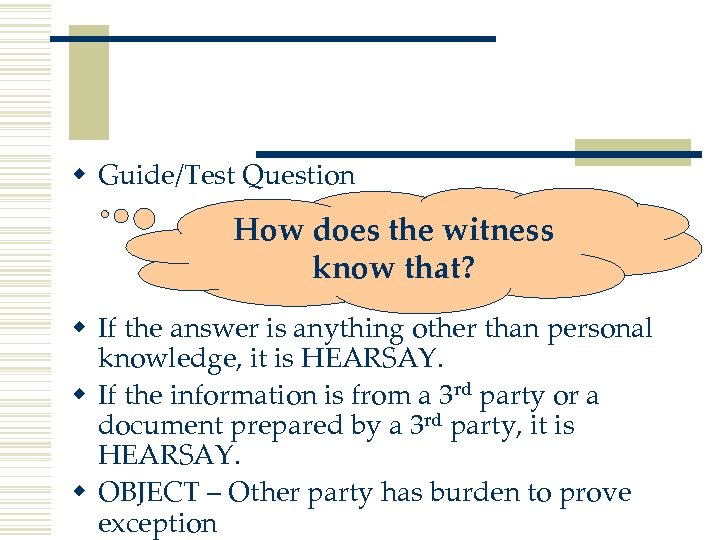
w Guide/Test Question How does the witness know that? w If the answer is anything other than personal knowledge, it is HEARSAY. w If the information is from a 3 rd party or a document prepared by a 3 rd party, it is HEARSAY. w OBJECT – Other party has burden to prove exception
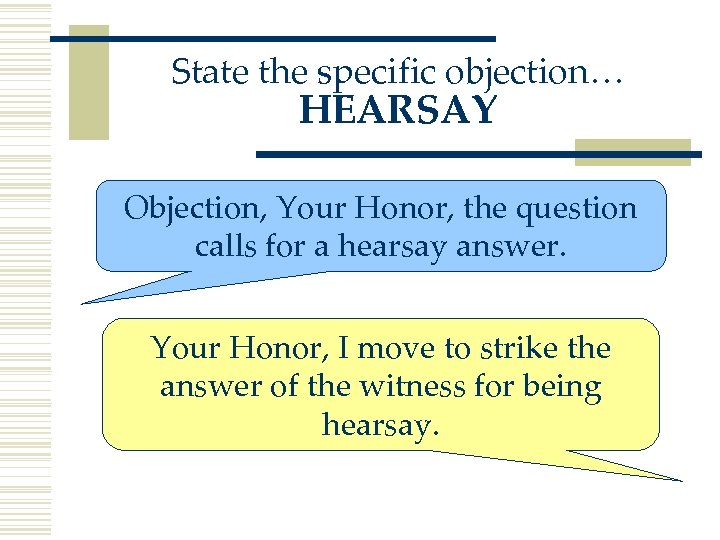
State the specific objection… HEARSAY Objection, Your Honor, the question calls for a hearsay answer. Your Honor, I move to strike the answer of the witness for being hearsay.
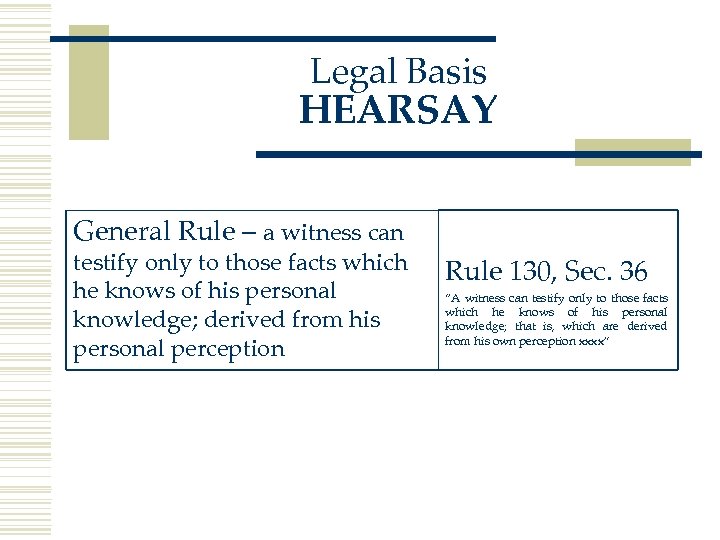
Legal Basis HEARSAY General Rule – a witness can testify only to those facts which he knows of his personal knowledge; derived from his personal perception Rule 130, Sec. 36 “A witness can testify only to those facts which he knows of his personal knowledge; that is, which are derived from his own perception xxxx”
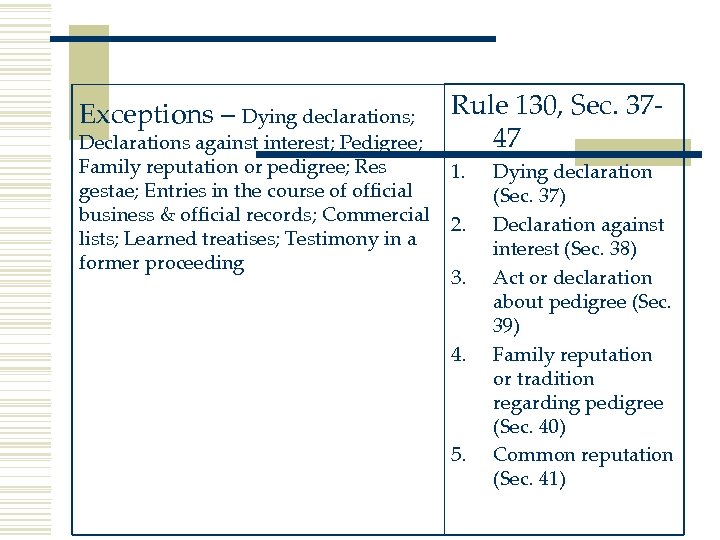
Exceptions – Dying declarations; Declarations against interest; Pedigree; Family reputation or pedigree; Res gestae; Entries in the course of official business & official records; Commercial lists; Learned treatises; Testimony in a former proceeding Rule 130, Sec. 3747 1. 2. 3. 4. 5. Dying declaration (Sec. 37) Declaration against interest (Sec. 38) Act or declaration about pedigree (Sec. 39) Family reputation or tradition regarding pedigree (Sec. 40) Common reputation (Sec. 41)
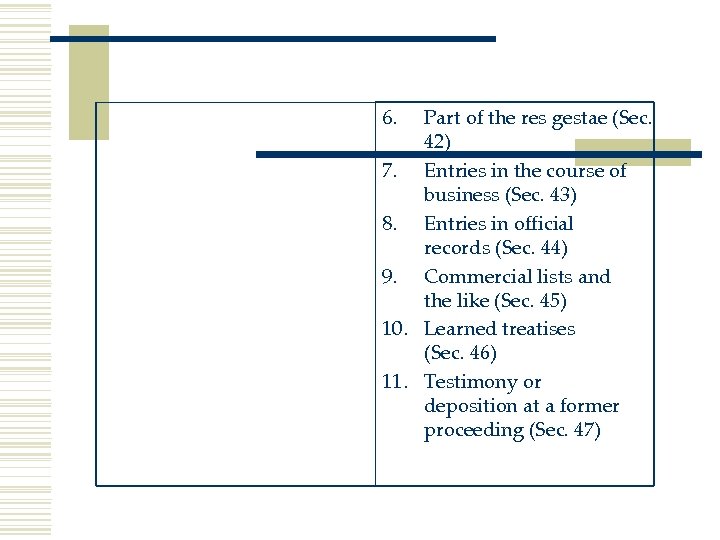
6. Part of the res gestae (Sec. 42) 7. Entries in the course of business (Sec. 43) 8. Entries in official records (Sec. 44) 9. Commercial lists and the like (Sec. 45) 10. Learned treatises (Sec. 46) 11. Testimony or deposition at a former proceeding (Sec. 47)
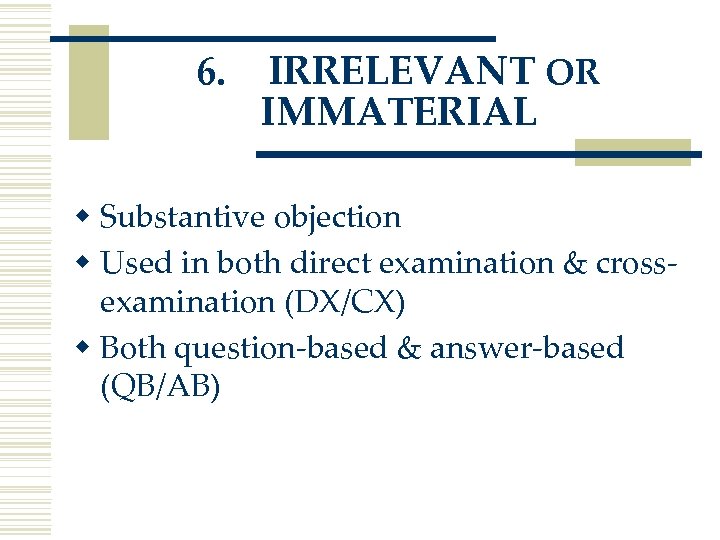
6. IRRELEVANT OR IMMATERIAL w Substantive objection w Used in both direct examination & crossexamination (DX/CX) w Both question-based & answer-based (QB/AB)
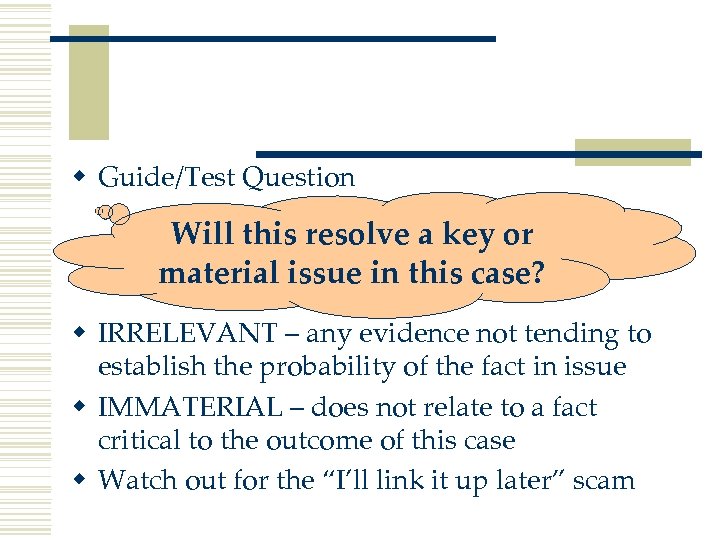
w Guide/Test Question Will this resolve a key or material issue in this case? w IRRELEVANT – any evidence not tending to establish the probability of the fact in issue w IMMATERIAL – does not relate to a fact critical to the outcome of this case w Watch out for the “I’ll link it up later” scam
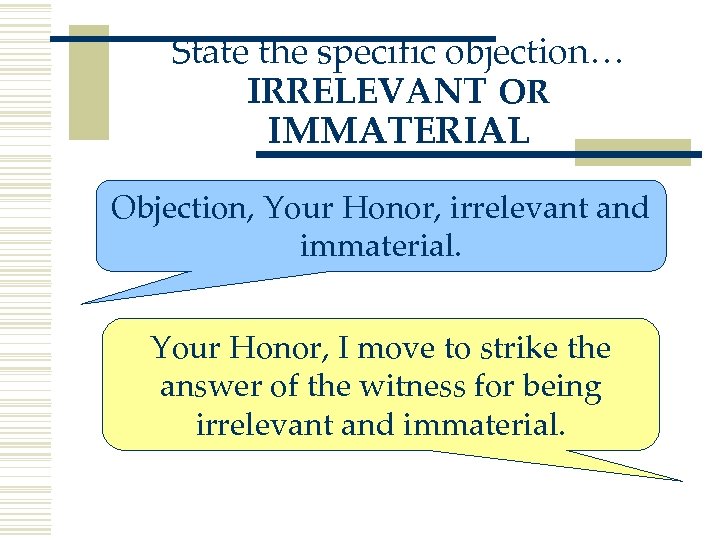
State the specific objection… IRRELEVANT OR IMMATERIAL Objection, Your Honor, irrelevant and immaterial. Your Honor, I move to strike the answer of the witness for being irrelevant and immaterial.
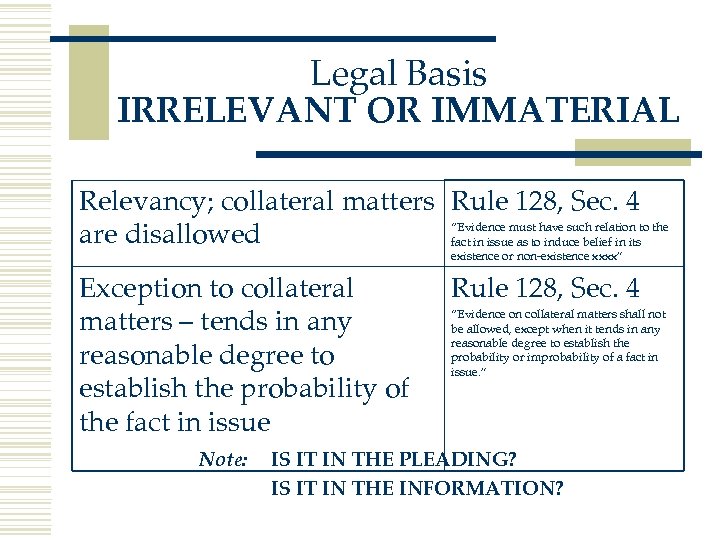
Legal Basis IRRELEVANT OR IMMATERIAL Relevancy; collateral matters Rule 128, Sec. 4 “Evidence must have such relation to the are disallowed fact in issue as to induce belief in its existence or non-existence xxxx” Exception to collateral matters – tends in any reasonable degree to establish the probability of the fact in issue Note: Rule 128, Sec. 4 “Evidence on collateral matters shall not be allowed, except when it tends in any reasonable degree to establish the probability or improbability of a fact in issue. ” IS IT IN THE PLEADING? IS IT IN THE INFORMATION?
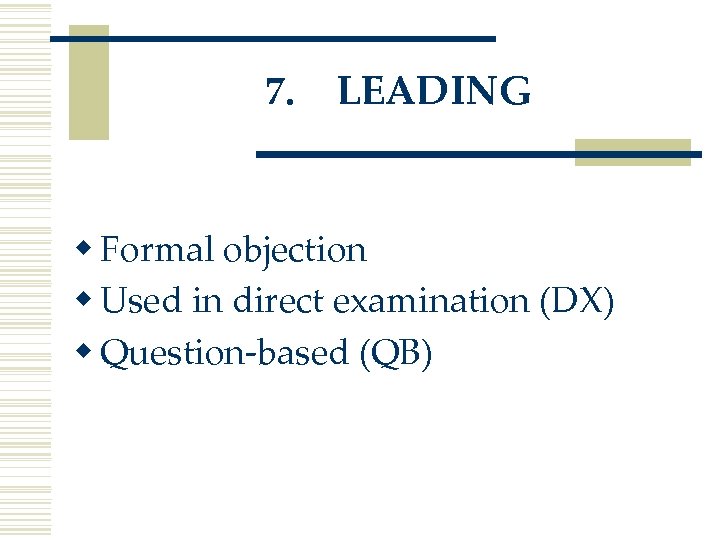
7. LEADING w Formal objection w Used in direct examination (DX) w Question-based (QB)
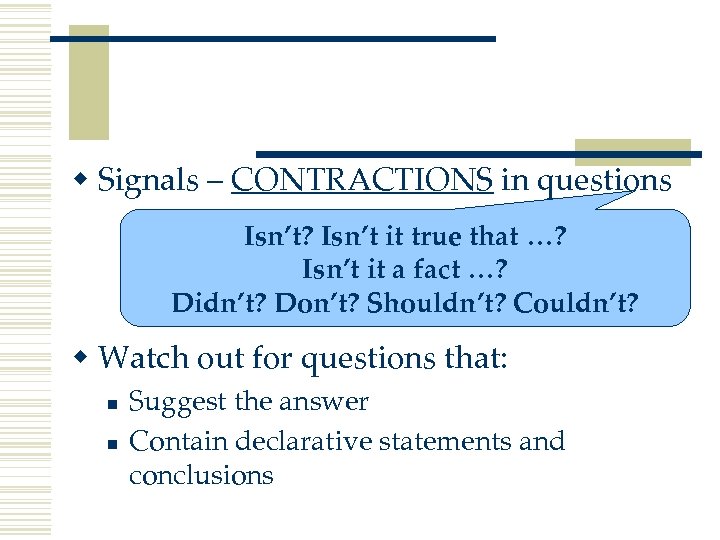
w Signals – CONTRACTIONS in questions Isn’t? Isn’t it true that …? Isn’t it a fact …? Didn’t? Don’t? Shouldn’t? Couldn’t? w Watch out for questions that: n n Suggest the answer Contain declarative statements and conclusions
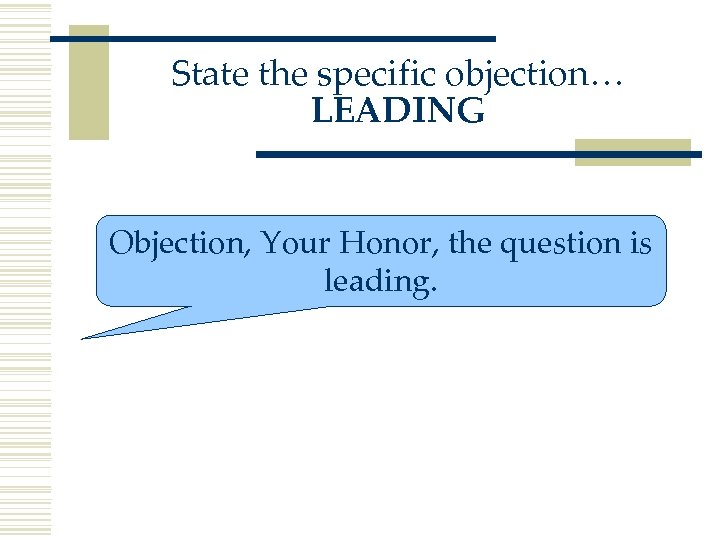
State the specific objection… LEADING Objection, Your Honor, the question is leading.
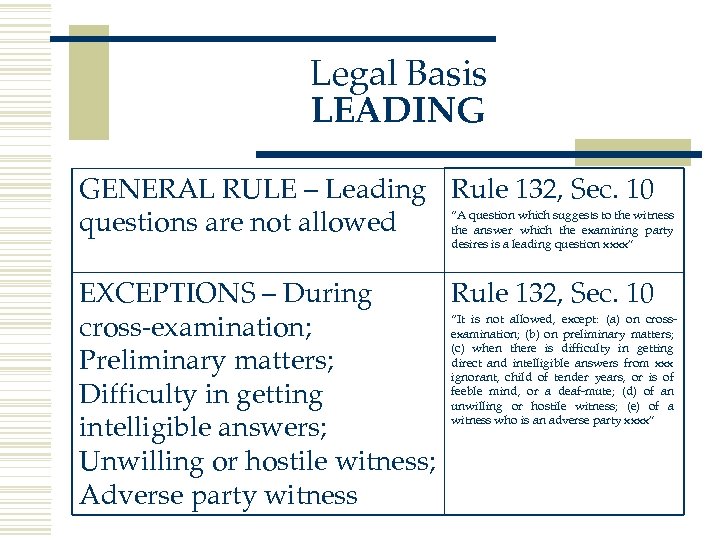
Legal Basis LEADING GENERAL RULE – Leading Rule 132, Sec. 10 “A question which suggests to the witness questions are not allowed the answer which the examining party desires is a leading question xxxx” EXCEPTIONS – During Rule 132, Sec. 10 “It is not allowed, except: (a) on cross-examination; (b) on preliminary matters; (c) when there is difficulty in getting direct and intelligible answers from xxx Preliminary matters; ignorant, child of tender years, or is of feeble mind, or a deaf-mute; (d) of an Difficulty in getting unwilling or hostile witness; (e) of a witness who is an adverse party xxxx” intelligible answers; Unwilling or hostile witness; Adverse party witness
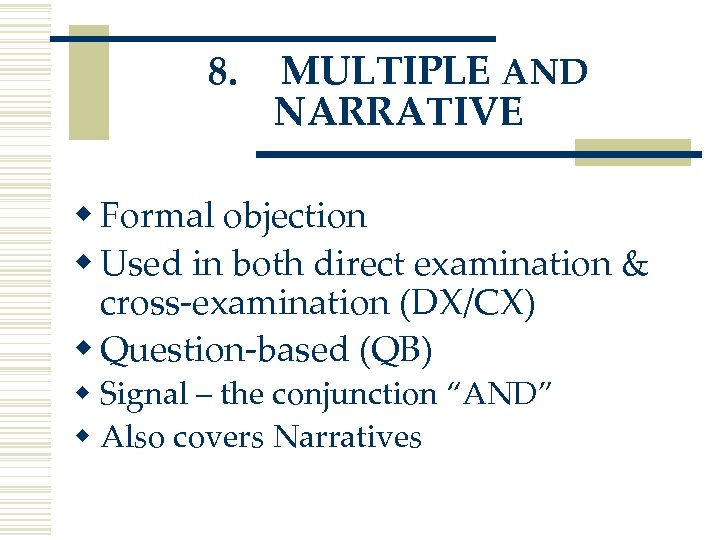
8. MULTIPLE AND NARRATIVE w Formal objection w Used in both direct examination & cross-examination (DX/CX) w Question-based (QB) w Signal – the conjunction “AND” w Also covers Narratives
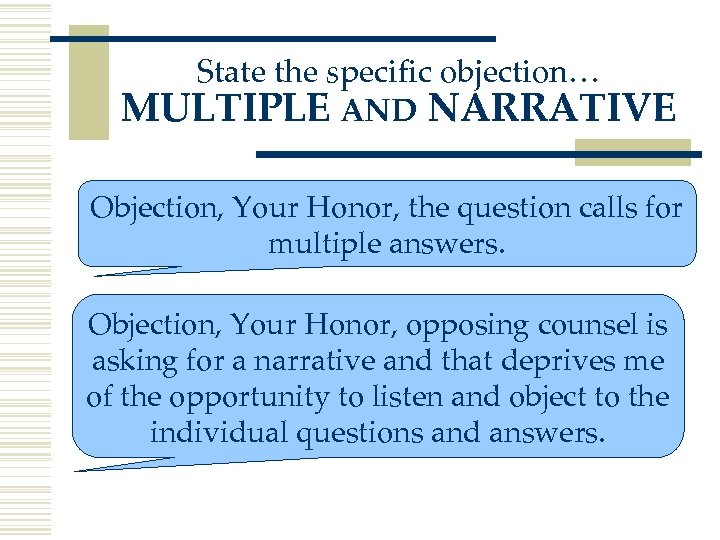
State the specific objection… MULTIPLE AND NARRATIVE Objection, Your Honor, the question calls for multiple answers. Objection, Your Honor, opposing counsel is asking for a narrative and that deprives me of the opportunity to listen and object to the individual questions and answers.
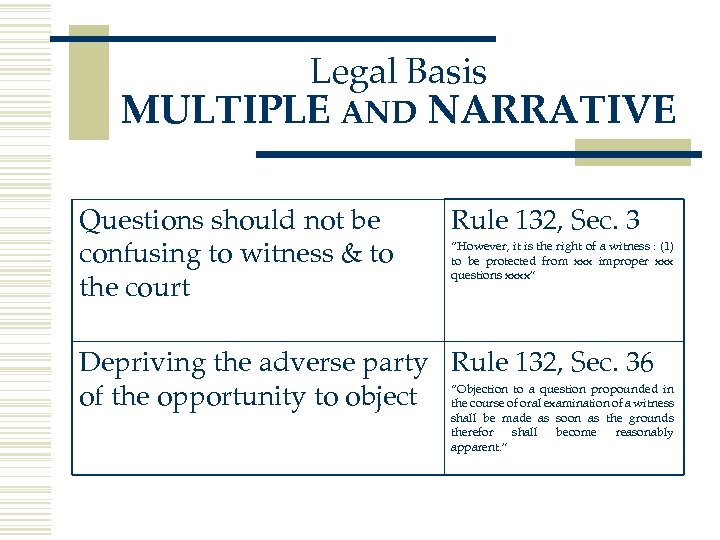
Legal Basis MULTIPLE AND NARRATIVE Questions should not be confusing to witness & to the court Rule 132, Sec. 3 “However, it is the right of a witness : (1) to be protected from xxx improper xxx questions xxxx” Depriving the adverse party Rule 132, Sec. 36 a of the opportunity to object “Objectionoftooralquestion propounded in the course examination of a witness shall be made as soon as the grounds therefor shall become reasonably apparent. ”
9. PRIVILEGE w Substantive objection w Used in both direct examination & cross-examination (DX/CX) w Both question-based & answerbased (QB/AB) w Link - Hearsay
w Watch out for any CONFIDENTIAL RELATIONSHIP i. e. Husband-wife; Lawyerclient; Physician-patient; Priest-penitent; Public officer w Second of two POWER OBJECTIONS Implications of failure to object and failure to protect your client’s privilege goes on beyond the hearing
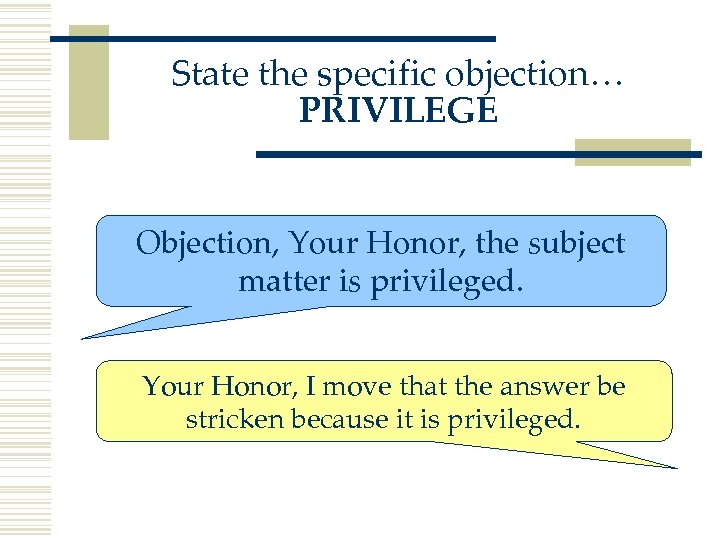
State the specific objection… PRIVILEGE Objection, Your Honor, the subject matter is privileged. Your Honor, I move that the answer be stricken because it is privileged.
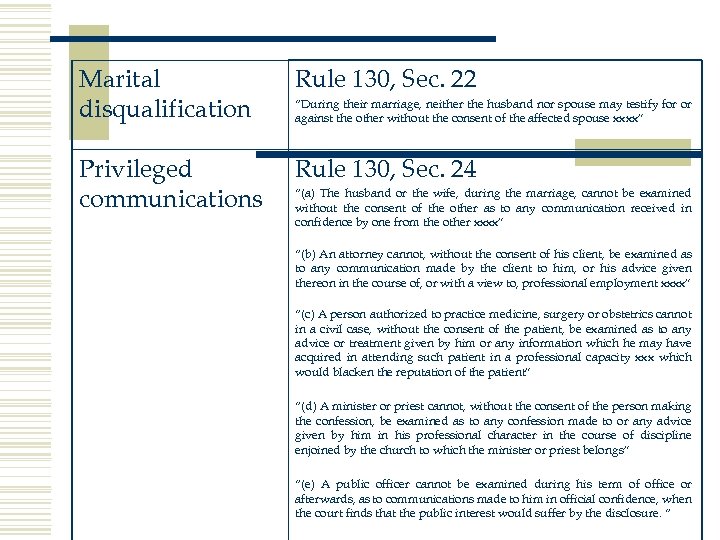
Marital disqualification Rule 130, Sec. 22 Privileged communications Rule 130, Sec. 24 “During their marriage, neither the husband nor spouse may testify for or against the other without the consent of the affected spouse xxxx” “(a) The husband or the wife, during the marriage, cannot be examined without the consent of the other as to any communication received in confidence by one from the other xxxx” “(b) An attorney cannot, without the consent of his client, be examined as to any communication made by the client to him, or his advice given thereon in the course of, or with a view to, professional employment xxxx” “(c) A person authorized to practice medicine, surgery or obstetrics cannot in a civil case, without the consent of the patient, be examined as to any advice or treatment given by him or any information which he may have acquired in attending such patient in a professional capacity xxx which would blacken the reputation of the patient” “(d) A minister or priest cannot, without the consent of the person making the confession, be examined as to any confession made to or any advice given by him in his professional character in the course of discipline enjoined by the church to which the minister or priest belongs” “(e) A public officer cannot be examined during his term of office or afterwards, as to communications made to him in official confidence, when the court finds that the public interest would suffer by the disclosure. “
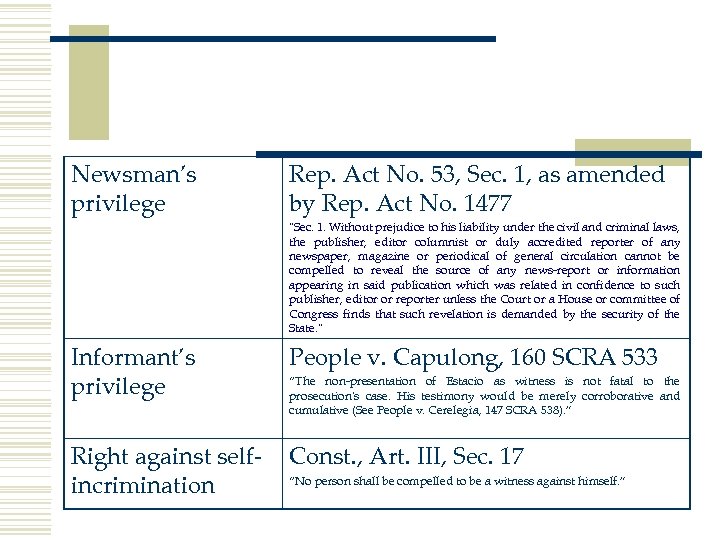
Newsman’s privilege Rep. Act No. 53, Sec. 1, as amended by Rep. Act No. 1477 "Sec. 1. Without prejudice to his liability under the civil and criminal laws, the publisher, editor columnist or duly accredited reporter of any newspaper, magazine or periodical of general circulation cannot be compelled to reveal the source of any news-report or information appearing in said publication which was related in confidence to such publisher, editor or reporter unless the Court or a House or committee of Congress finds that such revelation is demanded by the security of the State. " Informant’s privilege People v. Capulong, 160 SCRA 533 Right against selfincrimination Const. , Art. III, Sec. 17 “The non-presentation of Estacio as witness is not fatal to the prosecution's case. His testimony would be merely corroborative and cumulative (See People v. Cerelegia, 147 SCRA 538). ” “No person shall be compelled to be a witness against himself. ”
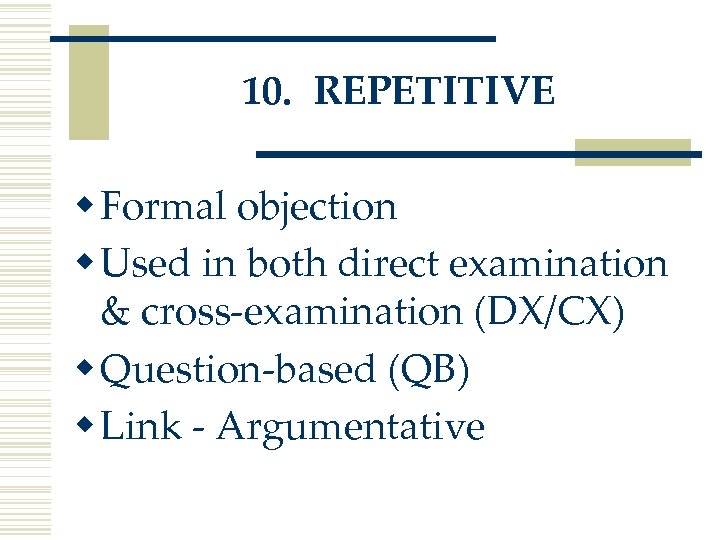
10. REPETITIVE w Formal objection w Used in both direct examination & cross-examination (DX/CX) w Question-based (QB) w Link - Argumentative
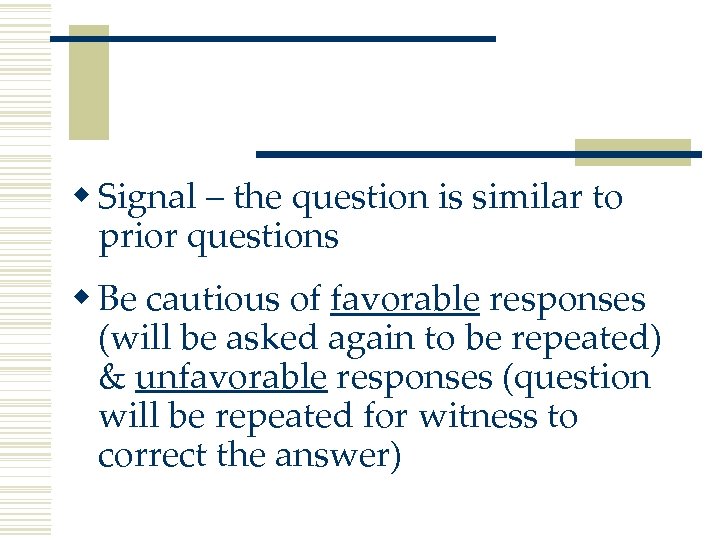
w Signal – the question is similar to prior questions w Be cautious of favorable responses (will be asked again to be repeated) & unfavorable responses (question will be repeated for witness to correct the answer)
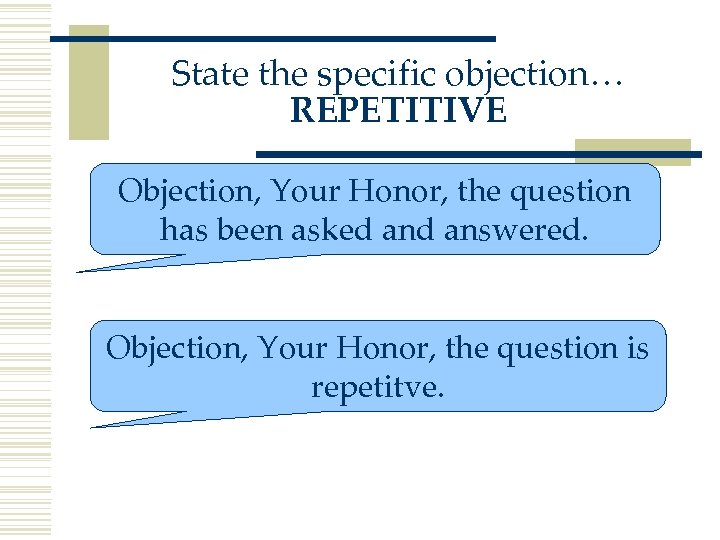
State the specific objection… REPETITIVE Objection, Your Honor, the question has been asked answered. Objection, Your Honor, the question is repetitve.
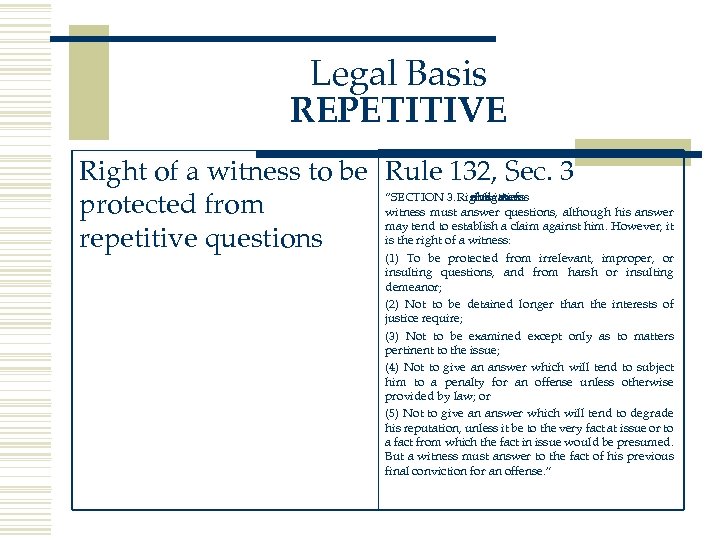
Legal Basis REPETITIVE Right of a witness to be Rule 132, Sec. 3 “SECTION 3. Rights A— obligations and a of witness. protected from witness must answer questions, although his answer may tend to establish a claim against him. However, it is the right of a witness: repetitive questions (1) To be protected from irrelevant, improper, or insulting questions, and from harsh or insulting demeanor; (2) Not to be detained longer than the interests of justice require; (3) Not to be examined except only as to matters pertinent to the issue; (4) Not to give an answer which will tend to subject him to a penalty for an offense unless otherwise provided by law; or (5) Not to give an answer which will tend to degrade his reputation, unless it be to the very fact at issue or to a fact from which the fact in issue would be presumed. But a witness must answer to the fact of his previous final conviction for an offense. ”
11. SPECULATIVE w Substantive objection w Used in direct examination (DX) w Both question-based & answerbased (QB/AB) w Links – Hearsay, Conclusion
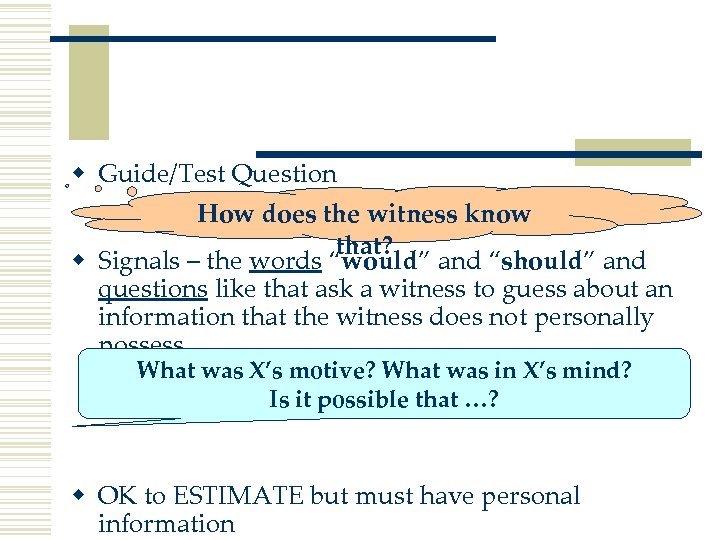
w Guide/Test Question How does the witness know that? w Signals – the words “would” and “should” and questions like that ask a witness to guess about an information that the witness does not personally possess What was X’s motive? What was in X’s mind? Is it possible that …? w OK to ESTIMATE but must have personal information
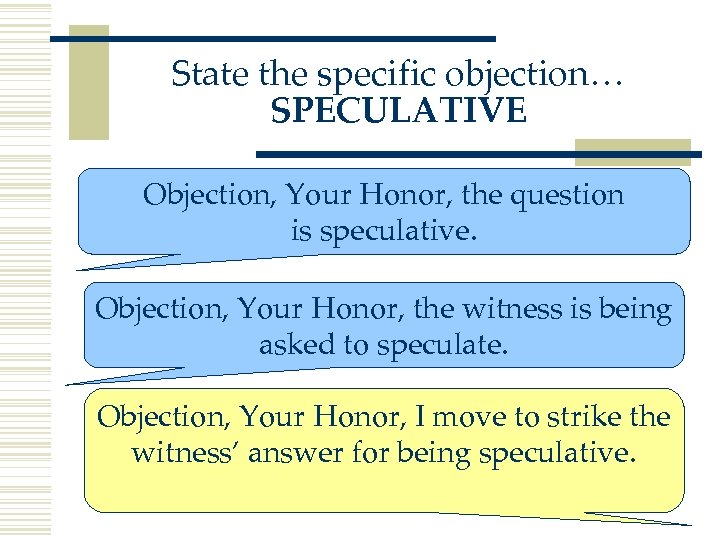
State the specific objection… SPECULATIVE Objection, Your Honor, the question is speculative. Objection, Your Honor, the witness is being asked to speculate. Objection, Your Honor, I move to strike the witness’ answer for being speculative.
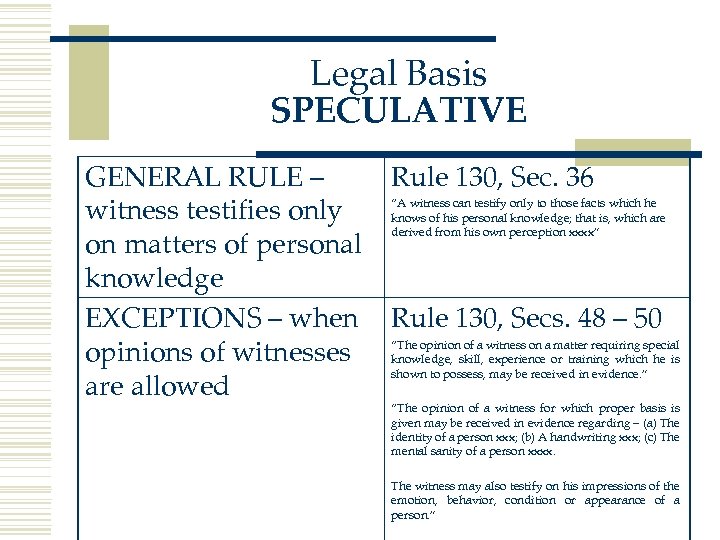
Legal Basis SPECULATIVE GENERAL RULE – witness testifies only on matters of personal knowledge EXCEPTIONS – when opinions of witnesses are allowed Rule 130, Sec. 36 “A witness can testify only to those facts which he knows of his personal knowledge; that is, which are derived from his own perception xxxx” Rule 130, Secs. 48 – 50 “The opinion of a witness on a matter requiring special knowledge, skill, experience or training which he is shown to possess, may be received in evidence. ” “The opinion of a witness for which proper basis is given may be received in evidence regarding – (a) The identity of a person xxx; (b) A handwriting xxx; (c) The mental sanity of a person xxxx. The witness may also testify on his impressions of the emotion, behavior, condition or appearance of a person. ”
12. VAGUE w Formal objection w Used in both direct examination & cross-examination (DX/CX) w Only question-based (QB)
w Signals – Watch out for questions that: n Are very long i. e. takes 10– 15 seconds to ask n Call for information that is very non-specific n You don’t understand
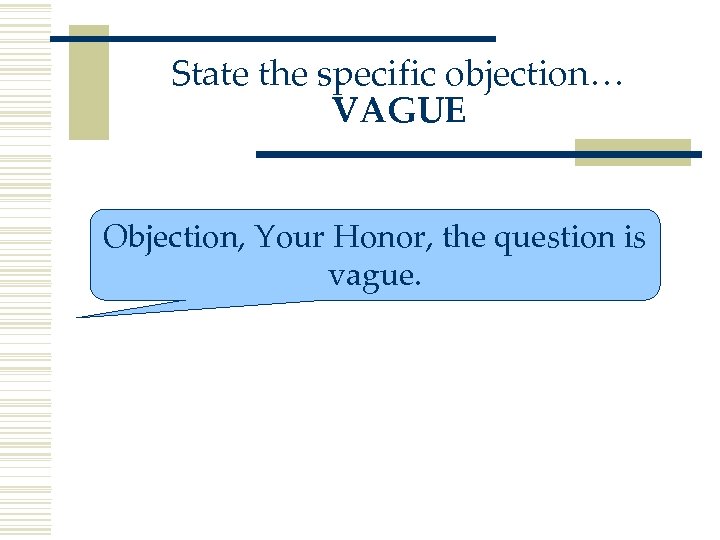
State the specific objection… VAGUE Objection, Your Honor, the question is vague.
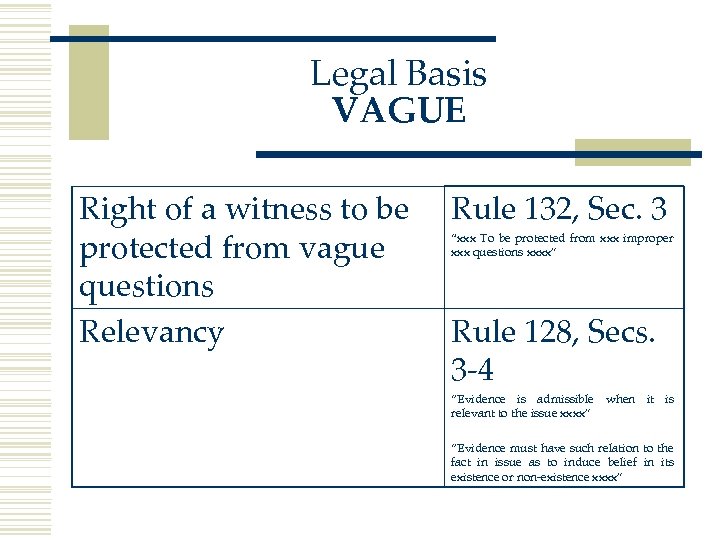
Legal Basis VAGUE Right of a witness to be protected from vague questions Relevancy Rule 132, Sec. 3 “xxx To be protected from xxx improper xxx questions xxxx” Rule 128, Secs. 3 -4 “Evidence is admissible when it is relevant to the issue xxxx” “Evidence must have such relation to the fact in issue as to induce belief in its existence or non-existence xxxx”
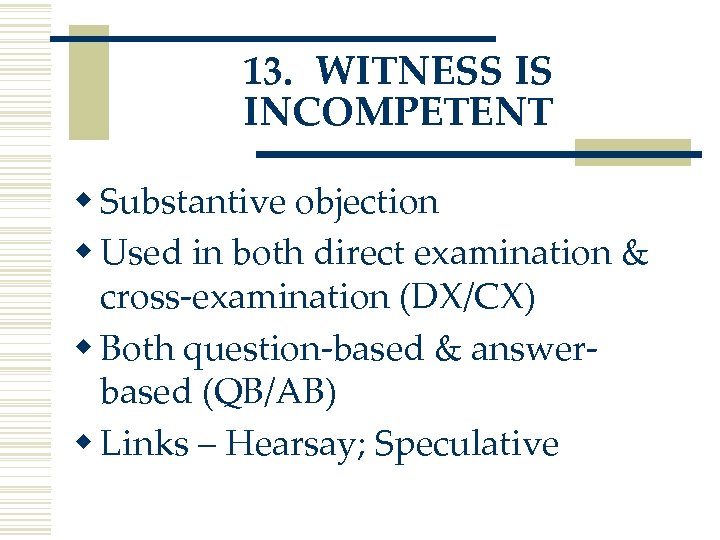
13. WITNESS IS INCOMPETENT w Substantive objection w Used in both direct examination & cross-examination (DX/CX) w Both question-based & answerbased (QB/AB) w Links – Hearsay; Speculative
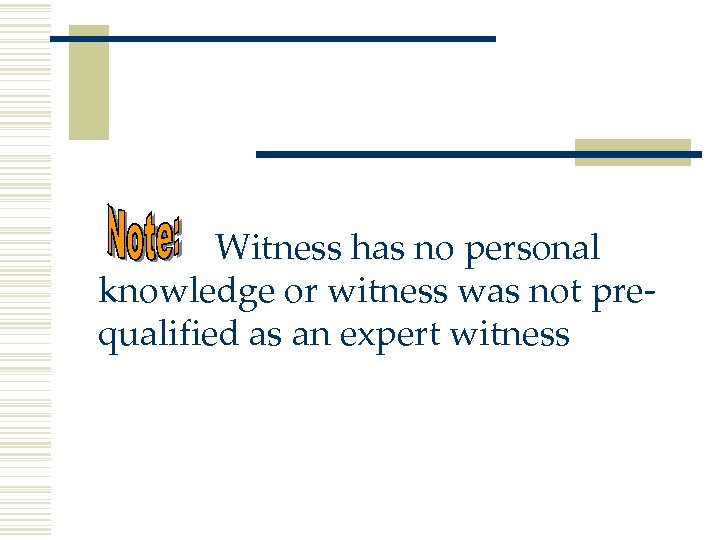
Witness has no personal knowledge or witness was not prequalified as an expert witness
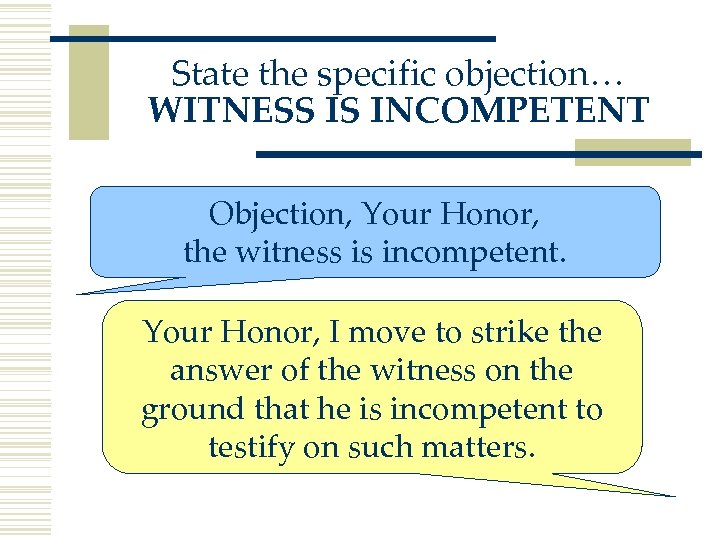
State the specific objection… WITNESS IS INCOMPETENT Objection, Your Honor, the witness is incompetent. Your Honor, I move to strike the answer of the witness on the ground that he is incompetent to testify on such matters.
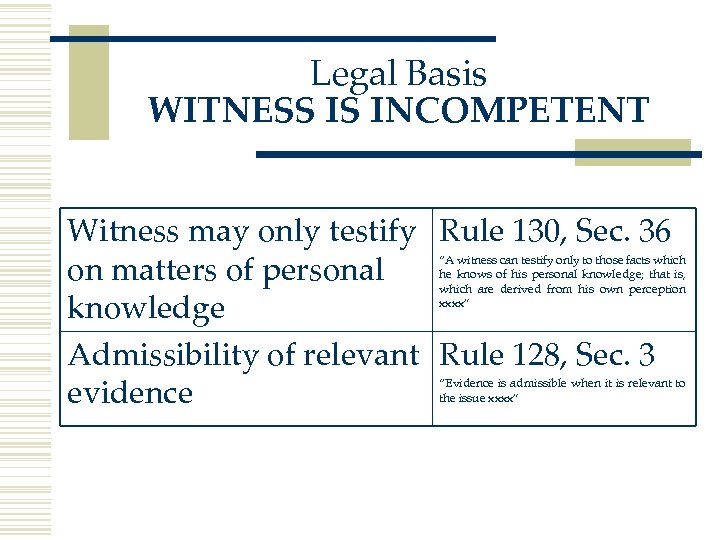
Legal Basis WITNESS IS INCOMPETENT Witness may only testify Rule 130, Sec. 36 on matters of personal knowledge Admissibility of relevant Rule 128, Sec. 3 evidence “A witness can testify only to those facts which he knows of his personal knowledge; that is, which are derived from his own perception xxxx” “Evidence is admissible when it is relevant to the issue xxxx”
14. INSUFFICIENT AUTHENTICATION/NO PROPER/ IMPROPER FOUNDATION w Substantive objection w Used in both direct examination & cross-examination (DX/CX) w Both question-based & answerbased (QB/AB)
w The document has not been identified, identified and/or authenticated.
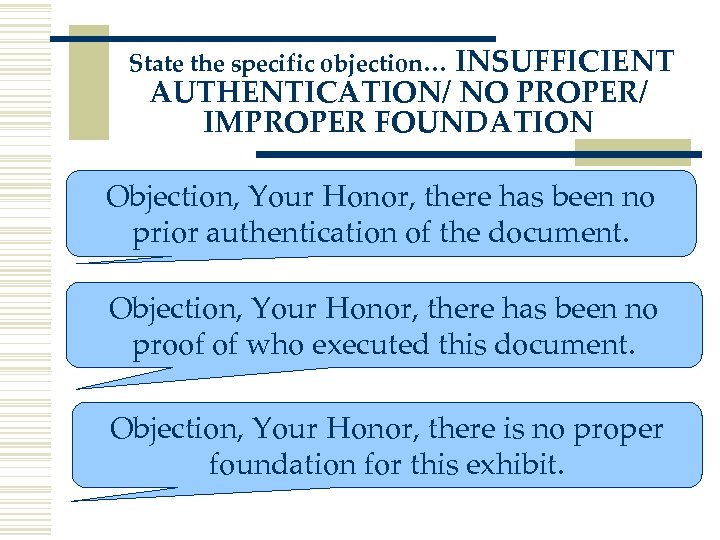
INSUFFICIENT AUTHENTICATION/ NO PROPER/ IMPROPER FOUNDATION State the specific objection… Objection, Your Honor, there has been no prior authentication of the document. Objection, Your Honor, there has been no proof of who executed this document. Objection, Your Honor, there is no proper foundation for this exhibit.
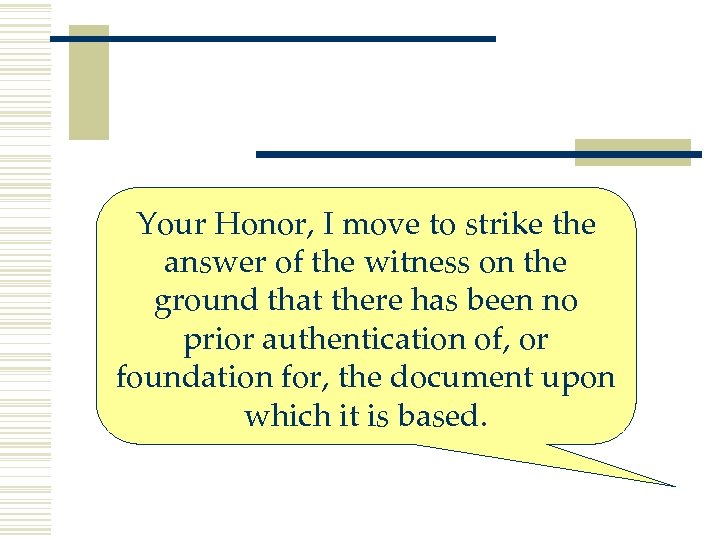
Your Honor, I move to strike the answer of the witness on the ground that there has been no prior authentication of, or foundation for, the document upon which it is based.
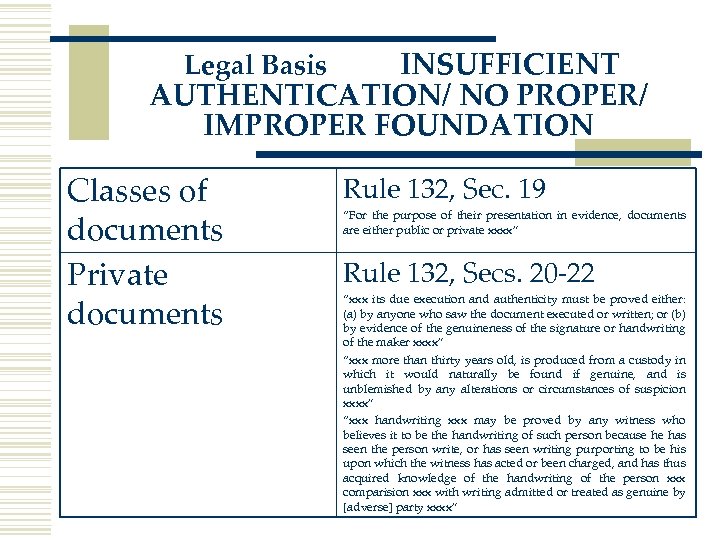
INSUFFICIENT AUTHENTICATION/ NO PROPER/ IMPROPER FOUNDATION Legal Basis Classes of documents Private documents Rule 132, Sec. 19 “For the purpose of their presentation in evidence, documents are either public or private xxxx” Rule 132, Secs. 20 -22 “xxx its due execution and authenticity must be proved either: (a) by anyone who saw the document executed or written; or (b) by evidence of the genuineness of the signature or handwriting of the maker xxxx” “xxx more than thirty years old, is produced from a custody in which it would naturally be found if genuine, and is unblemished by any alterations or circumstances of suspicion xxxx” “xxx handwriting xxx may be proved by any witness who believes it to be the handwriting of such person because he has seen the person write, or has seen writing purporting to be his upon which the witness has acted or been charged, and has thus acquired knowledge of the handwriting of the person xxx comparision xxx with writing admitted or treated as genuine by [adverse] party xxxx”
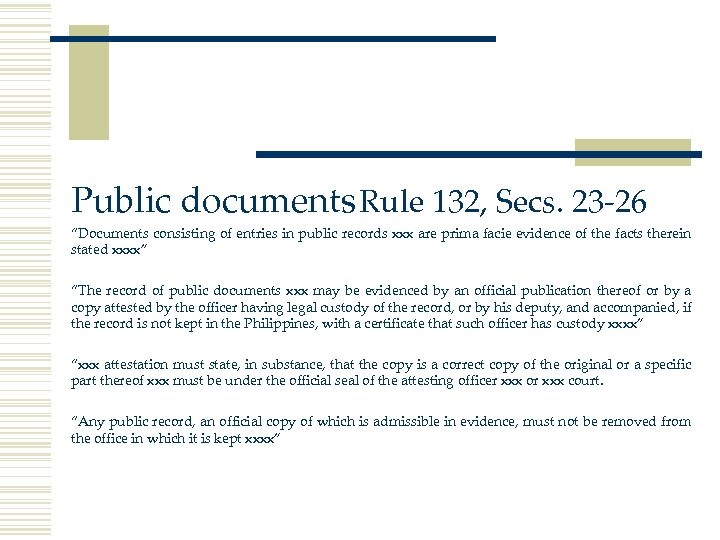
Public documents Rule 132, Secs. 23 -26 “Documents consisting of entries in public records xxx are prima facie evidence of the facts therein stated xxxx” “The record of public documents xxx may be evidenced by an official publication thereof or by a copy attested by the officer having legal custody of the record, or by his deputy, and accompanied, if the record is not kept in the Philippines, with a certificate that such officer has custody xxxx” “xxx attestation must state, in substance, that the copy is a correct copy of the original or a specific part thereof xxx must be under the official seal of the attesting officer xxx or xxx court. “Any public record, an official copy of which is admissible in evidence, must not be removed from the office in which it is kept xxxx”
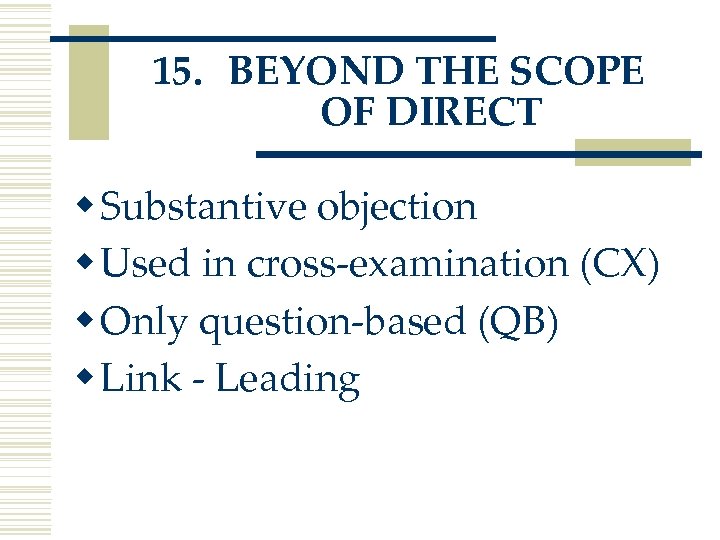
15. BEYOND THE SCOPE OF DIRECT w Substantive objection w Used in cross-examination (CX) w Only question-based (QB) w Link - Leading
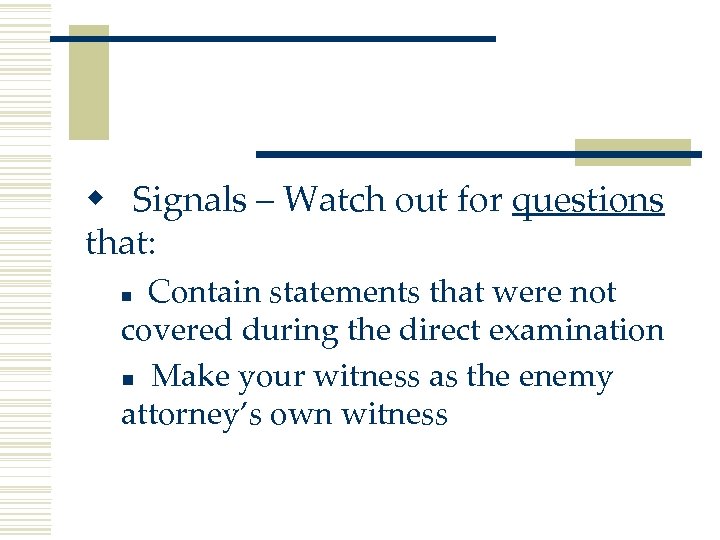
w Signals – Watch out for questions that: Contain statements that were not covered during the direct examination n Make your witness as the enemy attorney’s own witness n
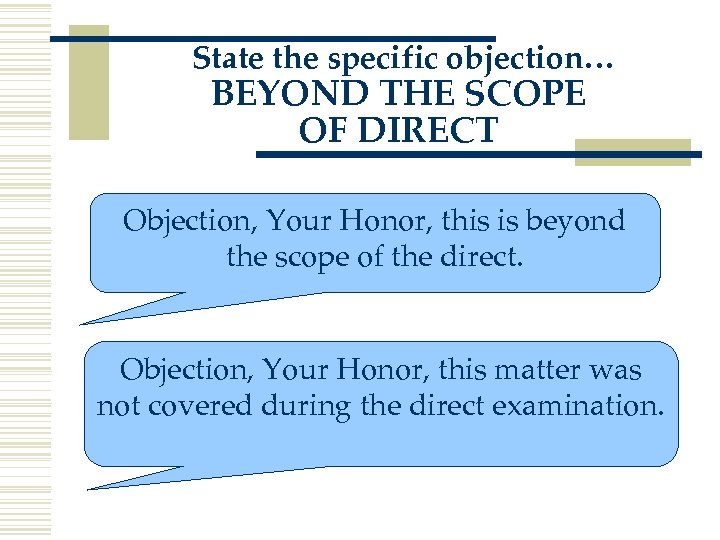
State the specific objection… BEYOND THE SCOPE OF DIRECT Objection, Your Honor, this is beyond the scope of the direct. Objection, Your Honor, this matter was not covered during the direct examination.
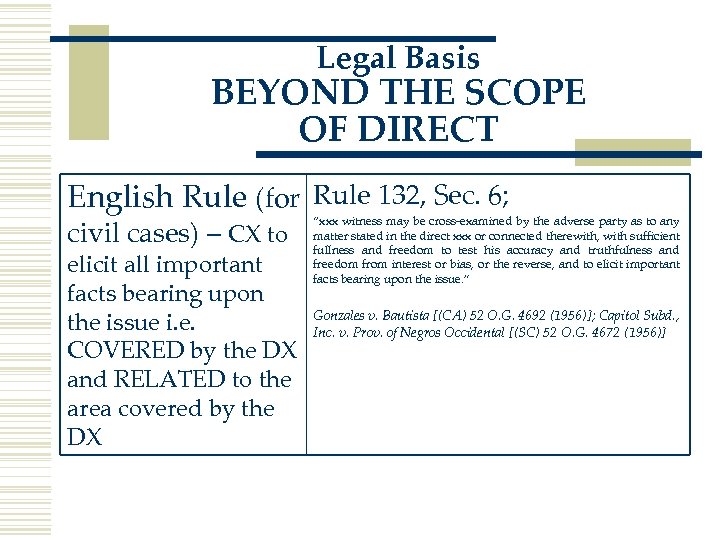
Legal Basis BEYOND THE SCOPE OF DIRECT English Rule (for Rule 132, Sec. 6; civil cases) – CX to elicit all important facts bearing upon the issue i. e. COVERED by the DX and RELATED to the area covered by the DX “xxx witness may be cross-examined by the adverse party as to any matter stated in the direct xxx or connected therewith, with sufficient fullness and freedom to test his accuracy and truthfulness and freedom from interest or bias, or the reverse, and to elicit important facts bearing upon the issue. ” Gonzales v. Bautista [(CA) 52 O. G. 4692 (1956)]; Capitol Subd. , Inc. v. Prov. of Negros Occidental [(SC) 52 O. G. 4672 (1956)]
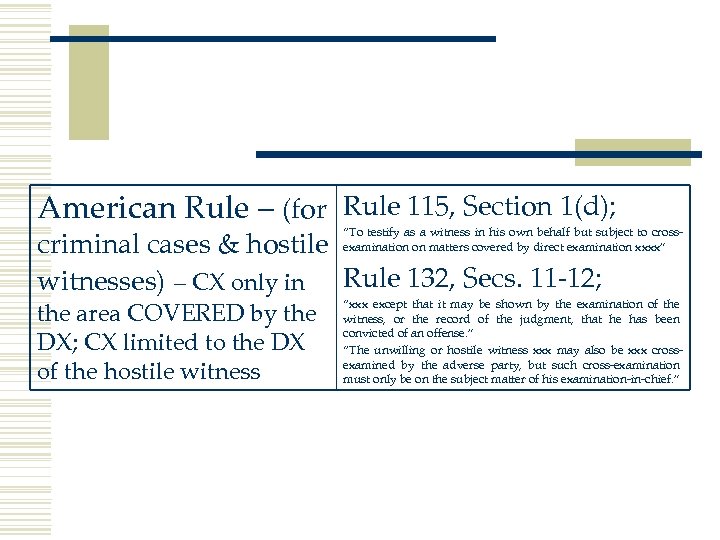
American Rule – (for Rule 115, Section 1(d); “To testify as a witness in his own behalf but subject to crossexamination on matters covered by direct examination xxxx” criminal cases & hostile witnesses) – CX only in Rule 132, Secs. 11 -12; the area COVERED by the DX; CX limited to the DX of the hostile witness “xxx except that it may be shown by the examination of the witness, or the record of the judgment, that he has been convicted of an offense. ” “The unwilling or hostile witness xxx may also be xxx crossexamined by the adverse party, but such cross-examination must only be on the subject matter of his examination-in-chief. ”
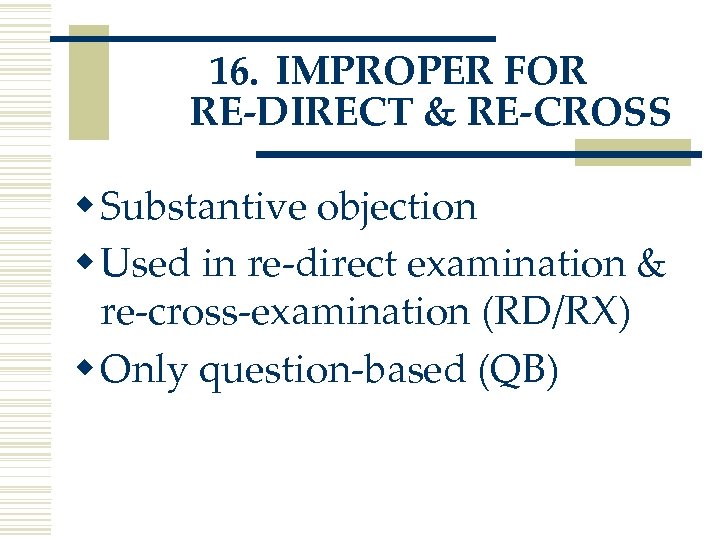
16. IMPROPER FOR RE-DIRECT & RE-CROSS w Substantive objection w Used in re-direct examination & re-cross-examination (RD/RX) w Only question-based (QB)
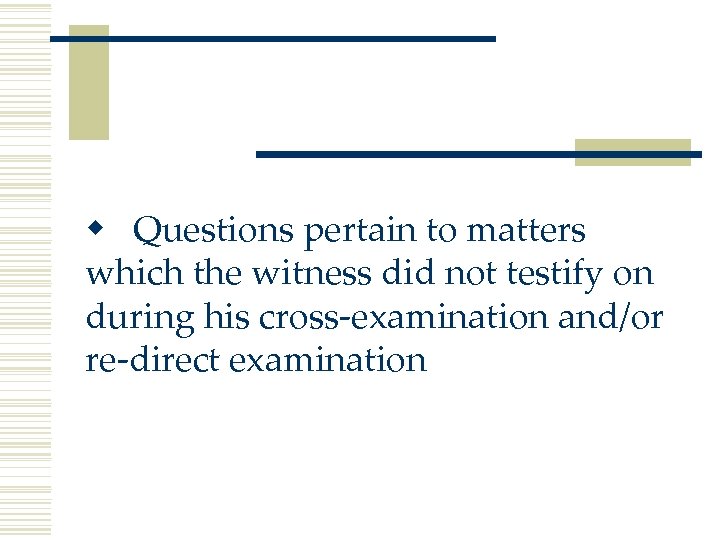
w Questions pertain to matters which the witness did not testify on during his cross-examination and/or re-direct examination
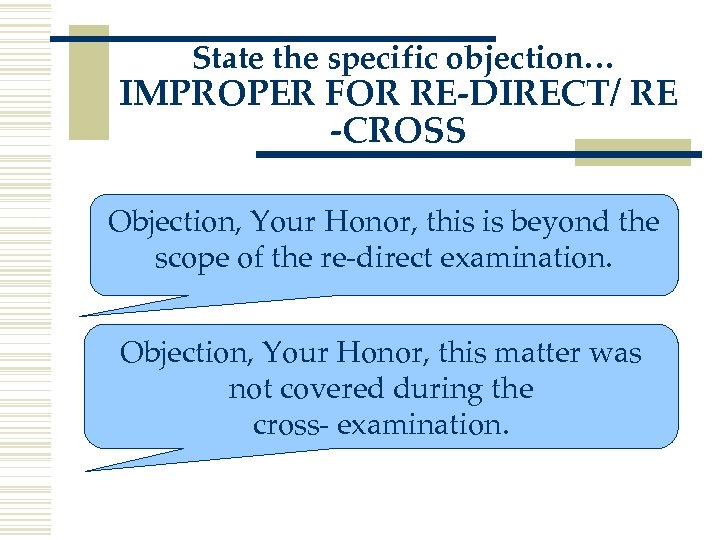
State the specific objection… IMPROPER FOR RE-DIRECT/ RE -CROSS Objection, Your Honor, this is beyond the scope of the re-direct examination. Objection, Your Honor, this matter was not covered during the cross- examination.
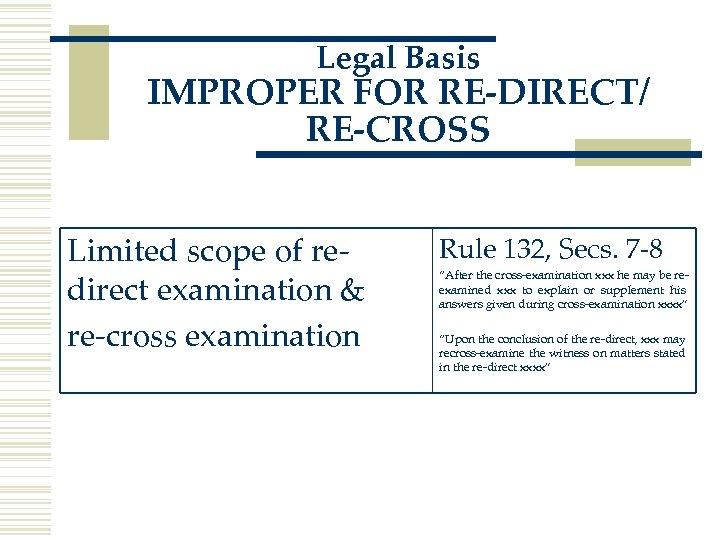
Legal Basis IMPROPER FOR RE-DIRECT/ RE-CROSS Limited scope of redirect examination & re-cross examination Rule 132, Secs. 7 -8 “After the cross-examination xxx he may be reexamined xxx to explain or supplement his answers given during cross-examination xxxx” “Upon the conclusion of the re-direct, xxx may recross-examine the witness on matters stated in the re-direct xxxx”
17. IMPROPER CHARACTERIZATION w Substantive objection w Used in direct examination & crossexamination (DX/CX) w Both question-based & answerbased (QB/AB) w Links – Argumentative, Conclusion
w Signal – Questions & answers that contain SLANTED ADJECTIVES “negligent driver”, “malicious thief”, “rescinded contract”
State the specific objection… IMPROPER CHARACTERIZATION Objection, Your Honor, I object to the improper characterization of … Your Honor, I move that the answer be stricken for being an improper characterization.
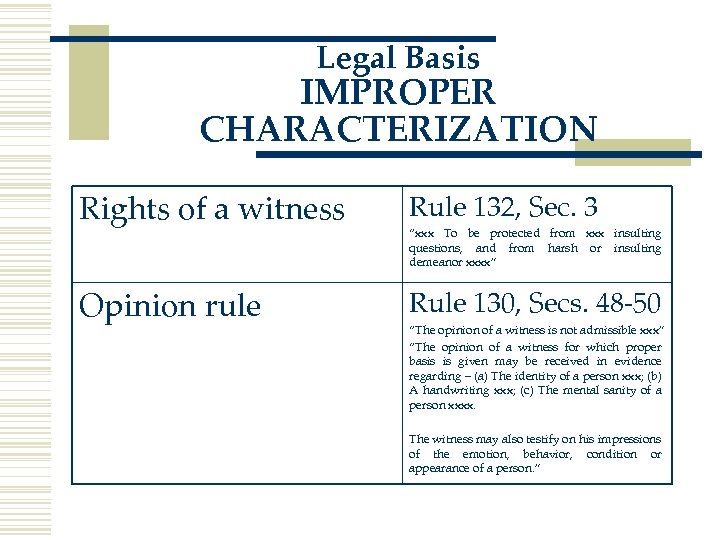
Legal Basis IMPROPER CHARACTERIZATION Rights of a witness Rule 132, Sec. 3 Opinion rule Rule 130, Secs. 48 -50 “xxx To be protected from xxx insulting questions, and from harsh or insulting demeanor xxxx” “The opinion of a witness is not admissible xxx” “The opinion of a witness for which proper basis is given may be received in evidence regarding – (a) The identity of a person xxx; (b) A handwriting xxx; (c) The mental sanity of a person xxxx. The witness may also testify on his impressions of the emotion, behavior, condition or appearance of a person. ”
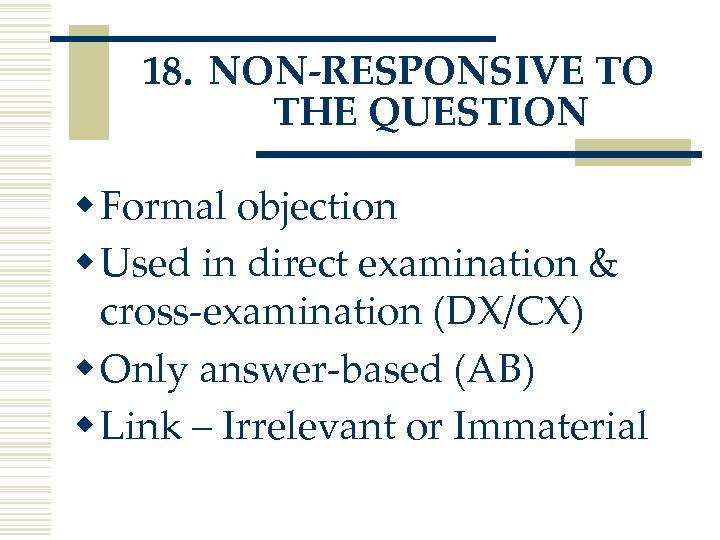
18. NON-RESPONSIVE TO THE QUESTION w Formal objection w Used in direct examination & cross-examination (DX/CX) w Only answer-based (AB) w Link – Irrelevant or Immaterial
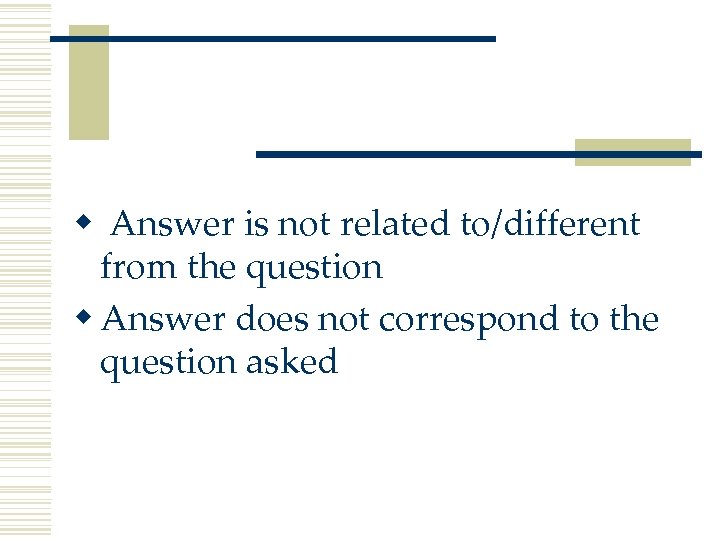
w Answer is not related to/different from the question w Answer does not correspond to the question asked
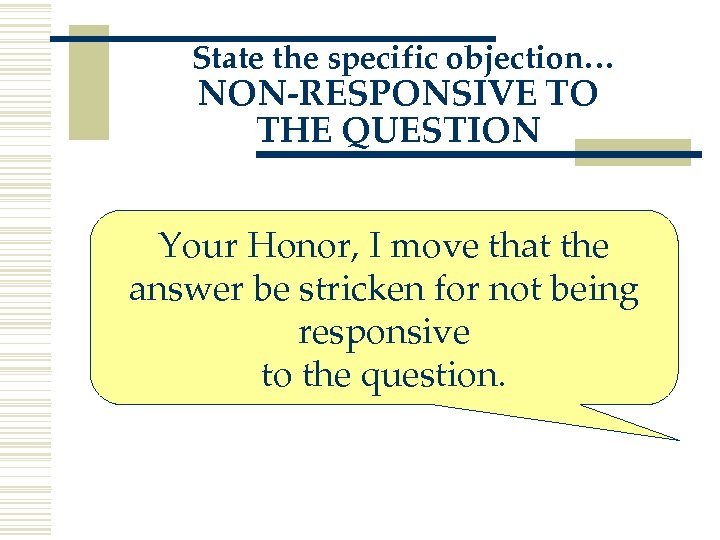
State the specific objection… NON-RESPONSIVE TO THE QUESTION Your Honor, I move that the answer be stricken for not being responsive to the question.
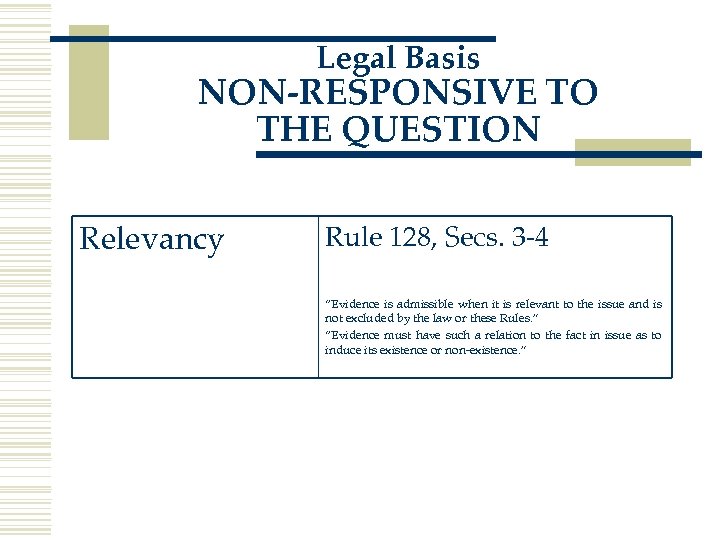
Legal Basis NON-RESPONSIVE TO THE QUESTION Relevancy Rule 128, Secs. 3 -4 “Evidence is admissible when it is relevant to the issue and is not excluded by the law or these Rules. ” “Evidence must have such a relation to the fact in issue as to induce its existence or non-existence. ”
19. IMPROPER MODE/ MANNER OF QUESTIONING w Formal objection w Used in direct examination & cross-examination (DX/CX) w Only question-based (QB) w Link – Argumentative
w Signals n DEMEANOR of enemy attorney l n TONE of enemy attorney l n Shouting, pounding the table, getting too close to the witness Loud, sarcastic INSULTING WORDS in questions and snide remarks or comments
State the specific objection… IMPROPER MODE/ MANNER OF QUESTIONING Objection, Your Honor, the opposing counsel is badgering my witness.
Legal Basis IMPROPER MODE/ MANNER OF QUESTIONING Rights of a witness Rule 132, Sec. 3 “xxx To be protected from xxx improper or insulting questions, and from harsh or insulting demeanor xxxx”
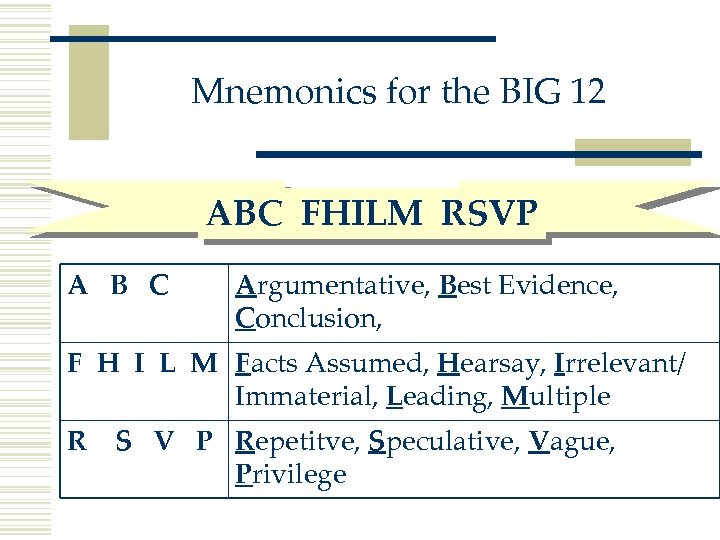
Mnemonics for the BIG 12 ABC FHILM RSVP A B C Argumentative, Best Evidence, Conclusion, F H I L M Facts Assumed, Hearsay, Irrelevant/ Immaterial, Leading, Multiple R S V P Repetitve, Speculative, Vague, Privilege
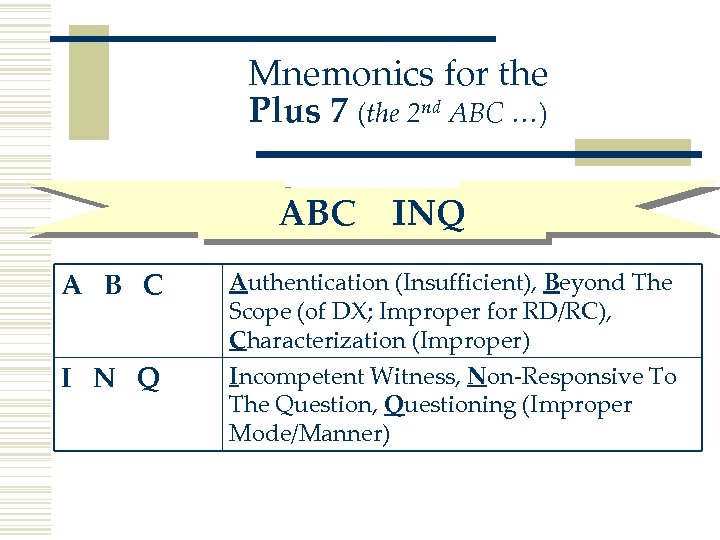
Mnemonics for the Plus 7 (the 2 nd ABC …) ABC INQ A B C Authentication (Insufficient), Beyond The Scope (of DX; Improper for RD/RC), Characterization (Improper) I N Q Incompetent Witness, Non-Responsive To The Question, Questioning (Improper Mode/Manner)
Скачать презентацию OBJECTIONS Why How and When To Object Litigation
1ee86ce3537337e10bccaeb80fc594b8.ppt