 Скачать презентацию Object-Oriented Software Engineering Using UML Patterns and Java
1226b5085a75b616d805c1a6e8414f9f.ppt
- Количество слайдов: 15



Object-Oriented Software Engineering Using UML, Patterns, and Java Chapter 1: Introduction
Objectives of the Course • Appreciate the Fundamentals of Software Engineering: • • • Methodologies Process models Description and modeling techniques System analysis - Requirements engineering System design Implementation: Principles of system development Bernd Bruegge & Allen H. Dutoit Object-Oriented Software Engineering: Using UML, Patterns, and Java 2
Focus: Acquire Technical Knowledge • Different methodologies (“philosophies”) to model and develop software systems • Different modeling notations • Different modeling methods • Different software lifecycle models (empirical control models, defined control models) • Different testing techniques (e. g. vertical testing, horizontal testing) • Rationale Management • Release and Configuration Management Bernd Bruegge & Allen H. Dutoit Object-Oriented Software Engineering: Using UML, Patterns, and Java 3
Acquire Managerial Knowledge • Learn the basics of software project management • Understand how to manage with a software lifecycle • Be able to capture software development knowledge (Rationale Management) • Manage change: Configuration Management • Learn the basic methodologies • Traditional software development • Agile methods Bernd Bruegge & Allen H. Dutoit Object-Oriented Software Engineering: Using UML, Patterns, and Java 4
Outline of Today’s Lecture • The development challenge • Dealing with change • Software engineering Bernd Bruegge & Allen H. Dutoit Object-Oriented Software Engineering: Using UML, Patterns, and Java 5
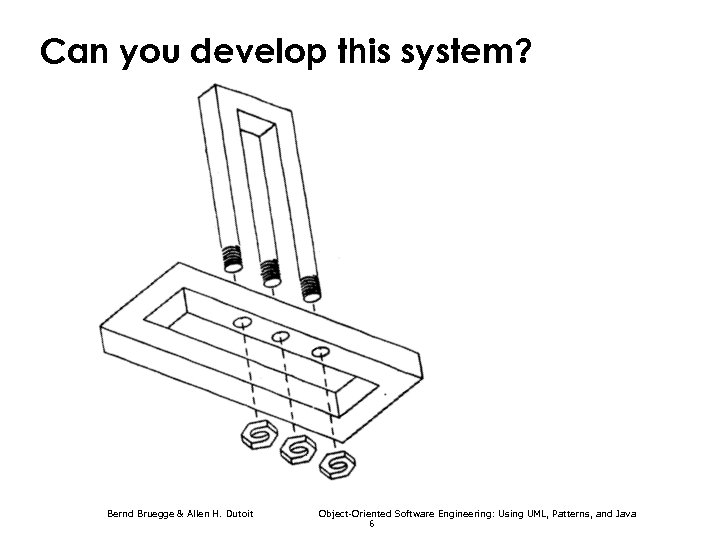
Can you develop this system? Bernd Bruegge & Allen H. Dutoit Object-Oriented Software Engineering: Using UML, Patterns, and Java 6
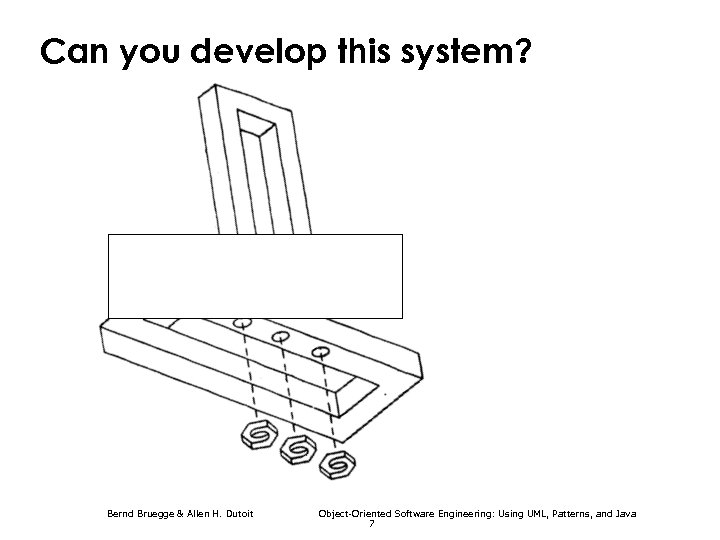
Can you develop this system? Bernd Bruegge & Allen H. Dutoit Object-Oriented Software Engineering: Using UML, Patterns, and Java 7
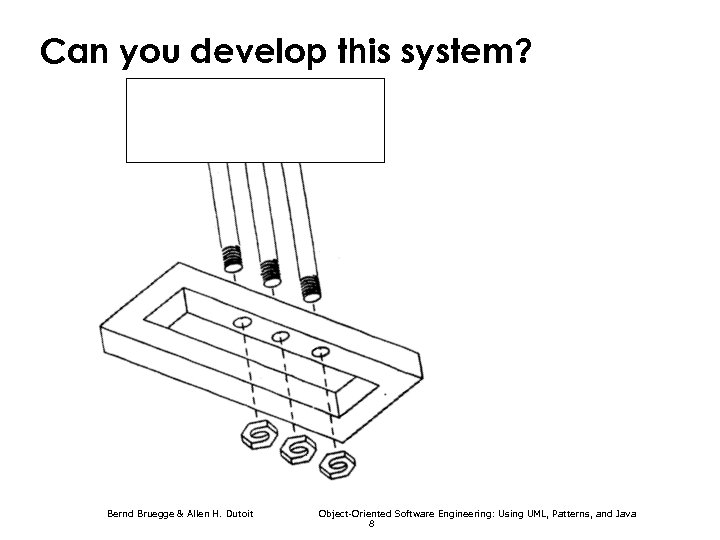
Can you develop this system? Bernd Bruegge & Allen H. Dutoit Object-Oriented Software Engineering: Using UML, Patterns, and Java 8
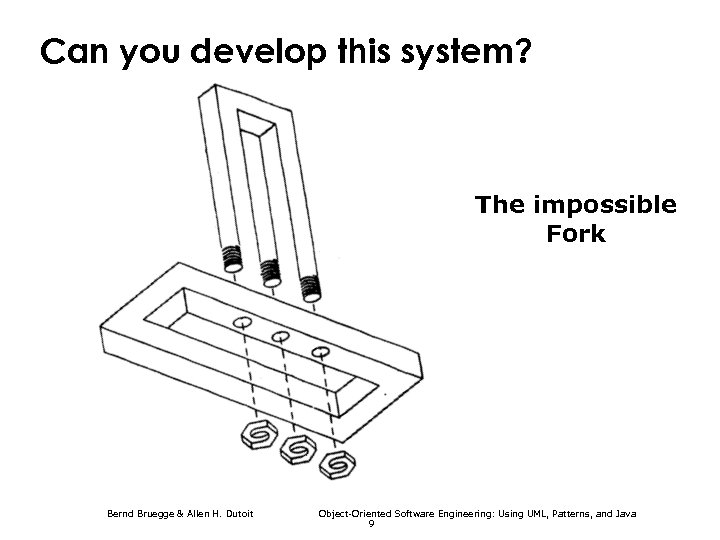
Can you develop this system? The impossible Fork Bernd Bruegge & Allen H. Dutoit Object-Oriented Software Engineering: Using UML, Patterns, and Java 9
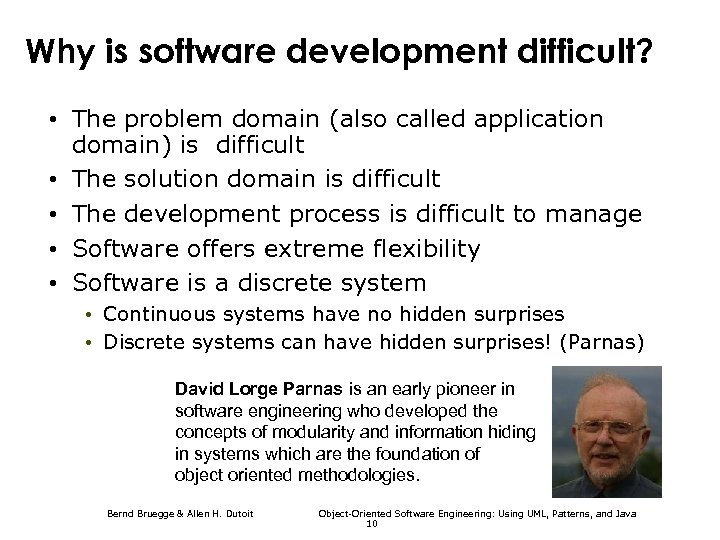
Why is software development difficult? • The problem domain (also called application domain) is difficult • The solution domain is difficult • The development process is difficult to manage • Software offers extreme flexibility • Software is a discrete system • Continuous systems have no hidden surprises • Discrete systems can have hidden surprises! (Parnas) David Lorge Parnas is an early pioneer in software engineering who developed the concepts of modularity and information hiding in systems which are the foundation of object oriented methodologies. Bernd Bruegge & Allen H. Dutoit Object-Oriented Software Engineering: Using UML, Patterns, and Java 10
Software Engineering is more than writing Code • Problem solving • Creating a solution • Engineering a system based on the solution • Modeling • Knowledge acquisition • Rationale management Bernd Bruegge & Allen H. Dutoit Object-Oriented Software Engineering: Using UML, Patterns, and Java 11
Techniques, Methodologies and Tools • Techniques: • Formal procedures for producing results using some well-defined notation • Methodologies: • Collection of techniques applied across software development and unified by a philosophical approach • Tools: • Instruments or automated systems to accomplish a technique • CASE = Computer Aided Software Engineering Bernd Bruegge & Allen H. Dutoit Object-Oriented Software Engineering: Using UML, Patterns, and Java 12
Computer Science vs. Engineering • Computer Scientist • Assumes techniques and tools have to be developed. • Proves theorems about algorithms, designs languages, defines knowledge representation schemes • Has infinite time… • Engineer • Develops a solution for a problem formulated by a client • Uses computers & languages, techniques and tools • Software Engineer • Works in multiple application domains • Has only 3 months. . . • …while changes occurs in the problem formulation (requirements) and also in the available technology. Bernd Bruegge & Allen H. Dutoit Object-Oriented Software Engineering: Using UML, Patterns, and Java 13
Software Engineering: A Working Definition Software Engineering is a collection of techniques, methodologies and tools that help with the production of A high quality software system developed with a given budget before a given deadline while change occurs Challenge: Dealing with complexity and change Bernd Bruegge & Allen H. Dutoit Object-Oriented Software Engineering: Using UML, Patterns, and Java 14 20
Software Engineering: A Problem Solving Activity • Analysis: • Understand the nature of the problem and break the problem into pieces • Synthesis: • Put the pieces together into a large structure For problem solving we use techniques, methodologies and tools. Bernd Bruegge & Allen H. Dutoit Object-Oriented Software Engineering: Using UML, Patterns, and Java 15
Скачать презентацию Object-Oriented Software Engineering Using UML Patterns and Java
1226b5085a75b616d805c1a6e8414f9f.ppt