 Скачать презентацию OBJECT FUNCTION S V O S
bd3930ac3544acf1641357b71228e978.ppt
- Количество слайдов: 72



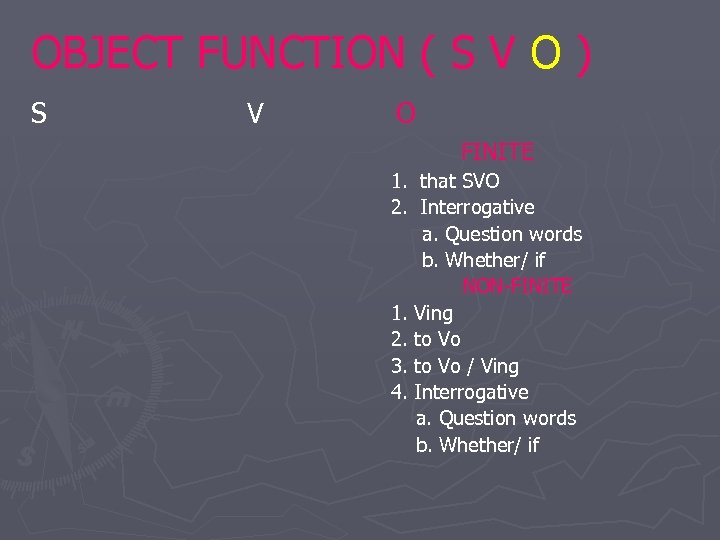
OBJECT FUNCTION ( S V O ) S V O FINITE 1. that SVO 2. Interrogative a. Question words b. Whether/ if NON-FINITE 1. Ving 2. to Vo 3. to Vo / Ving 4. Interrogative a. Question words b. Whether/ if
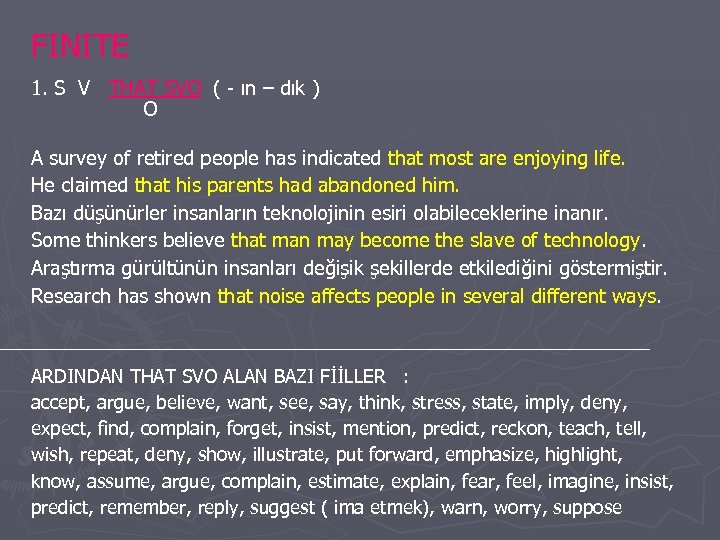
FINITE 1. S V THAT SVO ( - ın – dık ) O A survey of retired people has indicated that most are enjoying life. He claimed that his parents had abandoned him. Bazı düşünürler insanların teknolojinin esiri olabileceklerine inanır. Some thinkers believe that man may become the slave of technology. Araştırma gürültünün insanları değişik şekillerde etkilediğini göstermiştir. Research has shown that noise affects people in several different ways. ARDINDAN THAT SVO ALAN BAZI FİİLLER : accept, argue, believe, want, see, say, think, stress, state, imply, deny, expect, find, complain, forget, insist, mention, predict, reckon, teach, tell, wish, repeat, deny, show, illustrate, put forward, emphasize, highlight, know, assume, argue, complain, estimate, explain, fear, feel, imagine, insist, predict, remember, reply, suggest ( ima etmek), warn, worry, suppose
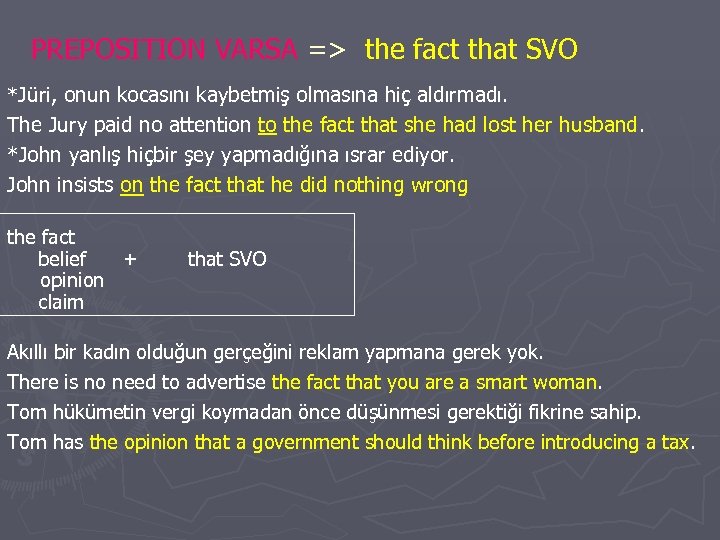
PREPOSITION VARSA => the fact that SVO *Jüri, onun kocasını kaybetmiş olmasına hiç aldırmadı. The Jury paid no attention to the fact that she had lost her husband. *John yanlış hiçbir şey yapmadığına ısrar ediyor. John insists on the fact that he did nothing wrong the fact belief + opinion claim that SVO Akıllı bir kadın olduğun gerçeğini reklam yapmana gerek yok. There is no need to advertise the fact that you are a smart woman. Tom hükümetin vergi koymadan önce düşünmesi gerektiği fikrine sahip. Tom has the opinion that a government should think before introducing a tax.
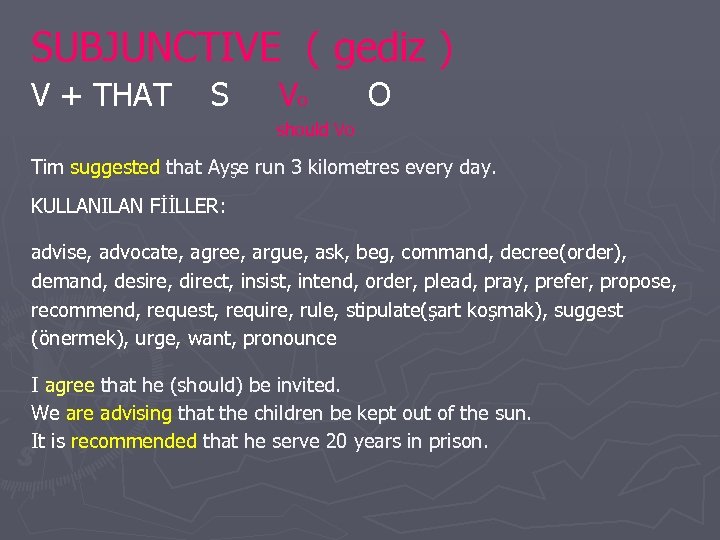
SUBJUNCTIVE ( gediz ) V + THAT S Vo O should Vo Tim suggested that Ayşe run 3 kilometres every day. KULLANILAN FİİLLER: advise, advocate, agree, argue, ask, beg, command, decree(order), demand, desire, direct, insist, intend, order, plead, pray, prefer, propose, recommend, request, require, rule, stipulate(şart koşmak), suggest (önermek), urge, want, pronounce I agree that he (should) be invited. We are advising that the children be kept out of the sun. It is recommended that he serve 20 years in prison.
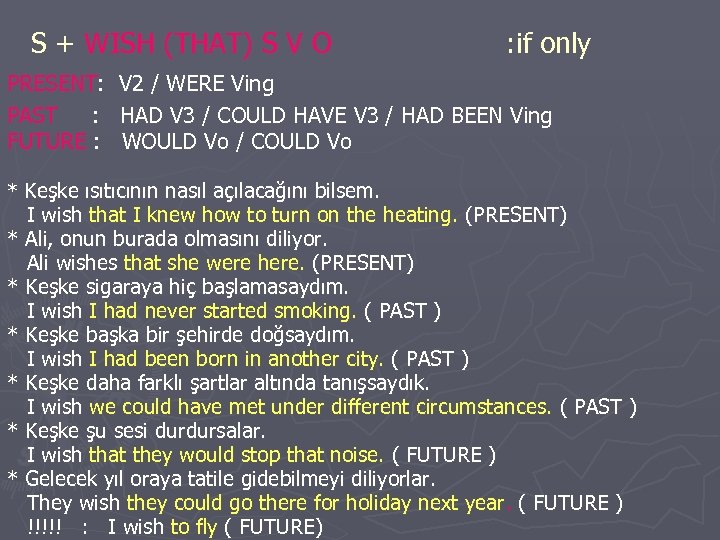
S + WISH (THAT) S V O PRESENT: PAST : FUTURE : : if only V 2 / WERE Ving HAD V 3 / COULD HAVE V 3 / HAD BEEN Ving WOULD Vo / COULD Vo * Keşke ısıtıcının nasıl açılacağını bilsem. I wish that I knew how to turn on the heating. (PRESENT) * Ali, onun burada olmasını diliyor. Ali wishes that she were here. (PRESENT) * Keşke sigaraya hiç başlamasaydım. I wish I had never started smoking. ( PAST ) * Keşke başka bir şehirde doğsaydım. I wish I had been born in another city. ( PAST ) * Keşke daha farklı şartlar altında tanışsaydık. I wish we could have met under different circumstances. ( PAST ) * Keşke şu sesi durdursalar. I wish that they would stop that noise. ( FUTURE ) * Gelecek yıl oraya tatile gidebilmeyi diliyorlar. They wish they could go there for holiday next year. ( FUTURE ) !!!!! : I wish to fly ( FUTURE)
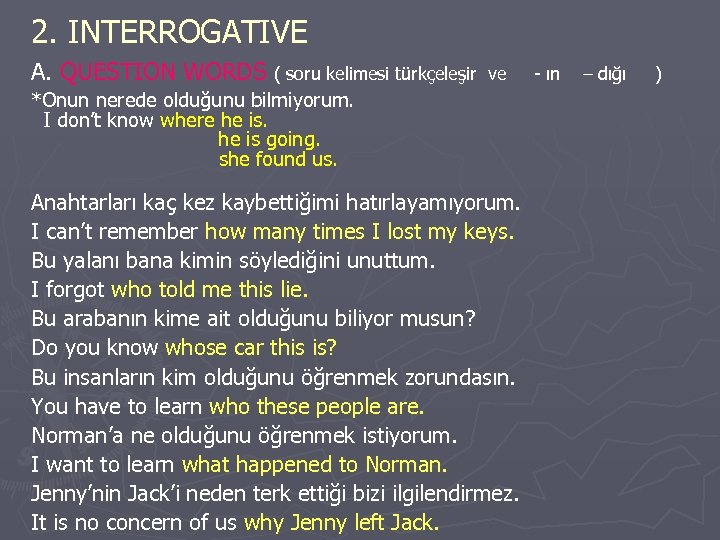
2. INTERROGATIVE A. QUESTION WORDS ( soru kelimesi türkçeleşir ve *Onun nerede olduğunu bilmiyorum. I don’t know where he is going. she found us. Anahtarları kaç kez kaybettiğimi hatırlayamıyorum. I can’t remember how many times I lost my keys. Bu yalanı bana kimin söylediğini unuttum. I forgot who told me this lie. Bu arabanın kime ait olduğunu biliyor musun? Do you know whose car this is? Bu insanların kim olduğunu öğrenmek zorundasın. You have to learn who these people are. Norman’a ne olduğunu öğrenmek istiyorum. I want to learn what happened to Norman. Jenny’nin Jack’i neden terk ettiği bizi ilgilendirmez. It is no concern of us why Jenny left Jack. - ın – dığı )
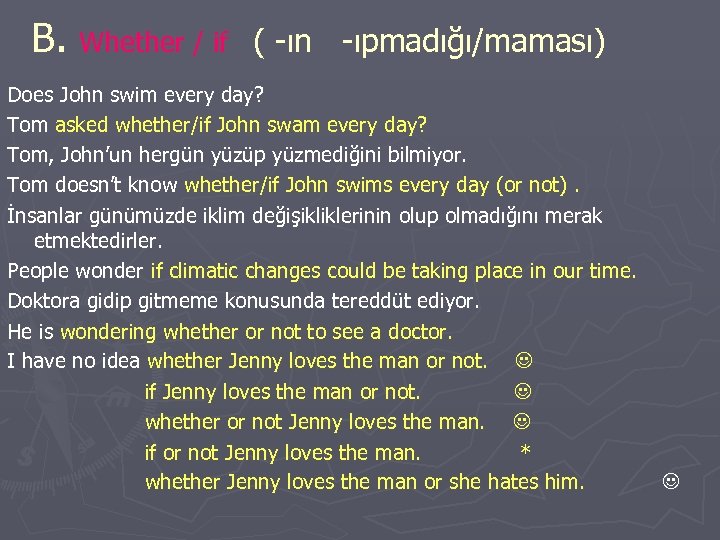
B. Whether / if ( -ın -ıpmadığı/maması) Does John swim every day? Tom asked whether/if John swam every day? Tom, John’un hergün yüzüp yüzmediğini bilmiyor. Tom doesn’t know whether/if John swims every day (or not). İnsanlar günümüzde iklim değişikliklerinin olup olmadığını merak etmektedirler. People wonder if climatic changes could be taking place in our time. Doktora gidip gitmeme konusunda tereddüt ediyor. He is wondering whether or not to see a doctor. I have no idea whether Jenny loves the man or not. if Jenny loves the man or not. whether or not Jenny loves the man. if or not Jenny loves the man. * whether Jenny loves the man or she hates him.
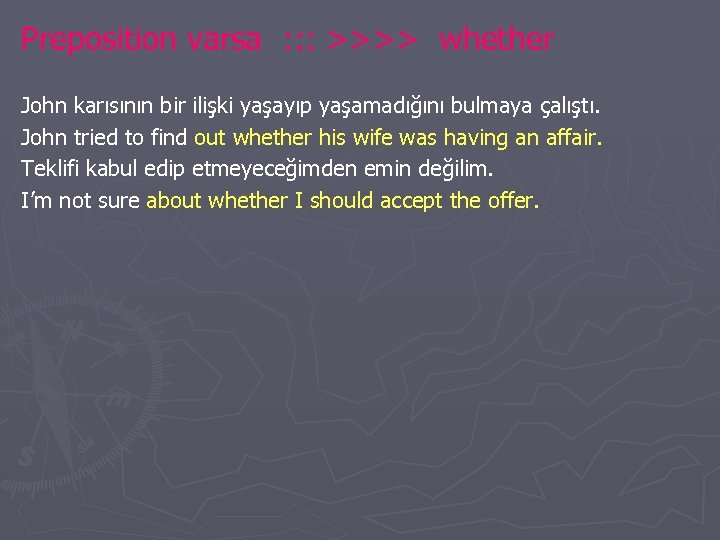
Preposition varsa : : : >>>> whether John karısının bir ilişki yaşayıp yaşamadığını bulmaya çalıştı. John tried to find out whether his wife was having an affair. Teklifi kabul edip etmeyeceğimden emin değilim. I’m not sure about whether I should accept the offer.
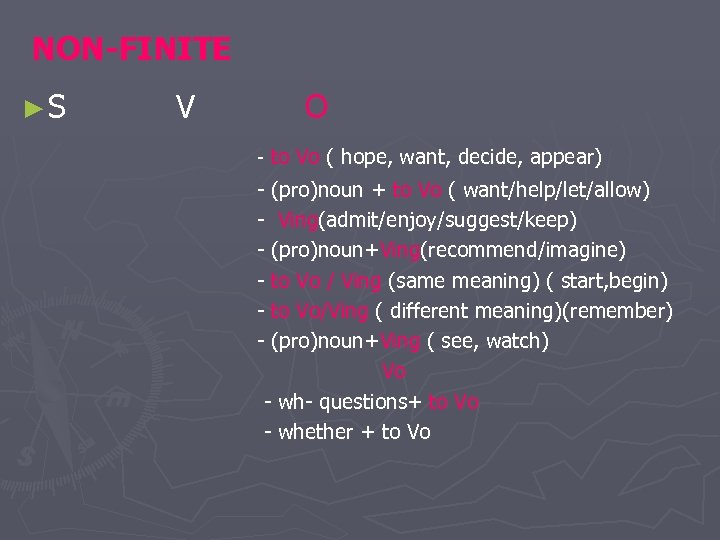
NON-FINITE ►S V O - to Vo ( hope, want, decide, appear) - (pro)noun + to Vo ( want/help/let/allow) - Ving(admit/enjoy/suggest/keep) - (pro)noun+Ving(recommend/imagine) - to Vo / Ving (same meaning) ( start, begin) - to Vo/Ving ( different meaning)(remember) - (pro)noun+Ving ( see, watch) Vo - wh- questions+ to Vo - whether + to Vo
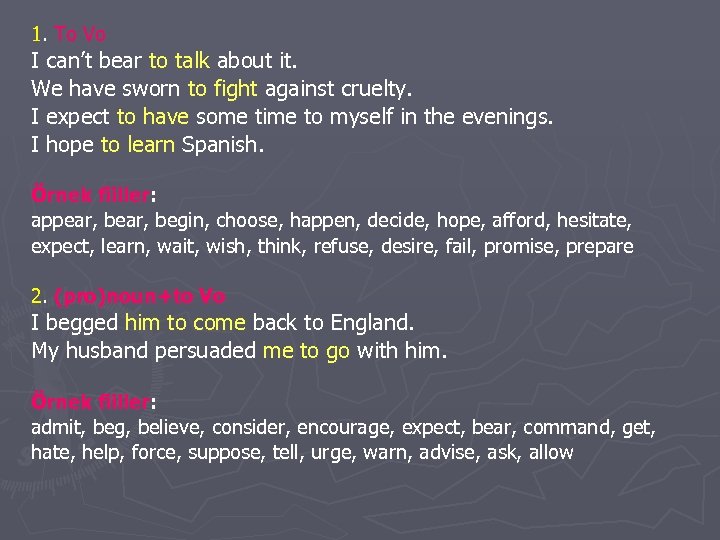
1. To Vo I can’t bear to talk about it. We have sworn to fight against cruelty. I expect to have some time to myself in the evenings. I hope to learn Spanish. Örnek fiiller: appear, begin, choose, happen, decide, hope, afford, hesitate, expect, learn, wait, wish, think, refuse, desire, fail, promise, prepare 2. (pro)noun+to Vo I begged him to come back to England. My husband persuaded me to go with him. Örnek fiiller: admit, beg, believe, consider, encourage, expect, bear, command, get, hate, help, force, suppose, tell, urge, warn, advise, ask, allow
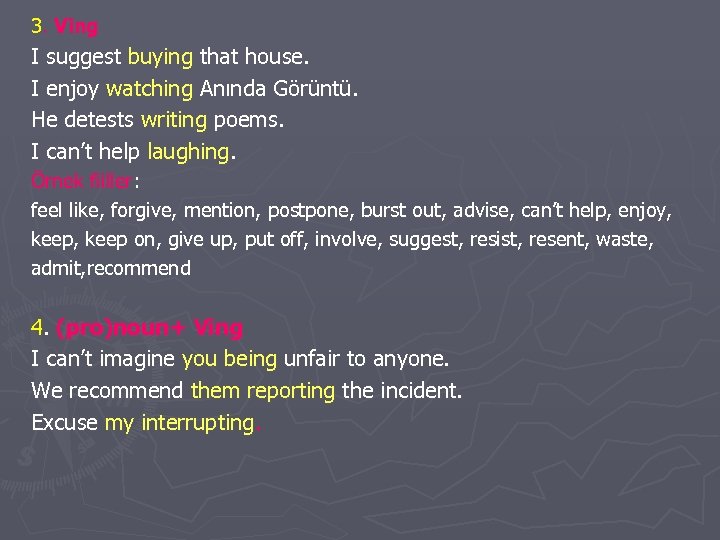
3. Ving I suggest buying that house. I enjoy watching Anında Görüntü. He detests writing poems. I can’t help laughing. Örnek fiiller: feel like, forgive, mention, postpone, burst out, advise, can’t help, enjoy, keep on, give up, put off, involve, suggest, resist, resent, waste, admit, recommend 4. (pro)noun+ Ving I can’t imagine you being unfair to anyone. We recommend them reporting the incident. Excuse my interrupting.
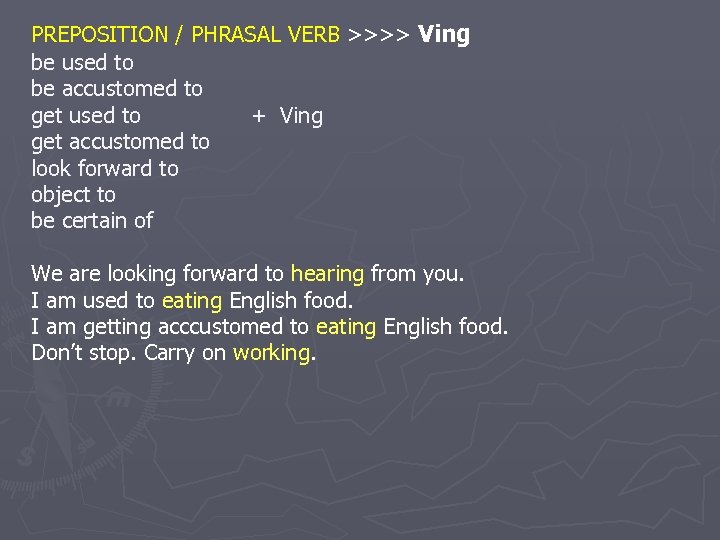
PREPOSITION / PHRASAL VERB >>>> Ving be used to be accustomed to get used to + Ving get accustomed to look forward to object to be certain of We are looking forward to hearing from you. I am used to eating English food. I am getting acccustomed to eating English food. Don’t stop. Carry on working.
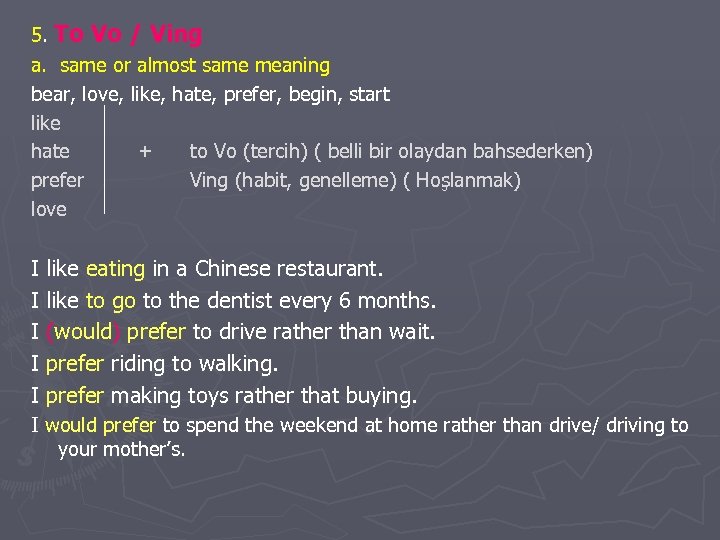
5. To Vo / Ving a. same or almost same meaning bear, love, like, hate, prefer, begin, start like hate + to Vo (tercih) ( belli bir olaydan bahsederken) prefer Ving (habit, genelleme) ( Hoşlanmak) love I like eating in a Chinese restaurant. I like to go to the dentist every 6 months. I (would) prefer to drive rather than wait. I prefer riding to walking. I prefer making toys rather that buying. I would prefer to spend the weekend at home rather than drive/ driving to your mother’s.
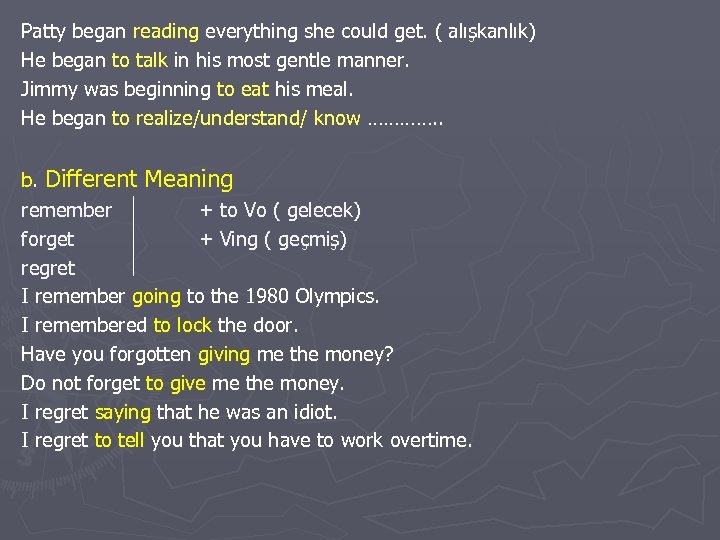
Patty began reading everything she could get. ( alışkanlık) He began to talk in his most gentle manner. Jimmy was beginning to eat his meal. He began to realize/understand/ know …………. . b. Different Meaning remember + to Vo ( gelecek) forget + Ving ( geçmiş) regret I remember going to the 1980 Olympics. I remembered to lock the door. Have you forgotten giving me the money? Do not forget to give me the money. I regret saying that he was an idiot. I regret to tell you that you have to work overtime.
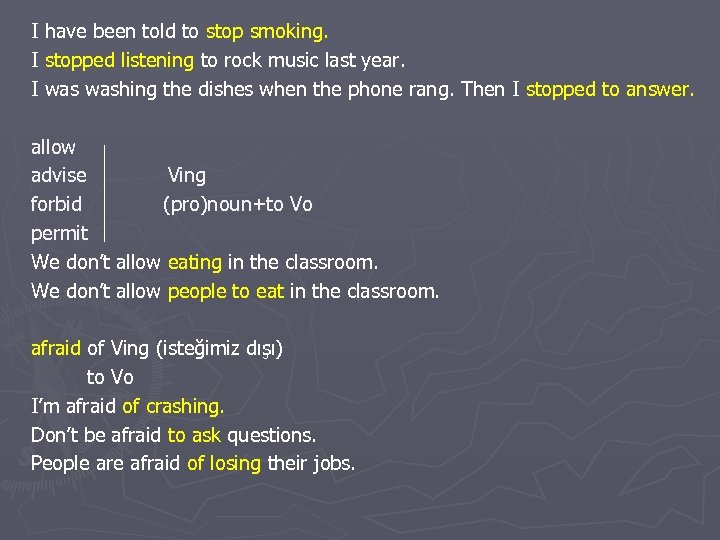
I have been told to stop smoking. I stopped listening to rock music last year. I washing the dishes when the phone rang. Then I stopped to answer. allow advise Ving forbid (pro)noun+to Vo permit We don’t allow eating in the classroom. We don’t allow people to eat in the classroom. afraid of Ving (isteğimiz dışı) to Vo I’m afraid of crashing. Don’t be afraid to ask questions. People are afraid of losing their jobs.
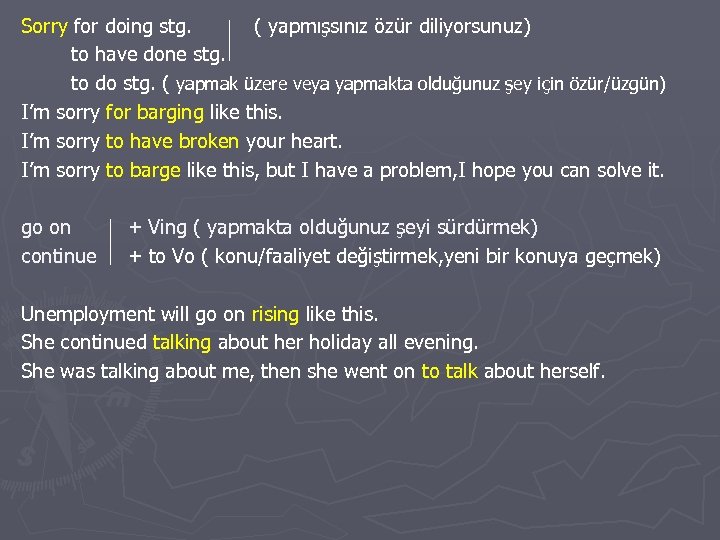
Sorry for doing stg. ( yapmışsınız özür diliyorsunuz) to have done stg. to do stg. ( yapmak üzere veya yapmakta olduğunuz şey için özür/üzgün) I’m sorry for barging like this. I’m sorry to have broken your heart. I’m sorry to barge like this, but I have a problem, I hope you can solve it. go on continue + Ving ( yapmakta olduğunuz şeyi sürdürmek) + to Vo ( konu/faaliyet değiştirmek, yeni bir konuya geçmek) Unemployment will go on rising like this. She continued talking about her holiday all evening. She was talking about me, then she went on to talk about herself.
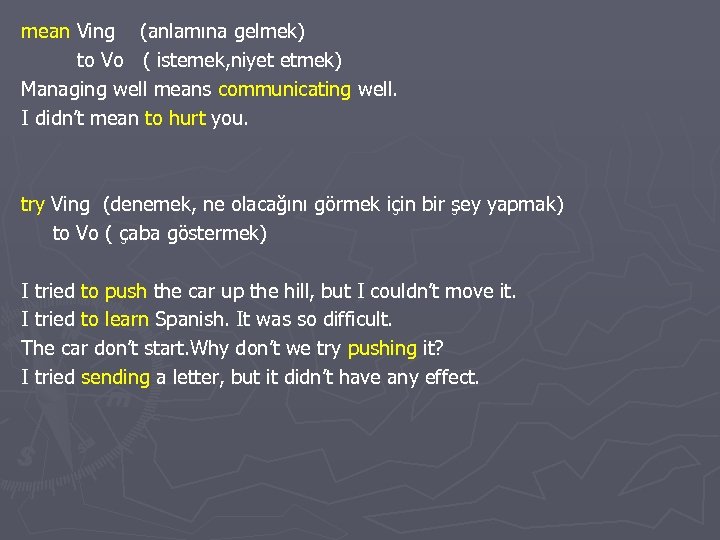
mean Ving (anlamına gelmek) to Vo ( istemek, niyet etmek) Managing well means communicating well. I didn’t mean to hurt you. try Ving (denemek, ne olacağını görmek için bir şey yapmak) to Vo ( çaba göstermek) I tried to push the car up the hill, but I couldn’t move it. I tried to learn Spanish. It was so difficult. The car don’t start. Why don’t we try pushing it? I tried sending a letter, but it didn’t have any effect.
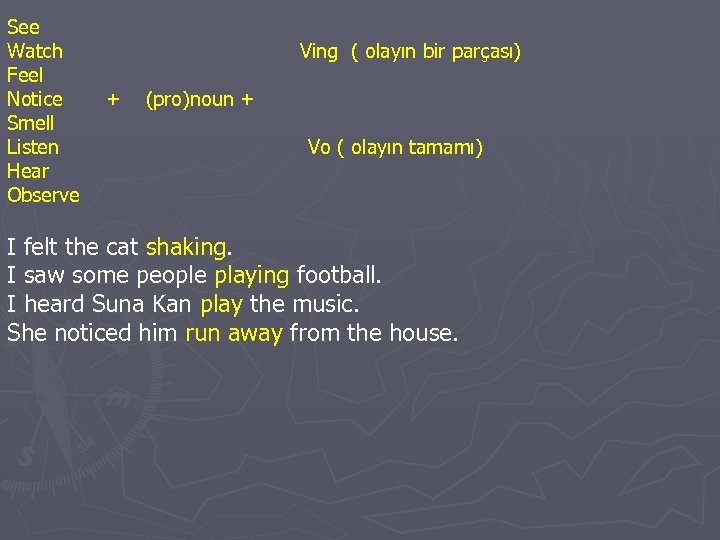
See Watch Feel Notice Smell Listen Hear Observe Ving ( olayın bir parçası) + (pro)noun + Vo ( olayın tamamı) I felt the cat shaking. I saw some people playing football. I heard Suna Kan play the music. She noticed him run away from the house.
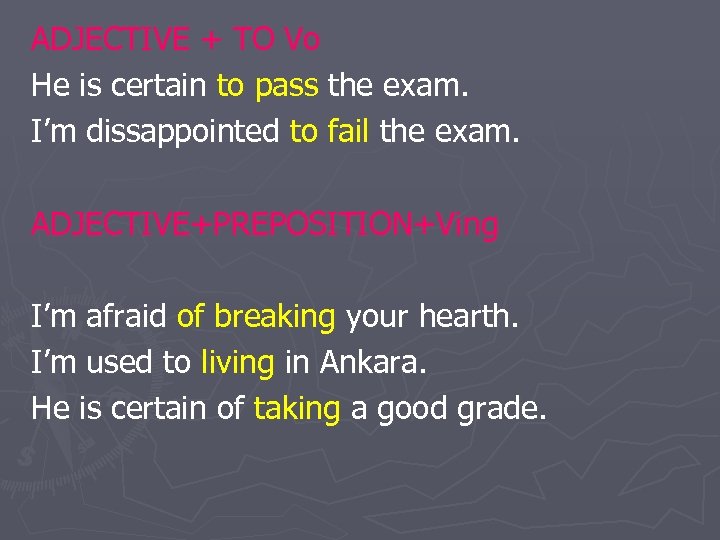
ADJECTIVE + TO Vo He is certain to pass the exam. I’m dissappointed to fail the exam. ADJECTIVE+PREPOSITION+Ving I’m afraid of breaking your hearth. I’m used to living in Ankara. He is certain of taking a good grade.
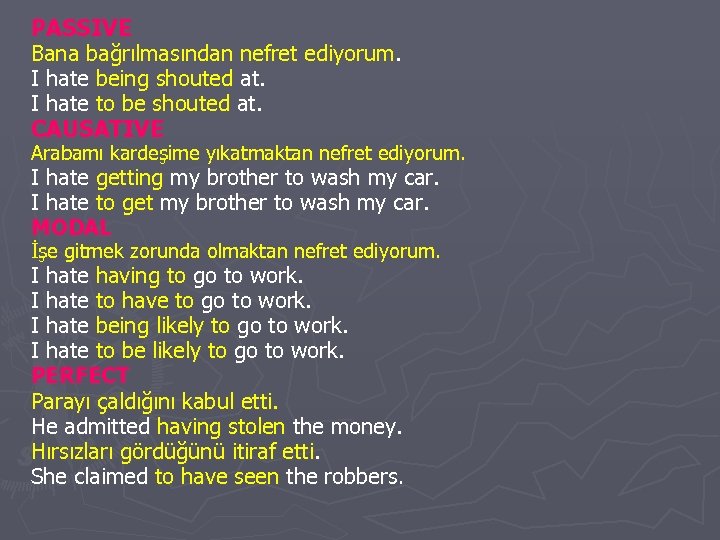
PASSIVE Bana bağrılmasından nefret ediyorum. I hate being shouted at. I hate to be shouted at. CAUSATIVE Arabamı kardeşime yıkatmaktan nefret ediyorum. I hate getting my brother to wash my car. I hate to get my brother to wash my car. MODAL İşe gitmek zorunda olmaktan nefret ediyorum. I hate having to go to work. I hate to have to go to work. I hate being likely to go to work. I hate to be likely to go to work. PERFECT Parayı çaldığını kabul etti. He admitted having stolen the money. Hırsızları gördüğünü itiraf etti. She claimed to have seen the robbers.
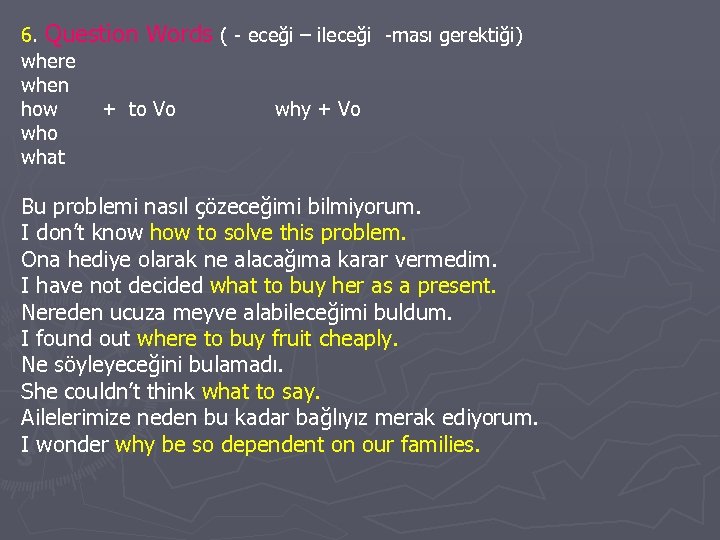
6. Question Words ( - eceği – ileceği -ması gerektiği) where when how + to Vo why + Vo what Bu problemi nasıl çözeceğimi bilmiyorum. I don’t know how to solve this problem. Ona hediye olarak ne alacağıma karar vermedim. I have not decided what to buy her as a present. Nereden ucuza meyve alabileceğimi buldum. I found out where to buy fruit cheaply. Ne söyleyeceğini bulamadı. She couldn’t think what to say. Ailelerimize neden bu kadar bağlıyız merak ediyorum. I wonder why be so dependent on our families.
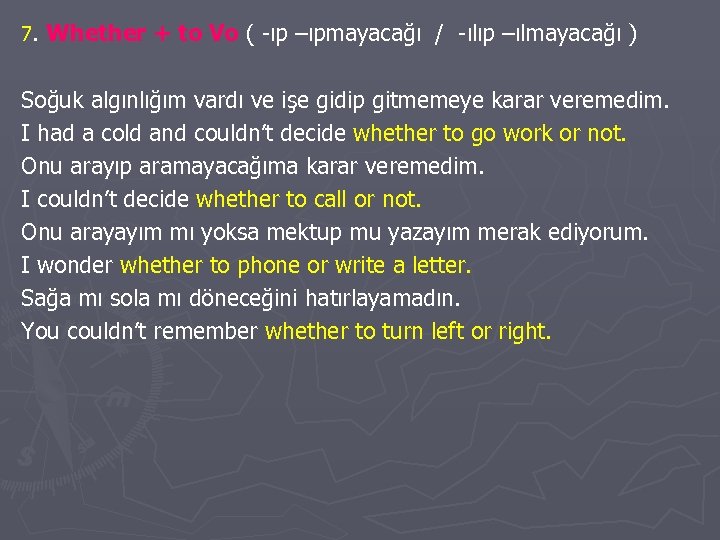
7. Whether + to Vo ( -ıp –ıpmayacağı / -ılıp –ılmayacağı ) Soğuk algınlığım vardı ve işe gidip gitmemeye karar veremedim. I had a cold and couldn’t decide whether to go work or not. Onu arayıp aramayacağıma karar veremedim. I couldn’t decide whether to call or not. Onu arayayım mı yoksa mektup mu yazayım merak ediyorum. I wonder whether to phone or write a letter. Sağa mı sola mı döneceğini hatırlayamadın. You couldn’t remember whether to turn left or right.
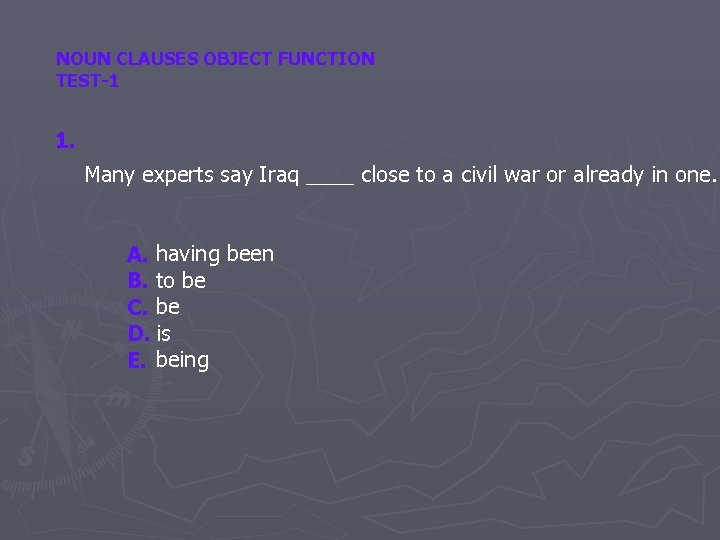
NOUN CLAUSES OBJECT FUNCTION TEST-1 1. Many experts say Iraq ____ close to a civil war or already in one. A. having been B. to be C. be D. is E. being
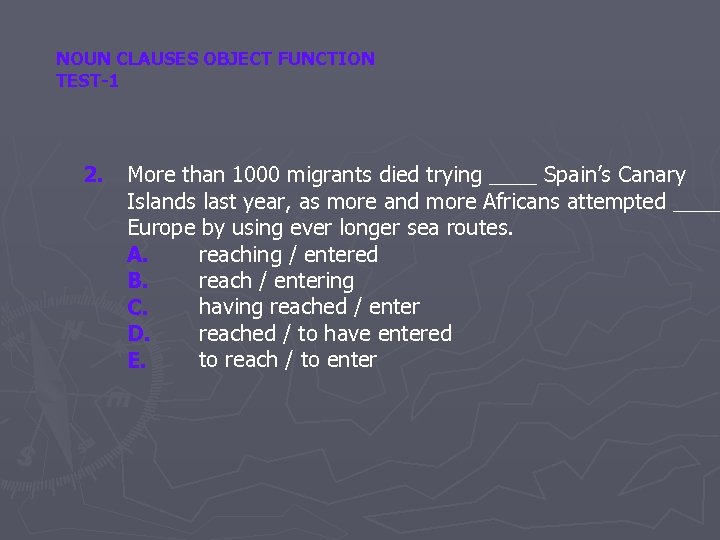
NOUN CLAUSES OBJECT FUNCTION TEST-1 2. More than 1000 migrants died trying ____ Spain’s Canary Islands last year, as more and more Africans attempted ____ Europe by using ever longer sea routes. reaching / entered A. reach / entering B. having reached / enter C. reached / to have entered D. to reach / to enter E.
NOUN CLAUSES OBJECT FUNCTION TEST-1 3. President da Silva of Brazil and Ken Livingstone, the mayor of London, discussed on Wednesday how ____ links between the South American nation and the British capital. A. strengthening B. being strengthened C. to strengthen D. are strengthened E. should strengthen
NOUN CLAUSES OBJECT FUNCTION TEST-1 4. The pipeline to be built jointly by Gazprom and two German energy giants will allow Russia ____ its gas directly to Europe, by passing Poland the Baltic states. A. B. C. D. E. to be sent sending to send being sent send
NOUN CLAUSES OBJECT FUNCTION TEST-1 According to those in the know, it is impossible to tell ____ the 5. adverse weather in Costa Rica in late 2005 was related to global climate change. A. if B. what C. when D. that E. which
NOUN CLAUSES OBJECT FUNCTION TEST-1 6. Men are at higher risk of ____ in a car accident if they are obese, researchers in the US have found. A. B. C. D. E. to killing having killed having been killed being killed
NOUN CLAUSES OBJECT FUNCTION TEST-1 7. In a quantum system, "qubits" are stored in a "superposition state"; that is, bit of data can be both 1 s and 0 s at the same time. This enables computers _____ multiple calculations simultaneously. A. perform B. to perform C. performing D. to have performed E. having performed
NOUN CLAUSES OBJECT FUNCTION TEST-1 8. Viruses invade human cells, so drugs to combat those germs must work like smart bombs to avoid ____ cells. A. B. C. D. E. being damaged damage be damaging to damage damaging
NOUN CLAUSES OBJECT FUNCTION TEST-1 9. Telecom Italia has already agreed with unions ____ the number of employees to 68. 300 next year. A. to have reduced B. their reducing C. reducing D. reduce E. to reduce
NOUN CLAUSES OBJECT FUNCTION TEST-1 10. Oil consumption is expected ____ by 2, 2 percent to 85 million barrels a day this year. A. B. C. D. E. increasing have increased to increase being increased having increased
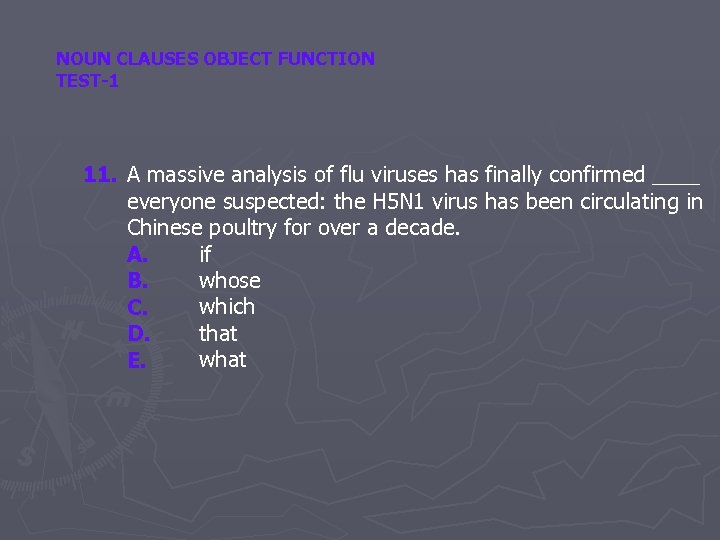
NOUN CLAUSES OBJECT FUNCTION TEST-1 11. A massive analysis of flu viruses has finally confirmed ____ everyone suspected: the H 5 N 1 virus has been circulating in Chinese poultry for over a decade. if A. whose B. which C. that D. what E.
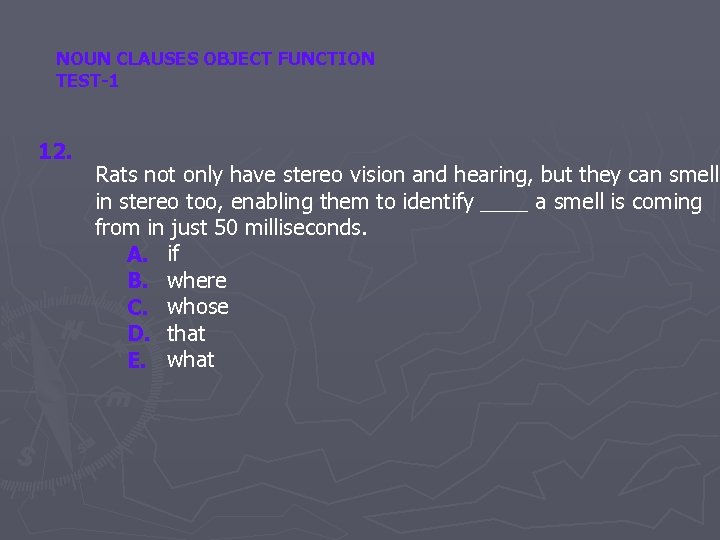
NOUN CLAUSES OBJECT FUNCTION TEST-1 12. Rats not only have stereo vision and hearing, but they can smell in stereo too, enabling them to identify ____ a smell is coming from in just 50 milliseconds. A. if B. where C. whose D. that E. what
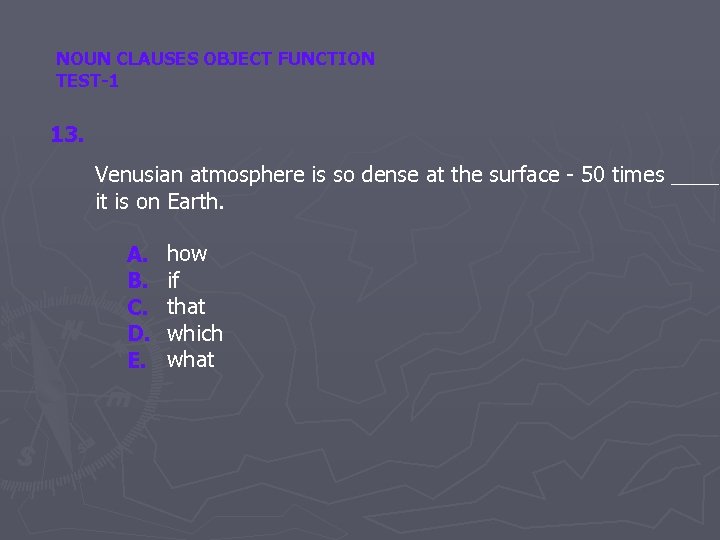
NOUN CLAUSES OBJECT FUNCTION TEST-1 13. Venusian atmosphere is so dense at the surface - 50 times ____ it is on Earth. A. B. C. D. E. how if that which what
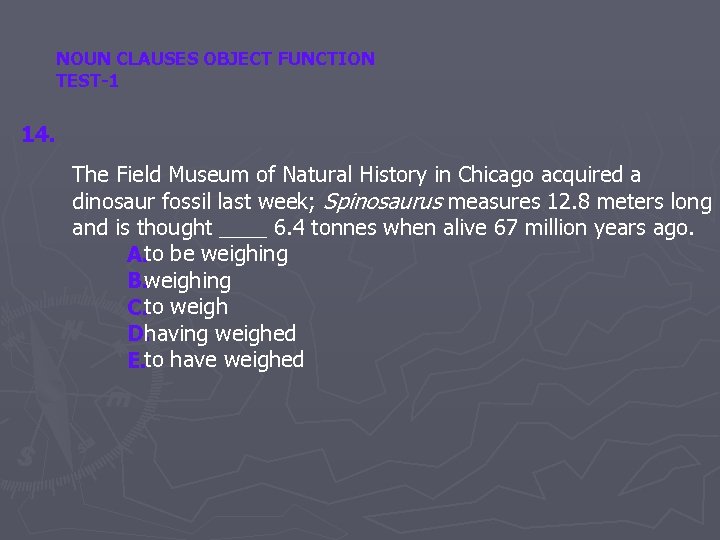
NOUN CLAUSES OBJECT FUNCTION TEST-1 14. The Field Museum of Natural History in Chicago acquired a dinosaur fossil last week; Spinosaurus measures 12. 8 meters long and is thought ____ 6. 4 tonnes when alive 67 million years ago. to A. be weighing B. C. to weigh having weighed D. E. to have weighed
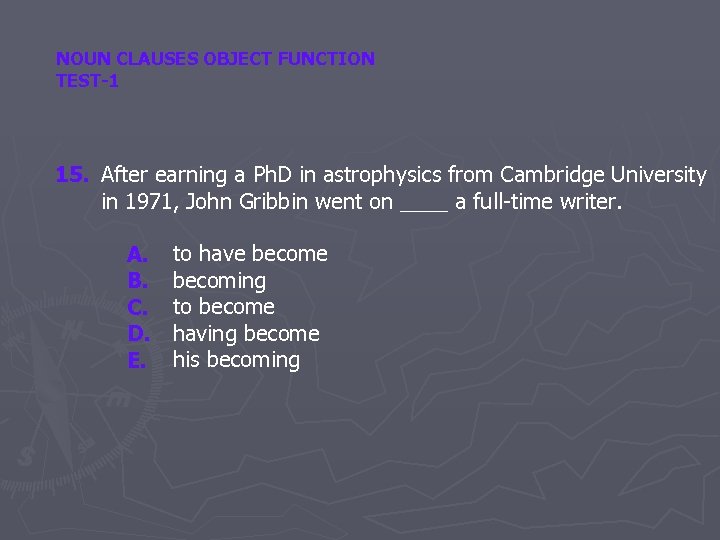
NOUN CLAUSES OBJECT FUNCTION TEST-1 15. After earning a Ph. D in astrophysics from Cambridge University in 1971, John Gribbin went on ____ a full-time writer. A. B. C. D. E. to have becoming to become having become his becoming
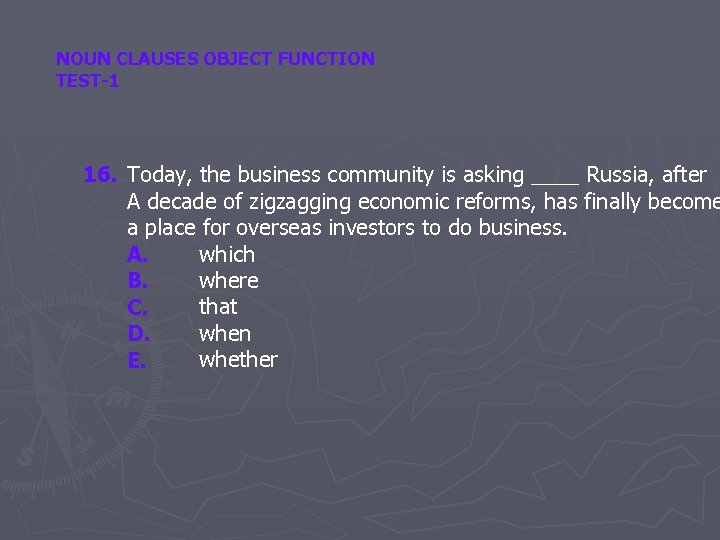
NOUN CLAUSES OBJECT FUNCTION TEST-1 16. Today, the business community is asking ____ Russia, after A decade of zigzagging economic reforms, has finally become a place for overseas investors to do business. which A. where B. that C. when D. whether E.
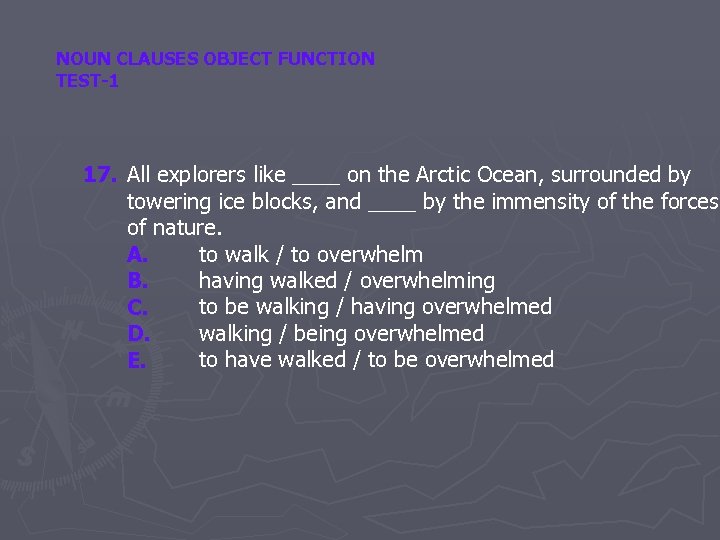
NOUN CLAUSES OBJECT FUNCTION TEST-1 17. All explorers like ____ on the Arctic Ocean, surrounded by towering ice blocks, and ____ by the immensity of the forces of nature. to walk / to overwhelm A. having walked / overwhelming B. to be walking / having overwhelmed C. walking / being overwhelmed D. to have walked / to be overwhelmed E.
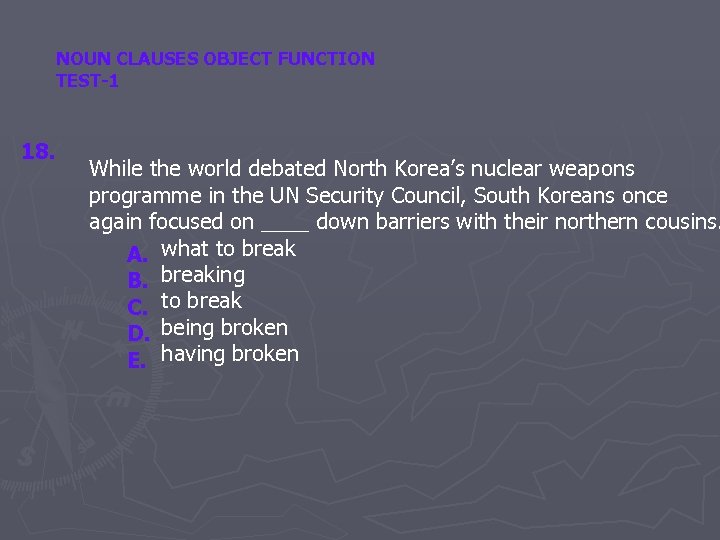
NOUN CLAUSES OBJECT FUNCTION TEST-1 18. While the world debated North Korea’s nuclear weapons programme in the UN Security Council, South Koreans once again focused on ____ down barriers with their northern cousins. A. what to break B. breaking C. to break D. being broken E. having broken
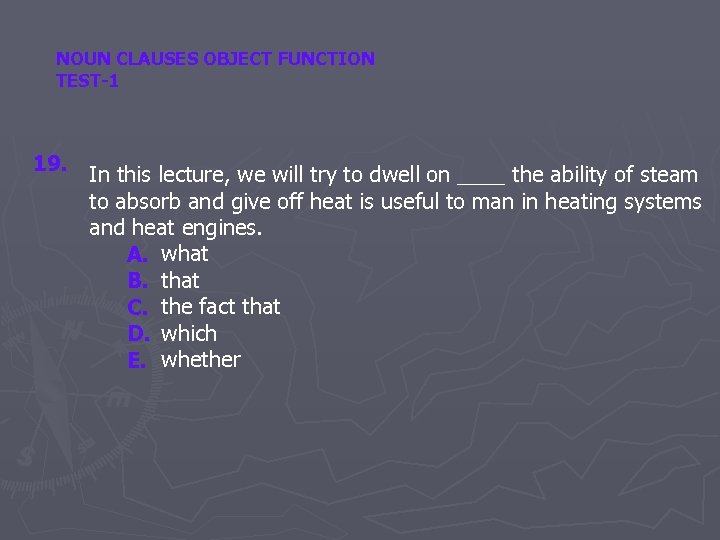
NOUN CLAUSES OBJECT FUNCTION TEST-1 19. In this lecture, we will try to dwell on ____ the ability of steam to absorb and give off heat is useful to man in heating systems and heat engines. A. what B. that C. the fact that D. which E. whether
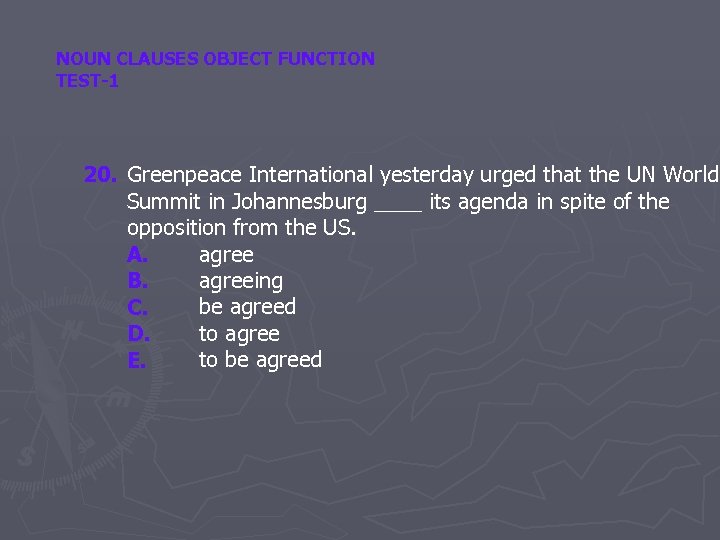
NOUN CLAUSES OBJECT FUNCTION TEST-1 20. Greenpeace International yesterday urged that the UN World Summit in Johannesburg ____ its agenda in spite of the opposition from the US. agree A. agreeing B. be agreed C. to agree D. to be agreed E.
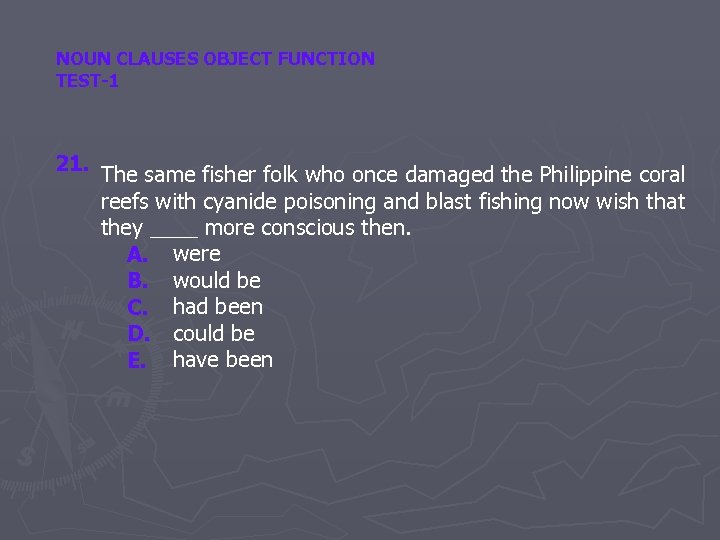
NOUN CLAUSES OBJECT FUNCTION TEST-1 21. The same fisher folk who once damaged the Philippine coral reefs with cyanide poisoning and blast fishing now wish that they ____ more conscious then. A. were B. would be C. had been D. could be E. have been
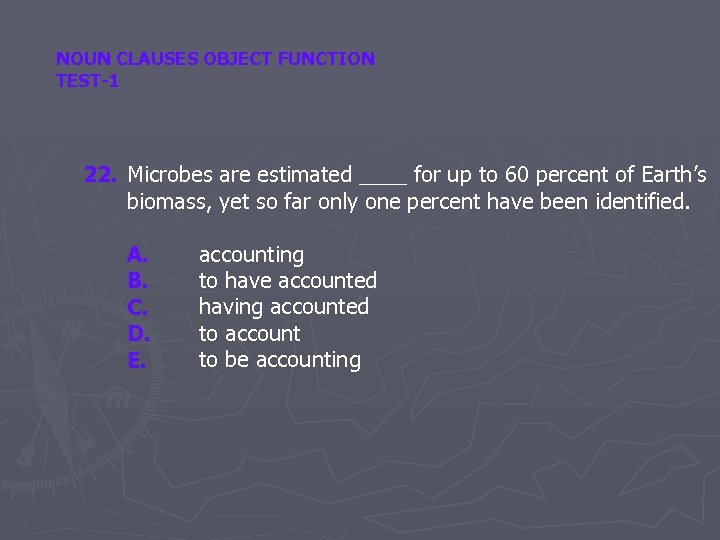
NOUN CLAUSES OBJECT FUNCTION TEST-1 22. Microbes are estimated ____ for up to 60 percent of Earth’s biomass, yet so far only one percent have been identified. A. B. C. D. E. accounting to have accounted having accounted to account to be accounting
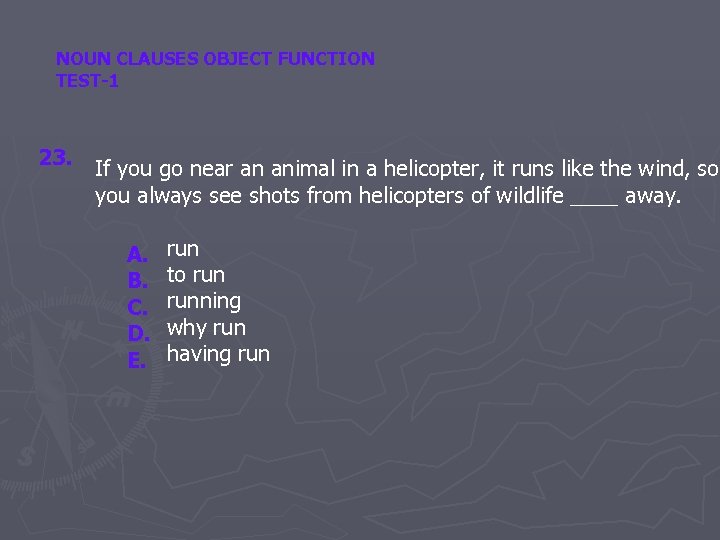
NOUN CLAUSES OBJECT FUNCTION TEST-1 23. If you go near an animal in a helicopter, it runs like the wind, so you always see shots from helicopters of wildlife ____ away. A. B. C. D. E. run to running why run having run
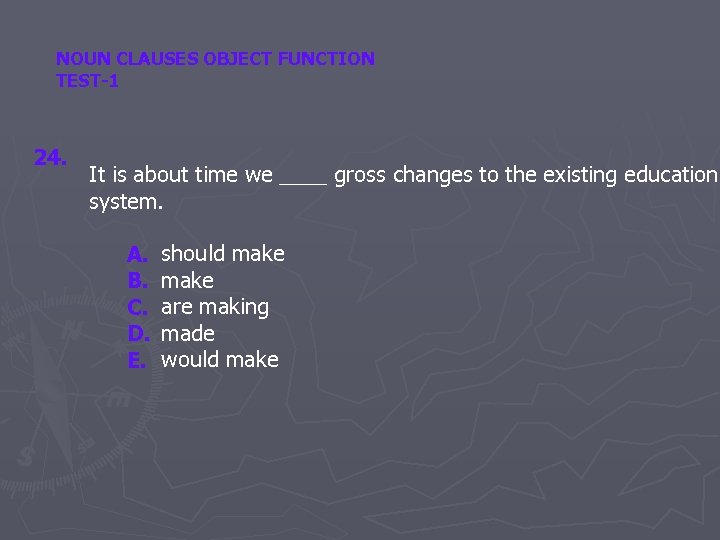
NOUN CLAUSES OBJECT FUNCTION TEST-1 24. It is about time we ____ gross changes to the existing education system. A. B. C. D. E. should make are making made would make
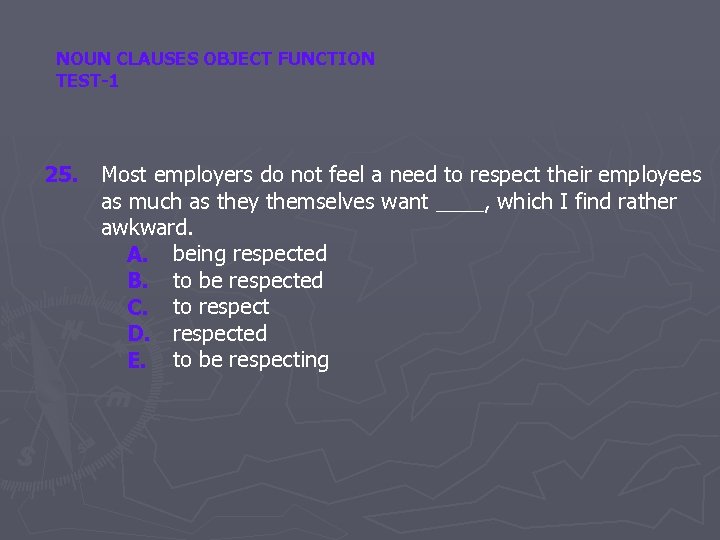
NOUN CLAUSES OBJECT FUNCTION TEST-1 25. Most employers do not feel a need to respect their employees as much as they themselves want ____, which I find rather awkward. A. being respected B. to be respected C. to respect D. respected E. to be respecting
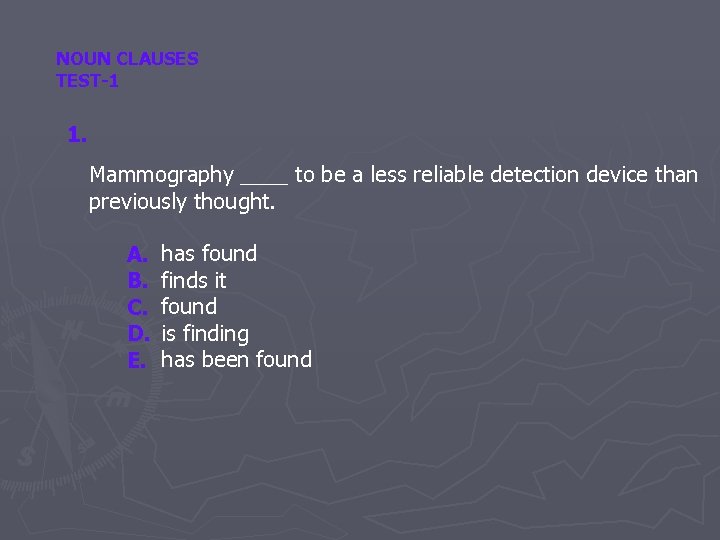
NOUN CLAUSES TEST-1 1. Mammography ____ to be a less reliable detection device than previously thought. A. B. C. D. E. has found finds it found is finding has been found
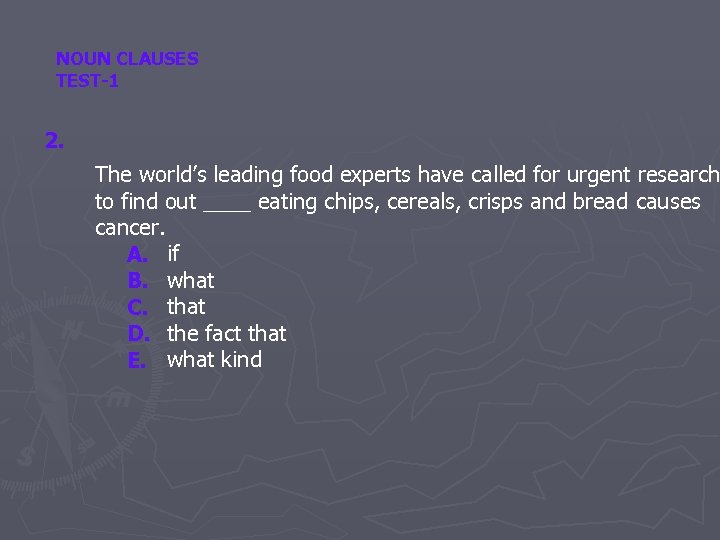
NOUN CLAUSES TEST-1 2. The world’s leading food experts have called for urgent research to find out ____ eating chips, cereals, crisps and bread causes cancer. A. if B. what C. that D. the fact that E. what kind
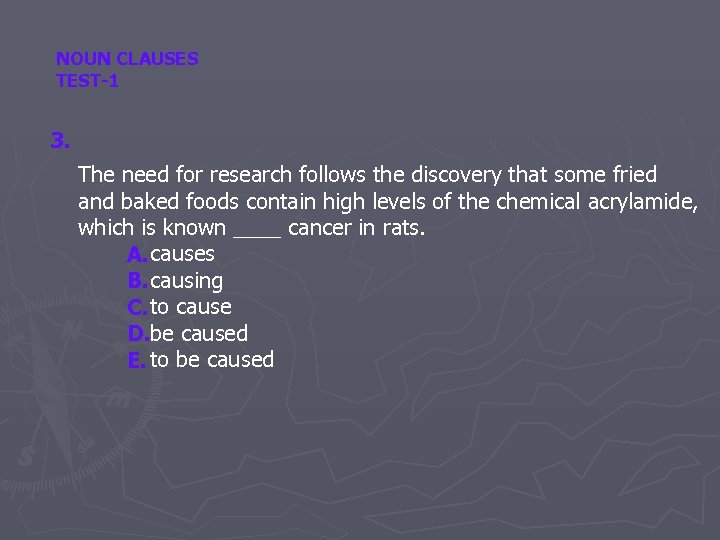
NOUN CLAUSES TEST-1 3. The need for research follows the discovery that some fried and baked foods contain high levels of the chemical acrylamide, which is known ____ cancer in rats. A. causes B. causing C. to cause D. be caused E. to be caused
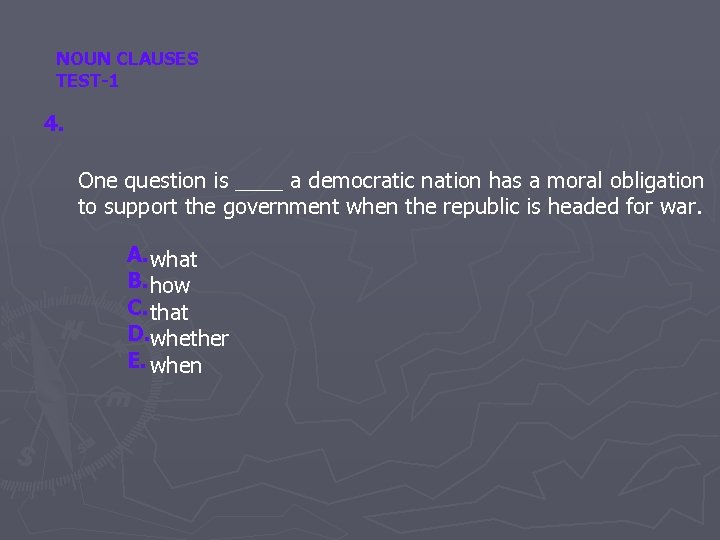
NOUN CLAUSES TEST-1 4. One question is ____ a democratic nation has a moral obligation to support the government when the republic is headed for war. A. what B. how C. that D. whether E. when
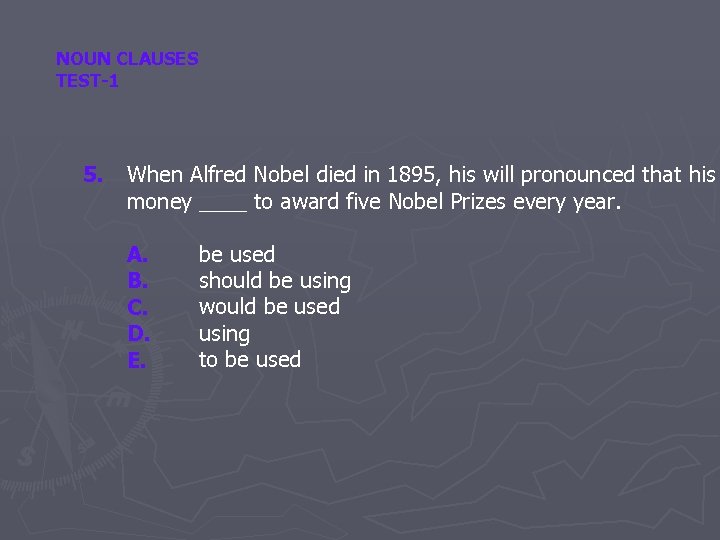
NOUN CLAUSES TEST-1 5. When Alfred Nobel died in 1895, his will pronounced that his money ____ to award five Nobel Prizes every year. A. B. C. D. E. be used should be using would be used using to be used
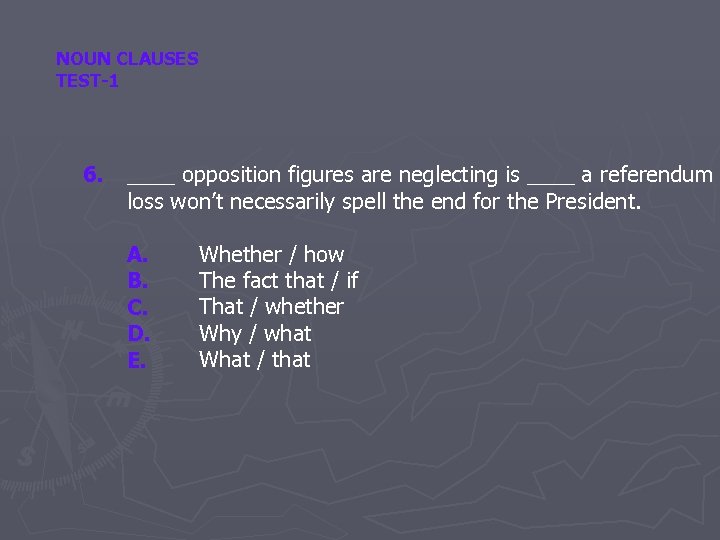
NOUN CLAUSES TEST-1 6. ____ opposition figures are neglecting is ____ a referendum loss won’t necessarily spell the end for the President. A. B. C. D. E. Whether / how The fact that / if That / whether Why / what What / that
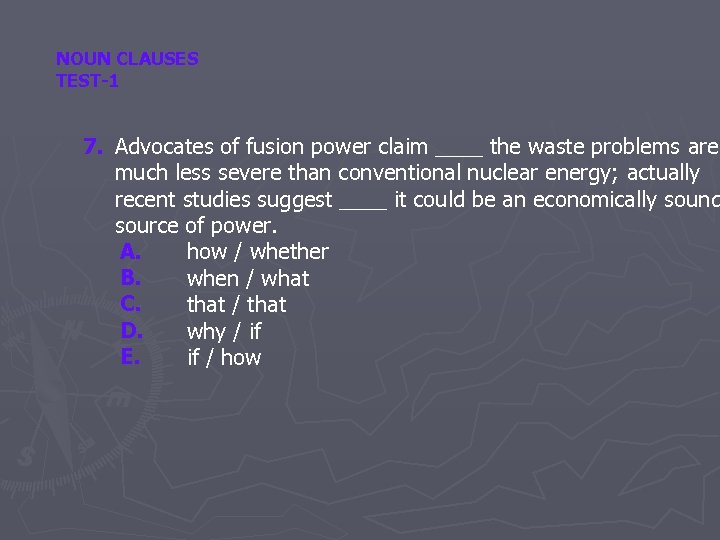
NOUN CLAUSES TEST-1 7. Advocates of fusion power claim ____ the waste problems are much less severe than conventional nuclear energy; actually recent studies suggest ____ it could be an economically sound source of power. A. how / whether B. when / what C. that / that D. why / if E. if / how
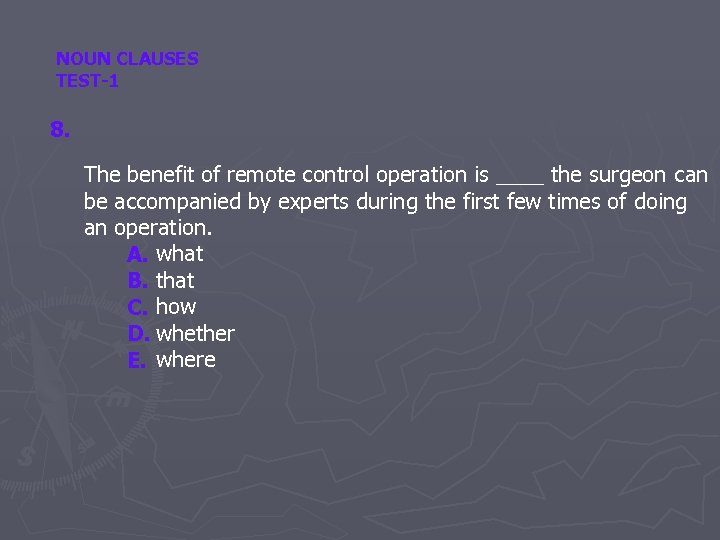
NOUN CLAUSES TEST-1 8. The benefit of remote control operation is ____ the surgeon can be accompanied by experts during the first few times of doing an operation. A. what B. that C. how D. whether E. where
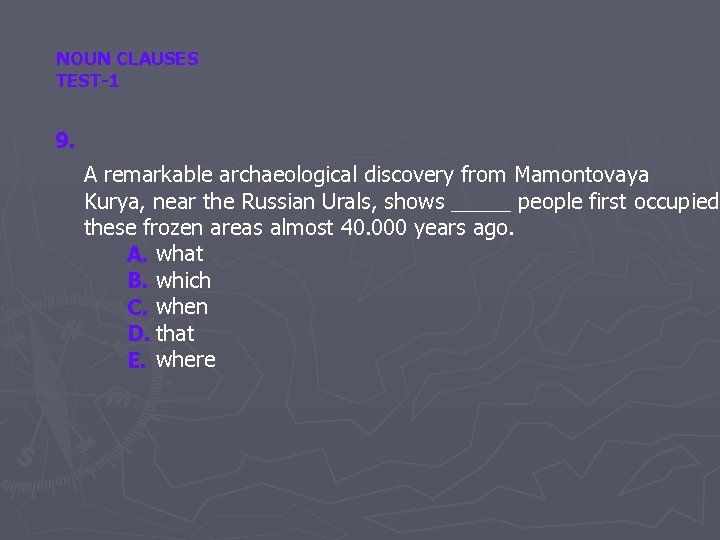
NOUN CLAUSES TEST-1 9. A remarkable archaeological discovery from Mamontovaya Kurya, near the Russian Urals, shows _____ people first occupied these frozen areas almost 40. 000 years ago. A. what B. which C. when D. that E. where
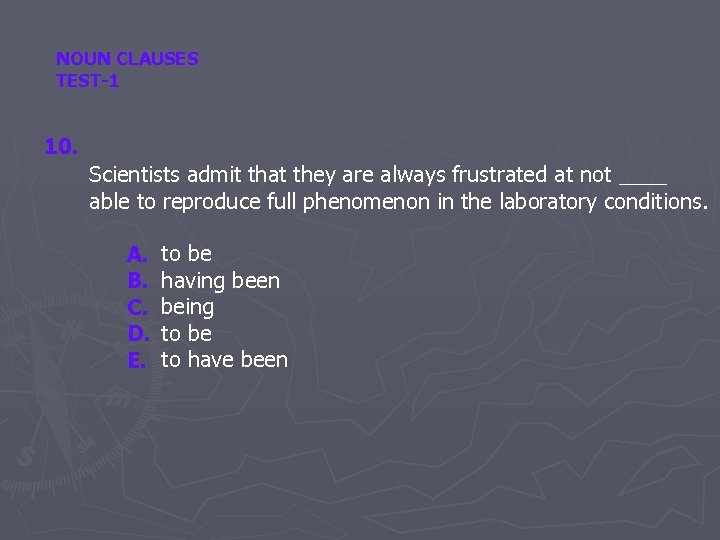
NOUN CLAUSES TEST-1 10. Scientists admit that they are always frustrated at not ____ able to reproduce full phenomenon in the laboratory conditions. A. B. C. D. E. to be having been being to be to have been
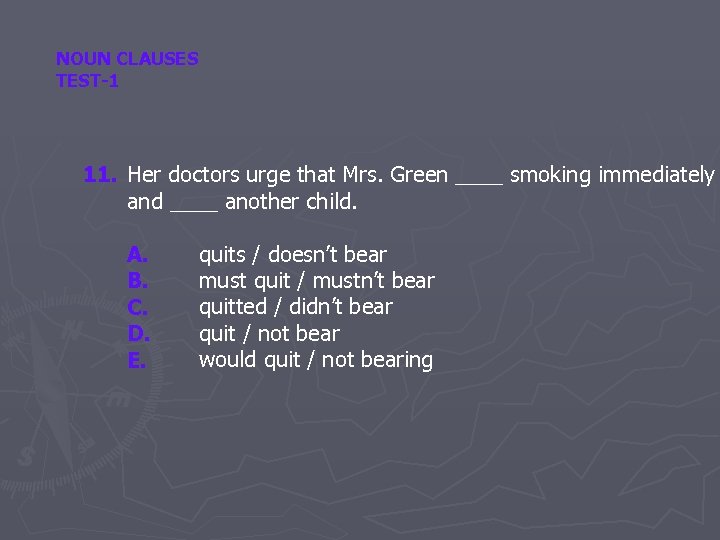
NOUN CLAUSES TEST-1 11. Her doctors urge that Mrs. Green ____ smoking immediately and ____ another child. A. B. C. D. E. quits / doesn’t bear must quit / mustn’t bear quitted / didn’t bear quit / not bear would quit / not bearing
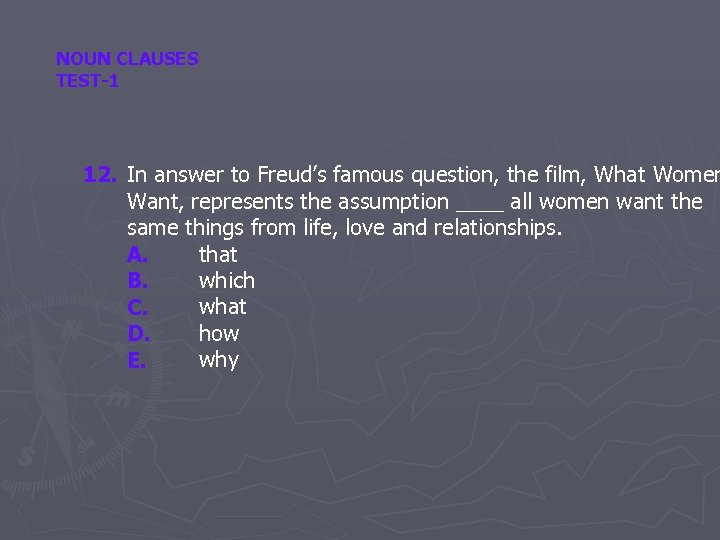
NOUN CLAUSES TEST-1 12. In answer to Freud’s famous question, the film, What Women Want, represents the assumption ____ all women want the same things from life, love and relationships. that A. which B. what C. how D. why E.
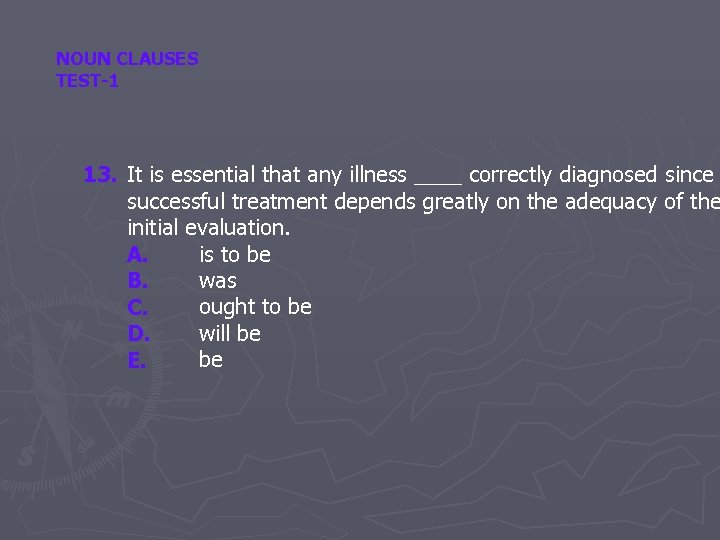
NOUN CLAUSES TEST-1 13. It is essential that any illness ____ correctly diagnosed since successful treatment depends greatly on the adequacy of the initial evaluation. is to be A. was B. ought to be C. will be D. be E.
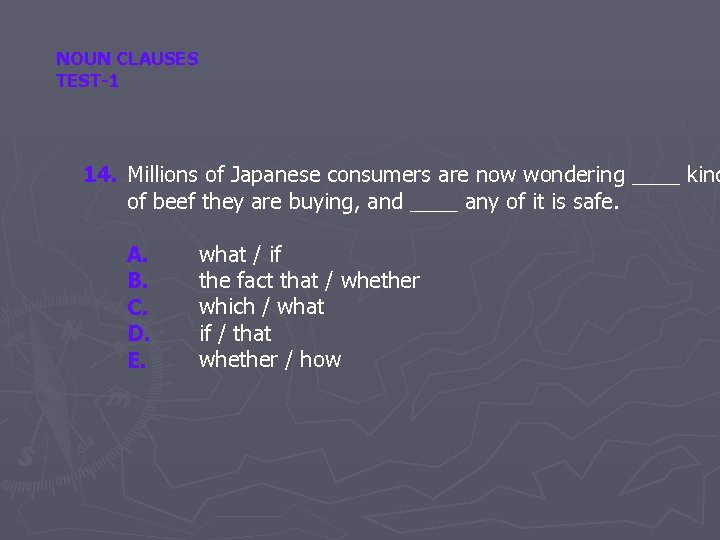
NOUN CLAUSES TEST-1 14. Millions of Japanese consumers are now wondering ____ kind of beef they are buying, and ____ any of it is safe. A. B. C. D. E. what / if the fact that / whether which / what if / that whether / how
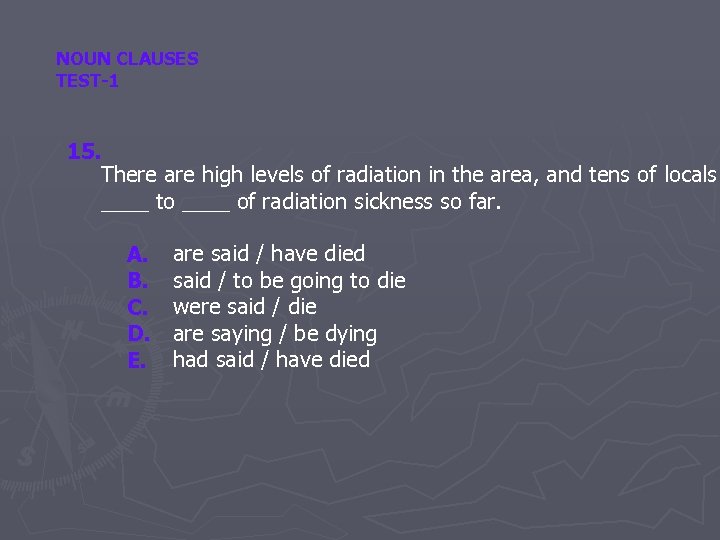
NOUN CLAUSES TEST-1 15. There are high levels of radiation in the area, and tens of locals ____ to ____ of radiation sickness so far. A. B. C. D. E. are said / have died said / to be going to die were said / die are saying / be dying had said / have died
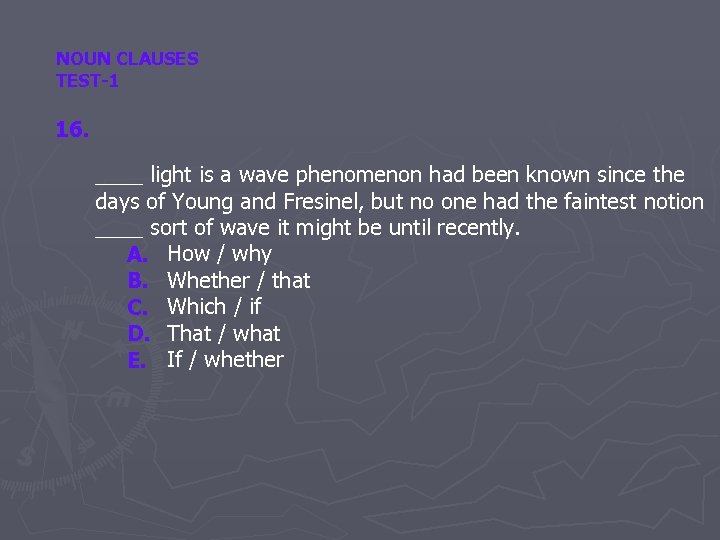
NOUN CLAUSES TEST-1 16. ____ light is a wave phenomenon had been known since the days of Young and Fresinel, but no one had the faintest notion ____ sort of wave it might be until recently. A. How / why B. Whether / that C. Which / if D. That / what E. If / whether
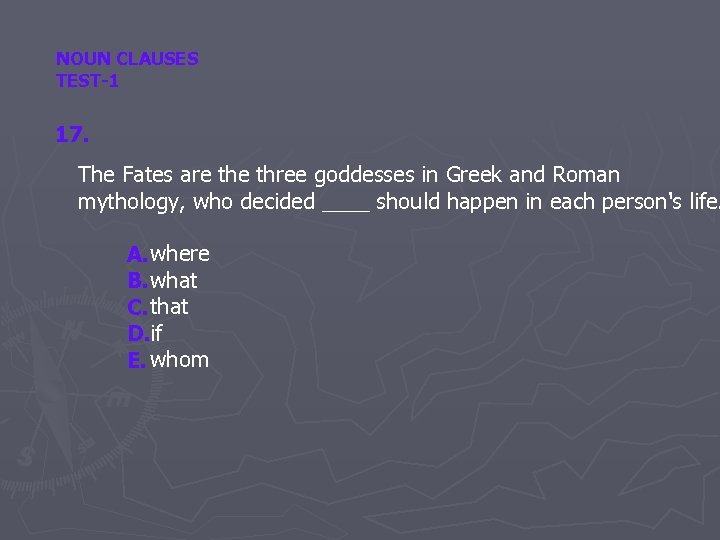
NOUN CLAUSES TEST-1 17. The Fates are three goddesses in Greek and Roman mythology, who decided ____ should happen in each person's life. A. where B. what C. that D. if E. whom
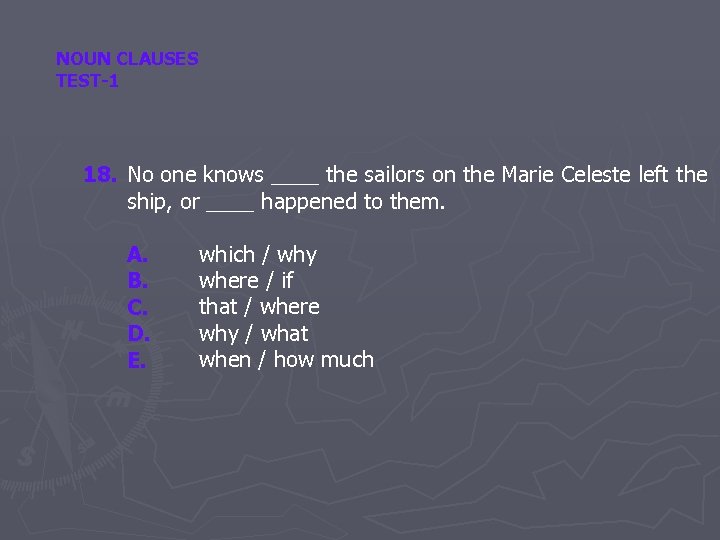
NOUN CLAUSES TEST-1 18. No one knows ____ the sailors on the Marie Celeste left the ship, or ____ happened to them. A. B. C. D. E. which / why where / if that / where why / what when / how much
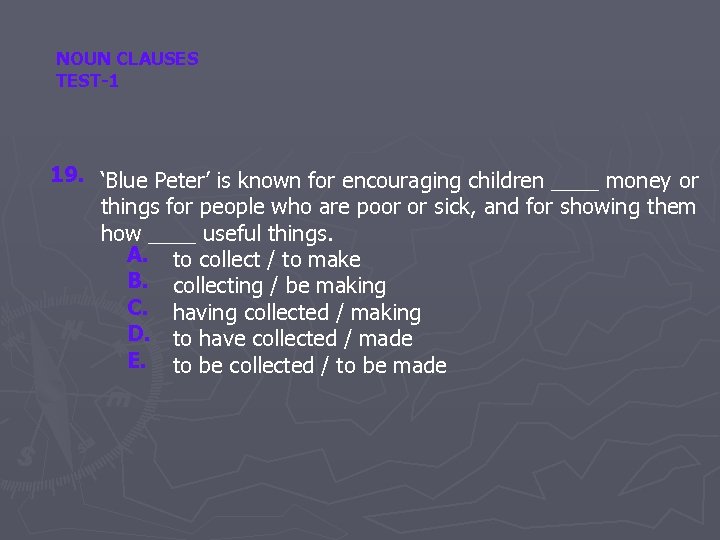
NOUN CLAUSES TEST-1 19. ‘Blue Peter’ is known for encouraging children ____ money or things for people who are poor or sick, and for showing them how ____ useful things. A. to collect / to make B. collecting / be making C. having collected / making D. to have collected / made E. to be collected / to be made
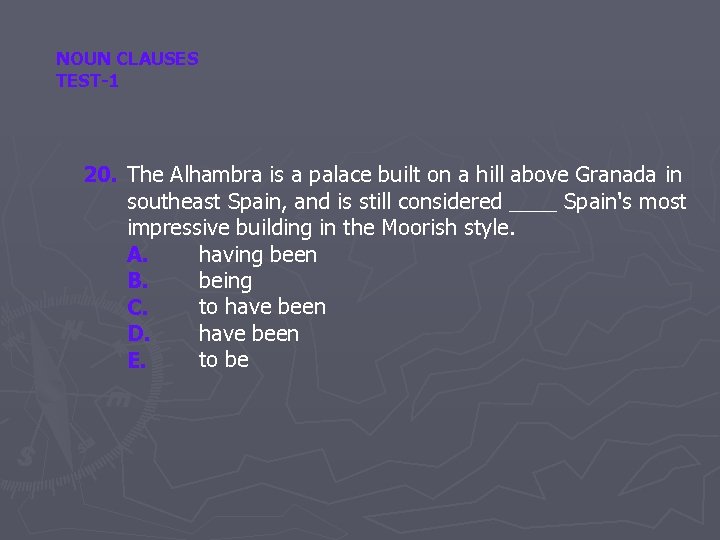
NOUN CLAUSES TEST-1 20. The Alhambra is a palace built on a hill above Granada in southeast Spain, and is still considered ____ Spain's most impressive building in the Moorish style. having been A. being B. to have been C. have been D. to be E.
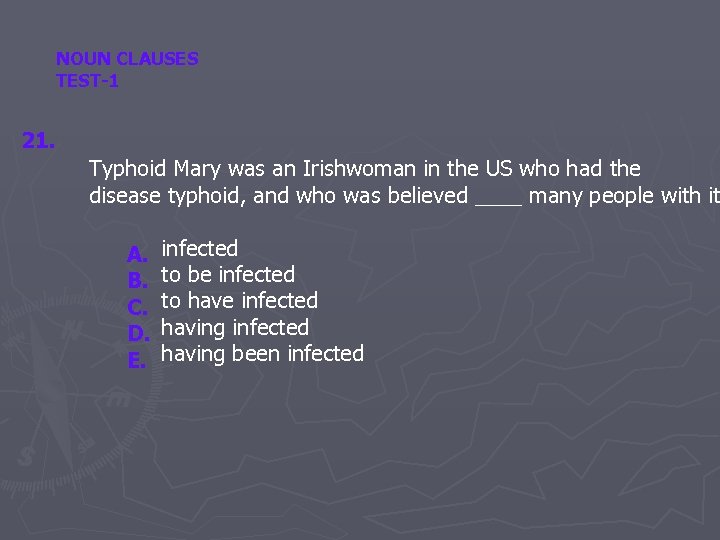
NOUN CLAUSES TEST-1 21. Typhoid Mary was an Irishwoman in the US who had the disease typhoid, and who was believed ____ many people with it A. B. C. D. E. infected to be infected to have infected having been infected
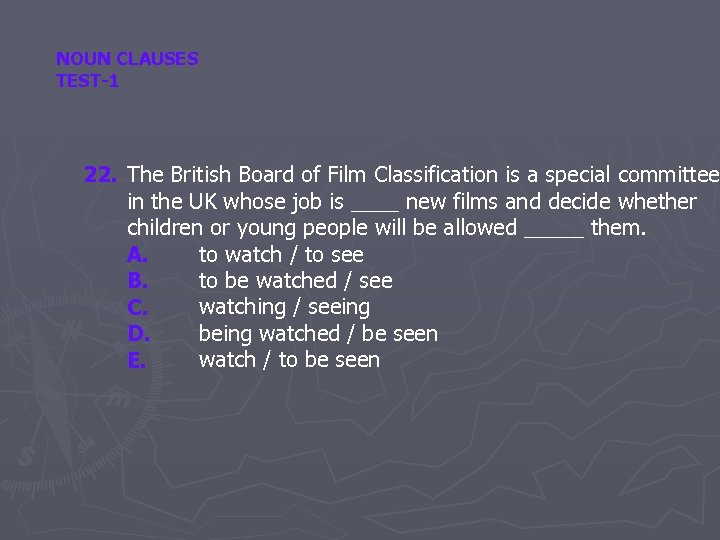
NOUN CLAUSES TEST-1 22. The British Board of Film Classification is a special committee in the UK whose job is ____ new films and decide whether children or young people will be allowed _____ them. to watch / to see A. to be watched / see B. watching / seeing C. being watched / be seen D. watch / to be seen E.
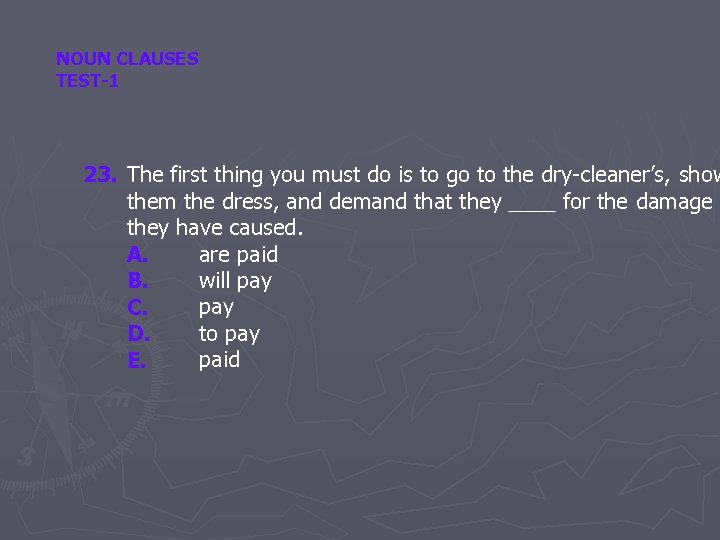
NOUN CLAUSES TEST-1 23. The first thing you must do is to go to the dry-cleaner’s, show them the dress, and demand that they ____ for the damage they have caused. are paid A. will pay B. pay C. to pay D. paid E.
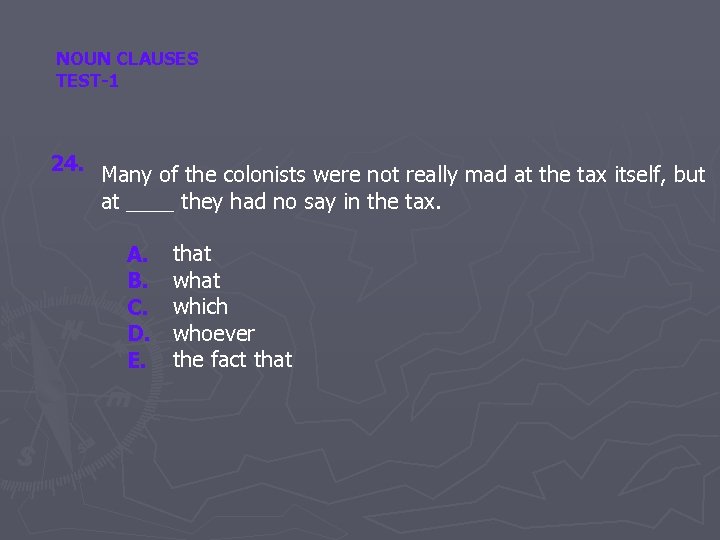
NOUN CLAUSES TEST-1 24. Many of the colonists were not really mad at the tax itself, but at ____ they had no say in the tax. A. B. C. D. E. that which whoever the fact that
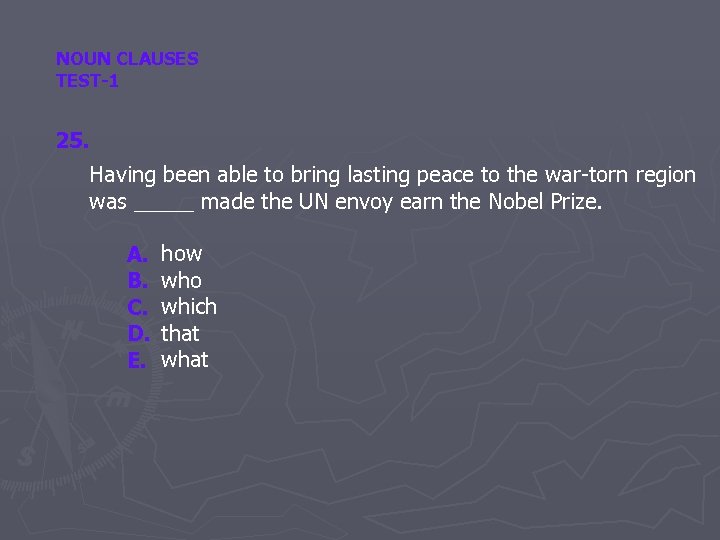
NOUN CLAUSES TEST-1 25. Having been able to bring lasting peace to the war-torn region was _____ made the UN envoy earn the Nobel Prize. A. B. C. D. E. how who which that what
Скачать презентацию OBJECT FUNCTION S V O S
bd3930ac3544acf1641357b71228e978.ppt